Skip to content
One Fish Foundation
  • Blog
    • Aquaculture
    • Education
    • Environment
    • Policy
    • Wild Harvest
    • Fish Tales
  • About
    • About One Fish
    • About Colles Stowell
  • Education
    • Elementary School
    • Middle School
    • High School
  • KNOW FISH Dinners®
  • Resources
    • One Fish Podcast
    • One Fish Foundation in the news
    • The 7 C’s of Sustainable Seafood
    • Newsletter Archive
    • Recipes
      • Skate with Capers and Butter — Chef Rizwan Ahmed
      • Grandma Davis’ Fish Chowder — Jane Almeida
      • Ginger Garlic Tamari Scallops — Colles Stowell
      • Fish Stock — Evan Mallett
      • Mussels San Remo — Chef Rob Martin
      • Salted Pollock Croquettes – Chef Mark Segal
  • Connect
    • Contact OneFish
    • Social
      • Instagram
      • Facebook
      • Twitter
All Blog Posts

Bristol Bay Beckoning

  • July 17, 2019October 19, 2021
  • by Colles Stowell
Share it!
Share

Plan for them all you want, but rich experiences often require overcoming some challenges, adapting to surprises and simply making do.

In the past two weeks in Bristol Bay, Alaska, I’ve watched massive brown bears stroll along the banks of the rivers I was fishing as they searched for their own meals, passively taking notice of us humans. Breathtaking.

I’ve picked fish out of set nets by hand, learning from a master how to extricate gill plates, untangle fins and bleed the fish quickly and efficiently as we practiced a centuries-old ritual. Working three sets in a 15-hour period gave me a glimpse at just how demanding a full four-week season must be.

I’ve toured one of the eight or so big processing facilities that represent half of the commercial fishing economic equation in Naknek. One million fish a day are vacuumed up a large pipe from the waterfront to a huge warehouse with hundreds of hairnetted seasonal workers that head, tail, gut and fillet the fresh fish. The salmon are then either frozen and packed, or smoked, frozen and packed, each fixed with the private label of one of the fishermen who contract with the plant. It is a very smooth operation.
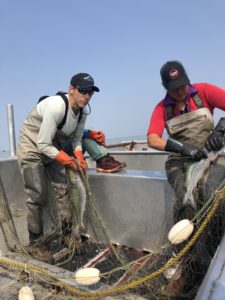
I’ve hitchhiked (for the first time, feeling at once a tad uneasy and adventurous) along the Alaska Peninsula Highway between Naknek and King Salmon, shortening the 15-mile distance, saving the $40 cab fare (and the $255 per day to rent a Kia) and meeting some really interesting people along the way. Hippie Doug may be a transplant from the 80s, but he sure seems to have carved out a creative, if off-color niche for himself smoking salmon in Bristol Bay.

The flora and fauna

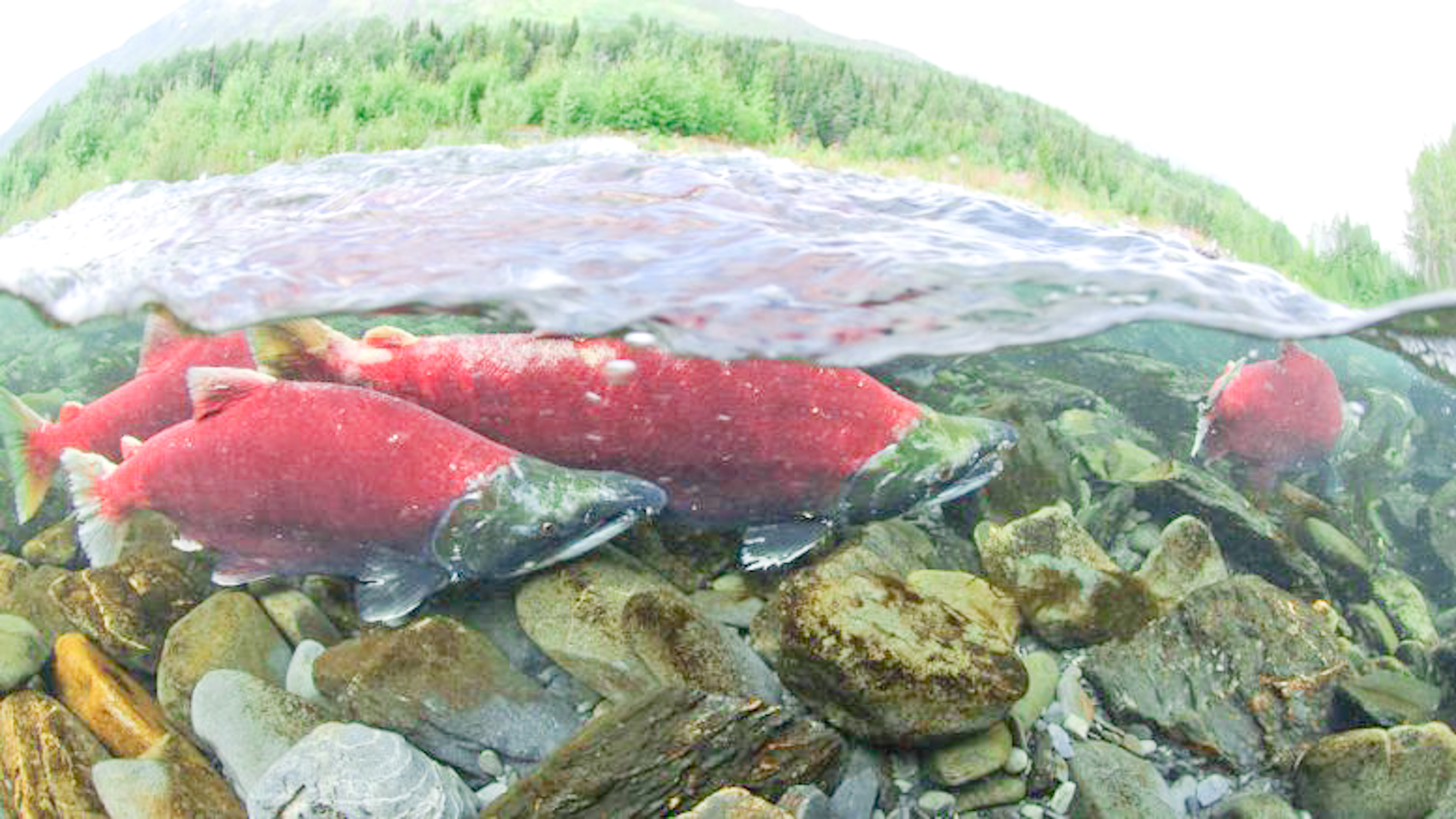
I’ve checked off a significant, life-long bucket list item: fly fishing Alaska’s wild rivers and streams, catching a variety of stunning salmonids with different flies and approaches. The red flame of the rainbow trout and the iridescent pink spots of the Dolly Varden or Arctic Char are seared in memory, recalled at will. Same with the small chrome blue thumbprint marks along the sides of the 30 or so 2-8 inch king salmon smolts I caught while fishing King Salmon Creek alone.

We stood still and watched, being sure to keep a low profile. Click to watch a clip and turn up the volume!

Finding relatively fresh bear, moose and caribou tracks in the same vicinity along one of the creek’s banks spoke to the remarkable stable of wildlife in this place. I found a new sense of awareness following well-worn bear trails along the creek, mindfully following the advice I learned at “Bear Camp” at Brooks Creek by keeping a running conversation with myself. Ironically, I recounted a story I made up for my toddler daughter called “Esty and the Bear Cub.”
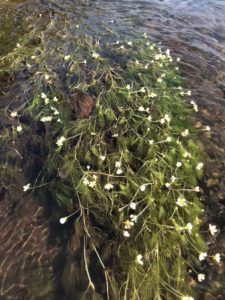
Mouse Ear Chickweed? Could be. Or it could be something else. Whatever it is, I sure did appreciate it at King Salmon Creek.

I drank in everything Nature had to offer. The colors of the fireweed, Toadflax (aka, butter and eggs), some form of lupine, something possibly called Mouse Ear Chickweed and countless other flowers I couldn’t identify. On one trek back from Contact Creek, I took in the cool shape and color of not-quite-ripe cloudberries, and the plethora of blueberry bushes along the trail, promising yet another ample food supply for bears, people and other critters in the next few weeks.

Bald eagles were fairly common, as were magpies, chickadees and some type of thrush providing the soundtrack for the wondrous ecosystem. On the flight from King Salmon to Dillingham, I watched beluga whales swimming in formation, chasing down a school of sockeye.

The people

I’ve also met some wonderful people who are corporeally and spiritually rooted to the land, the water and the resource. I was struck by their generosity, their openness and the power of their convictions. I spoke with both transplants and those whose roots to Bristol Bay extend for generations.
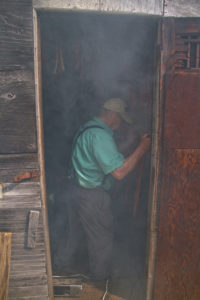
Al working his smoke shack magic.

Al Aspelund and his wife Lou were my endearing hosts at Al-Lous B&B in Naknek. At 88, he is a consummate putterer, always fixing something and tinkering with his smoke shack to get the right temperature, air flow, and humidity for the sockeye and king salmon he hangs. A lifelong resident of the area, he practices the craft passed down from the Aleut traditions of his heritage.
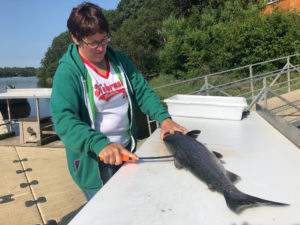
Lodge owner, fishing guide, master fish filleter and outdoors woman, Nanci Morris Lyon carefully cutting a king salmon I’d just landed.

Nanci Morris Lyon is a woman of the wilderness. She grew up on a subsistence farm in eastern Washington state, and has carried that wilderness spirit with her in her journey to become a commercial fisherman, a fishing guide and finally, a sport fishing lodge owner in King Salmon.
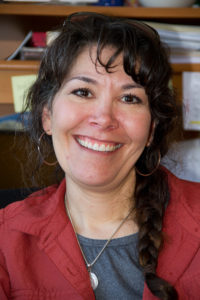
Gayla Hoseth advocates for indigenous rights and preservation of the wondrous natural resources of Bristol Bay.

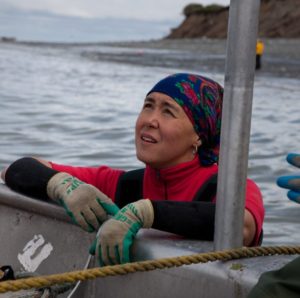
Gayla Hoseth is a force of nature, striving to protect indigenous rights with a focus on preservation and access to Bristol Bay’s natural resources as director of natural resources at Bristol Bay Native Association in Dillingham, and second chief of the Curyung Tribal Council. Born and raised in the area, she clings to the traditions she fights to preserve for indigenous tribes, such as learning to use an ulu (traditional knife) to fillet salmon from her grandmother.
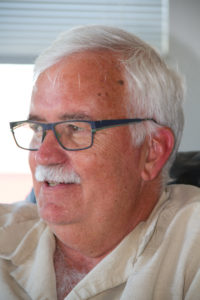
Years of adaptation on boat decks, in processing plants and running the Bristol Bay Economic Development Corporation have helped Norm Van Vactor put things in perspective.

Norm Van Vactor moved to Dillingham after graduating high school in the Philippines and soon became a deckhand on a tender (a boat which takes the catch from smaller boats to processors on shore). He’s spent much of his life on deck or in processing plants, eventually becoming president and CEO of the Bristol Bay Economic Development Corporation, charged with ensuring the rights of fishermen and others who want to earn a decent living in the area.
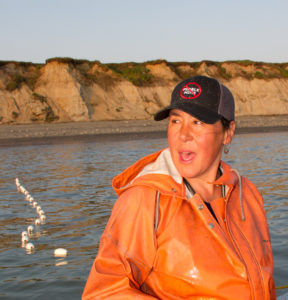
Melanie exudes good cheer, even during the fourth set of the day heading toward midnight.

Melanie Brown radiates love. She almost always has a smile on her face. She set net fishes with her son and daughter on the same sight her great grandfather established at the mouth of the Naknek River in the early 1900s, where thousands of sockeye funnel past heading many miles upriver to spawn. The one time I saw her really lose her smile was when she spoke about the impending threat of the Pebble Mine, showing her passion for protecting her rights, and those of everyone else who depend on the resource.

She wasn’t alone.

Unity in opposition

Everyone I spoke to let their raw emotions show on this topic. And every one of them echoed one clear sentiment. The proposed mine threatens something more valuable than the gold, copper and molybdenum couched in the earth at the headwaters of the world’s largest wild sockeye salmon run: the lives and livelihoods of thousands of people, natives, transplants and transient workers who depend on the health of that resource. And the economic impact of that resource cannot be overstated. The salmon fishery (both commercial and recreational) employs close to 15,000 people and generates a $1.5 billion economic impact.
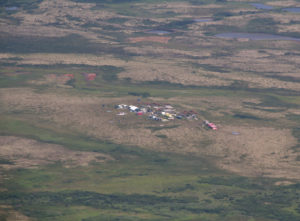
A scar on the tundra near Lake Illiamna, the watershed for much of the world’s largest wild salmon run. Wrong place. Wrong mine. Repeat.

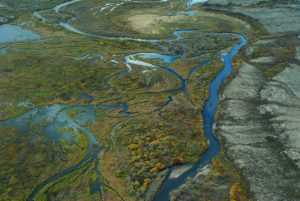
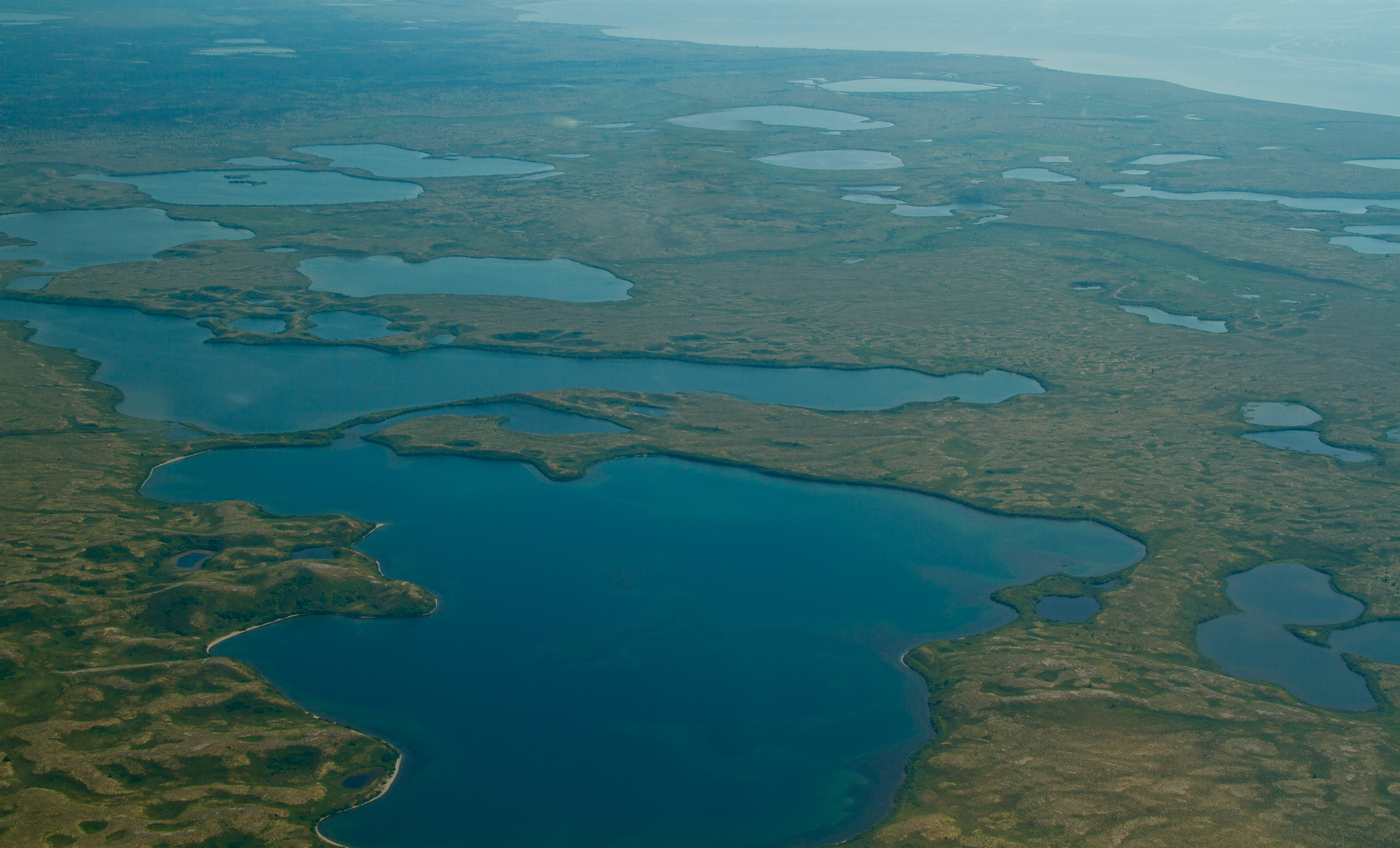
My mission to Alaska was twofold. First and foremost, I wanted to connect with these people and capture their stories for podcasts and blogs that I will share for broad distribution. This pitched battle has national significance, beyond what’s happening in Bristol Bay. These human stories will shed light on what’s at stake when huge multinational interests driven by profit and greed paint a rosy veneer over the devastating impacts of their operations. They want everyone in the lower 48 to assume this mine will bring jobs and boost local economies, ignoring the imminent ecological destruction of when (not if) the mine fails and leaks toxic chemicals into a priceless and fragile ecosystem. Flying over the pristine, water-veined tundra near Lake Illiamna, I wondered how anyone who saw the ugly outcropping of buildings dumped on this wondrous terrain could possibly think this mine was a good idea.

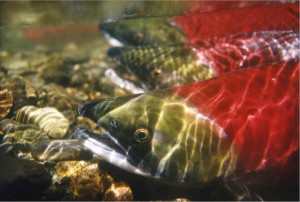
Second, I wanted to experience Bristol Bay firsthand, picking fish in set nets, walking across the tundra to remote rivers and streams to fly fish, seeing life in Naknek and King Salmon, touring a processor, and meeting new people. I visited at a time when the sockeye run is again above projections, showing the resilience and bounty of the resource, especially when it’s properly managed and allowed to thrive in healthy ecosystems.

I’ve done that. And there’s still much more to do. Stay tuned for the upcoming Fish Tales Podcasts featuring Nanci, Melanie, Norm, Gayla, Al and others to hear them tell their stories, and why preserving the resource matters to them, everyone in Bristol Bay, and to all of us who stand witness to the fierce battle to protect a priceless, irreplaceable resource.
All Blog Posts

Sustainable Seafood in Diverse Classrooms

  • May 3, 2019October 19, 2021
  • by Colles Stowell
Share it!
Share

I often talk about “democratizing the message.” That is, I want to reach the largest audience across the broadest demographic possible: different age groups, cultural backgrounds, economic brackets, life experiences…everything. In short, the entire social fabric that relies on seafood for part of its diet.

Why? Because fundamental societal change doesn’t happen within only one demographic. This type of change may start in one group, but must transcend differences to scale up to have societal impact. This is especially true for the domestic seafood supply chain. Habit and price, fueled by an industrialized global seafood supply chain, are the main drivers behind the fact that 90% of the seafood we eat in the US is imported. That’s why we need to speak to the broadest range of seafood consumers.

The goal in these conversations is to provide new perspective that might help consumers, regardless of demographic, make better choices for themselves, the resource and fish harvesters in and around their communities. There are health and socio-economic costs of that frozen shrimp from Thailand that offset the cheaper price. If people I’ve spoken to choose the cheaper imported product for whatever reason (often price is the limiting factor, which is a much larger food and social justice issue), they do it with a broader understanding of the consequences of that decision. Hopefully we can work toward re-localizing our seafood supply chain so folks of all incomes can find local, responsibly harvested, affordably priced species, especially under-utilized species like dogfish or scup.

And it all starts with education.

So, where can I find an audience with a range of cultural backgrounds, socioeconomic circumstances and life experiences? Our public schools bring together a cross section of society each day. I jumped at the opportunity to join students and teachers at two of Portland’s three public middle schools this spring.

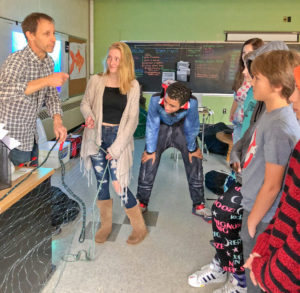
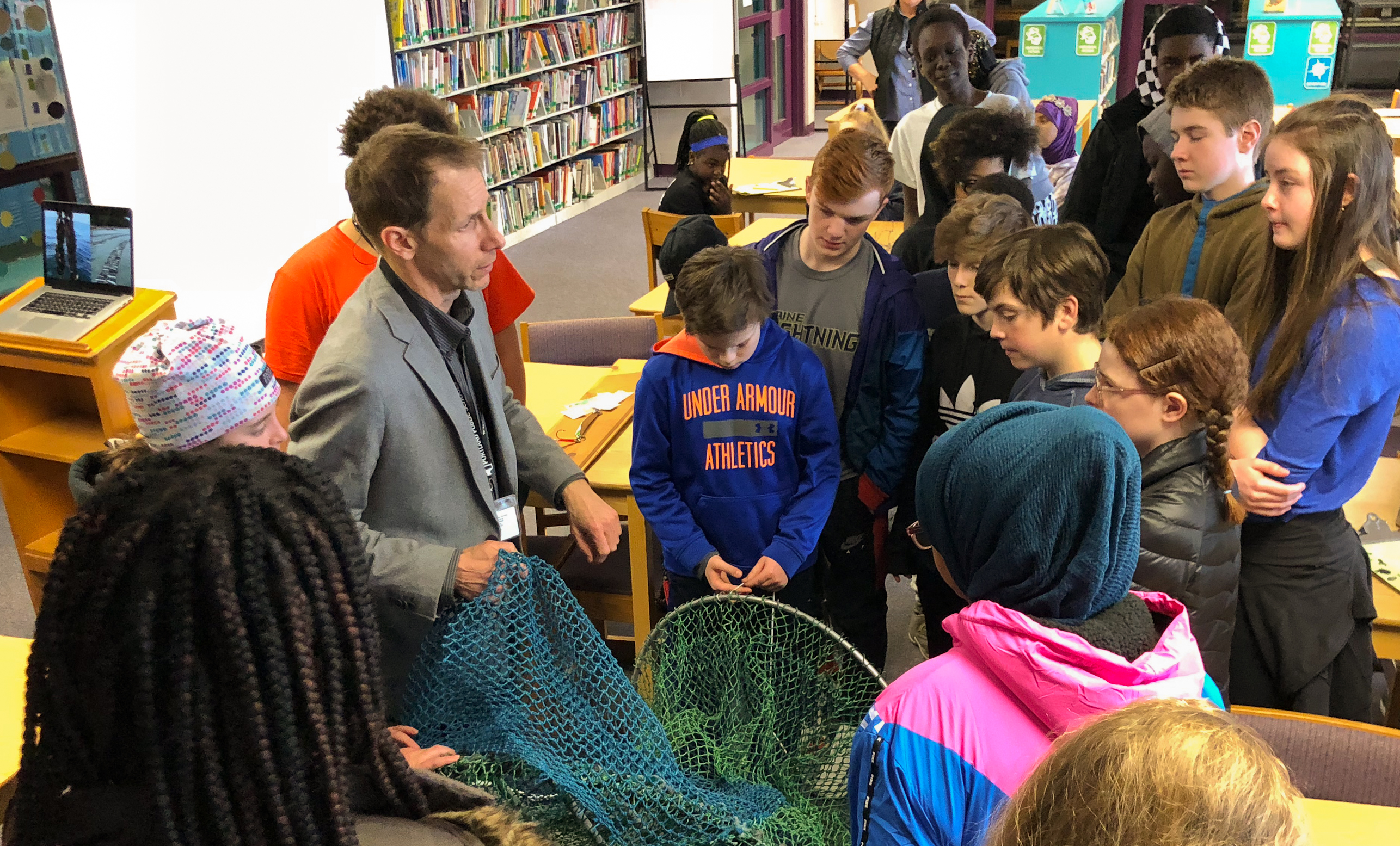
The Turtle excluder device is cumbersome, but a great hands-on tool for explaining innovation to reduce bycatch. photo: Lincoln Middle School Teacher Christel Driscoll

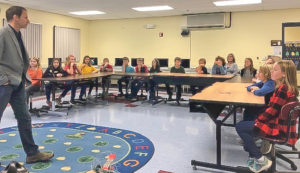
I seized the opportunity to democratize the message among students coming from diverse cultural backgrounds with respect to seafood while visiting classes at Lyman Moore Middle School and Lincoln Middle School a few weeks ago.

At Lyman Moore, I spoke to four large groups of 7th graders who reveled in laying hands on gill net, a turtle excluder device and a 24 oz. metal jig with some serious hooks. Fortunately, no one had to visit the school nurse afterward.

They also had the option to touch a dead black sea bass as we learned about why this mid-Atlantic species is showing up in lobster traps in and around Casco Bay, and the implications for marine ecosystem balance. This became a discussion about species adaptation as the Gulf of Maine continues to warm, and how climate change could impact what seafood is available down the road. We also talked about black sea bass as a local, underutilized species.

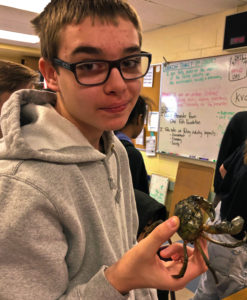
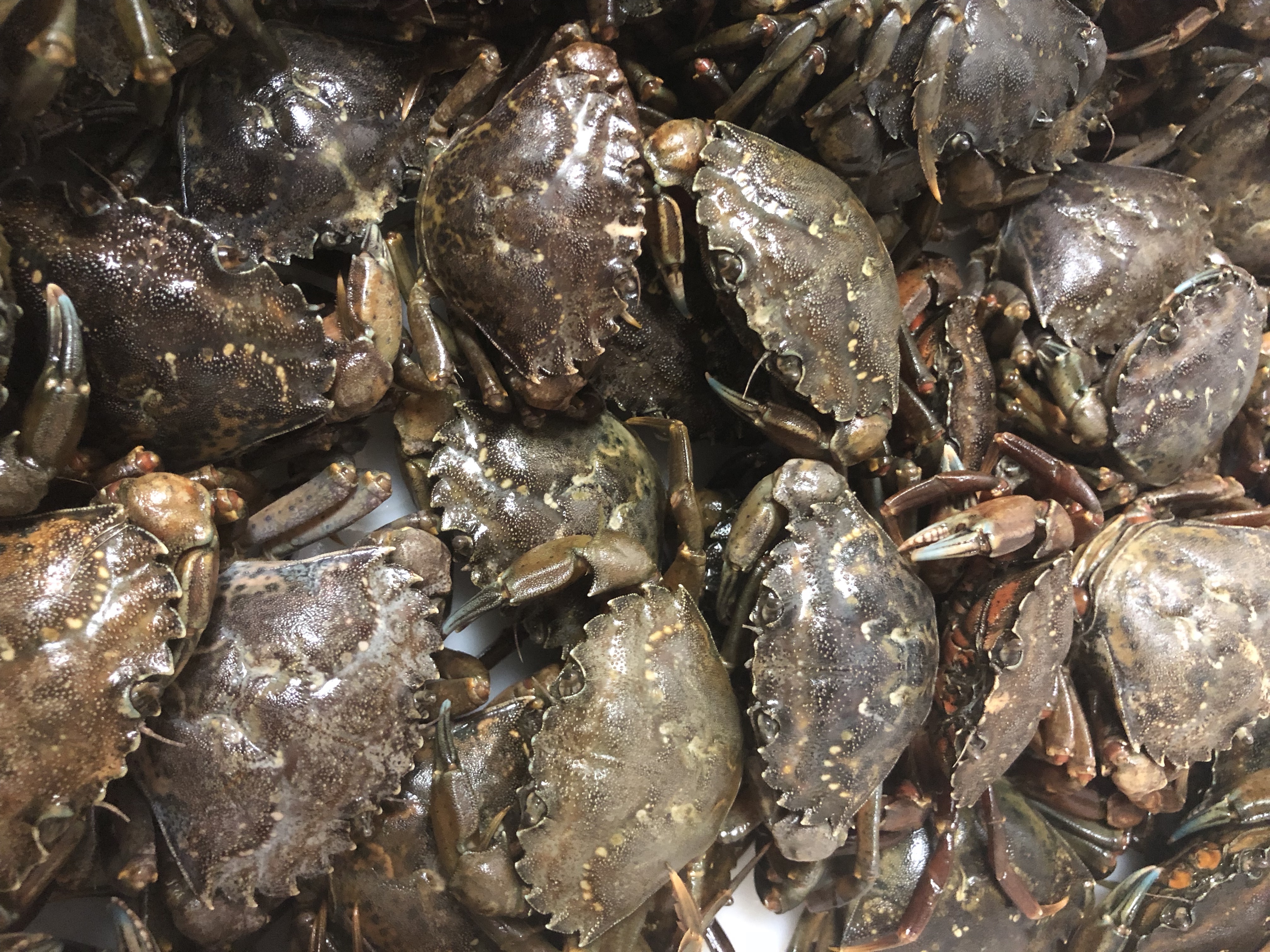
Live European green crabs held center stage as the keystone climate change adaptor species during the visit to Lincoln Middle school where I spoke with two classes of 8th graders taking a Sustainability Science course. The classroom, featuring a stove, sink, refrigerator and some counter space harkened back to the seemingly long-ago days of Home Economics.

“Can I keep it as a pet?” is one of the most common questions I get. Occasionally, when I ask what they’d do with it, I get, “I’ll feed it to my dog.” Ok. Eat the invasives!

This proved to be a perfect backdrop for discussing efforts to turn humans into pest control when it comes to green crabs, which are very fertile, very destructive (eating our mussels, clams and oysters at alarming rates) and have no significant natural predators. We also talked about industrial aquaculture, and how domestically grown oysters, mussels, clams and seaweed solve many of the serious issues with large-scale finfish aquaculture such as salmon (disease, sea lice, antibiotic use, feed sourcing and health and environmental impact).

In both schools, students took notes, asked questions and in some cases, showed a genuine interest in this new perspective: their decisions, whether they eat seafood or not, matter. Choosing locally harvested mackerel matters. Foregoing the single-use straw matters.

I passed out the 7 C’s of Sustainable Seafood in hopes they would take it home, put it on the fridge and have a conversation with their families and friends.

This is one important way to spread the message … regardless of demographic.

How do I know I made an impact? Among the several thank-you notes I received was one from a student whose uncle is from Senegal. I had spoken about how industrial Chinese fleets are vacuuming up the sardinella, anchovetta and mackerel artisanal and subsistence fishermen in West Africa depend on for their lives.

“All of these issues impact my future and hearing about the lack of knowledge many people have is very concerning, but I’m sure that eventually people will come to their senses and do something,” wrote the student.

Yes, people will come to their senses, hopefully, if we keep having conversations like this with people from diverse backgrounds.


All Blog Posts

Something There Is That Doesn’t Love A Mine

  • April 1, 2019October 19, 2021
  • by Colles Stowell
Share it!
Share

Nanci Morris Lyon’s daughter was born the year the Pebble Mine project was first proposed in Bristol Bay, Alaska. Rylie Lyon is now a sophomore in college. She is a guide at her family’s recreational fishing operation, Bear Trail Lodge, in King Salmon, Alaska. Nanci spoke out against the mine then, and she’s still doing it today.

Talk about a telling timeline.

Why is it that this mining project, purported to be resting on one of the world’s largest copper, gold and molybdenum deposits, has neither begun operation nor been abandoned as a bad job in nearly 20 years? Only recently did the U.S. Army Corps of Engineers just release its Environmental Impact Statement (EIS, which would form the basis for considering possible impacts of allowing the mine to operate) for public comment.

Ponder this the next time you use your cell phone, hop online or drive to the store: Those minerals are in more everyday items than most people know. Their claimed abundance in the geologic veins hiding in the Earth’s crust near Bristol Bay has sparked much controversy during the past two decades, sometimes, pitting neighbor against neighbor in Alaska.

Why have Lyon, her family, staff, friends and most everyone else in and around the recreational, commercial and indigenous fishing industries in the Bristol Bay region continued fighting this mine for this long? That such a unified and vocal coalition of very diverse groups and cultures directly tied to the resource continues to stand united says something.

With apologies to Robert Frost, something there is that doesn’t love a mine. Particularly this mine in this spot.


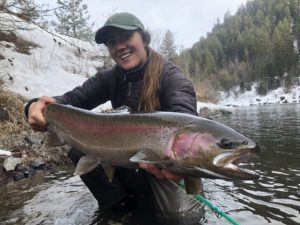
Rylie Lyon with a spring rainbow trout, just a few weeks ago.                        Photo courtesy Nanci Lyon

In perpetuity

The biggest concern is that minerals mining produces highly toxic chemicals that permeate much of the rock and other sedimentary layers exhumed from the earth in the process to extract the desired gold, copper and molybdenum. All of that nasty stuff must be stored safely somewhere forever. Whatever happens in that watershed now has generational impacts on everything, from salmon to water to land.

Mines aren’t supposed to let that crap loose in Nature. Sadly, time and again they do. Look no further than what happened in Brumadinho, Brazil in January, or what happened at the Mt. Polley Mine in 2014.

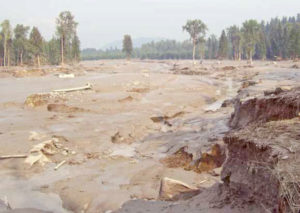
Aftermath of Mt. Polley tailings impoundment failure. This dam was initially engineered by the same firm engineering Pebble’s dam. National Park Service Photo

People like Lyon, and my friend and colleague Melanie Brown, who fishes for sockeye salmon with her mom and other family members near Naknek, have been fighting Pebble from the beginning. Melanie’s connection to Bristol Bay traces back over generations as her family has fished those waters commercially and for subsistence with the natural rhythms of returning salmon.

Opposition to the mine stems from its proposed location just north of Lake Iliamna, in the watershed of the world’s largest wild sockeye run … and the rivers that Brown, Lyon and thousands of others depend on for their livelihoods.

They don’t view the Pebble Mine as a potential resource for their phones and computers. They view it as a ticking bomb. In their minds, the question isn’t whether something is going to go wrong. It’s when, at what scale, and whether the damage is permanent. What they fear most is the salmon won’t return.

Melanie Brown doing what she loves near Naknek.  Photo courtesy Melanie Brown

Political tide change

Less than three years ago, the mine was left for dead, sentenced to purgatory by the Obama administration’s Environmental Protection Agency, which in 2014 declared the mine would violate the Clean Water Act because of its imminent threat to the wild salmon watershed. This was good news for everyone supporting the natural resource that provides a nearly $2 billion economic boost to the Alaska economy and supports over 14,000 jobs for commercial and recreational fishing businesses as well as countless related operations. Those numbers dwarf any realistic economic impact the mine would have on the state.

Then two elections happened (in 2016 and 2018), dramatically turning the political tides at both the federal and state levels and breathing life back into the project.

A 30-minute conversation between Pebble Limited Partnership CEO Tom Collier and former EPA Administrator Scott Pruitt in 2017 undid all of the work that Lyon, Brown, and many, many others amassed over decades to fight the project.

I wonder if someone uttered, “Good mines make good neighbors” in that meeting.

And now the mine’s permitting process, once estimated at decades if it ever got off the ground, is on a fast track. The Corps of Engineers on Feb. 20 released its draft EIS in “record time” by many accounts. Several critics claim the EIS glazes over if not outright ignores the ample scientific, economic and straightforward concerns voiced by recreational, commercial and indigenous fishermen, business owners, residents, scientists and countless voices from outside the state.

One chief concern is that the EIS does not account for the inevitable expansion the mine would have to undergo just to try and make a profit. Read this scathing economic review by a former permitting expert with one of the world’s largest mining operations (Rio Tinto, which previously pulled away from a financial deal with Pebble Limited Partnership). According to his analysis, the mine as proposed would have a big negative net present value of -$3 billion.

And despite loud protestations to extend the comment period sufficiently to allow thorough examination of the EIS and appropriate response, the Corps seems unwilling to do so. The comment period currently ends May 30, 2019.


Passion to safeguard Nature and livelihoods. Photo: Seafood News

Worse still, the last election produced a new pro-mine governor, who has appointed pro-mine commissioners (including a former employee of Anglo American, one of the world’s largest mining operations, which also pulled away from a financial deal with Pebble) of the departments of Environmental Conservation and Fish and Game. This move essentially sets the stage to fast-track state permits (of which there are nearly 60 to secure).

Follow the money

So why the rush? If the mine is as much a fait accomplis as its backers would have you think, why are they pushing state and federal agencies, which are supposed to have the state’s best interests (read natural resources and citizens) in mind, to approve everything now?

Perhaps it’s that Pebble’s owners want the appearance of momentum to continue so they might attract yet a fifth financial backer to the altar. The previous four, including three of the four largest mining interests in the world, bailed out citing massive opposition and the risk of economic disaster.

Maybe it’s the nifty clause that promises Collier more than $12.5 million in bonus money if he secures a positive Record of Decision from the Corps of Engineers within 4 years of submission of the permit (in Dec. of 2017). That’s on top of his $2+ million salary.

Talk about scale and incentive. The tailings impoundment to hold the toxic waste produced to extract these minerals would be up to 700 feet deep and extend for several miles. And it must be secured “in perpetuity.”

This is the same Collier recently quoted railing against the mine’s opposition: “I believe that a lot of these environmental organizations choose issues in Alaska. They make them cause celebs so they can raise money around them. And they choose Alaska primarily because they don’t have to suffer the backlash from the economic impact of the project being killed because no one gives a rat’s ass what happens in Alaska.”

Is that so? Within the Bristol Bay region, opposition to the project remains at over 75 percent, with the latest state-wide poll showing 61 percent opposed across Alaska. In 2014, 65% of Alaskans voted in favor of a measure that would require approval by the state legislature (rather than simply the state Department of Environmental Services) of any mine project that would threaten salmon habitat.

Priceless habitat.

But then again, politics and money can make a difference. A ballot measure was defeated last November that would have added enforcement teeth to existing state laws that would have made permitting a mine in crucial salmon habitat harder to do. How did this happen so soon after the 2014 vote?

Because Ballot measure 1’s proponents, which included many of the same collective of fishermen, business owners and residents opposing the mine, were out-spent by several out-of-state companies. Supporters raised close to $2 million. Opponents raised close to $12 million, with the top five cash donors being such “neighbors” as Conoco Phillips ($1.4 million), BP Exploration (Remember Deepwater Horizon! $1.05 million), Donlin gold ($976,000), Hecla Mining Company, (just shy of $1 million), Coeur Alaska, (just shy of $1 million).

Oh, and let’s not forget other outside influences, such as the Koch brothers, who funded the Alaska Policy Forum, Power the Future, and Americans for Prosperity- Alaska Chapter, which operated an influence campaign to defeat Ballot Measure 1.

Profits over living natural resources, anyone?

Rolling boulders, not pebbles up hill

Certainly the mine’s operation would most significantly benefit its owners, managers and shareholders, maybe a few dozen.

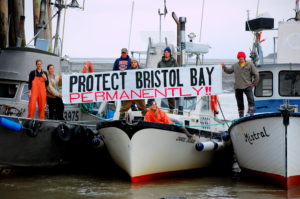
On the other side of the fence are tens of thousands currently working in harmony with the salmon resource. This has been a grueling uphill battle for Lyon, Brown and everyone else standing up to outside influence. Years of persistent, grinding effort and emotion, speaking out publicly, holding signs, singing songs and writing letters take an emotional, spiritual and physical toll.
Why keep at it?

Because it’s their way of life. A connection to the land and water and salmon deeply intertwined with who they are.
Perhaps that’s a reminder of what should be important, whether we live in Bristol Bay or not. Yes, we depend on our cell phones and stuff like that. But there’s something else at work here.

Perhaps mining interests/investors/manufacturers should find the raw materials somewhere else, where there isn’t an imminent threat to a priceless resource that may not be able to recover should when something bad happens.

Can the forces working to topple a fabled stone wall in northern New England woods serve as a proxy for what’s really at risk in Bristol Bay?

Would that we could ask the salmon.


Resources

  • Speak out: Your voice matters, whether you live in Alaska or not. Here’s a link to comment on the US Army Corps of Engineers draft EIS.
  • Let Sen. Lisa Murkowski R-Alaska, know what you think. She needs to hear from everyone, in and out of the state. Follow the link and add additional comments if you are out of state but concerned.
  • Good resource for timeline, facts and ways to engage: Save Bristol Bay
  • Pebblewatch, which also has some cool maps
  • National Park Service in-depth analysis of the long-term effects of tailings impoundment failures.
  • A Bristol Bay fisherman speaks out in Juneau Empire op-ed against the mine.
  • Op-ed by Ron Thiessen, CEO of Northern Dynasty Minerals, which owns Pebble Limited Partnership. Funny how this “neighbor” tells people not to buy into “the alarmism” about the mine, but doesn’t mention his salary is over $2 million. Even more ironic is that he encourages people to read the Army Corps of Engineers’ EIS, but fails to mention that it is incomplete and virtually ignores most of the more damning issues raised in the first phase of public comment.
  • Finally, if you love wild Pacific salmon, and would like to do something beyond commenting, check out this offer from Wild for Salmon.


Top photo: Alaska Region U.S. Fish & Wildlife Service/Flickr

All Blog Posts

DNA, Fraud and Next-Gen Scientists

  • March 27, 2019October 19, 2021
  • by Colles Stowell
Share it!
Share

Imagine a team of scientists collecting DNA samples to see if the seafood sold at local restaurants and stores is correctly labeled. They go to sushi shops, grocery stores and other retail venues and carefully place tiny samples of the fish in a small vial containing ethanol.

Then they take it to the lab where they will use genetic techniques, including Chelex extractions and polymerase chain reaction (PCR), to analyze the DNA of the sample to see if the snapper they purchased is actually Pacific rockfish. Their work is crucial. It will provide a deeper understanding of the rate at which seafood is mislabeled in area retail stores.

Now imagine these scientists are in high school.

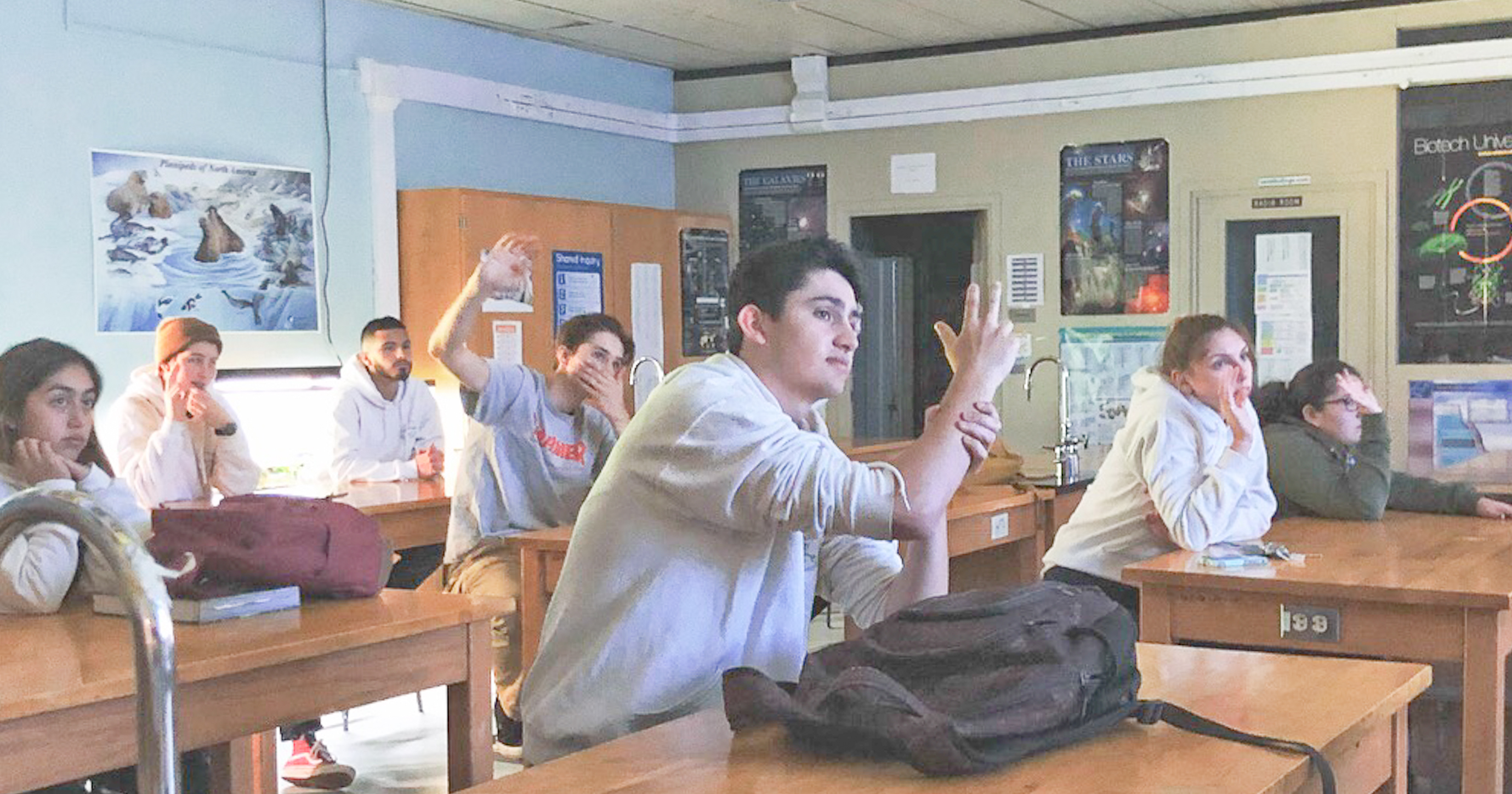
I was inspired by the senior biotech class I visited March 18 at Harbor High School in Santa Cruz, California. I was even more inspired by teacher Nehal Pfeiffer, who developed this project to combine classroom/lab study with real-world challenges. To get students thinking about how the process would work, she started students on testing different foods for genetically modified organisms (GMO).

The students were somewhat surprised to see high GMO content in Cheetos (corn) and veggie burgers (soy). Then the teacher had them break out into groups representing different players in the food industry such as farmers and Monsanto and try to get at the heart of the discussion.

You can guess how this ends up. Lively discussion. Engaged questions. Thoughtful conclusions.

Fraud talk

So I was honored to be invited to speak to these students about fraud in the seafood supply chain. I was there to give them a broader perspective of how and why it happens, the larger dynamic of US and global seafood consumption and what we can do about it.

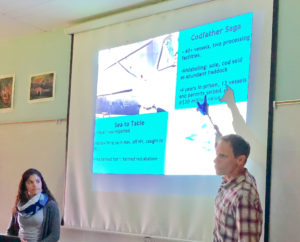
“Codfather” Carlos Rafael and Sea To Table are poster children for what can go wrong with fraud in the supply chain. Arina Favilla (left) helped coordinate the DNA sampling project. Photo credit: Stephanie Webb


After holding up Carlos Rafael and Sea To Table as prime examples of different types of fraud and their impacts on consumer trust, one student raised her hand and asked, “How can they get away with that? Who do we sue?”

Great question that prompted an excellent, interactive discussion. The truth is that current management policy, combined with a clunky mishmash of federal oversight spread over four disparate agencies with a confusing web of priorities and powers enables these types of fraud.

Rafael, the self-styled Codfather, was enabled by the catch share system in the New England groundfish fishery to amass a giant horde of access (permits) to essentially “own” the right to catch more groundfish than anyone else in and around the Gulf of Maine. He then used that power to force out many small-scale fishermen while vertically integrating so that his team of captains could work with his on-shore processing facilities to mask the cod and Dover sole he was catching as abundant (and less subject to expensive quota limits) haddock. He then sold this fish to New York restaurants for bags of cash.

Fortunately, he got caught bragging about the scheme to undercover IRS agents posing as Russian mafia.

I then explained the Sea to Table story as one of co-optation of values. One of the early pioneers of the national boat-to-plate sustainable seafood movement, Sea to Table was outed in an in-depth Associated Press exposé last summer, in which the Brooklyn-based company was alleged to have claimed some of its tuna had been locally harvested off Montauk, NY, when in fact it was caught in North Carolina. Other allegations include selling domestic seafood that may have been linked to international slave trade and offering wild harvested sea urchin that was actually farmed.

Taking initiative

My goal was to give Harbor High students an understanding of why this matters. Beyond the science, which is super cool and something I lament not having access to way back in my time, the understanding of how and why this type of fraud matters hopefully inspires these students to dig in. I’d love to see them discover the level of mislabeling in their communities, put that in context, and do something about it.

I hope they spread the message about why knowing where their (our) seafood comes from matters. I hope they ask questions and share the 7 C’s of Sustainable Seafood with family and friends. And I really hope they get involved in marine science, biotech, climate science or any related field. Seafood fraud is a significant problem and erodes the trust necessary to make community-based fisheries markets work.

And it is just one very complex problem in the domestic and global seafood supply chain.

So I would like to thank Nehal Pfeiffer at Harbor High, and University of California Santa Cruz graduate students Stephanie Webb, Arina Favilla and May Roberts, all of whom coordinated this year’s seafood project with Nehal, for inviting me to speak with the students.

My discussion with these thoughtful, determined students inspired me, giving me hope that we can address these complex issues together.


All Blog Posts

Slow Fish 201: Building Accountability in Seafood

  • January 31, 2019October 19, 2021
  • by Colles Stowell
Share it!
Share

Sometimes it’s tough to see the forest through the trees. Or in this case, effective fisheries enforcement through the quagmire of domestic fishing regulations.

Consider that laws established to ensure responsible harvest, proper trade/market practices and truth in advertising throughout the supply chain are enforced by at least four different federal agencies with different agendas, priorities, authority, funding and resources. Factor in state and local agencies involved in the process, and you’ve got layer upon layer of bureaucracy. And yet, there are still gaps.

This is why we conducted the Slow Fish 201 webinar: Building Accountability in Seafood Weds. Jan. 23. We wanted to shed light on this complexity and the challenges it presents as well as some innovative thinking on how to create markets that organically root out fraud (more on that later).

Alphabet soup: NOAA, FDA, CBP, USDA

In broad terms, the National Oceanic and Atmospheric Administration’s Office of Law Enforcement has jurisdiction over seafood entering the U.S., and can conduct warrantless inspections on vessels as they enter US waters. But it does not have the same broad authority once the seafood has crossed the border. The Department of Homeland Security’s Customs and Border Protection also has some authority to inspect and ensure proper labeling of seafood entering the U.S.

Once seafood has passed beyond US borders, the responsibility to enforce labeling, country of origin, food safety and related laws generally belongs to the Food and Drug Administration and to a lesser degree, the US Department of Agriculture (primarily for farm-raised seafood). There are of course, exceptions to these rules where, for example, NOAA does have some jurisdiction on product within US borders (which makes the situation all the more confusing to those in and outside the supply chain.

With all of these layers of protection, intelligence and resources, you’d think we’d have a good handle on fraud.

And still, less than 1% of the seafood we import in this country, representing some 90% of domestic consumption, is inspected. That doesn’t even account for what happens within the domestic seafood supply chain, such as the co-optation of core trusted values, as happened with the Sea To Table news last summer.

No wonder consumers, fish harvesters, retailers and everyone else in the supply chain is confused and likely frustrated. How do you keep tabs on all of that?

A label’s cautionary tale

Patty Lovera, food and water policy director for Food & Water Watch, has spent decades navigating the domestic food policy system. She began the webinar with a high-level view of the matrix of federal agencies and laws responsible for safeguarding the stream of seafood in the supply chain. In short, the very Jenga-like structure leaves many gaps in enforcement, too much room for interpretation and hence, exploitation, and some confusion among supply chain players about how to honestly comply with the law.

As Patty Lovera mentioned and others echoed, consumer education is critical in the seafood supply chain.

She presented the Certified Organic label as a cautionary tale when laws and values don’t gibe. Established to distinguish farmers who adhere to a set of standards that prohibits hormones, antibiotics, certain pesticides and other additives and destructive practices, the label became a battle cry in the conflict with huge multinational corporations seeking to own the food system.

Millions of dollars, countless hours, political wrangling, lawsuits, arm-twisting, scheming and in some cases, outright capitulation have led to a severely diluted label bearing no resemblance to the original mission. More than three decades of haggling, and products either owned or supported by the likes of industrial agriculture giants Monsanto, Dow Chemical and Tyson foods bear the Certified Organic seal.

The message? Labeling schemes and the values they promote can be co-opted if not rooted in strong values backed by stronger laws.

Congressional commitment

We were fortunate to have Congressman Jared Huffman (D-Calif.) join the conversation. He’s quite busy as he’s just taken the gavel for the powerful House Natural Resources Subcommittee on Water, Oceans and Wildlife, which is responsible for reauthorizing the Magnuson Stevens Act (MSA), otherwise known as the Fish Bill.

“I believe we’ve got to be supporting U.S. fishermen in an increasingly competitive international market.”

Congressman Jared Huffman

In outlining some of his priorities for the subcommittee, he said we need to preserve the health of the oceans, fix some of the environmental rollbacks established by the current administration and do what is necessary to help U.S. fishermen make a good living. “I believe we’ve got to be supporting U.S. fishermen in an increasingly competitive international market,” said Huffman.

He also mentioned “…ways to improve traceability throughout the supply chain. There may be new technology that could be utilized, examples from businesses that are doing some of this work. It’s clear to me that we need to better enforce, maybe even strengthen, existing policies to ensure accurate labeling, increased transparency and consumer trust.”

Marketing, education and leveling the playing field

Noah Oppenheim, executive director of the Pacific Coast Federation of Fishermen’s Associations and the Institute for Fisheries Resources, followed on that theme, saying that fraud has a significant impact on community-based fish harvesters who are trying to abide by the law.

“It’s only fair that the accountability that fishermen have been holding themselves to is rewarded in the marketplace.”

Noah Oppenheim

“Fraud can occur at any place in the market,” Oppenheim said. “It’s a huge problem, and we have to find comprehensive solutions that make it harder for anybody on the end of the chain of custody to mislabel or fraudulently market their product.”

He also spoke of the need to enhance education and marketing to help consumers better understand the value of domestic fisheries. “It’s only fair that the accountability that fishermen have been holding themselves to is rewarded in the marketplace.”

Jes Hathaway, editor in chief of National Fisherman, a national trade publication, echoed Oppenheim’s call for better education and more funding for marketing programs.

She zeroed in on increased funding to boost the infrastructure at our ports to level the playing field between domestic seafood standards and standards for imports. “As long as it’s easier to bring seafood into port in a container than to bring it in your fish holds, we are doing our seafood industry, our fishermen and our citizens a disservice.”

“As long as it’s easier to bring seafood into port in a container than to bring it in your fish holds, we are doing our seafood industry, our fishermen and our citizens a disservice.”

Jes Hathaway

Hathaway also proposed “encouraging region- and fisheries-specific solutions to the problem beyond Magnuson.” One such approach, in her view, would be to provide funding for test programs to track seafood from boat to plate in different regions. While some programs exist, she would like to see more cooperation and investment in such programs, rooted in common values across different supply chains and geographies.

Pier to peer community accountability

One of the webinar’s recurring themes hinged on supplementing better, more comprehensive enforcement of stronger laws with cultural changes within the fishing community. As Hathaway suggested, “Federal legislation is rarely a panacea for every issue in fisheries.” However, one possible path toward ensuring stakeholder buy-in while potentially reducing fraud involves a community accountability model.

Kevin Scribner, owner/operator of Forever Wild Seafood and one of Slow Fish national’s team leaders, described the notion of creating a seafood community accountability program, in effect, a cooperative rooted in a shared set of values. If you agree to uphold the values, you become part of the community that will support those values, identify and address any violation of those values (fraud), and offer support to those who need it.

This type of community accountability promotes a self-policing model that discourages any missteps while promoting the values that engender public trust. Scribner described it as a system in which “We take care of and manage our own.” But it would also be a system that is open to anyone willing to embrace the core values, which may be similar to the Slow Fish values of good, clean, fair, and/or the Local Catch Core Values embracing community-based fishermen.

“…a reliable trusted knowledge-based system of accountability can be developed and maintained by a seafood community that is committed to and guided by core values.”

Kevin Scribner

“We have confidence that with the proliferation of direct and immediate communication tools plus refined methods of traceability and a commitment to transparency, that a reliable trusted knowledge-based system of accountability can be developed and maintained by a seafood community that is committed to and guided by core values,” Scribner said.

A seafood community accountability framework would not seek to rebel against nor replace existing federal, state and local laws in place. Rather, it would operate under the umbrella of existing fisheries laws, augmenting the overall effort to minimize fraud while uplifting the values that support responsibly managed fisheries.

There’s much more to discuss on this topic, including different values and traceability and transparency technologies to support those values, all of which we’ll revisit in the third webinar in the Slow Fish 201 Webinar Series on Feb. 27. Stay tuned for more information regarding time, panelists and questions to be asked and answered.

The webinar closed out with some insightful questions from the audience regarding fair pay for seafood processing employees, economic justice to ensure fair pricing and access to quality seafood for all demographics and ways to measure success in the mission to uphold values and minimize fraud.

We will revisit all of these topics in some form in one of the following webinars.


Resources

If you’d like to watch the video recording of this webinar, follow this link.

If you’d like to watch the video recording of the first webinar, follow this link.

If you’d like to continue the discussion, visit the Local Catch Forum here.

If you’d like to communicate directly with one of the panelists, send an e-mail to colles@onefishfoundation.org.

Want a more in-depth understanding of the federal agencies at work against seafood fraud? Follow these links:

Congressional Research Foundation report on Seafood Fraud

University of Minnesota Food Policy Center Report


All Blog Posts

Getting to KNOW FISH in School

  • December 20, 2018October 19, 2021
  • by Colles Stowell
Share it!
Share

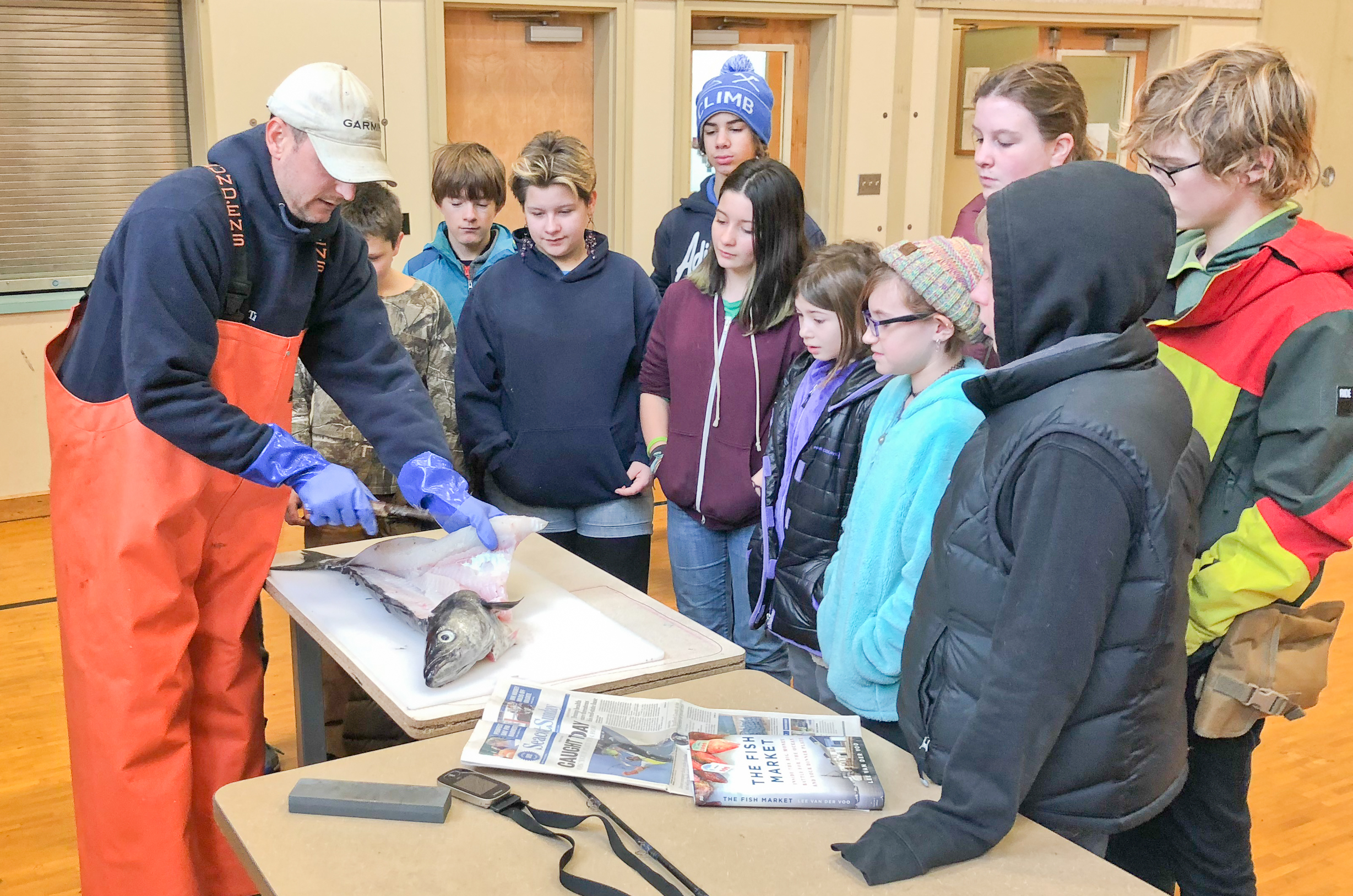
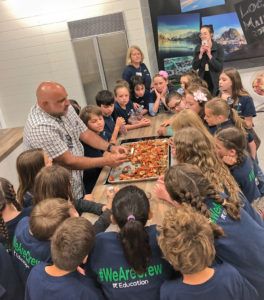
Students wrapped around the table, close, so they could get a good look as Capt. Tim Rider deftly worked the knife through the 15-pound pollock his crew had landed the day before. Neatly separating flesh from bone, he explained that filleting a fish is a matter of taking your time to be safe, but also to extract as much of the delicate meat as possible.

It’s a process he’s done many more times than he can remember. It is now automatic. For most of the middle school students at Harpswell Coastal Academy, this was a first. They asked questions about how the fish was caught, how it was bled and iced to keep it so fresh it almost looked like it could swim off the table.

They learned about the long days, the process of filleting a couple thousand pounds of fish before delivery to restaurants, stores and directly to consumers. They got an inside look at the life of a fish harvester.

This was the mission of the KNOW FISH Lunch® hosted at the school Dec. 11. We wanted students and their families to meet fishermen from their communities and learn how and why they harvest the species they do.

The gym was set up with tables framing a large rectangle with displays featuring clam rakes, lobster traps and some of the heavy steel used for scallop dredges. Students drifted from table to table with a broader perspective of the effort, process and forethought that goes into producing the seafood they eat.

They learned from Mason Warren how to put those wide rubber bands on lobster claws, occasionally getting their hands on a lobster, its claws and the bands. They learned what it’s like to bait and set several hundred traps a day, and what it’s like to get started in the business. Mason’s father is a lobsterman who travels offshore. This time of year, he and other fishermen often have to stay in port because the weather is just too dangerous (read: 20-foot seas).

Wendell Cressey discussed the backbreaking toil of bending over and digging clams and oysters out of the mud. He does mostly wild harvest, and therefore, the clam rake becomes an extension of his arms. He talked about the challenges a frozen mud flat can present in winter.

Students learned how a 2000-pound scallop dredge works from Terrance Kenney. A fisherman for decades, Kenney explained the constant  maintenance and plenty of work necessary to get scallops out of the shells and into market shape.

I had set up a table with live green crabs, some gill net, trawl net and a turtle excluder device. Several students wanted to adopt the green crabs as pets…or feed them to their dogs. Funny how live organisms with a hint of creepiness draw students close.

While eating chowder, students learned about the relationship they have to the seafood they eat. Photo: Micah Depper

The best part was the ambient buzz as students visited each harvester, shuttling in and out of the gym in three groups, absorbing the stories. At each station, students heard from small-scale local fish harvesters about how choosing locally sourced seafood affects them.

As if to illustrate the point, school chef Nicole Walker made a fabulous fish chowder using the fresh pollock provided by Capt. Tim Rider. Not too heavy, with a good balance of potatoes and seasoning, the chowder let the fish do the talking. And everyone praised the result.

While they finished off first or second helpings of the chowder, I rounded out the message with a quick discussion of the global seafood dynamic, illustrating why choosing local, regional and even domestic seafood is better for fish harvesters, the resource, the local economy and consumer health.

This was the first KNOW FISH event to bring fishermen, their gear and some of their product into a school to engage students, their parents and staff in conversations about how and why their choices matter.

By all accounts, the conversations and the food resonated, with some students saying they still have the 7 Cs of Sustainability stuck to their refrigerators at home after my visit in November.

That’s how I know the message is sinking in. So we’ll keep having these types of conversations in classrooms, or gyms or cafeterias, with students, their families, fishermen and teachers. And we’ll keep shifting the import dynamic away from imports and toward local or domestic seafood purchases.


All Blog Posts

Fish, Tamales and Community

  • December 13, 2018October 19, 2021
  • by Colles Stowell
Share it!
Share


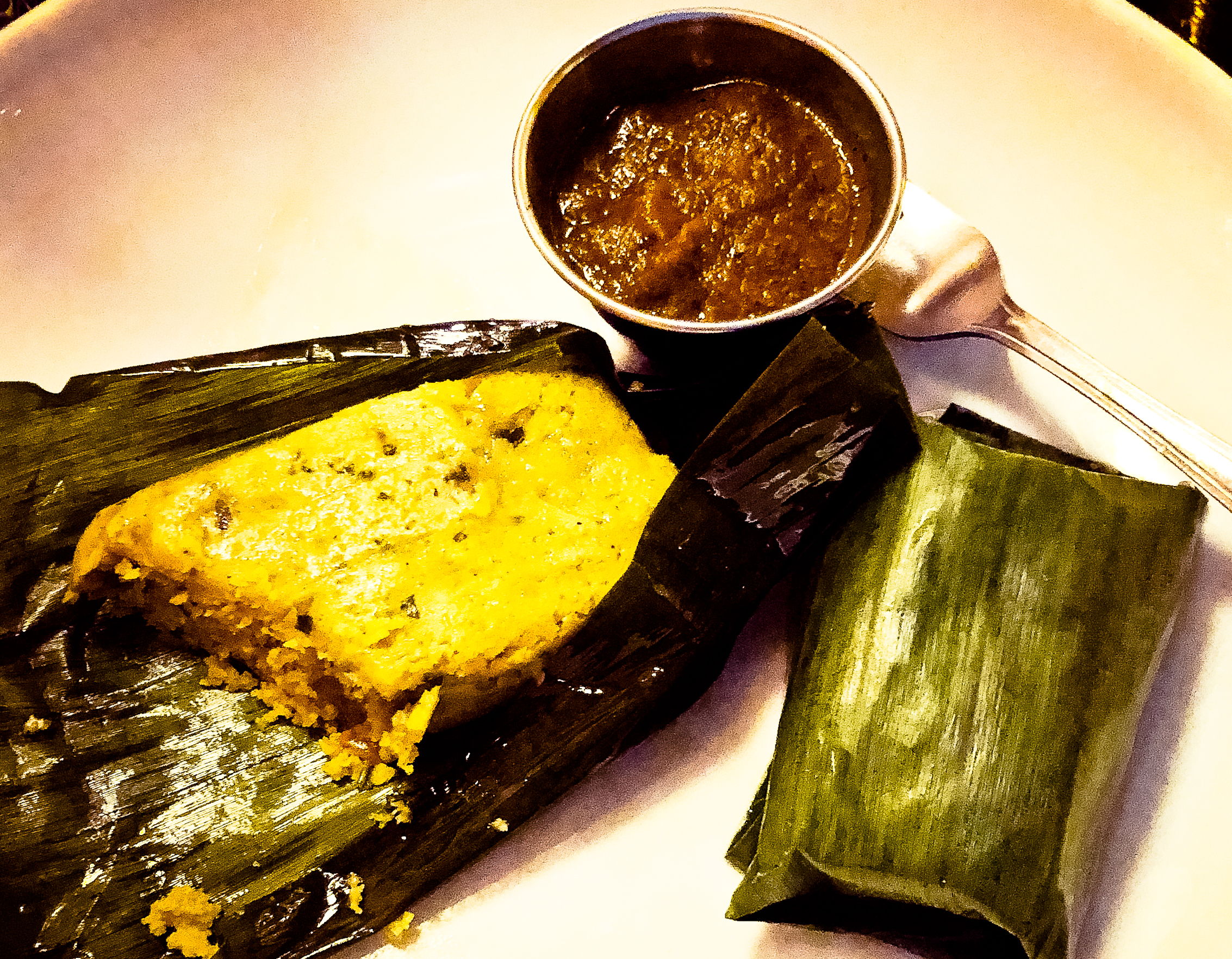
The banana leaf pollock dressed in a cilantro peanut tamale did it. I am no chef, but I like to cook and explore new interpretations of dishes I thought I knew. Growing up in New Orleans meant a vast menu of cool, authentic dishes that often transcended expectations.

I still remember the smell, taste and texture of the corn husk-wrapped tamales the neighborhood kids would buy from the old man pushing his cart up and down Napoleon Ave. We had no concept at the time of ingredient sourcing, labor, etc. We just knew that a couple of those tamales for $1 after playing football in the streets made for a great cap to the afternoon.

So biting into Chef David Vargas’ spin on the cod tamale opened my eyes and fired my taste buds. I would not have thought of this combination as a kid (I may not have wanted to try it). But it was a stark reminder of the beauty of culturally diverse approaches to seafood.

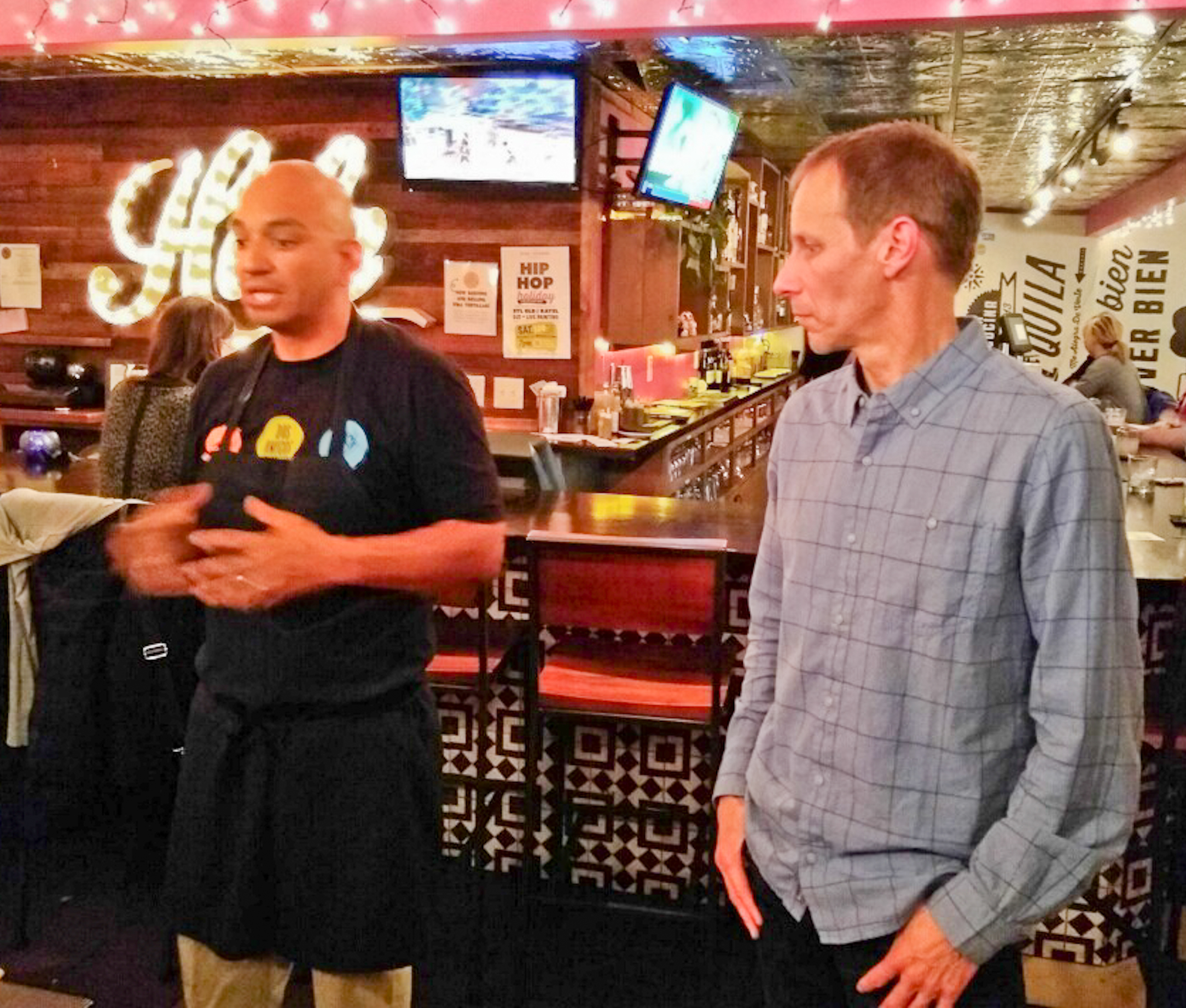
Chef David Vargas discusses his roots in local sourcing.

Deep roots

Chef David spoke about growing up in a Santa Ana (California) neighborhood of little means but deep cultural roots and strong food traditions. His family grew its own vegetables. If they wanted fresh seafood, they went to the local pier and caught it themselves. Local sourcing is ingrained in his DNA and is the bedrock of his menu at Vida Cantina in Portsmouth, N.H.

Chef David spoke about growing up in a Santa Ana (California) neighborhood of little means but deep cultural roots and strong food traditions. His family grew its own vegetables. If they wanted fresh seafood, they went to the local pier and caught it themselves. For him, local sourcing is ingrained in his DNA and is the bedrock of his menu at Vida Cantina in Portsmouth, N.H.

That explains his enthusiasm for hosting a KNOW FISH Dinner®. It was not too far of a leap from the community dining he grew up with, and the embracing of locally sourced food.

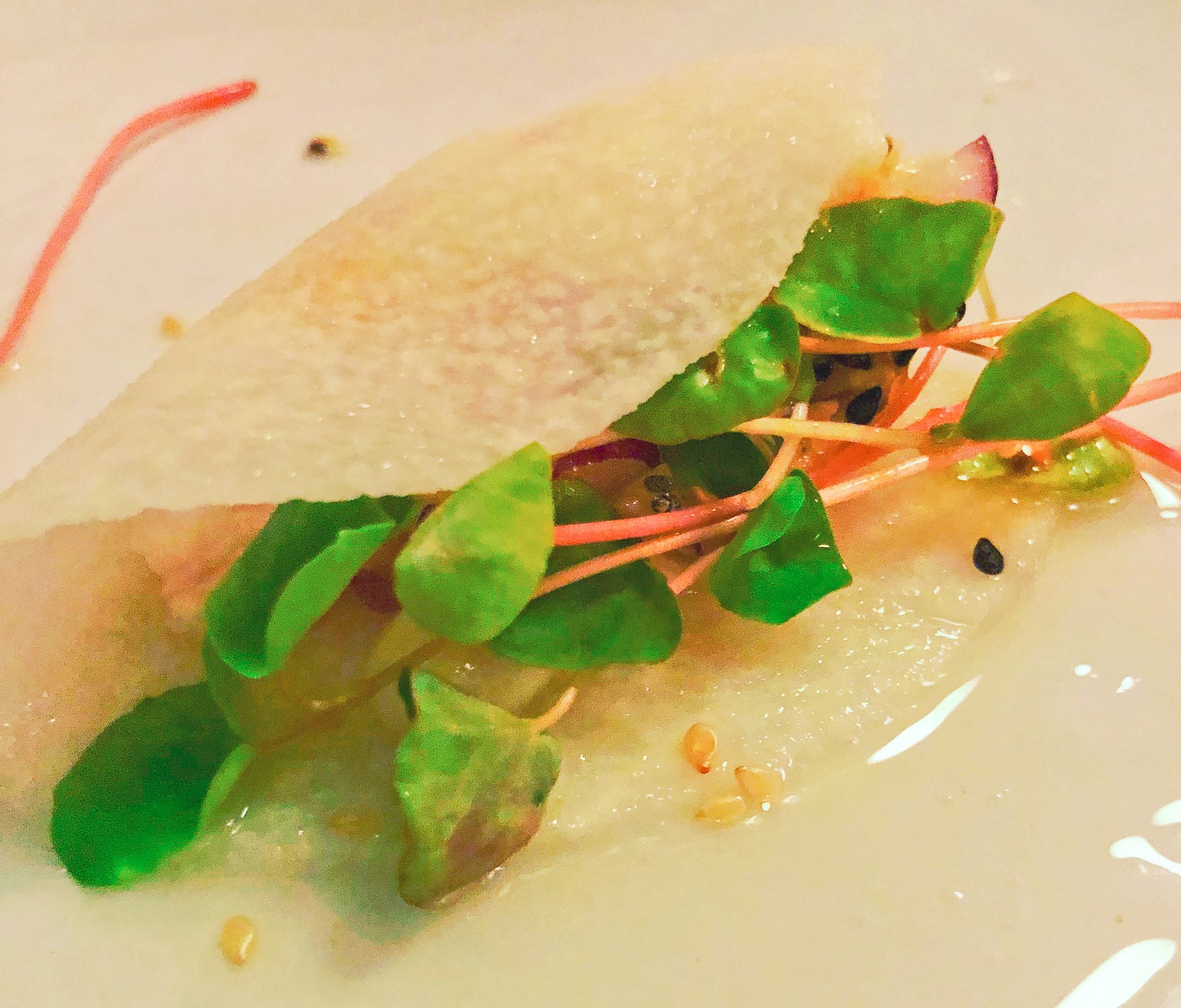
Cod ceviche, courtesy of Chef David Vargas and Capt. Tim Rider. Now that’s boat to table…with flair!

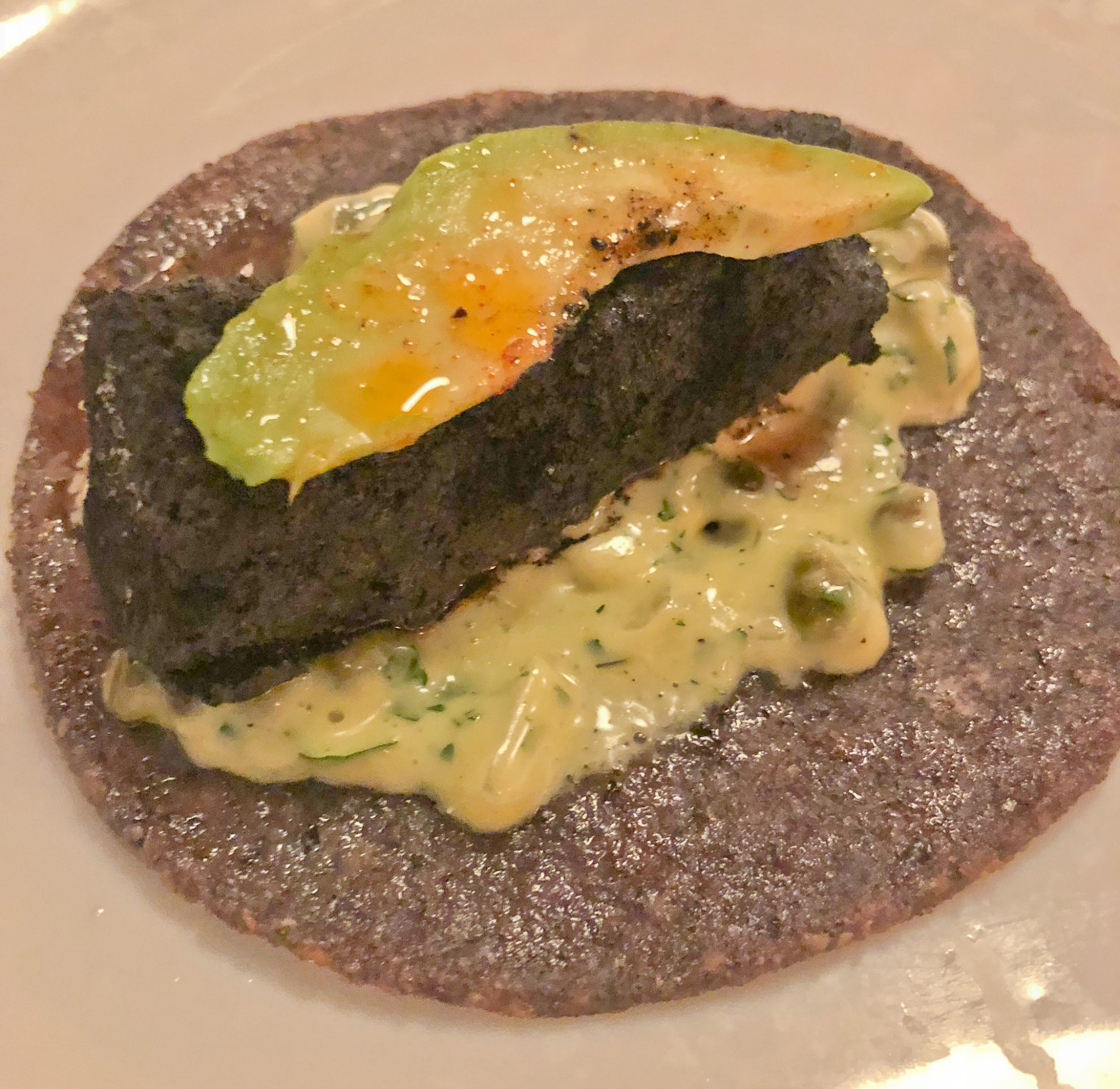
Capt. Tim Rider of New England Fishmongers provided the cod, haddock and pollock (that had been swimming the day before) Chef David turned into south-of-the-border feast fancies: cod ceviche served with a thin, but lightly crisp jicama tortilla and fresh mango, serrano and seeds; charred haddock taco paired with a crispy caper tartar sauce and marinated avocado; and the aforementioned tamale that also came with a mouth-warming charred arbol salsa.

Appreciating fish tales

Capt. Tim also provided some perspective on fishing for a living. He shed light on the passion, drive and unrelenting commitment required just to survive. The long hours, sometimes 20-hour days, sometimes 36 hours, are physically and psychologically draining to be sure.

Charred haddock taco. That marinated avocado complemented the charred coating on the haddock beautifully.

But the attendant pressures to make a living for a captain and crew outside of the actual harvest can be staggering. The expenses can drain bank accounts quickly, which leads to heavy debt. Beyond the table stakes of boat costs such as monthly payments, insurance, fuel, gear, maintenance etc. are, for many, the staggering fees just to be allowed to fish. Someone like Tim may have to pay in excess of $100,000 a year to someone else for the right to fish for cod, pollock, haddock, scallops, flounder and a host of other species in the Gulf of Maine.

It’s the complex, and often debilitating nature of the current fisheries management structure in New England and elsewhere in the United States. Without passion and commitment, facing those kinds of costs and demands on personal well-being would be a short-lived fool’s errand.

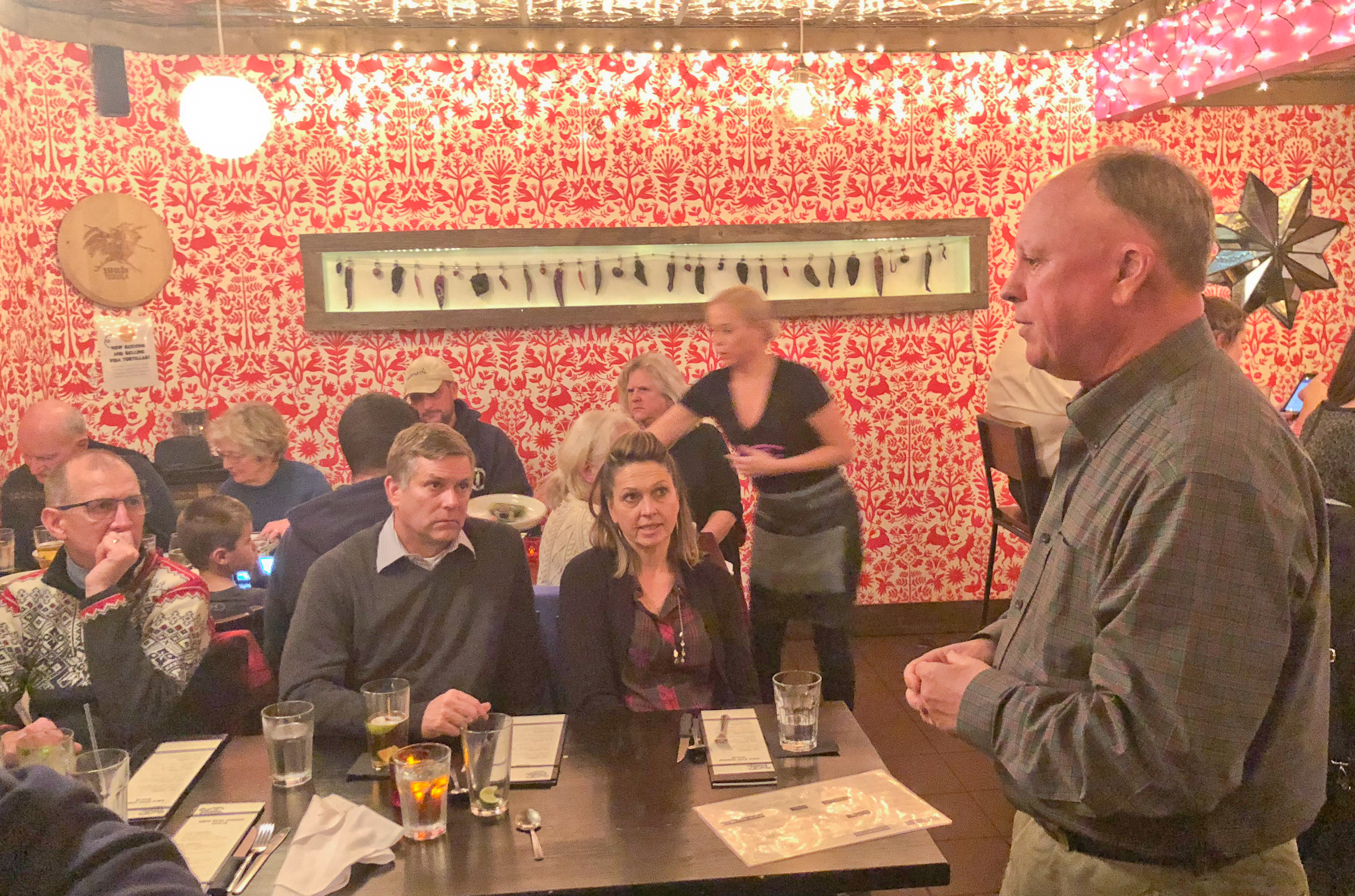
And so, KNOW FISH Dinner attendees at Vida Cantina last week gained new appreciation for the fish harvesters who produced the seafood they were eating.

Tim Henry of Bay Point Oyster Company describes the extraordinary patience and commitment to start and run a successful oyster farm.

They also heard from Tim Henry, owner of Bay Point Oyster Company, LLC., who also described the effort to produce top quality oysters right out of Great Bay in New Hampshire. It’s a three-year commitment, requiring tons of patience, significant capital, physical fortitude and an ability to adapt to constantly changing circumstance. Heavy rains can force the state to shut down the harvest, and alter scheduled deliveries, for example.

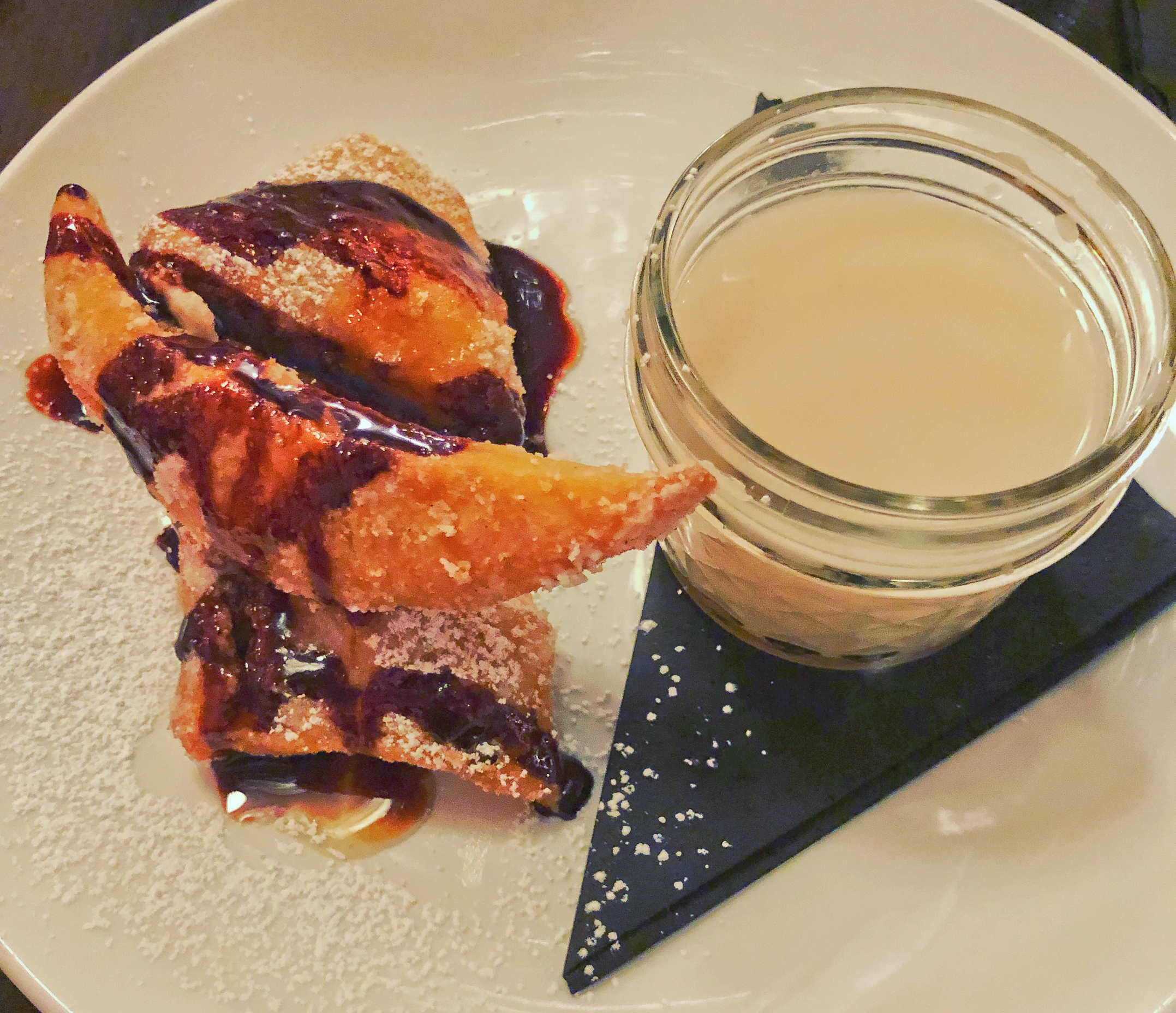
Dessert. This is the first good sopapilla I’d had since childhood.

As we dined on light, crisp sopapillas drizzled in chocolate sauce and local honey, we discussed why knowing the story behind the food we eat, especially the seafood we eat, matters. This is an important point for both classroom and community discussions. When you know when, where, how and by whom your seafood was harvested, you can appreciate the effort that went into producing that seafood. Moreover, you can trust it.

Frozen shrimp from Thailand? Not so much.

All Blog Posts

Building Mussels

  • November 29, 2018October 20, 2021
  • by Colles Stowell
Share it!
Share

Why in hell didn’t I schedule this on a more temperate day?

It was 21 degrees at 5:30 a.m. when I scraped the first significant frost coat off my car’s windshield to drive down to the Maine Wharf in Portland. Dawn was slowly breaking over the Atlantic, faint whisps of light harkening a chilly day on the water.

Though I was layered up, prepared to don some brand new, drab green Grundens oil slicks to shield myself from the forecasted wind and hopefully stay dry, I did begin to wonder what I’d gotten myself into.

What better way to get a sense of how mussel farms work than to get muddy? Doing it in mid-November in Maine just adds some texture to the experience. For me, this was research. I spend a lot of time talking about shellfish and finfish aquaculture in classrooms and at different speaking engagements. I wanted to have firsthand knowledge of what it takes to seed, grow and harvest some of the best mussels available.

Fortunately, Matt Moretti, co-owner of Bangs Island Mussels is happy to welcome visitors to the operation and let them get muddy if they so choose. They just need to understand that harvest days are fixed, regardless of the weather, because that’s how market demand works. Selling high-quality, responsibly grown mussels to restaurants and wholesalers across the country means you don’t get to choose the harvest conditions.

Portland has 12 working piers, including the Maine Wharf. Some of these piers are under threat from developers.

And so we pulled away from the dock as an early winter sunrise painted the sky pink, orange and light blue. Bangs Island lies just east of Chebeague Island, and not far from Portland’s historic working waterfront as the crow flies. But it still takes about an hour in a re-purposed fishing boat that doesn’t cruise over 15 mph.

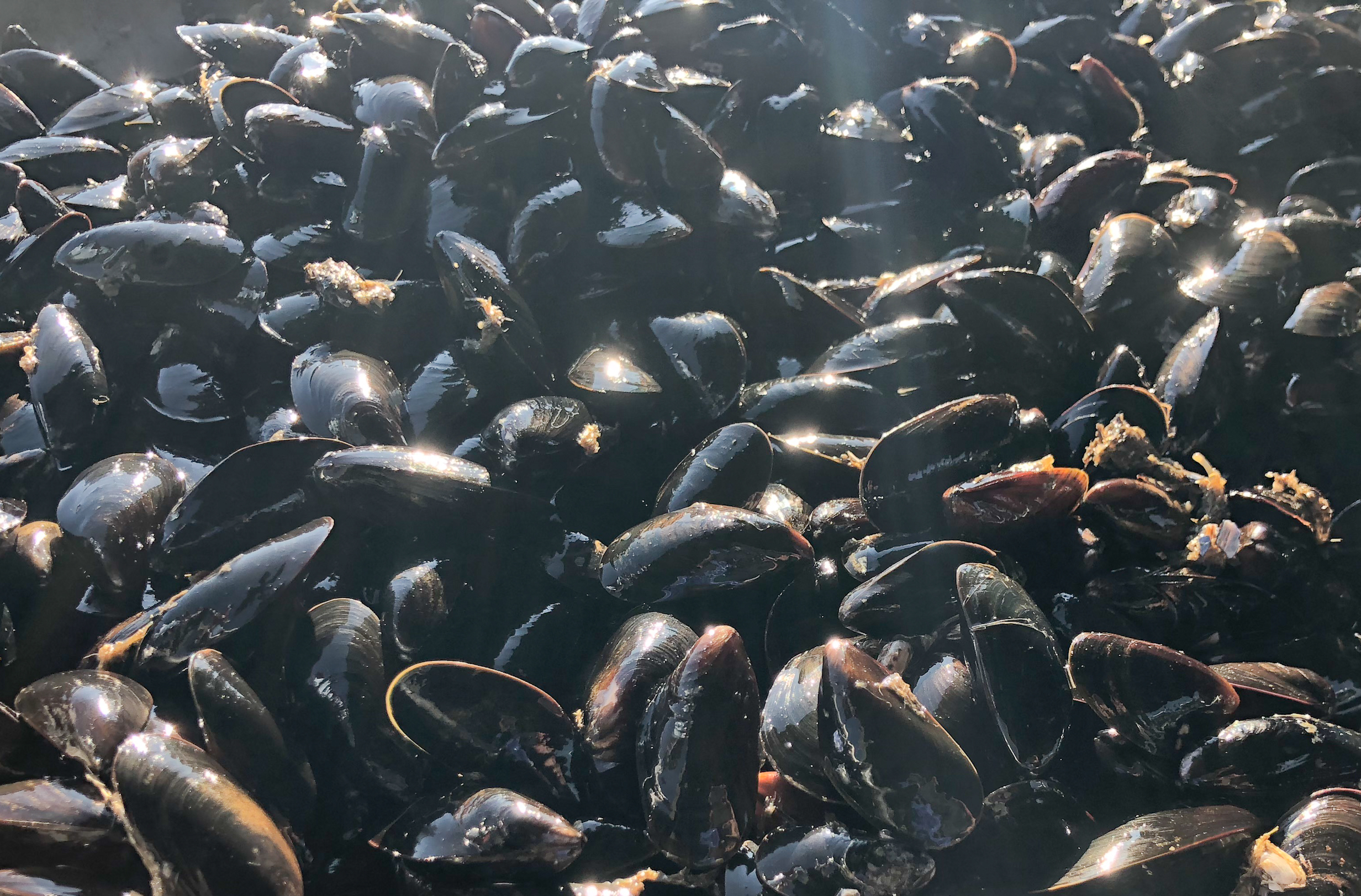
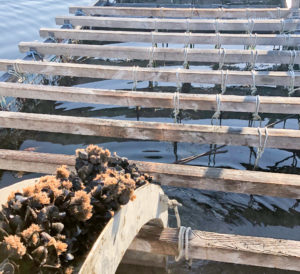
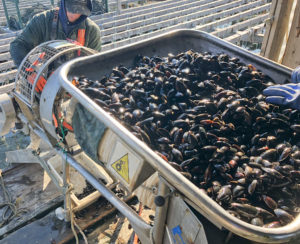
The mussels live, eat and grow on hundreds of ropes dangling from solid wood beams on three large rafts securely anchored a couple hundred yards from shore. The entire operation spans about 3 acres. Each raft has up to 2 million mussels or so in different stages of development, from newly seeded spat (the small seed that grows into three-inch adults) to dinner-size.

Millions of mussels at different stages of the three-year growth cycle.

Bivalve aquaculture 101

When discussing different harvest methods in classrooms or community events, I also talk about aquaculture practices. Since aquaculture has surpassed wild caught seafood for global direct human consumption, farmed fish, shellfish and seaweed play critical roles in any sustainable seafood discussion.

Just as with wild harvest methods, different aquaculture methods have a range of ecological impacts, some of which are beneficial, but many of which are disastrous. Industrial finfish aquaculture promises “to feed the world.” Yet the litany of debilitating ecological impacts ranging from massive fish escapes (threatening wild populations) to disease, antibiotic use, algal blooms (from excess nutrients from waste and undigested food), sea lice, feed (grinding up wild forage fish populations to make feed pellets), etc. have called into question the overall benefit of such operations.

Bivalve aquaculture avoids almost all of these issues. Mussels, clams and oysters are filter feeders. They eat plankton, not ground up forage fish, thereby reducing the particulate matter in bays and estuaries and rendering those ecosystems healthier for a broad swath of marine species. Properly siting them in areas with good current enhances their food source and minimizes oversaturation of nutrients and disease.

That said, they are constantly tested to make sure they are safe to eat, particularly after heavy rain events, which can elevate the amount of unhealthy nutrients and toxins they filter.

Yes, quality control is paramount.

From mud to tote

Bangs Island Mussels currently operates from a barge with shed walls and a roof to protect the crew and the mussels from the elements: driving rain, snow, sleet or blazing sun.

The hauler starts the harvest process.

The process begins with a large winch that hauls up the long, heavy (up to 500 pounds) ropes of mussels and millions of other tiny organisms that attach themselves to the biomass overtime. The winch slowly brings the rope up to a gateway that, with the help of someone standing there, strips the mussels from the rope. Sometimes the clumps can be the size of a soccer ball, but mussels and all have to come off the rope.

After the rope has passed through the gate and is mussel-free, you set it aside to be hosed off and re-seeded later with mussels that are too small for market (more on this later). Then you wind up the next rope.

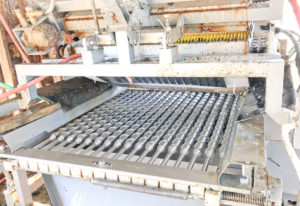
Once stripped, the mussels go up a conveyor belt to a brush declumper, a big machine with a series of rollers and stiff bristles that appear to gobble up the black shells. In fact, these bristles are helping to break up clusters of mussels and remove barnacles, seaweed and other organisms such as sea squirts that can attach themselves to the mussels and the rope. Someone stationed above the “mouth” of this machine physically pushes the mussels into the narrow gaps of the bristled rollers. It’s a physically taxing process.

The mussels that come out of the first section of that machine are relatively clean. They are dropped onto a grader, which has another system of adjacent rollers with spirals, like giant screws, that are closely spaced. This array weeds out the mussels Moretti and his crew deem too small for market size. As the screws turn, the smaller mussels slip through the cracks onto a chute and into a waiting bin to be re-seeded onto ropes and dropped back into the water to grow.

Market size mussels feed out into another bin that is dragged to the boat and packed in ice in huge totes arranged on the boat deck. Someone stands near the area where the market size mussels arrive and sorts through any remaining clumps held together by seaweed and their beards.

The declumper at the top of the photo uses yellow bristled rollers to separate and clean mussels before depositing them on the grader, which separates the market-sized product from the soon-to-be-re-seeded.

We processed about 2400 pounds of mussels (about average for this time of year) in a little over three hours. I was pretty damn happy to sit down and eat lunch … at 10:30 a.m. I felt satisfied with the teamwork involved in a surprisingly smooth and efficient operation considering the task at hand. Everyone had a role, and rotated around a bit to help each other. And the crew patiently coached me on technique and timing.

Measuring up

After lunch, we began re-seeding the ropes with mussels that were too small. I say too small – we returned mussels averaging just a little over two inches in length on the long edge – even though I’ve been served Canadian mussels that size in New England restaurants.

Getting mussels back on a rope and into the water is an intricate process aided by a machine that looks like a product of Jules Verne’s imagination. Called the seeder, or socking machine, this contraption draws clean rope through a type of snare where the mussels are dropped from a hopper onto the rope and enclosed by a thin cotton mesh that wraps the mussels like a sock. This sock will hold the mussels in place until they attach to the rope, before the net naturally biodegrades.

It’s a bit of a painstaking process in that you want to ensure the mesh goes on properly and ties off the mussels so they stay on the rope. We loaded several ropes back onto the raft.

The seeder, or socking machine in action. Not quite ready for prime time, these mussels need a little more time “on the vine” to get to Bangs Island size. (Turn up the volume).

Quality is everything

Next we took water samples for the state Division of Marine Resources to check the level of nutrients and toxins in the water. These tests, and direct mussel samples, are frequent, and ensure the safety of the mussels that go to market.

Back at the Maine Wharf, the mussels were hoisted off the boat with a powerful hydraulic lift, and brought into the warehouse where a team waited to do final sorting, grading, cleaning and bagging for market. As with the harvest operation, the final steps toward market readiness are meticulous.

Bangs Island has a reputation among chefs and foodies for big meats. That is, not only are the shells generally bigger than most other mussels on the market, but the meat inside them is bigger too.

Having opted for Bangs Island’s harvest for over a decade in restaurants and my home cooking (an excellent addition to gumbo!), it was with a deeper appreciation the next day as I set out to cook a couple pounds for my family. Harvested with my own hands not far from where I live, with a very coordinated process rooted in getting the details right, these mussels drove home one of my classroom and restaurant mantras: Know your seafood. Know your fisherman, or seafood producer.

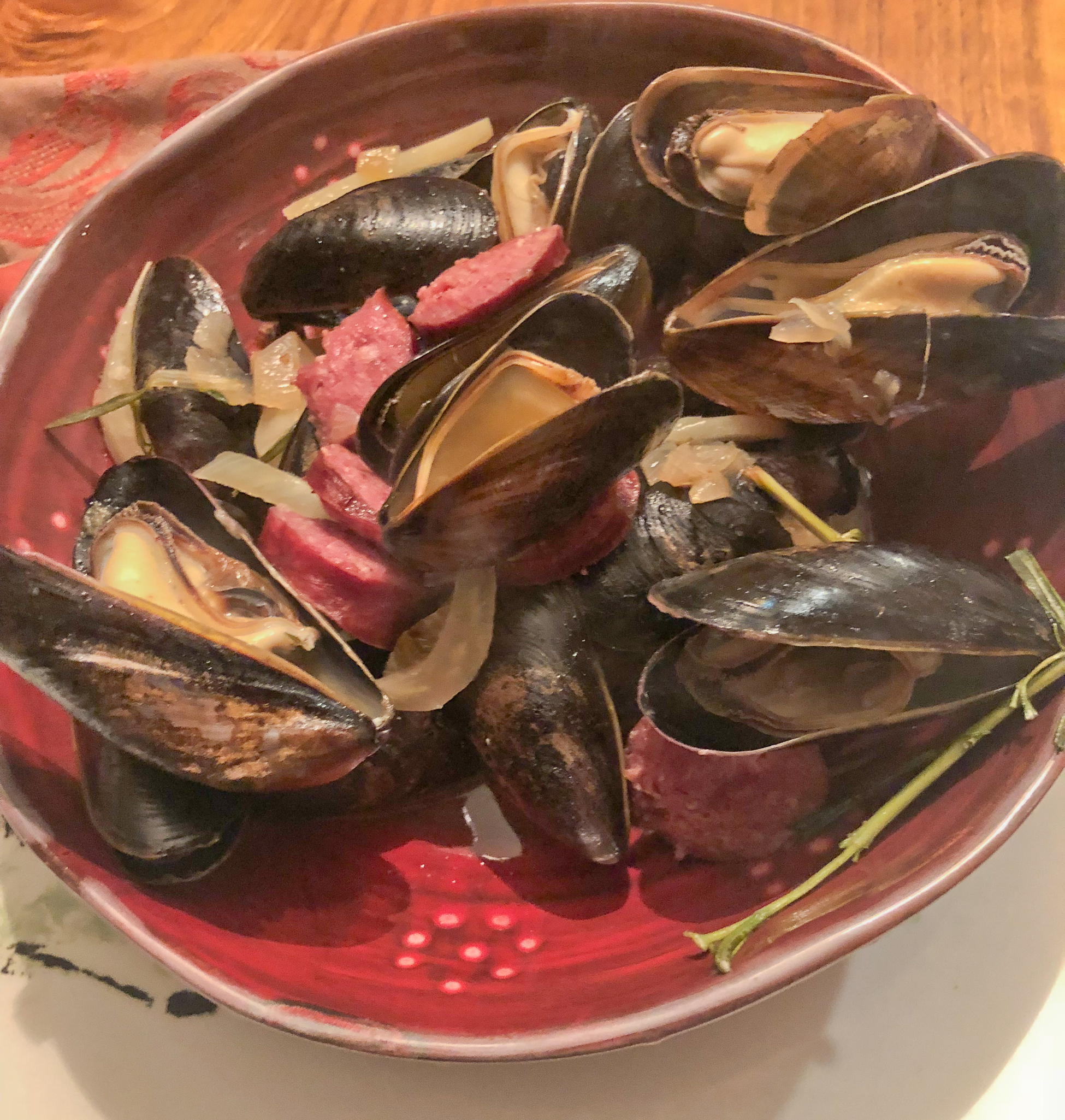
The fruits of spending a chilly day on the water. Follow this link to a recipe for mussels San Remo from my friend Chef Rob Martin at 1652 Restaurant in York, Maine.


Thanks to Matt Moretti and my crew mates John, Zack and Ben for welcoming me aboard and teaching me the ropes! It was worth muddying my new Grundens on that chilly morning to build a valuable experience that I’ll share in classrooms and restaurants.


All Blog Posts

One Seafood Conversation at a Time

  • November 14, 2018October 20, 2021
  • by Colles Stowell
Share it!
Share

One conversation at a time. That’s been my mantra for changing the seafood purchasing dynamic in the U.S. Whether I’m speaking with a 76-year-old retiree sporting a blue blazer, a group of AP Environmental Sciences students or a cluster of six-year-olds anxious to get their hands on some live green crabs.

The question comes up occasionally. “How do you keep your content fresh?” It’s a good question. A lot of the eye-popping statistics don’t move much year after year. More than 50% of the seafood we eat is farm raised, and 90% of the shrimp we eat is farm raised. The fact remains, sadly, that at least 90% of the seafood we eat here is imported. Some argue the percentage is actually 91 or 94. Either way, the number has not gone down, and it isn’t likely to change substantially in the next few years unless we have some significant policy changes.

For me, it’s not the numbers that change so much. It’s the people I’m speaking with that change. I want to democratize the message. Reach as many people as I can. Tell them the story. Answer their questions. And hopefully convince them to take those messages with them so they change their buying habits and spread the word.

Each new face or group of faces is an opportunity to spread that message. And I’ve found the most effective way to ensure the message resonates is to adapt the way I tell the story to the audience. So the method of the story telling changes too.

This varies dramatically between classrooms by age and subject and also between different restaurant demographics I may be engaging. I look at each new “audience” and venue as a challenge. How do I connect? How do I engage? How do I get them to own the conversation so they own their next seafood decision?

Rye Elementary fifth graders catching on quick that they have the power to ask smart seafood questions at restaurants and stores. Photo credit: Jennifer Halstead

I thought of these questions, as I always do, prior to a couple of school visits last month. Part of my preparation involves strategizing with the teacher beforehand about where the students are in their curriculum and what messaging would best fit with what they’ve learned or with what they will learn.

I’ve established relationships with several teachers who know what to expect. I still check in with them beforehand to make sure there aren’t any new messages they want me to introduce, or advise them of some new content or props (live mackerel, gear, etc.) One of these teachers is Doris Gianforte, a 5th grade science teacher at Rye Elementary School in New Hampshire.

As usual, when I met with her students, they were well prepared. They wanted to know more about why we import so much seafood, and why green crabs are such ecological monsters on this side of the Atlantic, and not in Europe. They couldn’t wait until they had the opportunity to ask questions at a restaurant.

Prior to my visit with 7th grade students at Harpswell Coastal Academy in Maine, I had a good discussion with their teacher Sarah Crockett. We talked about how they were in the middle of field lab work on green crabs in conjunction with an education program at Gulf of Maine Research Institute.

So we discussed introducing green crabs as a climate change marker, one that has implications for local ecosystems and shifting predator/prey relationships.

These students were also very well prepared, accurately talking about when and how European green crabs were introduced in US waters, what they like to eat and why they’re so destructive.

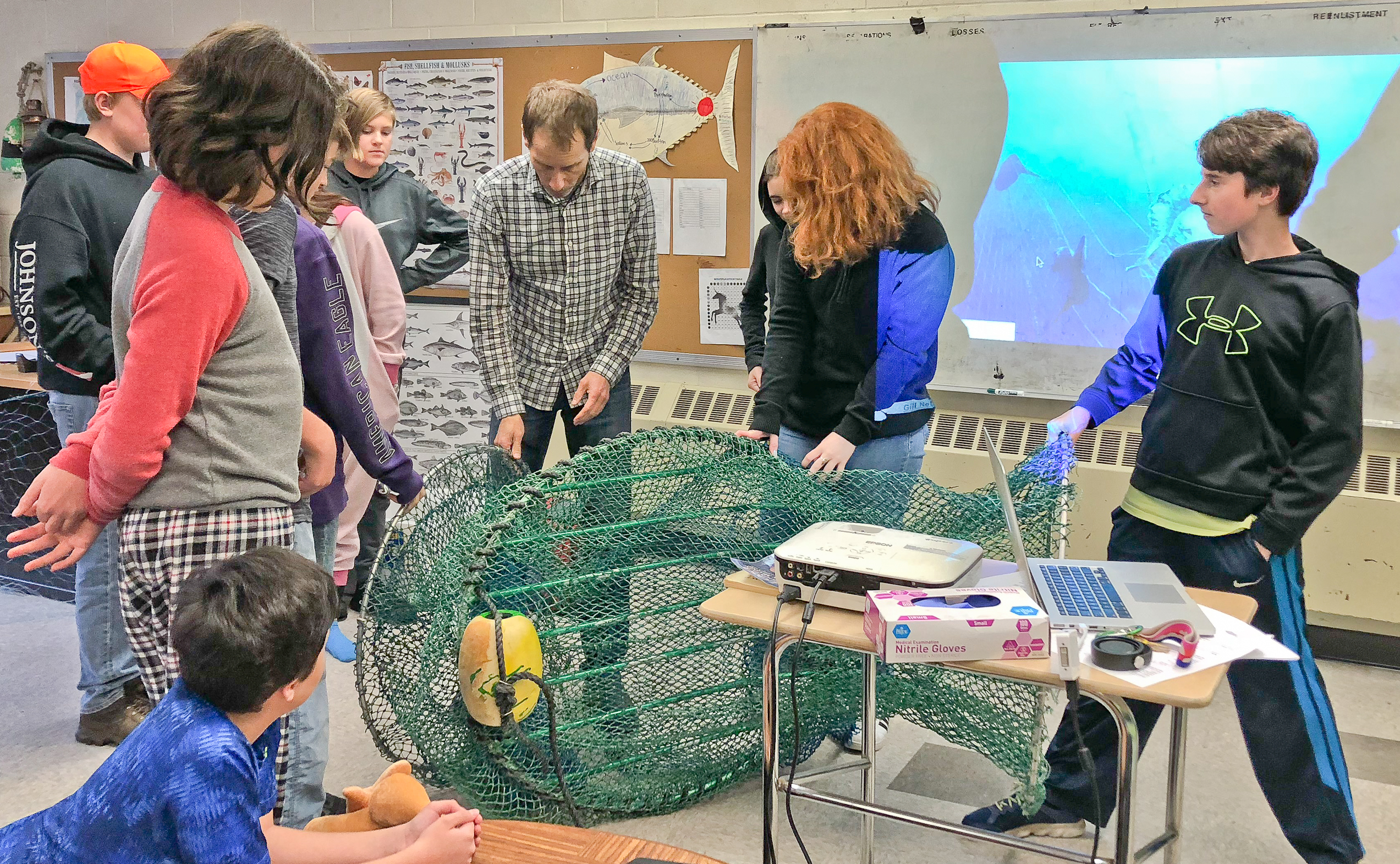
Harpswell Coastal Academy students learning about some measures to reduce gill net bycatch such as shorter soak times and acoustic pingers emitting signals to ward off marine mammals. Guess who didn’t get the memo about “Pajama Day.” Damn! Photo: Sarah Crockett

Students asked great questions about what fishermen and researchers are doing to minimize bycatch associated with different gear types. Like most students, getting their hands on some trawl net and a turtle excluder device helped them better understand efforts to reduce turtle bycatch in the Gulf of Mexico shrimp fishery as well as other fisheries.

These types of connections give me hope that change, real fundamental change, lies within the possibilities and ideas sparked by these conversations.

Even if it’s one at a time.


Top Photo: Harpswell Coastal Academy 7th graders getting their TED (turtle excluder device) talk on. Credit: Sarah Crockett


All Blog Posts

Attack of the Tiny Green Crabs

  • June 26, 2018October 20, 2021
  • by Colles Stowell
Share it!
Share

I geeked out at the Green Crab Summit in Portland earlier this month. Which is kind of ironic given that I double majored in English and French in college. I’ve always had a fascination with life in the oceans … just not enough to want to embrace organic chemistry in college or graduate work.

I parlayed my majors into a writing career that often drew on investigation to dig deeper into newspaper and magazine stories. The European Green Crab story is compelling. It’s also emblematic of humankind’s ability to alter natural balances with long-term negative consequences.

We’re working to nail down the timing of European Green Crabs here in the states. These soft shells were a delicacy at Enoteca Athena in Brunswick, Me. Photo: Marissa McMahan.

Abundant in Spain, France, Italy and other European countries, the green crab is not the frighteningly destructive, ecosystem-tipping species that it is here in North America. Many predators there like fish, crabs and birds help keep green crab populations in check. And Italian fish harvesters and chefs have figured out how to create a market for soft-shell Mediterranean green crabs (a slightly different species than the crabs we have here), as well as a top-dollar market for green crab as bait.


That’s not the case on this side of the Atlantic. The crabs were first officially documented between New Jersey and Cape Cod in 1817 after presumably hitchhiking aboard trans-Atlantic ships in the ballast. Their spread up the coast was steady and relatively uninhibited. To be sure, some were gobbled up by native species here such as striped bass, tautog, lobster, blue claw crabs and other species. But they weren’t and aren’t the regular diet for native species here as in Europe, and therefore they continue to spread.

Different story for other invasives, though. We’re now finding that the newly invasive Asian Shore Crab (first noted in 1988) seems to be displacing and possibly preying upon green crabs, dropping their populations significantly along rocky intertidal zones in Southern New England and heading northward as the water warms. However, we’re kind of swapping out one pest for another.

Christopher Baillie of the Marine Science Center at Northeastern University said Asian Shore Crabs are “generalist eaters” that may have an appetite for many native species such as lobsters, Jonah crabs and molluscs. While there are some Asian Shore Crabs already in Maine, he said they may be up here in bigger numbers in the near future. That’s not good considering they’re rampant in southern New England, where they’ve changed ecosystem balance by dominating once diverse habitats, with densities of up to 200 crabs per square meter.

Tough little buggers

Green crabs are tough, voracious, fertile and very hardy. They can live for days out of water. One crab can eat up to 40 mussels a day and lay 165,000 eggs a year. They are adapting to winter, which seems to be changing their spawning habits. They decimate vital eel grass beds while rooting out mussels, oysters and soft shell clams.

It’s the soft shell clams that have suffered the most at the claws of the green crabs. Casco Bay has witnessed a 70% drop in soft shell clam populations in the past decade. Maine’s landings have dropped from 8 million pounds in the 1970s to 1.5 million in 2016. Recent studies suggest that without significant steps to protect larval clams, 99% of the settling clams (the larval and growing stage molluscs) will fall to predation, and much of that comes from green crabs. Milky ribbon worms have also become a big problem.

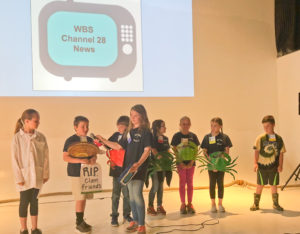
The news was even bleak on the West Bath School Channel 28 News, as students showcased what they’ve learned about green crabs…that they’re devastating to soft shell clams.

Adaptation will be central to protecting the soft shell clam industry and co-existing with green crabs, according to several researchers at the summit. As Sara Randall of the Downeast Institute put it, “We have to think of green crabs as a permanent part of our ecosystem. We need to be active, not passive.” Sara was part of a team of researchers that sifted through more than 34 tons of mud in a four-year study to determine what’s happening with soft shell clams and devise strategies such as protecting larval clams in screened boxes in tidal flats that would keep out green crabs.

However, as with everything concerning green crabs, it’s not that easy. Brian Beal has been studying green crabs and their impact on intertidal ecosystems for more than 30 years. A professor at the University of Maine at Machias, Brian has been outspoken about adapting to the new reality of green crabs and their impacts. “Population control is unlikely and impractical. They can’t be fished out,” he said, explaining that we’re talking about billions of organisms based on several trapping studies throughout the Gulf of Maine.

Commercial fisherman Jamie Bassett showing West Bath School students how to extract crab roe.

Green crab bisque, anyone?

One of the common discussion threads was finding ways to make humans the alpha green crab predator. How can we create culinary markets to make green crabs an attractive seafood choice? Again, it’s not so simple. First, their size means there’s little meat yield. And they’re built like tanks, so there’s a bunch of effort to get a small portion of meat.

Second, we Americans have a track record of following habit and price when making seafood decisions. This explains in part why 90% of the seafood we eat is imported. It’s cheaper and hews to menu selection we are most familiar with. Shrimp, salmon, tuna, etc. Collectively, we aren’t adventurous, and so, since we haven’t been eating green crabs for centuries, as they have in Italy (again the slightly different Mediterranean green crab), creating the marketing campaign to get us to start eating vast quantities of green crabs is a hard sell.

Chef Ali Waks-Adams laid down some green crab rangoon.

I know several chefs in coastal Maine and New Hampshire who are ready and willing to give it a go. Soft shell, stock, mixed in to other dishes. For example, at the event, Chef Ali Waks-Adams (executive chef at the Brunswick Inn) prepared delicious green crab Rangoon using mince (crabs that have been finely ground up, shell and all into a flavorful paste). She also demonstrated how to fry up the small crabs in a batter and eat them like popcorn. Chef Matt Louis (executive chef/owner of Moxy and The Franklin in Portsmouth, NH) created an inventive green crab pozoles dish and a delicately flavored green crab arancini. All of the food we sampled showed the tasty possibilities.

Chef Matt Louis using green crab for a pozoles, a traditional Mexican stew with hominy.

We still have a bit of research to do to nail down the soft shell season for green crabs. That’s because we don’t have the centuries of research the Italians do, and because the green crabs here seem to be adapting to the warming waters of the Gulf of Maine, which seems to be changing when they molt, or shed their old shells. Also, it’s easier to identify pre-molt Mediterranean green crabs than the species in the U.S.

Adapt or get run over

But even if we do create a viable market, we aren’t likely to make a huge dent in the green crab population. “The variability in density and mean size [of the crabs] will make it difficult to create a dependable fishery,” said Beal.

He also dropped another theory that raised several eyebrows. Clams aren’t just worried about the typically sized 3-inch or bigger crabs, but the 3 millimeter crabs feasting on clams that are half a millimeter in width. And it’s going to be damn hard to do much about those little s—s.

Beal agreed with others that adaption will be key, and we’re going to have to make some dramatic changes to the soft shell clam industry if we want to protect it. Some of his suggestions included increasing the amount of clam farming that now occurs, changing the size limit on clams to allow for the prime breeders to reproduce, and closing certain areas along the coast from May to July to allow for more productive spawning.

Some of the green crab brain trust discussing policy and other issues and how we need to continue to research and collaborate to better adapt to the new reality of Carcinus maenus.

We heard about one success in green crab mitigation in Canada from Gabrielle Beaulieu of Kejimkuik National Park Seaside Parks in Nova Scotia. She explained how a team of staff and citizen scientists harvested more than 2 million green crabs over a 10-year period. Following the intensive trapping and removal of the crabs, researchers noticed significant gains in eel grass recovery (in areas that crabs had mowed down) and soft shell clam populations.

Green crabs pose a significant threat to several commercially vital species in the Gulf of Maine. I agree with Brian Beale that putting a bounty on green crabs alone isn’t going to make a huge dent. However, I agree with others at the conference that we’re going to have to adapt, and implement a multi-pronged approach to mitigate the challenges. We’ll need to have some widespread harvest/green-crab-as-food markets opened up, along with raising public awareness both about the ecological threat and the culinary benefits of green crabs. We’re also going to have to take some significant steps as Brian mentioned to safeguard species like soft shell clams.

And yes, we need to devote more time, effort and financial resources to figuring out how to address this problem, and the looming time bomb of the Asian Shore Crabs. Knowledge is power … In this case, the power to adapt, rather than be overrun.


All Blog Posts

What It Means To Be Local

  • June 16, 2018October 20, 2021
  • by Colles Stowell
Share it!
Share

Update as of 4:45 p.m. 6-17-18:

Adding a link to the latest response from Sea To Table Founder Sean Dimmin to the AP story. In the response, he goes on the defensive, calling out “numerous misstatements and false allegations,” alluding to shoddy or incomplete reporting. Dimin points out instances where the reporting does seem to leave a bit of detail and process open to question. He also admits Sea To Table could have better communicated with its suppliers (in particular, Gosman’s) and with its customers.

That’s all fine. He’s saying the right things for someone in his predicament. But I don’t think the conversation should end there. Those in the domestic seafood industry, and those who promote it, face a steep challenge. Trust is absolutely essential to trying to convince even small percentages of US consumers to get seafood smart and buy domestically. The original premise behind Sea To Table or any similar minded operation is to promote local seafood, fishermen and waterfronts, often regardless of customer geography. So even if lapses in communication to customers or partners that led to  mislabeling, etc., are the only truly valid mistakes made, we need to be having this conversation. As we’re trying to limit the more than 1.5 million tons of cheap, imported farmed shrimp (among other unsustainably harvested species) flooding markets in this country every year, we need to be honest and forthright.

I do not agree with some who claim the negative attention and likely serious sales hit to Sea To Table is just desserts and the company should go away. I think these communications issues don’t rest with Sea To Table alone in the industry. It’s a tough, and generally laudable mission these companies try to accomplish. But I also don’t think we can make excuses for those whose lapses could set the entire movement back by calling trust in domestic seafood systems into question. We need to have these conversations, find solutions and move forward to turn that 90% domestic import figure around.


It all comes down to trust … and relationships.

This week’s news that one of the rising stars of the locally sourced, sustainable seafood movement may have been selling seafood that wasn’t local, may have been mislabeled and was possibly linked to slave labor in other countries sent shock waves through the industry.

Brooklyn-based Sea To Table has built quite a following with its promise of sustainable, traceable, domestically harvested wild seafood delivered to your doorstep. Clients included celebrity chefs like Rick Bayless national food chains such as Chopt Creative Salad, a bunch of universities like Yale, eateries at the Empire State Building and Chicago O’Hare airport and the home meal kit provider Hello Fresh. It can be found in almost every state.

But an Associated Press report issued earlier this week shed light on some of the issues that can arise with this boat-to-table model and the temptation of entrepreneurs to co-opt, then sweep aside the spirit and intent of terms such as “sustainable seafood” and “local.”

The colossal irony being that they may be knowingly or unknowingly violating the principles they promote, all in an attempt to bring clarity and trust to what Sea to Table Founder Sean Dimin calls “the historically opaque seafood industry.” The Sea To Table business model is to work with some 60 “local” fishermen and fishing operations/distributors to source “traceable” seafood from around the country.

The AP report outlines a lengthy investigation uncovering a slew of allegations that run headlong into the company’s  mission statement. For example, promoting fresh, locally caught yellow fin tuna in the winter off New York, when the migration south occurred several months beforehand and no local fishermen had been out. Or charges that some of the seafood Sea to Table sold was in fact imported and linked to Indonesian operations with a history of labor abuse. Other charges included selling farm-raised seafood despite the wild-only claim.

So yes, this was big news in that it surprised many in the industry. It will also raise lots of questions, piss some people off and confuse the hell out of consumers. What are they supposed to do to be sure they are buying local, sustainable seafood?

Dimin is correct in that the seafood industry is indeed opaque. There are few places that have completely transparent supply chains. Consider that seafood travels more than 5,000 miles on average from boat to plate in this country, often changing hands at least seven times.

The AP report is informative and sad, but it isn’t really broaching any new allegations about industry practices. Check out this exhaustive AP report on slave labor linked to imported seafood. The fact we import 90% of the seafood we eat just means more of the seafood consumed in the U.S. may be linked to brutal labor practices.

But the issue of trust and misrepresentation goes beyond just the seafood industry. The whole concept of questionable food sourcing and marketing practices isn’t new. For example, the Tampa Bay Times ran a series in 2016 about the farm-to-table movement, and how many restaurants and purveyors were glazing over, and sometimes outright lying about the provenance of their food.

What is local?

All of this goes back to a discussion I had this week with Josh Stoll, a research professor at the University of Maine and a co-founder of Local Catch, an organization that promotes community-supported fisheries and other direct-to-consumer operations aimed at bringing people closer to their seafood.

We discussed how the Sea to Table news raises the very valid question of how to define “local” and how to re-build consumer trust. Josh spends much of his time working to streamline and improve community-based fisheries governance for the benefit of fishermen, their communities and consumers.

“The definition of ‘local’ is evolving,” he said. “It’s less about geography and more about relationships.”

He’s exactly right. Just as the terms “organic” and “sustainable” have been stripped of their original intents by overuse and bastardization of meaning, “local” without valid context has become vapid marketing speak. It could mean so many things and nothing at all if there is no valid context to support its use.

Case in point: Sea To Table uses “local” in the first sentence of its mission statement to showcase the quality of the seafood it sources. Now, regardless of whether the company knowingly misled customers, it has much work to do to re-establish credibility. Dimin and his crew can’t just plead that they are still offering “local” seafood. They have to earn back that trust.

How? By going back to the basic mission and working to repair the relationships that the company was built on. Not an easy task.

When I host KNOW FISH Dinners® and invite people to talk to the fish harvester who caught the fish they are eating, I’m creating a direct link to the food producer that more often than not remains a mystery in this “opaque” industry. I tell people I want them to think about their next seafood purchase the same way they think about buying eggs or produce from a farmer at a farmer’s market.

Those are the kinds of relationships that define “local” for me.

Know your seafood, know your provider

So, say you live in Kansas. You probably don’t live next door to a commercial fish harvester. This is where enterprises like Sea To Table have begun to fill the void. The problem arises when customers take the “local” claim on faith without establishing some kind of relationship with the provider. If they get to know the provider, even if the provider is a distributor with direct links to the fish harvester, they get a better sense of the values and ethics used by the provider to promote their product. They should also be able to get the story of the fish harvester as well. Same goes for distributors like Sea To Table. They need to build solid relationships with the fish harvesters and docks providing the seafood to ensure they hew closely to strict guidelines.

That’s how you build trust. The AP story calls the latter point about Sea To Table’s supplier relationships into question.

Sure there are situations when establishing that level of trust isn’t possible. But one of the key points I make with folks is that knowledge really is power. Consumers fare much better ensuring the quality and provenance of the seafood they purchase when they get smart about what is locally and seasonally available, who has the best product, and who is trustworthy. This all takes time.

But it’s worth it.

Owning the relationship

Can things still go awry? Absolutely. Sea To Table is the proof. I’m not sure I believe this was a wholesale willful violation of trust. Read Sean Dimin’s first letter in response to the AP story. As I said, there are no new revelations in the news story about what happens in the industry. And Sea To Table has much work to do to repair its reputation. More so now that Sen. Edward Markey has asked NOAA and the Federal Trade Commission in a letter to investigate the claims against Sea To Table.

The situation underscores the fact there are many gray areas in domestic food systems. But it also reinforces the notion that people should take more ownership of their seafood purchases. Again, it’s all about relationships. We talk about the relationship people have to the seafood they eat during these hosted KNOW FISH Dinners. Their (our) choices have an impact on the resource, the fish harvester and the community. Getting closer to the source, even if that closeness is more relational than geographic, will minimize the risk of being misled.

That 90% import statistic won’t change unless we build, strengthen and multiply these very important relationships.

Check out the Local Catch website as it is a good resource for finding responsibly harvested seafood throughout the country. I believe there are several  operations who are delivering on their promise of responsibly harvested product. You can find some of them listed on the Local Catch website.

Also, stay tuned for more discussion about this topic. It is a fundamental reason for why we should care where, when, how and by whom our seafood was harvested.

If you’d like additional perspective, read Paul Greenberg’s take on the situation here.


Photo courtesy of New England Fishmongers

All Blog Posts

Students Teaching Students

  • May 24, 2018October 20, 2021
  • by Colles Stowell
Share it!
Share

Last week, One Fish Foundation visited Portland High School for the third year in a row to discuss seafood sustainability with seniors taking a Marine Sciences course. Intern Jennifer Halstead, a senior at the University of New Hampshire, adeptly presented a clear, concise and digestible explanation of ocean acidification and how it is affecting cornerstone Gulf of Maine species like lobster and mussels. In this guest blog, Jennifer discusses the importance of taking advantage of opportunities to speak to students and community members about ocean acidification, other challenges our oceans face with climate change, and why we all need to be involved.

By Jennifer Halstead

Speaking to a crowd of people, no matter the size or demographic, can be at once daunting and rewarding, especially for a college student. Truly. It’s empowering to have people listen to your words. It’s uplifting to have them ask questions and even challenge your ideas.

Talking to a small class of students at Portland High School last week was no different. Ocean acidification (OA) is something that’s not easy to wrap your head around, but these students understood the urgency related to the issue. If at least one of them continues to ask questions and be curious, I feel as though I did my job.

Sadly, we don’t know how acidification is going to impact lobsters, one of the most important economic industries in Maine (the entire industry, including the supply chain is valued at over $1 billion). [Lobster harvests already face threats from the rapidly warming Gulf of Maine. A recent study suggests the lobster harvest could decline by as much as 62% by 2050 if the Gulf of Maine keeps warming at its current pace].

As concerned citizens and scientists, we need to start asking more questions and demanding more answers. And that is how we create change. The power is in your hands – our hands – to save oceans and our beloved lobster rolls.

I’ve spent a good portion of my college career learning about OA. Unfortunately, while our understanding of the impacts of OA is growing, OA is occurring more rapidly than we can keep up with in some places, including the Gulf of Maine. The West Coast has dealt with OA fallout, such as steep declines in oyster hatchery production in 2005, which threatened economics and 130 years of oyster hatchery history. In the Gulf of Maine, we haven’t seen complete devastation yet, but top scientists fear that it’s coming, and so do I.

Part of Jennifer’s research on OA: a type of sea snail on the left, and blue mussel on the right. Both the sea snail and the half mussel shell you can almost see through (on the right) were exposed to acidic water. Increased acidity in the ocean weakens many shellfish’s capabilities to calcify their shells and protect themselves from disease. Credit: Jennifer Halstead.

We understand climate change impacts like OA, temperature, salinity, and currents, but not the details of how they interact and impact different species. We don’t understand the entire system. We only understand the pieces. Imagine trying to put a puzzle together with no idea what the end result is supposed to look like. That’s the immense challenge of trying to understand climate change impacts here in the Gulf of Maine and elsewhere; things are happening now that we won’t fully realize for several months, or even years.

To move forward and get research to catch up with the changes in the Gulf of Maine, we need the public’s interest and support. We need people to ask questions and demand answers. Spreading the word about these issues through presentations and hands-on demonstrations is a key piece to garnering support for these causes. Every time I stand in front of a group of people and talk to them about acidification, I can see us moving forward. Future generations are interested in problems, but even more interested in pushing for solutions.

As a college student, I often get asked where I see myself in 5 years, or what I want to do after I graduate. My broad answer is that I hope to be doing something to change the world for the better. To do that, I’ll keep standing in front of crowds of people, telling them about problems our oceans face, and asking for their help in saving them.

Posts pagination

1 2 3 4 … 9

Recent Posts

  • Hurricane Ida wreaks havoc on Louisiana’s seafood industry
  • EPA Should Use Clean Water Act To Kill Zombie Mine
  • Slow Fish 2021: Relationship Matters
  • Faith, Façades, and Futility
  • Pebble Permit Paused: Politics at Play

Archives

  • September 2021
  • August 2021
  • April 2021
  • December 2020
  • August 2020
  • June 2020
  • February 2020
  • December 2019
  • November 2019
  • October 2019
  • July 2019
  • May 2019
  • April 2019
  • March 2019
  • January 2019
  • December 2018
  • November 2018
  • June 2018
  • May 2018
  • March 2018
  • February 2018
  • January 2018
  • December 2017
  • November 2017
  • October 2017
  • September 2017
  • August 2017
  • July 2017
  • June 2017
  • May 2017
  • April 2017
  • March 2017
  • January 2017
  • December 2016
  • November 2016
  • October 2016
  • September 2016
  • August 2016
  • July 2016
  • June 2016
  • May 2016
  • April 2016
  • March 2016
  • February 2016
  • January 2016
  • December 2015
  • November 2015
  • October 2015
  • September 2015
  • July 2015
  • June 2015
  • May 2015
  • April 2015
  • March 2015
  • February 2015
  • January 2015
Theme by Colorlib Powered by WordPress