Skip to content
One Fish Foundation
  • Blog
    • Aquaculture
    • Education
    • Environment
    • Policy
    • Wild Harvest
    • Fish Tales
  • About
    • About One Fish
    • About Colles Stowell
  • Education
    • Elementary School
    • Middle School
    • High School
  • KNOW FISH Dinners®
  • Resources
    • One Fish Podcast
    • One Fish Foundation in the news
    • The 7 C’s of Sustainable Seafood
    • Newsletter Archive
    • Recipes
      • Skate with Capers and Butter — Chef Rizwan Ahmed
      • Grandma Davis’ Fish Chowder — Jane Almeida
      • Ginger Garlic Tamari Scallops — Colles Stowell
      • Fish Stock — Evan Mallett
      • Mussels San Remo — Chef Rob Martin
      • Salted Pollock Croquettes – Chef Mark Segal
  • Connect
    • Contact OneFish
    • Social
      • Instagram
      • Facebook
      • Twitter
All Blog Posts

Sustainable Seafood: One Conversation at a Time

  • October 18, 2016October 20, 2021
  • by Colles Stowell
Share it!
Share

“We need to be having more of these conversations.”

Yes, we do.

The overriding dynamic we need to change in this country regarding seafood is this: more than 90% of the seafood we eat is imported. This is an oft-cited statistic that seems to raise eyebrows … then disappears into the ether as we go about our business.

That statistic doesn’t really begin to take on significant meaning for people until they see it in context and start connecting the dots as to why this is happening, and what we can do about it.

I launched One Fish Foundation to bring this message to schools and communities. I started the KNOW FISH dinner series with a great team to spark the type of community discussions that get people to ask questions, seek answers and understand they have an impact, however small, on the resource. Hopefully, their decisions and their understanding can spark other conversations and even, dare I say it, start a groundswell.
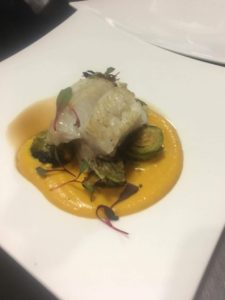
kfwpfpollock
Pan-seared pollock from the F/V Finlander

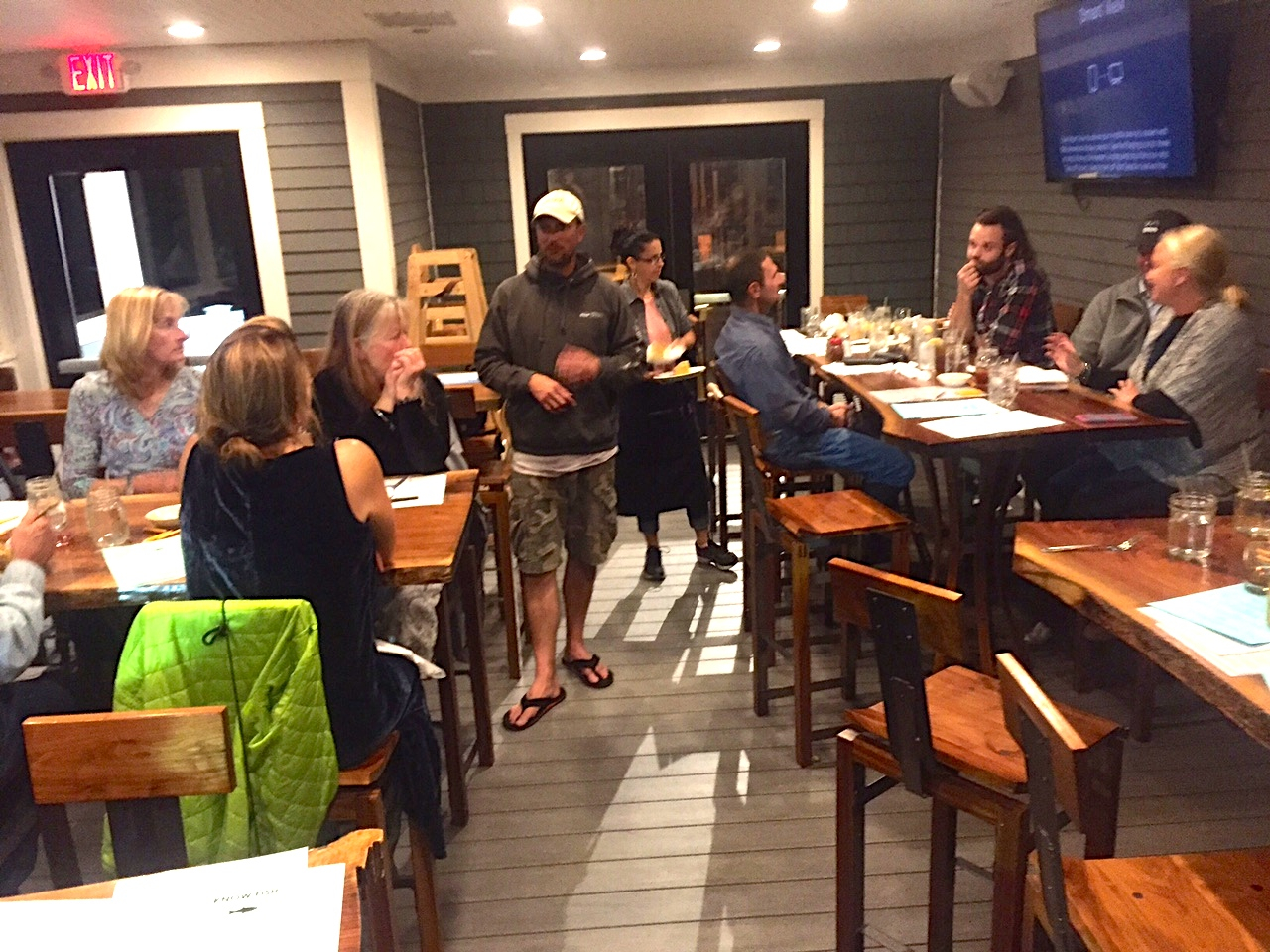
Thus, the first KNOW FISH dinner held last week at When Pigs Fly in Kittery was a success. Attendees sat next to fishermen, fishmongers and activists and asked questions. They discussed the domestic seafood picture and why we should care when, where, how and importantly, by whom our seafood is harvested.

They heard from Capt. Tim Rider, of the F/V Finlander and New England Fishmongers about how small-scale New England fishermen are getting squeezed out by unfair regulations and big operations with deep pockets. They learned what questions to ask and how to get smarter about the choices they make. They learned from Spencer Montgomery of Dole & Bailey and New England Fishmongers why it’s important to shorten the supply chain and buy locally caught seafood. He told them some signs to look for to tell if a fish has been sitting around too long.

They learned interesting trivia about New England and its fisheries. They learned how climate change is impacting the Gulf of Maine.
kfwpfsausage
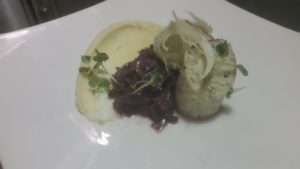
Unbelievably delicious cusk (local, abundant) sausage from M/V Finlander.

And Chef Robert Martin put on a feast: delicious cusk sausage (trust me here!), pan-seared pollock, and roast cod (all fresh caught and graciously donated by Capt. Rider) and accompanied by tasty, artfully presented seasonal vegetables.

I was encouraged with the comment above and others like it as departing attendees expressed a new perspective and perhaps reflected even a bit of my enthusiasm for sharing the sustainable seafood message. Our decisions make a difference.

Perhaps if we keep having these discussions, that 90% statistic will become a distant memory and the narrative will shift to one of widespread support for domestic, local, sustainable fisheries. One conversation at a time.

The next will be the KNOW FISH dinner on Oct. 27 at Black Trumpet in Portsmouth. Get tickets here.

Come join the conversation … and the feast.
All Blog Posts

What’s in This Fish?

  • October 3, 2016October 20, 2021
  • by Colles Stowell
Share it!
Share

I was sitting at a quiet sushi bar in Wilmington, N.C. at lunchtime a few years ago when the owner asked me a question that would have a lasting impact.

“Want to try some special tuna? It’s called white tuna.” This was several years ago, and I hadn’t yet delved into the world of seafood awareness. But I knew just enough to be sure there was no such species swimming in the ocean. When I asked exactly what species it was, he said it was escolar. “It’s just as delicious as tuna, but much cheaper.”

My skepticism gave way to curiosity, which gave way to the first lasting impact of gastrointestinal distress. Only later did I find out escolar has proteins that can wreak havoc on your bowels.

Deceptive marketing is nothing new. But I had to ask why someone would take that approach knowing the downstream impact. I wondered how someone could get away with that. Eventually the ramifications would catch up to them, right?

Ecolabeling’s initial steps

This was one of the seminal episodes that started me on my path. A year later, I wrote a blog on eco-labeling, suggesting it was a new tool to provide necessary information to consumers, like where and how the seafood was caught. Then I dug a bit deeper to find that while the practice was great in principal, there were issues.

Some leading labels ran into problems, such as certifying fisheries that weren’t really sustainable (see North Atlantic longline swordfish and its huge bycatch), or allowing fisheries to hire the “third-party” certifiers (the fox minding the henhouse).

I have written and spoken about seafood fraud several times since. It is a key classroom topic exemplifying the need to be smarter about the seafood we eat. We talk about the implications when someone substitutes cheaper farmed salmon for wild-caught at a restaurant or lower-priced pollock for cod at a seafood store.

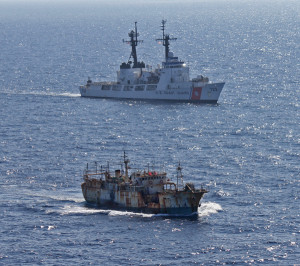
iuu_coastguard
Illegal, unreported and unregulated fishing clouds the supply chain.

Trailing the pack

One outcome from the most recent seafood fraud report by ocean conservancy Oceana is that while the U.S. is a leader in stock management and preservation, its oversight of the supply chain compared to the European Union and other countries is wanting.

This is ironic. The current administration has made combating illegal, unreported and unregulated (IUU) fishing a priority. Global IUU – which covers everything from human trafficking to mislabeling – costs the seafood industry up to $23 billion a year, according to the United Nations Food and Agriculture Organization. There is a new rule under consideration in the U.S. that would require labeling on 13 key species before they are imported into the country.

But the current administration also embraces the Trans Pacific Partnership, a trade deal that would essentially encourage larger exports of U.S. caught seafood and larger imports of cheaper, less regulated seafood. Many in the U.S. industry fear such a deal would flood the market with lower quality seafood that may not even be correctly labeled. Worse, language in the deal would render the U.S. virtually helpless to prevent that product from entering the market.

The Oceana report cites the European Union’s labeling standard as a potential role model for the U.S. According to Kimberly Warner, one of the report’s authors, the EU has reduced its seafood mislabeling to about 9% of the seafood sold there (excluding restaurants). This compares with 19% for the global average and a whopping 28% for the U.S.dna-sampling-2

“When we found fraud at 18% at the retail level in stores in Boston (in 2014), people were cheering,” said Warner. “But people in the EU were aghast. The question becomes, what level of mislabeling are you comfortable with?”

Indeed.

I’ve said before that increased transparency and labeling standards will only work if US fishermen have a say in developing the process and they aren’t completely saddled with the cost. Otherwise, any such proposal will fail before it gets started.

The National Fisheries Institute says better enforcement of the laws on the books, not increased labeling standards is the answer. But Warner counters that domestic laws leave a lot of room for the type of mislabeling found in the report. “You need strong laws to enforce,” she said. Vague or voluntary labeling (as has been discussed with genetically engineered salmon) don’t help.

Consumers want more info

Oceana released a poll yesterday that says 83% of Americans support new traceability requirements, including proper labeling of the seafood and where and how it was caught (or farmed). Of the 1,000 respondents, 76% said they would pay more to know their seafood was caught legally and labeled correctly and honestly.

Consumer desire is there. But we need the political will to make it happen. The EU program relies mostly on government subsidies as well as some infrastructure costs born by seafood processors. The EU seafood processors and traders association said in 2011 that implementing the new rules governing labeling and other IUU measures did not have long-term impacts on their businesses. And several links in the supply chain now view labeling as a competitive advantage.

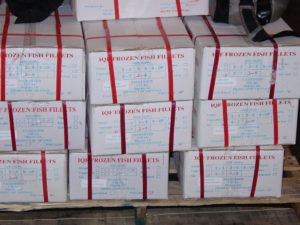
catfish-mislabel
Imported catfish marked as sole. This shipment was seized before entering U.S. markets.

A handful of small operations have cropped up in the U.S. aimed at digitizing supply chain records to elevate transparency. That’s a start. But, we need to bring all stakeholders to the table and make transparency and adequate labeling happen on a national scale. Otherwise, it’s just a process of randomly putting out small fires.

Our best defense is information. A national, verifiable schema for tracing the seafood from boat to retailer, and developed with fishermen’s input, would be helpful and widely embraced by consumers.


Photo credits: NOAA

Recent Posts

  • Hurricane Ida wreaks havoc on Louisiana’s seafood industry
  • EPA Should Use Clean Water Act To Kill Zombie Mine
  • Slow Fish 2021: Relationship Matters
  • Faith, Façades, and Futility
  • Pebble Permit Paused: Politics at Play

Archives

  • September 2021
  • August 2021
  • April 2021
  • December 2020
  • August 2020
  • June 2020
  • February 2020
  • December 2019
  • November 2019
  • October 2019
  • July 2019
  • May 2019
  • April 2019
  • March 2019
  • January 2019
  • December 2018
  • November 2018
  • June 2018
  • May 2018
  • March 2018
  • February 2018
  • January 2018
  • December 2017
  • November 2017
  • October 2017
  • September 2017
  • August 2017
  • July 2017
  • June 2017
  • May 2017
  • April 2017
  • March 2017
  • January 2017
  • December 2016
  • November 2016
  • October 2016
  • September 2016
  • August 2016
  • July 2016
  • June 2016
  • May 2016
  • April 2016
  • March 2016
  • February 2016
  • January 2016
  • December 2015
  • November 2015
  • October 2015
  • September 2015
  • July 2015
  • June 2015
  • May 2015
  • April 2015
  • March 2015
  • February 2015
  • January 2015
Theme by Colorlib Powered by WordPress