Skip to content
One Fish Foundation
  • Blog
    • Aquaculture
    • Education
    • Environment
    • Policy
    • Wild Harvest
    • Fish Tales
  • About
    • About One Fish
    • About Colles Stowell
  • Education
    • Elementary School
    • Middle School
    • High School
  • KNOW FISH Dinners®
  • Resources
    • One Fish Podcast
    • One Fish Foundation in the news
    • The 7 C’s of Sustainable Seafood
    • Newsletter Archive
    • Recipes
      • Skate with Capers and Butter — Chef Rizwan Ahmed
      • Grandma Davis’ Fish Chowder — Jane Almeida
      • Ginger Garlic Tamari Scallops — Colles Stowell
      • Fish Stock — Evan Mallett
      • Mussels San Remo — Chef Rob Martin
      • Salted Pollock Croquettes – Chef Mark Segal
  • Connect
    • Contact OneFish
    • Social
      • Instagram
      • Facebook
      • Twitter
All Blog Posts

The Story of Seafood

  • May 25, 2017October 20, 2021
  • by Colles Stowell
Share it!
Share

There’s a fair amount of planning that goes into these KNOW FISH dinners. Working with fishermen and oystermen to provide product. Coordinating dates, menus, sales operations, space, staffing etc. with chefs. Logistics.

Despite all of this planning, sometimes things change last minute and you have to adapt. It’s an almost everyday occurrence in the restaurant industry, particularly when you strive to be farm- or boat-to-table.

And so I found myself shucking a few dozen oysters at Tinos Greek Kitchen less than an hour before guests were to arrive last night. As often happens, Mother Nature dictated a deadline change when it dumped heavy rain on Great Bay on the Piscataqua River over the weekend, forcing the state of New Hampshire to close the bay to shellfish harvesting the day before the event.

We scrambled to get some Gulf of Maine oysters, and processed them just in time for dinner. It became a great talking point about eating with the ecosystem (ie, adapting to what’s available and what Mother Nature allows). Fishing is no exception. Capt. Tim Rider of New England Fishmongers, who provided the fish for the dinner, will tell you change is a constant. He could find pollock in the same spot three days in a row in 300 feet of water 60 miles offshore. But on the fourth day, the wind is cranking at 30 knots with eight-foot swells and his boat, the F/V Finlander, stays docked. On the fifth day, the fish have moved out.
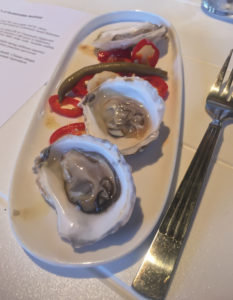
Snow Island Oysters, seeded in Quahog Bay off Harpswell, Maine to help clean the bay. Photo credit: Ed Marshall

Seafood stories

At the dinner, we discussed the importance of eating what’s locally available, abundant and in season. For example, squid are cruising in numbers in the Northeast Atlantic. Chef Mark Segal and his team prepared wood grilled squid (from the F/V Rimrack out of Rye, N.H.) with roasted eggplant, roasted red peppers, crispy smashed chickpeas, olives, pepperoncino, feta, egg breadcrumbs and green crab aqua pazzo. Fabulous. The plates went back to the kitchen scraped clean.
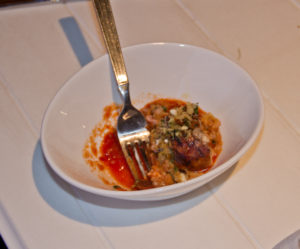
Stuffed local squid that didn’t last long in anyone’s dish. Photo credit: Mike McGrail

The menu itself testified to the narrative of eating what’s local and fresh. The fourth course was listed as “Local Whitefish al Forno” because Chef Mark prepared the menu not knowing which groundfish Capt. Tim would bring in that day. The pollock, which was fired to the perfect temperature, texture and taste, was served with finnan haddie (cold smoked Finlander haddock) risotto, English peas, fiddlehead ferns, and hen of the woods mushrooms. Stellar.
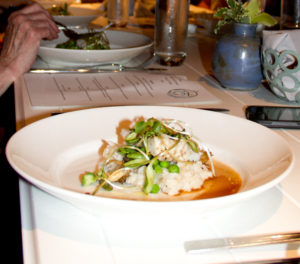
Fresh pollock al forno landed aboard the F/V Finlander. Photo credit: Mike McGrail

We discussed how every dish has a story, just as every piece of seafood we purchase has a story. The story tells where, when, how and by whom it was harvested. The question is whether we can get that story before we buy; whether we can believe that story; and what that story actually is. Because U.S. seafood consumption is so disproportionately skewed toward cheap imports (more than 90% of the total seafood consumed domestically), finding the truth behind the seafood requires vigilance from consumers. They have the right to find out these stories so they know what they’re eating.

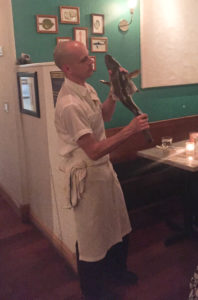
Capt. Tim rider displays a heavy jig and the type of fly used to catch groundfish, like the pollock on the menu. Photo credit: Ed Marshall

The Snow Island Oysters I helped shuck were from Quahog Bay in Harpswell. The Quahog Bay Conservancy seeded the oysters for aquaculture a few years back in an effort to help clean the bay. As filter feeders, oysters remove some of the excess particulate matter like plankton and nitrogen that could choke the bay with harmful algae if left unchecked.

Another course weaving in the local seafood narrative with a Greek twist featured Dolmades, grape leaves stuffed with Maine cultured mussels, golden raisins, red onion and served with saffron avgolemono (a Greek sauce featuring egg yolk, lemon and broth). Again, excellent Mediterranean flavors complementing Gulf of Maine seafood.

Rethinking seafood purchases

On the theme of adaptation, I urged attendees to re-think how they approach seafood purchases by taking a more active role in discovering the story behind the seafood. As with previous KNOW FISH dinners, we printed some sustainable seafood principles, called the 7 C’s of Sustainable Seafood, on the back of the menu. I encouraged them to take those concepts with them the next time they go to a seafood counter or a restaurant. Buying local is like making a covenant with local fishermen: “I trust you to provide good, sustainably harvested seafood. You trust me to pay a fair price.”
Capping the evening with a mission to spread the word over an inventive, and very satisfying dessert. Photo credit: Mike McGrail

Doing so likely supports fishermen like Capt. Tim Rider, or oystermen like Steve Weglarz of Cedar Point Shellfish and Brian Gennaco of Virgin Oyster, Co., who were both on hand to discuss local oyster aquaculture.

I asked everyone at the table to channel the energy from the event into conversations they have in their communities. Changing a broad national dynamic such as how we buy seafood in the U.S. happens at a grassroots level by spreading the message as often, as loudly, and as passionately as we can.

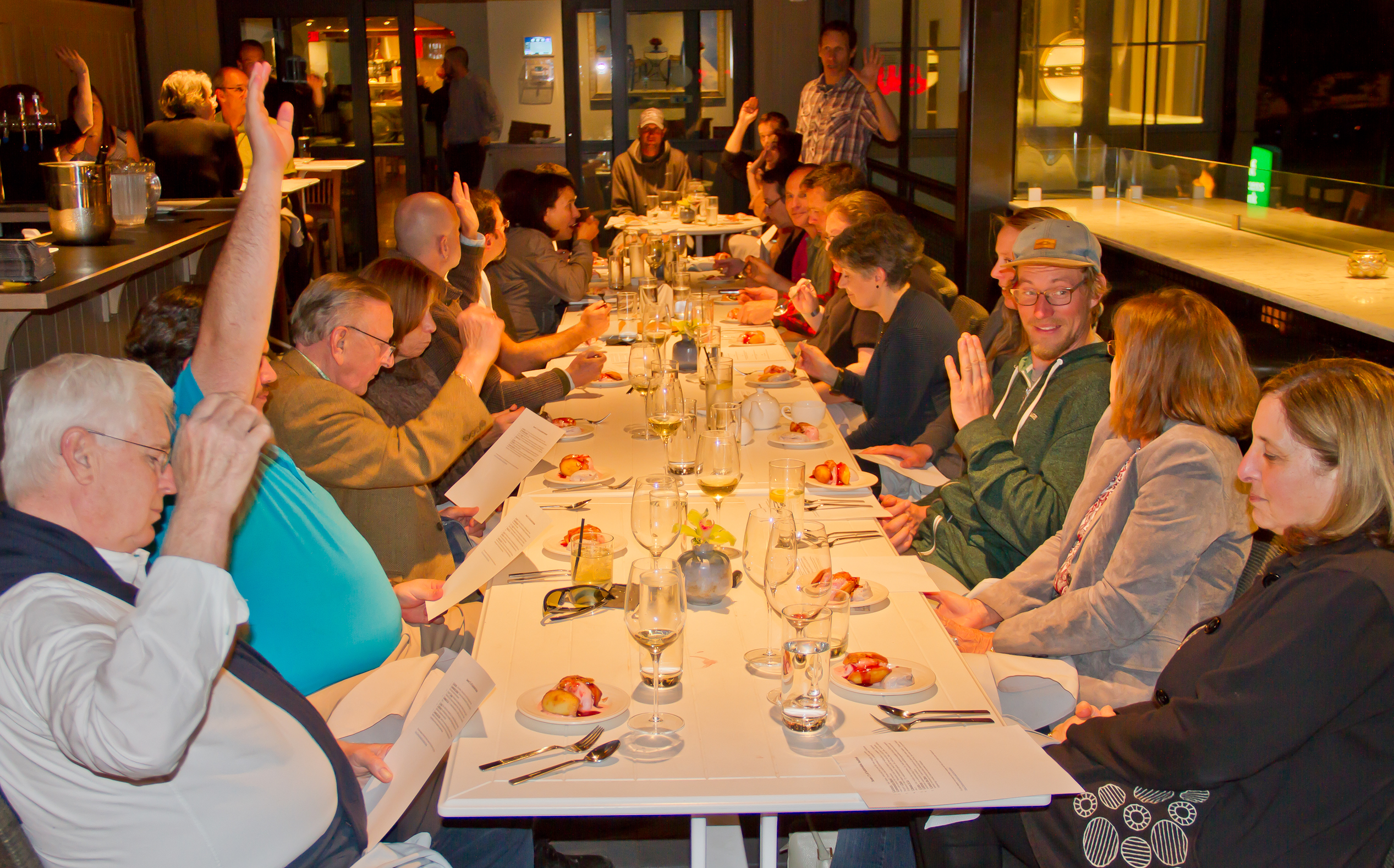
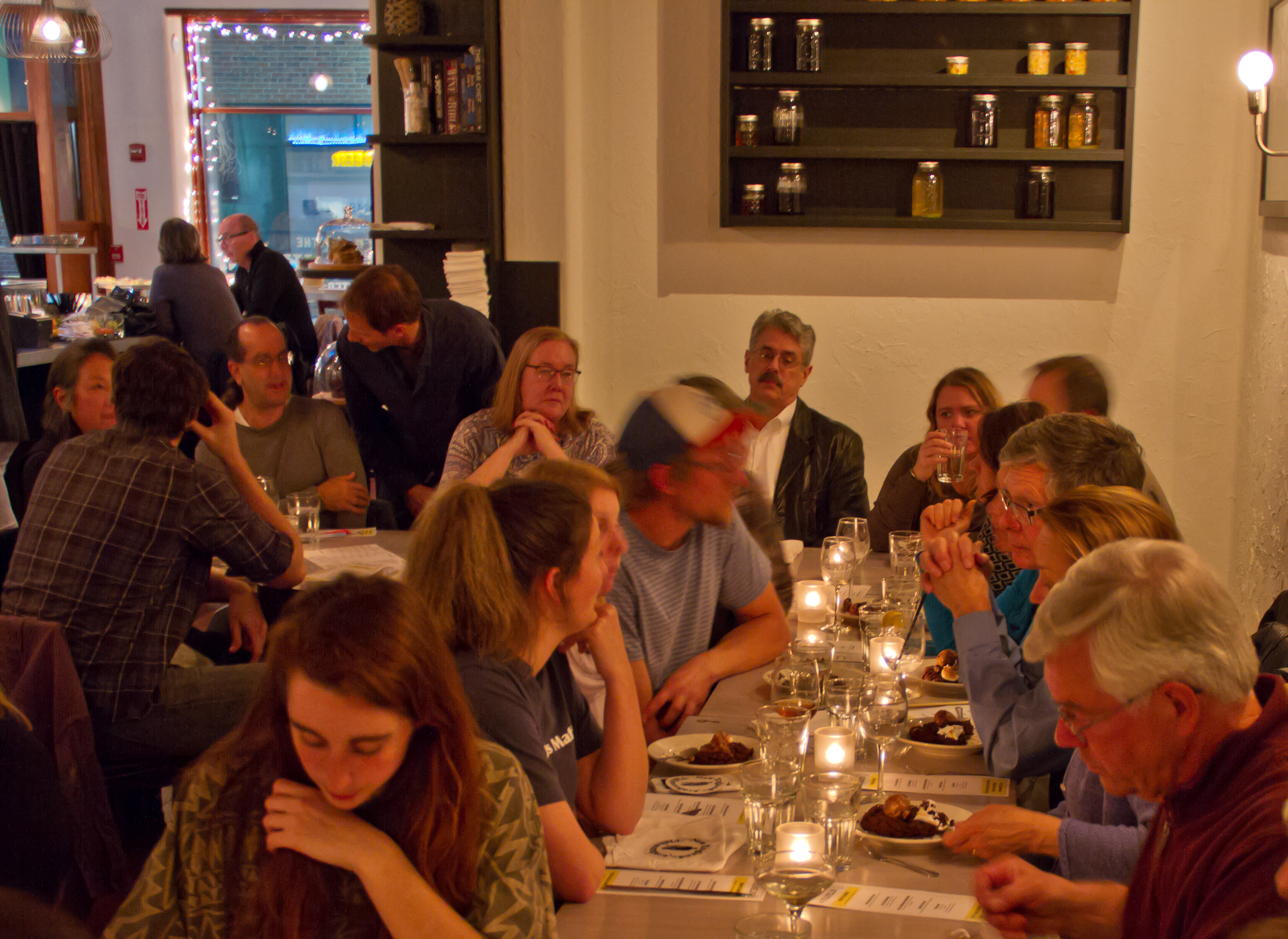
Top Photo: Reviewing the 7 C’s of Sustainability over dessert — Swedish Fish ice cream, lingonberry glaze, madeleine, almond brittle and blueberry cream legere. . Credit: Mike McGrail
All Blog Posts

KNOW FISH: Know your fishermen and make a difference

  • May 11, 2017October 20, 2021
  • by Colles Stowell
Share it!
Share

Relating sustainable seafood concepts is not always a linear conversation. Sure, you can cover the essentials: Buy local; buy abundant; avoid harmful harvest methods; be aware of any regulatory compliance issues. But getting the message to sink in involves an emotional trigger from the consumer. They have to care about it.

So I told the crowd at the KNOW FISH dinner at Franklin Oyster House in Portsmouth, NH Tuesday night that they might approach their next seafood purchase the same way they do when buying eggs or produce at a farmer’s market. That direct-from-the-producer purchase almost instantly resolves many of the trust issues that arise with buying seafood at a store or restaurant.

Seafood consumers have the right to ask the same questions standing at a seafood counter or sitting in front of a menu that they would have buying ground beef from the farmer. Where does it come from? How was it harvested? When was it harvested? If it was farmed, what was it fed?

Franklin Oyster House Chef/Owner Matt Louis telling the tale of the cod. photo credit: Stephen Martin.

One conversation at a time

It was anything but a quiet dinner. It was an engaging conversation and everyone was involved. The food curious. The fishermen. The locals looking for an interesting evening discussion and dinner. The oystermen. The foodies. The activists.

At the outset, I invited everyone into the conversation by asking them to either announce why they’d attended the KNOW FISH dinner or to mention a key factor in their seafood buying decisions.

From there, the conversation took off, and we covered topics such as sustainable seafood definitions, the shockingly high proportion of imported seafood consumed in the U.S., industrial scale fishing impacts on global and domestic markets, climate change, what to look for in local seafood and how to support local fishermen.

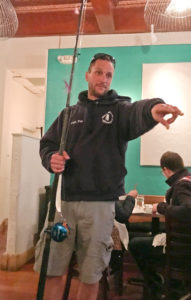
Capt. Tim Rider and the fishing gear responsible for the evening’s tasty meal. Photo credit: Kate Masury, Eating with the Ecosystem

Fish tales

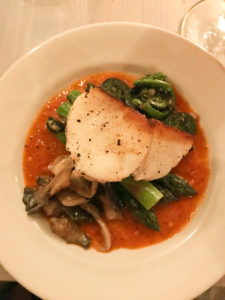
People were able to ask Capt. Tim Rider about how and why he fishes with rod and reel for ground fish. They wanted to know where they could get his fish, which was brilliantly prepared by Chefs Matt Louis and Matt Decker. Salt Cod Brandade with a killer ramp pesto and Roasted Cod that was swimming about five hours before it arrived on our plates. And what a treat it is was to taste the spring bounty of fresh fiddleheads, asparagus and ramps!

Got fresh? How about swimming in 100 feet of cold North Atlantic water 5 hours before appearing as roasted cod in this photo? Photo credit: Kate Masury

Capt. Tim suggested attendees patronize restaurants like Franklin Oyster House Black Trumpet and 7th Settlement in Seacoast N.H., and When Pigs Fly Pizzeria in Kittery, Me. (as well as other area restaurants) that buy fish from New England Fishmongers, the company he and business partner Amanda Parks operate. He also mentioned that they have started a local community supported fishery, which like a CSA, allows people to buy shares of the upcoming catch every week during a season. This model replicates the farmer’s market buying experience.

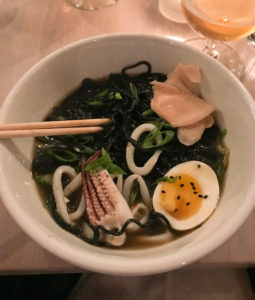
Attendees asked oysterman Tim Henry of Bay Point Oyster Company about the Franklin Oyster, which was served at the beginning of the meal, and which Tim grows expressly for Chef Matt Louis at Franklin Oyster House. They talked about some aquaculture details such as the process of nurturing the spat that grows into adult oysters with oysterman Brian Gennaco of Virgin Oyster Co. This conversation was set to the backdrop of an otherworldly Asian-inspired dish featuring grilled squid served over squid ink ramen cooked in a green crab stock. That stock fed the conversation about why green crabs do so much ecological harm and the ways of trying to popularize their use in cooking.

REALLY tempted to ask for seconds! photo credit: Kate Masury

As everyone tucked into a chocolate-coma-inducing dessert called “Phish food” (a “fudgy” cookie topped with chocolate ice cream, caramel and a torched marshmallow), we talked about how individually and together we can make a difference. Individually, attendees can refer to seven sustainable seafood principles printed on the back of the evening’s menu when considering seafood. Together, we all need to spread the message. When, where, how, and by whom seafood is harvested matters. It matters, locally to our diets, our conscience, the fishermen in our communities, the communities themselves, and the seafood resource. It also has global significance.

The next KNOW FISH dinner at Tinos Greek Kitchen on May 23 will continue this conversation.

The more we have these conversations, the more we shift the current domestic dynamic.

Here’s how to get your tickets and get in on the discussion.


Top photo credit: Stephen Martin


All Blog Posts

Whose protein is it anyway? Industrial fishing and it’s…

  • May 3, 2017October 20, 2021
  • by Colles Stowell
Share it!
Share

When we talk about food security, we broadly mean the ability of a people to have access to healthy, affordable food on a consistent basis. This dynamic assumes that the food has been legally harvested, has not been treated with tons of chemicals and is most often the product of local farmers and fishermen. From a global seafood perspective, the approach to food security has furthered the divide between the haves and the have-nots because food security overlooks two critical aspects: scale and community control.

Sure, money dictates the conversation, but the issue really comes down to scale. Artisanal fishermen, who either fish to eat or make a small living at local markets have a particular vested interest in the health and survival of the fishery. But larger operations have a different perspective. Because of their scale, they absolutely must focus on profit. Otherwise, they don’t survive. That viewpoint often puts fragile fisheries in peril.

A very long trawl

Take the fisheries off the coast of West Africa. Artisanal fishermen there typically harvest the migrating mackerel, anchovy, sardinella and other species passing through their waters. Unfortunately, their catches have plummeted as scores of foreign vessels have plundered their waters, scooping up millions of tons of fish illegally. A recent story in The New York Times spotlights illegal fishing off the coasts of Mauritania, Senegal, The Gambia, Guinea Bissau, Guinea, and Sierra Leone. This illegal harvest has cost these nations more than $2.3 billion in lost revenue, according to a report in the journal Frontiers in Marine Science.

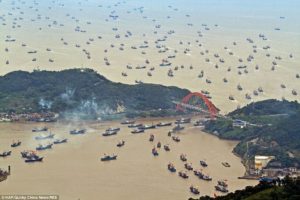
Want scale? Chinese fleet leaving busy harbor in Zhejiang Province.

The dominant foreign fleet is not surprisingly China, whose long-range fishing fleet has swelled to between 2,600 and 3,400 vessels (depending on whom you ask), which is at least ten times larger than that of the U.S. This fleet is government subsidized to both sate China’s enormous seafood appetite (which accounts for a third of global consumption, according to the U.N.), but also to grow foreign market revenue. China owns the global seafood export market and is responsible for more than 60% of the world’s exported farmed seafood.

China’s long-range fishing vessels working off the coast of Africa have increased from a dozen in 1985 to more than 450, according to Greenpeace. Much of the foreign fishing off the coast of Africa is illegal, whether because of intrusion within the 200-mile exclusive state waters, overharvest or other violations. Like other foreign fleets fishing illegally here, Chinese vessels fly local flags. They turn off their electronic monitoring devices. They fish in Senegalese (and other country’s) waters at night. They operate off the coast of other West African nations that don’t have much enforcement infrastructure.

By some estimates, one of China’s larger boats can theoretically haul in as much fish in one week as a Senegalese boat might harvest in an entire year.

So why should we care?

This should get our attention for several reasons. First, as foreign fleets deplete fish stocks off the coast of West Africa, they’re pushing small scale, artisanal fishermen out of business. Worse, they’re driving steep fish price increases in nations where food is already scarce in many regions, even as coastal populations increase.

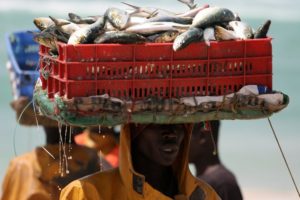
Senegal fish stocks have plummeted as the foreign industrial harvest has grown. Credit: Linda Schonknecht/Marine Photobank

Many of the migrating anchovy, mackerel and sardinella harvested there are ground up into fishmeal in processing plants in nearby Mauritania and elsewhere and sold to feed farmed shrimp, tuna and salmon (as well as pigs and chickens) shipped around the world.

Sadly, those fish fill much of the direct protein needs of people in coastal West Africa (as well as developing nations around the world). According to the UN Food and Agriculture Organization, seafood accounts for 20% of the protein intake of more than 3 billion people. In Senegal, those fish account for more than 40% of the country’s protein intake. A recent study states that 90% of the huge global harvest of these types of small oily fish could be consumed directly by humans rather than ground into fishmeal.

Food sovereignty imbalance

This is a regional food sovereignty issue because coastal Senegalese fishermen have little control over the massive Chinese fleet harvest that is taking their resource. This over-harvest crushes local communities and sends shock waves through global markets.

Here’s the kicker for U.S. seafood markets. That 90% of the seafood eaten in this country is imported has become a widely cited statistic. If China is by far the world’s largest exporter, and we import 90% of the seafood we eat here, there’s a damn good chance that the frozen fish sticks, farmed shrimp and salmon sold in supermarkets here are the byproducts of this illegal fishery off West Africa.

Again, the profit margins to feed higher priced farmed salmon and shrimp to the more well-to-do at the expense of the cheaper more readily accessible protein for the coastal impoverished seems a Faustian bargain. This type of “ocean grabbing” is global in scope and threatens the health of vital fish stocks as well as the lives of the people that depend on them.

Now think about small-scale fishermen in the United States, trying to earn a living, mostly complying with regulations and caring about the resource because their lives depend on it. Our markets are jammed with cheap, imported seafood, much of which is harvested in similar circumstances as mentioned above. And this seafood is pushing down market prices here because of its volume, making it harder for small-scale fishermen to compete.

Compounding the pressure on these small-scale fishermen are domestic policies like catch shares, which treat access to fishing areas like a market commodity to be traded like stocks and that encourage fleet consolidation. This consolidation raises the cost of doing business so high that many small-scale fishermen are forced out of business.

Some communities are fighting back against “ocean grabbing” by finding ways to gain local control over their fisheries and re-establishing their food sovereignty. Here is a link to The International Planning Committee for Food Sovereignty that is providing small-scale food producers and local organizations the infrastructure and guidance to strengthen their local markets.

What can we do about it?

Here are a few steps people can take in their personal lives to support local seafood systems and community fisheries:

  1. Know your seafood. I tell all of my classes, the best thing consumers can do is ask questions. Find out where, when, how and (if possible) by whom their seafood was harvested.
  2. Think about scale. Was this seafood caught by a local fisherman, or an industrial-scale operation?
  3. Find stores and restaurants that sell local, sustainably harvested seafood.
  4. Is there a community supported fishery near you? Like a CSA, CSFs, cut out the middle man and allow you to deal directly with fishermen. Get to know your fishermen and you’ll appreciate the work they put into it.
  5. Eat seasonally. Fish and shellfish aren’t necessarily available in one region throughout the year. So learn what is seasonally available near you.
  6. Do your research. Learn about local, regional and global fisheries issues. Learn about the different types of aquaculture and their environmental, social and economic impacts.
  7. Get involved. If these issues matter to you, be an evangelist. Share the message that our seafood decisions have an impact locally, regionally, nationally and globally.


Top photo credit: Inoussa Maiga


Recent Posts

  • Hurricane Ida wreaks havoc on Louisiana’s seafood industry
  • EPA Should Use Clean Water Act To Kill Zombie Mine
  • Slow Fish 2021: Relationship Matters
  • Faith, Façades, and Futility
  • Pebble Permit Paused: Politics at Play

Archives

  • September 2021
  • August 2021
  • April 2021
  • December 2020
  • August 2020
  • June 2020
  • February 2020
  • December 2019
  • November 2019
  • October 2019
  • July 2019
  • May 2019
  • April 2019
  • March 2019
  • January 2019
  • December 2018
  • November 2018
  • June 2018
  • May 2018
  • March 2018
  • February 2018
  • January 2018
  • December 2017
  • November 2017
  • October 2017
  • September 2017
  • August 2017
  • July 2017
  • June 2017
  • May 2017
  • April 2017
  • March 2017
  • January 2017
  • December 2016
  • November 2016
  • October 2016
  • September 2016
  • August 2016
  • July 2016
  • June 2016
  • May 2016
  • April 2016
  • March 2016
  • February 2016
  • January 2016
  • December 2015
  • November 2015
  • October 2015
  • September 2015
  • July 2015
  • June 2015
  • May 2015
  • April 2015
  • March 2015
  • February 2015
  • January 2015
Theme by Colorlib Powered by WordPress