Skip to content
One Fish Foundation
  • Blog
    • Aquaculture
    • Education
    • Environment
    • Policy
    • Wild Harvest
    • Fish Tales
  • About
    • About One Fish
    • About Colles Stowell
  • Education
    • Elementary School
    • Middle School
    • High School
  • KNOW FISH Dinners®
  • Resources
    • One Fish Podcast
    • One Fish Foundation in the news
    • The 7 C’s of Sustainable Seafood
    • Newsletter Archive
    • Recipes
      • Skate with Capers and Butter — Chef Rizwan Ahmed
      • Grandma Davis’ Fish Chowder — Jane Almeida
      • Ginger Garlic Tamari Scallops — Colles Stowell
      • Fish Stock — Evan Mallett
      • Mussels San Remo — Chef Rob Martin
      • Salted Pollock Croquettes – Chef Mark Segal
  • Connect
    • Contact OneFish
    • Social
      • Instagram
      • Facebook
      • Twitter
All Blog Posts

Seafood Learning Expeditions

  • December 9, 2019October 19, 2021
  • by Colles Stowell
Share it!
Share

With apologies to Charles Dickens, the Tale of Two Salmon began with a description of how it was the best of times, and then, how it was the worst of times.

How one species, Atlantic salmon, was pushed to near extinction because of 300+ years of intense fishing and damming of much of its critical habitat throughout New England and into Canada. How another group of salmonids, wild Pacific salmon (including king, sockeye, coho, pink and chum) were given lifelines by better management and some degree of habitat preservation.

And how the Pacific salmon in Alaska continue to provide largely abundant runs, serving a variety of stakeholders including commercial, recreational and subsistence fish harvesters. We discussed how policy there is a dynamic tool that better incorporates input from these different stakeholders, as well as up-to-the-minute harvest and escapement (fish that continue upstream to spawn) analysis to determine how and when the harvest starts and stops.

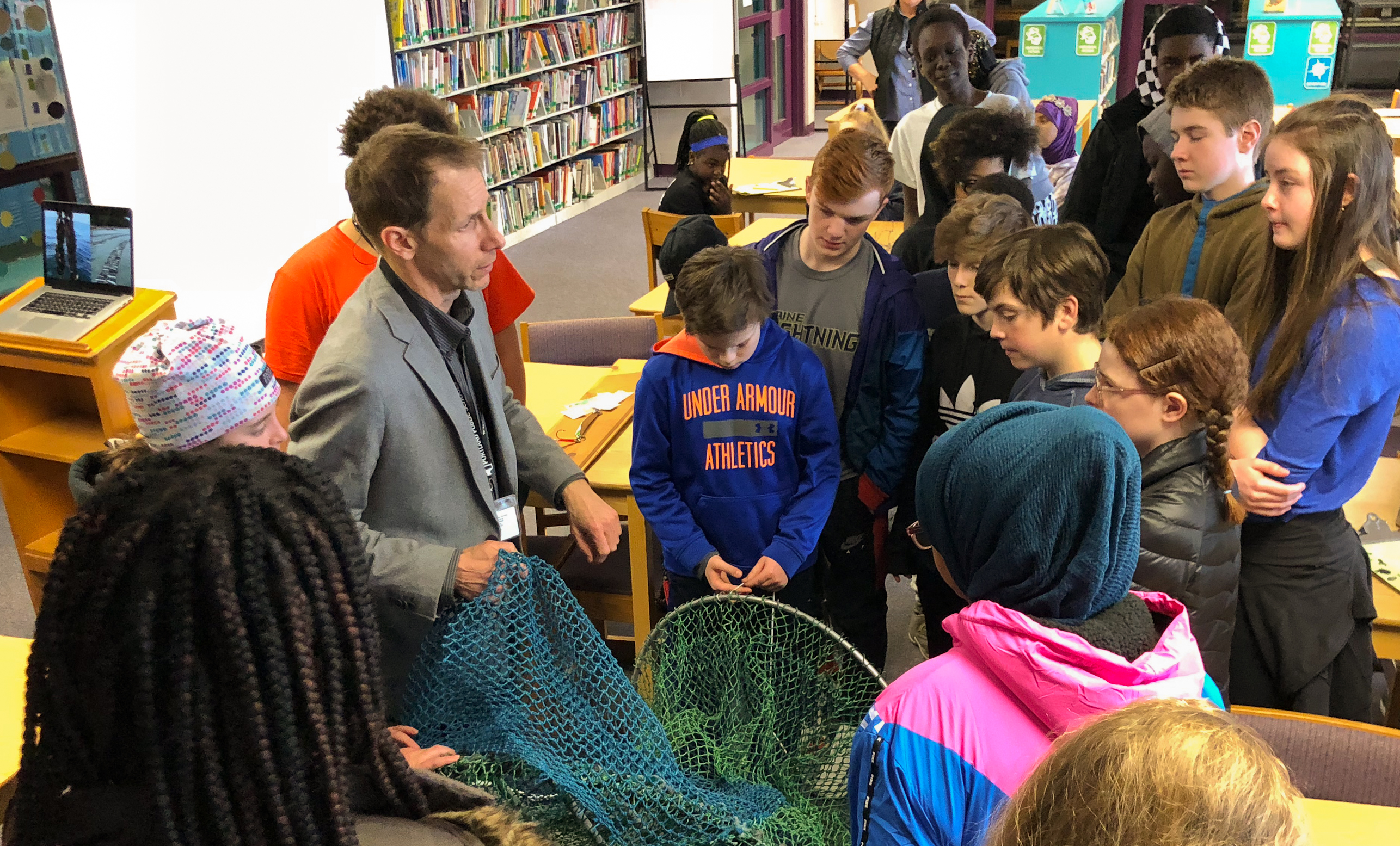
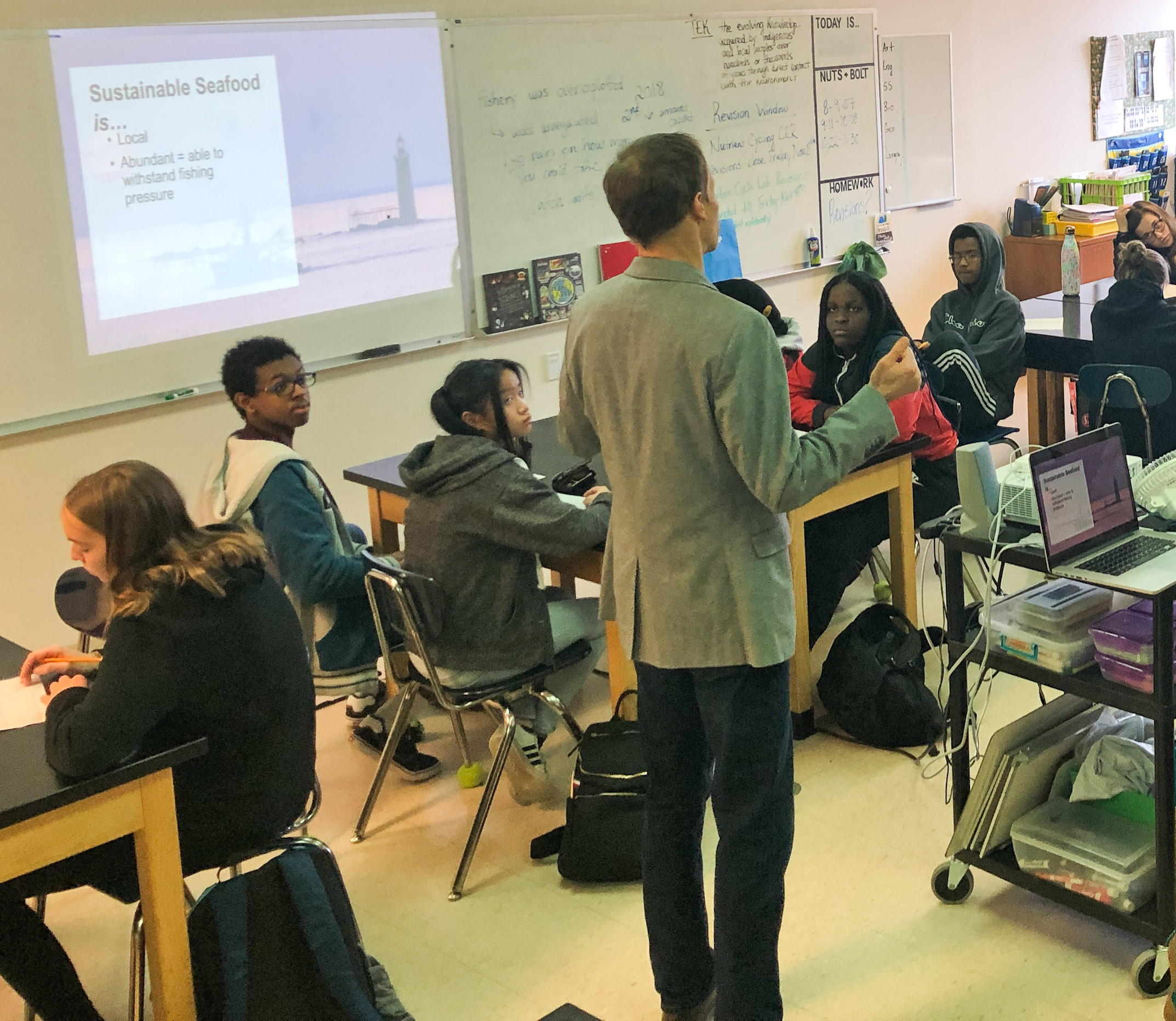
The focus on indigenous subsistence fishing was of particular importance to the 9th graders in Jenny Crowley’s ecology class at Casco Bay High School for Expeditionary Learning in Portland last month. They were learning about human interaction with natural resources and the impact humans can have on their surrounding environments. CBHS immerses students in “expeditions,” which allow them to dive deep into particular issues or topics while incorporating other facets of their education.

We talked about the delicate balance of policy on how to ensure different stakeholders have fair access to the resource. I shared my experience in Bristol Bay, Alaska this summer, talking with indigenous and subsistence fish harvesters there who described the traditions of learning to live in harmony with the salmon, the water and the land.

Finding that natural balance, taking only what they need to eat throughout the year and passing on that knowledge (like how to properly fillet a salmon using a traditional ulu knife and how to use the entire fish) are essential to maintaining that harmony from generation to generation.
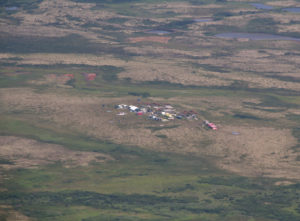
Pebble Mine exploration site. I took this photo during a flight to see how the mine would affect the headwaters of the world’s largest wild salmon run. I shared other photos depicting the breathtaking landscape that is veined with water. Students understood this one human “input” could result in devastation of that habitat.

We also spoke about how the different user groups in Alaska have united together in the past nearly two decades in solidarity to oppose the proposed Pebble Mine. It is largely due to that collaboration and the fierce determination to protect the resource that the proposed gigantic open pit copper and gold mine has not yet been built.

We talked about the tragedy of the commons and how communities working together to determine how best to manage the resource so it continues to provide for the entire community is absolutely essential.

So the students and I took those expeditions together in one-hour increments, talking about important socio-economic issues and how our choices affect the salmon and all marine life.

Collectively, we came to the conclusion that the type of community thinking in Alaska is one reason wild Pacific salmon there shade closer to the best of times.

Perhaps we should apply that model more diligently elsewhere.
All Blog Posts

Seafood Lovers and the Supply Chain

  • October 17, 2019October 19, 2021
  • by Colles Stowell
Share it!
Share

Most American consumers don’t know where their seafood comes from. In fact, a recent report from the Food Marketing Institute suggests that less than 30% of domestic consumers consider themselves knowledgeable about the seafood they eat.

 So why is that? And what can we do about it? What is the consumer’s role in the supply chain? It would be a fair assumption that the remaining 70% of those surveyed by FMI take a passive role. That is, they either rely on third-party information like eco-labels or they just don’t care. They surrender responsibility of the decision to someone else.

 No wonder our markets are so jammed with cheap, unhealthy imports.

 This topic was the crux of the fifth installment in the SlowFish webinar series, Slow Fish 201: Role of the Consumer, held on Sept. 23. To follow is a blog written by One Fish Foundation Intern Jennifer Halstead. In it, she captures some of the most salient points about how fishermen, fishmongers and others in the supply chain can help engage consumers in conversations about why they should care where, when, how and even by whom their seafood was harvested.


by Jennifer Halstead

Throughout the Slow Fish 201 Webinar series, expert panelists from different backgrounds, geographies and perspectives shared thoughts on how each link in the supply chain can help ensure the availability of responsibly harvested seafood. During the most recent webinar, Role of the Consumer, each panelist was thought-provoking, sharing their stories on how to engage consumers in the supply chain. Attendees left the discussion with a clear understanding of how consumers can become better informed (ASK QUESTIONS!!!) and assume a more active role in the supply chain.

On the panel were:

Patty Lovera, Food and Water Program Director, Food & Water Watch

Chef Evan Mallett, Chef, Co-owner, Black Trumpet

Capt. Tim Rider, New England Fishmongers

Charlie Lambert, Fisherman, Co-founder, Ocean2Table

Kirk Hardcastle, Premium Sales Accounts, Seafood Producers Cooperative

Colles Stowell, President, One Fish Foundation

Jessica Hathaway, Editor and Chief, National Fisherman, served as moderator

Each of them views the supply chain from a different perspective. But all of them agree that change within the supply chain is not only possible, but that it in many ways depends on consumers making smarter choices.

Fraud, mislabeling and a lack of transparency continue to cast a shadow over seafood sales in the U.S. It’s easy to see how consumers can feel helpless when it comes to fixing such issues. There are so many eco-labels providing conflicting guidelines and grocery store displays touting green-label “fresh, sustainably raised farmed salmon from Chile.”

As discussed during the webinar, well-informed seafood eaters have the power to pressure suppliers into knowing more about the products they are selling and to source from community-based fishermen who care about the resource.

Where to start

Panelists agreed that consumers should be asking restaurants and grocers a couple of questions just to get a part of the story of the seafood. It doesn’t have to be complicated or intimidating. You learn much just asking where, when and how it was harvested or grown. Even better if you can find out who harvested it. Is it local? Regional? Domestic? The U.S. has some of the best seafood safety and fisheries management policies in the world. If you can’t get domestic seafood, you’re better off choosing something else. Imported products carry a high risk of having been unsustainably farm raised or harvested.

“There is a lot of burden on the consumer,” said Patty Lovera. “We have to ask a lot of questions. The status quo in the supply chain isn’t good enough.” She and Colles Stowell both mentioned the influence consumers can have over retail seafood sourcing. If suppliers don’t know the answer to these questions, they will either feel compelled to learn, or responsible consumers will feel compelled to spend their money elsewhere.

What’s in season?

Chef Evan Mallett, Capt. Tim Rider and Charlie Lambert spoke about the importance of consumers better understanding seasonality. Just like when you go to the grocery store or market for vegetables and find different items available throughout the year, fish have their own seasonality. In New England, the height of the scallop season is in winter, while squid are generally available for a few weeks in the spring. Understanding what should be available during different times of the year will help consumers filter out which purveyors are supplying fresh, local fish and which are importing or using frozen, stored fish. “Being a chef is understanding sense of place, seasonal food, and the changes that the seasons bring,” said Mallet. That should also be true for consumers.

Eating seasonally enables consumers to enjoy fresh product throughout the year, experience cooking and preparing new species, support local fishermen, and promote healthy ecosystems by reducing fishing pressure on more popular species.

Location, location, location

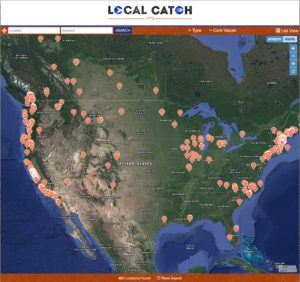
Some tools, such as the Local Catch nation-wide Seafood Finder, can help seafood eaters find local, responsibly harvested fish, shellfish and seaweed. In a map or list view, you can search for purveyors by location and species.

All agreed that consumer education is critical. Once consumers have enough information, they’ll feel empowered to own those decisions and will likely make smarter decisions again in the future. “Instead of telling people what to buy, which is what eco-labels do, we need to educate and equip them with tools to make the decision on their own,” said Colles. Charlie added, “We’re providing them with information and letting them complete the thought process on their own, … and not force-feeding the consumer.”

Buying local benefits the consumer, economies, and even the ecosystem. Fewer food miles, fresher products, strengthening local economies by building relationships with fishermen, and supporting healthy ecosystems are all advantages that consumers can feel good about.

Charlie acknowledged that carbon footprint is a growing concern for his customers. The average distance seafood travels from boat to plate in the U.S. is an astounding 5,000 miles. “The supply chain was largely hidden, and when it was exposed, it was very nasty. The West Coast is famous for market squid and calamari, but the supply chain is tumultuous. [The squid] is landed, frozen, shipped overseas, thawed, processed, refrozen, shipped back, thawed, then distributed to local businesses and consumers. The amount of food miles is not right,”he  said.

Quality is everything

Distance traveled can also (but not always) affect freshness. A fresher product tastes better and has a better shelf life. Rider said both his restaurant and retail customers note the long shelf life of his product because his crew properly bleeds and brines the fish on board the vessel at the time of catch, ensuring the fish is as fresh as possible for as long as possible. “Shelf life is huge. If something comes up and you can’t cook it when planned, it’s still good four days later.”

Chef Evan agreed: “ It was really with the first fish I got from Tim that I saw a marked difference between everything that I was getting from the Gulf of Maine before that.”

Product quality is integral to attracting and keeping customers. Kirk Hardcastle drove this point home, drawing on his decades of experience as fisherman, chef, distributor and now marketer with Seafood Producers Cooperative. “It starts with the fishermen, not the eco-labels, … making sure the quality of the product really comes through. … If it gets to someone’s house and the fish is poorly handled… You can put millions into messaging and you’ve burned it all away with the first bite of fish. Go for quality first and everything after that is easy,” he said.

Know your fisherman!

Charlie and Capt. Tim both sell directly to consumers: Charlie providing product from the network of fish harvesters he sources from in Monterey Bay up to San Francisco to his community supported fishery (CSF) customers, and Capt. Tim from the two boats he and his crew operate out of Maine and Mass. via drop-off points and farmer’s markets. When fishermen come off their boats into the community to sell their fish and meet customers, they’re building relationships that help support a stronger local economy.

These relationships build trust and help harvesters and consumers alike have open discussions about the industry, fishing methods, problems and challenges that fishermen have.

In the end, failure to know the story of seafood surrenders consumer decisions to other elements in the supply chain, which is often driven by industrial players with only profit in mind. Complacency in the supply chain will only ensure that consumers receive sub-par products, and the supply chain grows more opaque, rather than transparent. Lack of communication and interest can lead to what started this conversation last year, intentional mislabeling to turn a buck.

Smarter, responsible consumers and the relationships they forge with fishermen and fishmongers will help shift supply chains away from industrial-driven structures and toward a supply chain rooted in trust and knowledge.

In short, the role of the consumer is to ask questions and make responsible decisions. However, fishermen, chefs, retailers, distributors, educators, advocates and others in and around the supply chain should help consumers get smarter. That means telling the story of the seafood they’re selling.

Not sure where to start? Seafood eaters should ask the questions mentioned above. Check out the 7 C’s of Sustainable Seafood. If you can, buy local. If you can’t buy local, buy US caught and processed.

Fishermen, chefs and retailers should get to know their customers and tell them more about the seafood they’re selling them.

A supply chain built on trust is the best path forward.


Resources

7 C’s of Sustainable Seafood

Local Catch Core Values: Another reference point for how to think about the seafood supply chain.

Slow Fish Values: More values regarding seafood’s journey from boat to plate.

Eating with the Ecosystem, The 5 Anchors: A New England-focused view of values to consider when choosing seafood.

To view a recording of the webinar, follow this link.


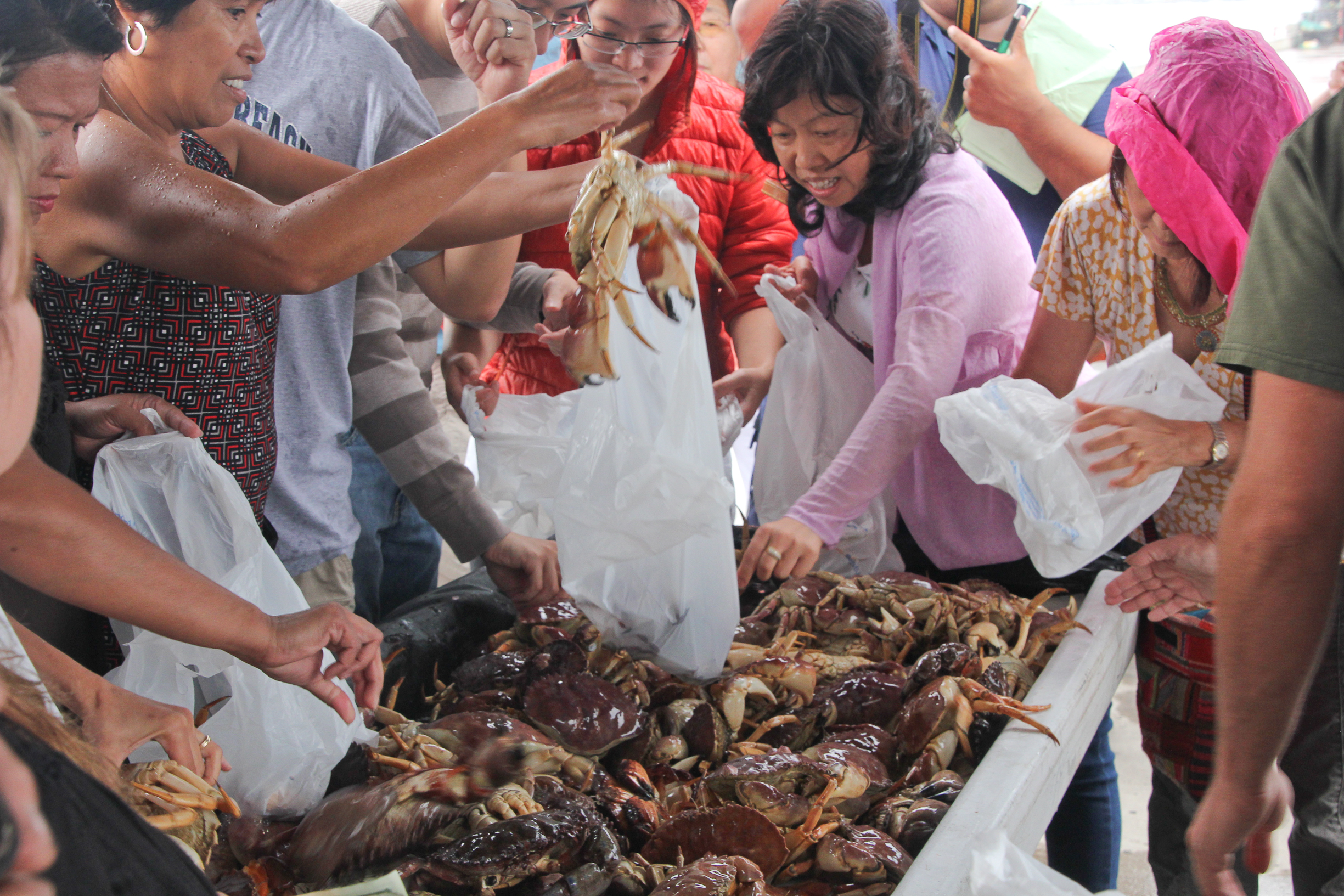
Top photo: Boat to consumer…literally.  Opening day for the Tuna Harbor Dockside Market in San Diego. Credit: Eric Buchanan

All Blog Posts

Sustainable Seafood in Diverse Classrooms

  • May 3, 2019October 19, 2021
  • by Colles Stowell
Share it!
Share

I often talk about “democratizing the message.” That is, I want to reach the largest audience across the broadest demographic possible: different age groups, cultural backgrounds, economic brackets, life experiences…everything. In short, the entire social fabric that relies on seafood for part of its diet.

Why? Because fundamental societal change doesn’t happen within only one demographic. This type of change may start in one group, but must transcend differences to scale up to have societal impact. This is especially true for the domestic seafood supply chain. Habit and price, fueled by an industrialized global seafood supply chain, are the main drivers behind the fact that 90% of the seafood we eat in the US is imported. That’s why we need to speak to the broadest range of seafood consumers.

The goal in these conversations is to provide new perspective that might help consumers, regardless of demographic, make better choices for themselves, the resource and fish harvesters in and around their communities. There are health and socio-economic costs of that frozen shrimp from Thailand that offset the cheaper price. If people I’ve spoken to choose the cheaper imported product for whatever reason (often price is the limiting factor, which is a much larger food and social justice issue), they do it with a broader understanding of the consequences of that decision. Hopefully we can work toward re-localizing our seafood supply chain so folks of all incomes can find local, responsibly harvested, affordably priced species, especially under-utilized species like dogfish or scup.

And it all starts with education.

So, where can I find an audience with a range of cultural backgrounds, socioeconomic circumstances and life experiences? Our public schools bring together a cross section of society each day. I jumped at the opportunity to join students and teachers at two of Portland’s three public middle schools this spring.

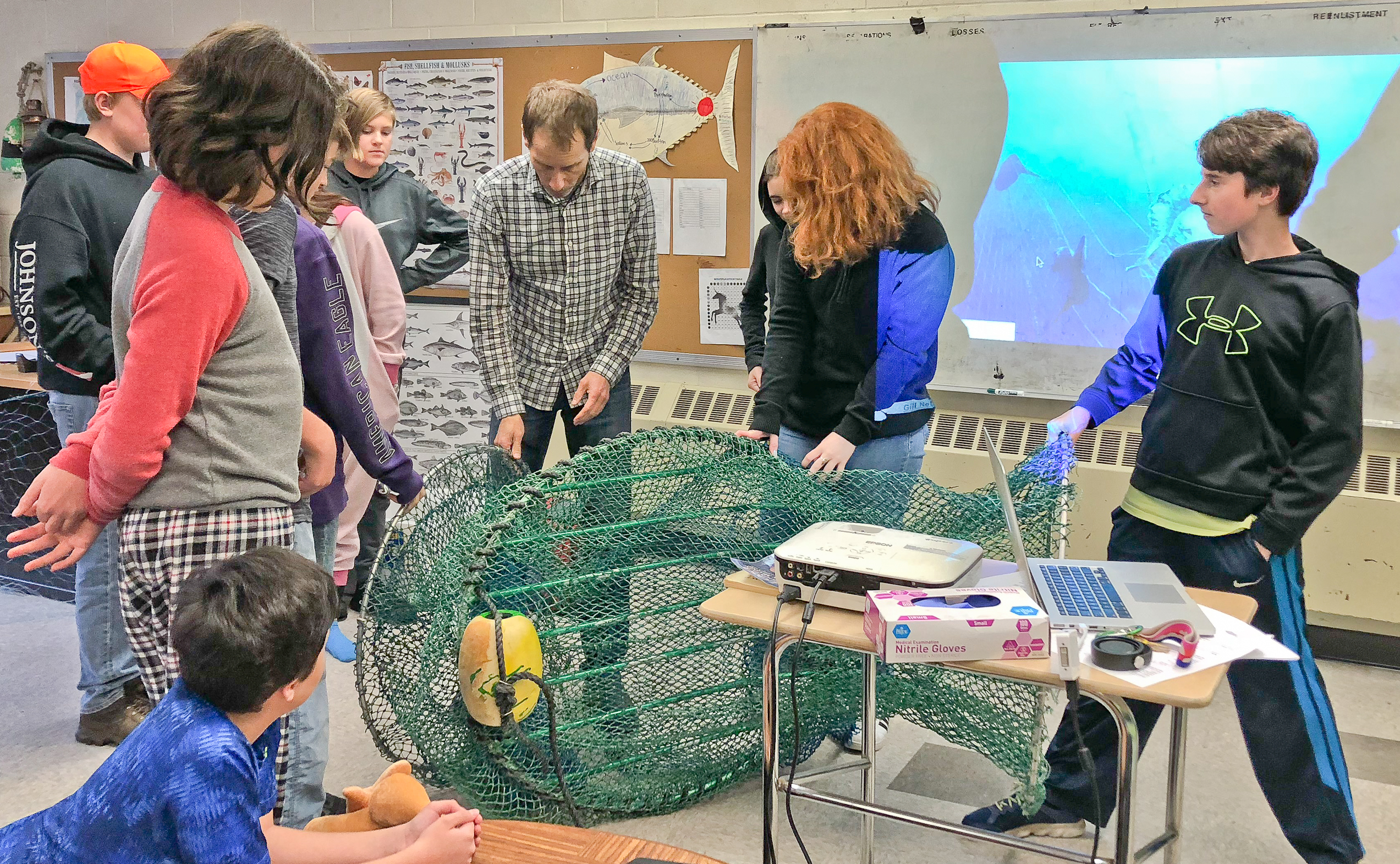
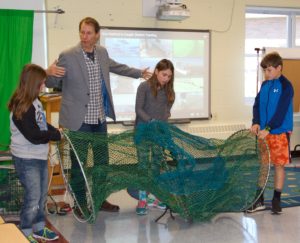
The Turtle excluder device is cumbersome, but a great hands-on tool for explaining innovation to reduce bycatch. photo: Lincoln Middle School Teacher Christel Driscoll

I seized the opportunity to democratize the message among students coming from diverse cultural backgrounds with respect to seafood while visiting classes at Lyman Moore Middle School and Lincoln Middle School a few weeks ago.

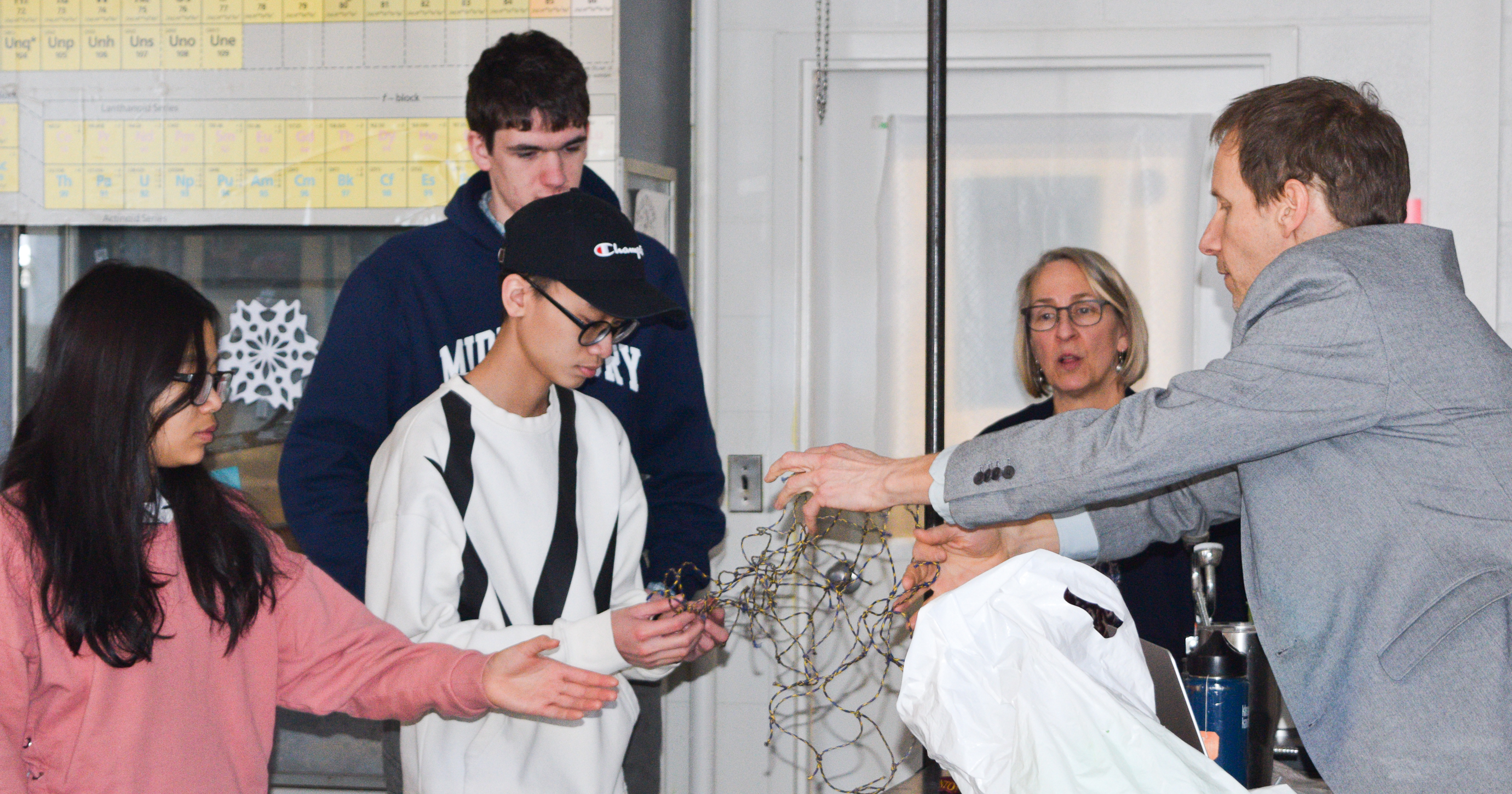
At Lyman Moore, I spoke to four large groups of 7th graders who reveled in laying hands on gill net, a turtle excluder device and a 24 oz. metal jig with some serious hooks. Fortunately, no one had to visit the school nurse afterward.

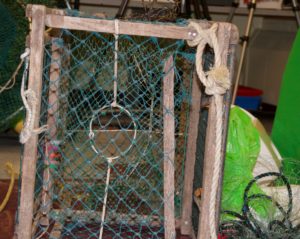
They also had the option to touch a dead black sea bass as we learned about why this mid-Atlantic species is showing up in lobster traps in and around Casco Bay, and the implications for marine ecosystem balance. This became a discussion about species adaptation as the Gulf of Maine continues to warm, and how climate change could impact what seafood is available down the road. We also talked about black sea bass as a local, underutilized species.

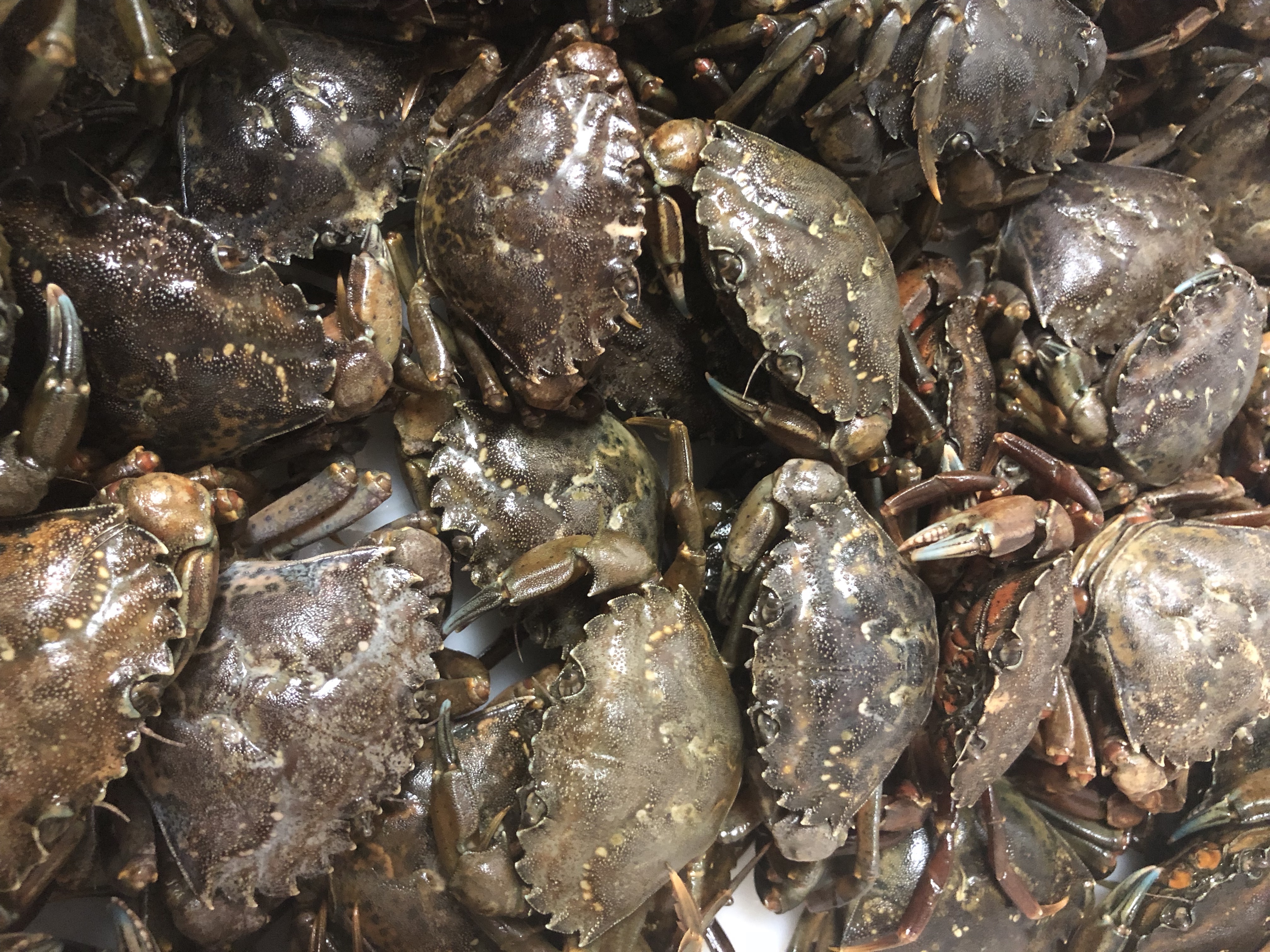
Live European green crabs held center stage as the keystone climate change adaptor species during the visit to Lincoln Middle school where I spoke with two classes of 8th graders taking a Sustainability Science course. The classroom, featuring a stove, sink, refrigerator and some counter space harkened back to the seemingly long-ago days of Home Economics.

“Can I keep it as a pet?” is one of the most common questions I get. Occasionally, when I ask what they’d do with it, I get, “I’ll feed it to my dog.” Ok. Eat the invasives!

This proved to be a perfect backdrop for discussing efforts to turn humans into pest control when it comes to green crabs, which are very fertile, very destructive (eating our mussels, clams and oysters at alarming rates) and have no significant natural predators. We also talked about industrial aquaculture, and how domestically grown oysters, mussels, clams and seaweed solve many of the serious issues with large-scale finfish aquaculture such as salmon (disease, sea lice, antibiotic use, feed sourcing and health and environmental impact).

In both schools, students took notes, asked questions and in some cases, showed a genuine interest in this new perspective: their decisions, whether they eat seafood or not, matter. Choosing locally harvested mackerel matters. Foregoing the single-use straw matters.

I passed out the 7 C’s of Sustainable Seafood in hopes they would take it home, put it on the fridge and have a conversation with their families and friends.

This is one important way to spread the message … regardless of demographic.

How do I know I made an impact? Among the several thank-you notes I received was one from a student whose uncle is from Senegal. I had spoken about how industrial Chinese fleets are vacuuming up the sardinella, anchovetta and mackerel artisanal and subsistence fishermen in West Africa depend on for their lives.

“All of these issues impact my future and hearing about the lack of knowledge many people have is very concerning, but I’m sure that eventually people will come to their senses and do something,” wrote the student.

Yes, people will come to their senses, hopefully, if we keep having conversations like this with people from diverse backgrounds.


All Blog Posts

DNA, Fraud and Next-Gen Scientists

  • March 27, 2019October 19, 2021
  • by Colles Stowell
Share it!
Share

Imagine a team of scientists collecting DNA samples to see if the seafood sold at local restaurants and stores is correctly labeled. They go to sushi shops, grocery stores and other retail venues and carefully place tiny samples of the fish in a small vial containing ethanol.

Then they take it to the lab where they will use genetic techniques, including Chelex extractions and polymerase chain reaction (PCR), to analyze the DNA of the sample to see if the snapper they purchased is actually Pacific rockfish. Their work is crucial. It will provide a deeper understanding of the rate at which seafood is mislabeled in area retail stores.

Now imagine these scientists are in high school.

I was inspired by the senior biotech class I visited March 18 at Harbor High School in Santa Cruz, California. I was even more inspired by teacher Nehal Pfeiffer, who developed this project to combine classroom/lab study with real-world challenges. To get students thinking about how the process would work, she started students on testing different foods for genetically modified organisms (GMO).

The students were somewhat surprised to see high GMO content in Cheetos (corn) and veggie burgers (soy). Then the teacher had them break out into groups representing different players in the food industry such as farmers and Monsanto and try to get at the heart of the discussion.

You can guess how this ends up. Lively discussion. Engaged questions. Thoughtful conclusions.

Fraud talk

So I was honored to be invited to speak to these students about fraud in the seafood supply chain. I was there to give them a broader perspective of how and why it happens, the larger dynamic of US and global seafood consumption and what we can do about it.

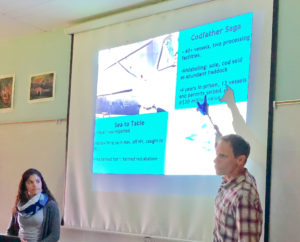
“Codfather” Carlos Rafael and Sea To Table are poster children for what can go wrong with fraud in the supply chain. Arina Favilla (left) helped coordinate the DNA sampling project. Photo credit: Stephanie Webb


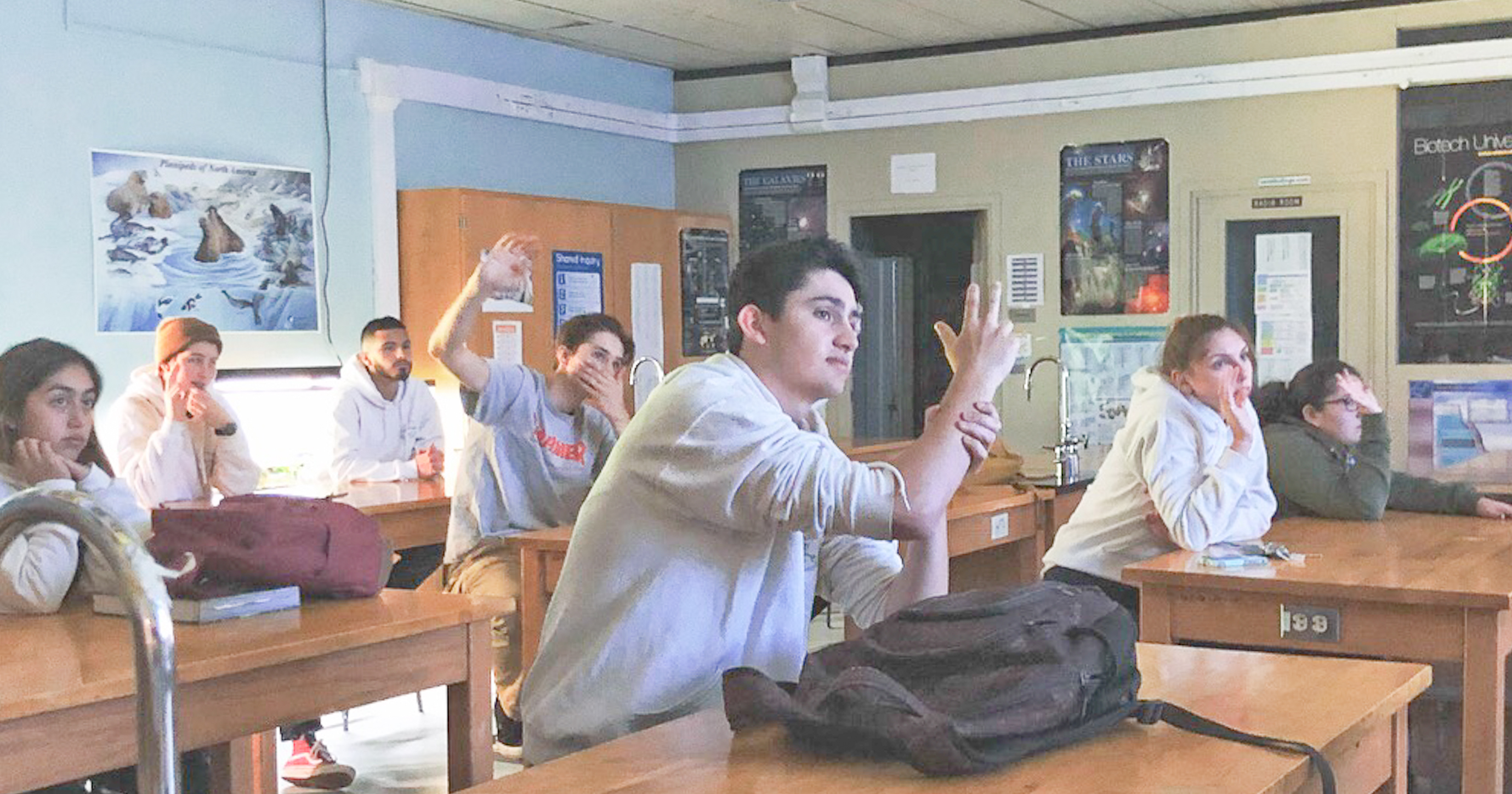
After holding up Carlos Rafael and Sea To Table as prime examples of different types of fraud and their impacts on consumer trust, one student raised her hand and asked, “How can they get away with that? Who do we sue?”

Great question that prompted an excellent, interactive discussion. The truth is that current management policy, combined with a clunky mishmash of federal oversight spread over four disparate agencies with a confusing web of priorities and powers enables these types of fraud.

Rafael, the self-styled Codfather, was enabled by the catch share system in the New England groundfish fishery to amass a giant horde of access (permits) to essentially “own” the right to catch more groundfish than anyone else in and around the Gulf of Maine. He then used that power to force out many small-scale fishermen while vertically integrating so that his team of captains could work with his on-shore processing facilities to mask the cod and Dover sole he was catching as abundant (and less subject to expensive quota limits) haddock. He then sold this fish to New York restaurants for bags of cash.

Fortunately, he got caught bragging about the scheme to undercover IRS agents posing as Russian mafia.

I then explained the Sea to Table story as one of co-optation of values. One of the early pioneers of the national boat-to-plate sustainable seafood movement, Sea to Table was outed in an in-depth Associated Press exposé last summer, in which the Brooklyn-based company was alleged to have claimed some of its tuna had been locally harvested off Montauk, NY, when in fact it was caught in North Carolina. Other allegations include selling domestic seafood that may have been linked to international slave trade and offering wild harvested sea urchin that was actually farmed.

Taking initiative

My goal was to give Harbor High students an understanding of why this matters. Beyond the science, which is super cool and something I lament not having access to way back in my time, the understanding of how and why this type of fraud matters hopefully inspires these students to dig in. I’d love to see them discover the level of mislabeling in their communities, put that in context, and do something about it.

I hope they spread the message about why knowing where their (our) seafood comes from matters. I hope they ask questions and share the 7 C’s of Sustainable Seafood with family and friends. And I really hope they get involved in marine science, biotech, climate science or any related field. Seafood fraud is a significant problem and erodes the trust necessary to make community-based fisheries markets work.

And it is just one very complex problem in the domestic and global seafood supply chain.

So I would like to thank Nehal Pfeiffer at Harbor High, and University of California Santa Cruz graduate students Stephanie Webb, Arina Favilla and May Roberts, all of whom coordinated this year’s seafood project with Nehal, for inviting me to speak with the students.

My discussion with these thoughtful, determined students inspired me, giving me hope that we can address these complex issues together.


All Blog Posts

Getting to KNOW FISH in School

  • December 20, 2018October 19, 2021
  • by Colles Stowell
Share it!
Share

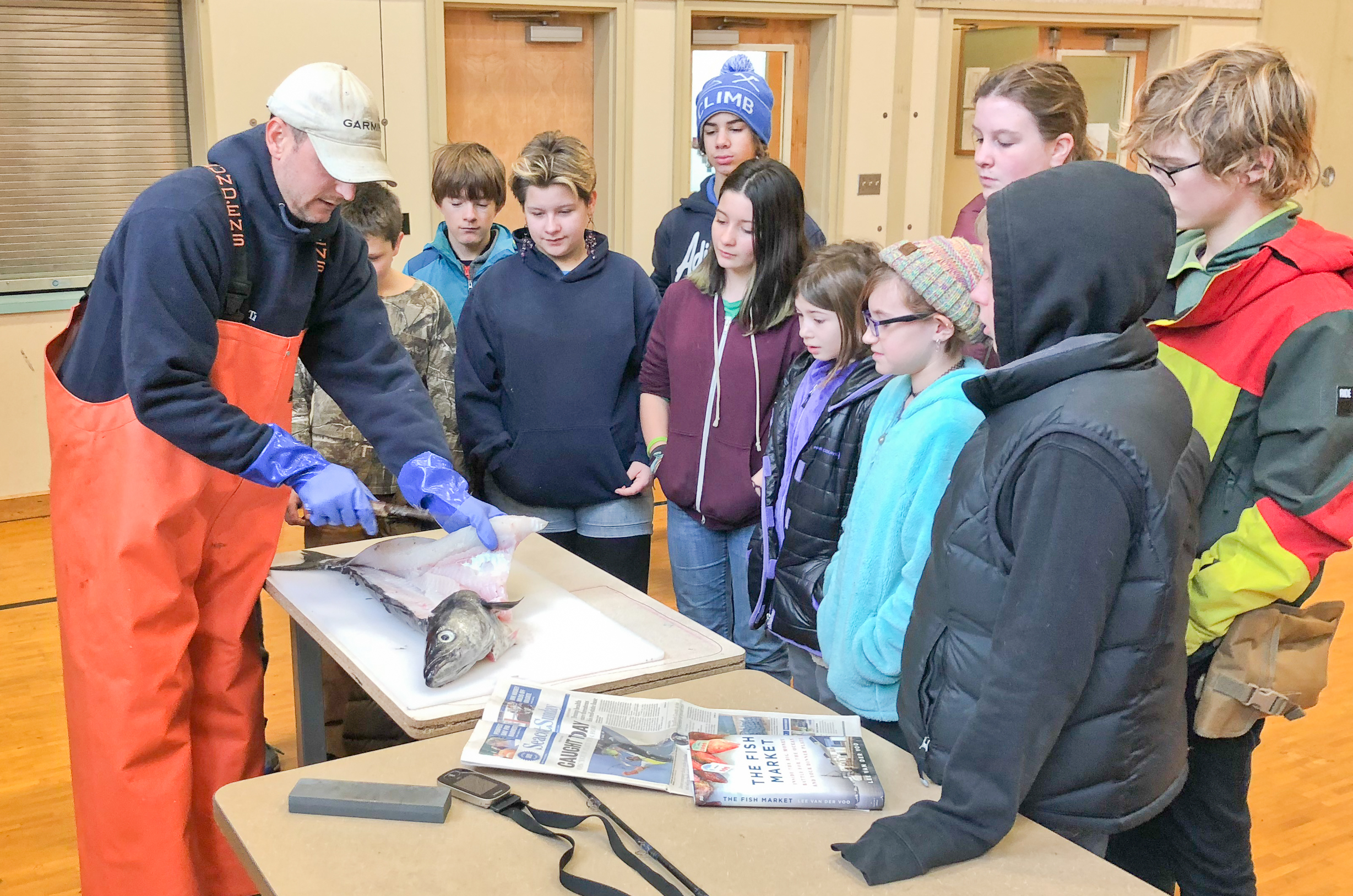
Students wrapped around the table, close, so they could get a good look as Capt. Tim Rider deftly worked the knife through the 15-pound pollock his crew had landed the day before. Neatly separating flesh from bone, he explained that filleting a fish is a matter of taking your time to be safe, but also to extract as much of the delicate meat as possible.

It’s a process he’s done many more times than he can remember. It is now automatic. For most of the middle school students at Harpswell Coastal Academy, this was a first. They asked questions about how the fish was caught, how it was bled and iced to keep it so fresh it almost looked like it could swim off the table.

They learned about the long days, the process of filleting a couple thousand pounds of fish before delivery to restaurants, stores and directly to consumers. They got an inside look at the life of a fish harvester.

This was the mission of the KNOW FISH Lunch® hosted at the school Dec. 11. We wanted students and their families to meet fishermen from their communities and learn how and why they harvest the species they do.

The gym was set up with tables framing a large rectangle with displays featuring clam rakes, lobster traps and some of the heavy steel used for scallop dredges. Students drifted from table to table with a broader perspective of the effort, process and forethought that goes into producing the seafood they eat.

They learned from Mason Warren how to put those wide rubber bands on lobster claws, occasionally getting their hands on a lobster, its claws and the bands. They learned what it’s like to bait and set several hundred traps a day, and what it’s like to get started in the business. Mason’s father is a lobsterman who travels offshore. This time of year, he and other fishermen often have to stay in port because the weather is just too dangerous (read: 20-foot seas).

Wendell Cressey discussed the backbreaking toil of bending over and digging clams and oysters out of the mud. He does mostly wild harvest, and therefore, the clam rake becomes an extension of his arms. He talked about the challenges a frozen mud flat can present in winter.

Students learned how a 2000-pound scallop dredge works from Terrance Kenney. A fisherman for decades, Kenney explained the constant  maintenance and plenty of work necessary to get scallops out of the shells and into market shape.

I had set up a table with live green crabs, some gill net, trawl net and a turtle excluder device. Several students wanted to adopt the green crabs as pets…or feed them to their dogs. Funny how live organisms with a hint of creepiness draw students close.

While eating chowder, students learned about the relationship they have to the seafood they eat. Photo: Micah Depper

The best part was the ambient buzz as students visited each harvester, shuttling in and out of the gym in three groups, absorbing the stories. At each station, students heard from small-scale local fish harvesters about how choosing locally sourced seafood affects them.

As if to illustrate the point, school chef Nicole Walker made a fabulous fish chowder using the fresh pollock provided by Capt. Tim Rider. Not too heavy, with a good balance of potatoes and seasoning, the chowder let the fish do the talking. And everyone praised the result.

While they finished off first or second helpings of the chowder, I rounded out the message with a quick discussion of the global seafood dynamic, illustrating why choosing local, regional and even domestic seafood is better for fish harvesters, the resource, the local economy and consumer health.

This was the first KNOW FISH event to bring fishermen, their gear and some of their product into a school to engage students, their parents and staff in conversations about how and why their choices matter.

By all accounts, the conversations and the food resonated, with some students saying they still have the 7 Cs of Sustainability stuck to their refrigerators at home after my visit in November.

That’s how I know the message is sinking in. So we’ll keep having these types of conversations in classrooms, or gyms or cafeterias, with students, their families, fishermen and teachers. And we’ll keep shifting the import dynamic away from imports and toward local or domestic seafood purchases.


All Blog Posts

One Seafood Conversation at a Time

  • November 14, 2018October 20, 2021
  • by Colles Stowell
Share it!
Share

One conversation at a time. That’s been my mantra for changing the seafood purchasing dynamic in the U.S. Whether I’m speaking with a 76-year-old retiree sporting a blue blazer, a group of AP Environmental Sciences students or a cluster of six-year-olds anxious to get their hands on some live green crabs.

The question comes up occasionally. “How do you keep your content fresh?” It’s a good question. A lot of the eye-popping statistics don’t move much year after year. More than 50% of the seafood we eat is farm raised, and 90% of the shrimp we eat is farm raised. The fact remains, sadly, that at least 90% of the seafood we eat here is imported. Some argue the percentage is actually 91 or 94. Either way, the number has not gone down, and it isn’t likely to change substantially in the next few years unless we have some significant policy changes.

For me, it’s not the numbers that change so much. It’s the people I’m speaking with that change. I want to democratize the message. Reach as many people as I can. Tell them the story. Answer their questions. And hopefully convince them to take those messages with them so they change their buying habits and spread the word.

Each new face or group of faces is an opportunity to spread that message. And I’ve found the most effective way to ensure the message resonates is to adapt the way I tell the story to the audience. So the method of the story telling changes too.

This varies dramatically between classrooms by age and subject and also between different restaurant demographics I may be engaging. I look at each new “audience” and venue as a challenge. How do I connect? How do I engage? How do I get them to own the conversation so they own their next seafood decision?

Rye Elementary fifth graders catching on quick that they have the power to ask smart seafood questions at restaurants and stores. Photo credit: Jennifer Halstead

I thought of these questions, as I always do, prior to a couple of school visits last month. Part of my preparation involves strategizing with the teacher beforehand about where the students are in their curriculum and what messaging would best fit with what they’ve learned or with what they will learn.

I’ve established relationships with several teachers who know what to expect. I still check in with them beforehand to make sure there aren’t any new messages they want me to introduce, or advise them of some new content or props (live mackerel, gear, etc.) One of these teachers is Doris Gianforte, a 5th grade science teacher at Rye Elementary School in New Hampshire.

As usual, when I met with her students, they were well prepared. They wanted to know more about why we import so much seafood, and why green crabs are such ecological monsters on this side of the Atlantic, and not in Europe. They couldn’t wait until they had the opportunity to ask questions at a restaurant.

Prior to my visit with 7th grade students at Harpswell Coastal Academy in Maine, I had a good discussion with their teacher Sarah Crockett. We talked about how they were in the middle of field lab work on green crabs in conjunction with an education program at Gulf of Maine Research Institute.

So we discussed introducing green crabs as a climate change marker, one that has implications for local ecosystems and shifting predator/prey relationships.

These students were also very well prepared, accurately talking about when and how European green crabs were introduced in US waters, what they like to eat and why they’re so destructive.

Harpswell Coastal Academy students learning about some measures to reduce gill net bycatch such as shorter soak times and acoustic pingers emitting signals to ward off marine mammals. Guess who didn’t get the memo about “Pajama Day.” Damn! Photo: Sarah Crockett

Students asked great questions about what fishermen and researchers are doing to minimize bycatch associated with different gear types. Like most students, getting their hands on some trawl net and a turtle excluder device helped them better understand efforts to reduce turtle bycatch in the Gulf of Mexico shrimp fishery as well as other fisheries.

These types of connections give me hope that change, real fundamental change, lies within the possibilities and ideas sparked by these conversations.

Even if it’s one at a time.


Top Photo: Harpswell Coastal Academy 7th graders getting their TED (turtle excluder device) talk on. Credit: Sarah Crockett


All Blog Posts

Attack of the Tiny Green Crabs

  • June 26, 2018October 20, 2021
  • by Colles Stowell
Share it!
Share

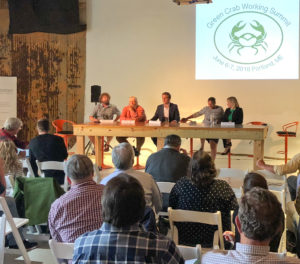
I geeked out at the Green Crab Summit in Portland earlier this month. Which is kind of ironic given that I double majored in English and French in college. I’ve always had a fascination with life in the oceans … just not enough to want to embrace organic chemistry in college or graduate work.

I parlayed my majors into a writing career that often drew on investigation to dig deeper into newspaper and magazine stories. The European Green Crab story is compelling. It’s also emblematic of humankind’s ability to alter natural balances with long-term negative consequences.

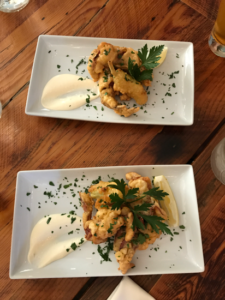
We’re working to nail down the timing of European Green Crabs here in the states. These soft shells were a delicacy at Enoteca Athena in Brunswick, Me. Photo: Marissa McMahan.

Abundant in Spain, France, Italy and other European countries, the green crab is not the frighteningly destructive, ecosystem-tipping species that it is here in North America. Many predators there like fish, crabs and birds help keep green crab populations in check. And Italian fish harvesters and chefs have figured out how to create a market for soft-shell Mediterranean green crabs (a slightly different species than the crabs we have here), as well as a top-dollar market for green crab as bait.


That’s not the case on this side of the Atlantic. The crabs were first officially documented between New Jersey and Cape Cod in 1817 after presumably hitchhiking aboard trans-Atlantic ships in the ballast. Their spread up the coast was steady and relatively uninhibited. To be sure, some were gobbled up by native species here such as striped bass, tautog, lobster, blue claw crabs and other species. But they weren’t and aren’t the regular diet for native species here as in Europe, and therefore they continue to spread.

Different story for other invasives, though. We’re now finding that the newly invasive Asian Shore Crab (first noted in 1988) seems to be displacing and possibly preying upon green crabs, dropping their populations significantly along rocky intertidal zones in Southern New England and heading northward as the water warms. However, we’re kind of swapping out one pest for another.

Christopher Baillie of the Marine Science Center at Northeastern University said Asian Shore Crabs are “generalist eaters” that may have an appetite for many native species such as lobsters, Jonah crabs and molluscs. While there are some Asian Shore Crabs already in Maine, he said they may be up here in bigger numbers in the near future. That’s not good considering they’re rampant in southern New England, where they’ve changed ecosystem balance by dominating once diverse habitats, with densities of up to 200 crabs per square meter.

Tough little buggers

Green crabs are tough, voracious, fertile and very hardy. They can live for days out of water. One crab can eat up to 40 mussels a day and lay 165,000 eggs a year. They are adapting to winter, which seems to be changing their spawning habits. They decimate vital eel grass beds while rooting out mussels, oysters and soft shell clams.

It’s the soft shell clams that have suffered the most at the claws of the green crabs. Casco Bay has witnessed a 70% drop in soft shell clam populations in the past decade. Maine’s landings have dropped from 8 million pounds in the 1970s to 1.5 million in 2016. Recent studies suggest that without significant steps to protect larval clams, 99% of the settling clams (the larval and growing stage molluscs) will fall to predation, and much of that comes from green crabs. Milky ribbon worms have also become a big problem.

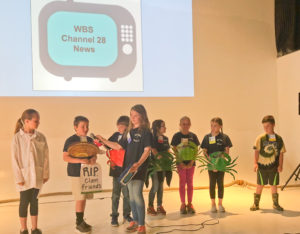
The news was even bleak on the West Bath School Channel 28 News, as students showcased what they’ve learned about green crabs…that they’re devastating to soft shell clams.

Adaptation will be central to protecting the soft shell clam industry and co-existing with green crabs, according to several researchers at the summit. As Sara Randall of the Downeast Institute put it, “We have to think of green crabs as a permanent part of our ecosystem. We need to be active, not passive.” Sara was part of a team of researchers that sifted through more than 34 tons of mud in a four-year study to determine what’s happening with soft shell clams and devise strategies such as protecting larval clams in screened boxes in tidal flats that would keep out green crabs.

However, as with everything concerning green crabs, it’s not that easy. Brian Beal has been studying green crabs and their impact on intertidal ecosystems for more than 30 years. A professor at the University of Maine at Machias, Brian has been outspoken about adapting to the new reality of green crabs and their impacts. “Population control is unlikely and impractical. They can’t be fished out,” he said, explaining that we’re talking about billions of organisms based on several trapping studies throughout the Gulf of Maine.

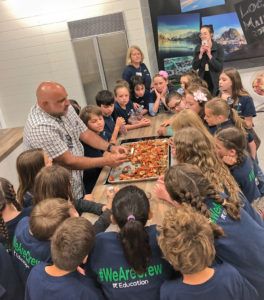
Commercial fisherman Jamie Bassett showing West Bath School students how to extract crab roe.

Green crab bisque, anyone?

One of the common discussion threads was finding ways to make humans the alpha green crab predator. How can we create culinary markets to make green crabs an attractive seafood choice? Again, it’s not so simple. First, their size means there’s little meat yield. And they’re built like tanks, so there’s a bunch of effort to get a small portion of meat.

Second, we Americans have a track record of following habit and price when making seafood decisions. This explains in part why 90% of the seafood we eat is imported. It’s cheaper and hews to menu selection we are most familiar with. Shrimp, salmon, tuna, etc. Collectively, we aren’t adventurous, and so, since we haven’t been eating green crabs for centuries, as they have in Italy (again the slightly different Mediterranean green crab), creating the marketing campaign to get us to start eating vast quantities of green crabs is a hard sell.

Chef Ali Waks-Adams laid down some green crab rangoon.

I know several chefs in coastal Maine and New Hampshire who are ready and willing to give it a go. Soft shell, stock, mixed in to other dishes. For example, at the event, Chef Ali Waks-Adams (executive chef at the Brunswick Inn) prepared delicious green crab Rangoon using mince (crabs that have been finely ground up, shell and all into a flavorful paste). She also demonstrated how to fry up the small crabs in a batter and eat them like popcorn. Chef Matt Louis (executive chef/owner of Moxy and The Franklin in Portsmouth, NH) created an inventive green crab pozoles dish and a delicately flavored green crab arancini. All of the food we sampled showed the tasty possibilities.

Chef Matt Louis using green crab for a pozoles, a traditional Mexican stew with hominy.

We still have a bit of research to do to nail down the soft shell season for green crabs. That’s because we don’t have the centuries of research the Italians do, and because the green crabs here seem to be adapting to the warming waters of the Gulf of Maine, which seems to be changing when they molt, or shed their old shells. Also, it’s easier to identify pre-molt Mediterranean green crabs than the species in the U.S.

Adapt or get run over

But even if we do create a viable market, we aren’t likely to make a huge dent in the green crab population. “The variability in density and mean size [of the crabs] will make it difficult to create a dependable fishery,” said Beal.

He also dropped another theory that raised several eyebrows. Clams aren’t just worried about the typically sized 3-inch or bigger crabs, but the 3 millimeter crabs feasting on clams that are half a millimeter in width. And it’s going to be damn hard to do much about those little s—s.

Beal agreed with others that adaption will be key, and we’re going to have to make some dramatic changes to the soft shell clam industry if we want to protect it. Some of his suggestions included increasing the amount of clam farming that now occurs, changing the size limit on clams to allow for the prime breeders to reproduce, and closing certain areas along the coast from May to July to allow for more productive spawning.

Some of the green crab brain trust discussing policy and other issues and how we need to continue to research and collaborate to better adapt to the new reality of Carcinus maenus.

We heard about one success in green crab mitigation in Canada from Gabrielle Beaulieu of Kejimkuik National Park Seaside Parks in Nova Scotia. She explained how a team of staff and citizen scientists harvested more than 2 million green crabs over a 10-year period. Following the intensive trapping and removal of the crabs, researchers noticed significant gains in eel grass recovery (in areas that crabs had mowed down) and soft shell clam populations.

Green crabs pose a significant threat to several commercially vital species in the Gulf of Maine. I agree with Brian Beale that putting a bounty on green crabs alone isn’t going to make a huge dent. However, I agree with others at the conference that we’re going to have to adapt, and implement a multi-pronged approach to mitigate the challenges. We’ll need to have some widespread harvest/green-crab-as-food markets opened up, along with raising public awareness both about the ecological threat and the culinary benefits of green crabs. We’re also going to have to take some significant steps as Brian mentioned to safeguard species like soft shell clams.

And yes, we need to devote more time, effort and financial resources to figuring out how to address this problem, and the looming time bomb of the Asian Shore Crabs. Knowledge is power … In this case, the power to adapt, rather than be overrun.


All Blog Posts

Students Teaching Students

  • May 24, 2018October 20, 2021
  • by Colles Stowell
Share it!
Share

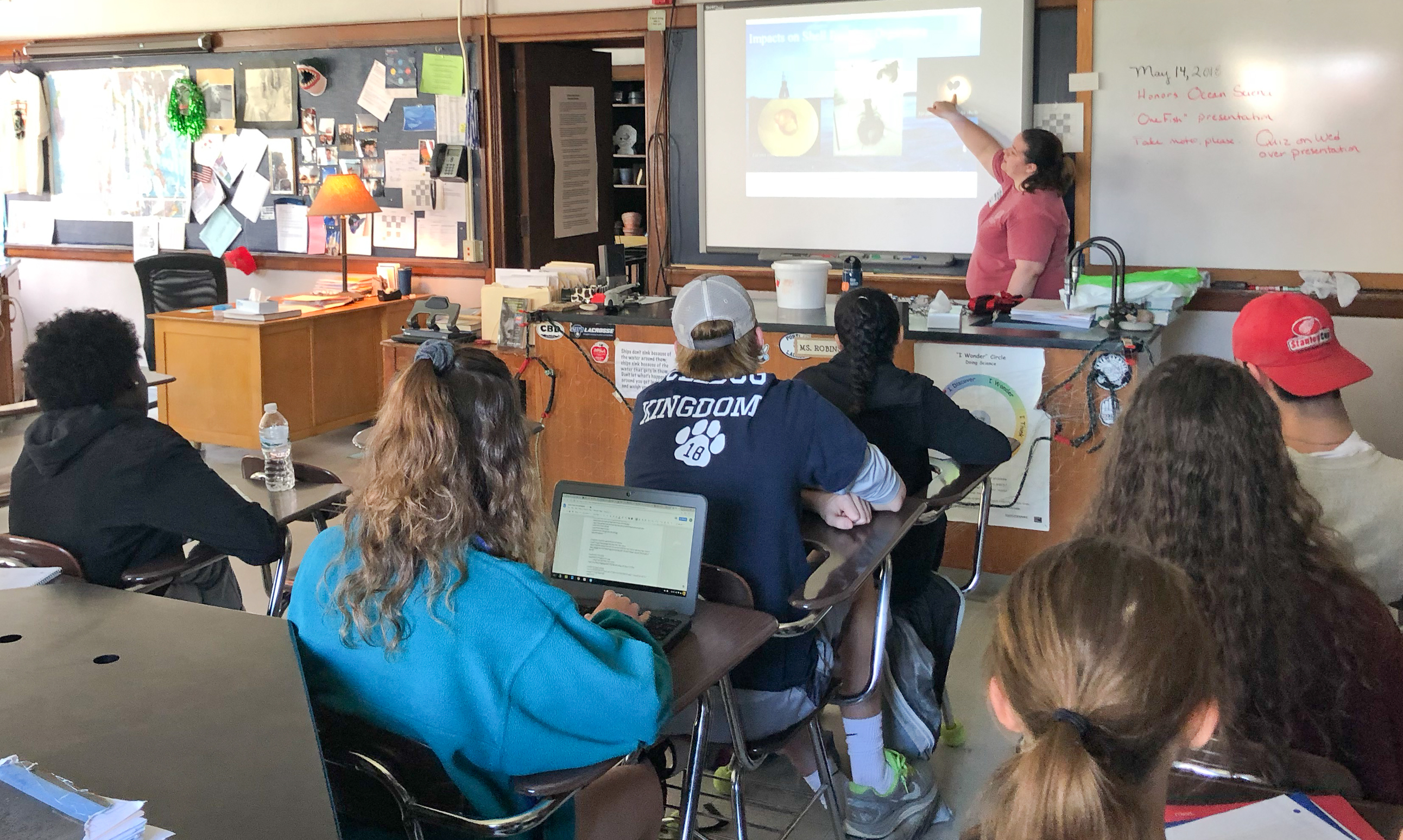
Last week, One Fish Foundation visited Portland High School for the third year in a row to discuss seafood sustainability with seniors taking a Marine Sciences course. Intern Jennifer Halstead, a senior at the University of New Hampshire, adeptly presented a clear, concise and digestible explanation of ocean acidification and how it is affecting cornerstone Gulf of Maine species like lobster and mussels. In this guest blog, Jennifer discusses the importance of taking advantage of opportunities to speak to students and community members about ocean acidification, other challenges our oceans face with climate change, and why we all need to be involved.

By Jennifer Halstead

Speaking to a crowd of people, no matter the size or demographic, can be at once daunting and rewarding, especially for a college student. Truly. It’s empowering to have people listen to your words. It’s uplifting to have them ask questions and even challenge your ideas.

Talking to a small class of students at Portland High School last week was no different. Ocean acidification (OA) is something that’s not easy to wrap your head around, but these students understood the urgency related to the issue. If at least one of them continues to ask questions and be curious, I feel as though I did my job.

Sadly, we don’t know how acidification is going to impact lobsters, one of the most important economic industries in Maine (the entire industry, including the supply chain is valued at over $1 billion). [Lobster harvests already face threats from the rapidly warming Gulf of Maine. A recent study suggests the lobster harvest could decline by as much as 62% by 2050 if the Gulf of Maine keeps warming at its current pace].

As concerned citizens and scientists, we need to start asking more questions and demanding more answers. And that is how we create change. The power is in your hands – our hands – to save oceans and our beloved lobster rolls.

I’ve spent a good portion of my college career learning about OA. Unfortunately, while our understanding of the impacts of OA is growing, OA is occurring more rapidly than we can keep up with in some places, including the Gulf of Maine. The West Coast has dealt with OA fallout, such as steep declines in oyster hatchery production in 2005, which threatened economics and 130 years of oyster hatchery history. In the Gulf of Maine, we haven’t seen complete devastation yet, but top scientists fear that it’s coming, and so do I.

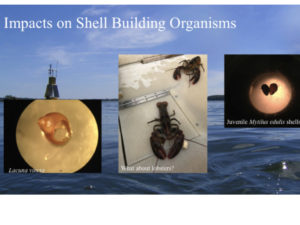
Part of Jennifer’s research on OA: a type of sea snail on the left, and blue mussel on the right. Both the sea snail and the half mussel shell you can almost see through (on the right) were exposed to acidic water. Increased acidity in the ocean weakens many shellfish’s capabilities to calcify their shells and protect themselves from disease. Credit: Jennifer Halstead.

We understand climate change impacts like OA, temperature, salinity, and currents, but not the details of how they interact and impact different species. We don’t understand the entire system. We only understand the pieces. Imagine trying to put a puzzle together with no idea what the end result is supposed to look like. That’s the immense challenge of trying to understand climate change impacts here in the Gulf of Maine and elsewhere; things are happening now that we won’t fully realize for several months, or even years.

To move forward and get research to catch up with the changes in the Gulf of Maine, we need the public’s interest and support. We need people to ask questions and demand answers. Spreading the word about these issues through presentations and hands-on demonstrations is a key piece to garnering support for these causes. Every time I stand in front of a group of people and talk to them about acidification, I can see us moving forward. Future generations are interested in problems, but even more interested in pushing for solutions.

As a college student, I often get asked where I see myself in 5 years, or what I want to do after I graduate. My broad answer is that I hope to be doing something to change the world for the better. To do that, I’ll keep standing in front of crowds of people, telling them about problems our oceans face, and asking for their help in saving them.

All Blog Posts

Opening Eyes and Providing Hope

  • March 23, 2018October 20, 2021
  • by Colles Stowell
Share it!
Share

Every class I speak to has a different dynamic. Aside from age and geography, there are other variables such as social fabric/personalities, ranges of interest in marine sciences, topics already covered in their curricula. These variables can sometimes determine how fast I make connections and get students engaged in the conversation.

This is why I work with teachers in advance to get a sense of the class dynamic and ensure I weave my message into content the students can relate to, either because they have already covered some of the material, or are about to do so.

Such was the case this week when Jennifer Halstead, One Fish Foundation’s intern, and I visited Thornton Academy in Saco, Maine. We had the pleasure of speaking to two groups of seniors. One was a group of AP Environmental Science students already conversant in eutrophication, ocean acidification and thermohaline circulation.

That background knowledge allowed us to dive deeper into issues around environmental impact of industrial aquaculture such as algal blooms (see Chile in 2016), net pen escapes (see Cooke Aquaculture last August) and feed (see West Coast of Africa…ongoing).

The key to successfully engaging students in the discussion about seafood sourcing and personal choices is connecting them emotionally to the narrative. When students care, they join the conversation and carry the salient points with them going forward…hopefully.

As Jennifer walked the environmental science students through how ocean acidification can impact shellfish ability to calcify protective shells, they immediately connected with the images of larval sea snails and blue mussels, both clearly compromised by more acidic waters.

Students in the senior marine science class engaged in the discussion about why European green crabs are capable of significantly shifting ecosystem balance. Naturalized “residents” in North America since the early 1800s, green crabs are everywhere. You can scarcely turn over a rock without finding at least one along New England coasts.
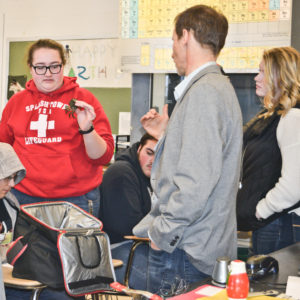
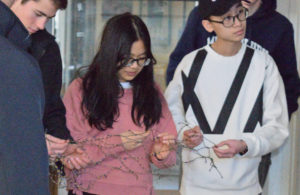
They are fertile (students were surprised to hear that one female can lay up to 190,000 eggs in its lifetime), hardy (they seem to be adapting to winter and changing their spawning habits) and very destructive. They are also voracious eaters. While handling some live crabs, students learned that one crab can eat up to 40 mussels in a day. To get to larval mussels, clams and oysters, green crabs tear up vital eel grass beds, which are precious nursery habitat for a host of species such as hermit crabs, sea snails, other shellfish and even smaller bait fish.


Can you eat this thing? Well, yes, but not easily.

Students asked good questions about what we are doing to try to become the predator that keeps green crabs in check. They learned some chefs make seafood stock with the crabs, while others are working with researchers from the Island Institute, New Hampshire Sea Grant and the Massachusetts Department of Marine Fisheries to determine when the crabs molt. Doing so would help them harvest crabs to cook up as tasty soft shell crabs, just as you’d find in the south.

In both classes, we discussed some of the challenges fishermen, scientists and policy makers must address in ensuring different seafood stock health in the face of issues like climate change, bycatch, industrial scale fishing and aquaculture and environmental impact.

And as we discussed how the fast changing Gulf of Maine affects local species and introduces new invasive species, we also discussed ways the industry is adapting to these changes. Rather than rob students of hope, we talked about our need and ability to adapt to, not solve, climate change and its impact on seafood in the Gulf of Maine.
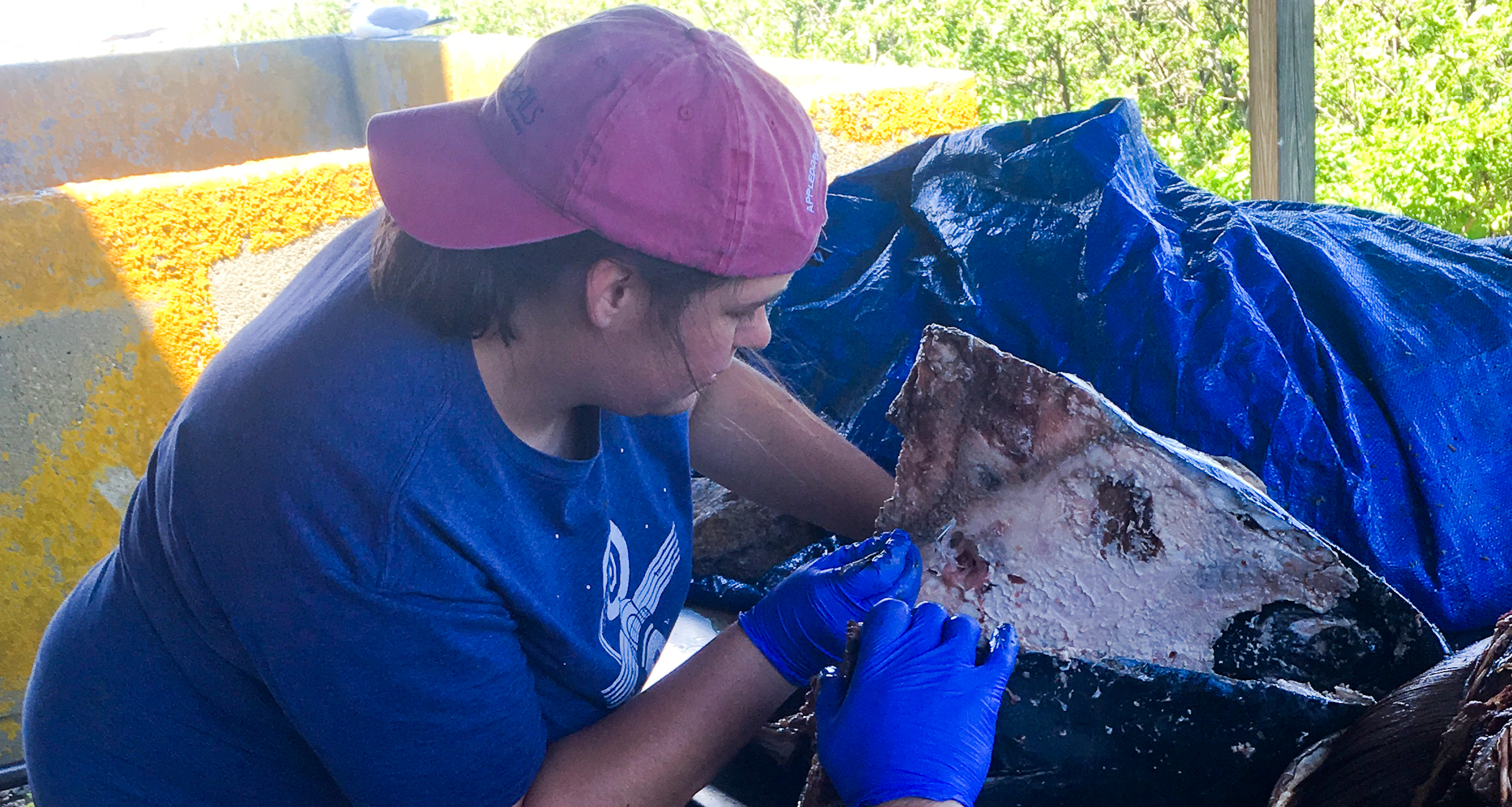
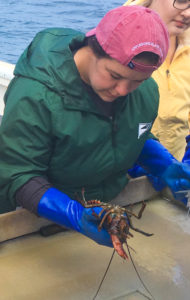
 

All photos credit: Jennifer Halstead


All Blog Posts

A College Student Walks into a Webinar…

  • November 23, 2017October 20, 2021
  • by Colles Stowell
Share it!
Share

One Fish Foundation Intern Jennifer Halstead is a senior at the University of New Hampshire. She has been instrumental with several One Fish projects, including the coordination of the recent Webinar co-hosted by One Fish Foundation and Local Catch, Fisheries Management: Best Available Science May Not Be Good Enough. Below is her take on the Webinar from the perspective of a college student, and why we should include college students in these discussions more frequently. And she’s right. Why wouldn’t we want to empower future leading researchers, fishermen and policy makers with a broader perspective and a voice?


By Jennifer Halstead

I had to drive to a neighboring town to run some errands immediately following the webinar, and I had a million thoughts swimming around in my head. So, I did what any millennial would do, and I used my smart phone to take notes for me, setting it to record as I drove.

Listening to the recording later, I realized some critical points. First, I was extremely fired up and passionate about the issues, and even a little angry about some of them. Second, I recognized through this webinar that the scientists, fishermen, and others taking part in the conversation represented a broad range of backgrounds and viewpoints, but were united on one theme: that the current fisheries management model doesn’t work for this extremely dynamic, and rapidly changing ecosystem.

Being a college student in marine sciences is exhilarating and intimidating. We’re presented with myriad challenges and questions, and rarely presented with solutions. We’re kind of left in limbo: We have a strong knowledge base, but a wide-open area to apply it, and we’re walking into a field of open-ended questions that have been asked for decades.

The curriculum of marine sciences now has a large portion of time allocated to climate change-related topics and challenges. As students, we’re presented with climate related disasters in all our classes. Not only is this depressing, but the lack of tangible solutions can take away our hope for our future in minutes. Being able to be part of an active discussion about how to change that as part of this Webinar put the last four years of me hearing about these unsolvable problems into a different perspective. I know we need change, because that’s what I’ve paid tuition to learn. An entirely different story starts when I hear other people talking about change, however. Suddenly, there’s a light ahead, collaboration forms, and solutions start to appear to all of those previously unsolvable problems.

Determining lobster sex aboard the F/V Vivian Mae this summer.

I was emboldened by hearing fishermen and scientists talk about how different, fast-changing dynamics throughout the Gulf of Maine necessitate a different data approach: one that is more localized. Hearing them talk about a solution motivated me to keep moving forward and not feel as overwhelmed by the issues. We as college students will listen and take heart when authoritative voices such as fishermen, council members and scientists uniformly agree on the need for change and discuss possible solutions. Hopefully, these credible voices will resonate with the larger community.

To move forward, we need to analyze the current model and determine what the problems are that are highest in priority to address. In addition to this, we need to keep the conversation going, and keep working toward common goals.

The current data collection model is a One-Size-Fits-All model, but the consensus of the discussion was that one size does not fit all. Therefore, the current model is not doing its job and needs to change. The Gulf of Maine is an extremely dynamic region, with highly productive areas, multiple spawning areas and freshwater inputs. Unfortunately, it is feeling climate change impacts at an alarming rate. In a system with this many moving parts, we should not be employing a model that is rigid. Instead of adjusting this model, however, it may be easier to start with new ideas. Relying on data from random trawl surveys that occurred three years ago is not a solid foundation to build a management plan on.

So, let’s change the way we collect data. Fishermen are out on the water every day in different areas, looking for different target species and making different observations. Why not make their observations available for scientists to use, creating an up-to-date, usable set of data? Up-to-date data means that the moving and fluctuating parts of the system can be more accurately accounted for, and we can develop more accurate and successful management plans more quickly. Collaboration between fishermen and scientists when it comes to collection of data and observations is important. It helps refine the current model and bring the sides together while doing it.

A large part of creating change and addressing these problems exists in the need to have active discussions. Everyone sitting at the table, simply discussing the challenges, could lead to change. Different perspectives bring different ideas, and then solutions can start to form. College students taking part in such discussions and offering their perspectives could be integral to the formation of such solutions. That involvement would also likely encourage them (as it has with me) to dive deeper into the issues and help find solutions, rather than be overwhelmed with fear and gloom.

Along with this, it is imperative that all stakeholders be involved in these discussions. If we want to use data that fishermen collect, for example, we need to make sure they’re on board with the idea, and we need to see how much they’re willing to do to create a better system. If too much is put on the fishermen’s plates, or on the plates of any other group for that matter, the new method will work as effectively as the current one. It won’t.


Jennifer Halstead is a senior at University of New Hampshire studying marine biology, and intern for One Fish Foundation.

Top Photo: Jennifer extracts the otoliths (ear bones) of a bluefin tuna to determine its age.

All Blog Posts

Making Good Impressions

  • October 21, 2017October 20, 2021
  • by Colles Stowell
Share it!
Share

Ten- and 11-year olds are very impressionable. I’m reminded of this every time I speak to a fifth grade class and start talking about bycatch and imported farmed shrimp. Their eyes get really big when I talk about how some foreign aquaculture producers use antibiotics to try and prevent disease, or when I show them videos of some bycatch issues with longline and gill nets.

So I’m quick to tell them about some measures to mitigate bycatch, such as changing hook types or using turtle excluder devices. They love handling the big hooped nets. We talk about different harvest methods that have lower ecological impact, and that innovation continues to lessen direct harm.

I show them a pie chart and ask them to choose either the really small slice set aside, or the rest of the pie to represent the domestically harvested seafood eaten in this country. Every now and then, one student will choose the small slice either playing the odds or actually knowing the reality. I love to watch the class discuss the answer and perhaps change their minds. When I tell them the larger section or 90% of the pie represents imports, they don’t mask their surprise.

I taught three 5th grade science classes at Rye (NH) Elementary School last week, and took note of students’ interaction with these potentially daunting topics. Typically with classes along the coast, a majority of students raise their hands at the outset when I ask how many like seafood. For those who don’t, I be sure to acknowledge that and tell them that it’s important to understand our relationship to, and impact on the resource, even if we don’t eat it.

The students at Rye Elementary were, as usual, well informed, inquisitive and engaged in learning about where seafood comes from. They were interested to learn about bivalve aquaculture in Maine, and why forage fish such as the mackerel they see right off the docks play a crucial role in the marine food webs.

We talked about gear selectivity, invasive species (live green crabs are always a hit) and that buying locally harvested seafood supports local fishermen in the community. And we talked about their responsibility to ask questions at restaurants and seafood stores.

Each class has a different personality and energy level. So we adapt the content and conversation to those variables and engage as many minds as possible.

Every time I teach a few classes in a row, I walk away energized by the fluidity and enthusiasm of the conversation … and a bit drained. Each class I teach is a renewal of my respect and admiration for teachers who do this day in and day out. This is especially true for teachers helping to stimulate young, impressionable minds.

All Blog Posts

Getting Hands Wet and Talking Seafood

  • August 4, 2017October 20, 2021
  • by Colles Stowell
Share it!
Share

Every time I speak to a group of students, campers, adults, etc. I learn something.

First, I learn what the audience knows and doesn’t yet comprehend about seafood sustainability in broad terms. I learn who in the audience is more ready to engage in discussion, who wants to challenge pre-conceived notions, and who isn’t really into the conversation.

Depending on the age group and location, these types of interactions can sometimes provide glimpses into a community’s overall seafood IQ. Observing students while I teach a class also provides a mirror of how effectively I’m getting the message across.

Gill nets are hard to see on land as well as in the ocean. Photo: Rich Harty

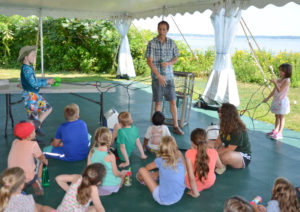
My first observation at the Seacoast Science Center in Rye, N.H. this week was how lucky the Seaside Safari campers were to have such a program. Set on the shore near Odiorne Point, surrounded by acres of tide pools loaded with lobsters, green crabs, seaweed, etc., the camp provides direct, hands-on access to coastal marine ecosystems. Campers handle live green crabs while learning about invasive species; they turn over rocks and hunt for juvenile lobsters while learning about food webs; they talk about the warming Gulf of Maine while learning about climate change.

I wish I had access to a program like that at that age.

So it was a privilege to learn some things from these campers as we chatted. I re-confirmed that green crabs are a very effective, hands-on prop … almost to the point of distraction when they started fighting.

I learned that these campers, when prompted, were generally eager to learn how seafood ends up on their plates. They wanted to know how a turtle excluder device works, and its impact on reducing bycatch.

Demonstrating the escape hatch for turtles. Photo: Rich Harty

Some campers who had fished recreationally before were genuinely surprised that some fishermen use rod and reel to fish commercially. They were intrigued by the weight of the 14 oz jig used to get the flies down 400 feet to where the haddock, cod and pollock are.

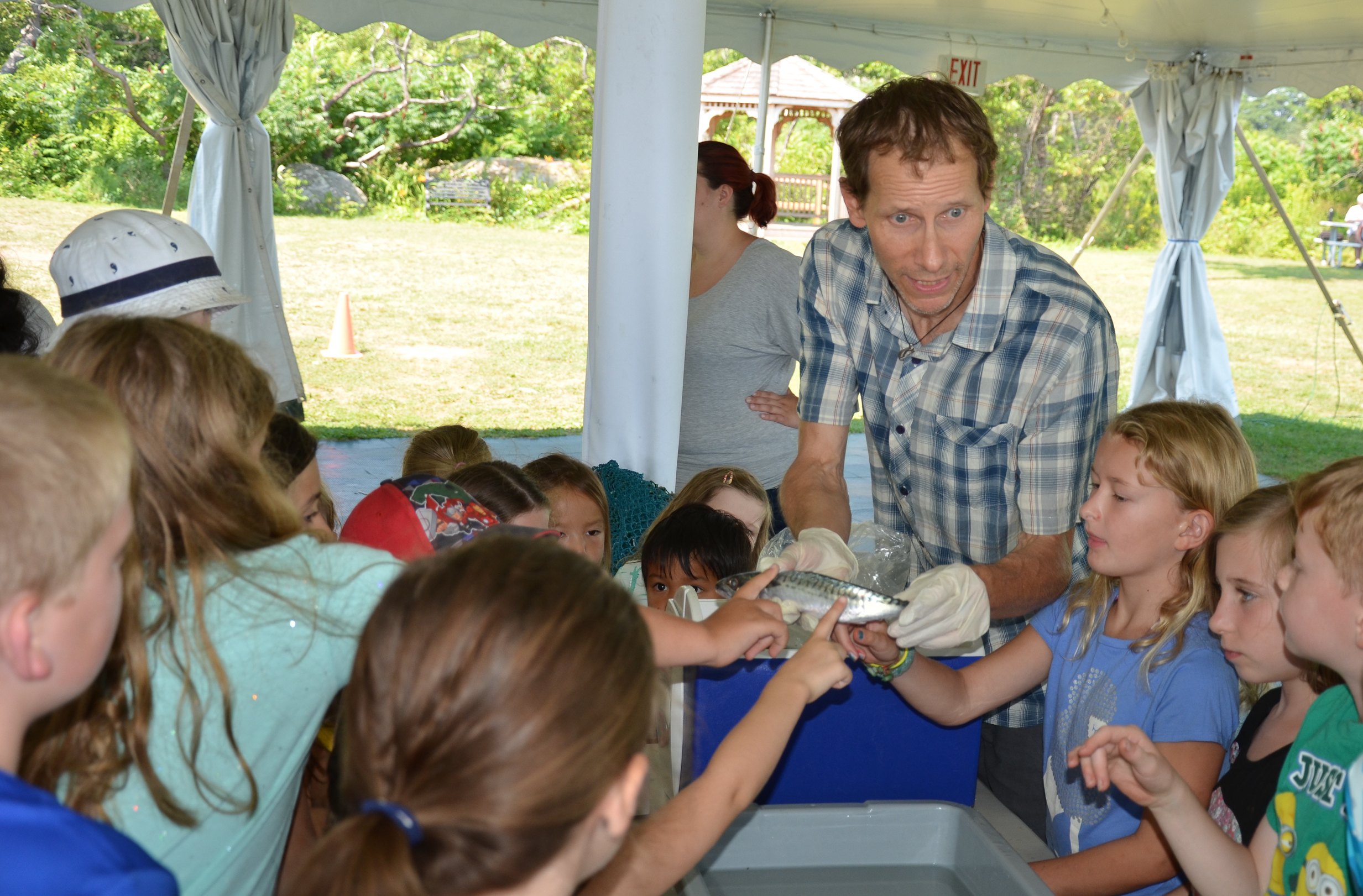
They were also pretty enthusiastic about touching the dead Atlantic mackerel while learning that mackerel are one of several forage fish species that are very important to seafood webs.

And they began to see their relationship to the seafood they eat.

And I learned, once again, that I love what I do.

Posts pagination

1 2 3

Recent Posts

  • Hurricane Ida wreaks havoc on Louisiana’s seafood industry
  • EPA Should Use Clean Water Act To Kill Zombie Mine
  • Slow Fish 2021: Relationship Matters
  • Faith, Façades, and Futility
  • Pebble Permit Paused: Politics at Play

Archives

  • September 2021
  • August 2021
  • April 2021
  • December 2020
  • August 2020
  • June 2020
  • February 2020
  • December 2019
  • November 2019
  • October 2019
  • July 2019
  • May 2019
  • April 2019
  • March 2019
  • January 2019
  • December 2018
  • November 2018
  • June 2018
  • May 2018
  • March 2018
  • February 2018
  • January 2018
  • December 2017
  • November 2017
  • October 2017
  • September 2017
  • August 2017
  • July 2017
  • June 2017
  • May 2017
  • April 2017
  • March 2017
  • January 2017
  • December 2016
  • November 2016
  • October 2016
  • September 2016
  • August 2016
  • July 2016
  • June 2016
  • May 2016
  • April 2016
  • March 2016
  • February 2016
  • January 2016
  • December 2015
  • November 2015
  • October 2015
  • September 2015
  • July 2015
  • June 2015
  • May 2015
  • April 2015
  • March 2015
  • February 2015
  • January 2015
Theme by Colorlib Powered by WordPress