Skip to content
One Fish Foundation
  • Blog
    • Aquaculture
    • Education
    • Environment
    • Policy
    • Wild Harvest
    • Fish Tales
  • About
    • About One Fish
    • About Colles Stowell
  • Education
    • Elementary School
    • Middle School
    • High School
  • KNOW FISH Dinners®
  • Resources
    • One Fish Podcast
    • One Fish Foundation in the news
    • The 7 C’s of Sustainable Seafood
    • Newsletter Archive
    • Recipes
      • Skate with Capers and Butter — Chef Rizwan Ahmed
      • Grandma Davis’ Fish Chowder — Jane Almeida
      • Ginger Garlic Tamari Scallops — Colles Stowell
      • Fish Stock — Evan Mallett
      • Mussels San Remo — Chef Rob Martin
      • Salted Pollock Croquettes – Chef Mark Segal
  • Connect
    • Contact OneFish
    • Social
      • Instagram
      • Facebook
      • Twitter
All Blog Posts

Fisheries Policy A Mixed Bag

  • April 26, 2016October 20, 2021
  • by Colles Stowell
Share it!
Share

The Magnuson-Stevens Fishery Conservation and Management Act (MSA) turns 40 this year. This is significant for fisheries because the law has been the backbone for management policy since its implementation in 1976.

And that fisheries policy is largely working, according to the 2015 Status of the Stocks released by NOAA last week. In short, the annual report boasted the percentage of domestic fish species that are overfished is near record lows. Thirty-nine fish stocks have been rebuilt since 2000 because of effective management policies, (up from 37 stocks in 2014), says the report. The number of stocks experiencing overfishing (when the harvest rate exceeds the stock’s ability to sustain harvest) has increased by 2 since 2014. The number of stocks that are overfished (when the population is too low and may not be able to support harvest) has increased by one to 38 since 2014.

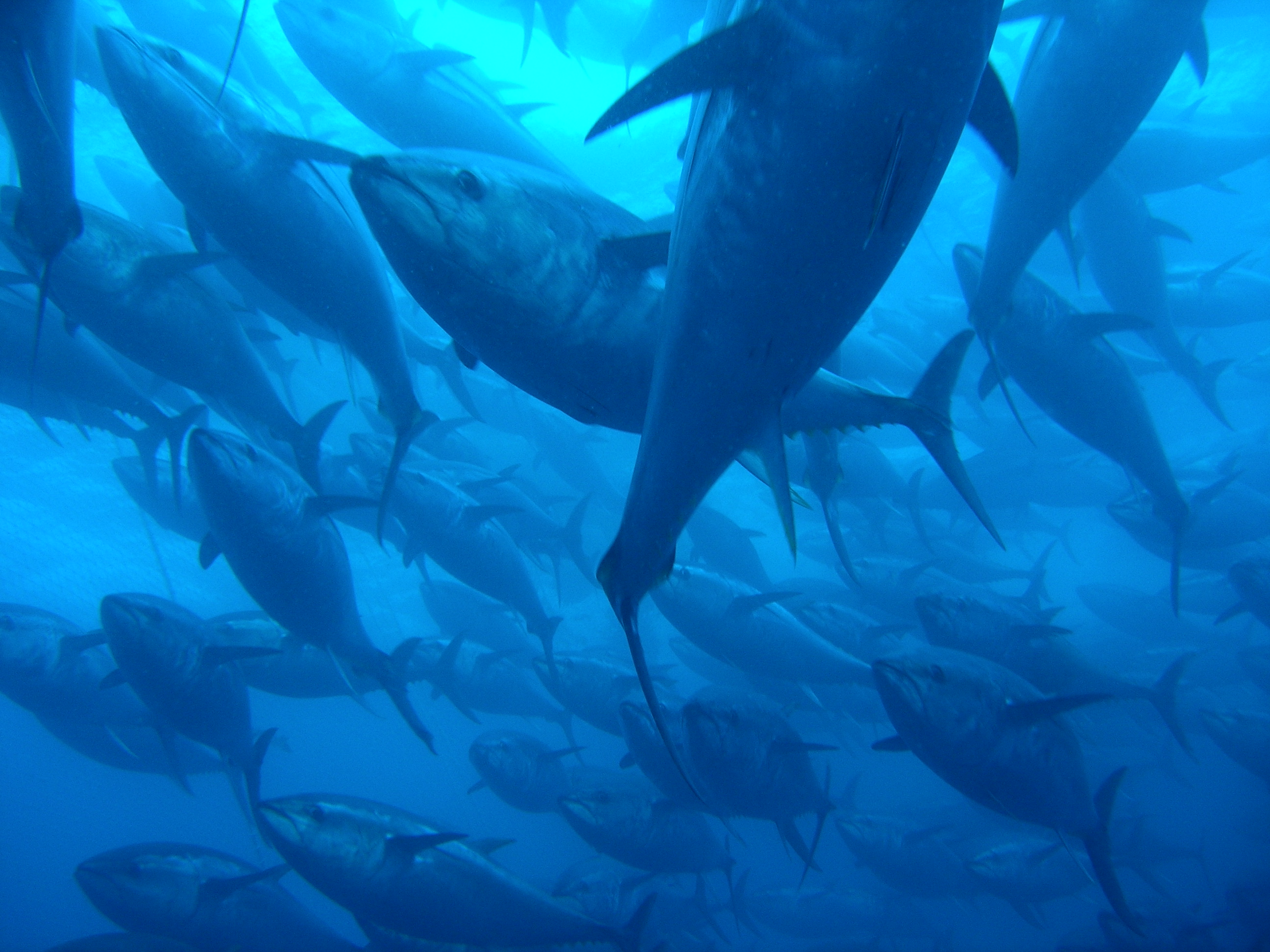
Some of the lowlights of species still considered under threat by NOAA’s standards: Atlantic cod (no surprise), Atlantic and Pacific bluefin tuna (no surprise), Atlantic salmon (longtime resident on this list), red snapper (ditto), different species of flounder, different shark species, Chinook and Coho salmon in different areas of Washington state, Atlantic halibut and Pacific swordfish.

To be sure, a lot of work goes into compiling these reports. And it gives a general barometer of fisheries in US waters, even if some of the species, such as bluefin tuna, are highly migratory and thus, fished by international fleets.

NOAA calls out the annual catch limit as an effective tool for ensuring against overfishing. One of the more recent “tools” added to the NOAA anti-overfishing toolbox is the individual transfer quota (ITQ). In essence, a certain fishery has a certain amount of quota that is available to fishermen…for a price. Fishermen can buy and sell quota within their regulated area just like stock traders can with stocks. The concept was to allow fishermen to self-regulate while managing to a catch limit.

scr_235573_24667

Unintended consequences

The unintended consequence shifted control from the pool of local fishermen to a select few with the money to buy up all of the quota. As quota became more expensive, more smaller scale fishermen were forced out of the equation. So not only is the ITQ system skewing access and control of the fishery away from local commercial fishermen, but it’s actually encouraging greater fishing pressure on the resource by larger operations who care more about profit than the health of the resource.

Many fishermen argue it is this environment that fueled the ascent of large operators, such as Carlos Rafael, the New Bedford distributor arrested last month on fraud charges. Authorities allege that he hid actual catch volumes and mislabeled fish in a scheme to sell regulated species to buyers in New York for bags of cash. He is currently under “house arrest” wearing an ankle bracelet that monitors his whereabouts and ensures he abides by his curfew.

Fisheries management is a complex issue. There’s no one-size-fits-all formula that provides equal protections for Atlantic Striped bass and Pacific Ocean perch. Different species in different ecosystems with different complexes of predator prey relationships and environmental factors require specific, targeted policies to account for all of these variables. And that doesn’t fully encompass the calculus of ecosystem-based management (managing fisheries not just by the narrow window of one specific species at a time, but as an entire ecosystem from plants up to alpha predators like sharks).

It’s hard to get it 100% right.

Magnuson-Stevens provided the framework that has evolved to the point where specific species management is possible. But the scale of the framework and sheer administration needed to manage such a menagerie of diverse fisheries has created what some fishermen see as a type of caste system where the well funded “inherit” the right to control large chunks of the US fishery. Smaller-scale fishermen who depend on the resource for their lives are forced out, and the resource suffers.

Mssing in this equation is a key tenet described in the amendment and renaming of the law in 1996: “Conservation and management measures shall not discriminate between residents of different States. If it becomes necessary to allocate or assign fishing privileges among various United States fishermen, such allocation shall be (A) fair and equitable to all such fishermen; (B) reasonably calculated to promote conservation; and (C) carried out in such manner that no particular individual, corporation, or other entity acquires an excessive share of such privileges.”

So yes, Magnuson-Stevens has provided a critical framework for managing a hugely diverse network of fisheries in U.S. waters. Better science gives us a more realistic idea of what is happening in our marine ecosystems, and policies are in place to help avoid fishing beyond capacity. But there is also room for improvement. Effective fisheries policy must include all stakeholders, including small-scale fishermen. Failure to do so has made the system vulnerable to fraud and disparity that hurts fishermen, consumers and the resource.

A better, more democratic approach that lets everyone have an equal voice is surely available. We just need to break the longstanding habit of repeating the same mistakes.


Photo credits: NOAA
All Blog Posts

Climatologist Sees Climate Change as Innovation Opportunity

  • April 11, 2016October 20, 2021
  • by Colles Stowell
Share it!
Share

Cameron Wake is used to being called “Dr. Doom.” He’s an ice core paleoclimatologist at the University of New Hampshire who’s been studying glaciers and their behavior for more than 30 years. He’s been on the forefront of some of the leading research into climate change, much of which now predicts more than six feet of sea level rise by 2100. That’s not fully accounting for the possible 20-25 additional feet of higher water if all of the earth’s glaciers melt.

So naturally, he does his best to be optimistic.

“Climate change is the innovation opportunity of the 21st century,” he says, whether at a climate summit hosted by MIT Seagrant in 2014, or at an intimate gathering of 200 in Portsmouth, N.H. on March 28. Even though the range of possible sea level rise jumped 2.6 feet from 2014 to 2016, his insistence on the opportunity angle echoes some of the enthusiasm born of the global climate accord reached in Paris in December.

“Climate changes,” he said. “It always has and it always will. The biggest difference today is that there is an extensive and ever-growing body of scientific evidence that shows that humans are the main driver of that change.”

But, we have time to avoid some of the darkest “Dr. Doom” predictions … if we act now, and decisively, he said.

There is an interesting dialectic at play with climate change that can be a bit challenging to grasp. At the Maine Fisherman’s forum last month, NOAA’s John Hare made a striking comment: “Climate change has a long memory.” The next 25-50 years of climate change are already fixed based on what we’ve done up until now. However, the steps we take now to reduce greenhouse gases, widely accepted as the leading culprit causing global warming, will affect our climate after 50 years or so.

In Portsmouth, Wake described why studying the different strata of glaciers yields so much information about what the climate has done in the past. “Glaciers are great archives,” he said. “We can look at oxygen isotopes to see what has happened.” One fairly constant measure is that when CO2 levels are high, the temperatures are higher, when they are low, temperatures are low.

Wake put some of the need to act immediately and globally in context with some recent data:

  • Within the past 18,000 years, massive ice sheets that once covered North America and Northern Europe have melted;
  • To slow long-term climate change effects, we need to keep global CO2 at 400 parts per million. We are now on a path toward 1,000 parts per million;
  • Arctic sea ice is the air conditioner for the northern hemisphere, reflecting UV rays back into the atmosphere. If that ice melts, it will lead to warming of the atmosphere and the oceans, accelerating global warming;
  • We’ve seen a significant reduction in Arctic sea ice in the summer since 1975. Sea ice is likely going to disappear in the Arctic Ocean this summer;
  • The rate of the Greenland ice sheet moving toward the ocean where it melts has doubled in the past decade. One particular glacier, the size of Mount Washington in N.H., has doubled its rate toward the Atlantic;
  • We may not fully understand the physics of glacial movement and melting in light of global warming for another decade;
  • There will be no shortage of fresh water in New England. The number of rain events in Southern N.H. with more than four inches in 48 hours is projected to jump from four between 1980-2009 to nearly 12 between 2070 to 2099. This means we’ll have more water falling in fewer events, making coastal and flood plain areas more vulnerable;
  • “It’s a challenge to talk about future on climate because we don’t know what humans are going to do,” said Wake, explaining why climatologists now use two scenarios representing high and low carbon emissions. While there is little variability between the two scenarios until 2050 because the pattern is locked, potential temperature ranges for New Hampshire vary widely afterward. If we drastically cut greenhouse gases, the average number of summer days hotter than 90 degrees Fahrenheit would be 20-25. If we continue on our current path of greenhouse gas emissions, New Hampshire could experience 50-60 days above 90 degrees;

“We can’t wait until 2050 or 2080 to address this challenge,” he said. “We won’t have enough money in one year to adapt. We need to keep checking back in with the science. Where there is little tolerance for risk, communities should commit to 4 feet of sea level of rise, but be flexible to manage to 6.6 feet.”

Solutions

To begin with, we need to at least meet the emissions goals set at the Paris accord. It was a significant achievement to get nearly 200 nations to commit to do something to reduce carbon emissions, with a goal of limiting global temperature increase to 2 degrees Celsius (3.5 degrees Fahrenheit) by 2100. But even with those commitments, we’d only keep the global temperature rise to 3 degrees Celsius, many scientists say. We have to get the largest polluters, China, the U.S., India and other countries to cut more.

“We must decouple economic growth from greenhouse emissions,” said Wake. That means leaving a lot of fossil fuels in the ground. To prevent global temperature increases of more than 2 degrees Celsius, we must not burn 82% of the coal, 49% of the gas and 33% of the oil global reserves. We also need to increase annual global renewable energy investments to at least $1 trillion, he said. That kind of investment will likely yield innovations that make renewable energy more affordable and accessible on a global scale.

Most importantly, he said, we need to make personal commitments to reduce our carbon footprints. “I think every home should be its own powerhouse,” he said. Solar panels, efficient heating systems, better insulation, efficient windows, etc. are all some of the ways to reduce the carbon footprint of our homes.

“Think about what you can do. Your family. Your community.”

Resources

 Cameron Wake’s slide presentation in Portsmouth

Chasing ice: Incredible video of largest ice calving event (Ilulissat Glacier, Greenland) ever captured on film.

New York Times article on new research showing how quickly the West Antarctic ice sheet could melt

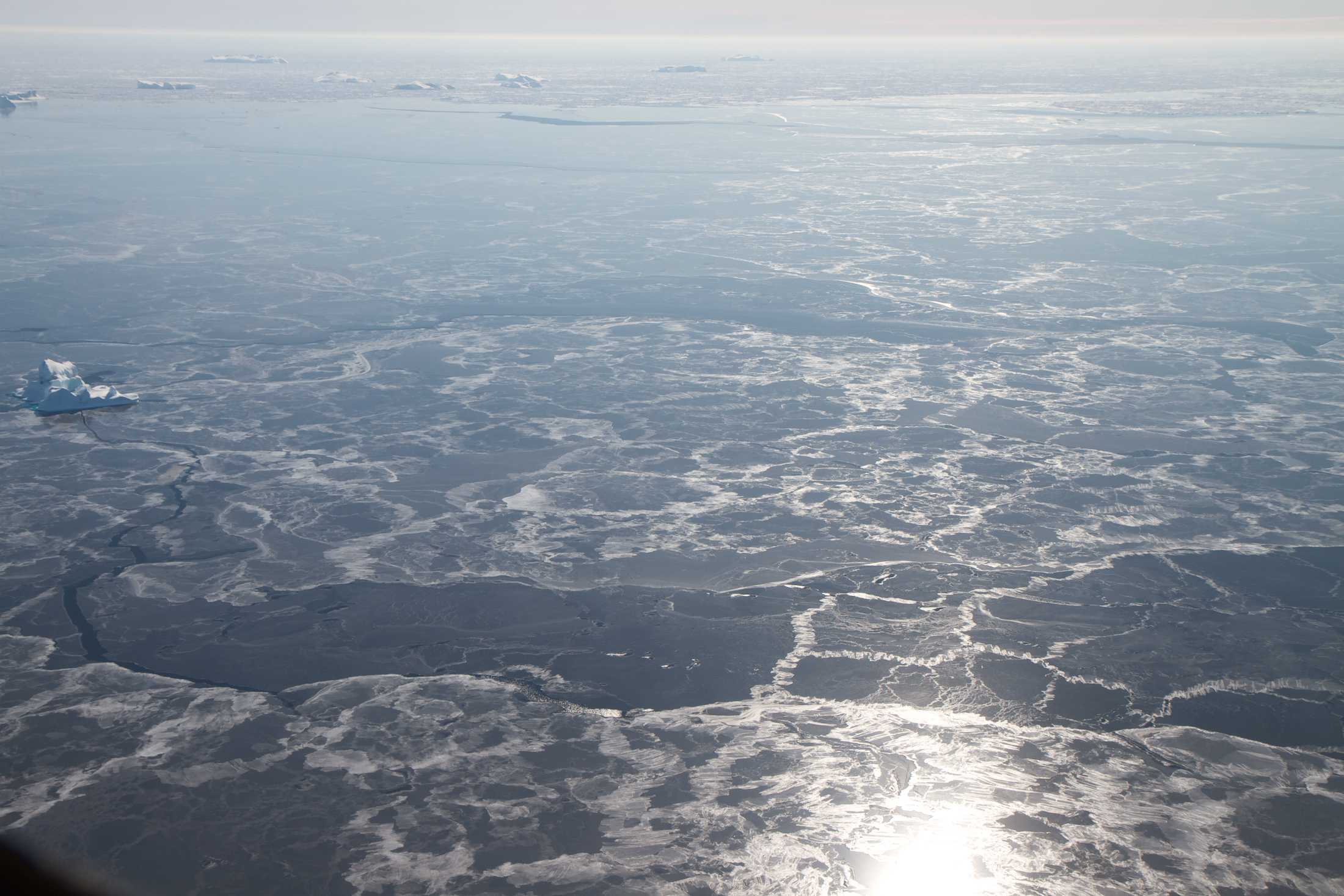
photo: Thin sea ice and a few floating ice bergs near the Denmark Strait off of eastern Greenland. Credit: NASA/Jefferson Beck

All Blog Posts

Fish Mogul’s Arrest Raises Questions About Fisheries Policy

  • April 1, 2016October 20, 2021
  • by Colles Stowell
Share it!
Share

To hear Carlos Rafael tell it, the oceans are there to make a profit on. It’s up to those who have the most resources to make the most profit.

Or so you might think if you looked at the pending federal criminal charges he faces. Or the electronic bracelet around his ankle, which lets law enforcement know if he’s abiding by his curfew, and that he’s likely not trying to slip another fast one past authorities.

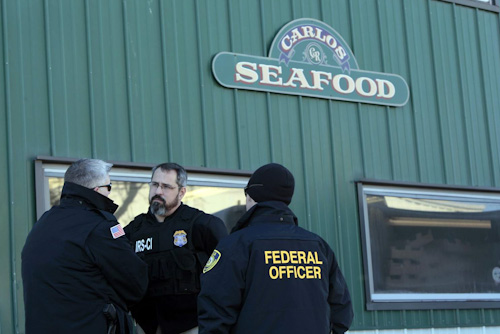
According to federal allegations, he’s slipped several million dollars worth of illegally harvested and labeled seafood through his Carlos Seafood operation in New Bedford, Mass. past authorities for decades. In court documents filed last month, investigators from the Internal Revenue Service claim Rafael, the largest seafood distributor in New England with more than 40 boats in his company’s name, intentionally defrauded the government by hiding his actual catch volumes and mislabeling fish. Prosecutors allege the mislabeling involved an intricate scheme whereby less abundant, more regulated and higher priced species like sole were labled as more abundant lower priced haddock arriving at port. Rafael allegedly misrepresented those species on federal catch quota forms he filed by mail or online. Then the species were sold at a higher price to a New York wholesaler who allegedly paid for the fish with bags of cash.

The brazenness with which he allegedly bragged about how he “did the dance,” as he described his activities, is astounding. “When the [inspector] disappears, that’s when we got a chance to make the fish disappear,” he allegedly told undercover agents posing as Russian mafia interested in buying his business, describing the ease of the deception when investigators did not meet his boats at dock. He boasted of netting $668,000 in less than six months, and that he smuggled some of the cash to bank accounts in Portugal, according to the affidavit.

Rafael is out on a million-dollar bond, wearing the ankle bracelet as a constant reminder of what went wrong after he allegedly tried to sell his business for $175 million, even though his books only reported $21 million in combined assets. The rest, he told undercover agents, was unreported profit, according to the affidavit filed in federal court.

As of last week, the court granted a prosecution request for an extension in seeking an indictment.

The news of Rafael’s arrest on Feb. 26 shook the industry from coast to coast. The aftershocks continue to send ripples throughout the entire supply chain and beyond.

Many commercial fishermen spoke out, pointing to Rafael as an example of how existing fisheries management policy has created an environment that breeds the kind of abuses Rafael is accused of. Specifically, they point to current catch share programs that allow deep-pocketed operations like Rafael’s to buy up the quota and essentially control fisheries. Not only do they gobble up quota and permits, they also snatch up processing facilities on shore, so that defrauding the management system, as prosecutors allege Rafael did, is easier. If you control the captains and crew on the water, the boat, the processor and the supply chain, mislabeling becomes a much easier process.

This schema has several negative impacts. First, it forces out smaller scale fishermen, many of whom are family operations in business for generations and just barely scraping by. If they don’t have the profit to pay for the ever-escalating quota costs, they can’t compete. Secondly, placing control over select fisheries into the hands of a few well-funded operations means there are fewer disparate voices on the water actually taking care of the resource. Put another way, there are fewer people self-policing the fishery to make sure peers aren’t cheating. Also, more eyes on the water can be a first alert to dramatic changes in the fishery, hopefully triggering a fast response to protect the resource.

But here’s another problem that arose in the wake of the news of Rafael’s arrest: Public image. It takes one or two people getting caught cheating the system on a grand scale to cast a long shadow on commercial fishermen. It’s the case of one bad apple taking out the whole bushel. The arrest of Rafael, who is a fleet owner and distributor, not a fisherman, has fueled questions about how rampant this kind of fraud is within the current quota system. Witness this blog from the Conservation Law Foundation. I’ve seen recreational fishing guides discussing this on social media.

The reality is that most commercial fishermen in the U.S. are just trying to make a living. Most know that if they don’t take care of the resource, they could put themselves out of business.

The U.S. has one of the most closely regulated fishing industries in the world. Any fraud or other illegal operations that occur here pale in comparison to what happens in Asia, for example. [Quick side note: It’s kind of frightening to think of what could happen if trade agreements like the Trans Pacific Partnership are fully ratified. Domestic fishermen already fighting an uphill battle against foreign imports and large quota grabs will likely be pushed out even faster, as cheap, largely uninspected foreign seafood floods the market.]

The close scrutiny of U.S. investigators led to the charges against Rafael. Perhaps the fact he’s been convicted of tax evasion and making false statements on landing slips and was acquitted of price fixing charges in the past 30 years helped focus that scrutiny.

If there is a silver lining in this mess, it’s this: First, a significant operator was caught allegedly cheating the system on several boldface fronts. Second, those charges have elevated the discussion of how and why such alleged crimes occurred. Third, the discussion will continue to focus on the current quota system, and how it promotes an uneven system of the “haves” controlling fisheries at the expense of the “have nots.” Fourth, it will hopefully unify commercial fishermen to speak out against current catch share policy, and perhaps take a renewed approach to self-policing violations that could further damage the industry image.


Further reading

Here are two additional examples where operators have exploited weaknesses in current catch share policy … and got caught.

Arne Fuglvog: Alaska fisherman, turned policy maker, turned federal inmate, turned lobbyist.

American Seafood, one of the largest businesses in U.S. Seafood, controlling Pollock quota system, convicted of tampering with the scales used to weigh and report Pollock catches.


photo credit: PETER PEREIRA/THE STANDARD-TIMES/SCMG


Recent Posts

  • Hurricane Ida wreaks havoc on Louisiana’s seafood industry
  • EPA Should Use Clean Water Act To Kill Zombie Mine
  • Slow Fish 2021: Relationship Matters
  • Faith, Façades, and Futility
  • Pebble Permit Paused: Politics at Play

Archives

  • September 2021
  • August 2021
  • April 2021
  • December 2020
  • August 2020
  • June 2020
  • February 2020
  • December 2019
  • November 2019
  • October 2019
  • July 2019
  • May 2019
  • April 2019
  • March 2019
  • January 2019
  • December 2018
  • November 2018
  • June 2018
  • May 2018
  • March 2018
  • February 2018
  • January 2018
  • December 2017
  • November 2017
  • October 2017
  • September 2017
  • August 2017
  • July 2017
  • June 2017
  • May 2017
  • April 2017
  • March 2017
  • January 2017
  • December 2016
  • November 2016
  • October 2016
  • September 2016
  • August 2016
  • July 2016
  • June 2016
  • May 2016
  • April 2016
  • March 2016
  • February 2016
  • January 2016
  • December 2015
  • November 2015
  • October 2015
  • September 2015
  • July 2015
  • June 2015
  • May 2015
  • April 2015
  • March 2015
  • February 2015
  • January 2015
Theme by Colorlib Powered by WordPress