 All Blog Posts
Fish Mogul’s Arrest Raises Questions About Fisheries Policy

To hear Carlos Rafael tell it, the oceans are there to make a profit on. It’s up to those who have the most resources to make the most profit.
Or so you might think if you looked at the pending federal criminal charges he faces. Or the electronic bracelet around his ankle, which lets law enforcement know if he’s abiding by his curfew, and that he’s likely not trying to slip another fast one past authorities.
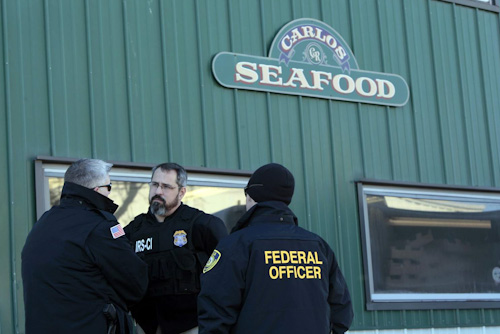
According to federal allegations, he’s slipped several million dollars worth of illegally harvested and labeled seafood through his Carlos Seafood operation in New Bedford, Mass. past authorities for decades. In court documents filed last month, investigators from the Internal Revenue Service claim Rafael, the largest seafood distributor in New England with more than 40 boats in his company’s name, intentionally defrauded the government by hiding his actual catch volumes and mislabeling fish. Prosecutors allege the mislabeling involved an intricate scheme whereby less abundant, more regulated and higher priced species like sole were labled as more abundant lower priced haddock arriving at port. Rafael allegedly misrepresented those species on federal catch quota forms he filed by mail or online. Then the species were sold at a higher price to a New York wholesaler who allegedly paid for the fish with bags of cash.
The brazenness with which he allegedly bragged about how he “did the dance,” as he described his activities, is astounding. “When the [inspector] disappears, that’s when we got a chance to make the fish disappear,” he allegedly told undercover agents posing as Russian mafia interested in buying his business, describing the ease of the deception when investigators did not meet his boats at dock. He boasted of netting $668,000 in less than six months, and that he smuggled some of the cash to bank accounts in Portugal, according to the affidavit.
Rafael is out on a million-dollar bond, wearing the ankle bracelet as a constant reminder of what went wrong after he allegedly tried to sell his business for $175 million, even though his books only reported $21 million in combined assets. The rest, he told undercover agents, was unreported profit, according to the affidavit filed in federal court.
As of last week, the court granted a prosecution request for an extension in seeking an indictment.
The news of Rafael’s arrest on Feb. 26 shook the industry from coast to coast. The aftershocks continue to send ripples throughout the entire supply chain and beyond.
Many commercial fishermen spoke out, pointing to Rafael as an example of how existing fisheries management policy has created an environment that breeds the kind of abuses Rafael is accused of. Specifically, they point to current catch share programs that allow deep-pocketed operations like Rafael’s to buy up the quota and essentially control fisheries. Not only do they gobble up quota and permits, they also snatch up processing facilities on shore, so that defrauding the management system, as prosecutors allege Rafael did, is easier. If you control the captains and crew on the water, the boat, the processor and the supply chain, mislabeling becomes a much easier process.
This schema has several negative impacts. First, it forces out smaller scale fishermen, many of whom are family operations in business for generations and just barely scraping by. If they don’t have the profit to pay for the ever-escalating quota costs, they can’t compete. Secondly, placing control over select fisheries into the hands of a few well-funded operations means there are fewer disparate voices on the water actually taking care of the resource. Put another way, there are fewer people self-policing the fishery to make sure peers aren’t cheating. Also, more eyes on the water can be a first alert to dramatic changes in the fishery, hopefully triggering a fast response to protect the resource.
But here’s another problem that arose in the wake of the news of Rafael’s arrest: Public image. It takes one or two people getting caught cheating the system on a grand scale to cast a long shadow on commercial fishermen. It’s the case of one bad apple taking out the whole bushel. The arrest of Rafael, who is a fleet owner and distributor, not a fisherman, has fueled questions about how rampant this kind of fraud is within the current quota system. Witness this blog from the Conservation Law Foundation. I’ve seen recreational fishing guides discussing this on social media.
The reality is that most commercial fishermen in the U.S. are just trying to make a living. Most know that if they don’t take care of the resource, they could put themselves out of business.
The U.S. has one of the most closely regulated fishing industries in the world. Any fraud or other illegal operations that occur here pale in comparison to what happens in Asia, for example. [Quick side note: It’s kind of frightening to think of what could happen if trade agreements like the Trans Pacific Partnership are fully ratified. Domestic fishermen already fighting an uphill battle against foreign imports and large quota grabs will likely be pushed out even faster, as cheap, largely uninspected foreign seafood floods the market.]
The close scrutiny of U.S. investigators led to the charges against Rafael. Perhaps the fact he’s been convicted of tax evasion and making false statements on landing slips and was acquitted of price fixing charges in the past 30 years helped focus that scrutiny.
If there is a silver lining in this mess, it’s this: First, a significant operator was caught allegedly cheating the system on several boldface fronts. Second, those charges have elevated the discussion of how and why such alleged crimes occurred. Third, the discussion will continue to focus on the current quota system, and how it promotes an uneven system of the “haves” controlling fisheries at the expense of the “have nots.” Fourth, it will hopefully unify commercial fishermen to speak out against current catch share policy, and perhaps take a renewed approach to self-policing violations that could further damage the industry image.
Further reading
Here are two additional examples where operators have exploited weaknesses in current catch share policy … and got caught.
Arne Fuglvog: Alaska fisherman, turned policy maker, turned federal inmate, turned lobbyist.
photo credit: PETER PEREIRA/THE STANDARD-TIMES/SCMG