Skip to content
One Fish Foundation
  • Blog
    • Aquaculture
    • Education
    • Environment
    • Policy
    • Wild Harvest
    • Fish Tales
  • About
    • About One Fish
    • About Colles Stowell
  • Education
    • Elementary School
    • Middle School
    • High School
  • KNOW FISH Dinners®
  • Resources
    • One Fish Podcast
    • One Fish Foundation in the news
    • The 7 C’s of Sustainable Seafood
    • Newsletter Archive
    • Recipes
      • Skate with Capers and Butter — Chef Rizwan Ahmed
      • Grandma Davis’ Fish Chowder — Jane Almeida
      • Ginger Garlic Tamari Scallops — Colles Stowell
      • Fish Stock — Evan Mallett
      • Mussels San Remo — Chef Rob Martin
      • Salted Pollock Croquettes – Chef Mark Segal
  • Connect
    • Contact OneFish
    • Social
      • Instagram
      • Facebook
      • Twitter
All Blog Posts

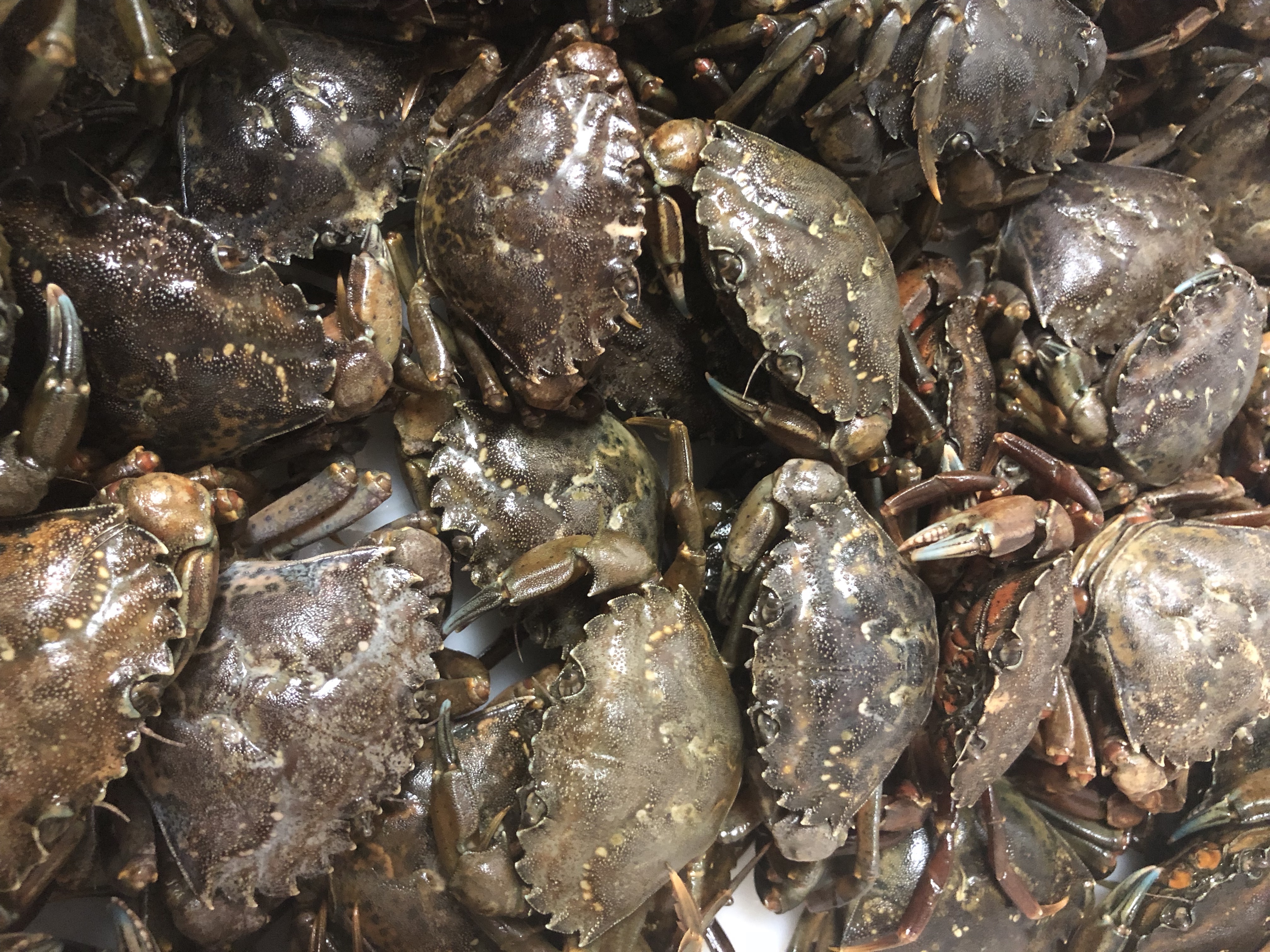
Attack of the Tiny Green Crabs

  • June 26, 2018October 20, 2021
  • by Colles Stowell
Share it!
Share

I geeked out at the Green Crab Summit in Portland earlier this month. Which is kind of ironic given that I double majored in English and French in college. I’ve always had a fascination with life in the oceans … just not enough to want to embrace organic chemistry in college or graduate work.

I parlayed my majors into a writing career that often drew on investigation to dig deeper into newspaper and magazine stories. The European Green Crab story is compelling. It’s also emblematic of humankind’s ability to alter natural balances with long-term negative consequences.
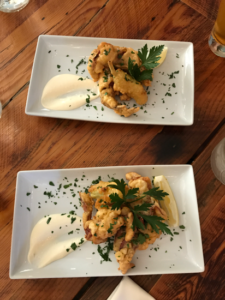
We’re working to nail down the timing of European Green Crabs here in the states. These soft shells were a delicacy at Enoteca Athena in Brunswick, Me. Photo: Marissa McMahan.

Abundant in Spain, France, Italy and other European countries, the green crab is not the frighteningly destructive, ecosystem-tipping species that it is here in North America. Many predators there like fish, crabs and birds help keep green crab populations in check. And Italian fish harvesters and chefs have figured out how to create a market for soft-shell Mediterranean green crabs (a slightly different species than the crabs we have here), as well as a top-dollar market for green crab as bait.


That’s not the case on this side of the Atlantic. The crabs were first officially documented between New Jersey and Cape Cod in 1817 after presumably hitchhiking aboard trans-Atlantic ships in the ballast. Their spread up the coast was steady and relatively uninhibited. To be sure, some were gobbled up by native species here such as striped bass, tautog, lobster, blue claw crabs and other species. But they weren’t and aren’t the regular diet for native species here as in Europe, and therefore they continue to spread.

Different story for other invasives, though. We’re now finding that the newly invasive Asian Shore Crab (first noted in 1988) seems to be displacing and possibly preying upon green crabs, dropping their populations significantly along rocky intertidal zones in Southern New England and heading northward as the water warms. However, we’re kind of swapping out one pest for another.

Christopher Baillie of the Marine Science Center at Northeastern University said Asian Shore Crabs are “generalist eaters” that may have an appetite for many native species such as lobsters, Jonah crabs and molluscs. While there are some Asian Shore Crabs already in Maine, he said they may be up here in bigger numbers in the near future. That’s not good considering they’re rampant in southern New England, where they’ve changed ecosystem balance by dominating once diverse habitats, with densities of up to 200 crabs per square meter.

Tough little buggers

Green crabs are tough, voracious, fertile and very hardy. They can live for days out of water. One crab can eat up to 40 mussels a day and lay 165,000 eggs a year. They are adapting to winter, which seems to be changing their spawning habits. They decimate vital eel grass beds while rooting out mussels, oysters and soft shell clams.

It’s the soft shell clams that have suffered the most at the claws of the green crabs. Casco Bay has witnessed a 70% drop in soft shell clam populations in the past decade. Maine’s landings have dropped from 8 million pounds in the 1970s to 1.5 million in 2016. Recent studies suggest that without significant steps to protect larval clams, 99% of the settling clams (the larval and growing stage molluscs) will fall to predation, and much of that comes from green crabs. Milky ribbon worms have also become a big problem.
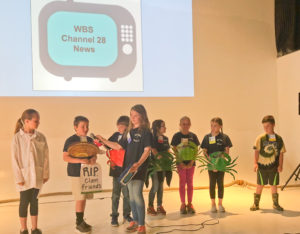
The news was even bleak on the West Bath School Channel 28 News, as students showcased what they’ve learned about green crabs…that they’re devastating to soft shell clams.

Adaptation will be central to protecting the soft shell clam industry and co-existing with green crabs, according to several researchers at the summit. As Sara Randall of the Downeast Institute put it, “We have to think of green crabs as a permanent part of our ecosystem. We need to be active, not passive.” Sara was part of a team of researchers that sifted through more than 34 tons of mud in a four-year study to determine what’s happening with soft shell clams and devise strategies such as protecting larval clams in screened boxes in tidal flats that would keep out green crabs.

However, as with everything concerning green crabs, it’s not that easy. Brian Beal has been studying green crabs and their impact on intertidal ecosystems for more than 30 years. A professor at the University of Maine at Machias, Brian has been outspoken about adapting to the new reality of green crabs and their impacts. “Population control is unlikely and impractical. They can’t be fished out,” he said, explaining that we’re talking about billions of organisms based on several trapping studies throughout the Gulf of Maine.
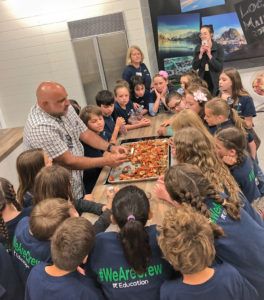
Commercial fisherman Jamie Bassett showing West Bath School students how to extract crab roe.

Green crab bisque, anyone?

One of the common discussion threads was finding ways to make humans the alpha green crab predator. How can we create culinary markets to make green crabs an attractive seafood choice? Again, it’s not so simple. First, their size means there’s little meat yield. And they’re built like tanks, so there’s a bunch of effort to get a small portion of meat.

Second, we Americans have a track record of following habit and price when making seafood decisions. This explains in part why 90% of the seafood we eat is imported. It’s cheaper and hews to menu selection we are most familiar with. Shrimp, salmon, tuna, etc. Collectively, we aren’t adventurous, and so, since we haven’t been eating green crabs for centuries, as they have in Italy (again the slightly different Mediterranean green crab), creating the marketing campaign to get us to start eating vast quantities of green crabs is a hard sell.
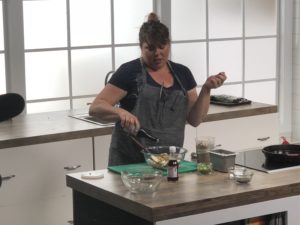
Chef Ali Waks-Adams laid down some green crab rangoon.

I know several chefs in coastal Maine and New Hampshire who are ready and willing to give it a go. Soft shell, stock, mixed in to other dishes. For example, at the event, Chef Ali Waks-Adams (executive chef at the Brunswick Inn) prepared delicious green crab Rangoon using mince (crabs that have been finely ground up, shell and all into a flavorful paste). She also demonstrated how to fry up the small crabs in a batter and eat them like popcorn. Chef Matt Louis (executive chef/owner of Moxy and The Franklin in Portsmouth, NH) created an inventive green crab pozoles dish and a delicately flavored green crab arancini. All of the food we sampled showed the tasty possibilities.
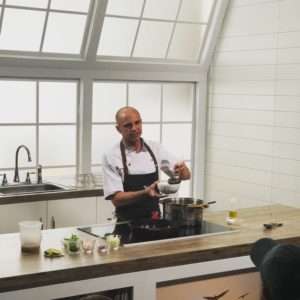
Chef Matt Louis using green crab for a pozoles, a traditional Mexican stew with hominy.

We still have a bit of research to do to nail down the soft shell season for green crabs. That’s because we don’t have the centuries of research the Italians do, and because the green crabs here seem to be adapting to the warming waters of the Gulf of Maine, which seems to be changing when they molt, or shed their old shells. Also, it’s easier to identify pre-molt Mediterranean green crabs than the species in the U.S.

Adapt or get run over

But even if we do create a viable market, we aren’t likely to make a huge dent in the green crab population. “The variability in density and mean size [of the crabs] will make it difficult to create a dependable fishery,” said Beal.

He also dropped another theory that raised several eyebrows. Clams aren’t just worried about the typically sized 3-inch or bigger crabs, but the 3 millimeter crabs feasting on clams that are half a millimeter in width. And it’s going to be damn hard to do much about those little s—s.

Beal agreed with others that adaption will be key, and we’re going to have to make some dramatic changes to the soft shell clam industry if we want to protect it. Some of his suggestions included increasing the amount of clam farming that now occurs, changing the size limit on clams to allow for the prime breeders to reproduce, and closing certain areas along the coast from May to July to allow for more productive spawning.
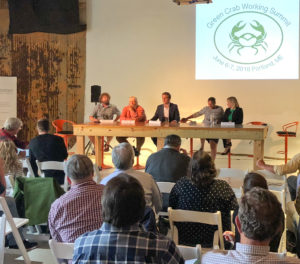
Some of the green crab brain trust discussing policy and other issues and how we need to continue to research and collaborate to better adapt to the new reality of Carcinus maenus.

We heard about one success in green crab mitigation in Canada from Gabrielle Beaulieu of Kejimkuik National Park Seaside Parks in Nova Scotia. She explained how a team of staff and citizen scientists harvested more than 2 million green crabs over a 10-year period. Following the intensive trapping and removal of the crabs, researchers noticed significant gains in eel grass recovery (in areas that crabs had mowed down) and soft shell clam populations.

Green crabs pose a significant threat to several commercially vital species in the Gulf of Maine. I agree with Brian Beale that putting a bounty on green crabs alone isn’t going to make a huge dent. However, I agree with others at the conference that we’re going to have to adapt, and implement a multi-pronged approach to mitigate the challenges. We’ll need to have some widespread harvest/green-crab-as-food markets opened up, along with raising public awareness both about the ecological threat and the culinary benefits of green crabs. We’re also going to have to take some significant steps as Brian mentioned to safeguard species like soft shell clams.

And yes, we need to devote more time, effort and financial resources to figuring out how to address this problem, and the looming time bomb of the Asian Shore Crabs. Knowledge is power … In this case, the power to adapt, rather than be overrun.


All Blog Posts

What It Means To Be Local

  • June 16, 2018October 20, 2021
  • by Colles Stowell
Share it!
Share

Update as of 4:45 p.m. 6-17-18:

Adding a link to the latest response from Sea To Table Founder Sean Dimmin to the AP story. In the response, he goes on the defensive, calling out “numerous misstatements and false allegations,” alluding to shoddy or incomplete reporting. Dimin points out instances where the reporting does seem to leave a bit of detail and process open to question. He also admits Sea To Table could have better communicated with its suppliers (in particular, Gosman’s) and with its customers.

That’s all fine. He’s saying the right things for someone in his predicament. But I don’t think the conversation should end there. Those in the domestic seafood industry, and those who promote it, face a steep challenge. Trust is absolutely essential to trying to convince even small percentages of US consumers to get seafood smart and buy domestically. The original premise behind Sea To Table or any similar minded operation is to promote local seafood, fishermen and waterfronts, often regardless of customer geography. So even if lapses in communication to customers or partners that led to  mislabeling, etc., are the only truly valid mistakes made, we need to be having this conversation. As we’re trying to limit the more than 1.5 million tons of cheap, imported farmed shrimp (among other unsustainably harvested species) flooding markets in this country every year, we need to be honest and forthright.

I do not agree with some who claim the negative attention and likely serious sales hit to Sea To Table is just desserts and the company should go away. I think these communications issues don’t rest with Sea To Table alone in the industry. It’s a tough, and generally laudable mission these companies try to accomplish. But I also don’t think we can make excuses for those whose lapses could set the entire movement back by calling trust in domestic seafood systems into question. We need to have these conversations, find solutions and move forward to turn that 90% domestic import figure around.


It all comes down to trust … and relationships.

This week’s news that one of the rising stars of the locally sourced, sustainable seafood movement may have been selling seafood that wasn’t local, may have been mislabeled and was possibly linked to slave labor in other countries sent shock waves through the industry.

Brooklyn-based Sea To Table has built quite a following with its promise of sustainable, traceable, domestically harvested wild seafood delivered to your doorstep. Clients included celebrity chefs like Rick Bayless national food chains such as Chopt Creative Salad, a bunch of universities like Yale, eateries at the Empire State Building and Chicago O’Hare airport and the home meal kit provider Hello Fresh. It can be found in almost every state.

But an Associated Press report issued earlier this week shed light on some of the issues that can arise with this boat-to-table model and the temptation of entrepreneurs to co-opt, then sweep aside the spirit and intent of terms such as “sustainable seafood” and “local.”

The colossal irony being that they may be knowingly or unknowingly violating the principles they promote, all in an attempt to bring clarity and trust to what Sea to Table Founder Sean Dimin calls “the historically opaque seafood industry.” The Sea To Table business model is to work with some 60 “local” fishermen and fishing operations/distributors to source “traceable” seafood from around the country.

The AP report outlines a lengthy investigation uncovering a slew of allegations that run headlong into the company’s  mission statement. For example, promoting fresh, locally caught yellow fin tuna in the winter off New York, when the migration south occurred several months beforehand and no local fishermen had been out. Or charges that some of the seafood Sea to Table sold was in fact imported and linked to Indonesian operations with a history of labor abuse. Other charges included selling farm-raised seafood despite the wild-only claim.

So yes, this was big news in that it surprised many in the industry. It will also raise lots of questions, piss some people off and confuse the hell out of consumers. What are they supposed to do to be sure they are buying local, sustainable seafood?

Dimin is correct in that the seafood industry is indeed opaque. There are few places that have completely transparent supply chains. Consider that seafood travels more than 5,000 miles on average from boat to plate in this country, often changing hands at least seven times.

The AP report is informative and sad, but it isn’t really broaching any new allegations about industry practices. Check out this exhaustive AP report on slave labor linked to imported seafood. The fact we import 90% of the seafood we eat just means more of the seafood consumed in the U.S. may be linked to brutal labor practices.

But the issue of trust and misrepresentation goes beyond just the seafood industry. The whole concept of questionable food sourcing and marketing practices isn’t new. For example, the Tampa Bay Times ran a series in 2016 about the farm-to-table movement, and how many restaurants and purveyors were glazing over, and sometimes outright lying about the provenance of their food.

What is local?

All of this goes back to a discussion I had this week with Josh Stoll, a research professor at the University of Maine and a co-founder of Local Catch, an organization that promotes community-supported fisheries and other direct-to-consumer operations aimed at bringing people closer to their seafood.

We discussed how the Sea to Table news raises the very valid question of how to define “local” and how to re-build consumer trust. Josh spends much of his time working to streamline and improve community-based fisheries governance for the benefit of fishermen, their communities and consumers.

“The definition of ‘local’ is evolving,” he said. “It’s less about geography and more about relationships.”

He’s exactly right. Just as the terms “organic” and “sustainable” have been stripped of their original intents by overuse and bastardization of meaning, “local” without valid context has become vapid marketing speak. It could mean so many things and nothing at all if there is no valid context to support its use.

Case in point: Sea To Table uses “local” in the first sentence of its mission statement to showcase the quality of the seafood it sources. Now, regardless of whether the company knowingly misled customers, it has much work to do to re-establish credibility. Dimin and his crew can’t just plead that they are still offering “local” seafood. They have to earn back that trust.

How? By going back to the basic mission and working to repair the relationships that the company was built on. Not an easy task.

When I host KNOW FISH Dinners® and invite people to talk to the fish harvester who caught the fish they are eating, I’m creating a direct link to the food producer that more often than not remains a mystery in this “opaque” industry. I tell people I want them to think about their next seafood purchase the same way they think about buying eggs or produce from a farmer at a farmer’s market.

Those are the kinds of relationships that define “local” for me.

Know your seafood, know your provider

So, say you live in Kansas. You probably don’t live next door to a commercial fish harvester. This is where enterprises like Sea To Table have begun to fill the void. The problem arises when customers take the “local” claim on faith without establishing some kind of relationship with the provider. If they get to know the provider, even if the provider is a distributor with direct links to the fish harvester, they get a better sense of the values and ethics used by the provider to promote their product. They should also be able to get the story of the fish harvester as well. Same goes for distributors like Sea To Table. They need to build solid relationships with the fish harvesters and docks providing the seafood to ensure they hew closely to strict guidelines.

That’s how you build trust. The AP story calls the latter point about Sea To Table’s supplier relationships into question.

Sure there are situations when establishing that level of trust isn’t possible. But one of the key points I make with folks is that knowledge really is power. Consumers fare much better ensuring the quality and provenance of the seafood they purchase when they get smart about what is locally and seasonally available, who has the best product, and who is trustworthy. This all takes time.

But it’s worth it.

Owning the relationship

Can things still go awry? Absolutely. Sea To Table is the proof. I’m not sure I believe this was a wholesale willful violation of trust. Read Sean Dimin’s first letter in response to the AP story. As I said, there are no new revelations in the news story about what happens in the industry. And Sea To Table has much work to do to repair its reputation. More so now that Sen. Edward Markey has asked NOAA and the Federal Trade Commission in a letter to investigate the claims against Sea To Table.

The situation underscores the fact there are many gray areas in domestic food systems. But it also reinforces the notion that people should take more ownership of their seafood purchases. Again, it’s all about relationships. We talk about the relationship people have to the seafood they eat during these hosted KNOW FISH Dinners. Their (our) choices have an impact on the resource, the fish harvester and the community. Getting closer to the source, even if that closeness is more relational than geographic, will minimize the risk of being misled.

That 90% import statistic won’t change unless we build, strengthen and multiply these very important relationships.

Check out the Local Catch website as it is a good resource for finding responsibly harvested seafood throughout the country. I believe there are several  operations who are delivering on their promise of responsibly harvested product. You can find some of them listed on the Local Catch website.

Also, stay tuned for more discussion about this topic. It is a fundamental reason for why we should care where, when, how and by whom our seafood was harvested.

If you’d like additional perspective, read Paul Greenberg’s take on the situation here.


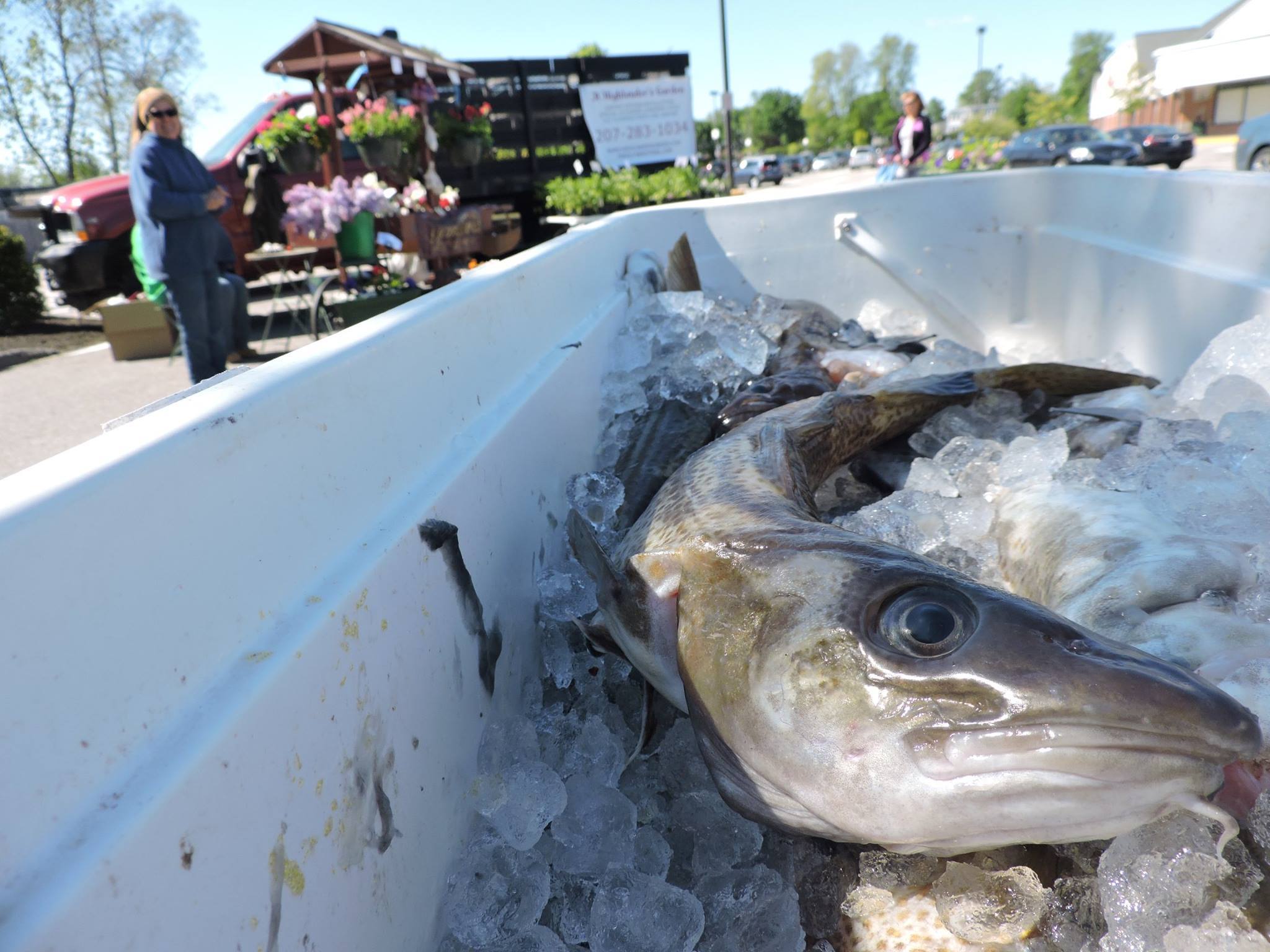
Photo courtesy of New England Fishmongers

Recent Posts

  • Hurricane Ida wreaks havoc on Louisiana’s seafood industry
  • EPA Should Use Clean Water Act To Kill Zombie Mine
  • Slow Fish 2021: Relationship Matters
  • Faith, Façades, and Futility
  • Pebble Permit Paused: Politics at Play

Archives

  • September 2021
  • August 2021
  • April 2021
  • December 2020
  • August 2020
  • June 2020
  • February 2020
  • December 2019
  • November 2019
  • October 2019
  • July 2019
  • May 2019
  • April 2019
  • March 2019
  • January 2019
  • December 2018
  • November 2018
  • June 2018
  • May 2018
  • March 2018
  • February 2018
  • January 2018
  • December 2017
  • November 2017
  • October 2017
  • September 2017
  • August 2017
  • July 2017
  • June 2017
  • May 2017
  • April 2017
  • March 2017
  • January 2017
  • December 2016
  • November 2016
  • October 2016
  • September 2016
  • August 2016
  • July 2016
  • June 2016
  • May 2016
  • April 2016
  • March 2016
  • February 2016
  • January 2016
  • December 2015
  • November 2015
  • October 2015
  • September 2015
  • July 2015
  • June 2015
  • May 2015
  • April 2015
  • March 2015
  • February 2015
  • January 2015
Theme by Colorlib Powered by WordPress