Skip to content
One Fish Foundation
  • Blog
    • Aquaculture
    • Education
    • Environment
    • Policy
    • Wild Harvest
    • Fish Tales
  • About
    • About One Fish
    • About Colles Stowell
  • Education
    • Elementary School
    • Middle School
    • High School
  • KNOW FISH Dinners®
  • Resources
    • One Fish Podcast
    • One Fish Foundation in the news
    • The 7 C’s of Sustainable Seafood
    • Newsletter Archive
    • Recipes
      • Skate with Capers and Butter — Chef Rizwan Ahmed
      • Grandma Davis’ Fish Chowder — Jane Almeida
      • Ginger Garlic Tamari Scallops — Colles Stowell
      • Fish Stock — Evan Mallett
      • Mussels San Remo — Chef Rob Martin
      • Salted Pollock Croquettes – Chef Mark Segal
  • Connect
    • Contact OneFish
    • Social
      • Instagram
      • Facebook
      • Twitter
All Blog Posts

The Telltale Cod

  • February 26, 2016October 20, 2021
  • by Colles Stowell
Share it!
Share

This is a blog written by my good friend Chef Evan Mallett for the Slow Fish 2016 website. Slow Fish 2016 is an international gathering of fishermen, chefs, scientists, policy makers and other activists to discuss and share local fishing community challenges and solutions from around the country and the world. One Fish Foundation will be attending. Evan speaks with a clear, informed and passionate voice on why we should care about seafood sustainability.


By Evan Mallet

In 2012, I wrote a blog entitled “Grandpa, What’s a Cod?” The motive for writing that blog was a dramatic realization that my children’s children might someday ask me such a question. Perhaps, I projected, they will see an old menu or read an article, or visit the Cape that bears the name of a mystery fish.

Entire books have been written about cod—citing the fish’s dominion over our national heritage, how it inspired colonization and later, an inestimably rich global seafood trade. As our New World and its human population have expanded from the shores where codfishing boats first landed, cod has been there every step of the way. Until now.

Since I wrote the blog, assessments of the cod population in the Gulf of Maine (my backyard) have only brought more bad news. I am a chef, and I have grown up alongside the bounty of North Atlantic fisheries. In recent years, I have watched those fisheries, and the small family-owned boats that ply our local waters, dwindle to the point of near-extinction. It is clear that a revolutionary shift in mindset is the only solution to a problem we have created over decades of fishing a species to the brink.

Some experts point to changing water temperatures, locally and globally, that might explain a shift in breeding grounds for Atlantic cod and other coldwater species. And, whether as a result of this shift or a three-decade moratorium on cod fishing, there is evidence that Newfoundland—where annual cod harvests once numbered over a million metric tons—might be experiencing a cod comeback of sorts.

It’s not that I personally hold cod up as the all-seeing banner of virtue and supremacy that our founding fathers did when they marched a “sacred cod” wooden replica to the Massachusetts State House, where it still hangs today. The truth is, I definitely revere cod’s flavor, texture and utility. However, a simple reality check tells us that we have no choice but to consider other species as alternatives to our New England culture’s longtime staple fish. I am one of those few chefs who sells Pollock, Acadian redfish, even dogfish, on my menu, because I believe with all of my heart that we have no choice but to ignite a new awareness now, before the fish we grew up eating are gone.

When I attended Slow Food’s Terra Madre and Salone del Gusto in 2010, I heard a fisherman from Oceania talk about how his family could afford frozen farmed salmon from Northern Europe, purchased in his local supermarket, but could not afford to eat his own fresh, local catch, upon which his livelihood depended. That fisherman’s story started my trip down the undercurrent of insanity that is our global seafood distribution system.

I have yet to understand how the economics of food have so egregiously ignored the ecology of food for so long, and I don’t know if even radical change will come too late. But I do know that right now, every community on our planet needs to wake up to a seafood crisis. At stake is not only the human diet’s most nutritious animal protein, but also the trophic balance of all aquatic ecosystems.

Slow Fish is uniquely positioned to spread this gospel like no other organization, and I look forward to seeing talk of change lead to actions that will preserve both fisheries and fishermen.

Evan Mallett is chef/owner of Black Trumpet in Portsmouth, N.H. He also sits on the national Chef’s Collaborative Board of Overseers, the Slow Food Seacoast Board of Directors and the NOAA Seafood Marketing Steering Committee.

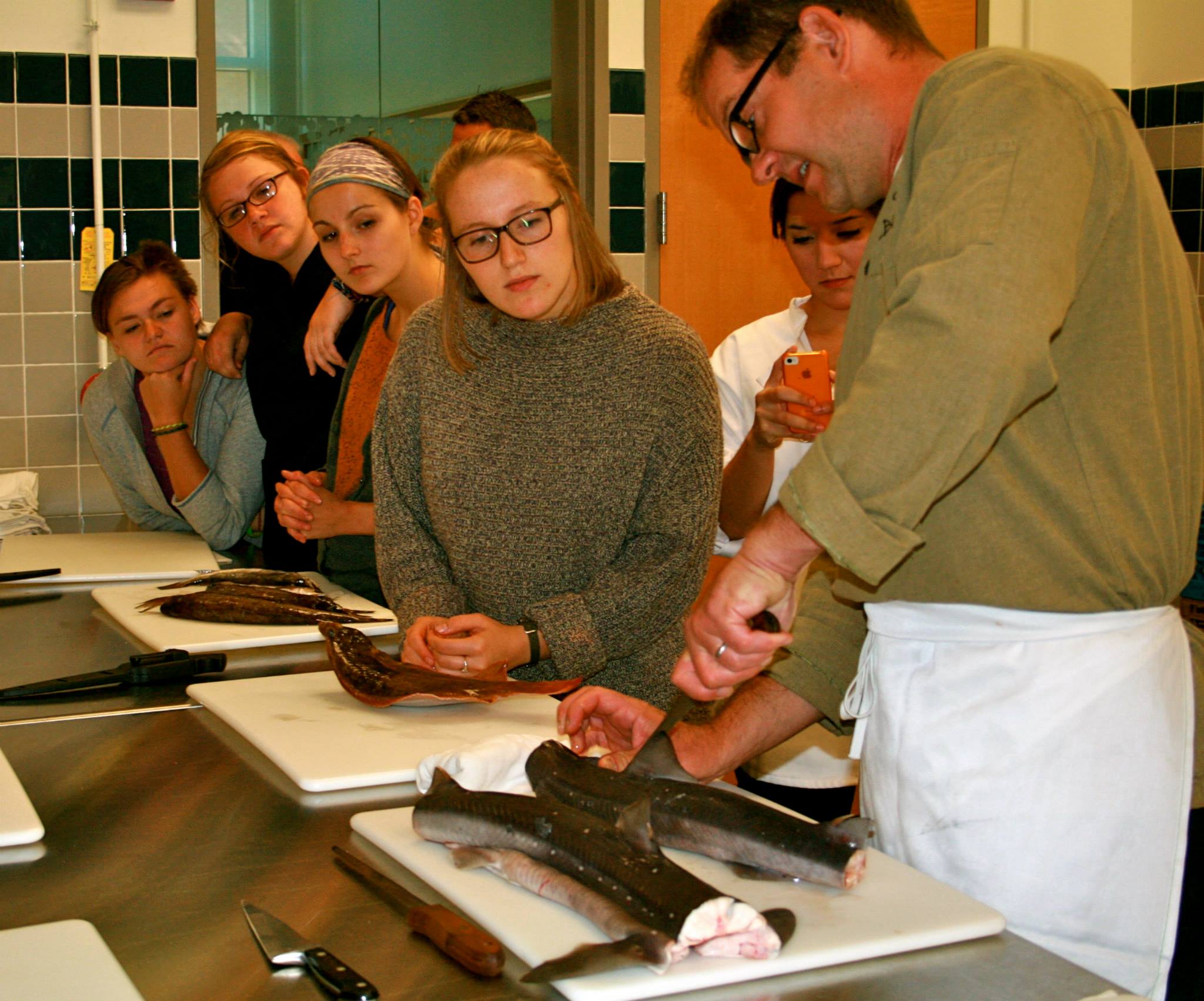
photo: Chef Evan Mallett showing Slow Food UNH students how to prepare dogfish.


SLOW FISH 2106 INFO

REGISTER for Slow Fish 2016.
JOIN our Facebook Event Page.
SUPPORT our Indiegogo fundraising campaign.
HOST a Fisher-Chef Alliance dinner.
 

All Blog Posts

Oceans Rising Faster Now Than In Past 3,000 Years

  • February 24, 2016October 20, 2021
  • by Colles Stowell
Share it!
Share

I wonder if there will ever be a tipping point for climate change deniers. That is, I wonder if a critical mass of scientific evidence suggesting man-made greenhouse gas emissions could ever sway even some of the most outspoken critics of climate change.

Perhaps not.

But as scientific methods become more exact, the scope and depth of research more extensive, and the conclusions of experts around the world more universal, denial becomes harder, and more futile.

New research released Monday suggests that not only have oceans risen over the past roughly 3,000 years, but that seas have risen faster in the 20th century than in the previous 27 centuries. Moreover, this century’s global sea level rise is largely due to anthropogenic greenhouse gas emissions, studies say. In effect, the research highlights just how much we have contributed to global warming and global sea level rise above normal fluctuations.

For example, one study, published in the journal Proceedings of the National Academy of Sciences, points to a strong link between global temperatures and sea levels. The study suggests sea levels would have risen by as much as 7 centimeters in the 20th century without global warming, reflecting the “typical” fluctuations that occur naturally. With global warming caused by man, scientists suggested global sea levels have risen by twice that much or 14 centimeters.

That may not sound like much, but when you account for oceans rising at a current rate of about a foot a century, several coastal communities are already imperiled. If seas rise by as much as four feet by 2100, as many scientists have predicted, communities like Miami, Charleston, S.C. and New Orleans could be under water.

Another study issued Monday, highlights how steadily rising waters have already affected coastal communities, and how much of that is attributable to greenhouse emissions. Scientists used data from instruments called tide gauges, which measure flooding based on above normal water levels in coastal communities around the country. They found that about two thirds of the nuisance flood days (days when waters flooded streets, clogged storm drains etc., but not catastrophic flooding) since 1950 have been caused by man-made emissions. More specifically, researchers found the greatest increase in the number of flood days occurred between 2005 and 2014.

For example, the number of flood days in Wilmington, N.C. jumped from 14 in the 1955-1964 decade to 376 in the last decade of 2005-2014. Researchers attributed 308 days, or more than 80% of those days to human-caused climate change. The researchers also suggested that trend of “nuisance flooding” where low-lying coastal communities experience flooded roads, dying grass, over-taxed infrastructure from high tides amplified by rising oceans will continue, costing billions of dollars in damage and pushing some communities further into danger.

Over time, this kind of flooding also dramatically changes coastal habitat for seafood, forcing many species to relocate, which in turn affects local fishermen as well.

So I wonder how high the pile of scientific and economic evidence needs to get to start changing some of the skeptics’ minds.

Perhaps it won’t happen until they’re flooded with it.


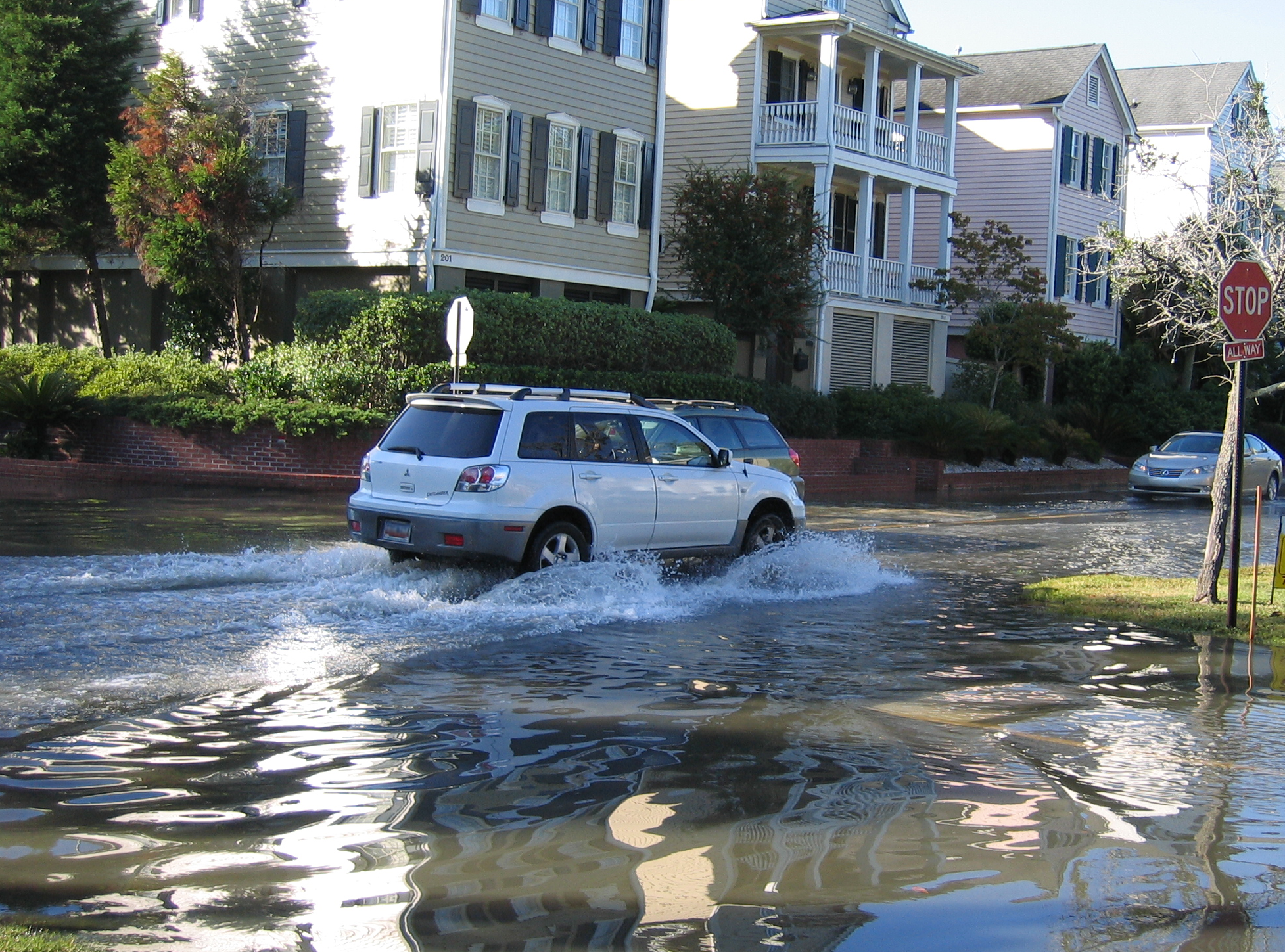
Photo: car driving through flooded street in Charleston, S.C.  credit: NOAA

All Blog Posts

When the Levee Breaks, Sugar

  • February 13, 2016October 20, 2021
  • by Colles Stowell
Share it!
Share

UPDATE 02/16/16: The U.S. Army Corps of Engineers plans to release water this week from Lake Okeechobee south to Everglades National Park, where it is badly needed. Doing so will alleviate the burst of polluted fresh water released into the Caloosahatchee and St. Lucie rivers and slow some of the negative impacts already taking place in those estuaries. The Everglades has been drier than normal for several years, and the fresh water influx will help balance the salinity levels to restore marsh areas. The water would pass through a reservoir south of the lake, where it will be purged of some of the unwanted nutrients from the lake.


In case you haven’t heard, Lake Okeechobee is rising. El Niño has spanked several areas in the U.S. with higher-than-average rainfall, and the second largest freshwater lake in the lower 48 states is now at 16 feet. Its average depth is between 10 and 12 feet. Officials with the U.S. Army Corps of Engineers and the South Florida Water Management District worried the 32-foot tall, 143-mile levee surrounding the lake could fail if any more rain fell. Ironically, this is “the dry season.”

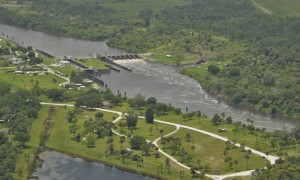
So last week they unleashed up to 4.9 billion gallons of water (think 7,400 Olympic swimming pools) per day out of two dams: one heading east via the St. Lucie River to the Atlantic Coast, and the other heading west via the Caloosahatchee River to the Gulf of Mexico. These outlets to the rivers were created decades ago to help manage the lake’s water levels. The “wet” season for the region is June through September, and for the past several years, these releases have unleashed torrents of dirty brown and sometimes green water through these canals.

Where does that polluted water come from? The agricultural and other pollutants dumped into the lake from areas north. Why not allow excess lake water to flow south, as it had for nearly 6,000 years before humans got involved? Because politically and financially powerful U.S. Sugar (hereon called Big Sugar) owns more than 60,000 acres of land directly south of the lake to grow and refine sugar cane. And because this has been the status quo for decades when state and federal regulators and the Corps of Engineers first laid out the plans for water management. In fact, it was because of the sugar industry that the water was diverted east and west to make those massive sugar cane fields arable.

So let’s summarize: An ill-conceived plan by man to redirect Nature’s intended path for water drainage to accommodate Big Sugar, as well as big development, now has imperiled several thousand people, their homes, their drinking water and the health and welfare of millions of acres of precious wetlands which serve as the nursery for some of the most ecologically rich, coastal habitat in the country.

And here’s the painful kicker. The state had the option to purchase that land as the first step to help restore the withering Everglades for several years up until last Oct. The state failed to exercise that option, and now Big Sugar wants to put up several thousand homes and big warehouses. Last fall, Fla. voters overwhelmingly approved a measure that would use some real estate tax money to buy lands for conservation and improved water quality. But the state government has so far used those funds toward agency support (salaries, insurance, etc.), not buying the more than 40,000 acres Big Sugar agreed to sell seven years ago. Several environmental groups have filed a lawsuit that is currently pending.

rushing water

The damage done

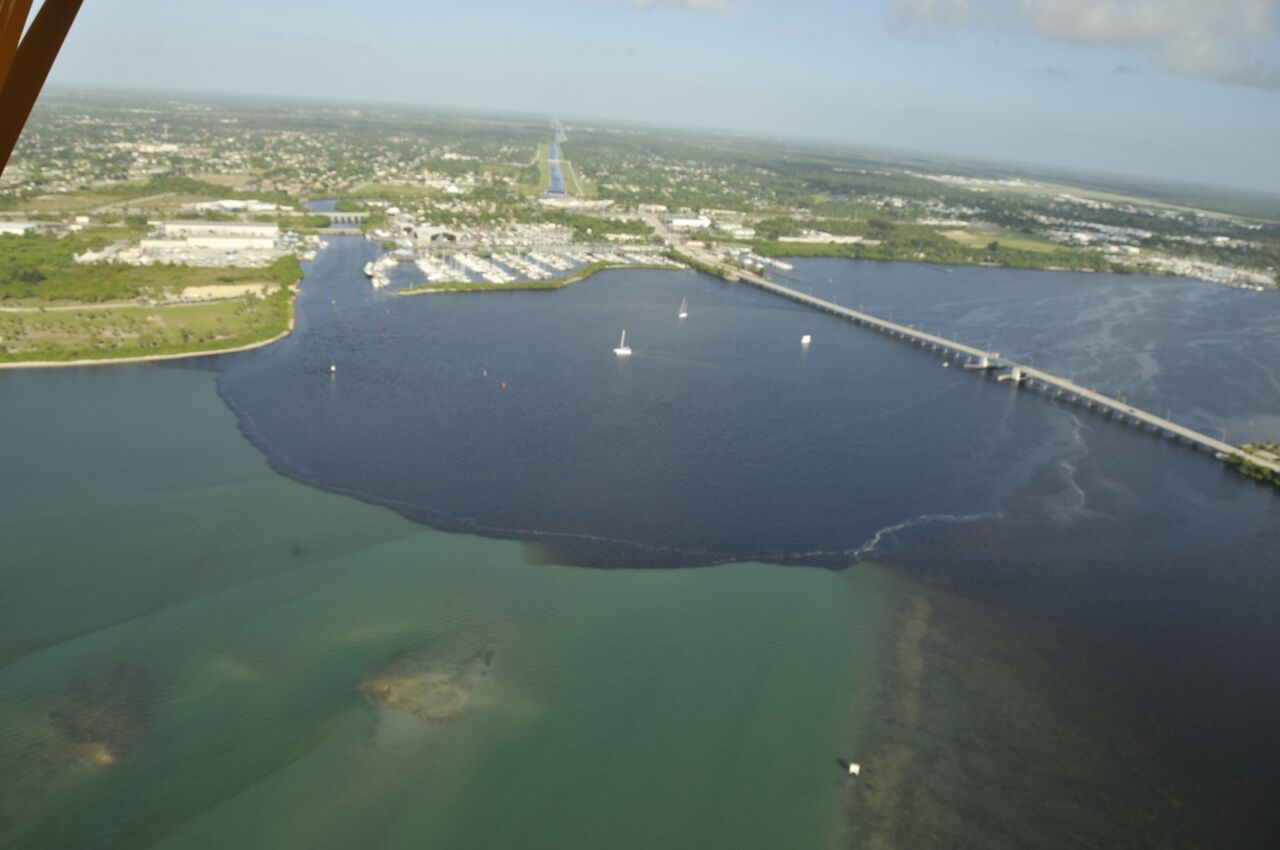
The nitrogen and phosphorous that pours into the lake from agriculture gets blasted out of canals into the St. Lucie and Caloosahatchee estuaries. The excess nutrients wreak havoc on the ecosystem, causing oxygen-choking algal blooms, massive fish kills and severe damage to prime shellfish habitats. Moreover, the influx of freshwater tips the delicate salinity balance in the marsh, killing vital grasses and forcing out species living in the brackish (part salt, part fresh) water. Conversely, during the dry season, the Corps releases much less fresh water (because it’s used for agriculture) than the Everglades needs to sustain that balance. That is, when the salinity gets too high, root structures get damaged and the vegetation can die in the marsh.

A technical study conducted by the University of Florida Water Institute last year makes several recommendations to reduce these outflows into the St. Lucie and Caloosahatchee river systems. Chief among them is to restore southerly flows into the estuaries after the water from the lake has been stored and treated in yet-to-be-built reservoirs. The study calls for similar reservoirs to be built or extended north of the lake and in or near the St. Lucie and Caloosahatchee basins. All of this would also help restore the Everglades.

As a former journalist, I have an inherent mistrust of politicians because too many times I’ve seen up close how they essentially followed the money. As a recreational fishermen, I don’t trust the state to consider the long-term economic impact if recreational fishing plummets because vital species can’t tolerate drastic habitat change. The impact for commercial fishermen could be equally dire.

As a New Orleans native whose elderly parents rode out Hurricane Katrina, only to leave two days after the storm on the last passable road and ultimately sell their house because the infrastructure was a shambles, I inherently don’t trust the U.S. Army Corps of Engineers.

About a year after Katrina, I spoke to the Corps colonel in charge of rebuilding the city’s levees. I asked him point blank why the Corps was restoring the levees to their previous standard of being able, in theory, to withstand a category 3 hurricane, when the city had just been devastated by a category 5 storm. He said the reconstruction was following the path laid out by Congress and the state. I asked him if he thought that was a good idea, and he said, “It’s not my call.”

Right now, the call on the future of the Everglades and the Indian River basin is in the hands of Florida’s governor and legislature. I only hope there are enough politicians outside of the mold that made me mistrustful in the first place to do the right thing. I hope enough of them will see that actually delivering on the promises they made to voters … to protect precious resources like the Everglades and surrounding watersheds … far outweighs surrendering integrity to the financial puppetry Big Sugar offers.

If not, getting re-elected won’t be so easy if a major environmental/economic disaster occurs and Florida becomes more of a poster child for environmental failure than it already is.

Here is some additional reading:

March 2015 Miami Herald column by Carl Hiassen about the money trial

Miami Herald Op Ed proposing a joint fix between state and Congress

Florida Department of Environmental Protection history of Lake Okeechobee

The News-Press: Fort Myers paper’s article on Gov. Rick Scott and legislators recently asking Army Corps to release lake water south toward Everglades

Huffington Post Column by Alan Farago


photos: Storm water releases. credit: Jaqqui Thurlow-Lippisch

All Blog Posts

Climate Change Could Threaten Several Northeast Fisheries New Study…

  • February 6, 2016October 20, 2021
  • by Colles Stowell
Share it!
Share

Go ask Long Island lobstermen … if you can find any … what they think about climate change. Trouble is, there aren’t many left because there aren’t many lobsters left in Long Island Sound. Same thing with Atlantic cod fishermen. There aren’t nearly as many boats targeting cod compared to 25 years ago because there are fewer fish.

We can blame climate change to a degree. No, it would be shortsighted to blame all fisheries depletions on warming waters. Myriad factors including fishing pressure can conspire to harm stock health. But a new study from NOAA underscores a concern many scientists and fishermen share: ever warming waters will continue to dramatically impact fisheries.

Published in the journal PLOS ONE, the study relies on a new methodology to look at how 82 species in the Northeast region have been and will be affected by climate change. Specifically, the study measures which species will be most vulnerable to climate change effects, including ocean acidification, as well as which species’ migratory patterns will most likely change because of ocean warming. In a nutshell, species that live along the ocean floor such as cod, mussels and lobsters, and those like salmon and sturgeon that migrate between salt and fresh water are most at risk.

Some of the species’ responses we already know. As the Gulf of Maine warms faster than 99% of all ocean climates on earth (at a rate of a half a degree Fahrenheit increase per year for the past decade), several native species have reacted. Lobsters have moved north and east along the coast, leaving fisheries in Long Island and Cape Cod in succession. The Northern Shrimp fishery has collapsed in the past few years. Scientists speculate the combination of warming waters limiting spawning and reducing the amount of plankton the shrimp eat is largely to blame. Scientists also say these warming waters limit cod reproduction and health and survivability of juveniles.

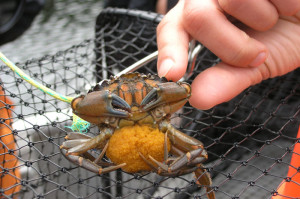
European green crab. Credit: NOAA

Gulf of Maine temperature increases have opened the door to invasive species like black sea bass and scup, and have made bays and estuaries more hospitable to European green crabs, whose numbers have risen exponentially in the past few years. Green crabs wreak havoc on eelgrass flats as they burrow in to eat larval mussels, clams and oysters.

Jon Hare, a fisheries oceanographer at NOAA Fisheries’ Northeast Fisheries Science Center (NEFSC) and lead study author, said the main purpose of this study is to give fisheries managers and other stakeholders tools to take climate change into account when devising management policy.

“We’re never going to have perfect information,” he said. “The ecosystem is going to change because of a combination of anthropogenic influence such as greenhouse gas and natural climate variability.” To keep up with the pace of that change, which has been dramatic in the past 10 years, Hare and his colleagues developed a methodology that incorporates already established research and factors in expert extrapolation. This methodology helps them predict things like how mussels will respond to warming waters or how they will react to increased acidity in their ecosystem in the next 10 years.


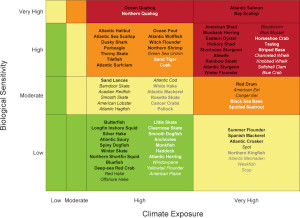
Overall climate vulnerability is denoted by color: low (green), moderate (yellow), high (orange), and very high (red). Certainty in score is denoted by text font and text color: very high certainty (>95%, black, bold font), high certainty (90–95%, black, italic font), moderate certainty (66–90%, white or gray, bold font), low certainty (<66%, white or gray, italic font). Source: Hare et al (2016)

The scientists graded each of the 82 species’ vulnerabilities taking into account different variables, and set those grades to peer review. The result is a composite view of how likely a species may suffer reproductive pressures from increased temperatures or how likely a species may change migratory patterns.

Hare said other studies are beginning in the Bering Sea and off the coast of California, and the National Marine Fisheries Service wants to conduct these studies on all U.S. coasts.

No doubt much discussion will arise from this study and others like it. Some will question the study’s approach, efficacy or even need. Some fishermen may view the study as simply another tool for regulatory bodies like the New England Fisheries Management Council to further restrict fishing without real stakeholder permit. Others might ask why this hasn’t occurred before.

I see a couple of potential positive outcomes. First, the fact that NOAA is not only acknowledging climate change, but also actively trying to take steps to factor that into management decisions is significant. Like any federal agency, NOAA moves at a glacial pace (I wonder how long we’ll be able to use that descriptor…). But Hare and his colleagues eschewed the traditional approach to ecosystem-based management via species-specific analyses, which could take decades, to adopt a faster, potentially more efficient methodology for studying the issue. This is largely because climate change has been transforming ecosystems faster than we can study them.

Secondly, Hare says he hopes this tool becomes iterative — that in fact it will adapt as ecosystems change so scientists and researchers will have a chance to keep closer tabs of impacts than before. Some of fishermen’s frustrations with past NOAA research/policies is that that they are static, and don’t change dynamically with ecosystems. But Hare hopes the iterative process for this methodology will take into account fishermen input when considering which species may be affected by climate change. “Fishing communities will be impacted as well,” he said.

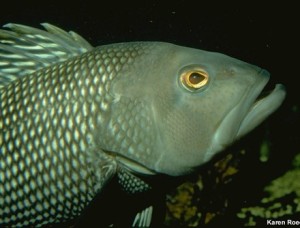
One impact is that some of these communities will start adapting to the changing marine ecosystems and harvest “locally abundant” species that were once considered invasive species. For example, black sea bass have started showing up in lobster traps in Maine because they’ve followed the warming trend north. Now they are an available seafood choice in local stores and restaurants.

black sea bass Credit: NOAA

I too hope this process becomes more collaborative. Because without that interactive participation in the science and policy making, the process will continue to be viewed by many as a set of unilateral decisions curtailing fisheries at the expense of small scale fishermen. As Hare said, even if we magically stopped all green house emissions now, the lingering effects of warming oceans would continue for decades.

Acting now, collaboratively, is the best chance at present for ensuring we effectively manage fisheries even as warming waters seek to change the dynamics. I attended a workshop a year ago in which scientists (including Hare), fishermen, and policy makers discussed how to better predict climate change impacts on fisheries and how to communicate that to fishermen.

Perhaps this is the first step.


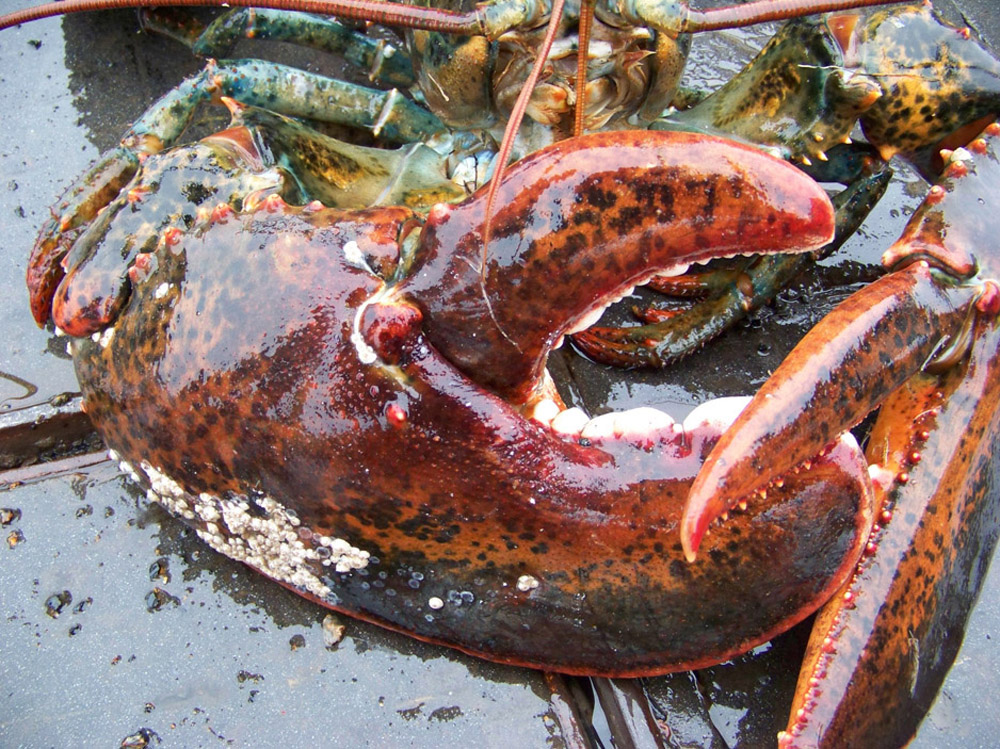
Lobster photo credit: NOAA

Recent Posts

  • Hurricane Ida wreaks havoc on Louisiana’s seafood industry
  • EPA Should Use Clean Water Act To Kill Zombie Mine
  • Slow Fish 2021: Relationship Matters
  • Faith, Façades, and Futility
  • Pebble Permit Paused: Politics at Play

Archives

  • September 2021
  • August 2021
  • April 2021
  • December 2020
  • August 2020
  • June 2020
  • February 2020
  • December 2019
  • November 2019
  • October 2019
  • July 2019
  • May 2019
  • April 2019
  • March 2019
  • January 2019
  • December 2018
  • November 2018
  • June 2018
  • May 2018
  • March 2018
  • February 2018
  • January 2018
  • December 2017
  • November 2017
  • October 2017
  • September 2017
  • August 2017
  • July 2017
  • June 2017
  • May 2017
  • April 2017
  • March 2017
  • January 2017
  • December 2016
  • November 2016
  • October 2016
  • September 2016
  • August 2016
  • July 2016
  • June 2016
  • May 2016
  • April 2016
  • March 2016
  • February 2016
  • January 2016
  • December 2015
  • November 2015
  • October 2015
  • September 2015
  • July 2015
  • June 2015
  • May 2015
  • April 2015
  • March 2015
  • February 2015
  • January 2015
Theme by Colorlib Powered by WordPress