 All Blog Posts
The Telltale Cod

This is a blog written by my good friend Chef Evan Mallett for the Slow Fish 2016 website. Slow Fish 2016 is an international gathering of fishermen, chefs, scientists, policy makers and other activists to discuss and share local fishing community challenges and solutions from around the country and the world. One Fish Foundation will be attending. Evan speaks with a clear, informed and passionate voice on why we should care about seafood sustainability.
By Evan Mallet
In 2012, I wrote a blog entitled “Grandpa, What’s a Cod?” The motive for writing that blog was a dramatic realization that my children’s children might someday ask me such a question. Perhaps, I projected, they will see an old menu or read an article, or visit the Cape that bears the name of a mystery fish.
Entire books have been written about cod—citing the fish’s dominion over our national heritage, how it inspired colonization and later, an inestimably rich global seafood trade. As our New World and its human population have expanded from the shores where codfishing boats first landed, cod has been there every step of the way. Until now.
Since I wrote the blog, assessments of the cod population in the Gulf of Maine (my backyard) have only brought more bad news. I am a chef, and I have grown up alongside the bounty of North Atlantic fisheries. In recent years, I have watched those fisheries, and the small family-owned boats that ply our local waters, dwindle to the point of near-extinction. It is clear that a revolutionary shift in mindset is the only solution to a problem we have created over decades of fishing a species to the brink.
Some experts point to changing water temperatures, locally and globally, that might explain a shift in breeding grounds for Atlantic cod and other coldwater species. And, whether as a result of this shift or a three-decade moratorium on cod fishing, there is evidence that Newfoundland—where annual cod harvests once numbered over a million metric tons—might be experiencing a cod comeback of sorts.
It’s not that I personally hold cod up as the all-seeing banner of virtue and supremacy that our founding fathers did when they marched a “sacred cod” wooden replica to the Massachusetts State House, where it still hangs today. The truth is, I definitely revere cod’s flavor, texture and utility. However, a simple reality check tells us that we have no choice but to consider other species as alternatives to our New England culture’s longtime staple fish. I am one of those few chefs who sells Pollock, Acadian redfish, even dogfish, on my menu, because I believe with all of my heart that we have no choice but to ignite a new awareness now, before the fish we grew up eating are gone.
When I attended Slow Food’s Terra Madre and Salone del Gusto in 2010, I heard a fisherman from Oceania talk about how his family could afford frozen farmed salmon from Northern Europe, purchased in his local supermarket, but could not afford to eat his own fresh, local catch, upon which his livelihood depended. That fisherman’s story started my trip down the undercurrent of insanity that is our global seafood distribution system.
I have yet to understand how the economics of food have so egregiously ignored the ecology of food for so long, and I don’t know if even radical change will come too late. But I do know that right now, every community on our planet needs to wake up to a seafood crisis. At stake is not only the human diet’s most nutritious animal protein, but also the trophic balance of all aquatic ecosystems.
Slow Fish is uniquely positioned to spread this gospel like no other organization, and I look forward to seeing talk of change lead to actions that will preserve both fisheries and fishermen.
Evan Mallett is chef/owner of Black Trumpet in Portsmouth, N.H. He also sits on the national Chef’s Collaborative Board of Overseers, the Slow Food Seacoast Board of Directors and the NOAA Seafood Marketing Steering Committee.
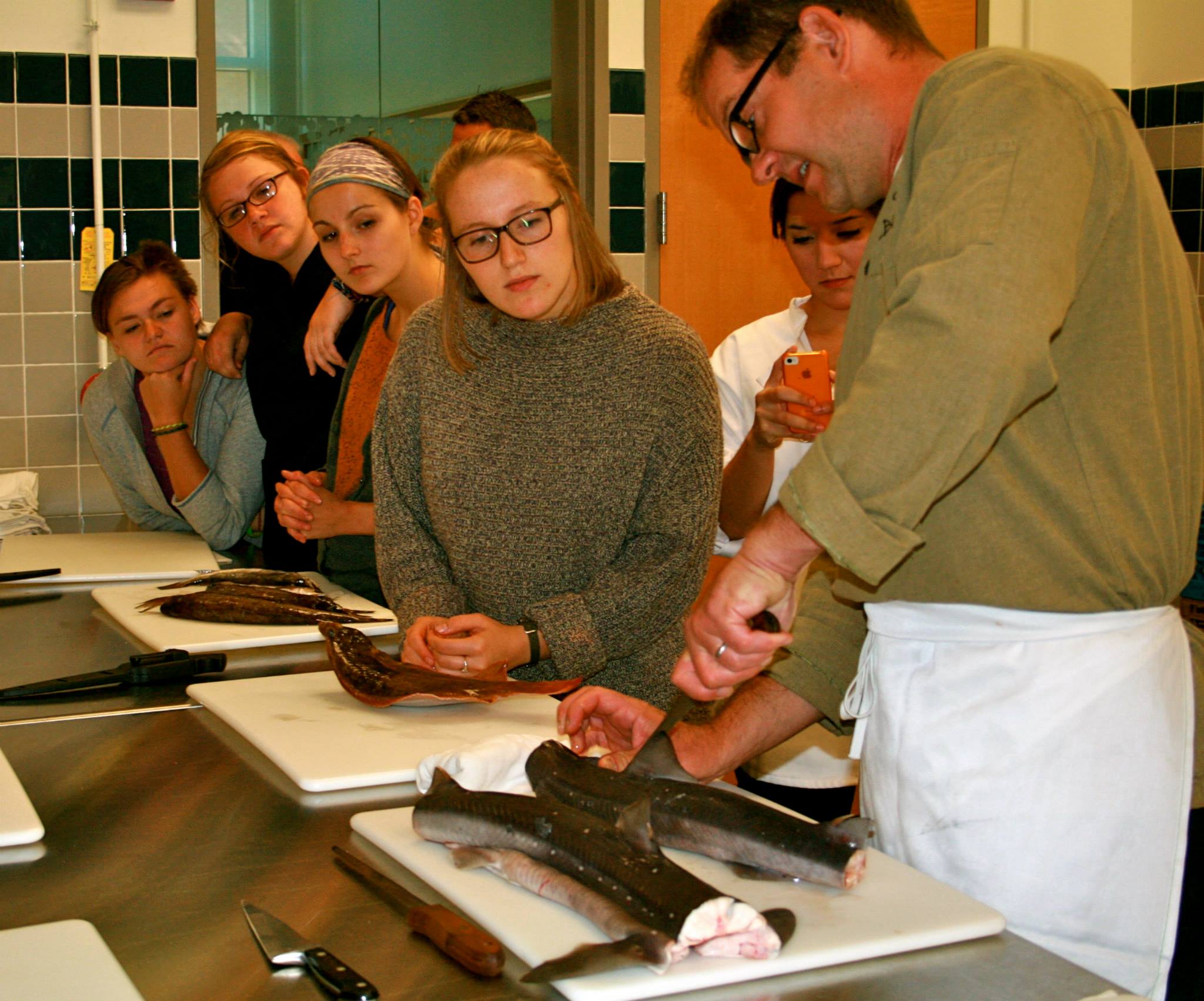
photo: Chef Evan Mallett showing Slow Food UNH students how to prepare dogfish.
SLOW FISH 2106 INFO
REGISTER for Slow Fish 2016.
JOIN our Facebook Event Page.
SUPPORT our Indiegogo fundraising campaign.
HOST a Fisher-Chef Alliance dinner.