Skip to content
One Fish Foundation
  • Blog
    • Aquaculture
    • Education
    • Environment
    • Policy
    • Wild Harvest
    • Fish Tales
  • About
    • About One Fish
    • About Colles Stowell
  • Education
    • Elementary School
    • Middle School
    • High School
  • KNOW FISH Dinners®
  • Resources
    • One Fish Podcast
    • One Fish Foundation in the news
    • The 7 C’s of Sustainable Seafood
    • Newsletter Archive
    • Recipes
      • Skate with Capers and Butter — Chef Rizwan Ahmed
      • Grandma Davis’ Fish Chowder — Jane Almeida
      • Ginger Garlic Tamari Scallops — Colles Stowell
      • Fish Stock — Evan Mallett
      • Mussels San Remo — Chef Rob Martin
      • Salted Pollock Croquettes – Chef Mark Segal
  • Connect
    • Contact OneFish
    • Social
      • Instagram
      • Facebook
      • Twitter
All Blog Posts

Arctic Climate Change Could Have Irreversible Global Impact

  • December 21, 2016October 20, 2021
  • by Colles Stowell
Share it!
Share

Every time I read a story with dire predictions about climate change impacts I imagine a gong the size of a barn door sending a warning echo off the mountains in the distance.

A team of scientists recently released a report stating that changes in the Arctic climate, everything from melting polar ice caps to warming waters and changing ocean salinity is happening faster than previously predicted. Currently, the atmospheric temperatures there are about 20 degrees Celsius warmer than normal and water temperatures are 4 degrees warmer than normal. The likelihood of no summer sea ice forming this century is very high.

Arctic tipping points

The Arctic Resilience Report states that all of this could push conditions in the Arctic toward 19 regime shifts or tipping points – climate situations that if reached, may prove to be irreversible. For example, the Greenland ice sheet is widely considered the Northern Hemisphere’s air conditioner. It is massive, nearly 1.1 million square miles, and it serves a critical role in keeping temperatures above the equator from getting too hot. This massive sheet of ice acts like a mirror, reflecting the sun’s powerful rays back into space and minimizing solar radiation warming.
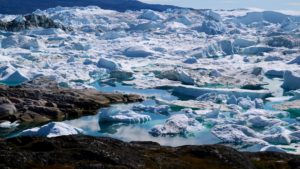
The melting Greenland ice sheet. Photo by Marcus Carson

But as global temperatures have risen, the ice sheet has become thinner and smaller, and as waters around the sheet have become warmer, they have accelerated melting. This creates a cycle in which the sheet’s shrinking could accelerate localized climate change, which could further accelerate the ice sheet’s shrinking. If the ice sheet disappears (which could take centuries), scientists predict it could cause global sea levels to rise by more than 20 feet.

This is just one of the 19 tipping points. Others include: Arctic sea ice loss, which would have some of the same effects as the melting of the Greenland ice sheet; changes in ocean salinity and current, which could spread warmer water faster than normal, with global implications; changes in land-based ecosystems that could release more greenhouse gases and reduce ice/snow reflectivity; and changes in Arctic snow patterns, which could also increase global ocean temperatures that effect climate patterns such as the monsoon season in Asia.

Fisheries impact

And then there is the impact on fisheries. The report cites manmade climate change (greenhouse gases, warming oceans, pollution, etc.) as well as other external factors like fishing pressure, as drivers for what could result in fisheries collapses in the Arctic. This could play out in a couple of different ways. First, a combination of warming water, shifting current, salinity and acidification could alter the vital nutrient upwellings that produce the plankton forage fish feed on. If the forage fish don’t thrive, neither do commercially important species like salmon, cod, pollock and shrimp. Couple that with continued fishing pressure, and you’ve got a recipe for collapse.
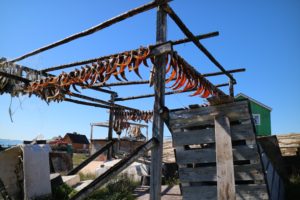
Climate change could cause fisheries collapse in the Arctic and elsewhere. Photo by Marcus Carson

The question is, how could fisheries collapse in the Arctic affect fisheries elsewhere?

This is no small question.

Complex challenges

So I asked Marcus Carson, one of the lead authors of the 218-page report. He talked about what we know and don’t know about how rapidly things are changing. “Often, when we see these things, it’s really hard to set in motion the processes we need to take them back,” he said from his home in Sweden.

“The challenge is the relational understanding. We understand the silos [warming oceans, ice melt, carbon storage in peat bogs, etc.] pretty well. What we’re lacking is how these connections in these really complex systems really work.”
Marcus Carson. Photo by Mark Tozer

For example, he mentioned that ocean acidification, the process by which the overall acidity of the ocean increases due to increased environmental carbon release, was not included as one of the tipping points in the report because scientists couldn’t pinpoint how it will behave in concert with other factors like salinity, temperature, current, etc. What scientists do know is that the rate of acidification in the Arctic has increased twice as high as almost anywhere on earth, and that acidification is generally higher in colder water.

“What we don’t understand is the exact relation between climate change and ocean acidification where fisheries are involved,” he said. Many species follow temperature, which is the case with some species here in the Gulf of Maine. For example, as waters have warmed off Long Island Sound, lobsters have pushed north and east, and there is no sustainable lobster fishery there anymore.

We also know as we dump more carbon into the atmosphere and put more chemicals into our estuaries, the acidity goes up. But as Carson said, we don’t yet know how changes in acidification from these types of drivers will work in concert with temperature, salinity, current to affect marine food webs. Species that are more tolerant of some or all of these drivers will likely thrive more in a changing Arctic climate than others.
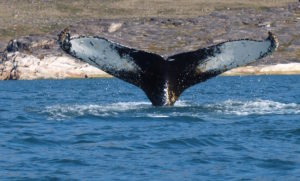
We need to better understand how all climate change factors could affect entire food webs. Photo by Mark Tozer

“There may be some biological variability that might get species competing with each other moving into the same space,” he said.

When it comes to impact on climate change in the Arctic affecting fisheries there and elsewhere, we still have to take a broad view. There will undoubtedly be an impact, especially when considering how currents will channel warmer, denser water globally.

A global climate

“There’s a saying around the working groups of the Arctic Council. ‘What happens in the Arctic doesn’t stay there.’ A lot of changes beyond seasonal fluctuations aren’t generated there. They start outside the Arctic, and get in there,” he said. And the changes in the Arctic may have global impacts.

“The implication with these 19 potential shifts … is that when these things start interacting with one another, the concern is that we could be setting forces in motion that are wildly out of our control,” he said.
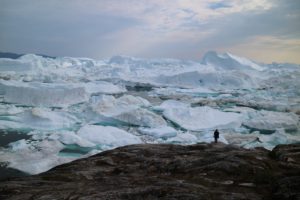
The cycle continues. Melting ice sheet allows more solar rays to warm oceans and atmosphere, accelerating ice melt. Photo by Marcus Carson

Not surprisingly, almost every response option cited in the report for the 19 tipping points calls for some form of reducing global greenhouse gases and shifting toward renewable energy.

This is the same message a majority of scientists have been saying in ever growing numbers and volume. However, the incoming administration has virtually declared war on climate change science.

Asked about threats to defund NASA’s climate science regimen, Carson used the analogy of “tearing the instrument panel out of your plane while in flight. It’s like you want to poke our eyes out while we’re heading into these big changes.”

Indeed.

That gong is getting louder. Do you hear it?
 

All Blog Posts

MSC Ecolabel Trashed by Founder

  • December 7, 2016October 20, 2021
  • by Colles Stowell
Share it!
Share

The question invariably arises at sustainable seafood dinner events or even in casual conversation.

“What about the MSC (Marine Stewardship Council) standard?”

Involuntarily, I shake my head, before explaining the complex nature of ecolabels, which seek to certify seafood as sustainably harvested, but often raise more questions than they answer.

That complexity came to the fore last week when the World Wide Fund for Nature (WWF) ignited a firestorm with a detailed … and leaked … report castigating the MSC, one of the best known labeling organizations. The report questions the non-profit’s neutrality, process and overall effectiveness in adequately protecting the resource and objectively informing consumers about the sustainability of the seafood they purchase.

The colossal irony here is that WWF was one of the key founders of MSC, a non-governmental organization (NGO). And now it has become an outspoken critic. Here is a link to the leaked WWF report. WWF claims the report was not finalized and has tried to backtrack. However, the 58-page document has detailed citations and thoroughly explained timelines noting the events that led to the drafting of the report, which by the way, is marked “FINAL.”

What rules?

The catalyst for this report was the MSC certification of certain tuna fisheries in the Indian Ocean. One of the key principles of the original MSC guidelines for certification was that fisheries have a set of harvest control rules (HCRs) that ensure the health of the fishery. WWF now claims there are “several troubling systemic flaws” in the MSC certification process and that the mission appears to have become more about profits from the royalties paid to have the MSC logo than the original mission.

That’s a stinging accusation from one of the organization’s original founders.

Some of the most damning accusations include:

  • Certification of fisheries where no credible HCRs exist;
  • Changing the process language on the fly to accommodate certification of fisheries whose certification has been challenged;
  • A clunky appeals/challenge process that generally falls on deaf ears; MSC admits that very few stakeholder comments (13%) have any impact on the process;
  • A system of contracting third-party certifiers that do not respond to stakeholder comments;
  • Conflict of interest whereby MSC profits from the royalties on the logo fees while “objectively” certifying the fisheries.

And if this report weren’t enough, Brendan May, MSC’s former CEO for five years wrote a blog about the WWF report. While he doesn’t directly indict MSC, the fact he is taking time to acknowledge the report says something about its significance.

An ecolabel’s complicated path

When I started writing about sustainable fisheries six years ago, I initially supported the concept of transparency in labeling. There were a few emerging standards, Friend of the Sea, Dolphin Safe and the Marine Stewardship Council among them. MSC’s goals were broad and ambitious. The U.K. based non-profit set a goal to certify 20% of the world’s fisheries by 2020.

But as I dug deeper in my research, I started seeing inconsistencies. Accusations from within and outside the industry arose, claiming MSC certified fisheries that aren’t sustainably managed and that the NGO instituted a system that isn’t objective. Witness the certification of the North Atlantic longline swordfish operation. The fishery was certified despite the high bycatch of sharks. The further I dug in, the more I realized how complex and thorny implementing proper transparency schemes really is.

So when asked, I explain this complexity, and some of the issues with all ecolabeling systems, then go into some detail about MSC.

This leaked report further underscores that complexity, and where good intentions can get thoroughly clouded by money. I still strongly advocate for transparency in seafood distribution from boat to plate. The U.S. has a long way to go, as do many other countries.

But if you aren’t going to really be transparent or objective, why bother?

When in doubt, ask questions

I tell my students and interested adults their best line of defense is knowledge. Get smart about some of the issues around seafood sustainability. Learn more about the environmental, ecosystem, socio-economic impact of different harvest and aquaculture methods.

Ask questions:

  1. Is it local? Was it caught, cleaned and/or filleted locally?
  2. How was it harvested?
  3. If it was farmed, were there any antibiotics, hormones or pesticides used?
  4. When was it harvested?

If you can’t get answers to these questions from your fishmonger or restaurant, perhaps you should consider something else.

I suggest people take a look at the Local Catch core values, which gives a good overview of how local, transparent community-based fisheries benefit both consumers and fishermen. These principles are rooted in accountability and trust: accountability in the fishermen who strive to take care of the resource and trust from the community that the fishermen are delivering sustainably harvested seafood.

Additional resources:

Marine Stewardship Council standards

World Wide Fund for Nature Overview of Tuna fisheries and relationship with MSC

The Times article, in which the publication first announced the leaked WWF report.

Undercurrent News article, in which MSC responds to the WWF report.

Ecolabel Index — gives a quick overview of different ecolabels from building design to farming and seafood.

Recent Posts

  • Hurricane Ida wreaks havoc on Louisiana’s seafood industry
  • EPA Should Use Clean Water Act To Kill Zombie Mine
  • Slow Fish 2021: Relationship Matters
  • Faith, Façades, and Futility
  • Pebble Permit Paused: Politics at Play

Archives

  • September 2021
  • August 2021
  • April 2021
  • December 2020
  • August 2020
  • June 2020
  • February 2020
  • December 2019
  • November 2019
  • October 2019
  • July 2019
  • May 2019
  • April 2019
  • March 2019
  • January 2019
  • December 2018
  • November 2018
  • June 2018
  • May 2018
  • March 2018
  • February 2018
  • January 2018
  • December 2017
  • November 2017
  • October 2017
  • September 2017
  • August 2017
  • July 2017
  • June 2017
  • May 2017
  • April 2017
  • March 2017
  • January 2017
  • December 2016
  • November 2016
  • October 2016
  • September 2016
  • August 2016
  • July 2016
  • June 2016
  • May 2016
  • April 2016
  • March 2016
  • February 2016
  • January 2016
  • December 2015
  • November 2015
  • October 2015
  • September 2015
  • July 2015
  • June 2015
  • May 2015
  • April 2015
  • March 2015
  • February 2015
  • January 2015
Theme by Colorlib Powered by WordPress