 All Blog Posts
Eating Smaller Fish is Better? New Research Says Yes

Are we really super predators? That is, are we so far up at the top of the food chain that we dictate the health and survivability of different species based on our collective eating patterns?
Short answer: Yes. And a new study claims that if we hunted or fished like natural predators, say wolves or tuna, we’d have fewer concerns about the long-term sustainability of our food source.
Published in a recent edition of Science, the study suggests natural predators don’t go for the trophy caribou or bluefin tuna. They target younger, weaker family members, leaving the bigger, healthier adults, which reproduce more, to continue growing the clan, and thus the species.
This is not to say predators consciously choose to eat what the study terms “the interest” or young because they know of the long-term implications. Wild predators naturally select the young, the weak, etc. because it’s the easiest access to food. The byproduct is natural selection “choosing” the stronger more reproductive animals to multiply.
We do not operate this way. Social, economic and cultural factors driven by technological advances have fueled the notion of “bigger is better” in our hunting, fishing and eating practices. This partly explains why a single tuna can sell for hundreds of thousands of dollars in Japan.
And because our own tastes drive our purchasing decisions (How often do you choose the smallest salmon fillet in the case?), fisheries management has followed suit. More often than not, fisheries regulations are governed by minimum size limits. So according to the study, we are in essence managing toward killing and eating the “reproductive capital,” and therefore steering populations into decline ¾ despite so-called management “safeguards” in place to preserve the species.
The upshot of the article is that we should instead be targeting the “reproductive interest,” or younger fish to somewhat mirror how natural predators hunt. Doing so should help us better manage our food source.
There are naturally some significant challenges:
- We would have to develop fishing methods that would allow larger, more reproductive fish and shellfish to be released unharmed after being caught. This is no easy feat;
- We would have to re-think management policies, based on scientific research and commercial fishermen input to identify the best way to target the right size and age group that won’t send a population into decline.
- We would need a better understanding of how varying reproductive rates in different species fits in with other crucial factors, such as predator/prey relationships, migratory patterns, etc.
- Most importantly, and this is the kicker, we as consumers need to re-think how we purchase seafood. We have to change what may be millennia of natural super-predator behavior and think long-term, not just the immediate gratification of eating big.
The last point determines the success of the first two. If we can change our buying habits, whether choosing underutilized species like hake or Pollock or choosing smaller fish (whole fish or fillets) and shellfish, the industry will slowly change.
That’s a big “if.” But if we don’t figure out some sensible alternatives, the research suggests we may eat our own food source into perilous paths already paved by Atlantic salmon and cod.
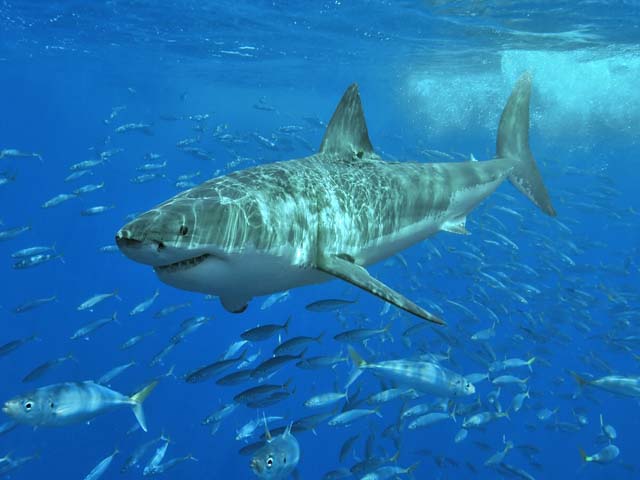
Photo credit: Pterantula (Terry Goss) at en.wikipedia – Derivative of w:Image:Whiteshark-TGoss5b.jpg