Skip to content
One Fish Foundation
  • Blog
    • Aquaculture
    • Education
    • Environment
    • Policy
    • Wild Harvest
    • Fish Tales
  • About
    • About One Fish
    • About Colles Stowell
  • Education
    • Elementary School
    • Middle School
    • High School
  • KNOW FISH Dinners®
  • Resources
    • One Fish Podcast
    • One Fish Foundation in the news
    • The 7 C’s of Sustainable Seafood
    • Newsletter Archive
    • Recipes
      • Skate with Capers and Butter — Chef Rizwan Ahmed
      • Grandma Davis’ Fish Chowder — Jane Almeida
      • Ginger Garlic Tamari Scallops — Colles Stowell
      • Fish Stock — Evan Mallett
      • Mussels San Remo — Chef Rob Martin
      • Salted Pollock Croquettes – Chef Mark Segal
  • Connect
    • Contact OneFish
    • Social
      • Instagram
      • Facebook
      • Twitter
All Blog Posts

Slow Fish 2021: Relationship Matters

  • April 14, 2021October 19, 2021
  • by Colles Stowell
Share it!
Share

Slow Fish is about relationships. Our relationships with seafood, those who harvest and sell that seafood, our broader communities, our oceans and waterways, and with each other.

Since the pandemic shut down our planned Slow Fish 2020 in-person event last March, we’ve been reimagining how we re-establish, strengthen, and explore these connections. Planning a virtual event was new for all of us. We learned you can’t apply the same thought process to a remote event.

The theme of relationships was prominent throughout Slow Fish 2021, held online from March 18-20 and March 25-27.

We heard it from Jim Embry, who spoke about the importance of striving for equity, inclusion, and justice even as racism persists in our water- and land-based food pathways. Keynote speaker Buck Jones of the Columbia River Intertribal Fisheries Commission reemphasized the importance of preserving both indigenous and non-indigenous connections to food sources.

Know your fishermen and women!

The theme of relationships cropped up again in the Seascape World Café where attendees joined rotating conversations about growing the network, advocacy and action, and young fish harvesters.

One central theme from the Seafood Supply Chain Deep Dive is that direct connections between fish harvesters and customers, retailers, and other harvesters are increasingly essential to growth and survival. Covid’s devastating impact on industrial supply chains continues to wreak havoc. In the end, the definition of “local” is becoming less about geography and more about relationships.

We heard this from several storytellers. Kayla Cox at New England Fishmongers based in NH described customer enthusiasm for the amazing shrimp from Anna Marie Shrimp in LA and wild salmon from Yakobe Fisheries in AK. Lance Nacio explained how these types of business networks have helped both Anna Marie Shrimp and its customers who buy all of the scallops he can get from New England Fishmongers.

These are the kinds of relationships that help fishermen and women troubleshoot logistical challenges like collective marketing, business questions, or mentorship. These are the connections that grow the network of folks that share Slow Fish values of good, clean, fair seafood.

Natural connections

Relationships to the land, the water, the fish, the birds, animals and Nature in general is at the center of Indigenous culture, and it was the foundation for many powerfully spiritual stories in the Indigenous Access to Food Sources Deep Dive. We heard perspectives from Indigenous communities from Martha’s Vineyard, MA. all the way to AK., including stories from smaller and bigger river systems in northern CA. and OR.

We heard resilience in the stories of opposing a massive proposed mine in the Bristol Bay, AK watershed, restoration of Indigenous access to wild salmon runs on the Columbia River; preservation of cultural knowledge around seasonal, balanced ocean and land harvests in northern California, and the continued efforts from all geographies to protect treaty rights around access to natural resources. The upshot? If we take care of our natural resources, they will take care of us. Protecting Indigenous access to cultural food sources is an important part of that equation.

This connection to natural resources and marine habitats played a crucial role in the Aquaculture Deep Dive, where we learned about small-scale, ecosystem-balanced operations like an oyster farm near Miami, seaweed farming in Maine, and wild seaweed harvest in British Columbia. We also heard about collective efforts to oppose industrial-scale finfish and shrimp farming and other operations, which upset marine ecological balance and often socio-economically displace coastal communities that depend on local fisheries for their lives.

The Rivers Connect the World discussion featured compelling stories of habitat restoration and preservation from the Mississippi, Danube, Snake, and Copper rivers as well as the rivers of Cork, Ireland. These efforts continue to succeed because of the collaboration within and among communities along those rivers, regardless of political borders.

Shared Resources

The Blue Commons Deep Dive explored how the industrial-scale development of the Blue Economy typically saps the lifeblood from coastal communities and their local economies, and cripples the independent fish harvesters living in those communities. Blue Economy plays such as massive fish farms, huge offshore wind farms, or large, investment-backed no-fish zones essentially privatize large sections of the ocean and have the most devastating impacts on independent, artisanal, and subsistence fishermen.

The Blue Commons is a counter-narrative to the Blue Economy, in which communities gather around a shared set of values to treat marine and estuarine water bodies as shared resources. We again heard stories of resilience, such as how the Okanagan Nation’s Alliance worked to restore wild sockeye salmon runs on the Snake River in their home waters in British Columbia. We learned about a Rhode Island community working to re-establish a vibrant, locally managed quahog fishery and provide more access to more fishermen despite consolidation by market forces.

We also learned how a fishing community in Sitka, AK worked to ban trawl nets in sensitive fishing areas to minimize halibut bycatch; develop a collaborative science approach to monitor rockfish biomass to ensure healthy stocks; and create an innovative program to train young fish harvesters. These types of commoning fortify the relationships between communities and their surrounding natural resources.

All of these discussions prompted thoughtful idea exchanges and questions in very active chat sessions, with 2,424 messages spread out over both weekends. This does not include the very vibrant feedback during the live panel discussions following the screenings of “Last Man Fishing” and “The Wild” films during the first weekend.

On the final day of the event, Slow Fish North America Oversight Team members Tasha Sutcliffe and Kevin Scribner provided a thorough synthesis of common threads arising from these discussions. Relationships, food sovereignty, equity and social justice, habitat protections, and intergenerational knowledge transfer or mentorship were some of the most common threads woven into the fabric of the event and of Slow Fish values. To see the full synopsis from Kevin and Tasha, follow this link.

Follow this link in case you’d like to see recordings of the different discussions from Slow Fish 2021. Scroll down the library until you see “Aquaculture.” The eight videos following Aquaculture were all part of the event.

A team of between 30 or so people worked tirelessly for several weeks to coordinate what turned out to be a stellar event. We met or exceeded our goals of strengthening and growing the community; empowering folks in the network to share their stories and become our values standard-bearers; spark meaningful conversations around several crucial topics to the Slow Fish network; and celebrate the community and collective energy of our shared values.

I am truly thankful to everyone who participated. Hopefully, the next event is in person!


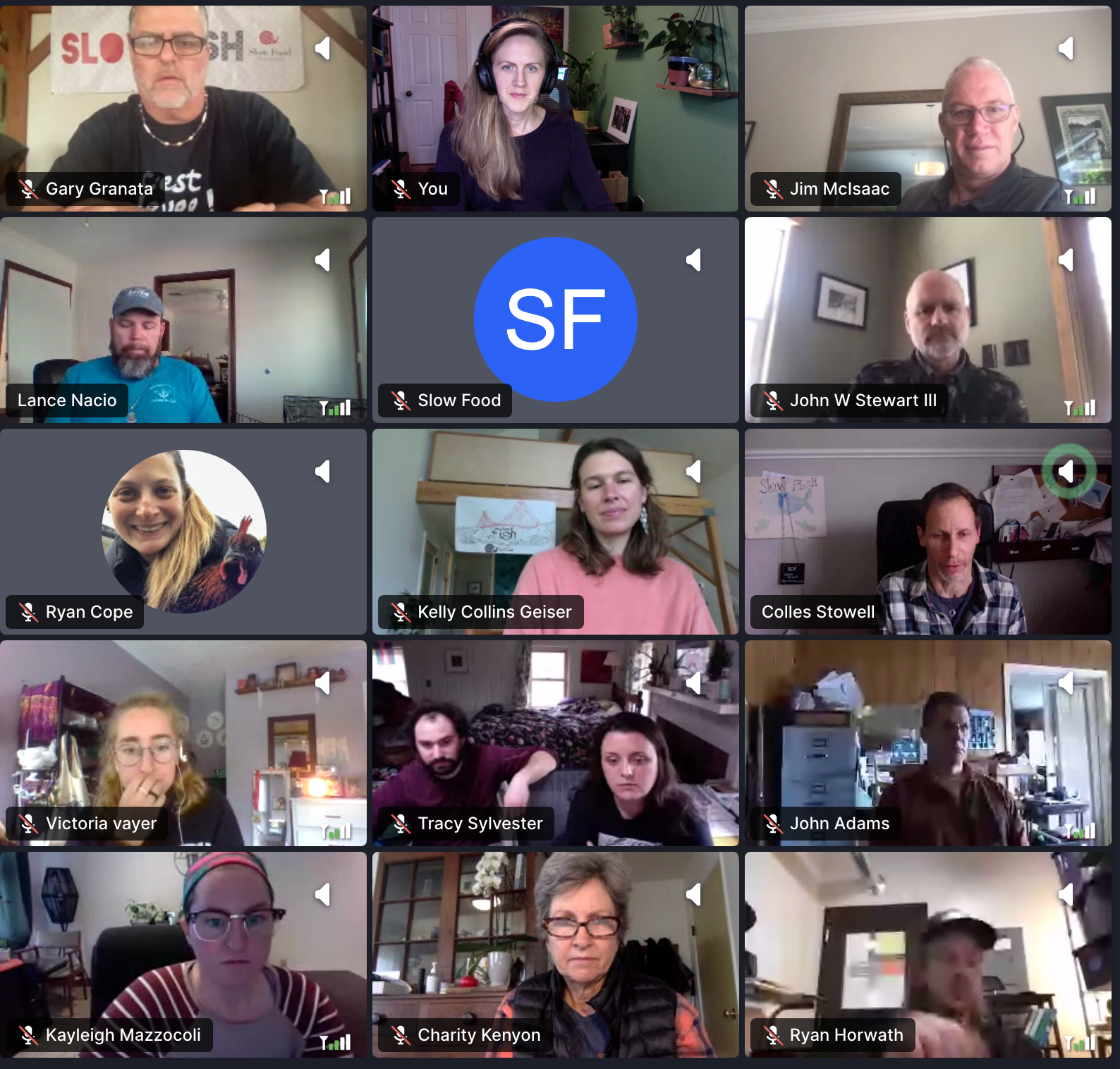
Top photo: Screenshot from the final day of Slow Fish 2021. Credit: Sister Denisa Livingston of Slow Food Turtle Island
All Blog Posts

Building Mussels

  • November 29, 2018October 20, 2021
  • by Colles Stowell
Share it!
Share

Why in hell didn’t I schedule this on a more temperate day?

It was 21 degrees at 5:30 a.m. when I scraped the first significant frost coat off my car’s windshield to drive down to the Maine Wharf in Portland. Dawn was slowly breaking over the Atlantic, faint whisps of light harkening a chilly day on the water.

Though I was layered up, prepared to don some brand new, drab green Grundens oil slicks to shield myself from the forecasted wind and hopefully stay dry, I did begin to wonder what I’d gotten myself into.

What better way to get a sense of how mussel farms work than to get muddy? Doing it in mid-November in Maine just adds some texture to the experience. For me, this was research. I spend a lot of time talking about shellfish and finfish aquaculture in classrooms and at different speaking engagements. I wanted to have firsthand knowledge of what it takes to seed, grow and harvest some of the best mussels available.

Fortunately, Matt Moretti, co-owner of Bangs Island Mussels is happy to welcome visitors to the operation and let them get muddy if they so choose. They just need to understand that harvest days are fixed, regardless of the weather, because that’s how market demand works. Selling high-quality, responsibly grown mussels to restaurants and wholesalers across the country means you don’t get to choose the harvest conditions.
Portland has 12 working piers, including the Maine Wharf. Some of these piers are under threat from developers.

And so we pulled away from the dock as an early winter sunrise painted the sky pink, orange and light blue. Bangs Island lies just east of Chebeague Island, and not far from Portland’s historic working waterfront as the crow flies. But it still takes about an hour in a re-purposed fishing boat that doesn’t cruise over 15 mph.
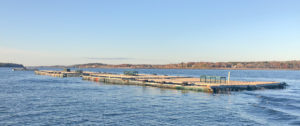
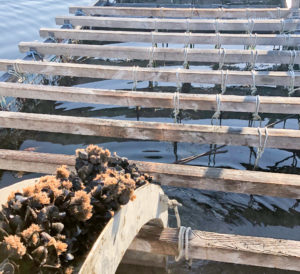
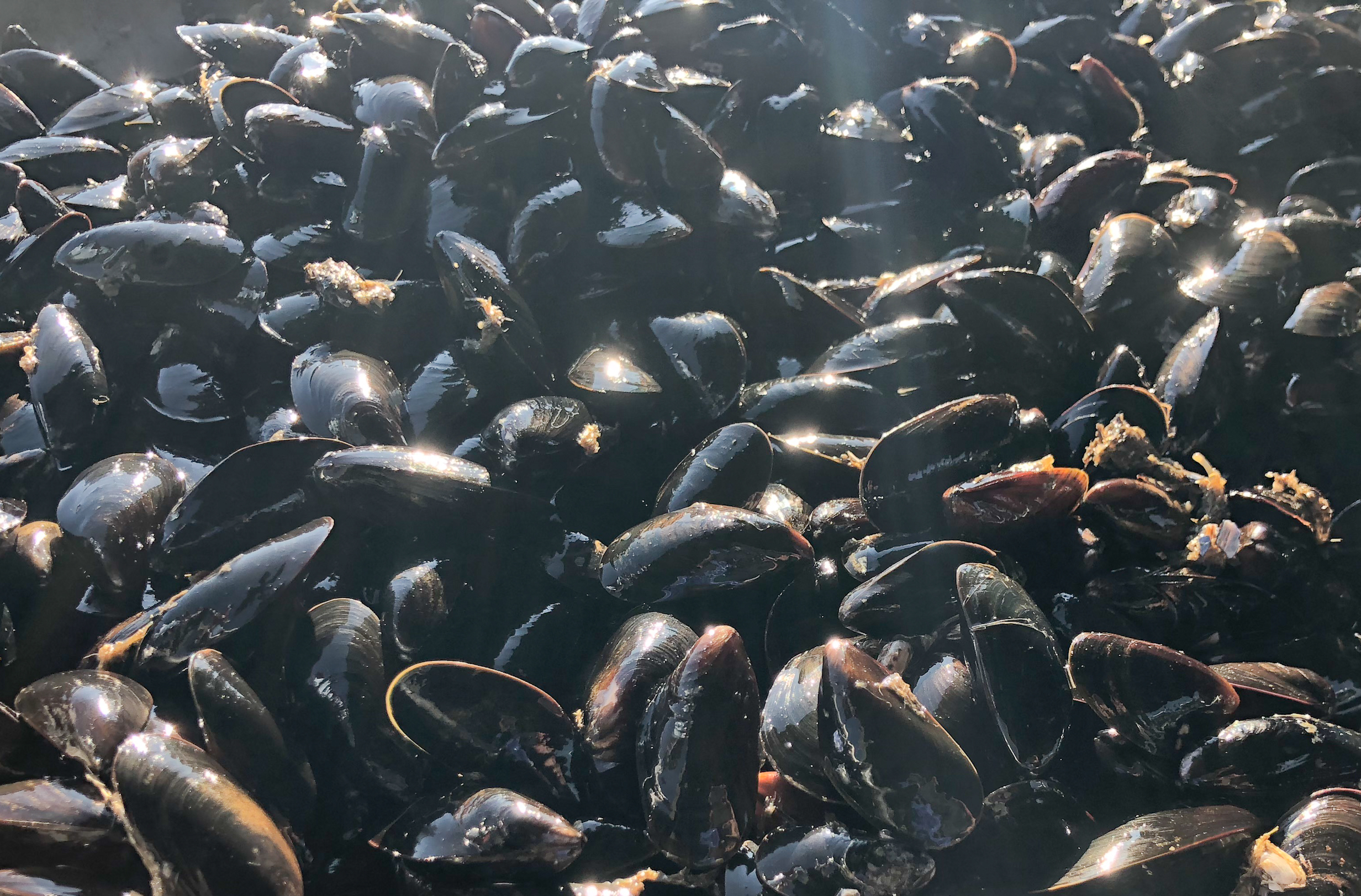
The mussels live, eat and grow on hundreds of ropes dangling from solid wood beams on three large rafts securely anchored a couple hundred yards from shore. The entire operation spans about 3 acres. Each raft has up to 2 million mussels or so in different stages of development, from newly seeded spat (the small seed that grows into three-inch adults) to dinner-size.

Millions of mussels at different stages of the three-year growth cycle.

Bivalve aquaculture 101

When discussing different harvest methods in classrooms or community events, I also talk about aquaculture practices. Since aquaculture has surpassed wild caught seafood for global direct human consumption, farmed fish, shellfish and seaweed play critical roles in any sustainable seafood discussion.

Just as with wild harvest methods, different aquaculture methods have a range of ecological impacts, some of which are beneficial, but many of which are disastrous. Industrial finfish aquaculture promises “to feed the world.” Yet the litany of debilitating ecological impacts ranging from massive fish escapes (threatening wild populations) to disease, antibiotic use, algal blooms (from excess nutrients from waste and undigested food), sea lice, feed (grinding up wild forage fish populations to make feed pellets), etc. have called into question the overall benefit of such operations.

Bivalve aquaculture avoids almost all of these issues. Mussels, clams and oysters are filter feeders. They eat plankton, not ground up forage fish, thereby reducing the particulate matter in bays and estuaries and rendering those ecosystems healthier for a broad swath of marine species. Properly siting them in areas with good current enhances their food source and minimizes oversaturation of nutrients and disease.

That said, they are constantly tested to make sure they are safe to eat, particularly after heavy rain events, which can elevate the amount of unhealthy nutrients and toxins they filter.

Yes, quality control is paramount.

From mud to tote

Bangs Island Mussels currently operates from a barge with shed walls and a roof to protect the crew and the mussels from the elements: driving rain, snow, sleet or blazing sun.
The hauler starts the harvest process.

The process begins with a large winch that hauls up the long, heavy (up to 500 pounds) ropes of mussels and millions of other tiny organisms that attach themselves to the biomass overtime. The winch slowly brings the rope up to a gateway that, with the help of someone standing there, strips the mussels from the rope. Sometimes the clumps can be the size of a soccer ball, but mussels and all have to come off the rope.

After the rope has passed through the gate and is mussel-free, you set it aside to be hosed off and re-seeded later with mussels that are too small for market (more on this later). Then you wind up the next rope.

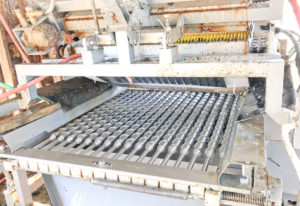
Once stripped, the mussels go up a conveyor belt to a brush declumper, a big machine with a series of rollers and stiff bristles that appear to gobble up the black shells. In fact, these bristles are helping to break up clusters of mussels and remove barnacles, seaweed and other organisms such as sea squirts that can attach themselves to the mussels and the rope. Someone stationed above the “mouth” of this machine physically pushes the mussels into the narrow gaps of the bristled rollers. It’s a physically taxing process.

The mussels that come out of the first section of that machine are relatively clean. They are dropped onto a grader, which has another system of adjacent rollers with spirals, like giant screws, that are closely spaced. This array weeds out the mussels Moretti and his crew deem too small for market size. As the screws turn, the smaller mussels slip through the cracks onto a chute and into a waiting bin to be re-seeded onto ropes and dropped back into the water to grow.

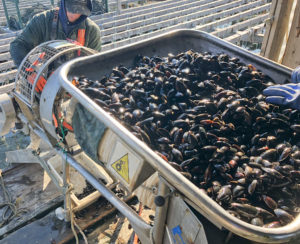
Market size mussels feed out into another bin that is dragged to the boat and packed in ice in huge totes arranged on the boat deck. Someone stands near the area where the market size mussels arrive and sorts through any remaining clumps held together by seaweed and their beards.

The declumper at the top of the photo uses yellow bristled rollers to separate and clean mussels before depositing them on the grader, which separates the market-sized product from the soon-to-be-re-seeded.

We processed about 2400 pounds of mussels (about average for this time of year) in a little over three hours. I was pretty damn happy to sit down and eat lunch … at 10:30 a.m. I felt satisfied with the teamwork involved in a surprisingly smooth and efficient operation considering the task at hand. Everyone had a role, and rotated around a bit to help each other. And the crew patiently coached me on technique and timing.

Measuring up

After lunch, we began re-seeding the ropes with mussels that were too small. I say too small – we returned mussels averaging just a little over two inches in length on the long edge – even though I’ve been served Canadian mussels that size in New England restaurants.

Getting mussels back on a rope and into the water is an intricate process aided by a machine that looks like a product of Jules Verne’s imagination. Called the seeder, or socking machine, this contraption draws clean rope through a type of snare where the mussels are dropped from a hopper onto the rope and enclosed by a thin cotton mesh that wraps the mussels like a sock. This sock will hold the mussels in place until they attach to the rope, before the net naturally biodegrades.
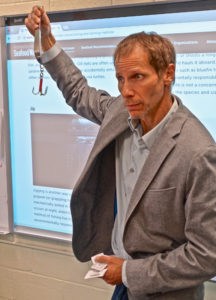
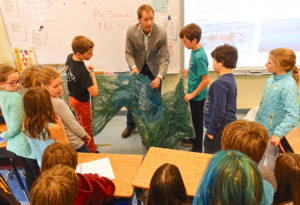
It’s a bit of a painstaking process in that you want to ensure the mesh goes on properly and ties off the mussels so they stay on the rope. We loaded several ropes back onto the raft.

The seeder, or socking machine in action. Not quite ready for prime time, these mussels need a little more time “on the vine” to get to Bangs Island size. (Turn up the volume).

Quality is everything

Next we took water samples for the state Division of Marine Resources to check the level of nutrients and toxins in the water. These tests, and direct mussel samples, are frequent, and ensure the safety of the mussels that go to market.

Back at the Maine Wharf, the mussels were hoisted off the boat with a powerful hydraulic lift, and brought into the warehouse where a team waited to do final sorting, grading, cleaning and bagging for market. As with the harvest operation, the final steps toward market readiness are meticulous.

Bangs Island has a reputation among chefs and foodies for big meats. That is, not only are the shells generally bigger than most other mussels on the market, but the meat inside them is bigger too.

Having opted for Bangs Island’s harvest for over a decade in restaurants and my home cooking (an excellent addition to gumbo!), it was with a deeper appreciation the next day as I set out to cook a couple pounds for my family. Harvested with my own hands not far from where I live, with a very coordinated process rooted in getting the details right, these mussels drove home one of my classroom and restaurant mantras: Know your seafood. Know your fisherman, or seafood producer.

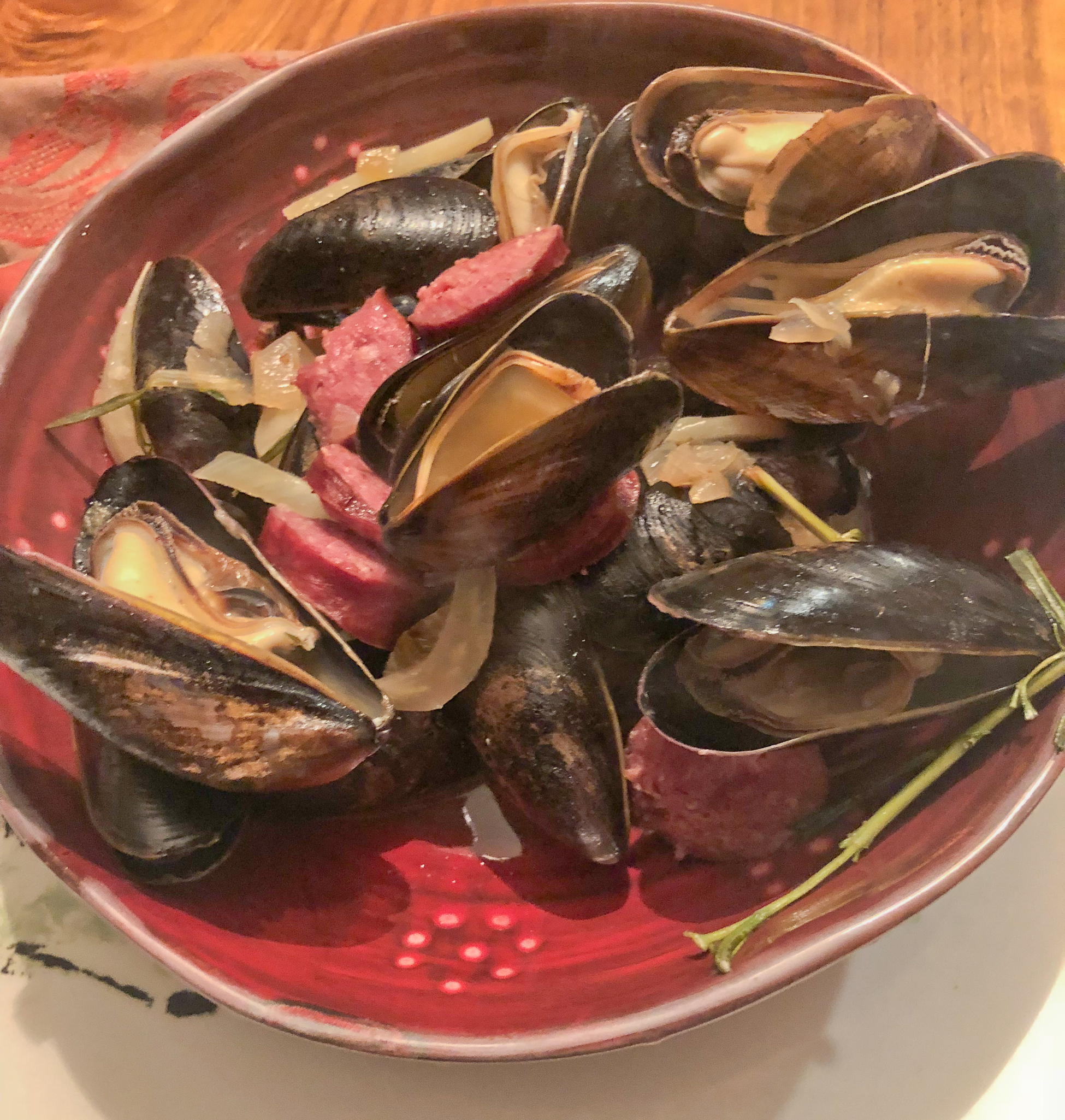
The fruits of spending a chilly day on the water. Follow this link to a recipe for mussels San Remo from my friend Chef Rob Martin at 1652 Restaurant in York, Maine.


Thanks to Matt Moretti and my crew mates John, Zack and Ben for welcoming me aboard and teaching me the ropes! It was worth muddying my new Grundens on that chilly morning to build a valuable experience that I’ll share in classrooms and restaurants.


All Blog Posts

What It Means To Be Local

  • June 16, 2018October 20, 2021
  • by Colles Stowell
Share it!
Share

Update as of 4:45 p.m. 6-17-18:

Adding a link to the latest response from Sea To Table Founder Sean Dimmin to the AP story. In the response, he goes on the defensive, calling out “numerous misstatements and false allegations,” alluding to shoddy or incomplete reporting. Dimin points out instances where the reporting does seem to leave a bit of detail and process open to question. He also admits Sea To Table could have better communicated with its suppliers (in particular, Gosman’s) and with its customers.

That’s all fine. He’s saying the right things for someone in his predicament. But I don’t think the conversation should end there. Those in the domestic seafood industry, and those who promote it, face a steep challenge. Trust is absolutely essential to trying to convince even small percentages of US consumers to get seafood smart and buy domestically. The original premise behind Sea To Table or any similar minded operation is to promote local seafood, fishermen and waterfronts, often regardless of customer geography. So even if lapses in communication to customers or partners that led to  mislabeling, etc., are the only truly valid mistakes made, we need to be having this conversation. As we’re trying to limit the more than 1.5 million tons of cheap, imported farmed shrimp (among other unsustainably harvested species) flooding markets in this country every year, we need to be honest and forthright.

I do not agree with some who claim the negative attention and likely serious sales hit to Sea To Table is just desserts and the company should go away. I think these communications issues don’t rest with Sea To Table alone in the industry. It’s a tough, and generally laudable mission these companies try to accomplish. But I also don’t think we can make excuses for those whose lapses could set the entire movement back by calling trust in domestic seafood systems into question. We need to have these conversations, find solutions and move forward to turn that 90% domestic import figure around.


It all comes down to trust … and relationships.

This week’s news that one of the rising stars of the locally sourced, sustainable seafood movement may have been selling seafood that wasn’t local, may have been mislabeled and was possibly linked to slave labor in other countries sent shock waves through the industry.

Brooklyn-based Sea To Table has built quite a following with its promise of sustainable, traceable, domestically harvested wild seafood delivered to your doorstep. Clients included celebrity chefs like Rick Bayless national food chains such as Chopt Creative Salad, a bunch of universities like Yale, eateries at the Empire State Building and Chicago O’Hare airport and the home meal kit provider Hello Fresh. It can be found in almost every state.

But an Associated Press report issued earlier this week shed light on some of the issues that can arise with this boat-to-table model and the temptation of entrepreneurs to co-opt, then sweep aside the spirit and intent of terms such as “sustainable seafood” and “local.”

The colossal irony being that they may be knowingly or unknowingly violating the principles they promote, all in an attempt to bring clarity and trust to what Sea to Table Founder Sean Dimin calls “the historically opaque seafood industry.” The Sea To Table business model is to work with some 60 “local” fishermen and fishing operations/distributors to source “traceable” seafood from around the country.

The AP report outlines a lengthy investigation uncovering a slew of allegations that run headlong into the company’s  mission statement. For example, promoting fresh, locally caught yellow fin tuna in the winter off New York, when the migration south occurred several months beforehand and no local fishermen had been out. Or charges that some of the seafood Sea to Table sold was in fact imported and linked to Indonesian operations with a history of labor abuse. Other charges included selling farm-raised seafood despite the wild-only claim.

So yes, this was big news in that it surprised many in the industry. It will also raise lots of questions, piss some people off and confuse the hell out of consumers. What are they supposed to do to be sure they are buying local, sustainable seafood?

Dimin is correct in that the seafood industry is indeed opaque. There are few places that have completely transparent supply chains. Consider that seafood travels more than 5,000 miles on average from boat to plate in this country, often changing hands at least seven times.

The AP report is informative and sad, but it isn’t really broaching any new allegations about industry practices. Check out this exhaustive AP report on slave labor linked to imported seafood. The fact we import 90% of the seafood we eat just means more of the seafood consumed in the U.S. may be linked to brutal labor practices.

But the issue of trust and misrepresentation goes beyond just the seafood industry. The whole concept of questionable food sourcing and marketing practices isn’t new. For example, the Tampa Bay Times ran a series in 2016 about the farm-to-table movement, and how many restaurants and purveyors were glazing over, and sometimes outright lying about the provenance of their food.

What is local?

All of this goes back to a discussion I had this week with Josh Stoll, a research professor at the University of Maine and a co-founder of Local Catch, an organization that promotes community-supported fisheries and other direct-to-consumer operations aimed at bringing people closer to their seafood.

We discussed how the Sea to Table news raises the very valid question of how to define “local” and how to re-build consumer trust. Josh spends much of his time working to streamline and improve community-based fisheries governance for the benefit of fishermen, their communities and consumers.

“The definition of ‘local’ is evolving,” he said. “It’s less about geography and more about relationships.”

He’s exactly right. Just as the terms “organic” and “sustainable” have been stripped of their original intents by overuse and bastardization of meaning, “local” without valid context has become vapid marketing speak. It could mean so many things and nothing at all if there is no valid context to support its use.

Case in point: Sea To Table uses “local” in the first sentence of its mission statement to showcase the quality of the seafood it sources. Now, regardless of whether the company knowingly misled customers, it has much work to do to re-establish credibility. Dimin and his crew can’t just plead that they are still offering “local” seafood. They have to earn back that trust.

How? By going back to the basic mission and working to repair the relationships that the company was built on. Not an easy task.

When I host KNOW FISH Dinners® and invite people to talk to the fish harvester who caught the fish they are eating, I’m creating a direct link to the food producer that more often than not remains a mystery in this “opaque” industry. I tell people I want them to think about their next seafood purchase the same way they think about buying eggs or produce from a farmer at a farmer’s market.

Those are the kinds of relationships that define “local” for me.

Know your seafood, know your provider

So, say you live in Kansas. You probably don’t live next door to a commercial fish harvester. This is where enterprises like Sea To Table have begun to fill the void. The problem arises when customers take the “local” claim on faith without establishing some kind of relationship with the provider. If they get to know the provider, even if the provider is a distributor with direct links to the fish harvester, they get a better sense of the values and ethics used by the provider to promote their product. They should also be able to get the story of the fish harvester as well. Same goes for distributors like Sea To Table. They need to build solid relationships with the fish harvesters and docks providing the seafood to ensure they hew closely to strict guidelines.

That’s how you build trust. The AP story calls the latter point about Sea To Table’s supplier relationships into question.

Sure there are situations when establishing that level of trust isn’t possible. But one of the key points I make with folks is that knowledge really is power. Consumers fare much better ensuring the quality and provenance of the seafood they purchase when they get smart about what is locally and seasonally available, who has the best product, and who is trustworthy. This all takes time.

But it’s worth it.

Owning the relationship

Can things still go awry? Absolutely. Sea To Table is the proof. I’m not sure I believe this was a wholesale willful violation of trust. Read Sean Dimin’s first letter in response to the AP story. As I said, there are no new revelations in the news story about what happens in the industry. And Sea To Table has much work to do to repair its reputation. More so now that Sen. Edward Markey has asked NOAA and the Federal Trade Commission in a letter to investigate the claims against Sea To Table.

The situation underscores the fact there are many gray areas in domestic food systems. But it also reinforces the notion that people should take more ownership of their seafood purchases. Again, it’s all about relationships. We talk about the relationship people have to the seafood they eat during these hosted KNOW FISH Dinners. Their (our) choices have an impact on the resource, the fish harvester and the community. Getting closer to the source, even if that closeness is more relational than geographic, will minimize the risk of being misled.

That 90% import statistic won’t change unless we build, strengthen and multiply these very important relationships.

Check out the Local Catch website as it is a good resource for finding responsibly harvested seafood throughout the country. I believe there are several  operations who are delivering on their promise of responsibly harvested product. You can find some of them listed on the Local Catch website.

Also, stay tuned for more discussion about this topic. It is a fundamental reason for why we should care where, when, how and by whom our seafood was harvested.

If you’d like additional perspective, read Paul Greenberg’s take on the situation here.


Photo courtesy of New England Fishmongers

All Blog Posts

Slow Fish 2018: Telling tales

  • May 9, 2018October 20, 2021
  • by Colles Stowell
Share it!
Share

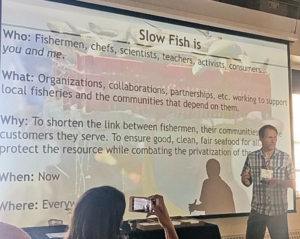
Slow Fish is making a difference.

Think of it as a collaboration of fish harvesters, scientists, chefs, students, food-lovers and activists around the world working toward one goal: good, clean fair seafood for all. This was on display throughout the three-day Slow Fish 2018 event in San Francisco April 14-16.

Setting the tone with the Slow Fish 101 presentation. Credit: Lance Nacio

Some of these successes were writ large on the main screen on the first morning of content programming in the Slow Fish 101 presentation.

  • Melanie Brown, a set net fish harvester from Bristol Bay, Alaska, spoke of indigenous ties to the land, the water and the resource. She spoke passionately about how wild salmon runs have sustained her family over time, and why that way of life is under threat from the proposed Pebble Mine. She also spoke of the coalition of disparate groups not normally siding with one another that oppose the mine: indigenous tribes, commercial fish harvesters, recreational fishing groups, environmental activists and politicians among others.
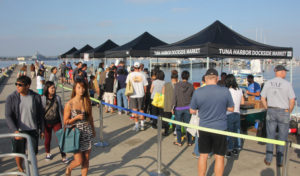
  • Jordyn Kastlunger reminded everyone of the importance of family connections and supporting the youth movement in fisheries as she described the trajectory of the Tuna Harbor Dockside Market in San Diego. Born of a coordinated effort of fishermen, food policy activists and lawmakers, the market features fisher folk docking on the pier and selling directly to customers. About 500 customers come every Saturday to buy about 12,500 pounds of locally harvested seafood.

    Jacquelyn Ross tells the story of abalone from Bodega Bay at the World Cafe. Credit: Eric Buchanan
  • Jacquelyn Ross of the Southern Pomo/Coast Miwok tribes spoke about her indigenous fishing lineage along Bodega Bay, hand harvesting abalone, and witnessing the changes to the fishery wrought by temperature, current and acidification. She too spoke of family love and respect for the resource, the land and the water and the importance of sharing those stories in the hopes that others will appreciate those connections to natural resources.
  • Paula Barbeito came from Italy to describe the work of Slow Fish International and highlight the story of the Thorupstrand Fishing Guild in Denmark. Several years ago, fishermen in the community of Thorupstrand pooled their resources to buy quota so they could provide access to the fishery without being overrun by industrial operations. The guild is a reminder of how fishermen can self-identify and protect their access by working together.

    World Cafe action. Just some of the discussions where things happen. Credit: Eric Buchanan

A parade of perspectives

These compelling narratives were just a few among many shared over the weekend. We heard from longtime fish harvester and policy activist Linda Behnken, who has fished commercially in the Gulf of Alaska and Bering Sea for over 30 years. She has drawn on that experience at the helm of her boat as she helped shape policy to protect small-scale fishing as a member of the North Pacific Fishery Management Council.

We also heard from Anne Mosness, who like Linda, has spent decades at the helm and in the trenches battling industrial scale operations. Anne described her longstanding campaigns against industrial aquaculture and genetically engineered salmon to the discussion, as well as the need to honor women’s voices and rights in fishing.

Filmmaker Mark Titus talked about his upcoming feature, The Wild, which shines a bright spotlight on the world’s largest wild sockeye salmon run in Bristol Bay, and what’s at stake in the battle against the Pebble Mine.

Know Your Supply Chain: Kenny Belov talks about choosing and selling responsibly harvested seafood. Left to right: Alan Lovewell, Real Good Fish; Joe Falcone, FishLine; Kenny; Anna Larsen, Dock to Dish; Jordyn Kastlunger, Tuna Harbor Dockside Market. Credit: Eric Buchanan

Kenny Belov talked about his mission in opening Fish. Restaurant in Sausalito and the TwoXSea sustainable seafood distribution company to provide responsibly harvested, abundant species to customers. Minimizing bycatch and other ecological impacts are critical factors in determining which fish harvesters he will work with.

Lance Nacio’s (right in hat) fried soft shell shrimp were very, very popular. Credit: Eric Buchanan

We heard from a broad range of seafood perspectives. Lance Nacio spoke about investing in new technologies such as the plate freezers used to individually quick freeze fresh caught shrimp to preserve the out-of-the-water freshness for shipping around the country. Several oyster growers provided insight on their operations and the myriad factors that go into a successful, delicious oyster harvest. Jack Crofts brought his energy and entrepreneurial spirit to the event, trying to raise visibility and money for this mobile oyster bar, called the Oyster Barrow. Lucas Raymond, a trawl fisherman from New Hampshire, also represented the youth movement at the event.

Young entrepreneur Jack Crofts (he’s 12 going on 13!) wows the crowd with his energy and enthusiasm. Credit: Eric Buchanan

We heard from chefs talking about smart sourcing, as well from seaweed growers like Amanda Swinimer, who described her journey harvesting, by hand, edible wild seaweeds for 17 years for her Dakini Tidal Wilds. Arielle Moinester talked about launching a company that promotes eating invasive species such as Asian Carp. Her GoWild Foods has made “The Silver Skipper” (aka asian carp) the poster child for managing an ecological problem in America’s rivers by eating it.

Christopher Wang describes his connection to fishing for salmon in Bristol Bay and why he started The Gypsy Fish Company as attendees listened at the We Are Bristol Bay Dinner.

Ideas, food and fun

More than 150 people from as far away as Italy, Maine, Alaska, Louisiana, Massachusetts and British Columbia, and as near as Washington, Oregon and right there in San Francisco descended on SOMArts and other venues. We held more than 6 separate events, including the Oyster Social, Seafood Throwdown, We Are Bristol Bay Dinner, and the final Seafood Dinner and film screenings at AirBnB. Core programming on Sunday and Monday included the World Café, 36 Pesce Kucha presentations and lots of interaction.

Stellar sticky salmon at the Bristol Bay Dinner.

We feasted on delicious wild salmon from Bristol Bay and oysters from Alaska down to Baja. We had fried soft-shell Louisiana shrimp and herring roe captured in a traditional method of submerging hemlock boughs in the bay during the spawn.

The Slow Fish 2018 planning team took on a monumental task to coordinate all of these events in a very short time period ahead of the California salmon season. The small, but very dedicated Slow Food San Francisco board of directors managed countless on-the-ground logistics to ensure everything went smoothly. It was the collective passion of the planners and attendees for the Slow Fish mission to grow the network, share our core values and collaborate on more projects that drove the event’s success.

Chef Matthew Dolen honors winner Chef Aaronette King at the Seafood Throwdown at the Ferry Plaza Farmer’s Market to kick off Slow Fish 2018. The crowd engaged in the process, tasted the food and asked great questions. Credit: Eric Buchanan

We discussed new projects on the horizon, such as a YouTube channel for sharing videos focusing on Slow Fish values, success stories and fisheries-related topics. We also discussed launching a Slow Fish website that will become a destination for those seeking Slow Fish updates, bait boxes to help launch community-based projects like a community supported fishery, Seafood Throwdowns, KNOW FISH Dinners® and more. To enable Slow Fish folks to to ask questions and discuss issues within an informed community, we may launch an online forum. We also discussed an ambitious project to reduce domestic imports from 90% to 50% by 2050. This 50 by 50 project models similar food system-related measures aimed at eating locally (or domestically) produced food.

And so we charted a course for Slow Fish’s future. To most effectively create change, we need to grow the Slow Fish family and foster continued collaboration on future success stories that will help change that massive import dynamic in this country.

And we will.

Stay tuned for Slow Fish 2020.


Top photo: Tyson Rasor of Ecotrust emcees the Know Your Fish Pesce Kucha session. Credit: Eric Buchanan.

All Blog Posts

Making Good Impressions

  • October 21, 2017October 20, 2021
  • by Colles Stowell
Share it!
Share

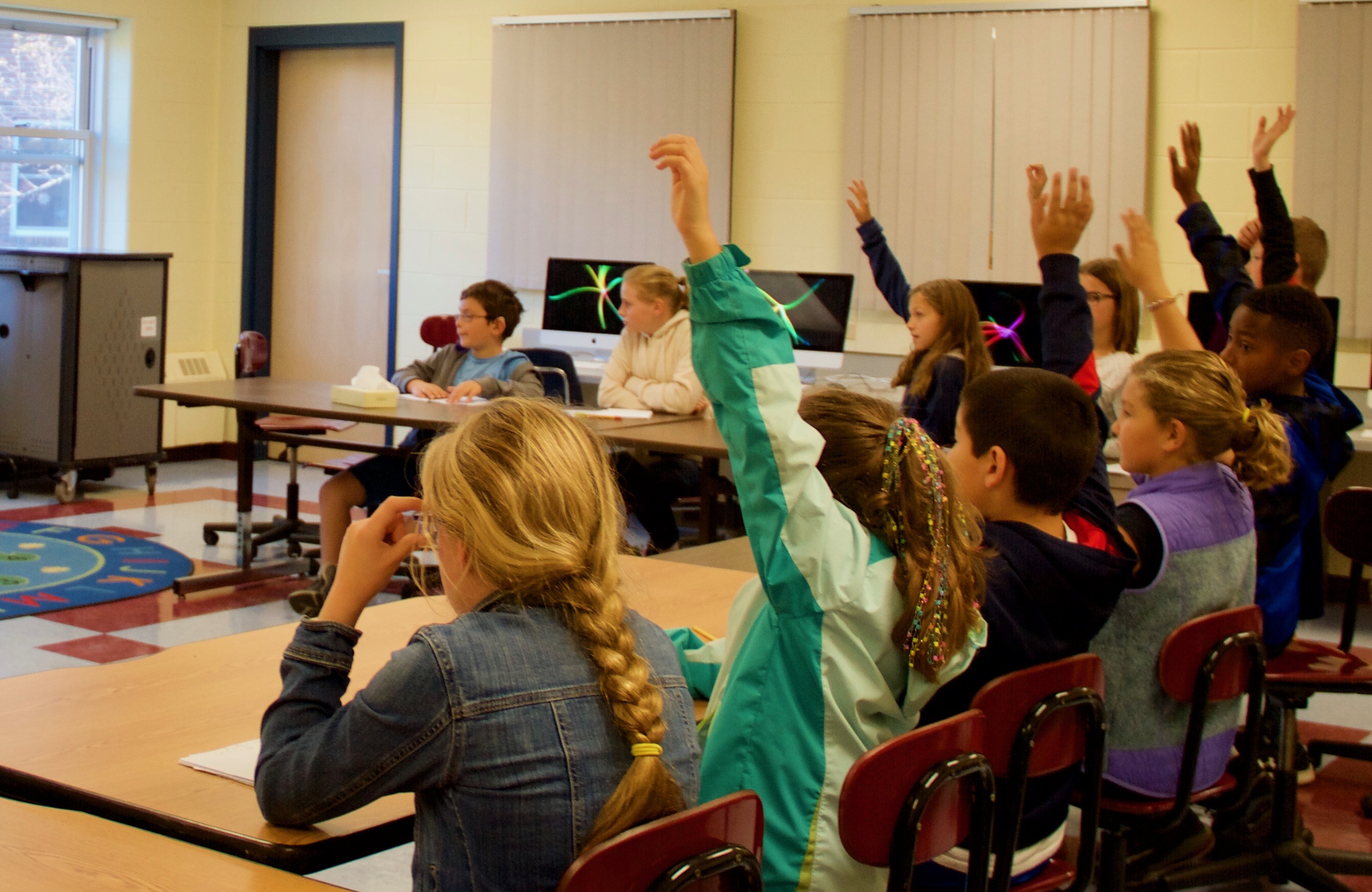
Ten- and 11-year olds are very impressionable. I’m reminded of this every time I speak to a fifth grade class and start talking about bycatch and imported farmed shrimp. Their eyes get really big when I talk about how some foreign aquaculture producers use antibiotics to try and prevent disease, or when I show them videos of some bycatch issues with longline and gill nets.

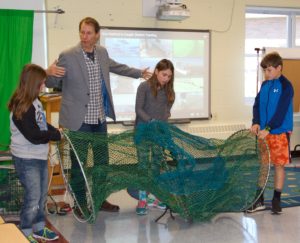
So I’m quick to tell them about some measures to mitigate bycatch, such as changing hook types or using turtle excluder devices. They love handling the big hooped nets. We talk about different harvest methods that have lower ecological impact, and that innovation continues to lessen direct harm.

I show them a pie chart and ask them to choose either the really small slice set aside, or the rest of the pie to represent the domestically harvested seafood eaten in this country. Every now and then, one student will choose the small slice either playing the odds or actually knowing the reality. I love to watch the class discuss the answer and perhaps change their minds. When I tell them the larger section or 90% of the pie represents imports, they don’t mask their surprise.

I taught three 5th grade science classes at Rye (NH) Elementary School last week, and took note of students’ interaction with these potentially daunting topics. Typically with classes along the coast, a majority of students raise their hands at the outset when I ask how many like seafood. For those who don’t, I be sure to acknowledge that and tell them that it’s important to understand our relationship to, and impact on the resource, even if we don’t eat it.

The students at Rye Elementary were, as usual, well informed, inquisitive and engaged in learning about where seafood comes from. They were interested to learn about bivalve aquaculture in Maine, and why forage fish such as the mackerel they see right off the docks play a crucial role in the marine food webs.

We talked about gear selectivity, invasive species (live green crabs are always a hit) and that buying locally harvested seafood supports local fishermen in the community. And we talked about their responsibility to ask questions at restaurants and seafood stores.

Each class has a different personality and energy level. So we adapt the content and conversation to those variables and engage as many minds as possible.

Every time I teach a few classes in a row, I walk away energized by the fluidity and enthusiasm of the conversation … and a bit drained. Each class I teach is a renewal of my respect and admiration for teachers who do this day in and day out. This is especially true for teachers helping to stimulate young, impressionable minds.

All Blog Posts

Farmed Salmon Jailbreak Exposes Systemic Industry Flaws

  • August 31, 2017October 20, 2021
  • by Colles Stowell
Share it!
Share

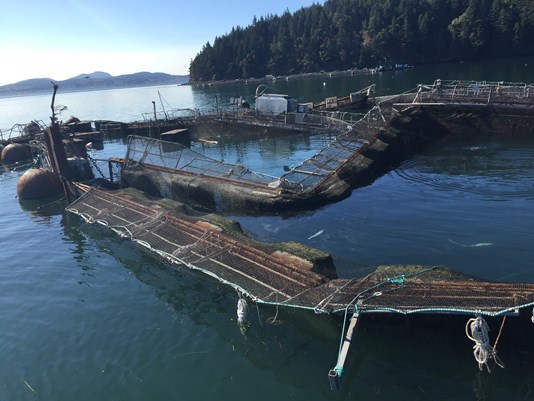
UPDATE Sept. 3, 2017  Recent reports indicate Cooke Aquaculture Pacific (subsidiary of Cooke Aquaculture) acknowledged in permit filings in February that the three-pen farm that failed in August was “nearing the end of its serviceable life” with visible rust and corrosion. Part of the permit application was to re-align the net pens so they would not be broadside to one of the strongest currents on the west coast. The application was filed shortly after Cooke bought the farm from Icicle Seafoods in 2016. But Cooke never fixed or replaced the pens, and a last-ditch attempt to stop the pens from drifting in the powerful currents in July proved futile on Aug. 19 when structures collapsed and more than 160,000 fish escaped.

Cooke reports that it has recovered over 140,000 fish from a total of 305,000, leaving about 160,000 fish that escaped.

There is increasing pressure from several fronts, including some state legislators and several regional native American tribes to stop the expansion of aquaculture in Puget Sound.


August 30, 2017 — In case you missed it, several thousand (potentially more than 300,000) Atlantic salmon escaped from net pens off Cypress Island in Washington state last week.

The idea that such high numbers of Atlantic salmon could potentially out-compete wild, native Pacific salmon for food, spawning grounds, etc. or even mate with them, has several environmental groups and commercial fishermen sounding alarms.

We should all be concerned.

Fish escapes from net pens are nothing new. It has happened several times with different ecological and social impacts in the past 30 years. Net pens are vulnerable to big storms which can crumple them up and leaving gaping holes.

Containment…?

This particular incident, which happened on August 19 at a facility owned by the massive Canadian firm Cooke Seafoods, is particularly notable for several reasons.

  • Cooke initially blamed the crumpling of the net on extreme high tide and strong currents related to the solar eclipse. Cooke has walked back that claim, instead blaming only abnormally high tides and strong currents. Scientists say the tides that day were actually milder than earlier in the summer.
  • In 2016, Cooke purchased the 30-year-old pens, which are located in an area that has one of the strongest currents (up to 4 mph) on the West Coast. Yes, you want strong enough currents to flush all of the waste and undigested food, antibiotics, what have you, to prevent the growth of lethal algal blooms. But you’re also setting up the inherent risk of net pen damage.
  • Cooke initially said that 4,000 fish escaped. Now they say they won’t know how many fish escaped until the final harvest (both in and around the farm and further out to sea) is complete. That could be never.
  • The state of Washington has frozen any new permitting for marine aquaculture. This is significant for Cooke, which has plans to extend its operations in the Strait of San Juan de Fuca.
  • Washington state aquaculture operations produce about 17 million pounds of farmed salmon per year, making it the state with the largest marine farmed finfish production in the U.S.
  • The state of Washington Dept. of Natural Resources has sent a notice of default to Cooke, claiming that Cooke violated its lease agreement (the co. leases the undersea land from the state) because of the environmental harm from the net pen failure.
  • Environmentalist organization Wild Fish Conservancy has filed an intent to sue Cooke for violating the Clean Water Act as a result of the “escape.”
  • The state asked for help from commercial and recreational anglers to catch/harvest/kill the Atlantic salmon in the wild.
  • Based in New Brunswick, Cooke has operations in Eastern Canada, Spain, Scotland, Chile, and Maine and claims they will produce more than 275,000 metric tons of seafood every year and generate $1.8 billion annually.

Long-term implications

So what does this all mean?

For me, it is yet another illustration that industrial scale finfish aquaculture has a long way to go before it truly delivers a net environmental, ecological, sociological and yes, financial positive.

The Cooke operation is sited perilously close to native Pacific salmon migratory routes. Subsistence and artisanal fishermen in the Lummi Nation, a Native American tribe in Washington State, join their voices with environmentalists fearing the ecological impacts of several hundred thousand non-native fish competing with struggling native Pacific salmon species like Chinook for food and habitat.

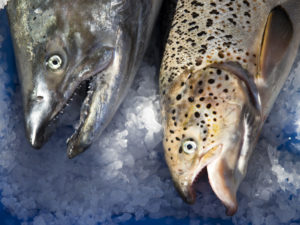
Washington state posted an identification guide to help fishers distinguish Atlantic salmon (right) from native Pacific salmon species. (Photo by Megan Farmer/KUOW)

Young Chinook are now leaving West Coast rivers to head to sea, and could be a prime food source for the 10-pound Atlantic salmon swimming about. Other potential impacts the farmed fish could have on wild stocks such as Chinook and Coho salmon now returning to spawn include increased competition for food, the potential for spreading disease and potentially weakening the gene pool from inter-breeding.

Many scientists agree we don’t have enough information to really know the impact of farmed salmon escapes. Some researchers doubt whether farmed Atlantic salmon can survive in the wild. Others doubt that they would really mate with wild, genetically different species, or that if a few did, the consequences would be negligible.

In the absence of real, credible data, I side with those who are concerned. Just because we don’t know with certainty all of the ecological threats escaped farmed salmon could pose on wild populations, we should NOT ignore the potentially significant damage. Put another way, this issue should serve as yet another warning that profit-driven finfish aquaculture, sometimes deemed marine feedlots because of industrial approach, is inherently dangerous.

It’s dangerous because these types of issues: escapes, algal blooms, disease, antibiotic use, etc. continue despite corporate attempts at greenwashing. Witness the mess created by the Chilean farmed salmon industry, which lost over a billion dollars last year after a huge algal bloom sparked a deadly bacteria outbreak that killed millions of fish.

Just because there isn’t tons of research doesn’t mean there aren’t readily identifiable stories supporting the need for caution. For example, one study from the University of Victoria relies on DNA sampling to confirm that some escaped Atlantic salmon had spawned in the Tsitik River in British Columbia in the late ‘90s. Another study showed that Atlantic salmon inhabited more than half of 41 known Pacific salmon rivers on Vancouver Island.

Scale

All of this is set against a new industry dynamic in which global aquaculture operations are scooping up smaller wild harvest operations. Last year, Cooke purchased Icicle Seafoods, Inc. of Alaska, a longtime, well-recognized company specializing in wild harvest of Alaska seafood and farmed Atlantic salmon.

Is this simply an attempt to diversify its seafood portfolio to minimize the financial risks of salmon farming, or is it an attempt at greenwashing the mounting concerns of farmed salmon by providing wild caught product? As my colleagues and executives of the Sitka Salmon Shares community supported fishery Nic Mink and Marsh Skeele write in their latest blog, “You buy farmed fish: they win. You buy wild fish: they win.”

I am not opposed to aquaculture in principal. I know several bivalve farmers who are doing good things with oysters, mussels and clams and are taking care not to over-crowd their beds. I know there are certain small-scale, artisanal finfish operations that provide subsistence to impoverished communities in Africa with minimal ecological footprint.

But as with many issues in fisheries, scale simply magnifies the damage when something goes wrong. So we need to do more research on the potential impacts of escaped farmed finfish on wild populations and ecosystems. We also need to look deeper into lowering the cost and technology barriers to land-based re-circulating systems that reuse the water and minimize the ecological impact of net pen operations. Finally, we have to re-think how we feed these farmed fish because grinding up millions of tons of forage fish like Menhaden for fish pellets every year stresses a critical layer in marine food webs.

Would that the industry takes note … sooner rather than later.


Additional reading:

Scientific American article diving into the issues surrounding last week’s Cooke Aquaculture escape.

Seattle Times story providing more detail about the Lummi Nation response to the escapes.

Youtube video by activist Alexandra Morton with some intense footage showing disease spread in Atlantic salmon net pens in Pacific Northwest.

TED talk with activist chef Dan Barber discussing an innovative and ecologically beneficial fish farm in Spain.

Cascadia Weekly column by former fisherman and activist Anne Mosness providing a good historical perspective on how industrial finfish aquaculture, or marine feedlots, rose to prominence in the Pacific Northwest.

Wild Fish Conservancy petition to Washington state Governor Jay Inslee to stop the expansion of salmon farming in Puget Sound.

Video of sea lice dispersal from salmon farms into wild rivers in Norway posted by Clayoquot Action.


Top Photo credit: Wild Fish Conservancy

All Blog Posts

Making Do at Slow Food Nations, Denver

  • July 19, 2017October 20, 2021
  • by Colles Stowell
Share it!
Share

Attending Slow Food Nations in Denver this past weekend, I had some expectations about the Slow Fish 101 presentation I would co-lead and the gumbo I would make.

As often happens, those expectations capsized last minute and I and many others had to adapt on the fly. For the second year in a row, the Slow Fish USA team had to respond quickly to a variety of circumstances outside our control.

In the midst of towed vehicles, last-minute technical presentation difficulties, and a bit of a cluster around the commissary kitchen, we scrambled to help each other out. And just as we did last year at the Slow Fish gathering in New Orleans, we made it work… well.

Blame it on the weather

Again, weather played a role, as it did last year when we had to change venues because a flood warning closed down the original host site. This time, I learned my Slow Fish 101 co-presenter Paul Molyneaux was stranded in Portland, Maine because of weather and would miss the presentation. Having fished commercially and written several books and articles about fisheries, Paul not only brings 40 years of experience to the conversation, he has also made important connections all over the world.

Anyone who loves seafood, cares about the resource and the fishermen who harvest it sustainably can be part of the Slow Fish movement. Photo: Kate Masury

We each had developed a portion of the deck, and his relied heavily on his global travels learning from and supporting artisanal fishermen and their efforts to thrive. I learned much about these issues from our discussions, but I didn’t feel good about trying to put my perspective on the narrative of all of his slides. So I was up until 11:30 the night before tweaking the slide deck to convey many of the same messages, but from a perspective I’m more comfortable with.

Slow Fish USA luminary Kevin Scribner prefaced the presentation next morning with a history of Slow Fish and provided valuable context for questions and discussion flow.

And it was a good discussion. The audience was a mix of Slow Fish representatives and Slow Food delegates interested in fisheries issues. We reviewed some compelling statistics demonstrating how current industrial seafood markets are stacked against small- and mid-scale fishermen.

We also discussed how Slow Fish empowers these fishermen around the world to compete in local and global markets using examples such as the Tuna Harbor Dockside Market in San Diego, Know Fish Dinners in New Hampshire and Maine, and projects that support artisanal fishermen in Uganda and Thorupstrand, Denmark.

Tuna Harbor Dockside Market, San Diego. Photo: courtesy THDM.

Tuna Harbor Dockside Market is a shining example of multi-tiered collaboration between fishermen, activists and government. More than three years ago, a group of San Diego fishermen sought a way to sell to consumers direct off the boat. Though there was no specific permit that would allow that type of retail setup, the city, county and state worked together to create legislation that supports the market.

The result?

  • Fishermen have created relationships with customers.
  • They’ve earned more money: sea urchin prices jumped from $.80 to $5 per lb. and mackerel rose from $.30 to processors to $4 per lb. to consumers.
  • Fishermen have changed the way they fish to accommodate market demand.
  • Fishermen’s families work the tents, getting their children’s hands on the product.

The audience posed great questions about aquaculture, fisheries management and the long-term prospects of wild harvest in the face of growing demand. The conversations continued even after we were kicked out of the room as the next group set up.

First mission accomplished.

Blood, sweat and gumbo

The plan was to highlight the story behind the fabulous shrimp and crabs from Lance Nacio’s Anna Marie Shrimp in Louisiana via gumbo. I also secured some of the best andouille sausage I’ve ever had from Toby Rodriguez, a born-on-the-bayou, pig whisperer, traditional butcher and co-owner of Lache Pas Boucherie and Cuisine in Lafayette, La. He had me at “I call bullshit on all commercially available andouille!”

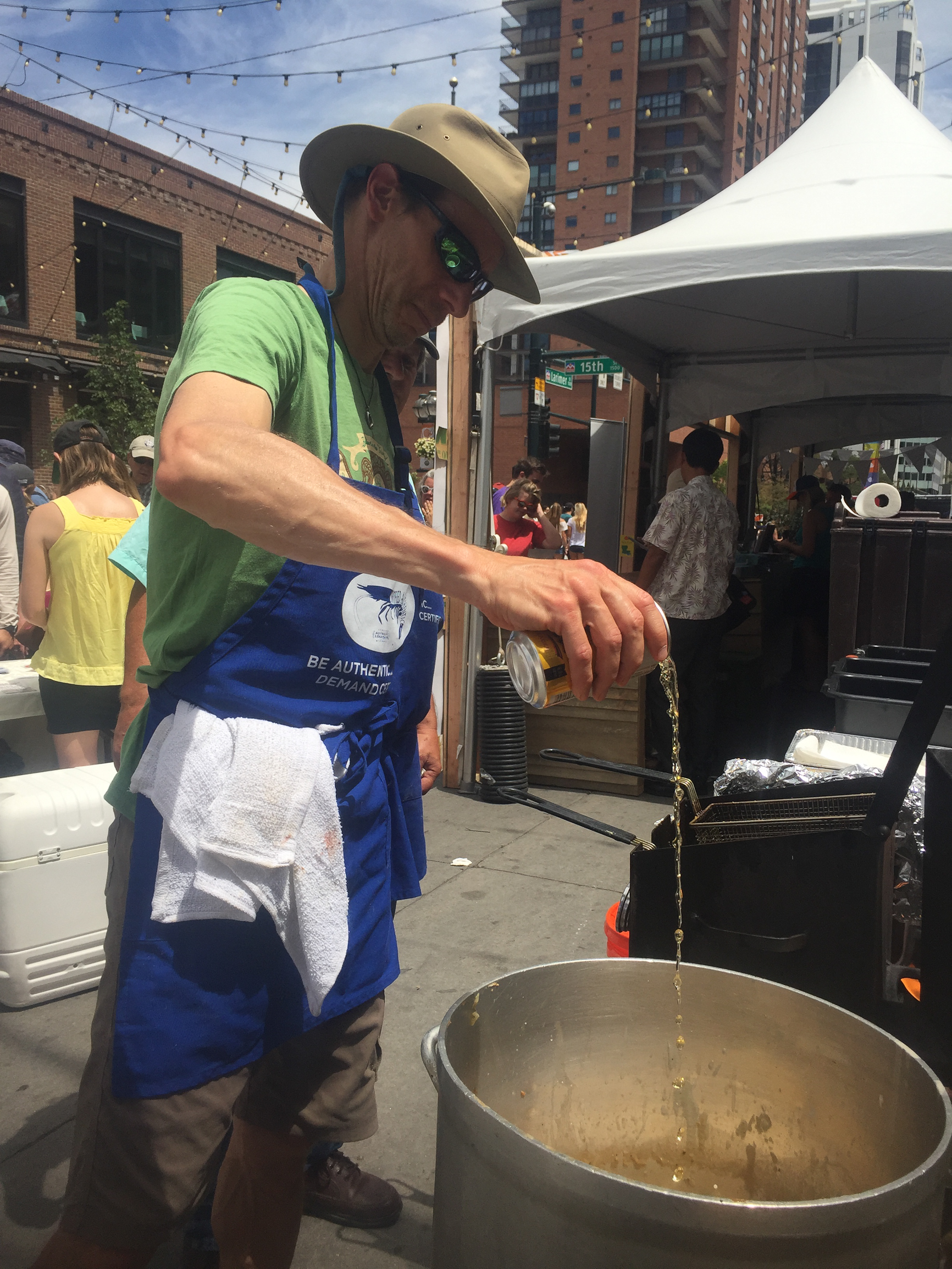
The BIG challenge was logistics, such as sourcing a 40-quart stockpot, stirrer, ladle and all of the flour, vegetables, oil etc. I’d need to deliver my standard of gumbo. I also needed a place to prep and make a stock. Even with weeks of planning, this still proved to be much more challenging than we expected or was necessary.

Thanks guidance from some chef friends, this was NOT a disaster.

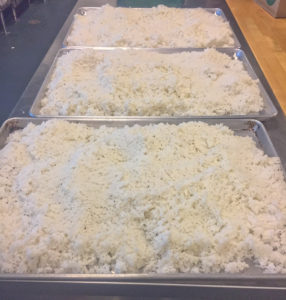
Fortunately, because of the connections I’ve forged with Slow Fish and some outstanding chefs, I found what I needed. A couple of chefs, Kelly Whitaker of Basta in Boulder, and my dear friend Evan Mallett of Black Trumpet in Portsmouth, NH helped me figure out how to cook up about 30 pounds of rice (which was way out of my comfort zone.) Evan also chopped and connected me with a chef for the pot and three locally sourced chickens.

I prepped with help from old and new friends for nearly seven hours after presenting. The morning of the food service, I got a late start because we had to wait for the health inspector and I had to try and figure out how to get 50+ pounds of food in different containers and 12 quarts of stock from the commissary kitchen 5 blocks to the site where I’d cook the gumbo. With a dolly and someone’s truck, we made it work.

Lance’s blue claw crabs added flavor…and some down-and-dirty eating for lucky patrons.

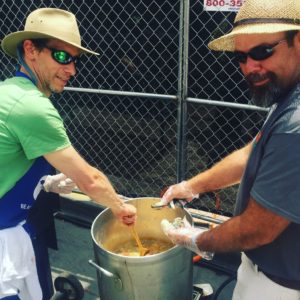
Four hours, a few laughs, a couple of cuss words, a stream of sweat and an unfortunate slip of a knife later, and I was ladling gumbo to praise. We had three tents serving fried shrimp, Baja oysters, miso and seaweed, Alaska salmon, salmon poke and black cod. All of it delicious. The quality and freshness of each product was exceptional.

The moment of truth for me came late that afternoon when an elderly African American man sporting a comfortable sun hat and shades asked, “What you got in that gumbo, son?”

I told him the ingredients, mentioning Toby’s sausage, and the fact I smoked the chicken over apple wood that morning.

“Where you from?”

“New Orleans, sir.”

“Who taught you?”

“A Creole woman who took care of me when both my parents were working. Nothing written down. All oral tradition. Took two years of her whacking me over the head with a wooden spoon every time I messed up for me to start getting it right.”

“Ok. Let’s try it,” he said, dropping his ticket in the cup.

Nervously, I spooned out some rice and carefully selected a ladle that had shrimp, crab, two different kinds of sausage, chicken and as many vegetables as could fit.

The man took a spoonful and seemed to swirl the gumbo around in his mouth like a sommelier, which made me uncomfortable. If he didn’t like it, my day was lost.

He raised his head, sniffed, then a slight smile curled his mouth.

“A lot of flavors that work well together.”

“You like it?” I asked, for confirmation.

“Yes. You done good. Thank you.”

“Thank you, sir!!!”

Notice the gloved hand.

So what if I may have shaved some time off the back end of my life stressing over logistics. So what if I’m now struggling to type with nine fingers because I damn near sliced off the tip of my index finger early in the morning before really getting going on the gumbo. Someone in the tent trained in wilderness survival did a field repair to stop the bleeding so I could complete the mission. I got four stitches only after most of the gumbo was gone and I received “official” validation.

Group effort

All of this goes back to something Slow Food USA director (and former New Orleans high school classmate) Richard McCarthy said in opening remarks that Slow Food is about pluralism. Change doesn’t come from any one person. It comes from a collective force.

So it is true with Slow Fish and specifically, my mission with One Fish Foundation. Changing attitudes about consumer food and seafood purchases requires a group effort. It requires communication, collaboration, partnerships and adaptation. Adapting to unforeseen challenges to event execution is becoming an illustrative trend for Slow Fish USA. It’s because of the connections and friendships we’ve formed that we’ve been able to overcome some last-minute hurdles, working together to send our message.

It’s because of those connections, and the new connections we make that we will continue to steer the conversation toward preserving the seafood resource and the way of life of the fishermen who harvest and care for it.


Top Photo: Don’t forget the secret ingredient! Credit: Lance Nacio.


All Blog Posts

Aquaculture, Antibiotics and Their Dark Path to Our Diets

  • January 17, 2017October 20, 2021
  • by Colles Stowell
Share it!
Share

“Why does that matter?”

It’s one of the first questions I get when I tell middle school students that 90% of the seafood eaten in this country is imported.

So I begin with the big picture, that much of that seafood is coming from countries that put a lot of chemicals in their seafood. Countries like China, Thailand, Chile and Ecuador don’t have the same health safety standards the U.S. does. I watch their facial expressions as I start talking about how and why antibiotics, hormones, bleach and other chemicals are used.

In just a few minutes, it does matter. They care where their seafood comes from.

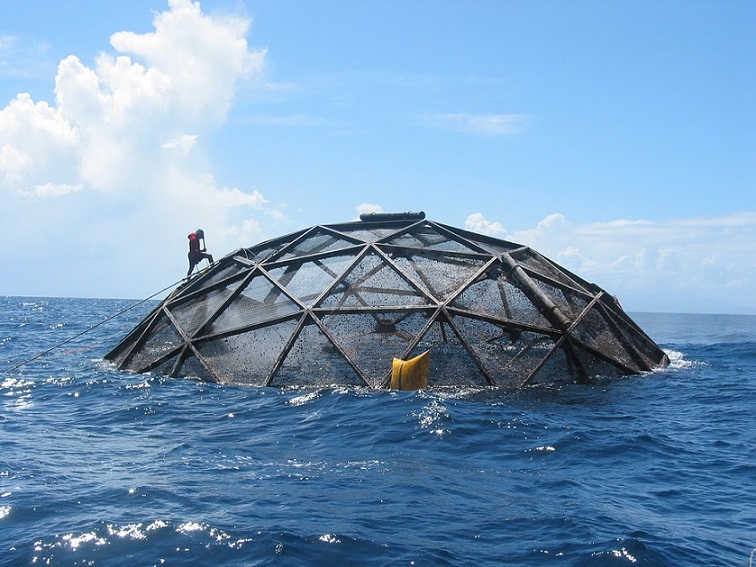
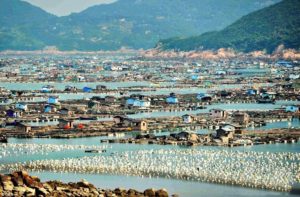
Massive floating community of fish farms in Luoyuan Bay, in south-eastern China’s Fujian province.

Why this happens

Sometimes the middle school students ask why this happens. More often though, that question comes from high school students and adults. I then explain how the FDA is outgunned simply by the fact agents only inspect 1-2% of all seafood imports. Over the past few years, I’ve watched the FDA issue more and more alerts authorizing agents to outright halt various shrimp and other seafood shipments from China, Malaysia, India and other countries because of links to US-banned antibiotics.

But the answer is really more complicated than that. Part of it has to do with U.S. consumption habits. We eat a lot of shrimp, but we don’t want to pay much for it. So the much cheaper product from Asia or South America floods supermarkets where consumers scoop it up without looking at the label or questioning the origin.

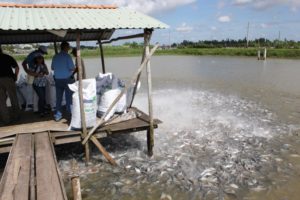
Fish farm in Viet Nam.

Lack of transparency

Part of the answer has to do with profit and the complex international seafood export industry. Bloomberg Business last month released an exhaustively researched, but well narrated story about this complex system. The report details how much of the seafood from China, which owns 60% of the $90 billion global aquaculture market, is shipped through other countries before arriving in the Western Hemisphere, thereby avoiding steep tariffs and close inspection (when it happens). This process is called transshipping, and it’s becoming widespread and difficult to track down, further masking true seafood origin.

I recommend reading the story if you have 20 minutes or so. Here is the link.

Here are a couple of highlights:

  • Asia has a centuries-old tradition of linking aquaculture and agriculture. Waste from pigs goes into ponds where tilapia and geese are raised. The tilapia gets much of their protein and nutrients from that waste.
  • As diseases have increased in pigs, farmers have increased the use of antibiotics to fight the disease. The antibiotics pass to the fish and/or shrimp.
  • Larger operations treat shrimp and fish with antibiotics to ward off disease.
  • Increased antibiotic use has given rise to potentially lethal antibiotic-resistant superbugs, which are becoming more common.
  • A recent study found that between 42% and 83% of Chinese shrimp carry bacteria that can destroy penicillin and most of its variants.
  • A 2006 FDA study found a quarter of all Asian seafood tested had traces of chemicals banned in the U.S. This has led to a succession of FDA bans and alerts.
  • The increased scrutiny has pushed some foreign seafood export operations into transshipping through countries like Malaysia that don’t have the high tariffs and increased inspection standards imposed by the FDA on China, for example.
  • Tracking the origin of transshipped seafood can be difficult. The Bloomberg report cites examples of companies that have been accused by the FDA, and that have folded, with new export companies cropping up shortly thereafter.
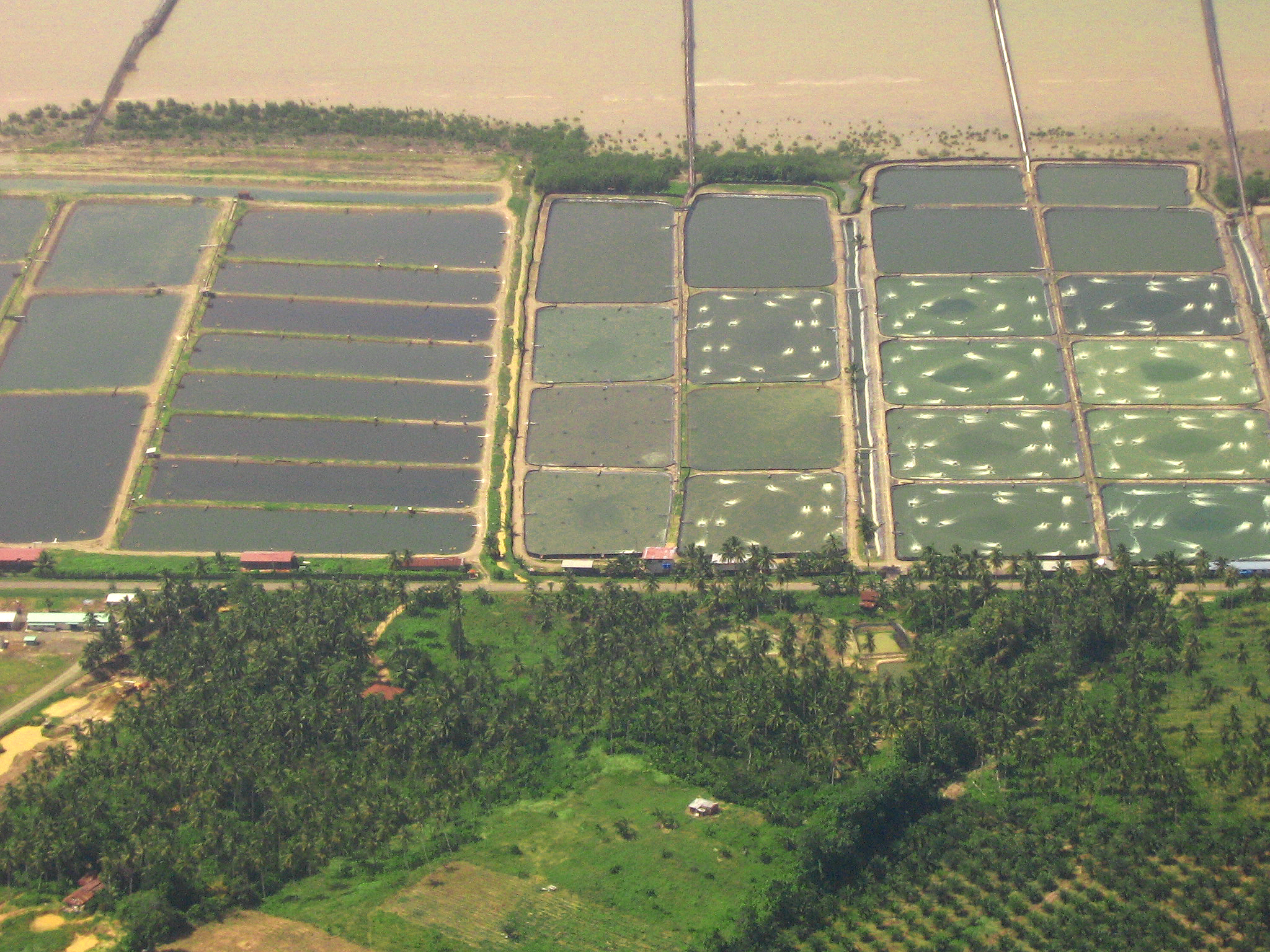
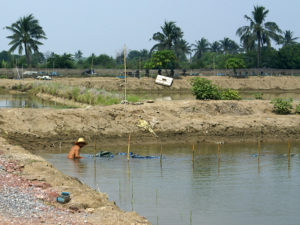
Shrimp pond in Thailand.

So what’s the lesson? Read labels. Ask questions. And if you can’t get seafood that is local or at least domestic to the U.S., consider other options. If you just absolutely have to have the farmed shrimp from Thailand because of the price, understand the implications … to your health and to the support of exporters more concerned with profit than customer health.

We can’t effect change in the domestic seafood web without at least first getting smarter about it.

That we can do.


Top photo: Tiger prawn farm in Malaysia.

All Blog Posts

Hearing Nature’s Lessons in the Classroom

  • November 22, 2016October 20, 2021
  • by Colles Stowell
Share it!
Share

“Nature has it right. It’s set things up that work. When we interfere, we mess it up.”

We’ve seen a lot of words of wisdom from different mindfulness gurus and healing practitioners in the past couple of weeks. Sometimes they come from a place of unclouded truth, such as the perspective of a fifth grade student.

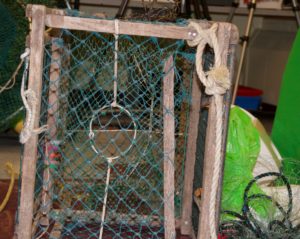
rye-elem-lobster-trap_
Yes, lobsters can waltz in and out of these traps pretty much as they please.

The quote above stemmed from a conversation about genetically engineered salmon at Rye Elementary School yesterday. We were talking about finfish farming and some of the drawbacks of the fish pellets used as feed, including the demand on ecologically critical forage fish and the reduced nutritional value. We discussed how farmed salmon have been found to have lower beneficial Omega 3s because of their feed than the naturally high Omega 3s of wild salmon. We discussed the same issues with GE salmon, as well as the various unknown risks of engineering fish as food and it’s ecological impact.

So when the student spoke about interfering with Nature’s design, I smiled and asked him to repeat it so that everyone in the class of 20 or so could hear it. Several in the class nodded their agreement.

rye-elem-jigs
Discussing the low bycatch of jig fishing.

I’d made a connection.

Every dialogue with students, their parents, sustainable seafood dinner attendees, etc. is based on telling a story and making connections. A connection that will resonate. A connection that will knit together the information into one cohesive, compelling narrative. A connection that will inform decisions in the future.

When I’ve made a good connection, the effect is immediate and sometimes profound. It is especially rewarding when someone who is 11 years old comes up with such clarity. It is also enlightening. I often learn something about myself and the message I’m sending just by listening to students.

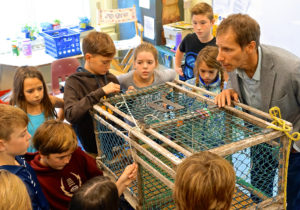
Turtle excluder device: always a crowd pleaser, and a good teaching tool.

The students at Rye Elementary asked thoughtful questions. They were truly engaged in the conversation. We poked at a lobster trap. We stretched out a turtle excluder device and talked about how it is an example of what we’re doing to reduce bycatch. We touched on how climate change is affecting the Gulf of Maine.

By the end of each of the three classes I visited, students seemed to take ownership of the fact that they do have a choice at restaurants or grocery stores and that their choice matters.

They left armed with questions to ask:

Where is it from? How was it caught? Was it farmed? Were there any hormones, antibiotics or pesticides used?

Perhaps they will spread the word … one connection at a time.


Photo credit: Denise Wheeler

All Blog Posts

Know Fish: A Dinner Series of Food, Fun and…

  • September 28, 2016October 20, 2021
  • by Colles Stowell
Share it!
Share

For most people, seafood is simply a protein either on a menu, laid across some ice in a display case or pre-packaged in a box at a supermarket. There’s typically no story about where and how the fish was caught, much less by whom. Consumers have little or no idea of how far the fish has traveled, nor whether the fish and shellfish are abundant, stressed or fed antibiotics and hormones at an industrial aquaculture site.

One Fish Foundation arose from a wish to spread the word about our relationship to oceans and specifically to seafood. This means bringing the story behind the seafood we eat into classrooms. I’ll lug in a bunch of fishing gear to talk about different harvest methods and their impact on the resource and marine ecosystems. I’ll throw out eye-popping stats to illustrate how skewed our domestic seafood consumption picture is.

Spreading the word also means going into communities and having conversations with people who care about the environment and want to learn more about the food they eat. That’s what the Know Fish Dinner Series is about. For the past five months, I’ve worked with Seacoast chefs who are passionate about sourcing sustainably harvested seafood; activists who speak out on issues like fisheries management fairness and climate change; fishmongers selling locally abundant, underutilized species; and one fisherman who is bucking the trend toward consolidation, resource depletion and massive bycatch.

These dinners will be a fun, interactive dialogue about why we should be concerned that 90% of the seafood consumed in the U.S. is imported. We’ll eat deliciously prepared, sustainable groundfish caught on rod and reel by Capt. Tim Rider out of Eliot, Me. We’ll discuss why supporting local fishing communities is important and how our seafood choices make a difference: to the resource, the oceans and the fishermen who work them

We’ll have some fun with trivia that sheds light on the resource, the supply chain, marine ecosystems, aquaculture, invasive species, climate change impacts and more. We’ll discuss these topics, ask and answer questions, and bring more of the story to life.

This will be your chance to talk to Capt. Rider about why he spends 18 hours a day or more on the water, fishing with rod and reel in a fishery dominated by trawl nets.

You’ll have the opportunity to talk with chefs Evan Mallett of Black Trumpet, Rob Martin of When Pigs Fly and Brendan Vesey of Joinery Restaurant (Brendan will be cooking with Evan at the Black Trumpet event) about how they choose what seafood to put on the menu.

You’ll be able to ask fishmongers Spencer Montgomery of Dole and Bailey and Amanda Parks of New England Fishmongers about the products they market and handle, and some of the discussions they’ve had around underutilized species.

Got questions about why many small-scale fishermen are struggling? Follow up with one of the event collaborators, Brett Tolley, the community organizer and policy advocate for Northwest Atlantic Marine Alliance. He’s been at the forefront of a campaign to revise current fisheries laws that are consolidating the fleet and squeezing out fishermen like Capt. Rider.

(And, I’ll be on hand to talk about sparking student interest in seafood sustainability, and the effectiveness of waving a dead fish at 6th graders).

This is the team that has volunteered many hours to help organize these events. Everyone brings a great energy and passion to the dinners on Oct. 13 at When Pigs Fly and Oct. 27 at Black Trumpet.

So come out and eat some fabulous seafood, listen to some cool stories, test your seafood trivia, and most of all, get to know your fisherman, your fishmonger, your chefs, a couple of evangelists and your FISH.

Get tickets via the links below.

I hope to see you there!

Oct. 13: When Pigs Fly

Oct. 27: Black Trumpet


All Blog Posts

UN Report: We’re Growing More Seafood Than We’re Catching

  • August 11, 2016October 20, 2021
  • by Colles Stowell
Share it!
Share

So what happens when the world’s wild-caught seafood supply is tapped beyond its capacity to feed the growing population? How do we sustain a human population that could reach 9.7 billion by 2050 when nearly a third of that number currently relies on seafood for 20% of their diet?

These are some of the questions posed, and somewhat answered in the United Nations Food and Agriculture Organization State of the World’s Fisheries 2016 report issued in July. However, the net results may leave many consumers conflicted over the need to fight hunger with the need to address industrial aquaculture’s ecological impacts. This is especially true since producing more food won’t necessarily fix the root causes of hunger.

Aquaculture on the rise…

The report’s authors suggest that aquaculture has, and will continue to play a critical role in meeting this demand. They point to aquaculture’s substantial growth to back this assertion. In 2000, aquaculture produced 27.3 million tons of seafood globally. Wild capture produced 94.8 million tons. In 2014 (the latest year for global UN FAO data), aquaculture was 73.8 million tons, and wild capture was little changed at 93.4 million tons. So as wild capture has remained relatively flat in 14 years, aquaculture increased 170%.

Global per capita fish consumption has risen above 20 kg for the first time in history. If we assume that wild capture stays flat based on global efforts to fish to maximum sustainable yield – the most we can fish without harming stocks’ ability to replenish themselves – then, yes, we need to meet the growing global demand in the face of expected population growth to 9.7 billion by 2050. The questions are how do we do that responsibly and at what cost?

aqua1Let’s dig a bit deeper into the numbers. The general aquaculture totals: Finfish, 49.8 million tons; mollusks, 16.1 million tons; crustaceans, 6.9 million tons; other aquatic animals including amphibians, 7.3 million tons.
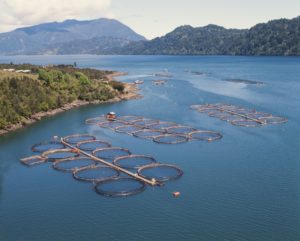
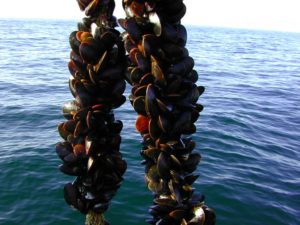
The report also states that about half of the 73.8 million tons of farmed seafood comes from fish, shellfish and plants that are non-fed species. That is, carp, mussels, kelp and similar organisms that don’t require the financial and environmental cost of fish pellets, often derived from forage fish, critically important links in the seafood web.

Additionally, for the first time, farmed fish exceeded wild caught fish for food consumption in 2014.

Think about that. We’re making more seafood than we’re harvesting.

…at what cost?

So all of this suggests we’re ramping up to meet the growing demand. Several countries are chipping in. No surprise that China is the big dog, accounting for nearly 60% of all aquaculture products, followed by India, Viet Nam, Bangladesh and Egypt. Salmon and trout are the top produced fish or shellfish (wild caught and farmed) on the planet, taking over the spot long held by shrimp. Norway and Chile are the top salmon producers.

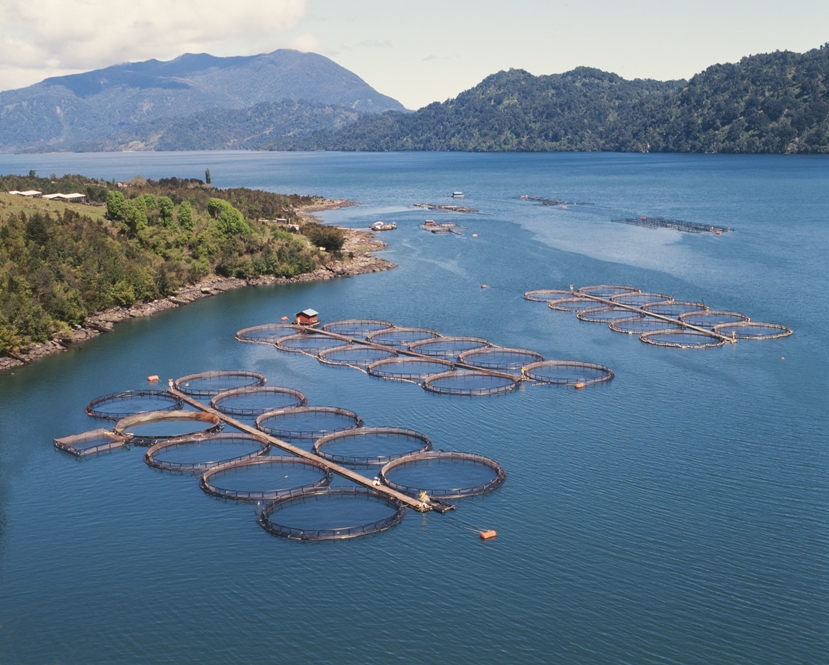
It is the legacy of farmedchile-salmon-farm shrimp and salmon that raises red flags. Yes, Chile is the second-largest salmon grower. But its industry is reeling from a disastrous start of the year: posting nearly $1 billion in losses due to ravaging algal blooms that destroyed millions of fish; crippling protests from commercial fishermen who blocked delivery of surviving farmed salmon; and, recent reports of staggeringly high (and ineffective) use of antibiotics.

Couple this with widespread reports of problems with shrimp farming, largely in Asia and South and Central America. Again heavy dosing of antibiotics, hormones to accelerate growth, and destruction of critical mangrove habitat are major issues. Look no further than frequent U.S. Food and Drug Administration alerts on imported farmed shrimp containing antibiotics the agency deems carcinogenic.

As with industrial agriculture, the push to increase seafood production and profits often storms past responsible practices. The result is often product that compares poorly to wild caught species from a nutritional, taste and environmental impact perspective.

The trouble with industrial Ag and Aq

All of these numbers and the consequent narratives of industrial aquaculture gone wrong overseas suggest we need to reassess industrial scale finfish and shrimp production to eliminate collateral damage. It can leave many people conflicted. Yes, hunger and rapid population growth are significant challenges that require global collaboration. And perhaps aquaculture can continue to play a role in addressing those problems.

But there are inherent flaws in the logic that industrial agriculture and aquaculture can “feed the world” or end hunger. First, the industrialization of food systems seeks to increase food supplies. But that model doesn’t address root causes of hunger such as poverty, inequity and fairness. In fact, some researchers believe the world produces more than enough food to feed everyone on the planet…up to 1.5 times as much.

Unfortunately, much of that food goes toward production of grains for industrial agriculture feed and corn for ethanol. This food system does little to address undernourishment. How can someone in Mali eat industrial-produced grains if he or she can’t afford it, much less find it? What about the small-scale fisherman in Oceana who can’t even afford the fresh seafood he harvests?

So no. Aquaculture is not a panacea for world hunger. But small-scale operations, which take a smart, balanced approach tLong-Line-Mussel-Aquaculture_NOAAhat minimizes ecological damage, can benefit local and regional food systems by providing locally produced seafood with minimal environmental costs.
For example, raising mollusks like oysters, mussels, clams and scallops is generally cleaner and even beneficial because it requires no feed, and as filter feeders, they actually clean bays and estuaries. Production of aquatic plants falls into the same category. Farming kelp, seaweed and other plants has increased substantially in the past decade, jumping 102% from 13.5 million tons in 2005 to 27.3 million tons in 2014 at a market value of $5.6 billion in 2014. New approaches, such as Bren Smith’s 3D Ocean Farming, are creating clean, self-sustaining and diverse marine polyculture farms that produce shellfish and plants.

A better way neededsalmon pen

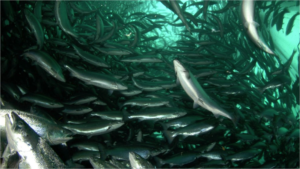
Since industrial aquaculture is already embedded in global food systems, we need to devote more energy to minimize or eliminate the downstream impacts of current industrial scale finfish and shrimp aquaculture. The rapidity with which the deadly virus spread among fish farms in Chile earlier this year confirms a long-held belief by some scientists and environmentalists that cramming tens of thousands of salmon into tight pens creates fertile ground for deadly diseases to spread rapidly. We need to figure out better ways to produce farmed fish and shellfish to minimize those hazards.

We need to devote more money, time and effort into making closed re-circulating systems – which reduce environmental impacts of escapes, disease spread to wild stocks, and resource depletion – more affordable and accessible to more operators around the world.

Pollock from Finlander
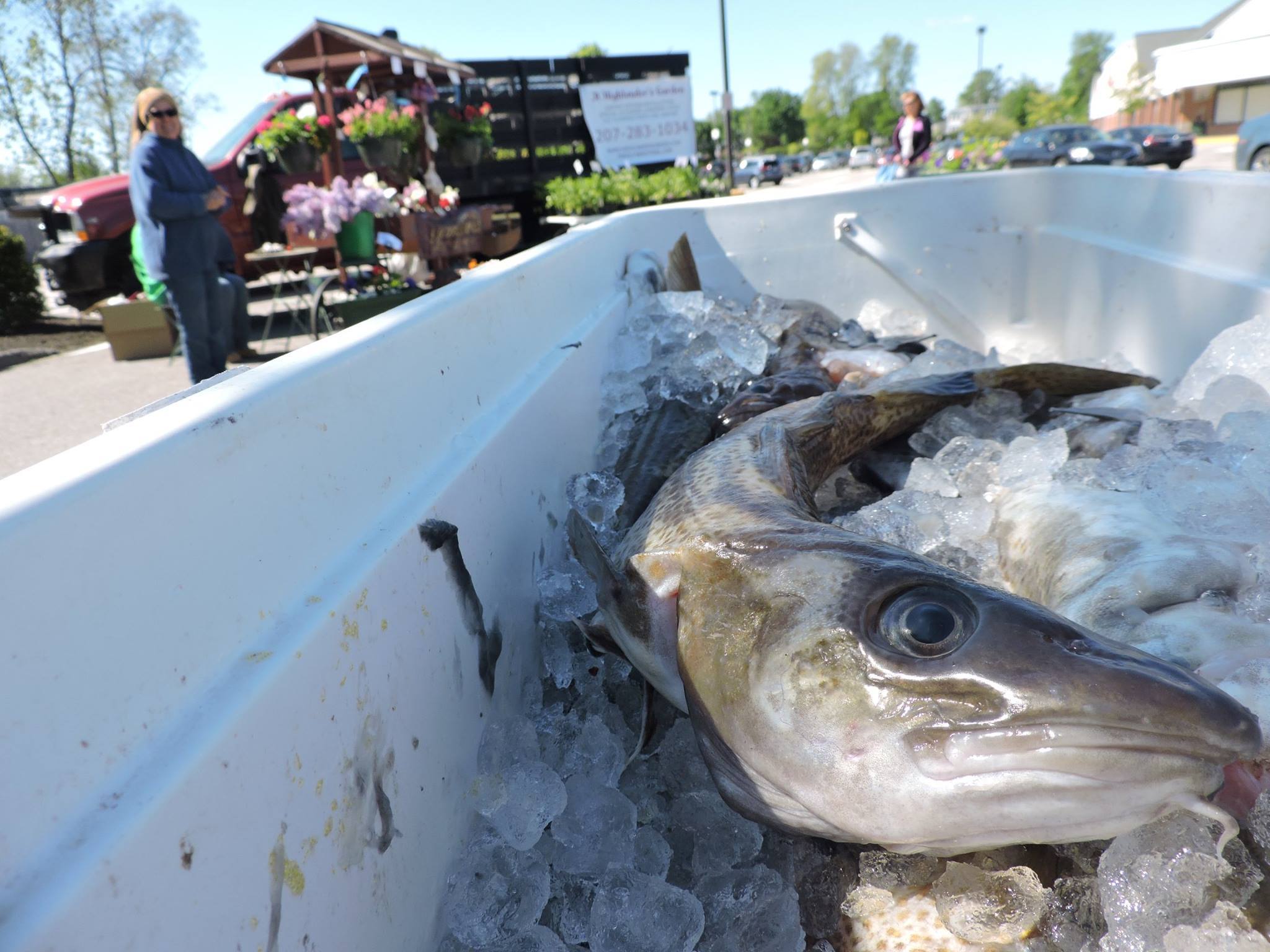
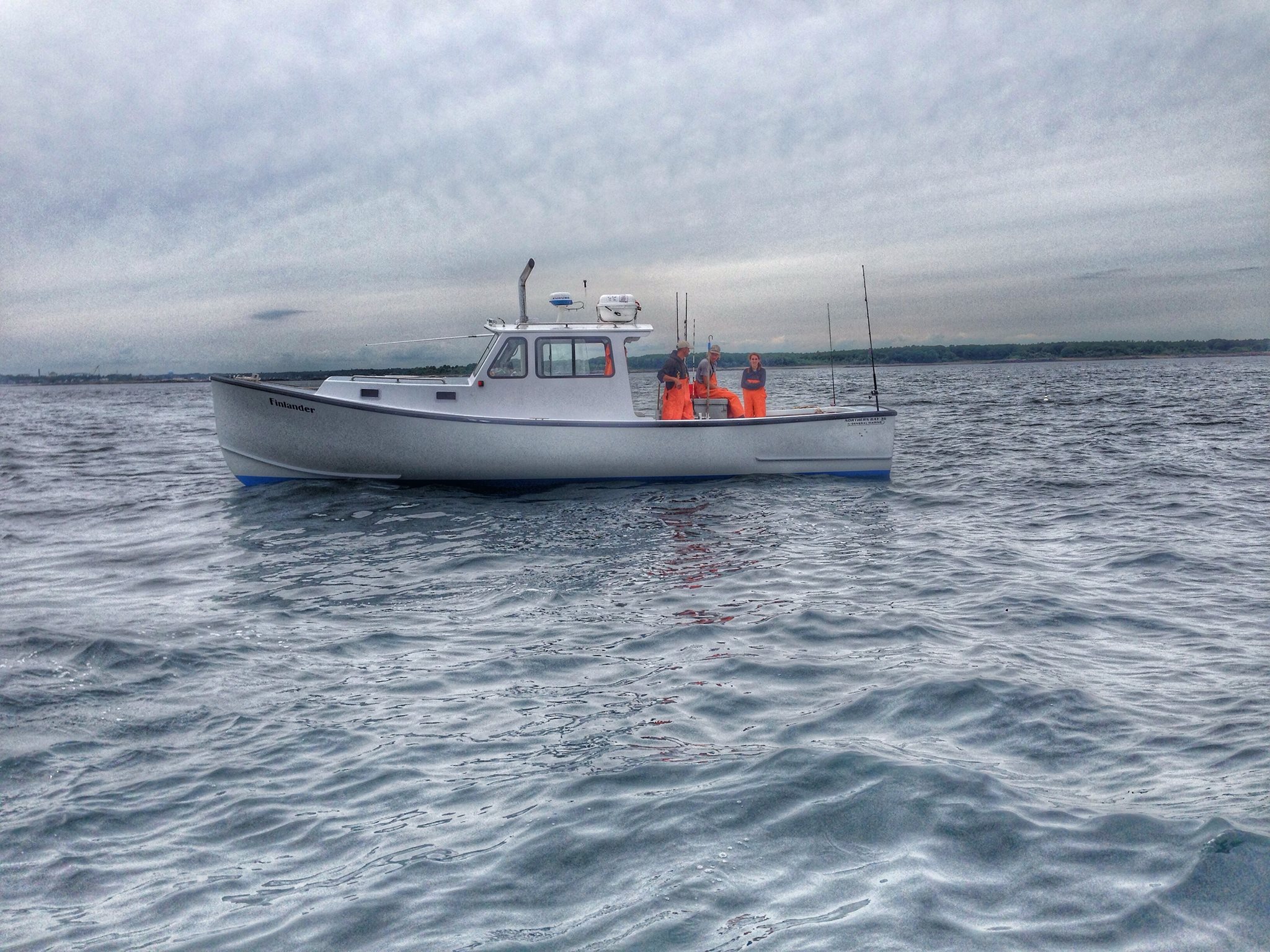
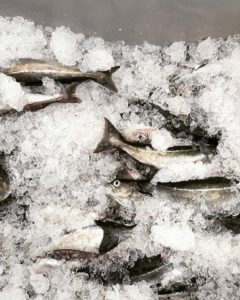
Fresh, abundant pollock from the M/V Finlander out of Eliot, Me.

Aquaculture practices and regulations vary widely around the world. Regulations are tighter domestically than most anywhere else in the world, significantly restricting the use of antibiotics and hormones. But we can do more to make the industry more sustainable and accountable from a resource, environmental, and health standpoint. We have to. The current situation leaves many consumers conflicted over current practices despite the increasing need to feed the planet and frustrated there hasn’t been enough effort to improve the industry.

A consumer’s best tool is knowledge. Find out more about the provenance of the fish or shellfish we eat, and we can at least safeguard what we and our families eat. When in doubt, ask questions and buy locally caught, responsibly harvested species that are abundant. Together, an informed customer base could perhaps spur some of the change discussed above.


All Blog Posts

Chilean Farmed Salmon: Poster Child for Caution

  • July 20, 2016October 20, 2021
  • by Colles Stowell
Share it!
Share

I remember the first time I tasted wild salmon. I was almost 10, and my dad had just returned from two weeks fishing the Whale River in Ungava Bay, Northern Quebec. This was 1974, and my dad brought two big crates with two 15 lb fish, packed with peat moss, sawdust and dry ice. The stories my dad told of these big leaping fish, the rugged beauty of the land, camping in tents and cooking over fires made the fish taste wild. I wanted to go and catch my own salmon and eat it. That didn’t happen for a while.

The best seafood I’ve ever tasted was a salmon I’d caught 15 minutes before I gingerly grabbed pieces of it out of a smoldering, greasy pan during a downpour at Twin Pools on the LaPoile River in Newfoundland in 2011. We’d hiked seven miles of terrain that ranged from peat bogs, to dense forest and giant boulders. I felt like I was in Middle Earth. No plates. No silverware. One crumpled napkin. No seasoning save for the dregs of some salt and pepper the guide scraped out of his coat pocket. He had to lean over the pan with his rain jacket flared while the tender pink flesh glazed over in the hot butter.

Nothing has topped that experience, before or since.

I think back on those experiences when I think about how far we’ve pulled away from our food sources. I can only imagine what the Atlantic salmon populations were like before we started damming their spawning habitats and fishing them with wanton abandon.

I guess the rise of salmon farming was an inevitable consequence of Atlantic salmon’s broadly appealing taste and appearance, even as the fishery collapsed over the last hundred years. The intentions may have been somewhat innocent, if a bit naïve, at the outset. But naturally, the rush to make these struggling, expensive operations profitable, if not solvent, perhaps bypassed some warning signs. The push to accelerate time-to-market as well as gross pounds produced has yielded some unpleasant results.

Bloom to bust

Look no further than the train wreck that is the Chilean salmon farming industry. The second largest producer of farmed Atlantic salmon in the world (Norway is tops), Chile’s industry had a terrible first half of 2016. In a four week span in late February and early March, four of the nation’s top producers lost more than 9 million salmon to an algal bloom that released a deadly bacteria, killing more than $70 million worth of product. Total salmon losses since this first reported algal bloom or red tide are estimated at around 25 million salmon weighing about 100,000 metric tons or 15% of the country’s total production. Chile scientists blame the algal bloom on unseasonably warm temperatures due to El Nino. I’ll get back to that.

Authorities dumped thirty percent of the dead fish in a landfill, the rest in the ocean. A few weeks later, giant flotillas of dead sardines, jellyfish, birds and some mammals washed up on Chile’s shores, which were also covered with dead clams. Commercial fishermen reacted, complaining the die-offs and the federal closures of nearby fishing grounds were a direct result of bad aquaculture practices.

To protest, they set up blockades effectively stopping transport of any of the surviving farmed salmon to market. At one point, producers were losing $10 million a day related to both the die-off and the delivery interruption, with estimates at about $800 million total loss.

Irony you say? Hold on, it gets better.

Antibiotics to the rescue?

The just desserts, if you could call it that, to this festering stew of salmon, bacteria and political angst is a recent appellate court decision forcing the industry to reveal just how much antibiotics each of its producers has used. The decision came in a lawsuit filed by Oceana, claiming international markets had a right to know how the world’s 2nd largest farmed salmon producer treated its fish. Until this decision, the true depth of Chile’s antibiotic use had been somewhat cloaked.

Now we know. And the details are stomach churning indeed. Government statistics released a couple of weeks ago show the proportion of antibiotics to tons of salmon increased from 2014 to 2015, during which time producers used 1.23 million pounds of antibiotics on about 895,000 tons of fish. On average, producers used about 660 grams of antibiotics per ton. One company, Australis Seafoods used 1,062 grams of antibiotics per metric ton of fish.

For comparison, consider that in 2008, Chile fed 385,635 kilograms of antibiotics to its salmon. Norway, the world’s largest farmed salmon producer? 941 kilograms.

So why is this such a big problem? For starters, it’s not good to ingest antibiotics unless you absolutely need them. You may have read about concerns over superbugs, or antibiotic-resistant bacteria. In essence, bacteria like E. coli or salmonella continue to evolve in their own quest to survive. And thus, some strains have developed a resistance to the antibiotics we would use to kill them, making us more susceptible to the nasty diseases these bugs can produce.salmon pen

Consider some frightening statistics from the US Center for Disease Control: An estimated 2 million people in the U.S. become infected with antibiotic-resistant bugs, resulting in 23,000 deaths. Now consider that some of the antibiotics used in aquaculture operations outside the U.S. have been deemed carcinogenic by the Food and Drug Administration.

No thanks.

Now let’s get back to the rise of the algal blooms in Chile. As I said, local officials claim the unseasonably warm temperatures gave rise to the situation. There is truth in that statement. However, scientists believe there is another direct cause. Concentrations of tens of thousands of fish in close proximity swimming in their own feces leaves them vulnerable to disease. So the farming operations dump tons of antibiotics as a preventative measure against the disease. They also throw in tons of pellets to feed the fish.

Now imagine a veritable rainfall of feces, undigested food and antibiotics landing on the ocean floor. There’s a lot of excess nitrogen and phosphorous introduced to the ocean ecosystem that in theory would otherwise be balanced. The extra nutrients create an environment more suitable for algae to grow than most other organisms. And it grows quickly, sucking up much of the available oxygen and releasing a deadly bacteria that ultimately kills the fish. The fish die and the bacteria have more “food.”

Worse still, the antibiotics used against the primary salmon-killing bacteria, SRS, aren’t working, according to an official with the National Service of Fisheries and Aquaculture (Sernapesca).

So if you’re keeping score, Chile salmon farmers are pounding their product with antibiotics that aren’t really working. And consumers are paying for it.

I’d call that a real loss on many, many levels.

We’ll talk about the global impact of finfish aquaculture in further posts, and explore some operations that are taking a better approach.


Resources

Here are some additional links to interesting info about aquaculture:

Lenfest study on aquaculture pollution

National Geographic glossary on algal blooms

World Wildlife Fund Report on environmental impacts of aquaculture


Posts pagination

1 2

Recent Posts

  • Hurricane Ida wreaks havoc on Louisiana’s seafood industry
  • EPA Should Use Clean Water Act To Kill Zombie Mine
  • Slow Fish 2021: Relationship Matters
  • Faith, Façades, and Futility
  • Pebble Permit Paused: Politics at Play

Archives

  • September 2021
  • August 2021
  • April 2021
  • December 2020
  • August 2020
  • June 2020
  • February 2020
  • December 2019
  • November 2019
  • October 2019
  • July 2019
  • May 2019
  • April 2019
  • March 2019
  • January 2019
  • December 2018
  • November 2018
  • June 2018
  • May 2018
  • March 2018
  • February 2018
  • January 2018
  • December 2017
  • November 2017
  • October 2017
  • September 2017
  • August 2017
  • July 2017
  • June 2017
  • May 2017
  • April 2017
  • March 2017
  • January 2017
  • December 2016
  • November 2016
  • October 2016
  • September 2016
  • August 2016
  • July 2016
  • June 2016
  • May 2016
  • April 2016
  • March 2016
  • February 2016
  • January 2016
  • December 2015
  • November 2015
  • October 2015
  • September 2015
  • July 2015
  • June 2015
  • May 2015
  • April 2015
  • March 2015
  • February 2015
  • January 2015
Theme by Colorlib Powered by WordPress