Skip to content
One Fish Foundation
  • Blog
    • Aquaculture
    • Education
    • Environment
    • Policy
    • Wild Harvest
    • Fish Tales
  • About
    • About One Fish
    • About Colles Stowell
  • Education
    • Elementary School
    • Middle School
    • High School
  • KNOW FISH Dinners®
  • Resources
    • One Fish Podcast
    • One Fish Foundation in the news
    • The 7 C’s of Sustainable Seafood
    • Newsletter Archive
    • Recipes
      • Skate with Capers and Butter — Chef Rizwan Ahmed
      • Grandma Davis’ Fish Chowder — Jane Almeida
      • Ginger Garlic Tamari Scallops — Colles Stowell
      • Fish Stock — Evan Mallett
      • Mussels San Remo — Chef Rob Martin
      • Salted Pollock Croquettes – Chef Mark Segal
  • Connect
    • Contact OneFish
    • Social
      • Instagram
      • Facebook
      • Twitter
All Blog Posts

Know Fish: A Dinner Series of Food, Fun and…

  • September 28, 2016October 20, 2021
  • by Colles Stowell
Share it!
Share

For most people, seafood is simply a protein either on a menu, laid across some ice in a display case or pre-packaged in a box at a supermarket. There’s typically no story about where and how the fish was caught, much less by whom. Consumers have little or no idea of how far the fish has traveled, nor whether the fish and shellfish are abundant, stressed or fed antibiotics and hormones at an industrial aquaculture site.

One Fish Foundation arose from a wish to spread the word about our relationship to oceans and specifically to seafood. This means bringing the story behind the seafood we eat into classrooms. I’ll lug in a bunch of fishing gear to talk about different harvest methods and their impact on the resource and marine ecosystems. I’ll throw out eye-popping stats to illustrate how skewed our domestic seafood consumption picture is.

Spreading the word also means going into communities and having conversations with people who care about the environment and want to learn more about the food they eat. That’s what the Know Fish Dinner Series is about. For the past five months, I’ve worked with Seacoast chefs who are passionate about sourcing sustainably harvested seafood; activists who speak out on issues like fisheries management fairness and climate change; fishmongers selling locally abundant, underutilized species; and one fisherman who is bucking the trend toward consolidation, resource depletion and massive bycatch.

These dinners will be a fun, interactive dialogue about why we should be concerned that 90% of the seafood consumed in the U.S. is imported. We’ll eat deliciously prepared, sustainable groundfish caught on rod and reel by Capt. Tim Rider out of Eliot, Me. We’ll discuss why supporting local fishing communities is important and how our seafood choices make a difference: to the resource, the oceans and the fishermen who work them

We’ll have some fun with trivia that sheds light on the resource, the supply chain, marine ecosystems, aquaculture, invasive species, climate change impacts and more. We’ll discuss these topics, ask and answer questions, and bring more of the story to life.

This will be your chance to talk to Capt. Rider about why he spends 18 hours a day or more on the water, fishing with rod and reel in a fishery dominated by trawl nets.

You’ll have the opportunity to talk with chefs Evan Mallett of Black Trumpet, Rob Martin of When Pigs Fly and Brendan Vesey of Joinery Restaurant (Brendan will be cooking with Evan at the Black Trumpet event) about how they choose what seafood to put on the menu.

You’ll be able to ask fishmongers Spencer Montgomery of Dole and Bailey and Amanda Parks of New England Fishmongers about the products they market and handle, and some of the discussions they’ve had around underutilized species.

Got questions about why many small-scale fishermen are struggling? Follow up with one of the event collaborators, Brett Tolley, the community organizer and policy advocate for Northwest Atlantic Marine Alliance. He’s been at the forefront of a campaign to revise current fisheries laws that are consolidating the fleet and squeezing out fishermen like Capt. Rider.

(And, I’ll be on hand to talk about sparking student interest in seafood sustainability, and the effectiveness of waving a dead fish at 6th graders).

This is the team that has volunteered many hours to help organize these events. Everyone brings a great energy and passion to the dinners on Oct. 13 at When Pigs Fly and Oct. 27 at Black Trumpet.

So come out and eat some fabulous seafood, listen to some cool stories, test your seafood trivia, and most of all, get to know your fisherman, your fishmonger, your chefs, a couple of evangelists and your FISH.

Get tickets via the links below.

I hope to see you there!
Oct. 13: When Pigs Fly

Oct. 27: Black Trumpet


All Blog Posts

Day in the Life of a New England Groundfish…

  • September 1, 2016October 20, 2021
  • by Colles Stowell
Share it!
Share

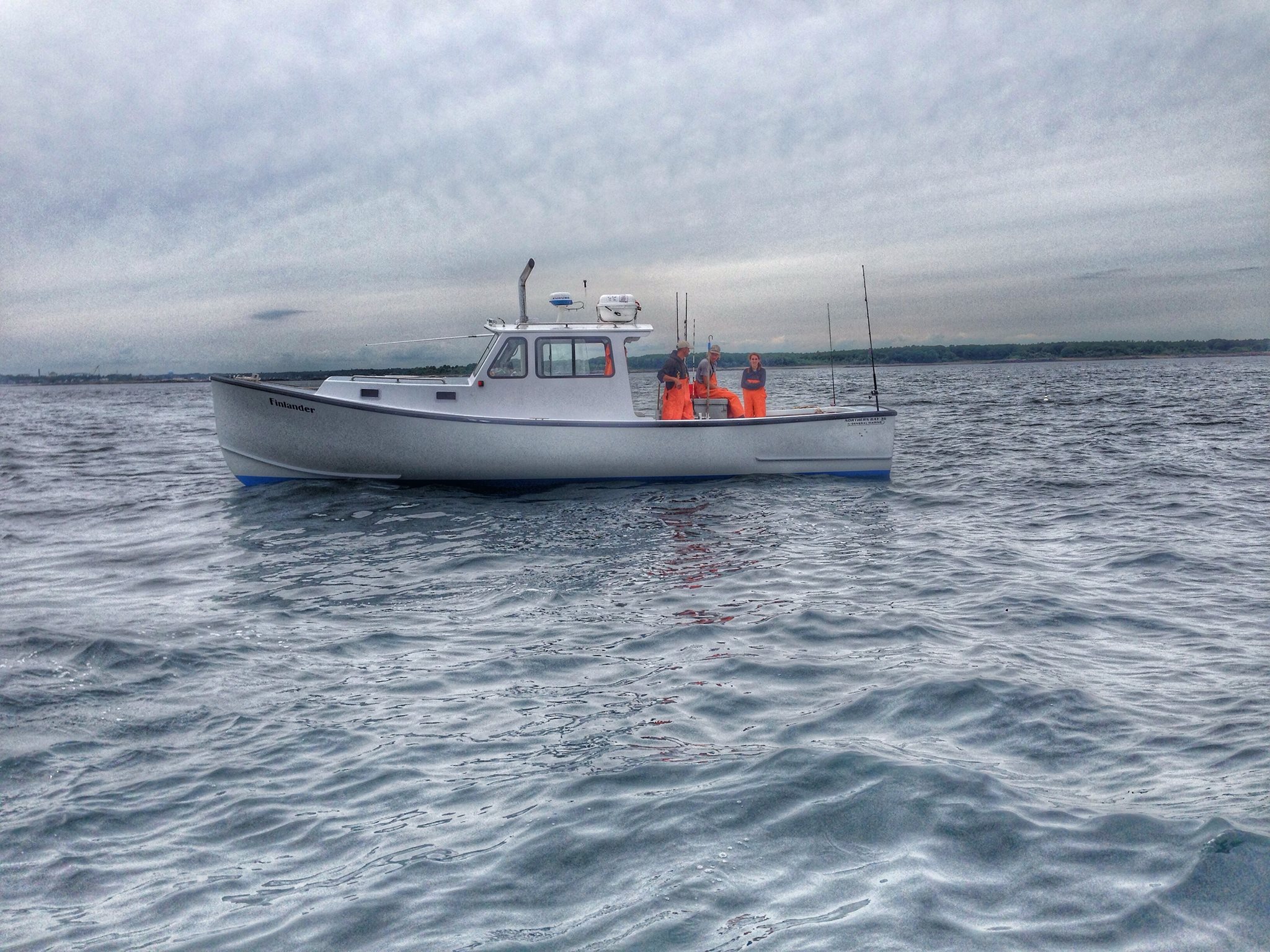
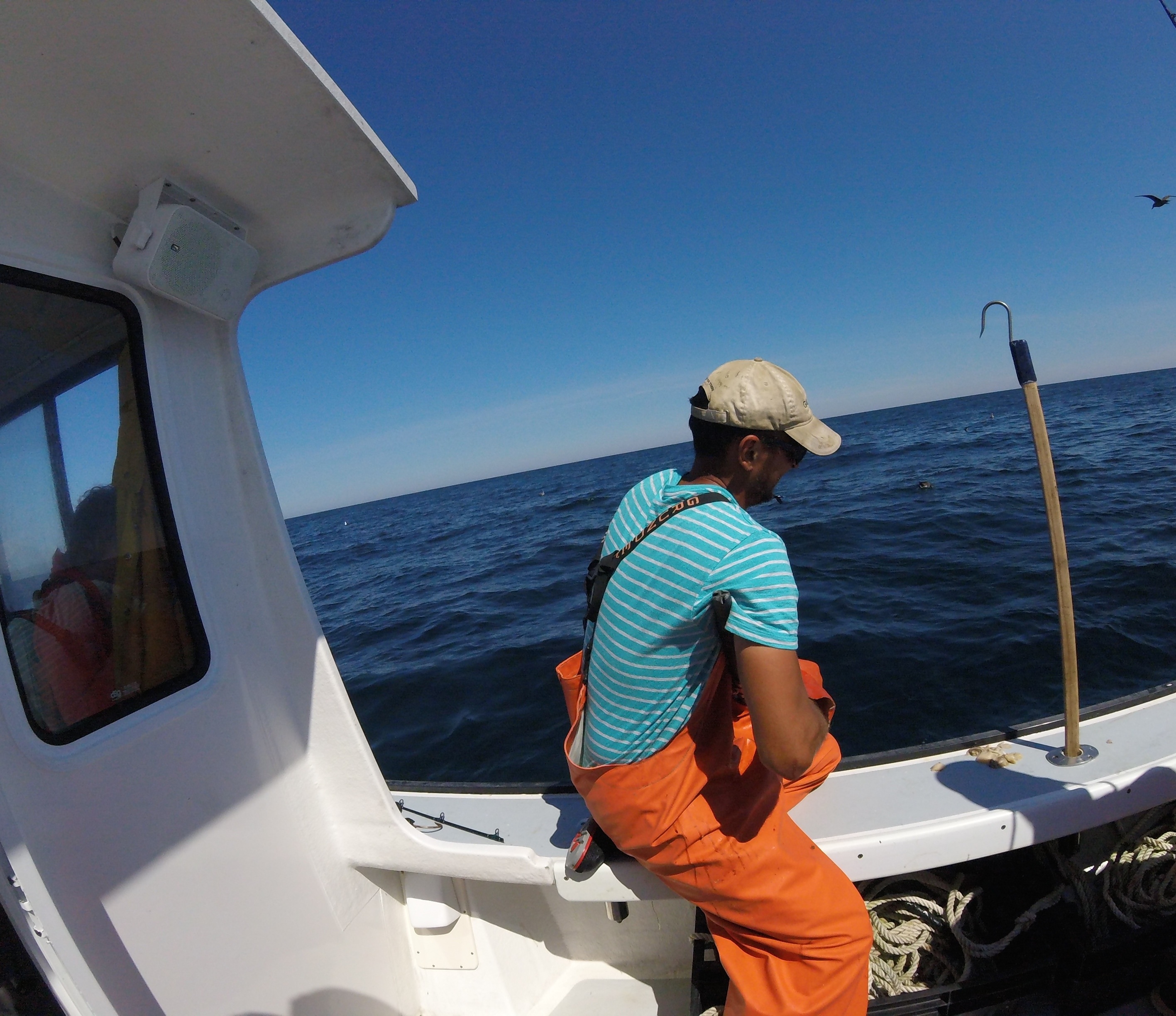
As the last sprays of daylight faded to black, I stepped off the M/V Finlander in Eliot, Maine and tried to get grounded. I was tired. Damn tired. And a bit sore. We’d left the dock at 1 a.m., traveled four hours to the fishing grounds 65 miles out, fished hard for 9 hours with rod and reel and chugged back to port, docking at about 8:30 p.m.

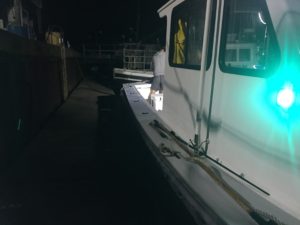
Loading up just after 1 a.m.

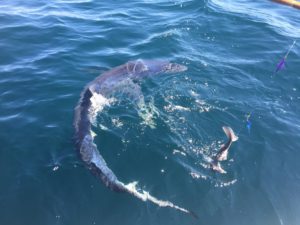
This wasn’t recreational fishing. To get comfortable, I dangled a leg over the gunwale of the 36-foot commercial fishing boat and rested the heavy-duty rod on my leg while jigging a 20-ounce shiny lure and three flies just a foot off the bottom, 400 feet down. When a fish hit, I’d have to crank it all the way up with an industrial-strength reel and hope the 10-foot blue sharks circling the boat wouldn’t steal the fish. Hoist the fish in, measure it after removing the hook, toss it in the tub. Do it again.

Get two fish and you’re likely to be winding 25 lbs or so up 400 feet. POW! A shark hits near the boat and starts smoking line off the reel. The telltale snap two minutes later signals the end of the fight, and you reel up nothing. Time to re-rig. Crank up a couple hundred pounds of fish or so in a few hours, and you’re going to feel it. At least I did. I managed to get past the queasiness and avoid any embarrassment on deck. Any concept of a toilet was sacrificed for an extra bunk to “conserve” some energy on the long rides. The head was a 5-gallon bucket.

It was a long day.

So I had one question for Capt. Tim Rider before I trekked back to my car. “You do this every day?”

Narrow miss
Narrow miss on a dogfish. Check out the video of five sharks circling the boat.

“Just about,” he said, as he cleaned the cabin for the next trip. He’d decided not to fish the next day. We’d brought back 800 lbs. of pollock and haddock, and he would need to drive it to the auction in Portland. (He often sells his catch directly to chefs who share the same beliefs on protecting the resource.) He hadn’t seen much of his family in the past two weeks, having slept in his own bed only two nights in 14 days. The rest of the time he was on the boat.

Paying the price

Fighting to stay awake on I-95 on the way home, I thought about that commitment. Fishing courses through Rider’s veins. It would have to. Otherwise, it sure would be a hell of a lot of work for not a lot of reward. This is particularly true because Rider is part of the Common Pool, a fisheries policy that often forces fishermen like Rider to fish way out because they didn’t have the capital, timing, luck or patience to get the permit to fish the Catch Share sectors. Catch shares are another fisheries policy that operates like a cap-and- trade quota system, often favoring those with the most capital, which can mean access to more desirable fishing grounds.

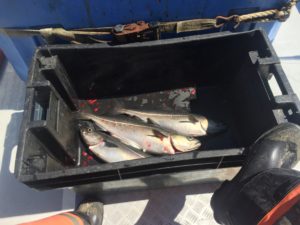
Quality control Step 1. Bleed the fish.

Currently, the outer edge of where Common Pool fishermen are allowed to fish fluctuates seasonally from 18 to 80 miles out. The difference means a couple of hours of travel and probably $300 or so in fuel, tackle and ice.

But the difference runs deeper than that.

When the Maine Department of Marine Resources distributed NOAA funds to offset losses from the groundfish (read cod) disaster relief last year, the money went to fishermen with quota who had the largest landings of groundfish. Those in the common pool were not invited to the table, and therefore, did not receive any disaster relief.

Many ironies exist in fisheries management. And this is one of the starkest examples. Those most hurt by the reduced fishing income were overlooked when it came time to provide financial support. Those like Rider who are so passionate about protecting the fishery that they jig fish in up to 500 feet of water to reduce bycatch seemingly face steeper hurdles than larger scale trawl fishermen, whose bycatch is much more significant.

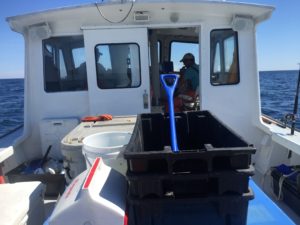
Strategizing the next fishing stop.

Sector inequality

It is easy to say this is purely a situation of the haves and have-nots. But fisheries management is much more complex than that. Current New England groundfish regulations were initially established in 2010 on the principal that fishermen would more equitably manage and effectively safeguard the resource by creating a free-market environment. The total allowable catch of groundfish such as cod, haddock, Pollock, flounder and other species was divided and allocated to groups of fishermen in sectors, or harvesting cooperatives, based on who had the largest landings between 1995-2005. Fishermen purchased permits that allowed them to fish for certain species in certain areas within the sector during certain seasons. Under this Catch Share system, they are allowed to continue catching fish during the season until they reach the quota limit for each species.

http://qkl.fa0.mwp.accessdomain.com/wp-content/uploads/2016/08/cabin-sound.mp4

The Finlander’s “purr”…

Unfortunately the Catch Share model overlooks a fundamental truth about fisheries economics: If financial resources determines access, then those with the most financial resources will have the most access. And so, an inequitable system was born and small-scale fishermen like Rider are squeezed … hard. Large-scale operators with the resources are encouraged by the very nature of the “get big or get out” system to grow and gobble up more quota, potentially leading to the type of abuses that led to the arrest of the largest distributor in New England last February.  Carlos Rafael’s arrest underscores another truth about the current system: the bigger players don’t necessarily think in terms of good stewardship.

Ocean classroom

Which brings me back to the reason I wanted to go out with Tim for what was pre-ordained to be a very full day. He’d tried to convince me soon after we passed the Isles of Shoals on the way out under a half moon sky. “Colles. I’m not kidding. Get some sleep. It’s a long @#$%&*! day. You’re going to need it.”

The Finlander heads home. Arrived at dock at 8:30 p.m.

I wanted a glimpse, however brief, of what it’s like to be a New England groundfish fisherman, passionate about the work and the resource, and riding the anxiety of an ever-changing fishery with continually tightening restrictions and razor-thin margins. Debt. Changing ecosystems, but slow-to-change consumer palettes. Perpetually bone tired, fueled on adrenaline and Monster drinks (not me) and taking in what the ocean has to offer: whether it be a full hold to bring back to the dock, un-forecasted six-foot seas, a tuna crashing bait or a giant ocean sunfish lazily cruising the surface.

I’ll think of that experience every time I stand in front of a group of people in a classroom or a restaurant to discuss what sustainable seafood means.


Check out the latest news updates about Capt. Tim Rider and the M/V Finlander crew at New England Fishmonger’s Facebook page. There, you’ll see some of the Seacoast restaurants the Finlander supplies.

Top photo: Capt. Tim Rider tries … unsuccessfully … to finagle his gear back from a blue shark.

All Blog Posts

UN Report: We’re Growing More Seafood Than We’re Catching

  • August 11, 2016October 20, 2021
  • by Colles Stowell
Share it!
Share

So what happens when the world’s wild-caught seafood supply is tapped beyond its capacity to feed the growing population? How do we sustain a human population that could reach 9.7 billion by 2050 when nearly a third of that number currently relies on seafood for 20% of their diet?

These are some of the questions posed, and somewhat answered in the United Nations Food and Agriculture Organization State of the World’s Fisheries 2016 report issued in July. However, the net results may leave many consumers conflicted over the need to fight hunger with the need to address industrial aquaculture’s ecological impacts. This is especially true since producing more food won’t necessarily fix the root causes of hunger.

Aquaculture on the rise…

The report’s authors suggest that aquaculture has, and will continue to play a critical role in meeting this demand. They point to aquaculture’s substantial growth to back this assertion. In 2000, aquaculture produced 27.3 million tons of seafood globally. Wild capture produced 94.8 million tons. In 2014 (the latest year for global UN FAO data), aquaculture was 73.8 million tons, and wild capture was little changed at 93.4 million tons. So as wild capture has remained relatively flat in 14 years, aquaculture increased 170%.

Global per capita fish consumption has risen above 20 kg for the first time in history. If we assume that wild capture stays flat based on global efforts to fish to maximum sustainable yield – the most we can fish without harming stocks’ ability to replenish themselves – then, yes, we need to meet the growing global demand in the face of expected population growth to 9.7 billion by 2050. The questions are how do we do that responsibly and at what cost?

aqua1Let’s dig a bit deeper into the numbers. The general aquaculture totals: Finfish, 49.8 million tons; mollusks, 16.1 million tons; crustaceans, 6.9 million tons; other aquatic animals including amphibians, 7.3 million tons.
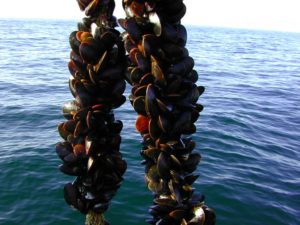
The report also states that about half of the 73.8 million tons of farmed seafood comes from fish, shellfish and plants that are non-fed species. That is, carp, mussels, kelp and similar organisms that don’t require the financial and environmental cost of fish pellets, often derived from forage fish, critically important links in the seafood web.

Additionally, for the first time, farmed fish exceeded wild caught fish for food consumption in 2014.

Think about that. We’re making more seafood than we’re harvesting.

…at what cost?

So all of this suggests we’re ramping up to meet the growing demand. Several countries are chipping in. No surprise that China is the big dog, accounting for nearly 60% of all aquaculture products, followed by India, Viet Nam, Bangladesh and Egypt. Salmon and trout are the top produced fish or shellfish (wild caught and farmed) on the planet, taking over the spot long held by shrimp. Norway and Chile are the top salmon producers.

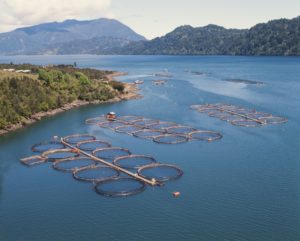
It is the legacy of farmedchile-salmon-farm shrimp and salmon that raises red flags. Yes, Chile is the second-largest salmon grower. But its industry is reeling from a disastrous start of the year: posting nearly $1 billion in losses due to ravaging algal blooms that destroyed millions of fish; crippling protests from commercial fishermen who blocked delivery of surviving farmed salmon; and, recent reports of staggeringly high (and ineffective) use of antibiotics.

Couple this with widespread reports of problems with shrimp farming, largely in Asia and South and Central America. Again heavy dosing of antibiotics, hormones to accelerate growth, and destruction of critical mangrove habitat are major issues. Look no further than frequent U.S. Food and Drug Administration alerts on imported farmed shrimp containing antibiotics the agency deems carcinogenic.

As with industrial agriculture, the push to increase seafood production and profits often storms past responsible practices. The result is often product that compares poorly to wild caught species from a nutritional, taste and environmental impact perspective.

The trouble with industrial Ag and Aq

All of these numbers and the consequent narratives of industrial aquaculture gone wrong overseas suggest we need to reassess industrial scale finfish and shrimp production to eliminate collateral damage. It can leave many people conflicted. Yes, hunger and rapid population growth are significant challenges that require global collaboration. And perhaps aquaculture can continue to play a role in addressing those problems.

But there are inherent flaws in the logic that industrial agriculture and aquaculture can “feed the world” or end hunger. First, the industrialization of food systems seeks to increase food supplies. But that model doesn’t address root causes of hunger such as poverty, inequity and fairness. In fact, some researchers believe the world produces more than enough food to feed everyone on the planet…up to 1.5 times as much.

Unfortunately, much of that food goes toward production of grains for industrial agriculture feed and corn for ethanol. This food system does little to address undernourishment. How can someone in Mali eat industrial-produced grains if he or she can’t afford it, much less find it? What about the small-scale fisherman in Oceana who can’t even afford the fresh seafood he harvests?

So no. Aquaculture is not a panacea for world hunger. But small-scale operations, which take a smart, balanced approach tLong-Line-Mussel-Aquaculture_NOAAhat minimizes ecological damage, can benefit local and regional food systems by providing locally produced seafood with minimal environmental costs.
For example, raising mollusks like oysters, mussels, clams and scallops is generally cleaner and even beneficial because it requires no feed, and as filter feeders, they actually clean bays and estuaries. Production of aquatic plants falls into the same category. Farming kelp, seaweed and other plants has increased substantially in the past decade, jumping 102% from 13.5 million tons in 2005 to 27.3 million tons in 2014 at a market value of $5.6 billion in 2014. New approaches, such as Bren Smith’s 3D Ocean Farming, are creating clean, self-sustaining and diverse marine polyculture farms that produce shellfish and plants.

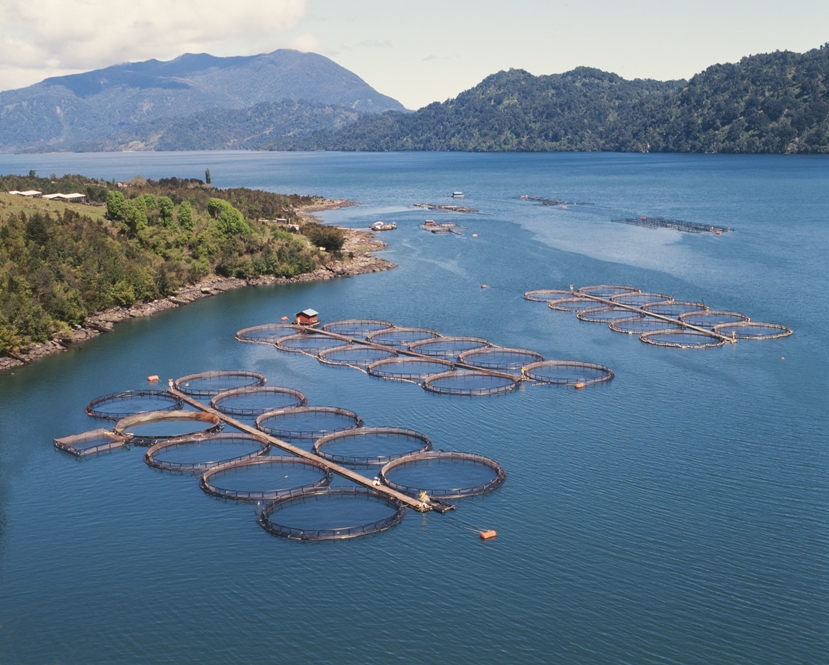
A better way neededsalmon pen

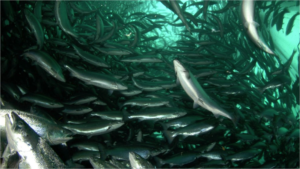
Since industrial aquaculture is already embedded in global food systems, we need to devote more energy to minimize or eliminate the downstream impacts of current industrial scale finfish and shrimp aquaculture. The rapidity with which the deadly virus spread among fish farms in Chile earlier this year confirms a long-held belief by some scientists and environmentalists that cramming tens of thousands of salmon into tight pens creates fertile ground for deadly diseases to spread rapidly. We need to figure out better ways to produce farmed fish and shellfish to minimize those hazards.

We need to devote more money, time and effort into making closed re-circulating systems – which reduce environmental impacts of escapes, disease spread to wild stocks, and resource depletion – more affordable and accessible to more operators around the world.

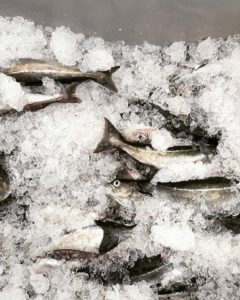
Pollock from Finlander
Fresh, abundant pollock from the M/V Finlander out of Eliot, Me.

Aquaculture practices and regulations vary widely around the world. Regulations are tighter domestically than most anywhere else in the world, significantly restricting the use of antibiotics and hormones. But we can do more to make the industry more sustainable and accountable from a resource, environmental, and health standpoint. We have to. The current situation leaves many consumers conflicted over current practices despite the increasing need to feed the planet and frustrated there hasn’t been enough effort to improve the industry.

A consumer’s best tool is knowledge. Find out more about the provenance of the fish or shellfish we eat, and we can at least safeguard what we and our families eat. When in doubt, ask questions and buy locally caught, responsibly harvested species that are abundant. Together, an informed customer base could perhaps spur some of the change discussed above.


All Blog Posts

Chilean Farmed Salmon: Poster Child for Caution

  • July 20, 2016October 20, 2021
  • by Colles Stowell
Share it!
Share

I remember the first time I tasted wild salmon. I was almost 10, and my dad had just returned from two weeks fishing the Whale River in Ungava Bay, Northern Quebec. This was 1974, and my dad brought two big crates with two 15 lb fish, packed with peat moss, sawdust and dry ice. The stories my dad told of these big leaping fish, the rugged beauty of the land, camping in tents and cooking over fires made the fish taste wild. I wanted to go and catch my own salmon and eat it. That didn’t happen for a while.

The best seafood I’ve ever tasted was a salmon I’d caught 15 minutes before I gingerly grabbed pieces of it out of a smoldering, greasy pan during a downpour at Twin Pools on the LaPoile River in Newfoundland in 2011. We’d hiked seven miles of terrain that ranged from peat bogs, to dense forest and giant boulders. I felt like I was in Middle Earth. No plates. No silverware. One crumpled napkin. No seasoning save for the dregs of some salt and pepper the guide scraped out of his coat pocket. He had to lean over the pan with his rain jacket flared while the tender pink flesh glazed over in the hot butter.

Nothing has topped that experience, before or since.

I think back on those experiences when I think about how far we’ve pulled away from our food sources. I can only imagine what the Atlantic salmon populations were like before we started damming their spawning habitats and fishing them with wanton abandon.

I guess the rise of salmon farming was an inevitable consequence of Atlantic salmon’s broadly appealing taste and appearance, even as the fishery collapsed over the last hundred years. The intentions may have been somewhat innocent, if a bit naïve, at the outset. But naturally, the rush to make these struggling, expensive operations profitable, if not solvent, perhaps bypassed some warning signs. The push to accelerate time-to-market as well as gross pounds produced has yielded some unpleasant results.

Bloom to bust

Look no further than the train wreck that is the Chilean salmon farming industry. The second largest producer of farmed Atlantic salmon in the world (Norway is tops), Chile’s industry had a terrible first half of 2016. In a four week span in late February and early March, four of the nation’s top producers lost more than 9 million salmon to an algal bloom that released a deadly bacteria, killing more than $70 million worth of product. Total salmon losses since this first reported algal bloom or red tide are estimated at around 25 million salmon weighing about 100,000 metric tons or 15% of the country’s total production. Chile scientists blame the algal bloom on unseasonably warm temperatures due to El Nino. I’ll get back to that.

Authorities dumped thirty percent of the dead fish in a landfill, the rest in the ocean. A few weeks later, giant flotillas of dead sardines, jellyfish, birds and some mammals washed up on Chile’s shores, which were also covered with dead clams. Commercial fishermen reacted, complaining the die-offs and the federal closures of nearby fishing grounds were a direct result of bad aquaculture practices.

To protest, they set up blockades effectively stopping transport of any of the surviving farmed salmon to market. At one point, producers were losing $10 million a day related to both the die-off and the delivery interruption, with estimates at about $800 million total loss.

Irony you say? Hold on, it gets better.

Antibiotics to the rescue?

The just desserts, if you could call it that, to this festering stew of salmon, bacteria and political angst is a recent appellate court decision forcing the industry to reveal just how much antibiotics each of its producers has used. The decision came in a lawsuit filed by Oceana, claiming international markets had a right to know how the world’s 2nd largest farmed salmon producer treated its fish. Until this decision, the true depth of Chile’s antibiotic use had been somewhat cloaked.

Now we know. And the details are stomach churning indeed. Government statistics released a couple of weeks ago show the proportion of antibiotics to tons of salmon increased from 2014 to 2015, during which time producers used 1.23 million pounds of antibiotics on about 895,000 tons of fish. On average, producers used about 660 grams of antibiotics per ton. One company, Australis Seafoods used 1,062 grams of antibiotics per metric ton of fish.

For comparison, consider that in 2008, Chile fed 385,635 kilograms of antibiotics to its salmon. Norway, the world’s largest farmed salmon producer? 941 kilograms.

So why is this such a big problem? For starters, it’s not good to ingest antibiotics unless you absolutely need them. You may have read about concerns over superbugs, or antibiotic-resistant bacteria. In essence, bacteria like E. coli or salmonella continue to evolve in their own quest to survive. And thus, some strains have developed a resistance to the antibiotics we would use to kill them, making us more susceptible to the nasty diseases these bugs can produce.salmon pen

Consider some frightening statistics from the US Center for Disease Control: An estimated 2 million people in the U.S. become infected with antibiotic-resistant bugs, resulting in 23,000 deaths. Now consider that some of the antibiotics used in aquaculture operations outside the U.S. have been deemed carcinogenic by the Food and Drug Administration.

No thanks.

Now let’s get back to the rise of the algal blooms in Chile. As I said, local officials claim the unseasonably warm temperatures gave rise to the situation. There is truth in that statement. However, scientists believe there is another direct cause. Concentrations of tens of thousands of fish in close proximity swimming in their own feces leaves them vulnerable to disease. So the farming operations dump tons of antibiotics as a preventative measure against the disease. They also throw in tons of pellets to feed the fish.

Now imagine a veritable rainfall of feces, undigested food and antibiotics landing on the ocean floor. There’s a lot of excess nitrogen and phosphorous introduced to the ocean ecosystem that in theory would otherwise be balanced. The extra nutrients create an environment more suitable for algae to grow than most other organisms. And it grows quickly, sucking up much of the available oxygen and releasing a deadly bacteria that ultimately kills the fish. The fish die and the bacteria have more “food.”

Worse still, the antibiotics used against the primary salmon-killing bacteria, SRS, aren’t working, according to an official with the National Service of Fisheries and Aquaculture (Sernapesca).

So if you’re keeping score, Chile salmon farmers are pounding their product with antibiotics that aren’t really working. And consumers are paying for it.

I’d call that a real loss on many, many levels.

We’ll talk about the global impact of finfish aquaculture in further posts, and explore some operations that are taking a better approach.


Resources

Here are some additional links to interesting info about aquaculture:

Lenfest study on aquaculture pollution

National Geographic glossary on algal blooms

World Wildlife Fund Report on environmental impacts of aquaculture


All Blog Posts

Of Pollock and Perception

  • June 7, 2016October 20, 2021
  • by Colles Stowell
Share it!
Share

I like a good discussion. That is my goal every time I walk into a classroom. I want students regardless of age to ask questions and even challenge me, as was the case a few weeks ago at Portland High School. Within the first five minutes or so, I can get a rough gauge of the overall class dynamic and determine which course the discussion will take.

My classroom last Saturday was a 100-year-old bakery, complete with freshly used dough machines, sacks of flour, wooden kneading blocks, coolers, rolling racks and trays of sealed brownies, blondies and linzer tortes. (I admit to nearly succumbing to covert temptation.)

What a great spot for a delicious dinner and compelling conversation! The location was the original Rosemont Market and Bakery in Portland, Maine. The “students” were in fact area adults interested in learning more about the local and global seafood system.

The discussion was free-flowing, dynamic, interactive, engaging, humorous. Just about all that I had planned for when originally working with Chef Bryan Dame to set up a sustainable seafood dinner a couple of months ago. The goal was to pair creative, tasty dishes featuring local, abundant seafood with a conversation about where the seafood comes from (ie, the boat and/or the harvester), and why knowing this kind of information is important.

So we first talked about a common definition of what sustainable seafood is and isn’t. As I explained how the average seafood consumed in the U.S. travels more than 5,000 miles from boat to plate, we feasted on locally sourced pollock and mussels ceviche served over a creamy corn pudding. The accompanying seaweed biscuits and sea salt nori butter were surprisingly addictive. I mentioned the pollock came from the Finlander out of Eliot, Maine, a boat that travels some 80 miles off shore to jig fish for pollock, haddock and other groundfish species. Jig fishing means virtually no bycatch, or the capture and possibly killing unintended species, a significant problem with some wild harvest methods.

The conversation then turned to the domestic and global seafood picture, with perhaps a little surprise at the revelation that 90% of the seafood eaten in the U.S. is imported. We discussed the implications of that while diving into Acadian rockfish served with local spinach and a bacon jam that would make anything taste better. (I kept thinking about ice cream.) The rockfish, also known as ocean perch or Acadian redfish, was supplied by the Dee Dee Mae II out of Biddeford.Rosemont2-2

We also looked at how global seafood demand continues to grow as the population surges toward 9 billion by 2050, and how almost 5 billion people now depend on seafood for at least 10% of their per capita annual animal protein intake. And as the wild harvest of seafood has remained relatively constant over the past decade, aquaculture has nearly doubled.

We discussed how bivalve (oyster, clam and mussel) and seaweed aquaculture is growing in Maine as we ate pan-roasted hake served over smoked mussels and spring pea puree with pillow-soft potato gnocchi. The mussels came from Pemaquid Mussel Farms and the seaweed (used in almost every course) came from Maine Sea Fresh Farms. The hake came from the November Gale out of Five Islands, Maine.

Finfish aquaculture and the ramifications of recent U.S. and Canada approvals of GMO salmon sparked lively interaction about balancing the needs of feeding a growing global population and addressing the many concerns with farmed fish. Hormone and antibiotic use, disease, environmental degradation (such as clearing out critical nursery habitats like mangroves for shrimp farms) are all significant challenges to widespread acceptance of fish farming. GMO salmon have a much steeper hill to climb because of the significant issues with the lack of labeling and questionable science.

The group collectively pondered the ramifications while dipping into dessert: dulse panna cotta (a subtle, unique whisper of the sea) with light, toasted sesame cookies.

The food and the narrative were perfect complements. And the evening reminded me why I started One Fish Foundation. Engaging people, no matter the age, in a discussion about where their seafood comes from, and why they should think about their decisions at a restaurant or seafood store is important to them and the resource. Just as with farms, we have a connection to the fish and shellfish we eat, and those who harvest them. And every decision we make has an impact on the resource.

All of the fish we ate was local and abundant, which are two of the most significant factors in determining seafood sustainability. Chef Bryan delivered on the promise of making what was once called “trash fish,” but is now better known as “abundant”, sing in beautifully prepared and creative dishes that we all enjoyed immensely.

We sourced the fish from Harbor Fish Market in Portland, which is where Rosemont gets most of the seafood they offer in their five area markets. Harbor Fish does a good job at sourcing locally, whenever possible, and being forthright about where its seafood comes from. That’s an important factor when deciding where to buy fish. You want to know they’ll tell you the truth about its provenance.

Rosemont owners John Naylor and Molly Thompson were very gracious in welcoming One Fish Foundation into their “kitchen.” The level of dialogue was inspiring, hopefully to the point that the conversation will continue among those who attended, and spread into their communities.

That’s why I do this.


Photo credits: Molly Thompson. Top: Chef Bryan Dame, seaweed whisperer.

All Blog Posts

Latest Gulf of Mexico Oil Spill Raises More Flags

  • May 20, 2016October 20, 2021
  • by Colles Stowell
Share it!
Share

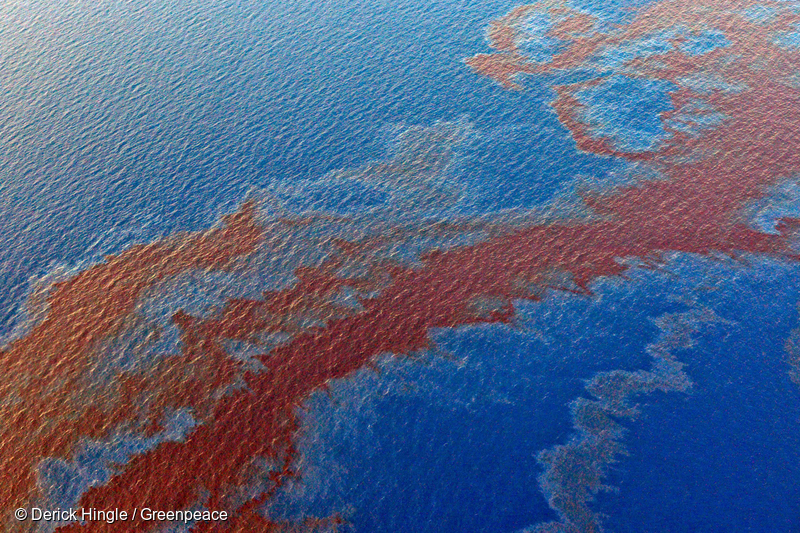
Here we go again. Another giant oil company is responsible for another oil spill in the Gulf of Mexico. Last week, a pipeline owned by Shell Oil sprung a leak, releasing nearly 90,000 gallons of oil that spread out in a slick the size of Manhattan more than 90 miles off the coast of Louisiana.

To be sure, this incident is much smaller than the Deepwater Horizon disaster in 2010, when a BP-owned oil rig caught fire, killing 11 workers and dumping more than 3 million barrels of oil into the Gulf. That disaster, and the downstream environmental, ecosystem and economic impacts it continues to wreak on the region, still qualifies as the largest manmade disaster of its kind in the U.S.

This latest release from Shell is no trifling matter. Shell says it has stopped the leak and shut off flow to the other wells the flow line connected. The Coast Guard deployed five ships and 150 people to place booms in the water to collect the oil/water mixture. The process of skimming the oil is similar to a vacuum cleaner for water, where the booms collect the mixture. Then the oil and water is likely separated, with the water returned to the gulf.

The Coast Guard announced Monday that it had completed the skimming operation, after collecting about 84,000 gallons of oil and water. So as is bound to happen, some of the oil remains in the ecosystem. The question is how much of a direct impact it will have. Some of the oil, which is light, sweet crude oil, will likely evaporate, and some will be consumed by bacteria, according to Tulane Professor Eric Smith.

Since the BP spill, there have been a variety of damning reports about how the oil and the many toxic dispersants released to “control” the situation have effected fish, shellfish and plants. The list includes everything from widely reported deaths of dolphins (up to 1,400 according to NOAA) and countless seabirds such as cormorants and pelicans to damage to juvenile tuna cardiovascular systems.

When I visited Venice, La. last November, I was struck by how much visible infrastructure there is along the Mississippi River delta and out in the Gulf. It looked like more than I could remember from my last time there, some 30 years ago. But what I later learned was the scope of the subsea infrastructure, the network to transport all of that oil and natural gas from the offshore rigs to the mainland. Some satellite overlays make the network look like a very tight, and complex cobweb.

The Shell leak apparently occurred on a transport line near a subsea terminal. And it will likely be awhile before there is any conclusive statement of cause. According to the federal Bureau of Safety and Environmental Enforcement, there have been 147 spills, releasing about 516,000 gallons of oil in the gulf since 2012.

So I have to wonder. With some 31,000 miles of pipeline (some of it installed 60 years ago) sprawled out on the ocean floor, what’s its lifespan? That is, do we really know enough to ensure such failures won’t happen again?

These are the questions I have when we get a reminder like this that placing such infrastructure near critical wildlife habitat has consequences. We can’t just rely on booms, bacteria and sun evaporation to keep cleaning up our messes. The Gulf is still recovering from the last time we relied on those approaches.


photo credit: Derick Hingle/Greenpeace

All Blog Posts

Student Questions Spark Hope For Fisheries Answers

  • May 18, 2016October 20, 2021
  • by Colles Stowell
Share it!
Share

I found myself facing one of the most difficult questions to answer about fisheries management last week. Posed by a senior at Portland (Maine) High School, the question was how to ensure all fishermen have fair access to the resource while still protecting that resource.

We had covered a lot of ground up to that point. We’d discussed the domestic and global seafood systems in broad strokes, touching on demand, and import/export statistics and issues. We’d reviewed different aquaculture approaches, global warming and its impact on the Gulf of Maine and the role invasive species play in altering local ecosystems.

We’d also discussed the unbalanced fishing quota landscape and its impact on fisheries and the fishermen who care about the resource. That prompted the senior, taking an Ocean Sciences course, to ask the hard question many fishermen, policy makers and activists continue to ponder.

I prefaced my answer with a bit of insight from years of studying management issues and listening to fishermen, managers and scientists discuss policy: There are no black-and-white or one-size-fits-all answers. There is no chance, whatsoever, of 100% satisfaction for all stakeholders. Feelings run too deep.

And that’s a large part of the problem. The quota system arose to eliminate the bycatch (discards of unintentionally caught species) and what some activists termed a “race to fish.” The previous management model limited effort, or days at sea, encouraging fishermen to fish as much as possible with a given time period. The quota system divided the ocean into different sectors and allotted quota based on the permits fishermen purchase. The idea was that if you had a permit, you might feel responsible for taking care of the resource.

Instead, the quota system bred new inefficiencies and more disparity in the “haves” and “have-nots.” Larger operators with deep pockets could buy more of the permits, driving up the price of the permits to the point where smaller scale fishermen are priced out of the markets. Local fishermen, those who typically care more about the resource more than the larger operators, are forced to switch gears or stop fishing. Small-scale farmers often face similar struggles against industrial agriculture.

A good bad example

I used the example of Carlos Rafael, the largest seafood distributor in New England, to illustrate how the system is ripe for abuse. Rafael is now under house arrest in his hometown of New Bedford, where he is awaiting trial on federal charges he defrauded the government by hiding his actual catch volumes and mislabeling fish. Rafael allegedly misrepresented species on federal catch quota forms he filed by mail or online. Then the species were sold at a higher price to a New York wholesaler who allegedly paid for the fish with bags of cash.

I answered the student by saying I don’t have an exact solution to the problem. But I explained that allowing all stakeholders, including local, small-scale fishermen, to have a meaningful say in how fisheries are managed would be a significant first step. Many fishermen argue that giving local fishing communities more control over management of their fisheries would prevent the kind of top-heavy, cash-driven management that nurtured the rise of operators like Carlos Rafael.

I see some merit to that approach, but also understand that the Magnuson Stevens Act is essential to creating a federal management backbone to ensure some consistency from coast to coast.

Above all, collaboration among different stakeholders, fishermen, policy makers, scientists, community activists, chefs, consumers, etc. is critical. We won’t move forward if we can’t all meet at the table.

And that underscores the importance of having discussions about where seafood comes from and how it’s managed with students like those seniors at Portland High School. I hope those discussions will eventually lead to more concrete solutions that are fair, equitable and sustainable for fishermen, their communities (read consumers) and most importantly, the resource.

If I can get students to ask intelligent questions, I’m at least sparking the conversation.

All Blog Posts

What’s In Your Imported Farm-Raised Shrimp?

  • May 3, 2016October 20, 2021
  • by Colles Stowell
Share it!
Share

A recent Food and Drug Administration alert about farmed shrimp from Asia raises health questions about the food system that delivers imported shrimp to the U.S. and the rest of the world. The notice also serves as a warning to consumers to know more about where the seafood comes from and how it was grown or harvested.

Forty-five out of 138 shipments (32%) from the Malaysian Peninsula sampled between October 1, 2014, through September 30, 2015 were found to have carcinogenic substances the FDA doesn’t want in our food. So the FDA has given inspectors the authority to reject all shrimp shipments from the Malaysian peninsula, save for a few exceptions, without a physical inspection.

What did they find? Antibiotics called nitrofurans and chloramphenicol, both of which have proved harmful to human health with prolonged exposure. Additionally, prolonged use can create antibiotic-resistant bacteria that can make matters worse.

So carcinogenic antibiotics were found in aquaculture shrimp from Asia.

Shock. Surprise.

The question is why. To better understand, let’s take a quick look at how shrimp farming typically works, and why it should give anyone pause when at a grocery store, seafood market or restaurant.

Big business, big risks

Shrimp farming is a huge business. Some estimates have global farmed shrimp at 3.7 million metric tons in 2014, worth between $12 billion and $15 billion dollars. The drive to grow profits as well as shrimp means increasing production.

Shrimp farming often starts by destroying and removing ecologically critical mangrove ecosystems (nurseries for many species) to create retention ponds where the shrimp will grow. These ponds are usually fed with seawater that passes through the ponds and often re-enters the ocean … carrying much of the waste filtered through ponds carrying thousands of pounds of shrimp and their feces. Many operations claim they filter the water before it enters the ocean, but…

But because shrimp are the number one consumed seafood around the world, many operations in Third World countries in Central and South America and Asia jam as many shrimp into these ponds as possible. Without proper filtration, those shrimp are highly susceptible to disease, because, you know, they’re swimming in their own poop.

Bad medicine

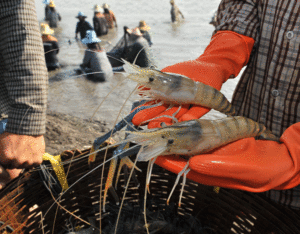
For the past decade or so, many operators have found it easier to use antibiotics and other potentially harmful materials to fend off the bacteria that could cause disease. Those antibiotics don’t just disappear overnight. They don’t always fend off disease either, resulting in huge losses. Just witness recent cases of “early mortality syndrome (EMS)” in Asia.asianshrimpfarm_405x250

EMS is a devastating disease borne of a microorganism found in estuaries around the world, and showing up in overcrowded ponds that have poor filtration. The bacteria shut down the shrimp’s digestive system, killing the shrimp. Its infection rate is fast and efficient, meaning it can quickly kill all of the shrimp in a pond. EMS has mostly been found in Asia, but has also cropped up in Mexico.

To try and avoid catastrophic losses, growers choose from a menu of preventative measures, such as chlorine, superphosphates and ozone to disinfect the water, probiotics to fight off the bad bacteria and stabilize the water quality and antibiotics to treat illness. Aside from the potential threats to human health, another issue with these approaches appears to be that they may actually make the ponds more susceptible to infection, according to some scientists.

None of this is good for the shrimp or consumers.

Market impact

The Global Aquaculture Alliance estimates EMS causes $1 billion in losses annually. This explains why shrimp farmers are willing to do most anything to bring “healthy” shrimp to market … including using antibiotics the US FDA deems carcinogenic.

Here are some problems with this food system:

  • 90% of the seafood eaten in the U.S. is imported;
  • 50% of the seafood consumed in the U.S. is farm raised;
  • Only 5% of the seafood consumed in the U.S. is farm raised domestically;
  • 90% of the world’s shrimp exports come from Asia and India;
  • 55% of global shrimp production is aquaculture;
  • The U.S. is far more strict about safe aquaculture practices than most of the world;
  • The FDA is understaffed for inspectors, particularly those inspecting incoming seafood.

Source: UN Food and Agriculture Organization 2014 Status of the Stocks

This all means that most of the farmed shrimp consumed in this country was farm-raised in Asia, where there is a greater chance that it was treated with chemicals deemed unsafe to consume by the FDA. And there aren’t enough inspectors checking all of the imports.

How could this situation get much worse? If the latest trade deal, the Trans-Pacific Partnership, is approved in Congress, the few inspectors checking U.S. imports may have their hands tied. The pact allows signatories like Thailand, Viet Nam and yes, Malaysia to sue the U.S. claiming that applying more strict U.S. health codes to imported seafood constitutes unfair trade practices. The result could be sanctions, fines and an open door to products tainted with carcinogenic substances.

Get smart

In the classroom the message always comes back to awareness. I encourage students to question where their seafood comes from. I considered it a shrimp-diseasemoral victory a few months ago when a 6th grader told the class she stopped her mom from ordering shrimp because it was from Thailand.
It’s that kind of awareness that helps students, their parents and anyone else understand that shrimp coming from Asia, or anywhere outside the U.S. is a good thing to avoid.

So you may want to pause before ordering the shrimp cocktail. Try to find the country of origin. If the shrimp isn’t from the U.S., you may want to consider another option. Because when the FDA sends up a red flag like this, it’s a good idea to take note.


Photo credits in order: Eco News Network, Food Safety News, U.S. Bureau of Labor Statistics

All Blog Posts

Fisheries Policy A Mixed Bag

  • April 26, 2016October 20, 2021
  • by Colles Stowell
Share it!
Share

The Magnuson-Stevens Fishery Conservation and Management Act (MSA) turns 40 this year. This is significant for fisheries because the law has been the backbone for management policy since its implementation in 1976.

And that fisheries policy is largely working, according to the 2015 Status of the Stocks released by NOAA last week. In short, the annual report boasted the percentage of domestic fish species that are overfished is near record lows. Thirty-nine fish stocks have been rebuilt since 2000 because of effective management policies, (up from 37 stocks in 2014), says the report. The number of stocks experiencing overfishing (when the harvest rate exceeds the stock’s ability to sustain harvest) has increased by 2 since 2014. The number of stocks that are overfished (when the population is too low and may not be able to support harvest) has increased by one to 38 since 2014.

Some of the lowlights of species still considered under threat by NOAA’s standards: Atlantic cod (no surprise), Atlantic and Pacific bluefin tuna (no surprise), Atlantic salmon (longtime resident on this list), red snapper (ditto), different species of flounder, different shark species, Chinook and Coho salmon in different areas of Washington state, Atlantic halibut and Pacific swordfish.

To be sure, a lot of work goes into compiling these reports. And it gives a general barometer of fisheries in US waters, even if some of the species, such as bluefin tuna, are highly migratory and thus, fished by international fleets.

NOAA calls out the annual catch limit as an effective tool for ensuring against overfishing. One of the more recent “tools” added to the NOAA anti-overfishing toolbox is the individual transfer quota (ITQ). In essence, a certain fishery has a certain amount of quota that is available to fishermen…for a price. Fishermen can buy and sell quota within their regulated area just like stock traders can with stocks. The concept was to allow fishermen to self-regulate while managing to a catch limit.

scr_235573_24667

Unintended consequences

The unintended consequence shifted control from the pool of local fishermen to a select few with the money to buy up all of the quota. As quota became more expensive, more smaller scale fishermen were forced out of the equation. So not only is the ITQ system skewing access and control of the fishery away from local commercial fishermen, but it’s actually encouraging greater fishing pressure on the resource by larger operations who care more about profit than the health of the resource.

Many fishermen argue it is this environment that fueled the ascent of large operators, such as Carlos Rafael, the New Bedford distributor arrested last month on fraud charges. Authorities allege that he hid actual catch volumes and mislabeled fish in a scheme to sell regulated species to buyers in New York for bags of cash. He is currently under “house arrest” wearing an ankle bracelet that monitors his whereabouts and ensures he abides by his curfew.

Fisheries management is a complex issue. There’s no one-size-fits-all formula that provides equal protections for Atlantic Striped bass and Pacific Ocean perch. Different species in different ecosystems with different complexes of predator prey relationships and environmental factors require specific, targeted policies to account for all of these variables. And that doesn’t fully encompass the calculus of ecosystem-based management (managing fisheries not just by the narrow window of one specific species at a time, but as an entire ecosystem from plants up to alpha predators like sharks).

It’s hard to get it 100% right.

Magnuson-Stevens provided the framework that has evolved to the point where specific species management is possible. But the scale of the framework and sheer administration needed to manage such a menagerie of diverse fisheries has created what some fishermen see as a type of caste system where the well funded “inherit” the right to control large chunks of the US fishery. Smaller-scale fishermen who depend on the resource for their lives are forced out, and the resource suffers.

Mssing in this equation is a key tenet described in the amendment and renaming of the law in 1996: “Conservation and management measures shall not discriminate between residents of different States. If it becomes necessary to allocate or assign fishing privileges among various United States fishermen, such allocation shall be (A) fair and equitable to all such fishermen; (B) reasonably calculated to promote conservation; and (C) carried out in such manner that no particular individual, corporation, or other entity acquires an excessive share of such privileges.”

So yes, Magnuson-Stevens has provided a critical framework for managing a hugely diverse network of fisheries in U.S. waters. Better science gives us a more realistic idea of what is happening in our marine ecosystems, and policies are in place to help avoid fishing beyond capacity. But there is also room for improvement. Effective fisheries policy must include all stakeholders, including small-scale fishermen. Failure to do so has made the system vulnerable to fraud and disparity that hurts fishermen, consumers and the resource.

A better, more democratic approach that lets everyone have an equal voice is surely available. We just need to break the longstanding habit of repeating the same mistakes.


Photo credits: NOAA

All Blog Posts

Climatologist Sees Climate Change as Innovation Opportunity

  • April 11, 2016October 20, 2021
  • by Colles Stowell
Share it!
Share

Cameron Wake is used to being called “Dr. Doom.” He’s an ice core paleoclimatologist at the University of New Hampshire who’s been studying glaciers and their behavior for more than 30 years. He’s been on the forefront of some of the leading research into climate change, much of which now predicts more than six feet of sea level rise by 2100. That’s not fully accounting for the possible 20-25 additional feet of higher water if all of the earth’s glaciers melt.

So naturally, he does his best to be optimistic.

“Climate change is the innovation opportunity of the 21st century,” he says, whether at a climate summit hosted by MIT Seagrant in 2014, or at an intimate gathering of 200 in Portsmouth, N.H. on March 28. Even though the range of possible sea level rise jumped 2.6 feet from 2014 to 2016, his insistence on the opportunity angle echoes some of the enthusiasm born of the global climate accord reached in Paris in December.

“Climate changes,” he said. “It always has and it always will. The biggest difference today is that there is an extensive and ever-growing body of scientific evidence that shows that humans are the main driver of that change.”

But, we have time to avoid some of the darkest “Dr. Doom” predictions … if we act now, and decisively, he said.

There is an interesting dialectic at play with climate change that can be a bit challenging to grasp. At the Maine Fisherman’s forum last month, NOAA’s John Hare made a striking comment: “Climate change has a long memory.” The next 25-50 years of climate change are already fixed based on what we’ve done up until now. However, the steps we take now to reduce greenhouse gases, widely accepted as the leading culprit causing global warming, will affect our climate after 50 years or so.

In Portsmouth, Wake described why studying the different strata of glaciers yields so much information about what the climate has done in the past. “Glaciers are great archives,” he said. “We can look at oxygen isotopes to see what has happened.” One fairly constant measure is that when CO2 levels are high, the temperatures are higher, when they are low, temperatures are low.

Wake put some of the need to act immediately and globally in context with some recent data:

  • Within the past 18,000 years, massive ice sheets that once covered North America and Northern Europe have melted;
  • To slow long-term climate change effects, we need to keep global CO2 at 400 parts per million. We are now on a path toward 1,000 parts per million;
  • Arctic sea ice is the air conditioner for the northern hemisphere, reflecting UV rays back into the atmosphere. If that ice melts, it will lead to warming of the atmosphere and the oceans, accelerating global warming;
  • We’ve seen a significant reduction in Arctic sea ice in the summer since 1975. Sea ice is likely going to disappear in the Arctic Ocean this summer;
  • The rate of the Greenland ice sheet moving toward the ocean where it melts has doubled in the past decade. One particular glacier, the size of Mount Washington in N.H., has doubled its rate toward the Atlantic;
  • We may not fully understand the physics of glacial movement and melting in light of global warming for another decade;
  • There will be no shortage of fresh water in New England. The number of rain events in Southern N.H. with more than four inches in 48 hours is projected to jump from four between 1980-2009 to nearly 12 between 2070 to 2099. This means we’ll have more water falling in fewer events, making coastal and flood plain areas more vulnerable;
  • “It’s a challenge to talk about future on climate because we don’t know what humans are going to do,” said Wake, explaining why climatologists now use two scenarios representing high and low carbon emissions. While there is little variability between the two scenarios until 2050 because the pattern is locked, potential temperature ranges for New Hampshire vary widely afterward. If we drastically cut greenhouse gases, the average number of summer days hotter than 90 degrees Fahrenheit would be 20-25. If we continue on our current path of greenhouse gas emissions, New Hampshire could experience 50-60 days above 90 degrees;

“We can’t wait until 2050 or 2080 to address this challenge,” he said. “We won’t have enough money in one year to adapt. We need to keep checking back in with the science. Where there is little tolerance for risk, communities should commit to 4 feet of sea level of rise, but be flexible to manage to 6.6 feet.”

Solutions

To begin with, we need to at least meet the emissions goals set at the Paris accord. It was a significant achievement to get nearly 200 nations to commit to do something to reduce carbon emissions, with a goal of limiting global temperature increase to 2 degrees Celsius (3.5 degrees Fahrenheit) by 2100. But even with those commitments, we’d only keep the global temperature rise to 3 degrees Celsius, many scientists say. We have to get the largest polluters, China, the U.S., India and other countries to cut more.

“We must decouple economic growth from greenhouse emissions,” said Wake. That means leaving a lot of fossil fuels in the ground. To prevent global temperature increases of more than 2 degrees Celsius, we must not burn 82% of the coal, 49% of the gas and 33% of the oil global reserves. We also need to increase annual global renewable energy investments to at least $1 trillion, he said. That kind of investment will likely yield innovations that make renewable energy more affordable and accessible on a global scale.

Most importantly, he said, we need to make personal commitments to reduce our carbon footprints. “I think every home should be its own powerhouse,” he said. Solar panels, efficient heating systems, better insulation, efficient windows, etc. are all some of the ways to reduce the carbon footprint of our homes.

“Think about what you can do. Your family. Your community.”

Resources

 Cameron Wake’s slide presentation in Portsmouth

Chasing ice: Incredible video of largest ice calving event (Ilulissat Glacier, Greenland) ever captured on film.

New York Times article on new research showing how quickly the West Antarctic ice sheet could melt

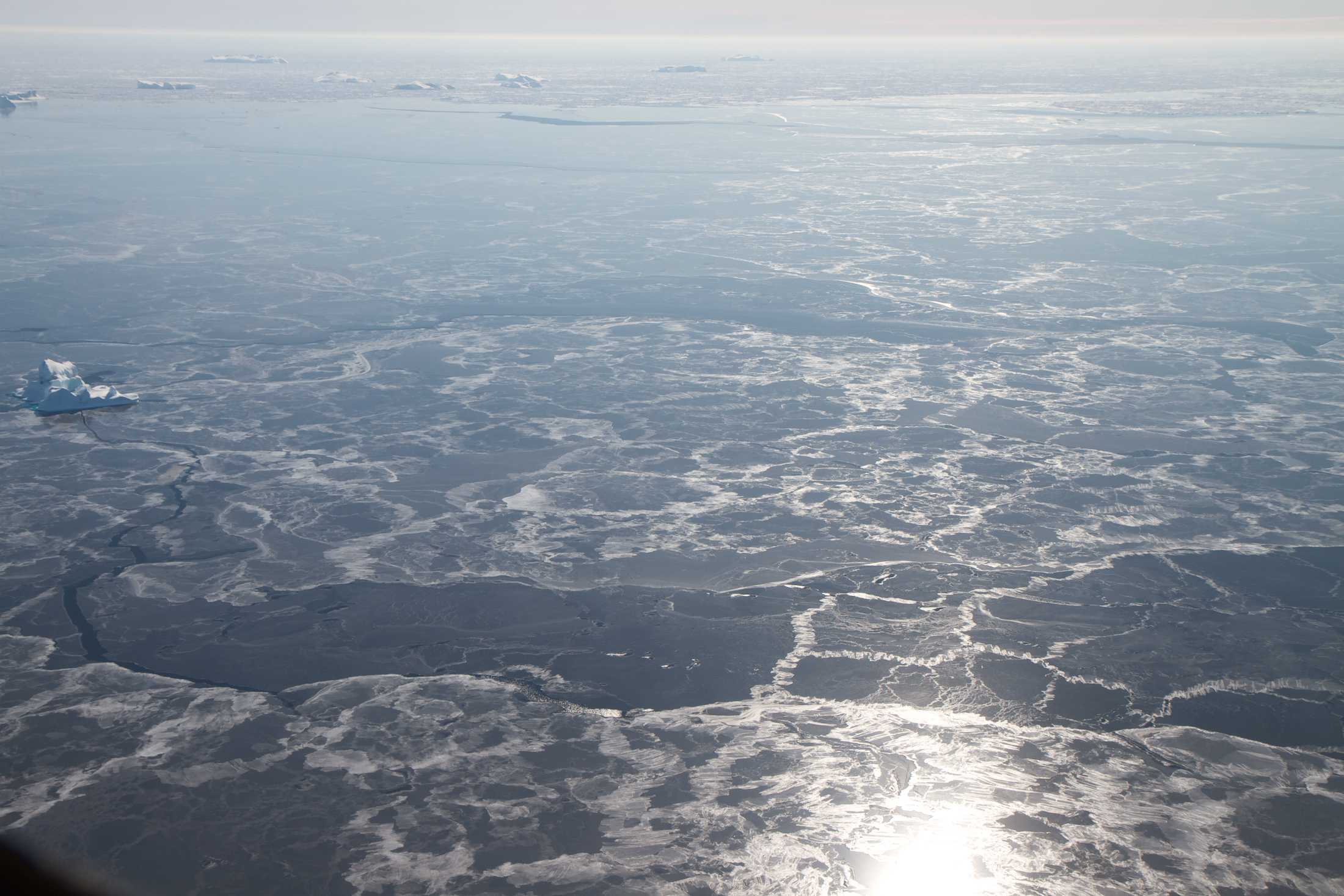
photo: Thin sea ice and a few floating ice bergs near the Denmark Strait off of eastern Greenland. Credit: NASA/Jefferson Beck

All Blog Posts

Fish Mogul’s Arrest Raises Questions About Fisheries Policy

  • April 1, 2016October 20, 2021
  • by Colles Stowell
Share it!
Share

To hear Carlos Rafael tell it, the oceans are there to make a profit on. It’s up to those who have the most resources to make the most profit.

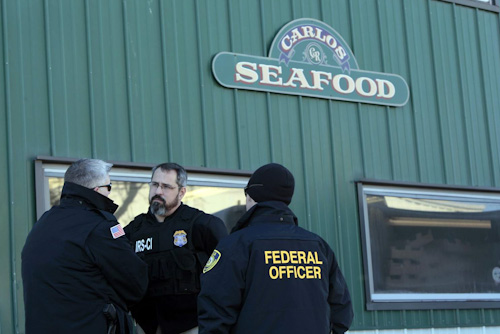
Or so you might think if you looked at the pending federal criminal charges he faces. Or the electronic bracelet around his ankle, which lets law enforcement know if he’s abiding by his curfew, and that he’s likely not trying to slip another fast one past authorities.

According to federal allegations, he’s slipped several million dollars worth of illegally harvested and labeled seafood through his Carlos Seafood operation in New Bedford, Mass. past authorities for decades. In court documents filed last month, investigators from the Internal Revenue Service claim Rafael, the largest seafood distributor in New England with more than 40 boats in his company’s name, intentionally defrauded the government by hiding his actual catch volumes and mislabeling fish. Prosecutors allege the mislabeling involved an intricate scheme whereby less abundant, more regulated and higher priced species like sole were labled as more abundant lower priced haddock arriving at port. Rafael allegedly misrepresented those species on federal catch quota forms he filed by mail or online. Then the species were sold at a higher price to a New York wholesaler who allegedly paid for the fish with bags of cash.

The brazenness with which he allegedly bragged about how he “did the dance,” as he described his activities, is astounding. “When the [inspector] disappears, that’s when we got a chance to make the fish disappear,” he allegedly told undercover agents posing as Russian mafia interested in buying his business, describing the ease of the deception when investigators did not meet his boats at dock. He boasted of netting $668,000 in less than six months, and that he smuggled some of the cash to bank accounts in Portugal, according to the affidavit.

Rafael is out on a million-dollar bond, wearing the ankle bracelet as a constant reminder of what went wrong after he allegedly tried to sell his business for $175 million, even though his books only reported $21 million in combined assets. The rest, he told undercover agents, was unreported profit, according to the affidavit filed in federal court.

As of last week, the court granted a prosecution request for an extension in seeking an indictment.

The news of Rafael’s arrest on Feb. 26 shook the industry from coast to coast. The aftershocks continue to send ripples throughout the entire supply chain and beyond.

Many commercial fishermen spoke out, pointing to Rafael as an example of how existing fisheries management policy has created an environment that breeds the kind of abuses Rafael is accused of. Specifically, they point to current catch share programs that allow deep-pocketed operations like Rafael’s to buy up the quota and essentially control fisheries. Not only do they gobble up quota and permits, they also snatch up processing facilities on shore, so that defrauding the management system, as prosecutors allege Rafael did, is easier. If you control the captains and crew on the water, the boat, the processor and the supply chain, mislabeling becomes a much easier process.

This schema has several negative impacts. First, it forces out smaller scale fishermen, many of whom are family operations in business for generations and just barely scraping by. If they don’t have the profit to pay for the ever-escalating quota costs, they can’t compete. Secondly, placing control over select fisheries into the hands of a few well-funded operations means there are fewer disparate voices on the water actually taking care of the resource. Put another way, there are fewer people self-policing the fishery to make sure peers aren’t cheating. Also, more eyes on the water can be a first alert to dramatic changes in the fishery, hopefully triggering a fast response to protect the resource.

But here’s another problem that arose in the wake of the news of Rafael’s arrest: Public image. It takes one or two people getting caught cheating the system on a grand scale to cast a long shadow on commercial fishermen. It’s the case of one bad apple taking out the whole bushel. The arrest of Rafael, who is a fleet owner and distributor, not a fisherman, has fueled questions about how rampant this kind of fraud is within the current quota system. Witness this blog from the Conservation Law Foundation. I’ve seen recreational fishing guides discussing this on social media.

The reality is that most commercial fishermen in the U.S. are just trying to make a living. Most know that if they don’t take care of the resource, they could put themselves out of business.

The U.S. has one of the most closely regulated fishing industries in the world. Any fraud or other illegal operations that occur here pale in comparison to what happens in Asia, for example. [Quick side note: It’s kind of frightening to think of what could happen if trade agreements like the Trans Pacific Partnership are fully ratified. Domestic fishermen already fighting an uphill battle against foreign imports and large quota grabs will likely be pushed out even faster, as cheap, largely uninspected foreign seafood floods the market.]

The close scrutiny of U.S. investigators led to the charges against Rafael. Perhaps the fact he’s been convicted of tax evasion and making false statements on landing slips and was acquitted of price fixing charges in the past 30 years helped focus that scrutiny.

If there is a silver lining in this mess, it’s this: First, a significant operator was caught allegedly cheating the system on several boldface fronts. Second, those charges have elevated the discussion of how and why such alleged crimes occurred. Third, the discussion will continue to focus on the current quota system, and how it promotes an uneven system of the “haves” controlling fisheries at the expense of the “have nots.” Fourth, it will hopefully unify commercial fishermen to speak out against current catch share policy, and perhaps take a renewed approach to self-policing violations that could further damage the industry image.


Further reading

Here are two additional examples where operators have exploited weaknesses in current catch share policy … and got caught.

Arne Fuglvog: Alaska fisherman, turned policy maker, turned federal inmate, turned lobbyist.

American Seafood, one of the largest businesses in U.S. Seafood, controlling Pollock quota system, convicted of tampering with the scales used to weigh and report Pollock catches.


photo credit: PETER PEREIRA/THE STANDARD-TIMES/SCMG


All Blog Posts

Slow Fish Rises to the Challenge

  • March 22, 2016October 20, 2021
  • by Colles Stowell
Share it!
Share

To say Slow Fish 2016 (March 10-13) in New Orleans was a success is an understatement. Overcoming last-minute weather challenges that shut down the planned venue, moving several thousand pounds of food around and getting people to deliver and attend informative, compelling presentations at three different, distinct venues was a stroke of genius from the event organizers and their motivated team. Here is the blog I wrote about the experience. 

It’s a surreal, if a bit funny experience to eat oysters surrounded by larger-than-life representations of male and female anatomy. Kind of a Harold-Robbins-meets-Jules-Verne aura.

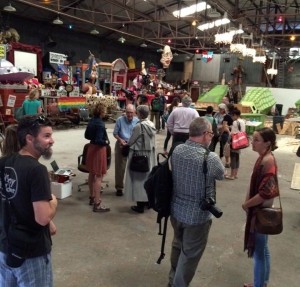
How a bunch of fishermen, chefs, scientists and seafood activists from around the world ended up in a dilapidated warehouse surrounded by lewdly, yet very craftily decorated Mardi Gras floats for the Krewe du Vieux (pronounced “croo du voo” and which pulls no punches lambasting anything/anyone political or sexual) is a study in adaptation.

We had gathered for the Slow Fish 2016 event in New Orleans to discuss important fisheries issues, make connections and celebrate locally caught, fresh and delicious seafood. Naturally, intense Louisiana spring weather turned carefully planned scheduling on its head with impending violent thunderstorms and potential flooding. Not one hour into the 150-person event at the Old US Mint, the state called for emergency evacuations and closed our base of operations for the next three days.

Krewe du Vieux warehouse, where Slow Fish 2016 attendees got an eyeful in New Orleans.
Krewe du Vieux warehouse, where Slow Fish 2016 attendees got an eyeful.

So instead of celebrating the gathering on the grounds of a historic building, we found ourselves feasting on pompano and sea bass in the shadows of papier-mâché sex. Ironically, that kind of mandatory last-minute logistical two-step closely parallels the rapid fire challenges many family fishermen face, constantly having to adapt to ever-shifting polices, seafood markets, climate, etc. beyond their control. We banned together at Slow Fish to pull it off, perhaps serving as proof that collaboration and flexibility are critical to addressing broader policy and market challenges ahead. That was the first of several truly unique experiences at Slow Fish 2016.

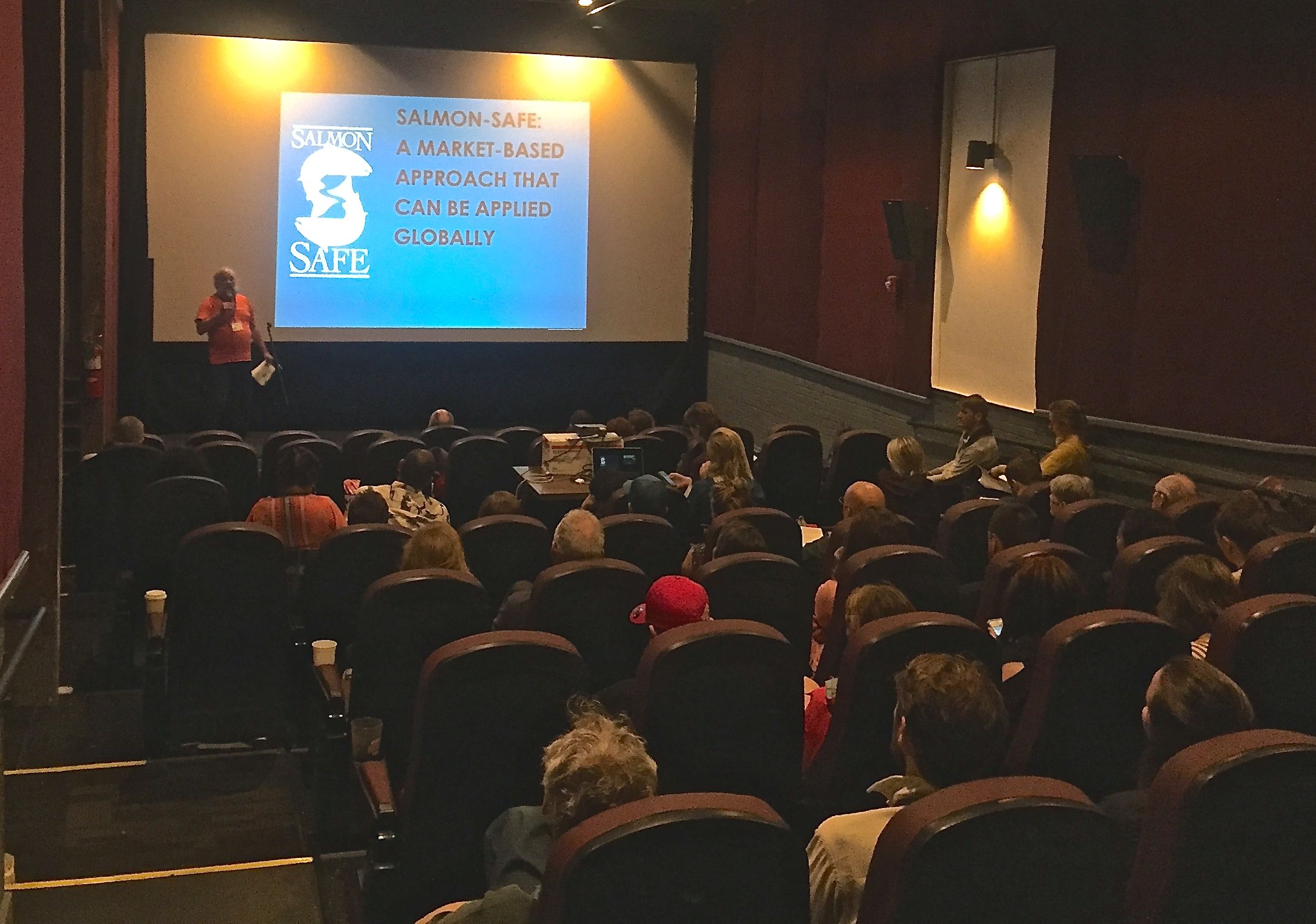
The next was the following day at the quirky Broad Theater in Mid City, a neighborhood at the heart of New Orleans. There, fishermen ranging from Alaska to California, and from Louisiana to Maine shared stories about their watersheds, community-based fisheries traditions and the management policies changing the landscape of how, when and where they can fish.Kevin Scribner discusses Salmon Safe's success.

Kevin Scribner highlights Salmon Safe's success.
Kevin Scribner highlights Salmon Safe’s success.

They discussed challenges such as privatization and resource allocation, biodiversity, policy impacts and ways to protect watersheds and fishing community heritage. Former Alaskan salmon fishermen and current Slow Fish board member Kevin Scribner described how the Salmon Safe program has worked with farmers, businesses and urban planners to reduce downstream impacts on native salmon habitat. This means the owners or tenants of more than 95,000 acres of agricultural and urban land (including the Nike campus, and several major farms) in three states and British Columbia have committed to reducing harmful nutrient and pollutant discharge into precious streams.

Kindra Arnesen spoke passionately about the challenges facing fishing families on the Mississippi River delta. She described her Herculean efforts to unite struggling fishermen after the BP oil disaster, first to get jobs helping with cleanup, then to challenge BP, the EPA, NOAA and other local, state and federal agencies on their methods of cleanup, cover-up and compensation. It was yet another story of adaptation and survival.

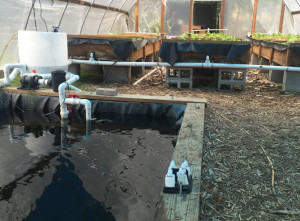
Happy Recirculating Farms Coalition catfish swimming in water filtered through lava rocks holding the lettuce in the background.

Other presenters discussed creating direct channels between fishermen, retailers and chefs to bring fresh seafood inland from the coast. Marianne Cufone, executive director of Recirculating Farms Coalition, showed the audience how a motivated team was able to start a clean, productive aquaponics operation right in a Central City neighborhood. Restaurants have already expressed interest in the fresh lettuce and catfish growing in recirculated water.

Set to the backdrop of compelling images, each story brought to life some of the common struggles many fishermen and coastal communities face, and some of the successful solutions to those challenges.

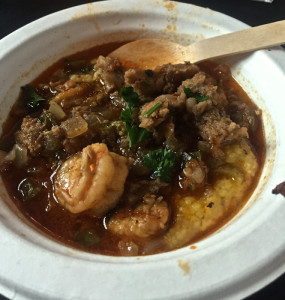
Alligator, shrimp and grits, down and dirty in New Orleans.

The adaptation of the Slow Fish 2016 continued Saturday at the Dryades Market, whose previous life had been a public school in Central City, another neighborhood steeped in diversity. Groups of concerned fishermen spoke about adequately addressing quotas and fairness issues and ways to promote local fisheries management. One common theme that emerged, perhaps prophetically, was the issue of adaptation.

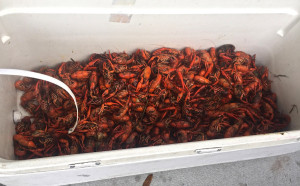
And of course crawfish. Deeper down, dirtier and delicious!
And of course, crawfish. Deeper down, dirtier and delicious!

Louisiana fishermen are constantly forced to adapt to changing ecosystem habitats, based on the chilling statistic that the coastline loses a football field of marsh every 45 minutes. Okanagan tribes have to adapt to the ebb and flow of wild sockeye migrating several hundred miles into incredibly diverse watersheds straddling the border between British Columbia and Washington state. Maine fishermen have to navigate the fluctuations in their fisheries due to the rapidly warming Gulf of Maine and the seemingly arbitrary nature of regional management.

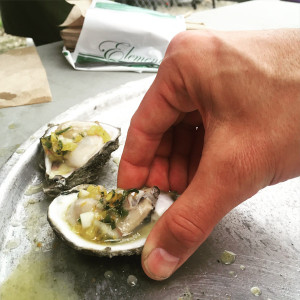
Two of about three hundred dozen oysters brought to the event.

Perhaps it was divinely appropriate that Mother Nature decided to throw a curveball and forced organizers to scramble. Because it is that instinct to go into auto pilot in the face of adversity and figure out a solution that determines success. For a Pacific salmon, that instinct to swim several hundred miles to its natal waters to spawn, die and give sustenance to its young is pure survival. For fishermen, it’s the ability to chase different available species when Nature or policy forces their hands. It’s in banding together to work toward a common cause to bring communities closer to their seafood.

Through all of the rain and high wind and last-minute venue changes, the shuttling of food from here to there…and back again, the audio-visual challenges, the taxis, carpools and long walks through a noisy French Quarter, Slow Fish 2016 attendees made connections. They found common ground. They discussed ways to organize, set goals and pursue them. They made friends.

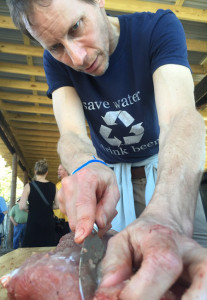
I learned some skills from Chef Zack Engel (chef de cuisine at Shaya Restaurant) and pit master Howard Conyers.

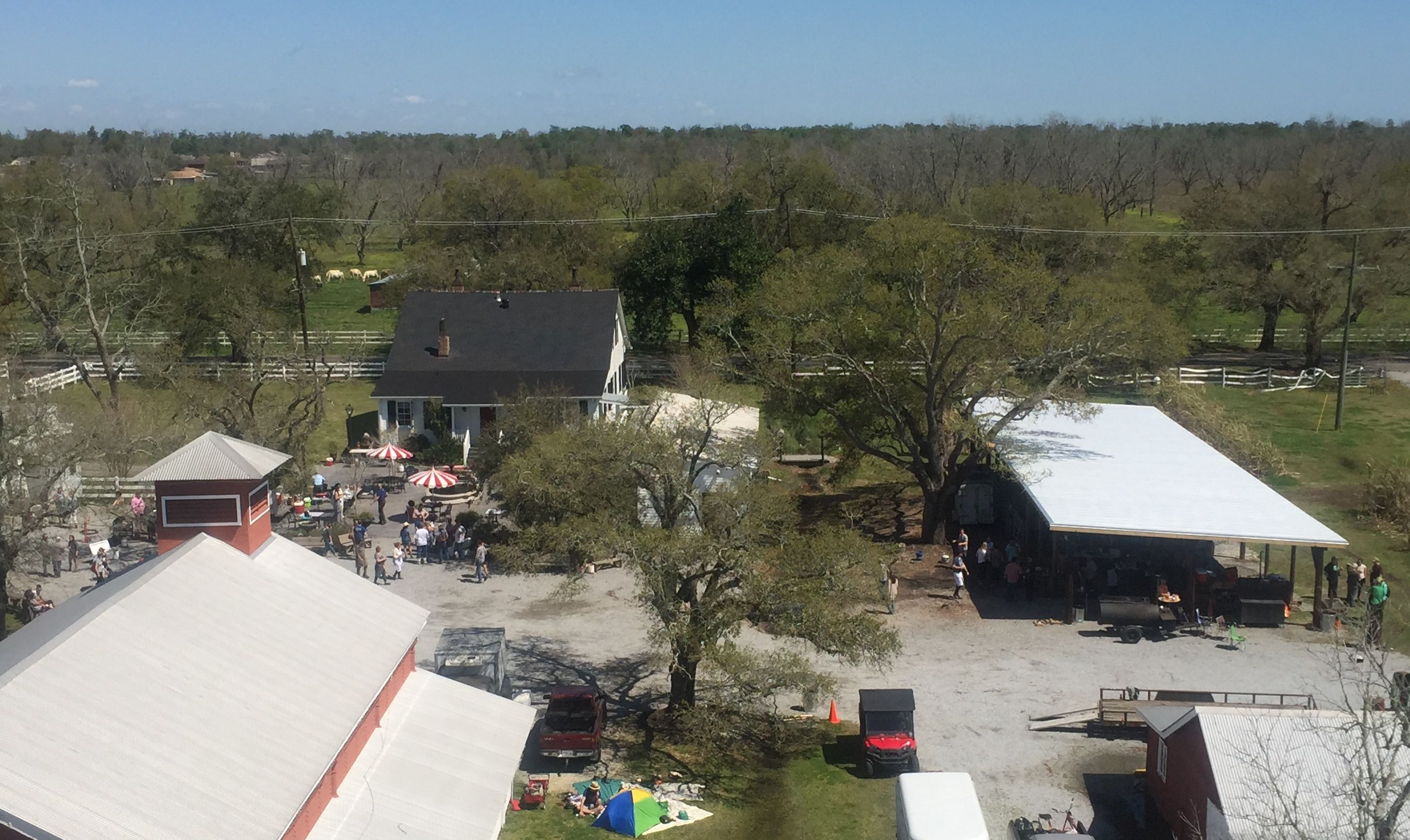
Perhaps the skies dawned on a warm,bluebird day on the tail end of the gathering at Docville Farm in Violet, La., a boucherie and seafood feast, as a reckoning of sorts. Adapt. Persevere. Hope. Something good will come out of it.

The memory of the food, the conversation, the energy and camaraderie will stay with all of us for a long time.


Posts pagination

1 … 4 5 6 7 8 9

Recent Posts

  • Hurricane Ida wreaks havoc on Louisiana’s seafood industry
  • EPA Should Use Clean Water Act To Kill Zombie Mine
  • Slow Fish 2021: Relationship Matters
  • Faith, Façades, and Futility
  • Pebble Permit Paused: Politics at Play

Archives

  • September 2021
  • August 2021
  • April 2021
  • December 2020
  • August 2020
  • June 2020
  • February 2020
  • December 2019
  • November 2019
  • October 2019
  • July 2019
  • May 2019
  • April 2019
  • March 2019
  • January 2019
  • December 2018
  • November 2018
  • June 2018
  • May 2018
  • March 2018
  • February 2018
  • January 2018
  • December 2017
  • November 2017
  • October 2017
  • September 2017
  • August 2017
  • July 2017
  • June 2017
  • May 2017
  • April 2017
  • March 2017
  • January 2017
  • December 2016
  • November 2016
  • October 2016
  • September 2016
  • August 2016
  • July 2016
  • June 2016
  • May 2016
  • April 2016
  • March 2016
  • February 2016
  • January 2016
  • December 2015
  • November 2015
  • October 2015
  • September 2015
  • July 2015
  • June 2015
  • May 2015
  • April 2015
  • March 2015
  • February 2015
  • January 2015
Theme by Colorlib Powered by WordPress