 All Blog Posts
Challenging Next-Gen Scientists

Call it irony.
Last week I was putting the finishing touches on a presentation about climate change impacts on seafood for two classes when I saw a news brief about how ocean acidification is spreading quickly in the western Arctic Ocean.
Specifically, a report from NOAA cited a new study showing how high acidity waters have spread more than 300 nautical miles almost to the North Pole and have increased in depth from 325 feet to 800 feet in the past 20 years. This rate of expansion is more than twice the global average, and it could harm mussel, clam and sea snail (food for salmon) populations.
So I had some fresh, relevant news to discuss with these students.
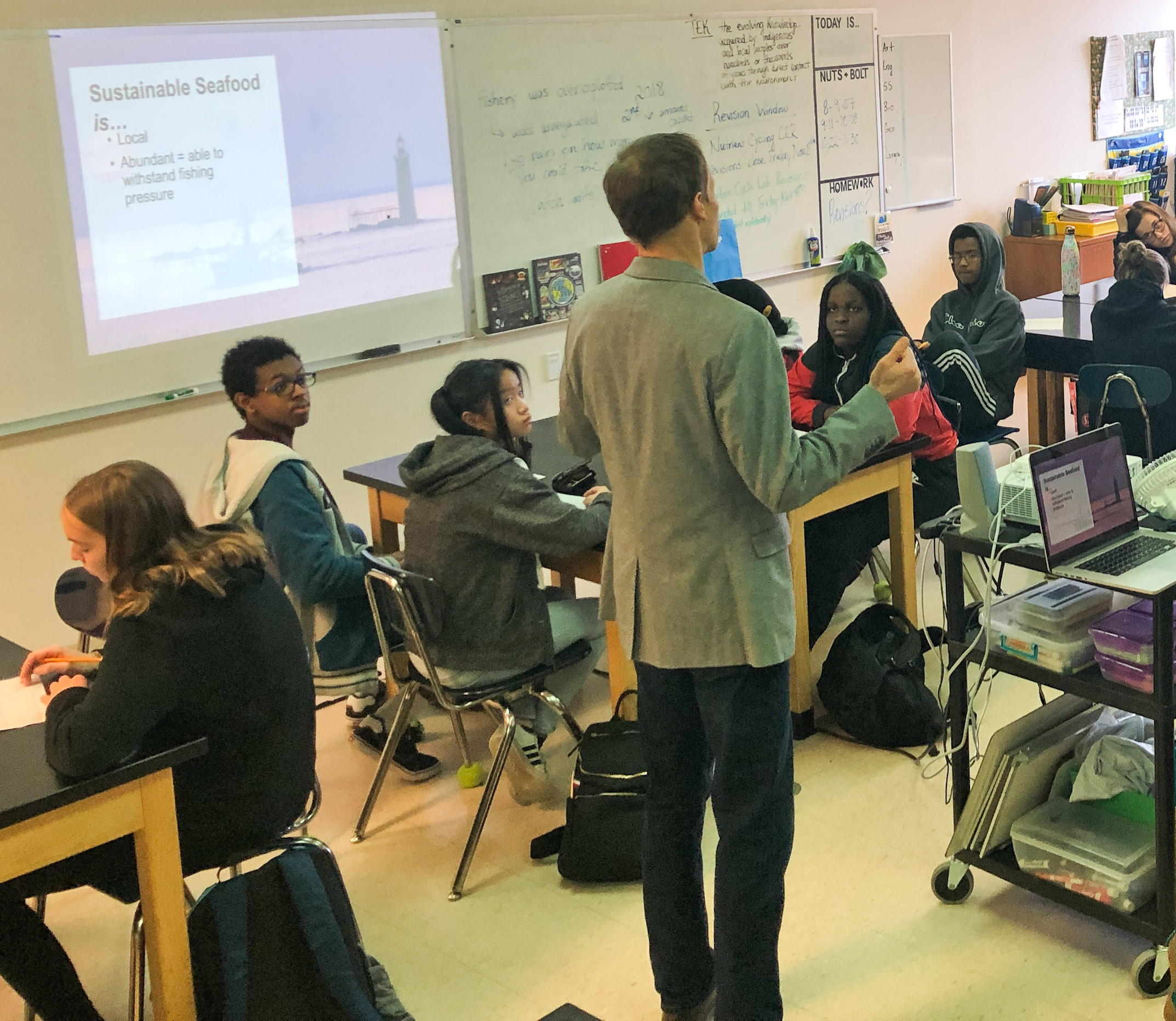
The classes were part of a statewide symposium bringing high school students interested in marine sciences to Salem State University. I was one of a dozen or so teachers speaking with students that day. I focused on four significant but interrelated climate factors that affect seafood webs in and around the Gulf of Maine: temperature increase, changes in current and salinity, and ocean acidification.
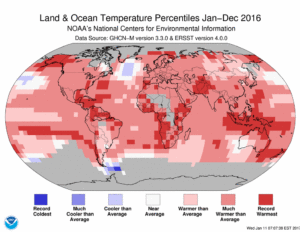
First, I briefly discussed seafood as an economic resource, and why we should care about where, when, how and by whom it was harvested. Next we talked about 2016 being the fifth year in a row for setting global land and ocean temperature records, and that the first 16 years of the 21st century are among the 17 warmest on record (138 years). We talked about how the Gulf of Maine is warming four times faster than 99% of the oceans on the planet.
Influential currents
Students asked questions about new research showing that some key currents in the Atlantic Ocean may be slowing down because of warming waters in the Arctic. The Atlantic Meridional Overturning Circulation or AMOC, (known as the ocean conveyor belt), drives global ocean currents and climates.
Scientists think that if warming continues, the collision of warm and cold water in the Arctic that drives the global currents could slow or even stall, eventually putting Europe in a deep freeze and baking the southern hemisphere. This could significantly change the number and intensity of Atlantic hurricanes and Pacific Monsoons.
It could also have major impacts on a wide swath of seafood in the Gulf of Maine. These types of temperature and current fluctuations dramatically affect salinity and ocean acidification. All of these changes can alter ecosystems, including spawning areas and timing, migration, plankton production (which is the base layer of the ecosystem) and predator-prey relationships.
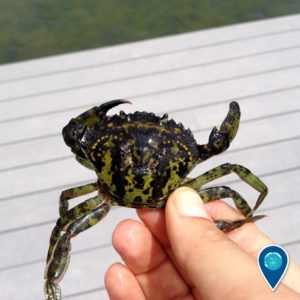
To drive the point home, I brought out some live green crabs. The students were all about hearing how the green crab can wipe out entire mini-ecosystems of eel grass as they root out mussels and clams to devour. They also learned about increasing efforts to determine how to best control green crab populations as they’ve become omnipresent in the Gulf of Maine as temperatures increase. Though they’ve been around since the early 1800s, they’ve become much more populous here because they have adapted to the seasonal temperature changes and they are prolific.
Throwing down a challenge
I ended the class with a challenge. I described discussions I’ve had with scientists on the forefront of the research on climate impacts on seafood … all leading to the same conclusion. We currently know a fair amount about the impacts of temperature, current, salinity and OA on different ecosystems. But we don’t have a real good, long-term, predictive view of how these (and other) factors work in concert to affect ecosystems and even specific species.
We need the next generation of scientists to help us find these answers. As Marcus Carson, lead scientist on the in-depth Arctic Resilience Report on climate change said, “It’s frustrating always being two or three steps behind climate change.”
We need bright minds to dive into the advanced geophysical, meteorological, metabolic and organic shifts climate change will impose on our marine ecosystems to help us better understand how to adapt to these changes. It’s unlikely we’ll fully stop climate change. But perhaps if we begin collectively cutting carbon emissions and planning ahead, we can slow it down enough for future scientists to help us better anticipate, rather than react to these changes. That’s how we take care of seafood as a resource.
So yes, the NOAA acidification report was timely, if a bit ironic … another unfortunate red flag that should serve as a call to arms.
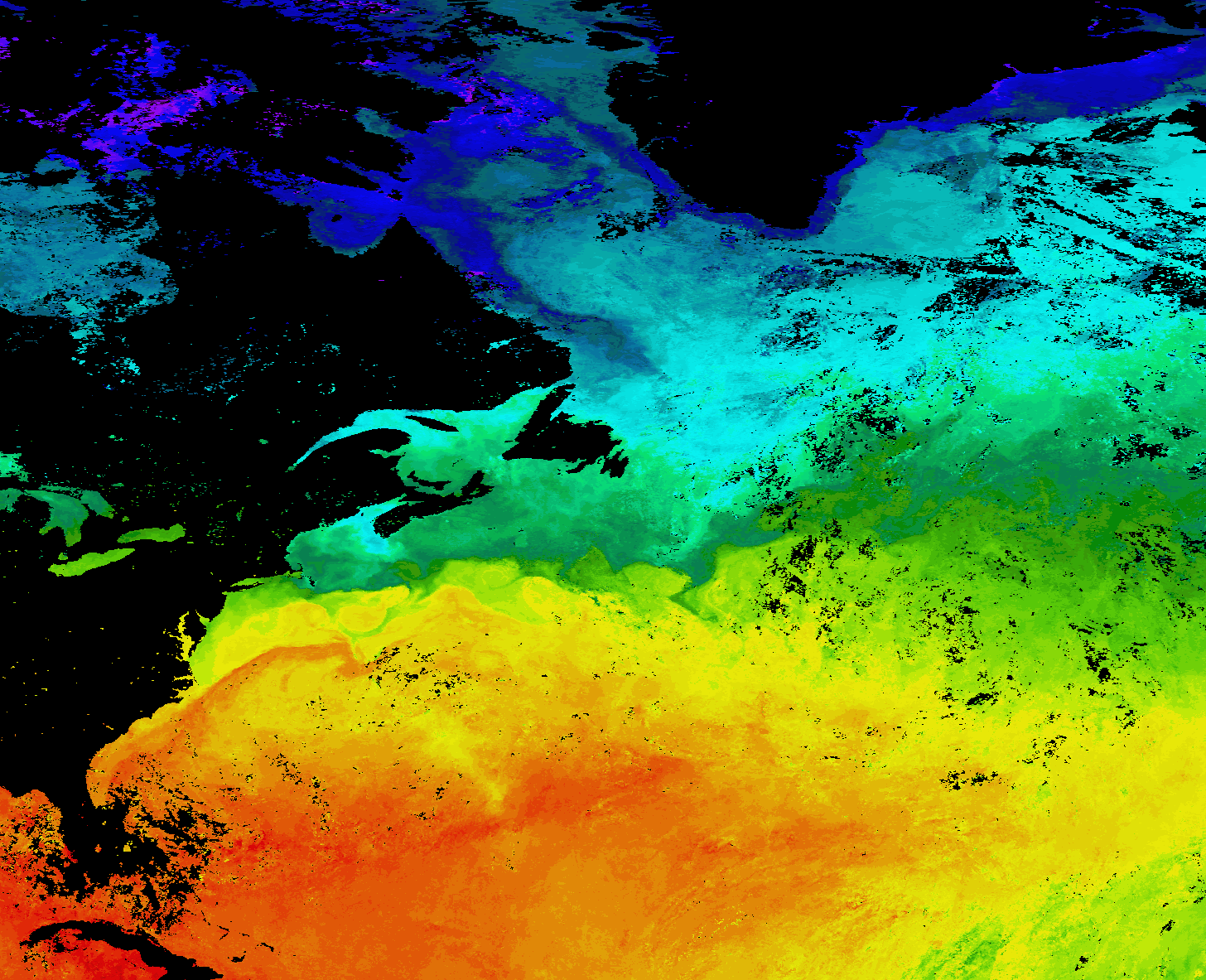
Top image credit: NASA spectroradiometer view of thermal variations in the Northwest Atlantic ocean. The warm Gulf Stream is the orange streak along the Eastern seaboard.