Skip to content
One Fish Foundation
  • Blog
    • Aquaculture
    • Education
    • Environment
    • Policy
    • Wild Harvest
    • Fish Tales
  • About
    • About One Fish
    • About Colles Stowell
  • Education
    • Elementary School
    • Middle School
    • High School
  • KNOW FISH Dinners®
  • Resources
    • One Fish Podcast
    • One Fish Foundation in the news
    • The 7 C’s of Sustainable Seafood
    • Newsletter Archive
    • Recipes
      • Skate with Capers and Butter — Chef Rizwan Ahmed
      • Grandma Davis’ Fish Chowder — Jane Almeida
      • Ginger Garlic Tamari Scallops — Colles Stowell
      • Fish Stock — Evan Mallett
      • Mussels San Remo — Chef Rob Martin
      • Salted Pollock Croquettes – Chef Mark Segal
  • Connect
    • Contact OneFish
    • Social
      • Instagram
      • Facebook
      • Twitter
All Blog Posts

One Seafood Conversation at a Time

  • November 14, 2018October 20, 2021
  • by Colles Stowell
Share it!
Share

One conversation at a time. That’s been my mantra for changing the seafood purchasing dynamic in the U.S. Whether I’m speaking with a 76-year-old retiree sporting a blue blazer, a group of AP Environmental Sciences students or a cluster of six-year-olds anxious to get their hands on some live green crabs.

The question comes up occasionally. “How do you keep your content fresh?” It’s a good question. A lot of the eye-popping statistics don’t move much year after year. More than 50% of the seafood we eat is farm raised, and 90% of the shrimp we eat is farm raised. The fact remains, sadly, that at least 90% of the seafood we eat here is imported. Some argue the percentage is actually 91 or 94. Either way, the number has not gone down, and it isn’t likely to change substantially in the next few years unless we have some significant policy changes.

For me, it’s not the numbers that change so much. It’s the people I’m speaking with that change. I want to democratize the message. Reach as many people as I can. Tell them the story. Answer their questions. And hopefully convince them to take those messages with them so they change their buying habits and spread the word.

Each new face or group of faces is an opportunity to spread that message. And I’ve found the most effective way to ensure the message resonates is to adapt the way I tell the story to the audience. So the method of the story telling changes too.

This varies dramatically between classrooms by age and subject and also between different restaurant demographics I may be engaging. I look at each new “audience” and venue as a challenge. How do I connect? How do I engage? How do I get them to own the conversation so they own their next seafood decision?
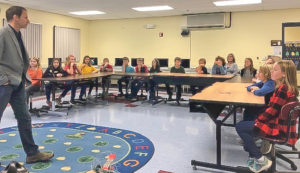
Rye Elementary fifth graders catching on quick that they have the power to ask smart seafood questions at restaurants and stores. Photo credit: Jennifer Halstead

I thought of these questions, as I always do, prior to a couple of school visits last month. Part of my preparation involves strategizing with the teacher beforehand about where the students are in their curriculum and what messaging would best fit with what they’ve learned or with what they will learn.

I’ve established relationships with several teachers who know what to expect. I still check in with them beforehand to make sure there aren’t any new messages they want me to introduce, or advise them of some new content or props (live mackerel, gear, etc.) One of these teachers is Doris Gianforte, a 5th grade science teacher at Rye Elementary School in New Hampshire.

As usual, when I met with her students, they were well prepared. They wanted to know more about why we import so much seafood, and why green crabs are such ecological monsters on this side of the Atlantic, and not in Europe. They couldn’t wait until they had the opportunity to ask questions at a restaurant.

Prior to my visit with 7th grade students at Harpswell Coastal Academy in Maine, I had a good discussion with their teacher Sarah Crockett. We talked about how they were in the middle of field lab work on green crabs in conjunction with an education program at Gulf of Maine Research Institute.

So we discussed introducing green crabs as a climate change marker, one that has implications for local ecosystems and shifting predator/prey relationships.

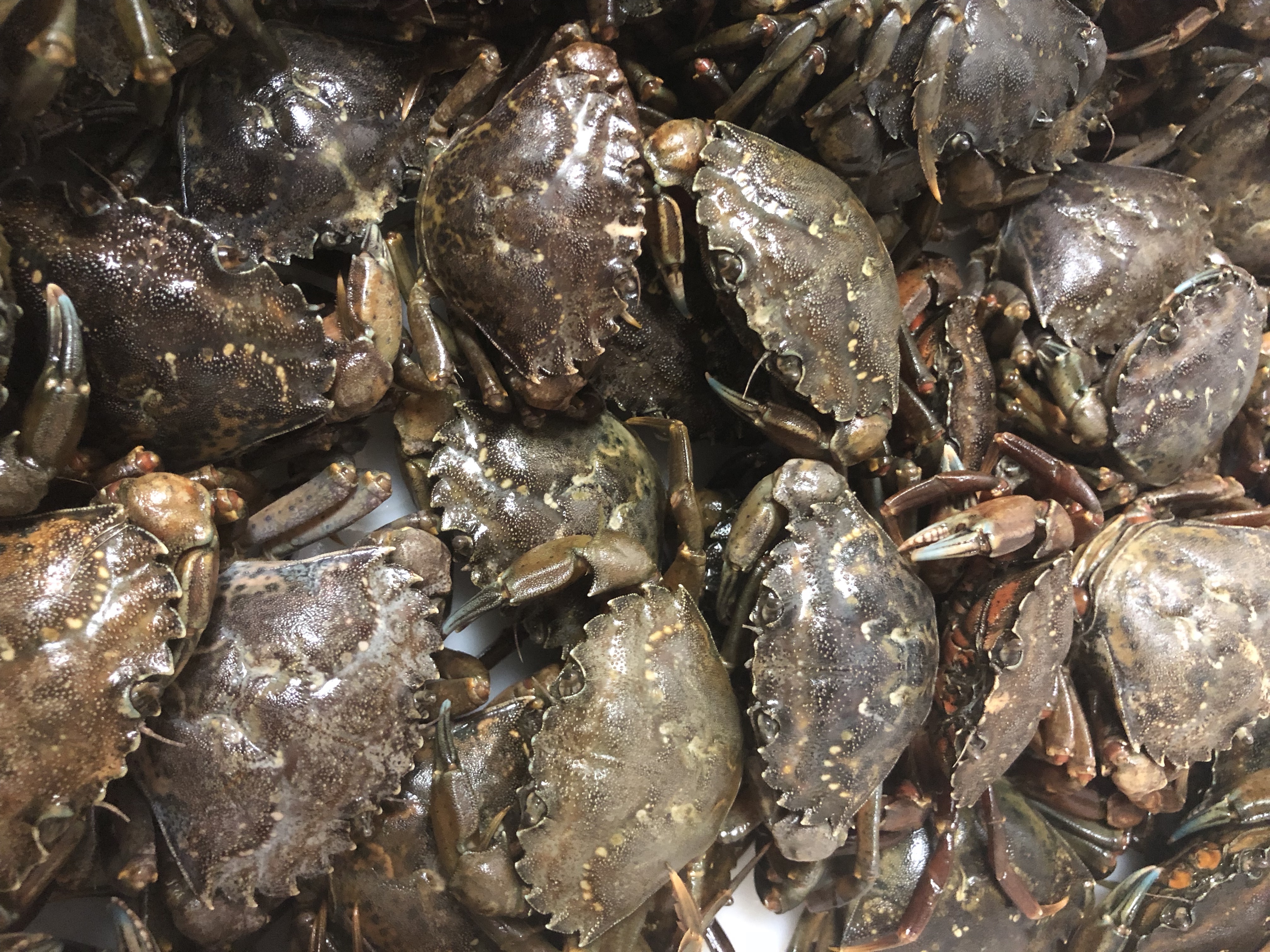
These students were also very well prepared, accurately talking about when and how European green crabs were introduced in US waters, what they like to eat and why they’re so destructive.
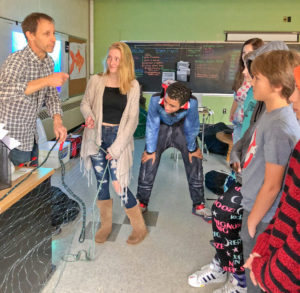
Harpswell Coastal Academy students learning about some measures to reduce gill net bycatch such as shorter soak times and acoustic pingers emitting signals to ward off marine mammals. Guess who didn’t get the memo about “Pajama Day.” Damn! Photo: Sarah Crockett

Students asked great questions about what fishermen and researchers are doing to minimize bycatch associated with different gear types. Like most students, getting their hands on some trawl net and a turtle excluder device helped them better understand efforts to reduce turtle bycatch in the Gulf of Mexico shrimp fishery as well as other fisheries.

These types of connections give me hope that change, real fundamental change, lies within the possibilities and ideas sparked by these conversations.

Even if it’s one at a time.


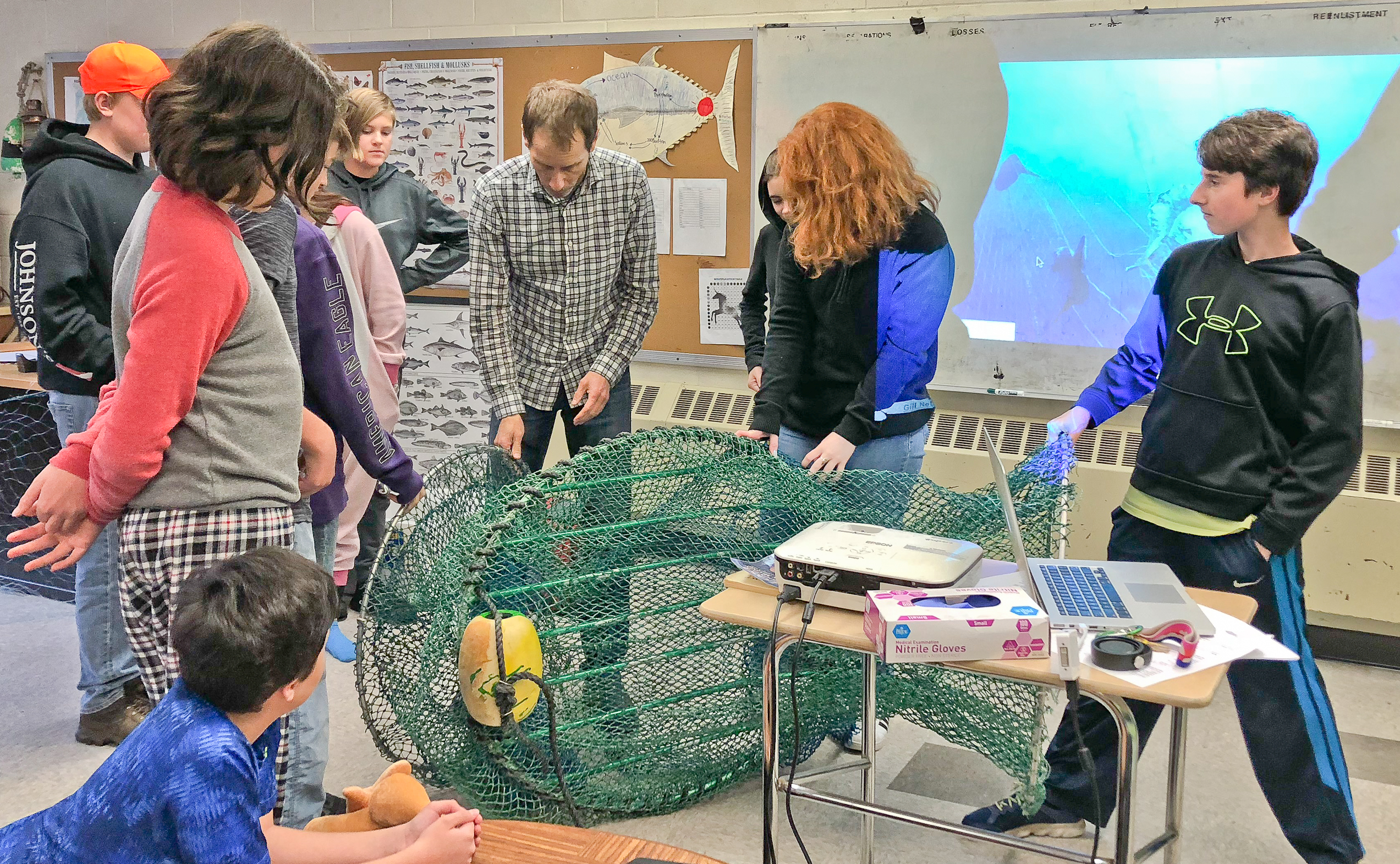
Top Photo: Harpswell Coastal Academy 7th graders getting their TED (turtle excluder device) talk on. Credit: Sarah Crockett
 

All Blog Posts

Attack of the Tiny Green Crabs

  • June 26, 2018October 20, 2021
  • by Colles Stowell
Share it!
Share

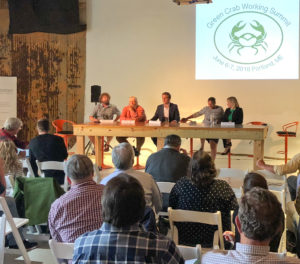
I geeked out at the Green Crab Summit in Portland earlier this month. Which is kind of ironic given that I double majored in English and French in college. I’ve always had a fascination with life in the oceans … just not enough to want to embrace organic chemistry in college or graduate work.

I parlayed my majors into a writing career that often drew on investigation to dig deeper into newspaper and magazine stories. The European Green Crab story is compelling. It’s also emblematic of humankind’s ability to alter natural balances with long-term negative consequences.

We’re working to nail down the timing of European Green Crabs here in the states. These soft shells were a delicacy at Enoteca Athena in Brunswick, Me. Photo: Marissa McMahan.

Abundant in Spain, France, Italy and other European countries, the green crab is not the frighteningly destructive, ecosystem-tipping species that it is here in North America. Many predators there like fish, crabs and birds help keep green crab populations in check. And Italian fish harvesters and chefs have figured out how to create a market for soft-shell Mediterranean green crabs (a slightly different species than the crabs we have here), as well as a top-dollar market for green crab as bait.


That’s not the case on this side of the Atlantic. The crabs were first officially documented between New Jersey and Cape Cod in 1817 after presumably hitchhiking aboard trans-Atlantic ships in the ballast. Their spread up the coast was steady and relatively uninhibited. To be sure, some were gobbled up by native species here such as striped bass, tautog, lobster, blue claw crabs and other species. But they weren’t and aren’t the regular diet for native species here as in Europe, and therefore they continue to spread.

Different story for other invasives, though. We’re now finding that the newly invasive Asian Shore Crab (first noted in 1988) seems to be displacing and possibly preying upon green crabs, dropping their populations significantly along rocky intertidal zones in Southern New England and heading northward as the water warms. However, we’re kind of swapping out one pest for another.

Christopher Baillie of the Marine Science Center at Northeastern University said Asian Shore Crabs are “generalist eaters” that may have an appetite for many native species such as lobsters, Jonah crabs and molluscs. While there are some Asian Shore Crabs already in Maine, he said they may be up here in bigger numbers in the near future. That’s not good considering they’re rampant in southern New England, where they’ve changed ecosystem balance by dominating once diverse habitats, with densities of up to 200 crabs per square meter.

Tough little buggers

Green crabs are tough, voracious, fertile and very hardy. They can live for days out of water. One crab can eat up to 40 mussels a day and lay 165,000 eggs a year. They are adapting to winter, which seems to be changing their spawning habits. They decimate vital eel grass beds while rooting out mussels, oysters and soft shell clams.

It’s the soft shell clams that have suffered the most at the claws of the green crabs. Casco Bay has witnessed a 70% drop in soft shell clam populations in the past decade. Maine’s landings have dropped from 8 million pounds in the 1970s to 1.5 million in 2016. Recent studies suggest that without significant steps to protect larval clams, 99% of the settling clams (the larval and growing stage molluscs) will fall to predation, and much of that comes from green crabs. Milky ribbon worms have also become a big problem.

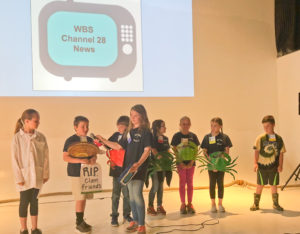
The news was even bleak on the West Bath School Channel 28 News, as students showcased what they’ve learned about green crabs…that they’re devastating to soft shell clams.

Adaptation will be central to protecting the soft shell clam industry and co-existing with green crabs, according to several researchers at the summit. As Sara Randall of the Downeast Institute put it, “We have to think of green crabs as a permanent part of our ecosystem. We need to be active, not passive.” Sara was part of a team of researchers that sifted through more than 34 tons of mud in a four-year study to determine what’s happening with soft shell clams and devise strategies such as protecting larval clams in screened boxes in tidal flats that would keep out green crabs.

However, as with everything concerning green crabs, it’s not that easy. Brian Beal has been studying green crabs and their impact on intertidal ecosystems for more than 30 years. A professor at the University of Maine at Machias, Brian has been outspoken about adapting to the new reality of green crabs and their impacts. “Population control is unlikely and impractical. They can’t be fished out,” he said, explaining that we’re talking about billions of organisms based on several trapping studies throughout the Gulf of Maine.

Commercial fisherman Jamie Bassett showing West Bath School students how to extract crab roe.

Green crab bisque, anyone?

One of the common discussion threads was finding ways to make humans the alpha green crab predator. How can we create culinary markets to make green crabs an attractive seafood choice? Again, it’s not so simple. First, their size means there’s little meat yield. And they’re built like tanks, so there’s a bunch of effort to get a small portion of meat.

Second, we Americans have a track record of following habit and price when making seafood decisions. This explains in part why 90% of the seafood we eat is imported. It’s cheaper and hews to menu selection we are most familiar with. Shrimp, salmon, tuna, etc. Collectively, we aren’t adventurous, and so, since we haven’t been eating green crabs for centuries, as they have in Italy (again the slightly different Mediterranean green crab), creating the marketing campaign to get us to start eating vast quantities of green crabs is a hard sell.

Chef Ali Waks-Adams laid down some green crab rangoon.

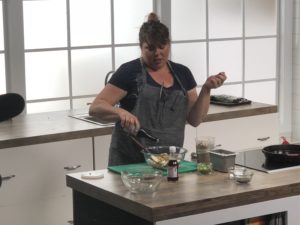
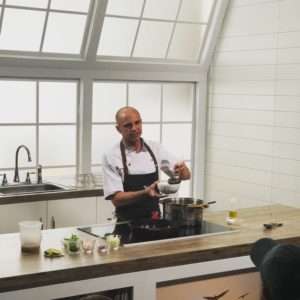
I know several chefs in coastal Maine and New Hampshire who are ready and willing to give it a go. Soft shell, stock, mixed in to other dishes. For example, at the event, Chef Ali Waks-Adams (executive chef at the Brunswick Inn) prepared delicious green crab Rangoon using mince (crabs that have been finely ground up, shell and all into a flavorful paste). She also demonstrated how to fry up the small crabs in a batter and eat them like popcorn. Chef Matt Louis (executive chef/owner of Moxy and The Franklin in Portsmouth, NH) created an inventive green crab pozoles dish and a delicately flavored green crab arancini. All of the food we sampled showed the tasty possibilities.

Chef Matt Louis using green crab for a pozoles, a traditional Mexican stew with hominy.

We still have a bit of research to do to nail down the soft shell season for green crabs. That’s because we don’t have the centuries of research the Italians do, and because the green crabs here seem to be adapting to the warming waters of the Gulf of Maine, which seems to be changing when they molt, or shed their old shells. Also, it’s easier to identify pre-molt Mediterranean green crabs than the species in the U.S.

Adapt or get run over

But even if we do create a viable market, we aren’t likely to make a huge dent in the green crab population. “The variability in density and mean size [of the crabs] will make it difficult to create a dependable fishery,” said Beal.

He also dropped another theory that raised several eyebrows. Clams aren’t just worried about the typically sized 3-inch or bigger crabs, but the 3 millimeter crabs feasting on clams that are half a millimeter in width. And it’s going to be damn hard to do much about those little s—s.

Beal agreed with others that adaption will be key, and we’re going to have to make some dramatic changes to the soft shell clam industry if we want to protect it. Some of his suggestions included increasing the amount of clam farming that now occurs, changing the size limit on clams to allow for the prime breeders to reproduce, and closing certain areas along the coast from May to July to allow for more productive spawning.

Some of the green crab brain trust discussing policy and other issues and how we need to continue to research and collaborate to better adapt to the new reality of Carcinus maenus.

We heard about one success in green crab mitigation in Canada from Gabrielle Beaulieu of Kejimkuik National Park Seaside Parks in Nova Scotia. She explained how a team of staff and citizen scientists harvested more than 2 million green crabs over a 10-year period. Following the intensive trapping and removal of the crabs, researchers noticed significant gains in eel grass recovery (in areas that crabs had mowed down) and soft shell clam populations.

Green crabs pose a significant threat to several commercially vital species in the Gulf of Maine. I agree with Brian Beale that putting a bounty on green crabs alone isn’t going to make a huge dent. However, I agree with others at the conference that we’re going to have to adapt, and implement a multi-pronged approach to mitigate the challenges. We’ll need to have some widespread harvest/green-crab-as-food markets opened up, along with raising public awareness both about the ecological threat and the culinary benefits of green crabs. We’re also going to have to take some significant steps as Brian mentioned to safeguard species like soft shell clams.

And yes, we need to devote more time, effort and financial resources to figuring out how to address this problem, and the looming time bomb of the Asian Shore Crabs. Knowledge is power … In this case, the power to adapt, rather than be overrun.


All Blog Posts

Students Teaching Students

  • May 24, 2018October 20, 2021
  • by Colles Stowell
Share it!
Share

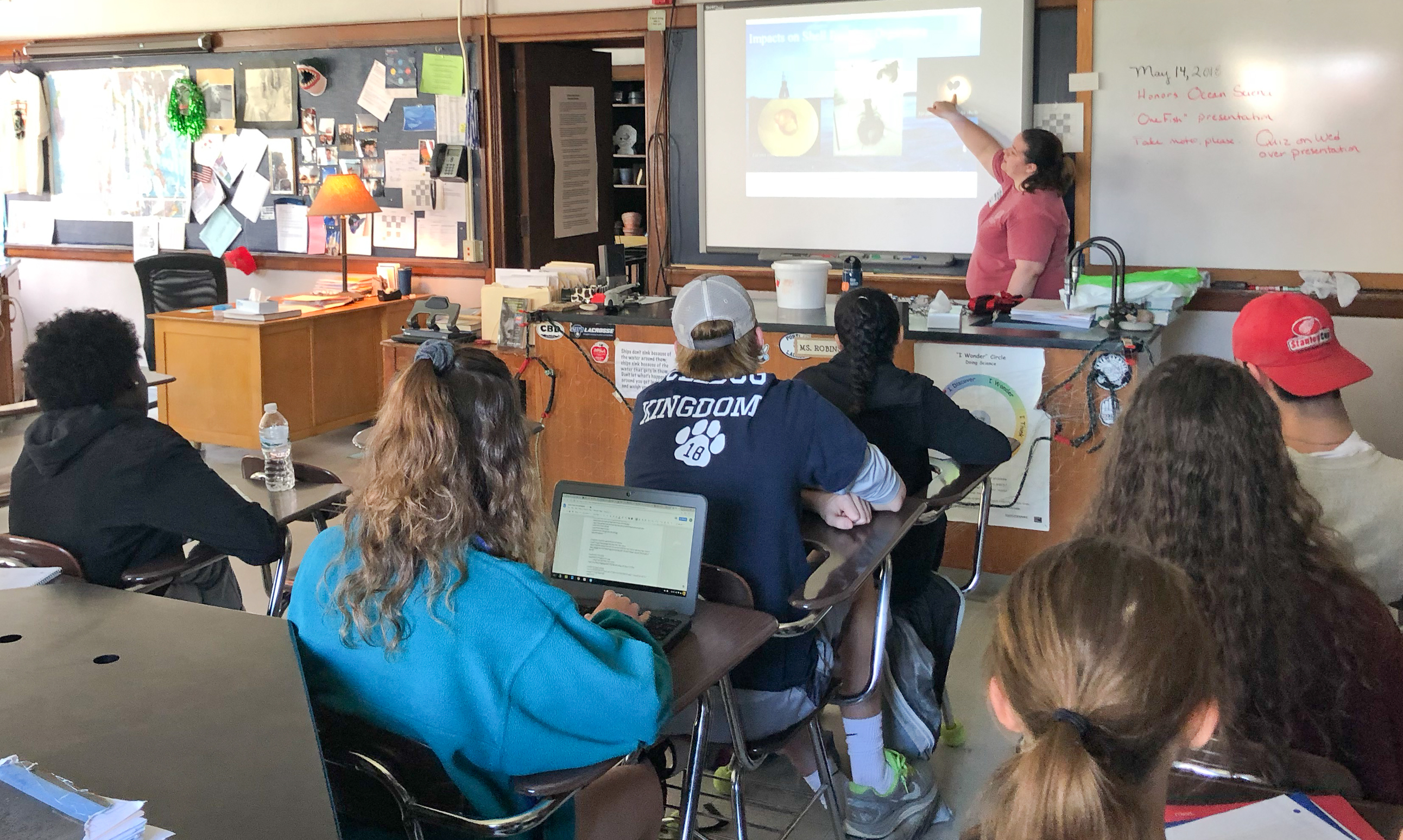
Last week, One Fish Foundation visited Portland High School for the third year in a row to discuss seafood sustainability with seniors taking a Marine Sciences course. Intern Jennifer Halstead, a senior at the University of New Hampshire, adeptly presented a clear, concise and digestible explanation of ocean acidification and how it is affecting cornerstone Gulf of Maine species like lobster and mussels. In this guest blog, Jennifer discusses the importance of taking advantage of opportunities to speak to students and community members about ocean acidification, other challenges our oceans face with climate change, and why we all need to be involved.

By Jennifer Halstead

Speaking to a crowd of people, no matter the size or demographic, can be at once daunting and rewarding, especially for a college student. Truly. It’s empowering to have people listen to your words. It’s uplifting to have them ask questions and even challenge your ideas.

Talking to a small class of students at Portland High School last week was no different. Ocean acidification (OA) is something that’s not easy to wrap your head around, but these students understood the urgency related to the issue. If at least one of them continues to ask questions and be curious, I feel as though I did my job.

Sadly, we don’t know how acidification is going to impact lobsters, one of the most important economic industries in Maine (the entire industry, including the supply chain is valued at over $1 billion). [Lobster harvests already face threats from the rapidly warming Gulf of Maine. A recent study suggests the lobster harvest could decline by as much as 62% by 2050 if the Gulf of Maine keeps warming at its current pace].

As concerned citizens and scientists, we need to start asking more questions and demanding more answers. And that is how we create change. The power is in your hands – our hands – to save oceans and our beloved lobster rolls.

I’ve spent a good portion of my college career learning about OA. Unfortunately, while our understanding of the impacts of OA is growing, OA is occurring more rapidly than we can keep up with in some places, including the Gulf of Maine. The West Coast has dealt with OA fallout, such as steep declines in oyster hatchery production in 2005, which threatened economics and 130 years of oyster hatchery history. In the Gulf of Maine, we haven’t seen complete devastation yet, but top scientists fear that it’s coming, and so do I.

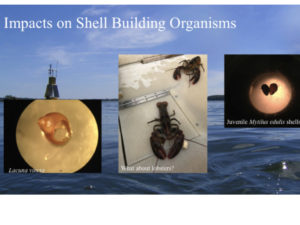
Part of Jennifer’s research on OA: a type of sea snail on the left, and blue mussel on the right. Both the sea snail and the half mussel shell you can almost see through (on the right) were exposed to acidic water. Increased acidity in the ocean weakens many shellfish’s capabilities to calcify their shells and protect themselves from disease. Credit: Jennifer Halstead.

We understand climate change impacts like OA, temperature, salinity, and currents, but not the details of how they interact and impact different species. We don’t understand the entire system. We only understand the pieces. Imagine trying to put a puzzle together with no idea what the end result is supposed to look like. That’s the immense challenge of trying to understand climate change impacts here in the Gulf of Maine and elsewhere; things are happening now that we won’t fully realize for several months, or even years.

To move forward and get research to catch up with the changes in the Gulf of Maine, we need the public’s interest and support. We need people to ask questions and demand answers. Spreading the word about these issues through presentations and hands-on demonstrations is a key piece to garnering support for these causes. Every time I stand in front of a group of people and talk to them about acidification, I can see us moving forward. Future generations are interested in problems, but even more interested in pushing for solutions.

As a college student, I often get asked where I see myself in 5 years, or what I want to do after I graduate. My broad answer is that I hope to be doing something to change the world for the better. To do that, I’ll keep standing in front of crowds of people, telling them about problems our oceans face, and asking for their help in saving them.

All Blog Posts

Getting Seafood Smart!

  • May 14, 2018October 20, 2021
  • by Colles Stowell
Share it!
Share

“What happens if you live in Kansas and you want sustainable seafood?” I get this question occasionally. Interestingly, Kansas seems to be the state most often cited. Perhaps it’s because it’s flat as a pancake and just about as far away from any coastline as any state in the union.

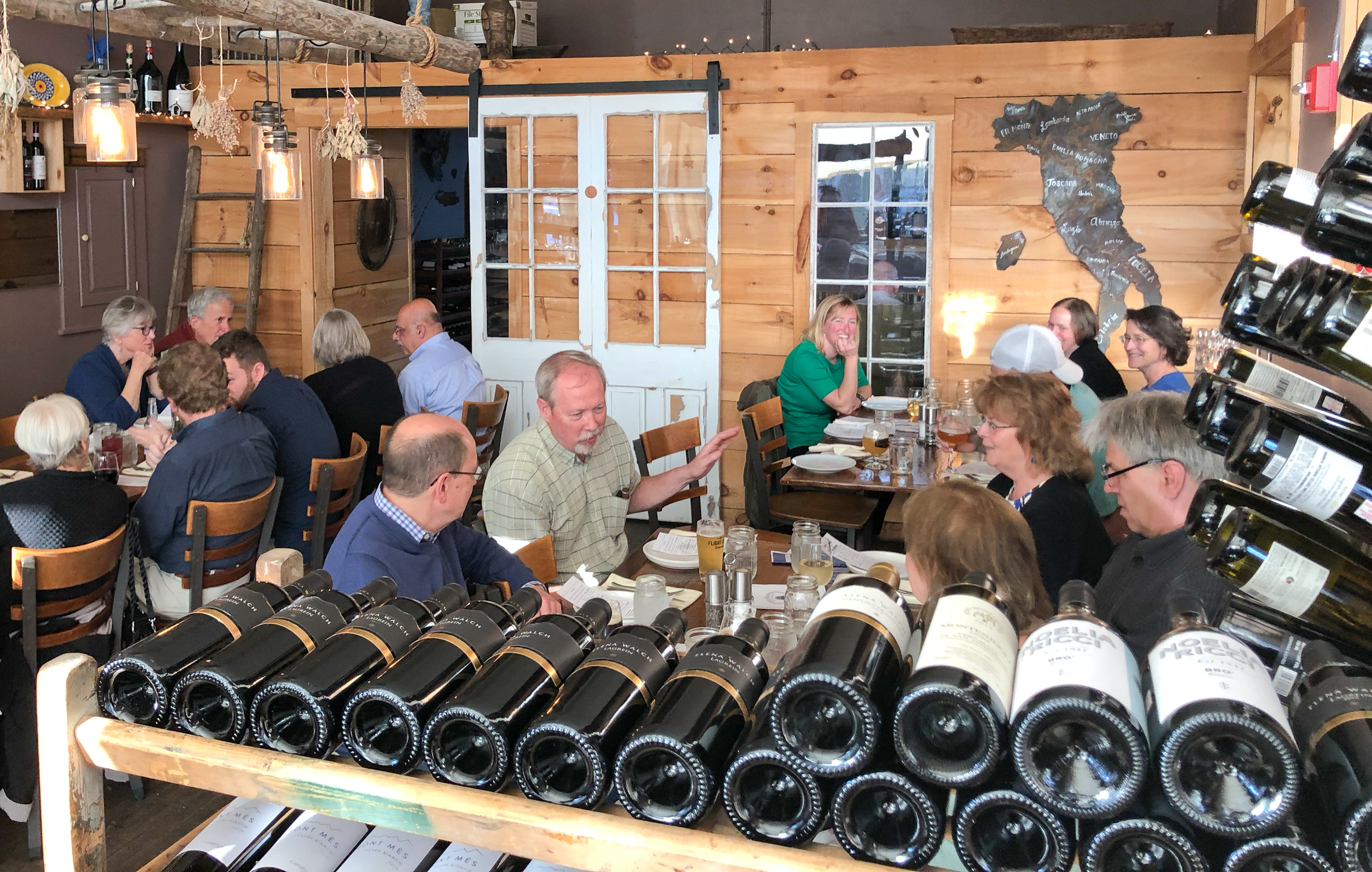
But, it’s a valid question, and one that came up Wednesday night at the latest KNOW FISH Dinner® at Enoteca Athena in Brunswick, Maine. This was the 10th in the series of events aimed at bringing communities together to meet the harvester who caught or grew the seafood they’re eating and learn more about why their choices matter. The question of knowing the story of your seafood permeated the discussion throughout the evening. We’ll return to that question in a bit.

Chef Tim O’Brien went above and beyond the call of duty by staying up until 2 a.m. that day figuring out the most efficient way to skin a couple dozen skate wings (think gloves, towels, a sharp knife and some strong language). This was part of the prep for a fabulous meal also featuring yellowtail flounder, haddock, European green crabs and oysters from Mook Sea Farm.

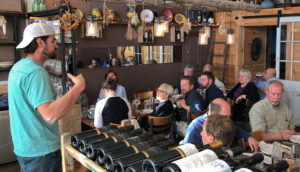
Jeff Auger talking about having the “Mookie Blues.” Credit: Steve Wyman

Jeff Auger of Mook Sea Farm talked about the long time between receiving spat (or seed) and growing oysters to market weight and the many variables, such as climate, that can affect the success of the process. As he spoke, we feasted on his Mookie Blues oysters from Damariscotta that Tim had fried perfectly and served with a spicy lemon aioli.

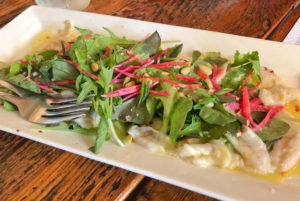
Tim emphasized the importance of local sourcing, or at least, knowing the source of the food he serves. He mentioned connections with different fish and shellfish providers and local distributors as we enjoyed delicately balanced yellowtail flounder ceviche (“cooked” in blood organge and balsamic vinegar) caught the day before by Capt. Tim Rider of New England Fishmongers. The flounder was served amid a crisp spring, palate-awakening salad of greens, chives watermelon radish and pine nuts.

Perfect spring-into-summer ceviche.

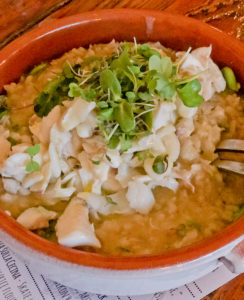
As we discussed getting seafood smart about underutilized species, we devoured a risotto made with green crab stock, green crab roe and haddock. European green crabs have been around the U.S. coast for almost 200 years, can eat up to 40 mussels a day and can produce up to 160,000 eggs a year. They destroy eelgrass beds while devouring larval mussels, clams and oysters.

Green crabs make an excellent stock. The roe and the roasted haddock made this risotto sing. Credit: Steve Wyman

So it was good to hear from Marissa McMahan of Manomet that a collaboration of researchers and fishermen are sorting out the soft shell timing of green crabs in hopes of creating a consumer market to eat the invasive species. An established market already exists in Italy. The stock and roe added a fabulous flavor to the risotto, which also featured roasted haddock and daikon radish. Excellent balance.

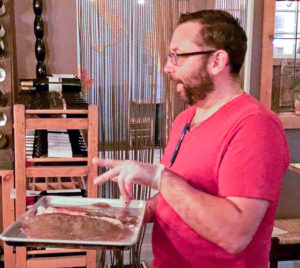
Risky move showing the before side of the skate story? Nah, it’s all part of getting to know your seafood. Chef Tim O’Brien describing the process and the benefits of this under-loved species.

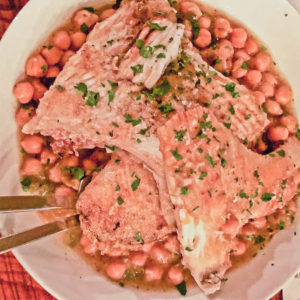
The last course was “Razza Sull Cecina”, the heretofore mentioned skate wing pan-seared with rice flour and finished atop cecina, which is an outstanding preparation of wine and butter braised chickpeas, leeks, garlic and black pepper. The skate was tender but flavorful with the cecina backdrop.


The skate may be a beast to skin, but it’s delicate and carried the flavor of the cecina very well. Credit: Steve Wyman

A fisherman’s tale

As we discussed the importance of knowing the story behind the seafood, I talked about Capt Tim Rider, who also provided the haddock and the skate for the dinner. He planned to attend the dinner and tell his story so people would have context behind the fish they were eating.

Sadly, he was unable to make it because he had to tow in a fellow rod-and-reel fisherman whose boat broke down offshore. New England Fishmongers forges close relationships with chefs to bring in fresh, properly handled seafood harvested in the Gulf of Maine. Capt. Tim and his crew often leave the dock at 1 a.m. and return late in the afternoon or in the evening, only to turn around and do it again. If someone is broken down out on the ocean, they help them out.

That is his story, and it’s the story of many fish harvesters. Knowing who caught your fish, when, where and how they caught it is great if you can discover that. Those of us fortunate enough to live around the Gulf of Maine live in the cradle of one of the seafood capitals of the world. We don’t have to work too hard to find fresh, locally harvested fish and shellfish, and the story behind it.

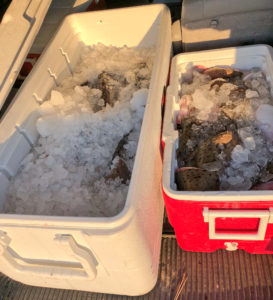
Fresh off the boats. The haddock came from Capt. Tim’s Finlander I in Porstmouth, NH, and the flounder and skate came from his Finlander II in Gloucester, Mass. All delivered to Chef Tim in Brunswick the night before.

Back to the question

Folks in Kansas? Not so much. So my answer to the question about what they can do stems from the premise behind One Fish Foundation: Know your seafood. I believe habit, driven by price is one of the main catalysts behind the astronomically high rate (90%!) of imported seafood in the US.

You want salmon for dinner in the Heartland? You go to your local Walmart or other chain, grab the salmon in the case and head for the checkout. You may even read the label and see that it was “all natural” and farm-raised “fresh” in Chile. And that may be all the information you need to make your decision to buy.

But it’s also all the information you need to give you pause. Suppose you knew that Chile salmon farming operations have the highest rate of antibiotics use, by far, of any country in the world. Even with all of that antibiotic use, Chile suffered a massive algal bloom in 2016 due to a confluence of environmental and management issues such as improper net pen siting and overcrowding. Twenty-four million fish died at a roughly $1 billion cost to the industry.

To get around the BIG hurdle of habit, we need to be having more of these conversations about why our choices matter. So yes, knowledge is power. For folks in Kansas, some knowledge could help them realize that even though they can’t get pollock right off the boat, they may be able to get some that has been caught domestically. The technology for frozen-at-sea products is such that the freshness of the fish or shellfish is preserved as if it had just come out of the water, if done properly. This was an enlightening discussion at Slow Fish 2018.

The US has some of the highest standards for food safety and fisheries management in the world. And if your local store doesn’t have anything that fits the bill, apply some pressure. It may take some time, but consistent pressure can change their buying policies.

Also see if there is some sort of community-supported fishery that may provide good, responsibly harvested domestic seafood. Like a CSA for farm produce, a CSF offers nearly direct from the boat fish delivered weekly (or whatever timeframe) for buying a share up front. Some operations provide this service in the heartland.

If price is a factor, look for a species that is abundant, and not salmon, tuna, cod, etc. Try cusk, for example. Also, some seafood counters offer the small pieces that can’t be sold alone at affordable prices. Cost can be the elephant in the room, particularly for those who may not be able to afford “sustainable seafood,” and it will be a topic for a future blog.

So the KNOW FISH Dinner at Enoteca was again a great discussion set to the backdrop of an outstanding meal prepared with locally harvested seafood with a compelling story behind it.

We’ll keep trying to change the import dynamic, one conversation at a time.

Stay tuned.


Top photo credit: Steve Wyman


All Blog Posts

Age Is Irrelevant: Our Seafood Choices Matter

  • April 24, 2017October 20, 2021
  • by Colles Stowell
Share it!
Share

Standing in a light misting rain at a chilly March for Science rally with my daughter on my shoulders, I marveled at the number of families in attendance. The scene struck a chord with me. Science has a story for everyone, regardless of race, sex, age, income, etc. It’s all in how the story is told, and our willingness to listen to it.

Early involvement! Photo credit: Jaime Stowell

This is true for my work with One Fish Foundation. Regardless of where I’m speaking, there is one constant. The age may change, but the overall message is the same: Our seafood choices matter.

I saw this writ large last week when I spoke to two groups of high school seniors about climate change impacts on seafood in the Gulf of Maine, and then spoke to four groups of elementary students the next morning. That I delivered the latter talks in French was just icing on the cake.

What keeps everyone’s attention is the ability to tell a story that resonates.

Seafood, as a hook for discussing climate change

I initially engaged Portland High School students in the discussion by getting them to tell me what type of seafood they liked. Then we talked about how some of that seafood was likely caught … or farmed and the implications. From bycatch to chemicals, the narrative opened their eyes … quite wide with some stats … as to why they should try and find out where, when, how and even by whom (if possible) their seafood was caught.

That led into a more involved discussion about how climate change impacts, such as warming water, ocean acidification, changes in current and salinity, affect the seafood we eat globally, domestically and regionally in the Gulf of Maine. We talked about the mystery surrounding the collapse of the Northern Shrimp fishery in 2012, and the race for scientists and fishermen to get answers. Right now, scientists believe the shrimp have a narrow comfort range, and that the increasing temperatures in the Gulf of Maine may be affecting everything from reproduction to eating habits.

Students also learned that we’re gaining more information every day about the effects of warming waters, increased ocean acidity (particularly on molluscs’ ability to calcify their shells) and how ocean currents and salinity are changing. But as one of the lead authors of the Arctic Resilience Report told me last fall, we still have a way to go before we understand in depth how disparate climate change factors work in concert to affect different ecosystems or species in those ecosystems.

I left the students pondering the notion that rather than trying to fix climate change (we can’t), we need to learn how to adapt. This means finding more ways to better predict and respond to these changes. It also means that on a personal level, we need to understand what we can do. Students learned they have the right to try and find out when, where and how their seafood was harvested (or farmed). They also learned they can be evangelists for the sustainable seafood message.

Hands-on…the crabs, the dead fish, the gear…

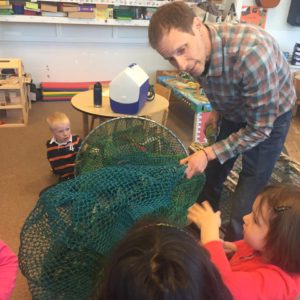
The younger the audience age, the more hands-on the discussion needs to be. So I hauled in a lobster trap, a turtle excluder device, some gillnet, live green crabs and a dead black seabass to L’Ecole Française Du Maine.

Turtle excluder devices are great conversation pieces…seriously. Photo credit: Elodie Le Nezet

I varied the message to accommodate students between ages 4 and 11. For the younger students we first talked about what seafood they liked before talking about the different methods for ensuring fishermen catch what they’re targeting so they can minimize bycatch. We talked about how a lobster trap works, how videos have shown lobsters can go in and out of these traps at will, and what it means when a lobsterman pulls up a trap filled with black sea bass.

We also used my daughter’s stuffed turtle to demonstrate how a turtle can escape being caught – and ultimately drowned in a trawl – by way of the grate used in a turtle excluder device. The primary message to them is that for the most part, fishermen want to take care of the resource, and that some capture methods are better than others at minimizing bycatch.

I extended that discussion with older students to include predator/prey relationships, and how things like bycatch or climate change are changing ecosystems in the Gulf of Maine. They loved seeing the green crabs up close as we discussed the devastation wrought on eelgrass beds as the crabs dig up clams, mussels and oysters.

All of the students wanted to touch the fish.

In the end, all of the students I spoke with last week, at Portland High School and L’Ecole Française Du Maine, began to understand that yes, where their seafood comes from and how it was harvested matters to them and the resource.


Top photo credit: Taylor Mason, College of the Atlantic

All Blog Posts

Challenging Next-Gen Scientists

  • March 21, 2017October 20, 2021
  • by Colles Stowell
Share it!
Share

Call it irony.

Last week I was putting the finishing touches on a presentation about climate change impacts on seafood for two classes when I saw a news brief about how ocean acidification is spreading quickly in the western Arctic Ocean.

Specifically, a report from NOAA cited a new study showing how high acidity waters have spread more than 300 nautical miles almost to the North Pole and have increased in depth from 325 feet to 800 feet in the past 20 years. This rate of expansion is more than twice the global average, and it could harm mussel, clam and sea snail (food for salmon) populations.

So I had some fresh, relevant news to discuss with these students.

The classes were part of a statewide symposium bringing high school students interested in marine sciences to Salem State University. I was one of a dozen or so teachers speaking with students that day. I focused on four significant but interrelated climate factors that affect seafood webs in and around the Gulf of Maine: temperature increase, changes in current and salinity, and ocean acidification.

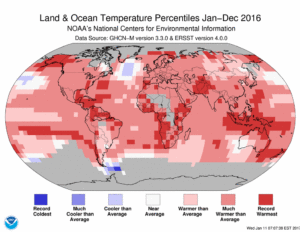
2016 was the warmest year on record. NOAA graphic

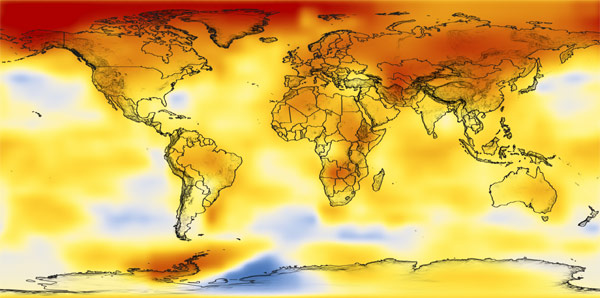
First, I briefly discussed seafood as an economic resource, and why we should care about where, when, how and by whom it was harvested. Next we talked about 2016 being the fifth year in a row for setting global land and ocean temperature records, and that the first 16 years of the 21st century are among the 17 warmest on record (138 years). We talked about how the Gulf of Maine is warming four times faster than 99% of the oceans on the planet.

Influential currents

Students asked questions about new research showing that some key currents in the Atlantic Ocean may be slowing down because of warming waters in the Arctic. The Atlantic Meridional Overturning Circulation or AMOC, (known as the ocean conveyor belt), drives global ocean currents and climates.

http://qkl.fa0.mwp.accessdomain.com/wp-content/uploads/2017/03/thermohaline_conveyor_30fps.mp4

Scientists think that if warming continues, the collision of warm and cold water in the Arctic that drives the global currents could slow or even stall, eventually putting Europe in a deep freeze and baking the southern hemisphere. This could significantly change the number and intensity of Atlantic hurricanes and Pacific Monsoons.

It could also have major impacts on a wide swath of seafood in the Gulf of Maine. These types of temperature and current fluctuations dramatically affect salinity and ocean acidification. All of these changes can alter ecosystems, including spawning areas and timing, migration, plankton production (which is the base layer of the ecosystem) and predator-prey relationships.

NOAA photo

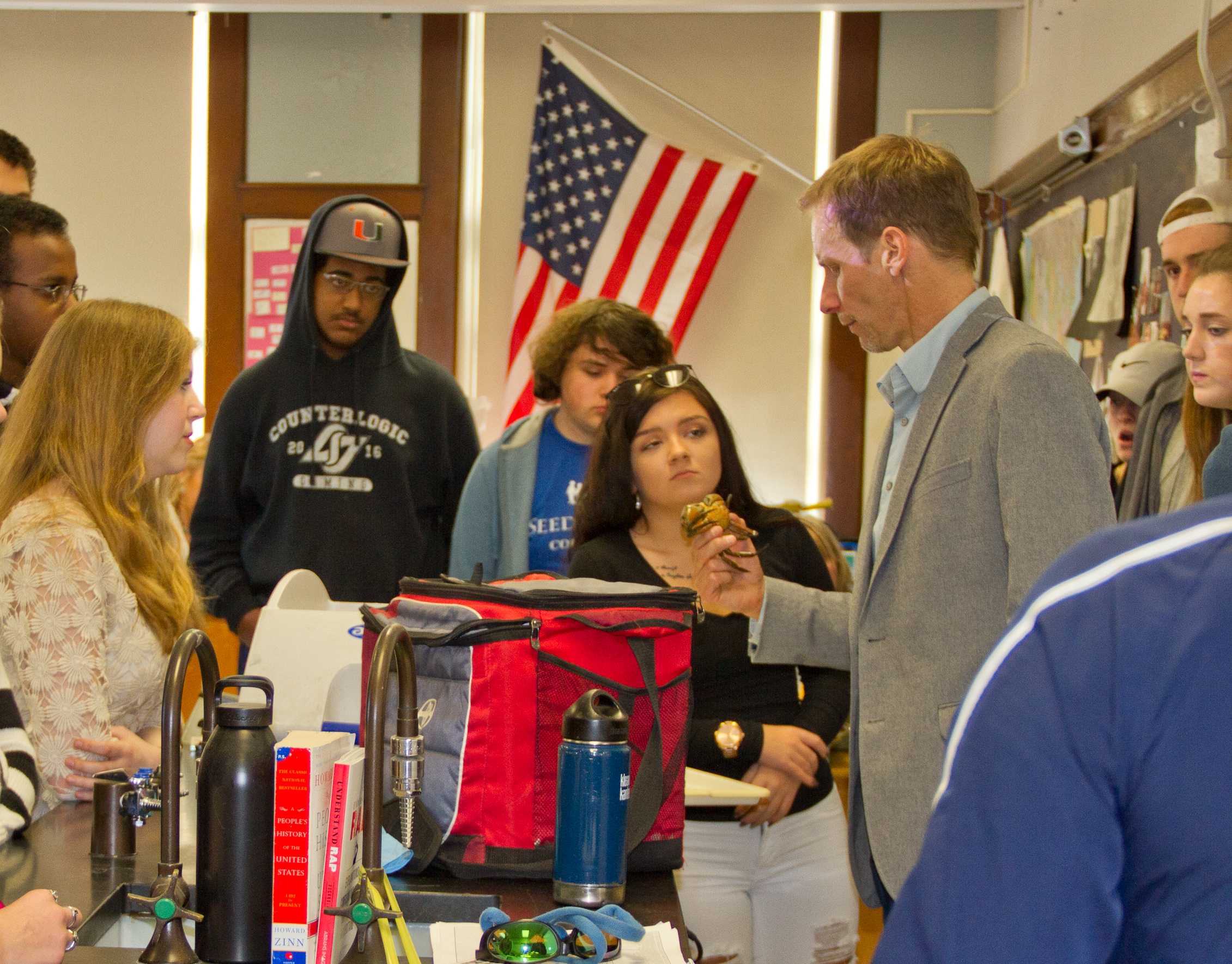
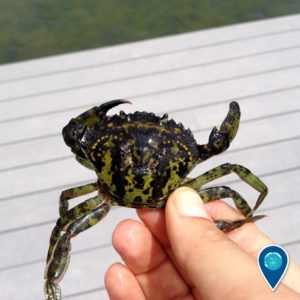
To drive the point home, I brought out some live green crabs. The students were all about hearing how the green crab can wipe out entire mini-ecosystems of eel grass as they root out mussels and clams to devour. They also learned about increasing efforts to determine how to best control green crab populations as they’ve become omnipresent in the Gulf of Maine as temperatures increase. Though they’ve been around since the early 1800s, they’ve become much more populous here because they have adapted to the seasonal temperature changes and they are prolific.

Throwing down a challenge

I ended the class with a challenge. I described discussions I’ve had with scientists on the forefront of the research on climate impacts on seafood … all leading to the same conclusion. We currently know a fair amount about the impacts of temperature, current, salinity and OA on different ecosystems. But we don’t have a real good, long-term, predictive view of how these (and other) factors work in concert to affect ecosystems and even specific species.

We need the next generation of scientists to help us find these answers. As Marcus Carson, lead scientist on the in-depth Arctic Resilience Report on climate change said, “It’s frustrating always being two or three steps behind climate change.”

We need bright minds to dive into the advanced geophysical, meteorological, metabolic and organic shifts climate change will impose on our marine ecosystems to help us better understand how to adapt to these changes. It’s unlikely we’ll fully stop climate change. But perhaps if we begin collectively cutting carbon emissions and planning ahead, we can slow it down enough for future scientists to help us better anticipate, rather than react to these changes. That’s how we take care of seafood as a resource.

So yes, the NOAA acidification report was timely, if a bit ironic … another unfortunate red flag that should serve as a call to arms.


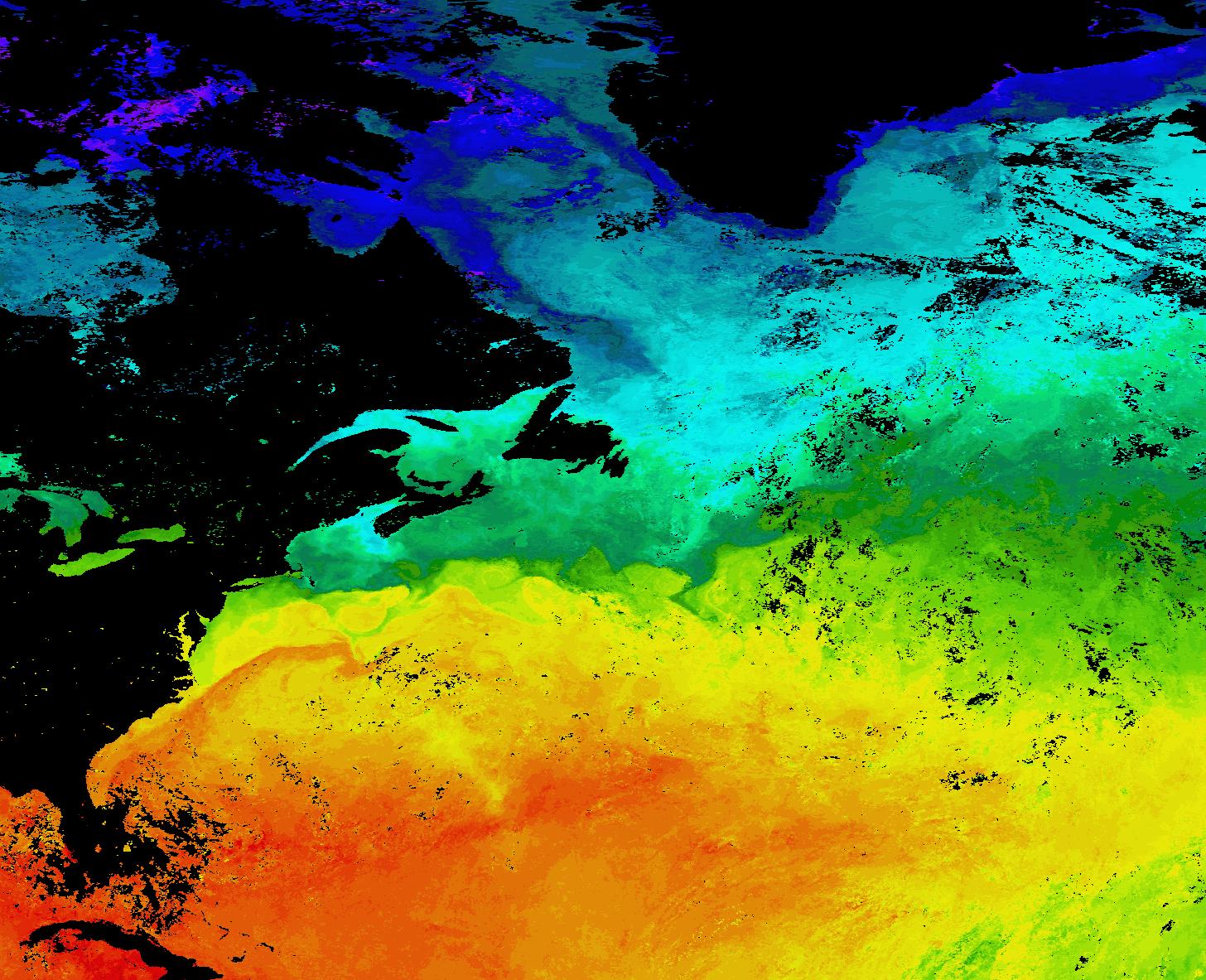
Top image credit: NASA spectroradiometer view of thermal variations in the Northwest Atlantic ocean. The warm Gulf Stream is the orange streak along the Eastern seaboard.


All Blog Posts

Rising Temperatures Raising Global Warming Alarms

  • January 28, 2016October 20, 2021
  • by Colles Stowell
Share it!
Share

Summers in New Orleans can all but suffocate the uninitiated. The heat and humidity in August make a five block walk feel like a five mile run in normal conditions. The last time I experienced it for any length of time was in 1985, when I rode the streetcar to and from downtown for a summer job as an accounting clerk. After a couple of days of showing up drenched in my suit and tie, I began tucking my office clothes in a backpack and wearing shorts for the commute. Read more “Rising Temperatures Raising Global Warming Alarms” →

Recent Posts

  • Hurricane Ida wreaks havoc on Louisiana’s seafood industry
  • EPA Should Use Clean Water Act To Kill Zombie Mine
  • Slow Fish 2021: Relationship Matters
  • Faith, Façades, and Futility
  • Pebble Permit Paused: Politics at Play

Archives

  • September 2021
  • August 2021
  • April 2021
  • December 2020
  • August 2020
  • June 2020
  • February 2020
  • December 2019
  • November 2019
  • October 2019
  • July 2019
  • May 2019
  • April 2019
  • March 2019
  • January 2019
  • December 2018
  • November 2018
  • June 2018
  • May 2018
  • March 2018
  • February 2018
  • January 2018
  • December 2017
  • November 2017
  • October 2017
  • September 2017
  • August 2017
  • July 2017
  • June 2017
  • May 2017
  • April 2017
  • March 2017
  • January 2017
  • December 2016
  • November 2016
  • October 2016
  • September 2016
  • August 2016
  • July 2016
  • June 2016
  • May 2016
  • April 2016
  • March 2016
  • February 2016
  • January 2016
  • December 2015
  • November 2015
  • October 2015
  • September 2015
  • July 2015
  • June 2015
  • May 2015
  • April 2015
  • March 2015
  • February 2015
  • January 2015
Theme by Colorlib Powered by WordPress