Skip to content
One Fish Foundation
  • Blog
    • Aquaculture
    • Education
    • Environment
    • Policy
    • Wild Harvest
    • Fish Tales
  • About
    • About One Fish
    • About Colles Stowell
  • Education
    • Elementary School
    • Middle School
    • High School
  • KNOW FISH Dinners®
  • Resources
    • One Fish Podcast
    • One Fish Foundation in the news
    • The 7 C’s of Sustainable Seafood
    • Newsletter Archive
    • Recipes
      • Skate with Capers and Butter — Chef Rizwan Ahmed
      • Grandma Davis’ Fish Chowder — Jane Almeida
      • Ginger Garlic Tamari Scallops — Colles Stowell
      • Fish Stock — Evan Mallett
      • Mussels San Remo — Chef Rob Martin
      • Salted Pollock Croquettes – Chef Mark Segal
  • Connect
    • Contact OneFish
    • Social
      • Instagram
      • Facebook
      • Twitter
All Blog Posts

Students Teaching Students

  • May 24, 2018October 20, 2021
  • by Colles Stowell
Share it!
Share

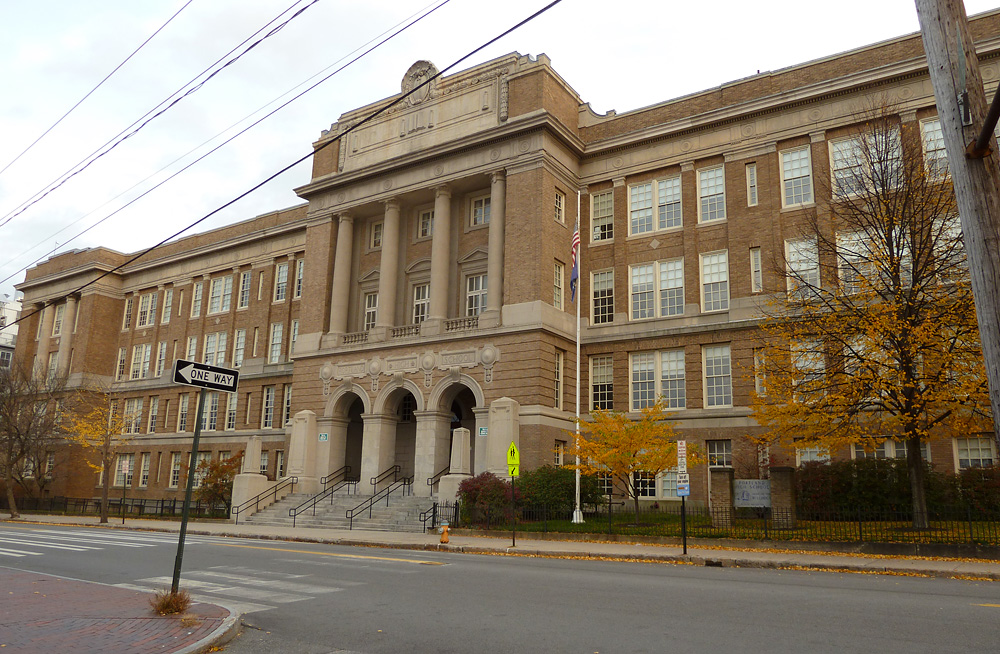
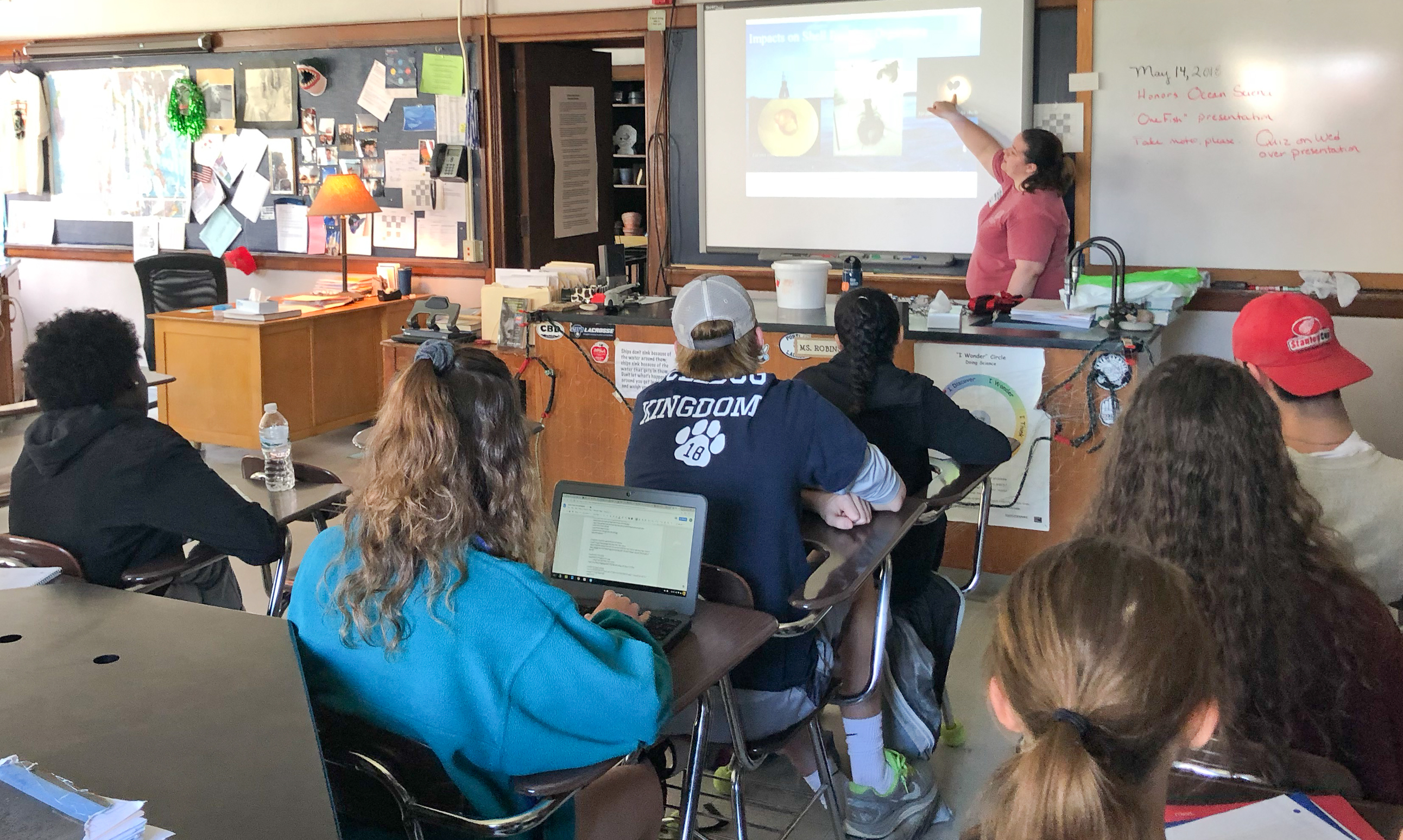
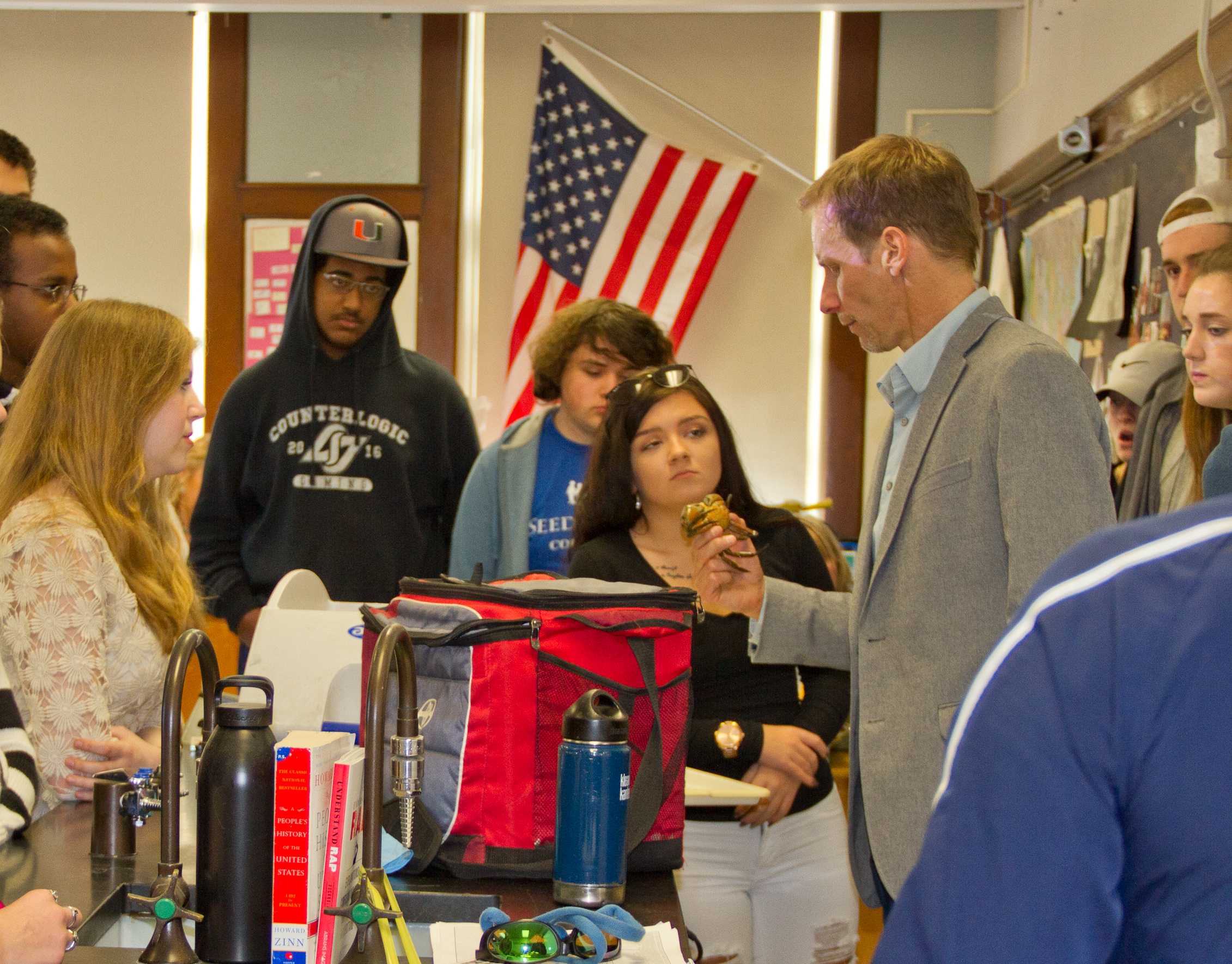
Last week, One Fish Foundation visited Portland High School for the third year in a row to discuss seafood sustainability with seniors taking a Marine Sciences course. Intern Jennifer Halstead, a senior at the University of New Hampshire, adeptly presented a clear, concise and digestible explanation of ocean acidification and how it is affecting cornerstone Gulf of Maine species like lobster and mussels. In this guest blog, Jennifer discusses the importance of taking advantage of opportunities to speak to students and community members about ocean acidification, other challenges our oceans face with climate change, and why we all need to be involved.

By Jennifer Halstead

Speaking to a crowd of people, no matter the size or demographic, can be at once daunting and rewarding, especially for a college student. Truly. It’s empowering to have people listen to your words. It’s uplifting to have them ask questions and even challenge your ideas.

Talking to a small class of students at Portland High School last week was no different. Ocean acidification (OA) is something that’s not easy to wrap your head around, but these students understood the urgency related to the issue. If at least one of them continues to ask questions and be curious, I feel as though I did my job.

Sadly, we don’t know how acidification is going to impact lobsters, one of the most important economic industries in Maine (the entire industry, including the supply chain is valued at over $1 billion). [Lobster harvests already face threats from the rapidly warming Gulf of Maine. A recent study suggests the lobster harvest could decline by as much as 62% by 2050 if the Gulf of Maine keeps warming at its current pace].

As concerned citizens and scientists, we need to start asking more questions and demanding more answers. And that is how we create change. The power is in your hands – our hands – to save oceans and our beloved lobster rolls.

I’ve spent a good portion of my college career learning about OA. Unfortunately, while our understanding of the impacts of OA is growing, OA is occurring more rapidly than we can keep up with in some places, including the Gulf of Maine. The West Coast has dealt with OA fallout, such as steep declines in oyster hatchery production in 2005, which threatened economics and 130 years of oyster hatchery history. In the Gulf of Maine, we haven’t seen complete devastation yet, but top scientists fear that it’s coming, and so do I.
Part of Jennifer’s research on OA: a type of sea snail on the left, and blue mussel on the right. Both the sea snail and the half mussel shell you can almost see through (on the right) were exposed to acidic water. Increased acidity in the ocean weakens many shellfish’s capabilities to calcify their shells and protect themselves from disease. Credit: Jennifer Halstead.

We understand climate change impacts like OA, temperature, salinity, and currents, but not the details of how they interact and impact different species. We don’t understand the entire system. We only understand the pieces. Imagine trying to put a puzzle together with no idea what the end result is supposed to look like. That’s the immense challenge of trying to understand climate change impacts here in the Gulf of Maine and elsewhere; things are happening now that we won’t fully realize for several months, or even years.

To move forward and get research to catch up with the changes in the Gulf of Maine, we need the public’s interest and support. We need people to ask questions and demand answers. Spreading the word about these issues through presentations and hands-on demonstrations is a key piece to garnering support for these causes. Every time I stand in front of a group of people and talk to them about acidification, I can see us moving forward. Future generations are interested in problems, but even more interested in pushing for solutions.

As a college student, I often get asked where I see myself in 5 years, or what I want to do after I graduate. My broad answer is that I hope to be doing something to change the world for the better. To do that, I’ll keep standing in front of crowds of people, telling them about problems our oceans face, and asking for their help in saving them.
All Blog Posts

Age Is Irrelevant: Our Seafood Choices Matter

  • April 24, 2017October 20, 2021
  • by Colles Stowell
Share it!
Share

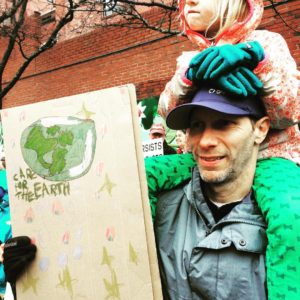
Standing in a light misting rain at a chilly March for Science rally with my daughter on my shoulders, I marveled at the number of families in attendance. The scene struck a chord with me. Science has a story for everyone, regardless of race, sex, age, income, etc. It’s all in how the story is told, and our willingness to listen to it.

Early involvement! Photo credit: Jaime Stowell

This is true for my work with One Fish Foundation. Regardless of where I’m speaking, there is one constant. The age may change, but the overall message is the same: Our seafood choices matter.

I saw this writ large last week when I spoke to two groups of high school seniors about climate change impacts on seafood in the Gulf of Maine, and then spoke to four groups of elementary students the next morning. That I delivered the latter talks in French was just icing on the cake.

What keeps everyone’s attention is the ability to tell a story that resonates.

Seafood, as a hook for discussing climate change

I initially engaged Portland High School students in the discussion by getting them to tell me what type of seafood they liked. Then we talked about how some of that seafood was likely caught … or farmed and the implications. From bycatch to chemicals, the narrative opened their eyes … quite wide with some stats … as to why they should try and find out where, when, how and even by whom (if possible) their seafood was caught.

That led into a more involved discussion about how climate change impacts, such as warming water, ocean acidification, changes in current and salinity, affect the seafood we eat globally, domestically and regionally in the Gulf of Maine. We talked about the mystery surrounding the collapse of the Northern Shrimp fishery in 2012, and the race for scientists and fishermen to get answers. Right now, scientists believe the shrimp have a narrow comfort range, and that the increasing temperatures in the Gulf of Maine may be affecting everything from reproduction to eating habits.

Students also learned that we’re gaining more information every day about the effects of warming waters, increased ocean acidity (particularly on molluscs’ ability to calcify their shells) and how ocean currents and salinity are changing. But as one of the lead authors of the Arctic Resilience Report told me last fall, we still have a way to go before we understand in depth how disparate climate change factors work in concert to affect different ecosystems or species in those ecosystems.

I left the students pondering the notion that rather than trying to fix climate change (we can’t), we need to learn how to adapt. This means finding more ways to better predict and respond to these changes. It also means that on a personal level, we need to understand what we can do. Students learned they have the right to try and find out when, where and how their seafood was harvested (or farmed). They also learned they can be evangelists for the sustainable seafood message.

Hands-on…the crabs, the dead fish, the gear…

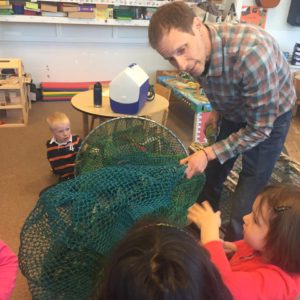
The younger the audience age, the more hands-on the discussion needs to be. So I hauled in a lobster trap, a turtle excluder device, some gillnet, live green crabs and a dead black seabass to L’Ecole Française Du Maine.

Turtle excluder devices are great conversation pieces…seriously. Photo credit: Elodie Le Nezet

I varied the message to accommodate students between ages 4 and 11. For the younger students we first talked about what seafood they liked before talking about the different methods for ensuring fishermen catch what they’re targeting so they can minimize bycatch. We talked about how a lobster trap works, how videos have shown lobsters can go in and out of these traps at will, and what it means when a lobsterman pulls up a trap filled with black sea bass.

We also used my daughter’s stuffed turtle to demonstrate how a turtle can escape being caught – and ultimately drowned in a trawl – by way of the grate used in a turtle excluder device. The primary message to them is that for the most part, fishermen want to take care of the resource, and that some capture methods are better than others at minimizing bycatch.

I extended that discussion with older students to include predator/prey relationships, and how things like bycatch or climate change are changing ecosystems in the Gulf of Maine. They loved seeing the green crabs up close as we discussed the devastation wrought on eelgrass beds as the crabs dig up clams, mussels and oysters.

All of the students wanted to touch the fish.

In the end, all of the students I spoke with last week, at Portland High School and L’Ecole Française Du Maine, began to understand that yes, where their seafood comes from and how it was harvested matters to them and the resource.


Top photo credit: Taylor Mason, College of the Atlantic

All Blog Posts

Student Questions Spark Hope For Fisheries Answers

  • May 18, 2016October 20, 2021
  • by Colles Stowell
Share it!
Share

I found myself facing one of the most difficult questions to answer about fisheries management last week. Posed by a senior at Portland (Maine) High School, the question was how to ensure all fishermen have fair access to the resource while still protecting that resource.

We had covered a lot of ground up to that point. We’d discussed the domestic and global seafood systems in broad strokes, touching on demand, and import/export statistics and issues. We’d reviewed different aquaculture approaches, global warming and its impact on the Gulf of Maine and the role invasive species play in altering local ecosystems.

We’d also discussed the unbalanced fishing quota landscape and its impact on fisheries and the fishermen who care about the resource. That prompted the senior, taking an Ocean Sciences course, to ask the hard question many fishermen, policy makers and activists continue to ponder.

I prefaced my answer with a bit of insight from years of studying management issues and listening to fishermen, managers and scientists discuss policy: There are no black-and-white or one-size-fits-all answers. There is no chance, whatsoever, of 100% satisfaction for all stakeholders. Feelings run too deep.

And that’s a large part of the problem. The quota system arose to eliminate the bycatch (discards of unintentionally caught species) and what some activists termed a “race to fish.” The previous management model limited effort, or days at sea, encouraging fishermen to fish as much as possible with a given time period. The quota system divided the ocean into different sectors and allotted quota based on the permits fishermen purchase. The idea was that if you had a permit, you might feel responsible for taking care of the resource.

Instead, the quota system bred new inefficiencies and more disparity in the “haves” and “have-nots.” Larger operators with deep pockets could buy more of the permits, driving up the price of the permits to the point where smaller scale fishermen are priced out of the markets. Local fishermen, those who typically care more about the resource more than the larger operators, are forced to switch gears or stop fishing. Small-scale farmers often face similar struggles against industrial agriculture.

A good bad example

I used the example of Carlos Rafael, the largest seafood distributor in New England, to illustrate how the system is ripe for abuse. Rafael is now under house arrest in his hometown of New Bedford, where he is awaiting trial on federal charges he defrauded the government by hiding his actual catch volumes and mislabeling fish. Rafael allegedly misrepresented species on federal catch quota forms he filed by mail or online. Then the species were sold at a higher price to a New York wholesaler who allegedly paid for the fish with bags of cash.

I answered the student by saying I don’t have an exact solution to the problem. But I explained that allowing all stakeholders, including local, small-scale fishermen, to have a meaningful say in how fisheries are managed would be a significant first step. Many fishermen argue that giving local fishing communities more control over management of their fisheries would prevent the kind of top-heavy, cash-driven management that nurtured the rise of operators like Carlos Rafael.

I see some merit to that approach, but also understand that the Magnuson Stevens Act is essential to creating a federal management backbone to ensure some consistency from coast to coast.

Above all, collaboration among different stakeholders, fishermen, policy makers, scientists, community activists, chefs, consumers, etc. is critical. We won’t move forward if we can’t all meet at the table.

And that underscores the importance of having discussions about where seafood comes from and how it’s managed with students like those seniors at Portland High School. I hope those discussions will eventually lead to more concrete solutions that are fair, equitable and sustainable for fishermen, their communities (read consumers) and most importantly, the resource.

If I can get students to ask intelligent questions, I’m at least sparking the conversation.

Recent Posts

  • Hurricane Ida wreaks havoc on Louisiana’s seafood industry
  • EPA Should Use Clean Water Act To Kill Zombie Mine
  • Slow Fish 2021: Relationship Matters
  • Faith, Façades, and Futility
  • Pebble Permit Paused: Politics at Play

Archives

  • September 2021
  • August 2021
  • April 2021
  • December 2020
  • August 2020
  • June 2020
  • February 2020
  • December 2019
  • November 2019
  • October 2019
  • July 2019
  • May 2019
  • April 2019
  • March 2019
  • January 2019
  • December 2018
  • November 2018
  • June 2018
  • May 2018
  • March 2018
  • February 2018
  • January 2018
  • December 2017
  • November 2017
  • October 2017
  • September 2017
  • August 2017
  • July 2017
  • June 2017
  • May 2017
  • April 2017
  • March 2017
  • January 2017
  • December 2016
  • November 2016
  • October 2016
  • September 2016
  • August 2016
  • July 2016
  • June 2016
  • May 2016
  • April 2016
  • March 2016
  • February 2016
  • January 2016
  • December 2015
  • November 2015
  • October 2015
  • September 2015
  • July 2015
  • June 2015
  • May 2015
  • April 2015
  • March 2015
  • February 2015
  • January 2015
Theme by Colorlib Powered by WordPress