Skip to content
One Fish Foundation
  • Blog
    • Aquaculture
    • Education
    • Environment
    • Policy
    • Wild Harvest
    • Fish Tales
  • About
    • About One Fish
    • About Colles Stowell
  • Education
    • Elementary School
    • Middle School
    • High School
  • KNOW FISH Dinners®
  • Resources
    • One Fish Podcast
    • One Fish Foundation in the news
    • The 7 C’s of Sustainable Seafood
    • Newsletter Archive
    • Recipes
      • Skate with Capers and Butter — Chef Rizwan Ahmed
      • Grandma Davis’ Fish Chowder — Jane Almeida
      • Ginger Garlic Tamari Scallops — Colles Stowell
      • Fish Stock — Evan Mallett
      • Mussels San Remo — Chef Rob Martin
      • Salted Pollock Croquettes – Chef Mark Segal
  • Connect
    • Contact OneFish
    • Social
      • Instagram
      • Facebook
      • Twitter
All Blog Posts

A College Student Walks into a Webinar…

  • November 23, 2017October 20, 2021
  • by Colles Stowell
Share it!
Share

One Fish Foundation Intern Jennifer Halstead is a senior at the University of New Hampshire. She has been instrumental with several One Fish projects, including the coordination of the recent Webinar co-hosted by One Fish Foundation and Local Catch, Fisheries Management: Best Available Science May Not Be Good Enough. Below is her take on the Webinar from the perspective of a college student, and why we should include college students in these discussions more frequently. And she’s right. Why wouldn’t we want to empower future leading researchers, fishermen and policy makers with a broader perspective and a voice?


By Jennifer Halstead

I had to drive to a neighboring town to run some errands immediately following the webinar, and I had a million thoughts swimming around in my head. So, I did what any millennial would do, and I used my smart phone to take notes for me, setting it to record as I drove.

Listening to the recording later, I realized some critical points. First, I was extremely fired up and passionate about the issues, and even a little angry about some of them. Second, I recognized through this webinar that the scientists, fishermen, and others taking part in the conversation represented a broad range of backgrounds and viewpoints, but were united on one theme: that the current fisheries management model doesn’t work for this extremely dynamic, and rapidly changing ecosystem.

Being a college student in marine sciences is exhilarating and intimidating. We’re presented with myriad challenges and questions, and rarely presented with solutions. We’re kind of left in limbo: We have a strong knowledge base, but a wide-open area to apply it, and we’re walking into a field of open-ended questions that have been asked for decades.

The curriculum of marine sciences now has a large portion of time allocated to climate change-related topics and challenges. As students, we’re presented with climate related disasters in all our classes. Not only is this depressing, but the lack of tangible solutions can take away our hope for our future in minutes. Being able to be part of an active discussion about how to change that as part of this Webinar put the last four years of me hearing about these unsolvable problems into a different perspective. I know we need change, because that’s what I’ve paid tuition to learn. An entirely different story starts when I hear other people talking about change, however. Suddenly, there’s a light ahead, collaboration forms, and solutions start to appear to all of those previously unsolvable problems.
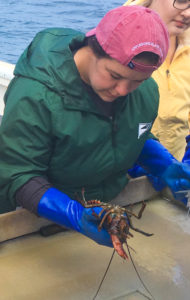
Determining lobster sex aboard the F/V Vivian Mae this summer.

I was emboldened by hearing fishermen and scientists talk about how different, fast-changing dynamics throughout the Gulf of Maine necessitate a different data approach: one that is more localized. Hearing them talk about a solution motivated me to keep moving forward and not feel as overwhelmed by the issues. We as college students will listen and take heart when authoritative voices such as fishermen, council members and scientists uniformly agree on the need for change and discuss possible solutions. Hopefully, these credible voices will resonate with the larger community.

To move forward, we need to analyze the current model and determine what the problems are that are highest in priority to address. In addition to this, we need to keep the conversation going, and keep working toward common goals.

The current data collection model is a One-Size-Fits-All model, but the consensus of the discussion was that one size does not fit all. Therefore, the current model is not doing its job and needs to change. The Gulf of Maine is an extremely dynamic region, with highly productive areas, multiple spawning areas and freshwater inputs. Unfortunately, it is feeling climate change impacts at an alarming rate. In a system with this many moving parts, we should not be employing a model that is rigid. Instead of adjusting this model, however, it may be easier to start with new ideas. Relying on data from random trawl surveys that occurred three years ago is not a solid foundation to build a management plan on.

So, let’s change the way we collect data. Fishermen are out on the water every day in different areas, looking for different target species and making different observations. Why not make their observations available for scientists to use, creating an up-to-date, usable set of data? Up-to-date data means that the moving and fluctuating parts of the system can be more accurately accounted for, and we can develop more accurate and successful management plans more quickly. Collaboration between fishermen and scientists when it comes to collection of data and observations is important. It helps refine the current model and bring the sides together while doing it.

A large part of creating change and addressing these problems exists in the need to have active discussions. Everyone sitting at the table, simply discussing the challenges, could lead to change. Different perspectives bring different ideas, and then solutions can start to form. College students taking part in such discussions and offering their perspectives could be integral to the formation of such solutions. That involvement would also likely encourage them (as it has with me) to dive deeper into the issues and help find solutions, rather than be overwhelmed with fear and gloom.

Along with this, it is imperative that all stakeholders be involved in these discussions. If we want to use data that fishermen collect, for example, we need to make sure they’re on board with the idea, and we need to see how much they’re willing to do to create a better system. If too much is put on the fishermen’s plates, or on the plates of any other group for that matter, the new method will work as effectively as the current one. It won’t.


Jennifer Halstead is a senior at University of New Hampshire studying marine biology, and intern for One Fish Foundation.

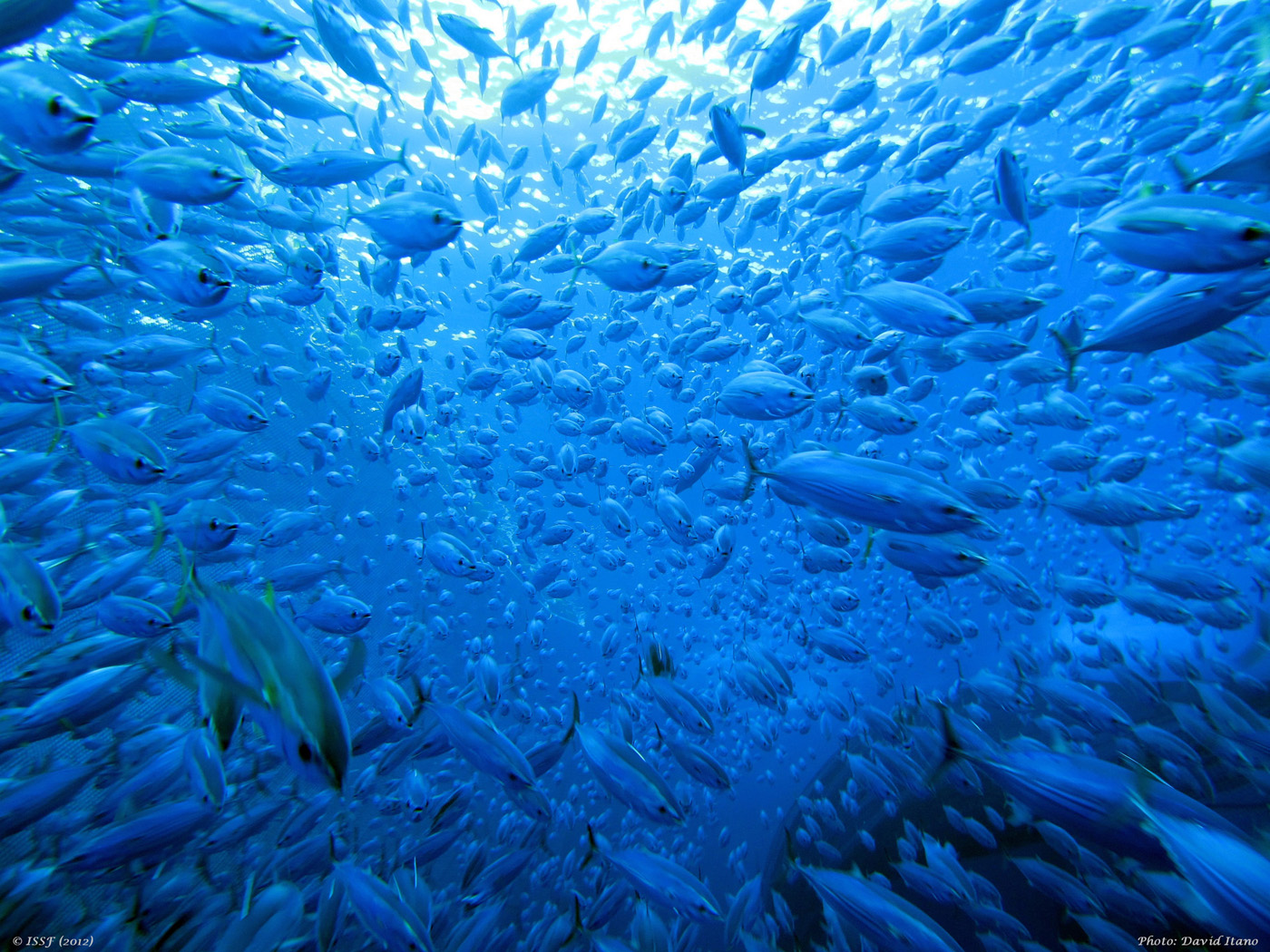
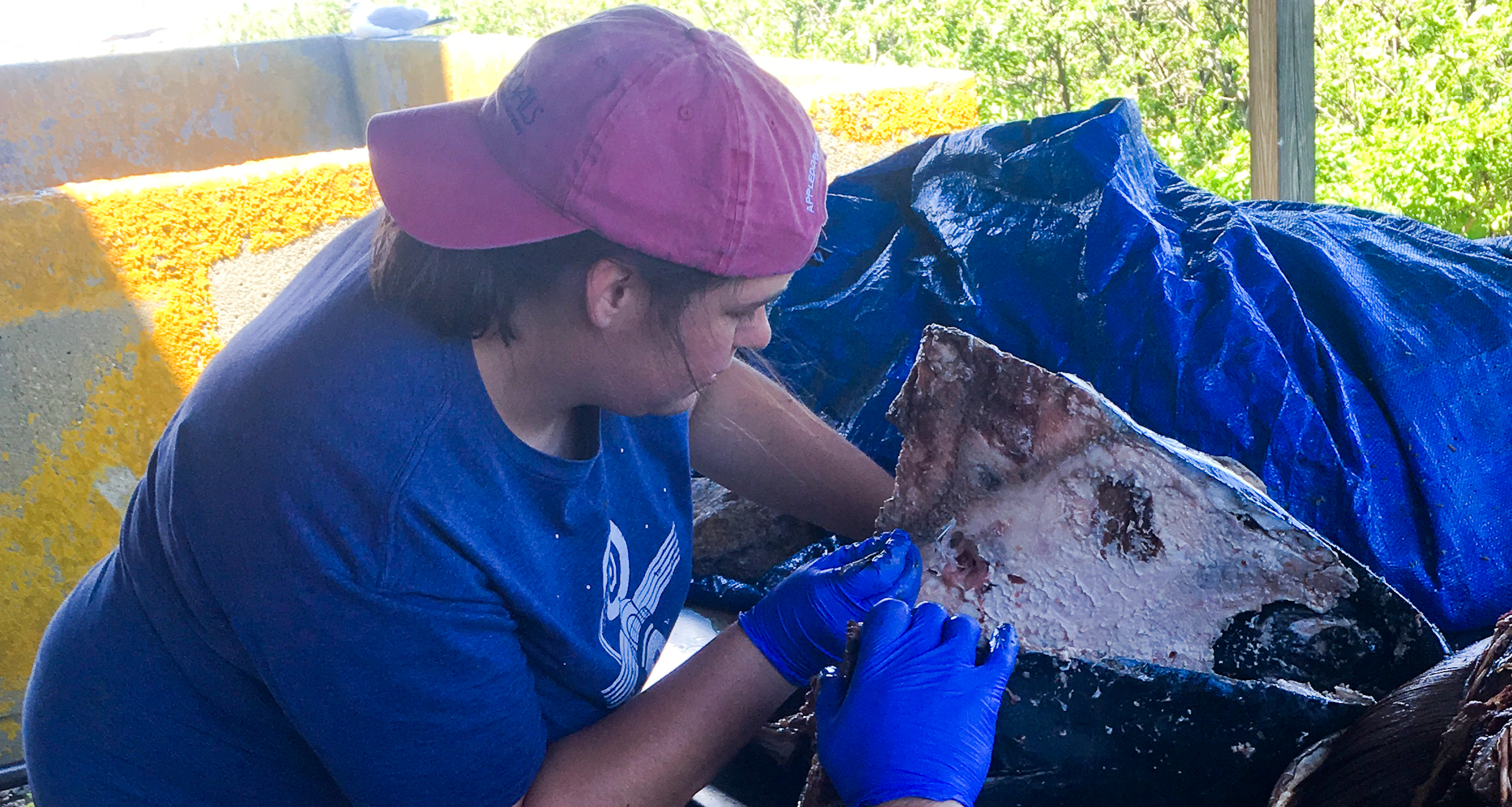
Top Photo: Jennifer extracts the otoliths (ear bones) of a bluefin tuna to determine its age.
All Blog Posts

A scientist, a fisherman and a healthcare rep enter…

  • November 14, 2017November 15, 2017
  • by Colles Stowell
Share it!
Share

Back in January as everyone was adjusting to a new political landscape, I was on a call with Brett Tolley of the Northwest Atlantic Marine Alliance and Bob Steneck, Professor of Oceanography, Marine Biology and Marine Policy at University of Maine. We were talking about a recent report on climate change impacts in the Gulf of Maine, and what fisheries policy may look like in the context of climate impact and the shifting political landscape.

Needless to say there were many unanswered questions. At the time, the administration threatened to cut crucial funding for Sea Grant, climate science and even some fisheries management programs. Our discussion centered on how to adapt more nimbly to climate change impacts on fisheries, and how to make fisheries management more efficient and effective. We also wondered how significantly US fisheries management could shift in a year or two.

That conversation was the seed for last Friday’s (Nov. 3) Webinar: Fisheries Management: Best Available Science May Not Be Good Enough. The discussion was a frank look at the issues with current fisheries policy based on specific examples and some speculation on what management would look like if it were more localized and relied on a different data modeling system.

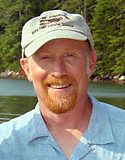
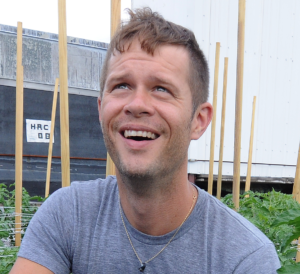
Joining me on the call were David Goethel, commercial fishermen from Hampton, NH and former three-term member of the New England Fisheries Management Council; John Stoddard, New England Regional Coordinator for Health Care Without Harm’s Healthy Food in Health Care program; and Steneck.

This was a diverse panel with deep knowledge from broad perspectives. Steneck has been at the forefront of research on coral, lobsters, urchins, kelp, forage fish and species interrelationships in coastal ecosystems. Goethel has the unique experience of a commercial fishermen who has had to shift his harvest target and method because of changes in the Gulf of Maine, and who has spent several years either as an advisor to the Atlantic States Marine Fisheries Council or NEFMC. John Stoddard brought an institutional buyer’s perspective to the panel. He knows what healthcare representatives want from the seafood they serve their patients. They do have some concerns about sustainability, and when policy creates market forces that may limit access to locally harvested seafood, they may want to know what can be done to change the dynamic.

How’d we get here?

Steneck methodically walked us through some of the core issues with the current management system. Chief among those is the fact the Gulf of Maine, as well as other US coastal ecosystems, are changing faster than we can manage them. We have been a couple of steps behind climate change because our current data assessment system takes several years between collection and analysis and policy action. In essence, by the time policy has been set, the seascape has changed because of rising temperatures, current shifts, increased ocean acidification, etc. All of these changes have forced commercially valuable species to shift their patterns and adapt.

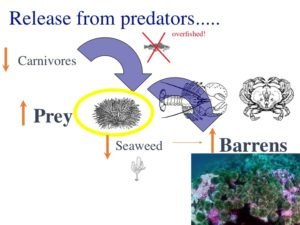
Overfishing of cod resulted in a sea urchin boom in the Gulf of Maine that collapsed in a decade. Interspecies relationships are critical to understanding dynamically changing ecosystems, and are often overlooked with current data management tools.

He pointed to the cod collapse in particular as a bellwether for how we missed the warning signs because of static data analysis, and how that type of “miss” happens frequently due to the data-intensive approach to stock assessment. He showed a brief video featuring a Canadian fisherman who said he had the trip reports to show cod stocks persistently dropping in key areas … data the government ignored because of its current management system.

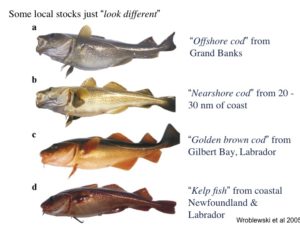
Genetically distinct cod inhabit different ocean ecosystems and should be managed accordingly, not as one, all-inclusive species.

Steneck concluded that we need to “reinvent fisheries management to include multiple, independent indicators”, rather than drill down into details of one species without taking into account other critical factors such as complex interspecies relationships. Taking into account the dynamic changes within spatially appropriate areas of observation will give a more accurate view of fisheries and how quickly they change. Equally importantly, he stressed the need to expand collaboration with fishermen, mining their knowledge base to enhance data collection and analysis.

A unique point of view

David Goethel echoed those concerns. From both perspectives as fisherman and NEFMC member, he saw how current modeling methods’ stagnation meant policy did not match actual stock health and ability to withstand fishing pressure. He pointed to the impact the recent collapse of capelin in Newfoundland had on cod, seals and northern shrimp. Like Steneck, he called for managing fisheries based on the correct spatial scale and with a better understanding of changing predator-prey relationships.

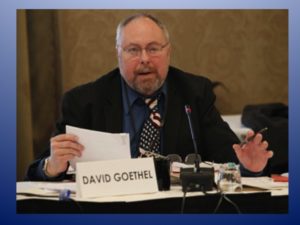
Getting his point across at a management council meeting.

He also urged continued public/fishermen input at council meetings. The system breaks down when fishermen who feel disenfranchised by restrictive policies don’t participate in the process. He decried a lack of transparency in the policy process that frustrates fishermen to the point where many don’t believe it’s worth their time to speak out.

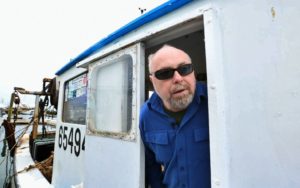
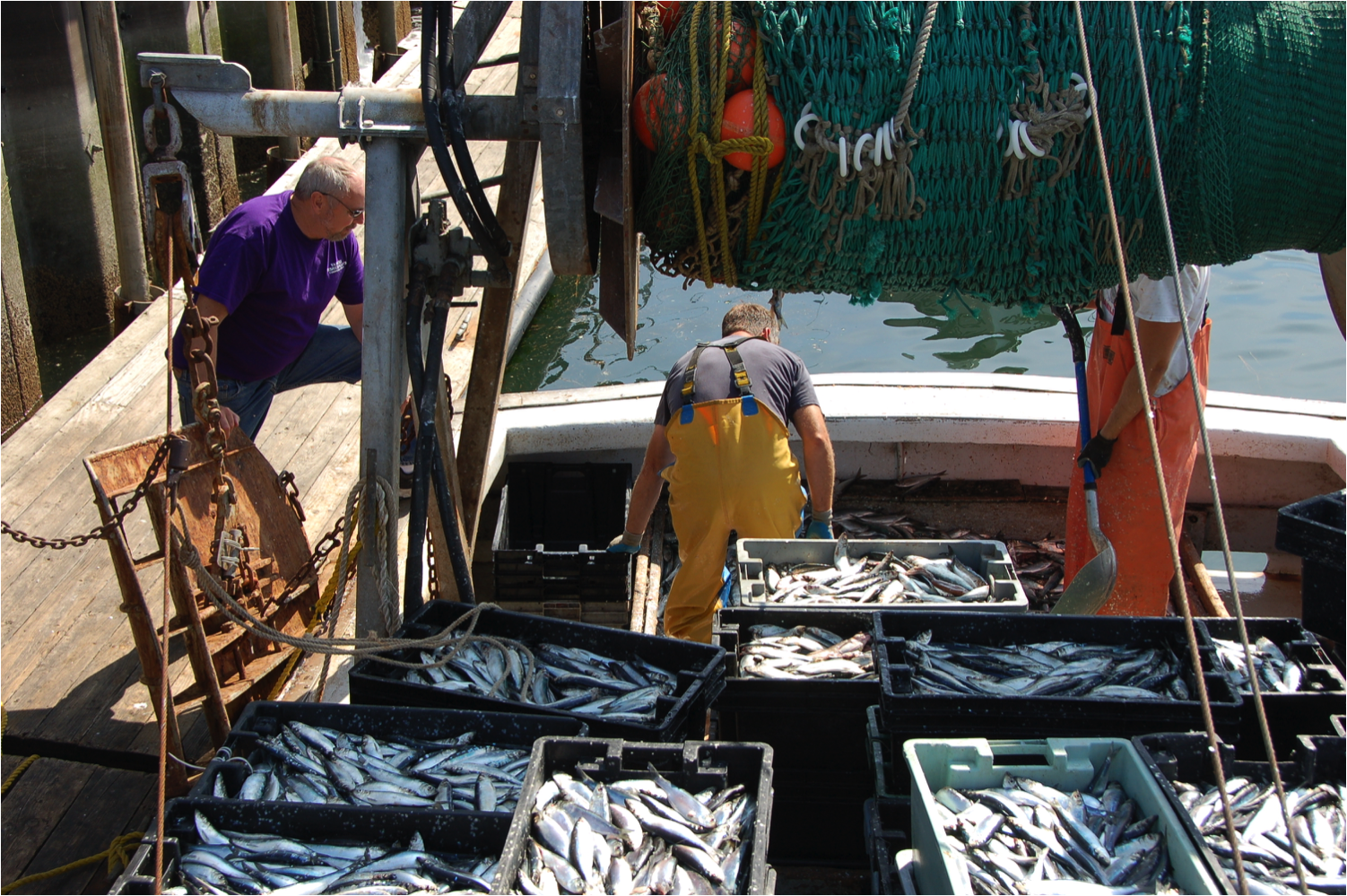
Aboard the Ellen Diane

Goethel agreed with Steneck that data poor methods based on local, spatially appropriate areas of survey would provide the local detail current “big solution” modeling misses. He also agreed that involving more fishermen in the process would play a significant role in collecting more accurate data in a timely fashion, and restoring more fishermen’s faith in the process.

A healthcare approach

Stoddard emphasized Health Care Without Harm’s mission to provide locally sourced, sustainable seafood, with a goal toward supporting community based fishermen. This is a critical issue healthcare industry staff are finding with many patients, especially in coastal New England. Some of these patients have had family or friends who fished commercially, so the some of these issues matter to them.

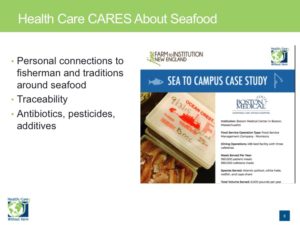
An example of a successful program providing locally harvested seafood to patients.

He said Health Care Without Harm has steadily moved away from big ecolabels such as MSC to support more locally focused programs. Stoddard highlighted a successful program by which Massachusetts Eye and Ear Infirmary sources locally harvested seafood from Gloucester via the Gloucester Fishermen’s Wives Association. Such programs address patient demand for locally sourced seafood while strengthening healthcare institutions’ support of surrounding communities … and specifically fishermen.

Continuing the dialogue

It was a good discussion, with some engaged back and forth on next steps. For example, one of the parting questions focused on what a successful, cooperative data-poor, localized management program might look like. Steneck suggested a demonstration project within an already existing sample area (under the current management system), using a data poor assessment approach. Goethel suggested using echo system modeling that incorporates multiple species relationships, that he believes would yield a more realistic view of stock health.

The next step in the community discussion about these issues is to begin planning the next conversation. At the outset, I said we weren’t going to solve all of the issues we discussed in one conversation. But the goal is to follow up the conversation with another Webinar that explores a bit deeper what a demonstration project might look like, the type of data to study, and the hoped-for outcomes.

We will aim to set up another Webinar in the first quarter of 2018 tapping the collective knowledge of a well-informed panel, willing to explore the possibilities and elevate the discussion. Ultimately, we hope to build a foundation of knowledge that may lead to a roadmap for change.

Stay tuned.

If you’d like to view the Webinar, click on this link and then the tab that says Watch Now: Fisheries Management: Best Available Science May Not Be Good Enough.


All Blog Posts

Re-Thinking Current Policy, Data Analysis: a Webinar 11/3/17

  • October 17, 2017October 20, 2021
  • by Colles Stowell
Share it!
Share

Very little in fisheries management is black and white. This is a constant refrain in any conversations I have in classrooms or restaurants. It is often filled with paradoxes. For example, restrictions such as quotas are aimed at preserving a given species, but loopholes, vagaries in the law and profiteering have led to abuses that have jeopardized some stocks.

Look no further than the recent sentencing of Carlos Rafael, AKA the Codfather, after pleading guilty to 28 counts of fisheries fraud, or the administration’s overturning of a federal agency ruling that New Jersey fishermen had landed too many summer flounder (fluke). Both issues are fraught with complexity, and both point to flaws in the current management system.

That’s why we’re hosting a Webinar next month – not to try to solve all of these complex issues, but rather to hone in on one critical piece of the puzzle that often gets overlooked: How to improve fish stock assessments and strengthen collaborative efforts between fishermen, scientists, and managers. We’re going to discuss the idea of turning the current top-down management model on its head by localizing fisheries management and bringing fishermen further into the process of collecting data and determining policy.

We’ll discuss long-term goals and obstacles to achieving a more balanced approach to ensuring the health of marine resources while supporting local fishermen and the coastal communities they serve. This type of approach would allow scientists, policymakers and fishermen working together, to respond more quickly to regional climate-induced ecosystem shifts.

This Webinar will posit these questions: What can we do to bridge the gap between fishermen, scientists and policy makers? Can we build fishermen’s trust in management and data while still safeguarding the resource? Should we re-think the current fisheries management schema, including the data collection model, to respond more nimbly to rapid, often localized climate change impacts? Can we create a system that better protects the resource, supports local fishermen and strengthens coastal communities with a fishing heritage? How would such a system impact individual seafood consumers and institutional buyers?

The hope is this discussion will lay the foundation for more constructive dialogue, which could eventually lead to a framework for fundamental, meaningful change. We recognize that bucking the system carries additional barriers and challenges. That’s why we have Health Care Without Harm (HCWH) joining us. HCWH has a proven track record of leveraging institutional buying power to shift major policy. By breaking out of the fisheries bubble and engaging HCWH, we can lay the groundwork for real change.

Join us online on Nov. 3 at 3 p.m. and become part of the discussion. Would you change fisheries policy now? What does a better management model look like to you? The panel discussion will last for an hour, followed by a moderated audience Q&A.

Here is the link to sign up for the discussion.

Panelists will include:

Bob Steneck: Professor of Oceanography, Marine Biology and Marine Policy School of Marine Sciences, University of Maine Darling Marine Center. Bob has been at the forefront of important research on lobsters, kelp and groundfish in the Gulf of Maine, as well as coral in the Caribbean for decades. He has a unique perspective on the dynamic ecosystem changes in the Gulf of Maine and the Caribbean and the recent history of data-driven policy.

David Goethel: Commercial fisherman out of Hampton, NH and a three-term member of the New England Fishery Management council, which establishes many of the rules regarding groundfish harvest in the Gulf of Maine. He has also served as an advisor to several panels for the Atlantic States Marine Fisheries Commission, which also regulates many New England fisheries species. David brings a powerful perspective having been on both sides of the fisheries management dilemma.


John Stoddard: New England Regional Coordinator for Health Care Without Harm’s Healthy Food in Health Care program. John brings a compelling perspective from working with healthcare food services on what healthcare patients, staff and food buyers look for in sustainably harvested seafood. We know that improved science also affects individual consumers and institutional seafood buyers like hospitals. What role can seafood buyers play in helping improve the system?
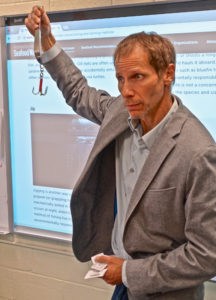
Moderator

Colles Stowell: President of One Fish Foundation, a sustainable seafood education non-profit teaching consumers about why they should care where, when, how and by whom their seafood was harvested. Colles works with students in classrooms from kindergarten through college, and adults via community events to discuss a variety of crucial seafood sustainability topics ranging from harvest and aquaculture methods to climate change impacts and policy.


All Blog Posts

Student Questions Spark Hope For Fisheries Answers

  • May 18, 2016October 20, 2021
  • by Colles Stowell
Share it!
Share

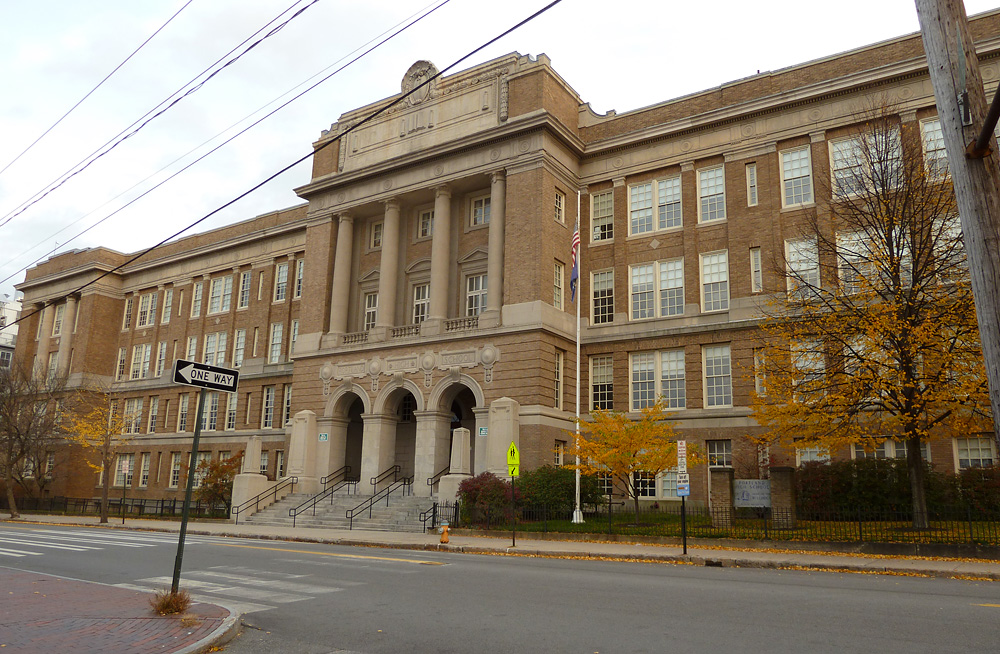
I found myself facing one of the most difficult questions to answer about fisheries management last week. Posed by a senior at Portland (Maine) High School, the question was how to ensure all fishermen have fair access to the resource while still protecting that resource.

We had covered a lot of ground up to that point. We’d discussed the domestic and global seafood systems in broad strokes, touching on demand, and import/export statistics and issues. We’d reviewed different aquaculture approaches, global warming and its impact on the Gulf of Maine and the role invasive species play in altering local ecosystems.

We’d also discussed the unbalanced fishing quota landscape and its impact on fisheries and the fishermen who care about the resource. That prompted the senior, taking an Ocean Sciences course, to ask the hard question many fishermen, policy makers and activists continue to ponder.

I prefaced my answer with a bit of insight from years of studying management issues and listening to fishermen, managers and scientists discuss policy: There are no black-and-white or one-size-fits-all answers. There is no chance, whatsoever, of 100% satisfaction for all stakeholders. Feelings run too deep.

And that’s a large part of the problem. The quota system arose to eliminate the bycatch (discards of unintentionally caught species) and what some activists termed a “race to fish.” The previous management model limited effort, or days at sea, encouraging fishermen to fish as much as possible with a given time period. The quota system divided the ocean into different sectors and allotted quota based on the permits fishermen purchase. The idea was that if you had a permit, you might feel responsible for taking care of the resource.

Instead, the quota system bred new inefficiencies and more disparity in the “haves” and “have-nots.” Larger operators with deep pockets could buy more of the permits, driving up the price of the permits to the point where smaller scale fishermen are priced out of the markets. Local fishermen, those who typically care more about the resource more than the larger operators, are forced to switch gears or stop fishing. Small-scale farmers often face similar struggles against industrial agriculture.

A good bad example

I used the example of Carlos Rafael, the largest seafood distributor in New England, to illustrate how the system is ripe for abuse. Rafael is now under house arrest in his hometown of New Bedford, where he is awaiting trial on federal charges he defrauded the government by hiding his actual catch volumes and mislabeling fish. Rafael allegedly misrepresented species on federal catch quota forms he filed by mail or online. Then the species were sold at a higher price to a New York wholesaler who allegedly paid for the fish with bags of cash.

I answered the student by saying I don’t have an exact solution to the problem. But I explained that allowing all stakeholders, including local, small-scale fishermen, to have a meaningful say in how fisheries are managed would be a significant first step. Many fishermen argue that giving local fishing communities more control over management of their fisheries would prevent the kind of top-heavy, cash-driven management that nurtured the rise of operators like Carlos Rafael.

I see some merit to that approach, but also understand that the Magnuson Stevens Act is essential to creating a federal management backbone to ensure some consistency from coast to coast.

Above all, collaboration among different stakeholders, fishermen, policy makers, scientists, community activists, chefs, consumers, etc. is critical. We won’t move forward if we can’t all meet at the table.

And that underscores the importance of having discussions about where seafood comes from and how it’s managed with students like those seniors at Portland High School. I hope those discussions will eventually lead to more concrete solutions that are fair, equitable and sustainable for fishermen, their communities (read consumers) and most importantly, the resource.

If I can get students to ask intelligent questions, I’m at least sparking the conversation.

Recent Posts

  • Hurricane Ida wreaks havoc on Louisiana’s seafood industry
  • EPA Should Use Clean Water Act To Kill Zombie Mine
  • Slow Fish 2021: Relationship Matters
  • Faith, Façades, and Futility
  • Pebble Permit Paused: Politics at Play

Archives

  • September 2021
  • August 2021
  • April 2021
  • December 2020
  • August 2020
  • June 2020
  • February 2020
  • December 2019
  • November 2019
  • October 2019
  • July 2019
  • May 2019
  • April 2019
  • March 2019
  • January 2019
  • December 2018
  • November 2018
  • June 2018
  • May 2018
  • March 2018
  • February 2018
  • January 2018
  • December 2017
  • November 2017
  • October 2017
  • September 2017
  • August 2017
  • July 2017
  • June 2017
  • May 2017
  • April 2017
  • March 2017
  • January 2017
  • December 2016
  • November 2016
  • October 2016
  • September 2016
  • August 2016
  • July 2016
  • June 2016
  • May 2016
  • April 2016
  • March 2016
  • February 2016
  • January 2016
  • December 2015
  • November 2015
  • October 2015
  • September 2015
  • July 2015
  • June 2015
  • May 2015
  • April 2015
  • March 2015
  • February 2015
  • January 2015
Theme by Colorlib Powered by WordPress