Skip to content
One Fish Foundation
  • Blog
    • Aquaculture
    • Education
    • Environment
    • Policy
    • Wild Harvest
    • Fish Tales
  • About
    • About One Fish
    • About Colles Stowell
  • Education
    • Elementary School
    • Middle School
    • High School
  • KNOW FISH Dinners®
  • Resources
    • One Fish Podcast
    • One Fish Foundation in the news
    • The 7 C’s of Sustainable Seafood
    • Newsletter Archive
    • Recipes
      • Skate with Capers and Butter — Chef Rizwan Ahmed
      • Grandma Davis’ Fish Chowder — Jane Almeida
      • Ginger Garlic Tamari Scallops — Colles Stowell
      • Fish Stock — Evan Mallett
      • Mussels San Remo — Chef Rob Martin
      • Salted Pollock Croquettes – Chef Mark Segal
  • Connect
    • Contact OneFish
    • Social
      • Instagram
      • Facebook
      • Twitter
All Blog Posts

Farmed Salmon Jailbreak Exposes Systemic Industry Flaws

  • August 31, 2017October 20, 2021
  • by Colles Stowell
Share it!
Share

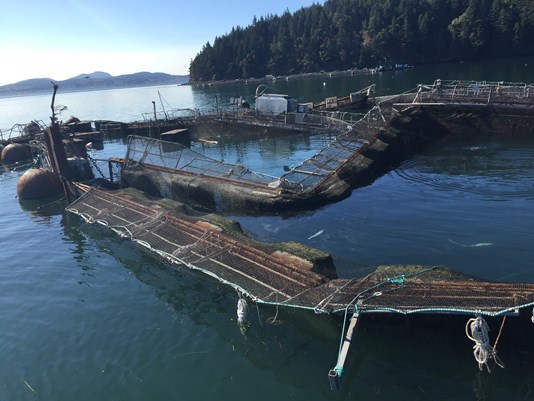
UPDATE Sept. 3, 2017  Recent reports indicate Cooke Aquaculture Pacific (subsidiary of Cooke Aquaculture) acknowledged in permit filings in February that the three-pen farm that failed in August was “nearing the end of its serviceable life” with visible rust and corrosion. Part of the permit application was to re-align the net pens so they would not be broadside to one of the strongest currents on the west coast. The application was filed shortly after Cooke bought the farm from Icicle Seafoods in 2016. But Cooke never fixed or replaced the pens, and a last-ditch attempt to stop the pens from drifting in the powerful currents in July proved futile on Aug. 19 when structures collapsed and more than 160,000 fish escaped.

Cooke reports that it has recovered over 140,000 fish from a total of 305,000, leaving about 160,000 fish that escaped.

There is increasing pressure from several fronts, including some state legislators and several regional native American tribes to stop the expansion of aquaculture in Puget Sound.


August 30, 2017 — In case you missed it, several thousand (potentially more than 300,000) Atlantic salmon escaped from net pens off Cypress Island in Washington state last week.

The idea that such high numbers of Atlantic salmon could potentially out-compete wild, native Pacific salmon for food, spawning grounds, etc. or even mate with them, has several environmental groups and commercial fishermen sounding alarms.

We should all be concerned.

Fish escapes from net pens are nothing new. It has happened several times with different ecological and social impacts in the past 30 years. Net pens are vulnerable to big storms which can crumple them up and leaving gaping holes.

Containment…?

This particular incident, which happened on August 19 at a facility owned by the massive Canadian firm Cooke Seafoods, is particularly notable for several reasons.

  • Cooke initially blamed the crumpling of the net on extreme high tide and strong currents related to the solar eclipse. Cooke has walked back that claim, instead blaming only abnormally high tides and strong currents. Scientists say the tides that day were actually milder than earlier in the summer.
  • In 2016, Cooke purchased the 30-year-old pens, which are located in an area that has one of the strongest currents (up to 4 mph) on the West Coast. Yes, you want strong enough currents to flush all of the waste and undigested food, antibiotics, what have you, to prevent the growth of lethal algal blooms. But you’re also setting up the inherent risk of net pen damage.
  • Cooke initially said that 4,000 fish escaped. Now they say they won’t know how many fish escaped until the final harvest (both in and around the farm and further out to sea) is complete. That could be never.
  • The state of Washington has frozen any new permitting for marine aquaculture. This is significant for Cooke, which has plans to extend its operations in the Strait of San Juan de Fuca.
  • Washington state aquaculture operations produce about 17 million pounds of farmed salmon per year, making it the state with the largest marine farmed finfish production in the U.S.
  • The state of Washington Dept. of Natural Resources has sent a notice of default to Cooke, claiming that Cooke violated its lease agreement (the co. leases the undersea land from the state) because of the environmental harm from the net pen failure.
  • Environmentalist organization Wild Fish Conservancy has filed an intent to sue Cooke for violating the Clean Water Act as a result of the “escape.”
  • The state asked for help from commercial and recreational anglers to catch/harvest/kill the Atlantic salmon in the wild.
  • Based in New Brunswick, Cooke has operations in Eastern Canada, Spain, Scotland, Chile, and Maine and claims they will produce more than 275,000 metric tons of seafood every year and generate $1.8 billion annually.

Long-term implications

So what does this all mean?

For me, it is yet another illustration that industrial scale finfish aquaculture has a long way to go before it truly delivers a net environmental, ecological, sociological and yes, financial positive.

The Cooke operation is sited perilously close to native Pacific salmon migratory routes. Subsistence and artisanal fishermen in the Lummi Nation, a Native American tribe in Washington State, join their voices with environmentalists fearing the ecological impacts of several hundred thousand non-native fish competing with struggling native Pacific salmon species like Chinook for food and habitat.
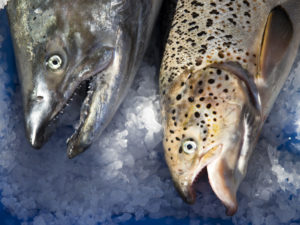
Washington state posted an identification guide to help fishers distinguish Atlantic salmon (right) from native Pacific salmon species. (Photo by Megan Farmer/KUOW)

Young Chinook are now leaving West Coast rivers to head to sea, and could be a prime food source for the 10-pound Atlantic salmon swimming about. Other potential impacts the farmed fish could have on wild stocks such as Chinook and Coho salmon now returning to spawn include increased competition for food, the potential for spreading disease and potentially weakening the gene pool from inter-breeding.

Many scientists agree we don’t have enough information to really know the impact of farmed salmon escapes. Some researchers doubt whether farmed Atlantic salmon can survive in the wild. Others doubt that they would really mate with wild, genetically different species, or that if a few did, the consequences would be negligible.

In the absence of real, credible data, I side with those who are concerned. Just because we don’t know with certainty all of the ecological threats escaped farmed salmon could pose on wild populations, we should NOT ignore the potentially significant damage. Put another way, this issue should serve as yet another warning that profit-driven finfish aquaculture, sometimes deemed marine feedlots because of industrial approach, is inherently dangerous.

It’s dangerous because these types of issues: escapes, algal blooms, disease, antibiotic use, etc. continue despite corporate attempts at greenwashing. Witness the mess created by the Chilean farmed salmon industry, which lost over a billion dollars last year after a huge algal bloom sparked a deadly bacteria outbreak that killed millions of fish.

Just because there isn’t tons of research doesn’t mean there aren’t readily identifiable stories supporting the need for caution. For example, one study from the University of Victoria relies on DNA sampling to confirm that some escaped Atlantic salmon had spawned in the Tsitik River in British Columbia in the late ‘90s. Another study showed that Atlantic salmon inhabited more than half of 41 known Pacific salmon rivers on Vancouver Island.

Scale

All of this is set against a new industry dynamic in which global aquaculture operations are scooping up smaller wild harvest operations. Last year, Cooke purchased Icicle Seafoods, Inc. of Alaska, a longtime, well-recognized company specializing in wild harvest of Alaska seafood and farmed Atlantic salmon.

Is this simply an attempt to diversify its seafood portfolio to minimize the financial risks of salmon farming, or is it an attempt at greenwashing the mounting concerns of farmed salmon by providing wild caught product? As my colleagues and executives of the Sitka Salmon Shares community supported fishery Nic Mink and Marsh Skeele write in their latest blog, “You buy farmed fish: they win. You buy wild fish: they win.”

I am not opposed to aquaculture in principal. I know several bivalve farmers who are doing good things with oysters, mussels and clams and are taking care not to over-crowd their beds. I know there are certain small-scale, artisanal finfish operations that provide subsistence to impoverished communities in Africa with minimal ecological footprint.

But as with many issues in fisheries, scale simply magnifies the damage when something goes wrong. So we need to do more research on the potential impacts of escaped farmed finfish on wild populations and ecosystems. We also need to look deeper into lowering the cost and technology barriers to land-based re-circulating systems that reuse the water and minimize the ecological impact of net pen operations. Finally, we have to re-think how we feed these farmed fish because grinding up millions of tons of forage fish like Menhaden for fish pellets every year stresses a critical layer in marine food webs.

Would that the industry takes note … sooner rather than later.


Additional reading:

Scientific American article diving into the issues surrounding last week’s Cooke Aquaculture escape.

Seattle Times story providing more detail about the Lummi Nation response to the escapes.

Youtube video by activist Alexandra Morton with some intense footage showing disease spread in Atlantic salmon net pens in Pacific Northwest.

TED talk with activist chef Dan Barber discussing an innovative and ecologically beneficial fish farm in Spain.

Cascadia Weekly column by former fisherman and activist Anne Mosness providing a good historical perspective on how industrial finfish aquaculture, or marine feedlots, rose to prominence in the Pacific Northwest.

Wild Fish Conservancy petition to Washington state Governor Jay Inslee to stop the expansion of salmon farming in Puget Sound.

Video of sea lice dispersal from salmon farms into wild rivers in Norway posted by Clayoquot Action.


Top Photo credit: Wild Fish Conservancy
All Blog Posts

Getting Hands Wet and Talking Seafood

  • August 4, 2017October 20, 2021
  • by Colles Stowell
Share it!
Share

Every time I speak to a group of students, campers, adults, etc. I learn something.

First, I learn what the audience knows and doesn’t yet comprehend about seafood sustainability in broad terms. I learn who in the audience is more ready to engage in discussion, who wants to challenge pre-conceived notions, and who isn’t really into the conversation.

Depending on the age group and location, these types of interactions can sometimes provide glimpses into a community’s overall seafood IQ. Observing students while I teach a class also provides a mirror of how effectively I’m getting the message across.

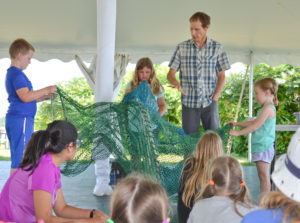
Gill nets are hard to see on land as well as in the ocean. Photo: Rich Harty

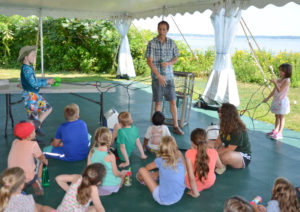
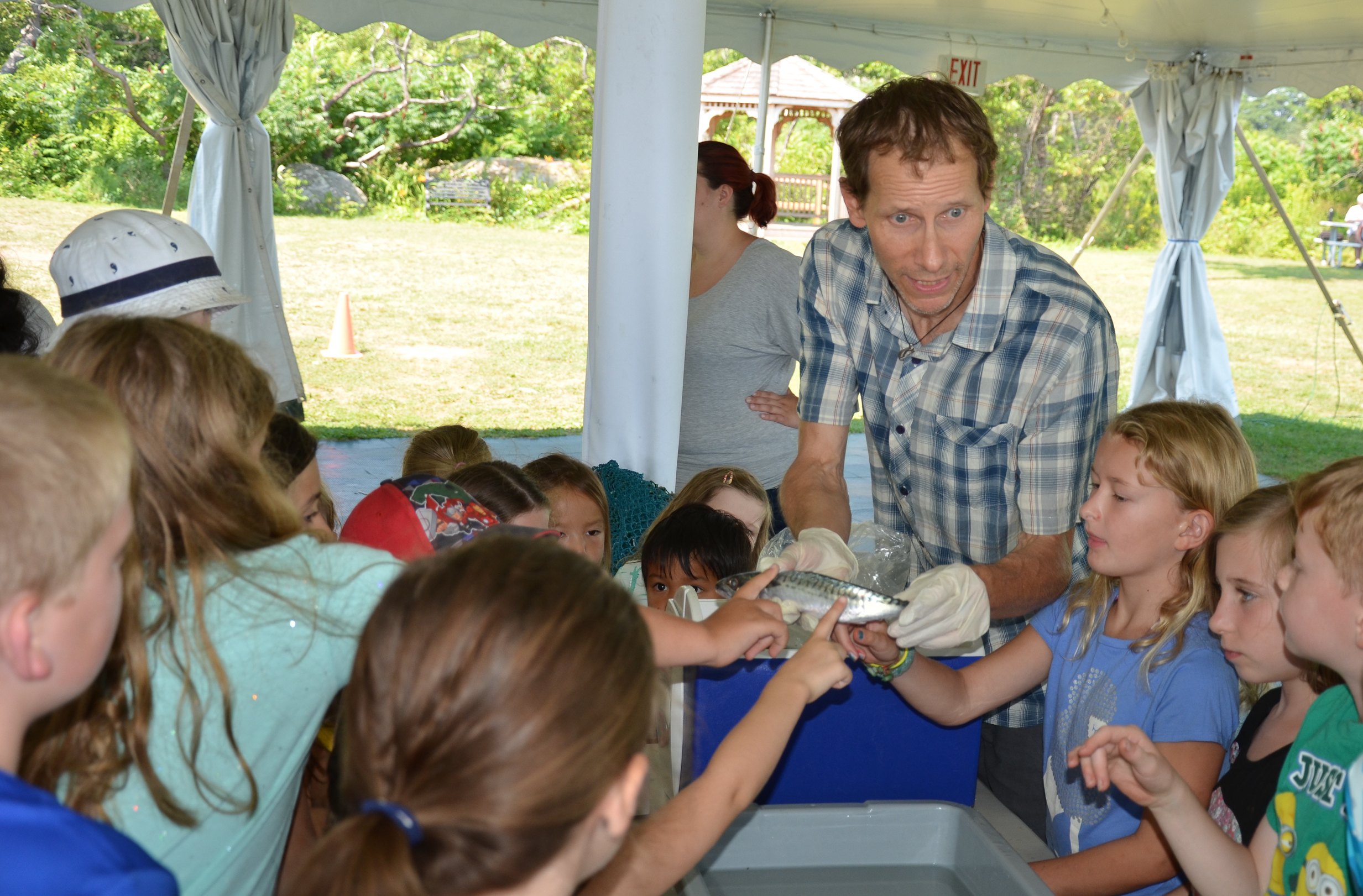
My first observation at the Seacoast Science Center in Rye, N.H. this week was how lucky the Seaside Safari campers were to have such a program. Set on the shore near Odiorne Point, surrounded by acres of tide pools loaded with lobsters, green crabs, seaweed, etc., the camp provides direct, hands-on access to coastal marine ecosystems. Campers handle live green crabs while learning about invasive species; they turn over rocks and hunt for juvenile lobsters while learning about food webs; they talk about the warming Gulf of Maine while learning about climate change.

I wish I had access to a program like that at that age.

So it was a privilege to learn some things from these campers as we chatted. I re-confirmed that green crabs are a very effective, hands-on prop … almost to the point of distraction when they started fighting.

I learned that these campers, when prompted, were generally eager to learn how seafood ends up on their plates. They wanted to know how a turtle excluder device works, and its impact on reducing bycatch.

Demonstrating the escape hatch for turtles. Photo: Rich Harty

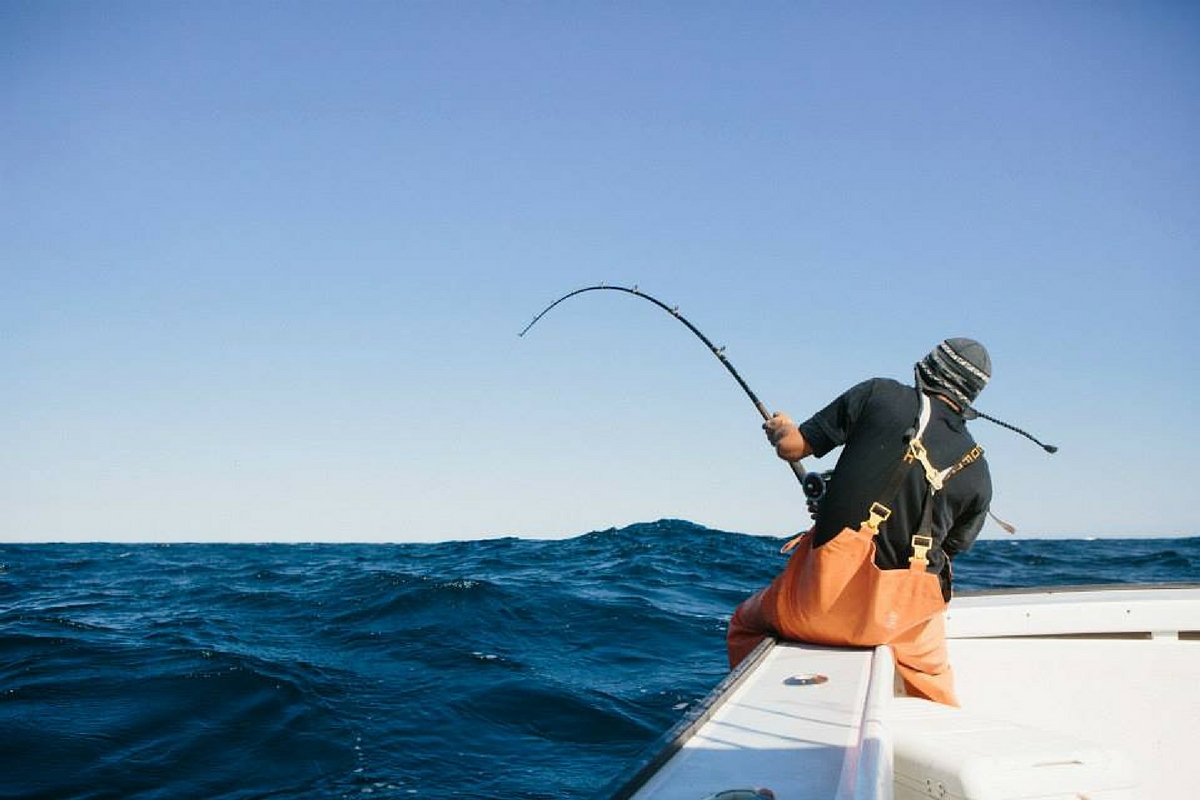
Some campers who had fished recreationally before were genuinely surprised that some fishermen use rod and reel to fish commercially. They were intrigued by the weight of the 14 oz jig used to get the flies down 400 feet to where the haddock, cod and pollock are.

They were also pretty enthusiastic about touching the dead Atlantic mackerel while learning that mackerel are one of several forage fish species that are very important to seafood webs.

And they began to see their relationship to the seafood they eat.

And I learned, once again, that I love what I do.

All Blog Posts

Making Do at Slow Food Nations, Denver

  • July 19, 2017October 20, 2021
  • by Colles Stowell
Share it!
Share

Attending Slow Food Nations in Denver this past weekend, I had some expectations about the Slow Fish 101 presentation I would co-lead and the gumbo I would make.

As often happens, those expectations capsized last minute and I and many others had to adapt on the fly. For the second year in a row, the Slow Fish USA team had to respond quickly to a variety of circumstances outside our control.

In the midst of towed vehicles, last-minute technical presentation difficulties, and a bit of a cluster around the commissary kitchen, we scrambled to help each other out. And just as we did last year at the Slow Fish gathering in New Orleans, we made it work… well.

Blame it on the weather

Again, weather played a role, as it did last year when we had to change venues because a flood warning closed down the original host site. This time, I learned my Slow Fish 101 co-presenter Paul Molyneaux was stranded in Portland, Maine because of weather and would miss the presentation. Having fished commercially and written several books and articles about fisheries, Paul not only brings 40 years of experience to the conversation, he has also made important connections all over the world.

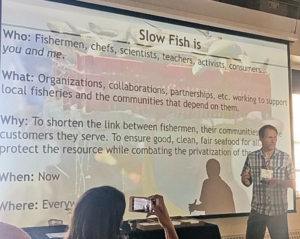
Anyone who loves seafood, cares about the resource and the fishermen who harvest it sustainably can be part of the Slow Fish movement. Photo: Kate Masury

We each had developed a portion of the deck, and his relied heavily on his global travels learning from and supporting artisanal fishermen and their efforts to thrive. I learned much about these issues from our discussions, but I didn’t feel good about trying to put my perspective on the narrative of all of his slides. So I was up until 11:30 the night before tweaking the slide deck to convey many of the same messages, but from a perspective I’m more comfortable with.

Slow Fish USA luminary Kevin Scribner prefaced the presentation next morning with a history of Slow Fish and provided valuable context for questions and discussion flow.

And it was a good discussion. The audience was a mix of Slow Fish representatives and Slow Food delegates interested in fisheries issues. We reviewed some compelling statistics demonstrating how current industrial seafood markets are stacked against small- and mid-scale fishermen.

We also discussed how Slow Fish empowers these fishermen around the world to compete in local and global markets using examples such as the Tuna Harbor Dockside Market in San Diego, Know Fish Dinners in New Hampshire and Maine, and projects that support artisanal fishermen in Uganda and Thorupstrand, Denmark.

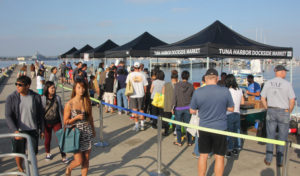
Tuna Harbor Dockside Market, San Diego. Photo: courtesy THDM.

Tuna Harbor Dockside Market is a shining example of multi-tiered collaboration between fishermen, activists and government. More than three years ago, a group of San Diego fishermen sought a way to sell to consumers direct off the boat. Though there was no specific permit that would allow that type of retail setup, the city, county and state worked together to create legislation that supports the market.

The result?

  • Fishermen have created relationships with customers.
  • They’ve earned more money: sea urchin prices jumped from $.80 to $5 per lb. and mackerel rose from $.30 to processors to $4 per lb. to consumers.
  • Fishermen have changed the way they fish to accommodate market demand.
  • Fishermen’s families work the tents, getting their children’s hands on the product.

The audience posed great questions about aquaculture, fisheries management and the long-term prospects of wild harvest in the face of growing demand. The conversations continued even after we were kicked out of the room as the next group set up.

First mission accomplished.

Blood, sweat and gumbo

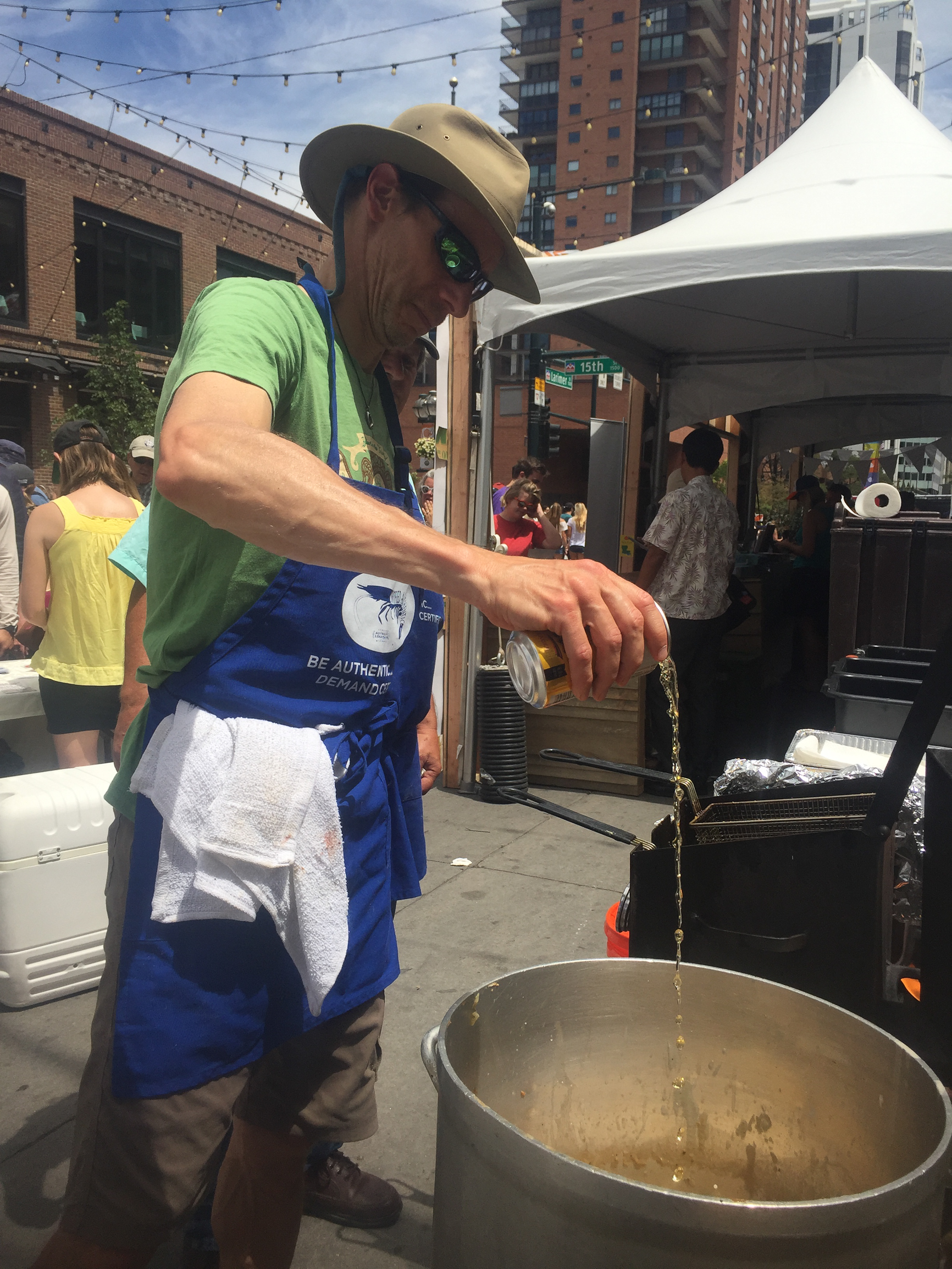
The plan was to highlight the story behind the fabulous shrimp and crabs from Lance Nacio’s Anna Marie Shrimp in Louisiana via gumbo. I also secured some of the best andouille sausage I’ve ever had from Toby Rodriguez, a born-on-the-bayou, pig whisperer, traditional butcher and co-owner of Lache Pas Boucherie and Cuisine in Lafayette, La. He had me at “I call bullshit on all commercially available andouille!”

The BIG challenge was logistics, such as sourcing a 40-quart stockpot, stirrer, ladle and all of the flour, vegetables, oil etc. I’d need to deliver my standard of gumbo. I also needed a place to prep and make a stock. Even with weeks of planning, this still proved to be much more challenging than we expected or was necessary.

Thanks guidance from some chef friends, this was NOT a disaster.

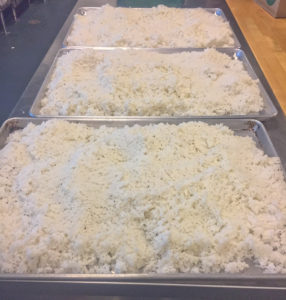
Fortunately, because of the connections I’ve forged with Slow Fish and some outstanding chefs, I found what I needed. A couple of chefs, Kelly Whitaker of Basta in Boulder, and my dear friend Evan Mallett of Black Trumpet in Portsmouth, NH helped me figure out how to cook up about 30 pounds of rice (which was way out of my comfort zone.) Evan also chopped and connected me with a chef for the pot and three locally sourced chickens.

I prepped with help from old and new friends for nearly seven hours after presenting. The morning of the food service, I got a late start because we had to wait for the health inspector and I had to try and figure out how to get 50+ pounds of food in different containers and 12 quarts of stock from the commissary kitchen 5 blocks to the site where I’d cook the gumbo. With a dolly and someone’s truck, we made it work.

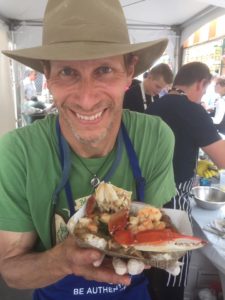
Lance’s blue claw crabs added flavor…and some down-and-dirty eating for lucky patrons.

Four hours, a few laughs, a couple of cuss words, a stream of sweat and an unfortunate slip of a knife later, and I was ladling gumbo to praise. We had three tents serving fried shrimp, Baja oysters, miso and seaweed, Alaska salmon, salmon poke and black cod. All of it delicious. The quality and freshness of each product was exceptional.

The moment of truth for me came late that afternoon when an elderly African American man sporting a comfortable sun hat and shades asked, “What you got in that gumbo, son?”

I told him the ingredients, mentioning Toby’s sausage, and the fact I smoked the chicken over apple wood that morning.

“Where you from?”

“New Orleans, sir.”

“Who taught you?”

“A Creole woman who took care of me when both my parents were working. Nothing written down. All oral tradition. Took two years of her whacking me over the head with a wooden spoon every time I messed up for me to start getting it right.”

“Ok. Let’s try it,” he said, dropping his ticket in the cup.

Nervously, I spooned out some rice and carefully selected a ladle that had shrimp, crab, two different kinds of sausage, chicken and as many vegetables as could fit.

The man took a spoonful and seemed to swirl the gumbo around in his mouth like a sommelier, which made me uncomfortable. If he didn’t like it, my day was lost.

He raised his head, sniffed, then a slight smile curled his mouth.

“A lot of flavors that work well together.”

“You like it?” I asked, for confirmation.

“Yes. You done good. Thank you.”

“Thank you, sir!!!”

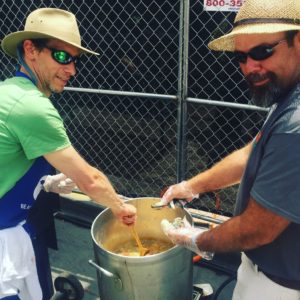
Notice the gloved hand.

So what if I may have shaved some time off the back end of my life stressing over logistics. So what if I’m now struggling to type with nine fingers because I damn near sliced off the tip of my index finger early in the morning before really getting going on the gumbo. Someone in the tent trained in wilderness survival did a field repair to stop the bleeding so I could complete the mission. I got four stitches only after most of the gumbo was gone and I received “official” validation.

Group effort

All of this goes back to something Slow Food USA director (and former New Orleans high school classmate) Richard McCarthy said in opening remarks that Slow Food is about pluralism. Change doesn’t come from any one person. It comes from a collective force.

So it is true with Slow Fish and specifically, my mission with One Fish Foundation. Changing attitudes about consumer food and seafood purchases requires a group effort. It requires communication, collaboration, partnerships and adaptation. Adapting to unforeseen challenges to event execution is becoming an illustrative trend for Slow Fish USA. It’s because of the connections and friendships we’ve formed that we’ve been able to overcome some last-minute hurdles, working together to send our message.

It’s because of those connections, and the new connections we make that we will continue to steer the conversation toward preserving the seafood resource and the way of life of the fishermen who harvest and care for it.


Top Photo: Don’t forget the secret ingredient! Credit: Lance Nacio.


All Blog Posts

Slow Fish Gumbo

  • July 8, 2017October 20, 2021
  • by Colles Stowell
Share it!
Share

I like farmer’s markets. I like talking to farmers about how they grow food, from discussing the subtle flavor profiles of 40 different types of garlic to the homemade sticky buns some breeders feed heritage pigs. That’s because I like good food and the interesting story behind it. I like connecting with the farmers who produce the food my wife and I prepare for our family. I no longer can stand walking into a big grocery store chain where all too often the story behind the food is muddled, glossed over or fabricated.

Slow Food has done much to shift the paradigm away from the agribusiness, industrial food system culture that so dominates local, regional, national and international grocery store shelves. Its central premise is to make good, clean, fair food accessible to all. That is, Slow Food promotes food that hasn’t been grown in industrial environments flecked with chemicals and other additives; food that hasn’t traveled long distances; and, food that is sold at a fair price by the farmer to the consumer.

Slow Fish has the same essential mission: to ensure good, clean, fair seafood is available to all. This mission also promotes shortening the supply chain between the producer – in this case, fishermen – and the consumer, while ensuring fishermen have a chance to earn a fair market price.

Representing One Fish Foundation, I will have the opportunity to discuss the Slow Fish mission at the Slow Food Nations Conference in Denver next week. I’ll be co-leading a presentation on how Slow Fish aims to shine a spotlight on local seafood producers providing fresh, local, responsibly harvested fish and shellfish to their communities and beyond. We’ll talk about why so much of the seafood eaten in the U.S. is imported, and ways that small scale fishermen have banded together to change that dynamic. We’ll encourage attendees to get involved by starting a community supported fishery (same as a CSA, but for seafood), join the discussion on improving management policies, or simply demand local seafood at nearby restaurants and grocery stores.

It will be a good discussion.

I will also help drive the point home by making gumbo with shrimp and blue claw crabs from the Gulf of Mexico harvested by Lance Nacio and Anna Marie Shrimp. For me, this will be a treat because it’s been far too long since I’ve been able to cook with the seafood of my New Orleans heritage (now that I live in Maine).

I will also be cooking with andouille sausage made by Toby Rodriguez, a butcher, chef, and authority on Cajun food traditions who gives dissertations on why commercially available andouille is crap. I can still remember the smell of traditional andouille as it was rendered before the roux was made when I was young. I’ve not really had that rich, dense, somewhat spicy flavor in decades, but it will grace the gumbo I make at Slow Food Nations.

The gumbo in effect will be a metaphor for Slow Food and Slow Fish. Standing up to industrial food systems often means establishing a relationship with your food producer and weaving their narratives into the dish you’re preparing. It’s a shared narrative, steeped in tradition, trust, good will and that not-too-subtle, nutty-sweet aroma of the trinity (celery, peppers and onions) after you first stir it into the roux.

All Blog Posts

Fishing, Passion and Bad Music

  • June 20, 2017October 20, 2021
  • by Colles Stowell
Share it!
Share

I don’t know if it was Queensryche, Dokken or Whitesnake. Whatever flavor of 80’s hair band, the music was pulverizing my ear drums. As they pulsed laterally, the fluid in my ears splashed up and down every time the bow of the boat jumped six feet and plunged back down on the back side of a wave, punctuated by the incessant hammering of the kick drum in the background.

What were we doing?

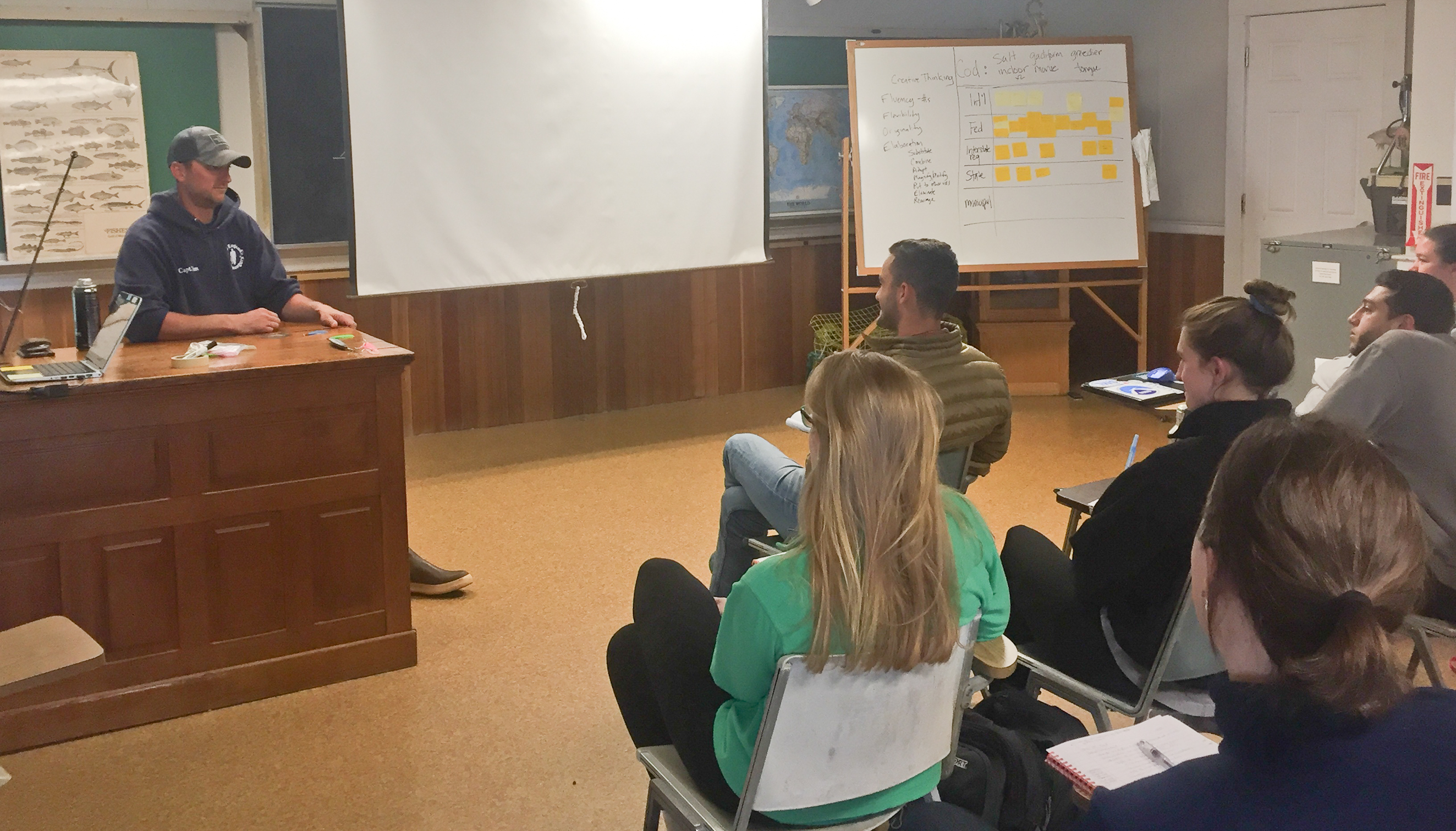
I was heading out to the Shoals Marine Laboratory on Appledore Island off the coast of Portsmouth, N.H. to talk with some students from the University of New Hampshire, Cornell University and Carleton College about regional, domestic and global seafood markets, consumer choices, market influences and climate change impacts. The students were participating in a two-week intensive sustainable fisheries course coordinated by N.H. Seagrant. I was riding with Capt. Tim Rider, whose fondness for that particular XM station was amplified by the conditions.

June in New England. Heading to the lab in wind-driven rain, but fortunately out of the six-foot waves … and the music. Photo: Tim Rider

A fisherman’s tale

If you’ve ever attended one of the KNOW FISH dinners, you know Tim is very passionate about what he does: bucking the trend toward high-bycatch harvesting by fishing for groundfish in up to 500 feet of water 80 miles offshore with rod and reel. And he’s not shy about sharing his feelings on current management policies, consolidation of the fleet (forcing small-scale fishermen out) and the need for change.

Perhaps it is this passion and willingness to speak out that has alternately cast him as either a pioneer striving to do the right thing against many odds or a loud-mouthed maverick who refuses to get in line. Perhaps that’s why he’s been lauded by restaurant chefs and consumers for the quality of his product, and vilified – even threatened – by others in the industry who don’t share his views.

That passion, along with a lifelong obsession of fishing and the experiences he’s had trying to survive make for a compelling, if a bit incessant, narrative. He keeps on talking, he says, because he has a lot to say.

The unsuspecting students at the Shoals Marine Laboratory heard stories of being shut down from speaking in New England Fisheries Management Council meetings, excessive and unfounded accusations from law enforcement, and confrontations with other fishermen who don’t like him rocking the boat.

“Bait,” or the tools of the trade.

Struggling against poor policy

He provides a firsthand account of how the current management system has pushed him to the brink of bankruptcy multiple times, even as he’s trying to support his wife and young son and his crew. He talks about the money trail that has played a significant role in dictating fisheries management policy, including controversial catch shares.

Set up to allow fishermen to self-regulate by creating a marketplace for access to different fisheries, catch shares have spawned a money-driven resource grab in which access is bought and sold like stocks. The result is now an unfair system that too often privatizes the resource at the expense of small-scale fishermen who don’t have the money to buy quota or to compete in the limited fisheries allotted to fishermen with no specific quota.

Tim has joined a sector, or group of fishermen with quota, that is primarily “geared” toward fishermen using hooks rather than nets. The hope is to work collectively to promote low-impact fishing and perhaps gain a stronger voice during council meetings.

Reviewing new and old fishing gear with Dr. Nathan Hamilton, professor of archaeology at Univ. of Southern Maine. Photo: Owen Nichols

And for as many stories Tim told, the students on Appledore Island were engaged. They asked pertinent and insightful questions. They wanted to know about possible management solutions. They even laughed at some of his jokes.

Most importantly, they took advantage of a special opportunity to speak with a fisherman who gives his blood and sweat 12 days out of 14 (sometimes more than that), leaving the dock at 1 a.m. and returning at 9 p.m. because he believes in what he’s doing.

Talking about how consumer habit driven by price and convenience have opened the flood gates to cheap seafood imports. Photo: Owen Nichols

Changing habits

The students also asked smart questions about the big picture of local, national and global seafood dynamics. While Tim pointed to access and quota as two of the biggest issues with fisheries here, I added habit: Policy maker habit in keeping a faulty, skewed system in play; and fishermen and operator habit to own the most quota and to resist change for obvious reasons.

And worse still: Consumer habit. One of the most significant drivers for the amount of imported seafood eaten in the U.S. is consumer choices, dictated largely by price and convenience. We discussed how getting smarter about seafood systems and how to get closer to the domestic source (local fishermen) is crucial to changing that dynamic.

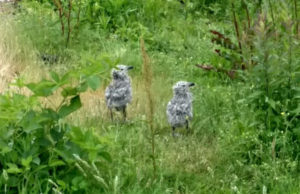
As a annoying as the adults can be, seagull chicks register high on the cute scale. At least we didn’t get attacked by the mamma. Photo: Tim Rider

We also talked about climate change and its impact on everything from native and invasive species to ocean acidification and changing currents. We talked about the need to keep diving into these issues and pursue careers in marine science, climatology, ecology, etc. to help solve some of the complex challenges climate change presents.

Students thanked us for coming and talked about some of the projects they were working on and their planned study focus in college.

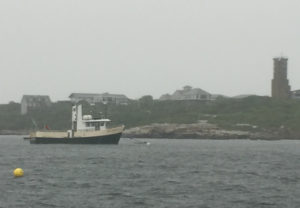
Departure, before the fog really set in.

On the ride home, as the grey skies grew darker into dusk and the bow bobbed to the pounding beat of blaring rap music, Tim and I remembered why we took a full day off to plow through some fairly gnarly weather and talk to a handful of college students from across the northeast.


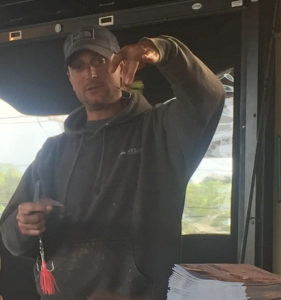
Top photo: Capt. Tim Rider telling fish tales.

All Blog Posts

“We’ll Always Have Paris”… or not

  • June 10, 2017October 20, 2021
  • by Colles Stowell
Share it!
Share

Some interesting questions on climate change arise as I’m preparing a discussion on seafood sustainability with college students next week. The administration’s withdrawal from the landmark Paris climate accord have brought these questions to the fore, even if the underlying causes have been brewing for some time.

  1. What message are we sending high school and college students if we as a country (the largest historical contributor to climate change) step away from a global agreement on the issue?
  2. How do we convince students who may be on the fence about pursuing marine or climate science careers that we need more research, funding and more young brilliant minds to help us try to keep up with climate change if our government shows little willingness to believe in the need for, much less fund further research?

Throwing down a challenge

This spring I developed new high school lesson plans for seniors that focused on climate change impacts on seafood in the Gulf of Maine. The narrative begins with a broad view of the domestic and global seafood dynamic, and then focuses on why consumers should care, highlighting everything from bycatch to environmental impact and social ramifications.

Then we discuss the rapid temperature increase in the Gulf of Maine (faster than 99% of the Earth’s oceans), recent research on changes to global ocean currents and salinity and increasing ocean acidification due to higher absorption of man-made CO2. We talk about how fishermen are on the front lines of recognizing climate change impacts, and how they are struggling to interpret what the long-term ramifications are on their livelihoods. We discuss how researchers continue to improve our visibility into near- and long-term impacts of warming water, OA, and current and salinity changes.

We also discuss how despite these advances, we’re still often two steps behind climate change because we have much more research to do to figure out how myriad factors work in concert to change marine ecosystems where fish and shellfish try to thrive. A lot of the complex geophysical interactions demand more research so that we can have a more precise view of how we must adapt to, not fix, climate change impacts.

Then I challenge them to help find a solution. I urge any of them remotely interested in marine or climate sciences to commit to help us better understand these issues. Doing so would not just help from an environmental perspective, but an economic and social one as well. If our oceans rise by nearly seven feet by the end of the century (as some scientists now predict), water temperatures increase by several degrees and the ocean’s acidity increases just a little bit, seafood markets could suffer tremendously.

Mixed messages

So when the 2nd largest polluter in the world (China is tops by far, but the US has generated more over time) pulls out of the most significant global agreement on climate change – one that it helped coordinate – what does that say to these students? At a time when we should be doing everything to encourage young people to pursue these careers, our administration is caving to an industry that is literally fueling the problem.

The irony is staggering.

I will continue proselytizing. This is not the time to let political isolationism derail global momentum toward some semblance of unified action on climate change. Stepping away now simply cedes the leadership role to other countries that may have more to gain.

Reneging on the deal may also create another hurdle to convincing students we need their help. Why would they want to spend the time and energy diving into the issues if there isn’t going to be any money to support their efforts?

Rallying cry

Conversely, the administration’s move may have some consequences advisers may not have fully predicted ahead of time. Climate change has again become a major topic of conversation here. Individual cities and states are talking about signing on independently. Perhaps the withdrawal will, like other recent administration edicts, become a galvanizing point.

I hope so. That would make these discussions more relevant, and perhaps, more effective. I’ll have a better perspective next week after I speak with the students participating in the Sustainable Marine Fisheries Course at the Shoals Marine Laboratory hosted by N.H. Sea Grant.


Additional reading:

Vox overview of the Paris Accord and climate change.

The Economist view of the impact of the US withdrawal.

New York Times analysis with compelling graphics on the implications of the withdrawal.

National Review blog showing conservative support for the administration’s decision.

Climate Nexus analysis disputing conservative claims in the president’s speech on the withdrawal.


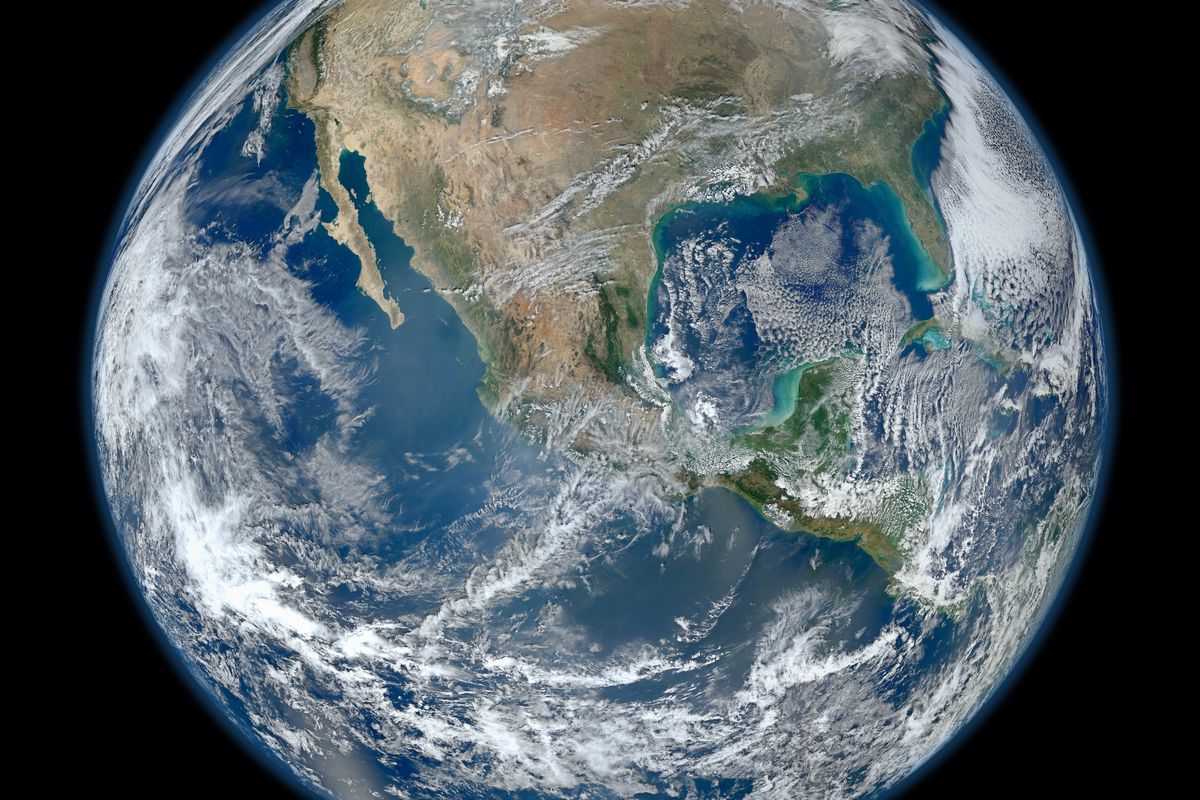
Top photo credit: (NASA/NOAA/GSFC/Suomi NPP/VIIRS/Norman Kuring)

All Blog Posts

The Story of Seafood

  • May 25, 2017October 20, 2021
  • by Colles Stowell
Share it!
Share

There’s a fair amount of planning that goes into these KNOW FISH dinners. Working with fishermen and oystermen to provide product. Coordinating dates, menus, sales operations, space, staffing etc. with chefs. Logistics.

Despite all of this planning, sometimes things change last minute and you have to adapt. It’s an almost everyday occurrence in the restaurant industry, particularly when you strive to be farm- or boat-to-table.

And so I found myself shucking a few dozen oysters at Tinos Greek Kitchen less than an hour before guests were to arrive last night. As often happens, Mother Nature dictated a deadline change when it dumped heavy rain on Great Bay on the Piscataqua River over the weekend, forcing the state of New Hampshire to close the bay to shellfish harvesting the day before the event.

We scrambled to get some Gulf of Maine oysters, and processed them just in time for dinner. It became a great talking point about eating with the ecosystem (ie, adapting to what’s available and what Mother Nature allows). Fishing is no exception. Capt. Tim Rider of New England Fishmongers, who provided the fish for the dinner, will tell you change is a constant. He could find pollock in the same spot three days in a row in 300 feet of water 60 miles offshore. But on the fourth day, the wind is cranking at 30 knots with eight-foot swells and his boat, the F/V Finlander, stays docked. On the fifth day, the fish have moved out.

Snow Island Oysters, seeded in Quahog Bay off Harpswell, Maine to help clean the bay. Photo credit: Ed Marshall

Seafood stories

At the dinner, we discussed the importance of eating what’s locally available, abundant and in season. For example, squid are cruising in numbers in the Northeast Atlantic. Chef Mark Segal and his team prepared wood grilled squid (from the F/V Rimrack out of Rye, N.H.) with roasted eggplant, roasted red peppers, crispy smashed chickpeas, olives, pepperoncino, feta, egg breadcrumbs and green crab aqua pazzo. Fabulous. The plates went back to the kitchen scraped clean.

Stuffed local squid that didn’t last long in anyone’s dish. Photo credit: Mike McGrail

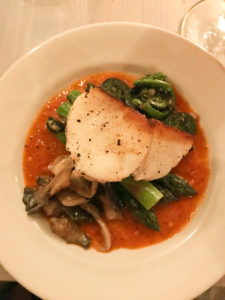
The menu itself testified to the narrative of eating what’s local and fresh. The fourth course was listed as “Local Whitefish al Forno” because Chef Mark prepared the menu not knowing which groundfish Capt. Tim would bring in that day. The pollock, which was fired to the perfect temperature, texture and taste, was served with finnan haddie (cold smoked Finlander haddock) risotto, English peas, fiddlehead ferns, and hen of the woods mushrooms. Stellar.

Fresh pollock al forno landed aboard the F/V Finlander. Photo credit: Mike McGrail

We discussed how every dish has a story, just as every piece of seafood we purchase has a story. The story tells where, when, how and by whom it was harvested. The question is whether we can get that story before we buy; whether we can believe that story; and what that story actually is. Because U.S. seafood consumption is so disproportionately skewed toward cheap imports (more than 90% of the total seafood consumed domestically), finding the truth behind the seafood requires vigilance from consumers. They have the right to find out these stories so they know what they’re eating.

Capt. Tim rider displays a heavy jig and the type of fly used to catch groundfish, like the pollock on the menu. Photo credit: Ed Marshall

The Snow Island Oysters I helped shuck were from Quahog Bay in Harpswell. The Quahog Bay Conservancy seeded the oysters for aquaculture a few years back in an effort to help clean the bay. As filter feeders, oysters remove some of the excess particulate matter like plankton and nitrogen that could choke the bay with harmful algae if left unchecked.
Another course weaving in the local seafood narrative with a Greek twist featured Dolmades, grape leaves stuffed with Maine cultured mussels, golden raisins, red onion and served with saffron avgolemono (a Greek sauce featuring egg yolk, lemon and broth). Again, excellent Mediterranean flavors complementing Gulf of Maine seafood.

Rethinking seafood purchases

On the theme of adaptation, I urged attendees to re-think how they approach seafood purchases by taking a more active role in discovering the story behind the seafood. As with previous KNOW FISH dinners, we printed some sustainable seafood principles, called the 7 C’s of Sustainable Seafood, on the back of the menu. I encouraged them to take those concepts with them the next time they go to a seafood counter or a restaurant. Buying local is like making a covenant with local fishermen: “I trust you to provide good, sustainably harvested seafood. You trust me to pay a fair price.”

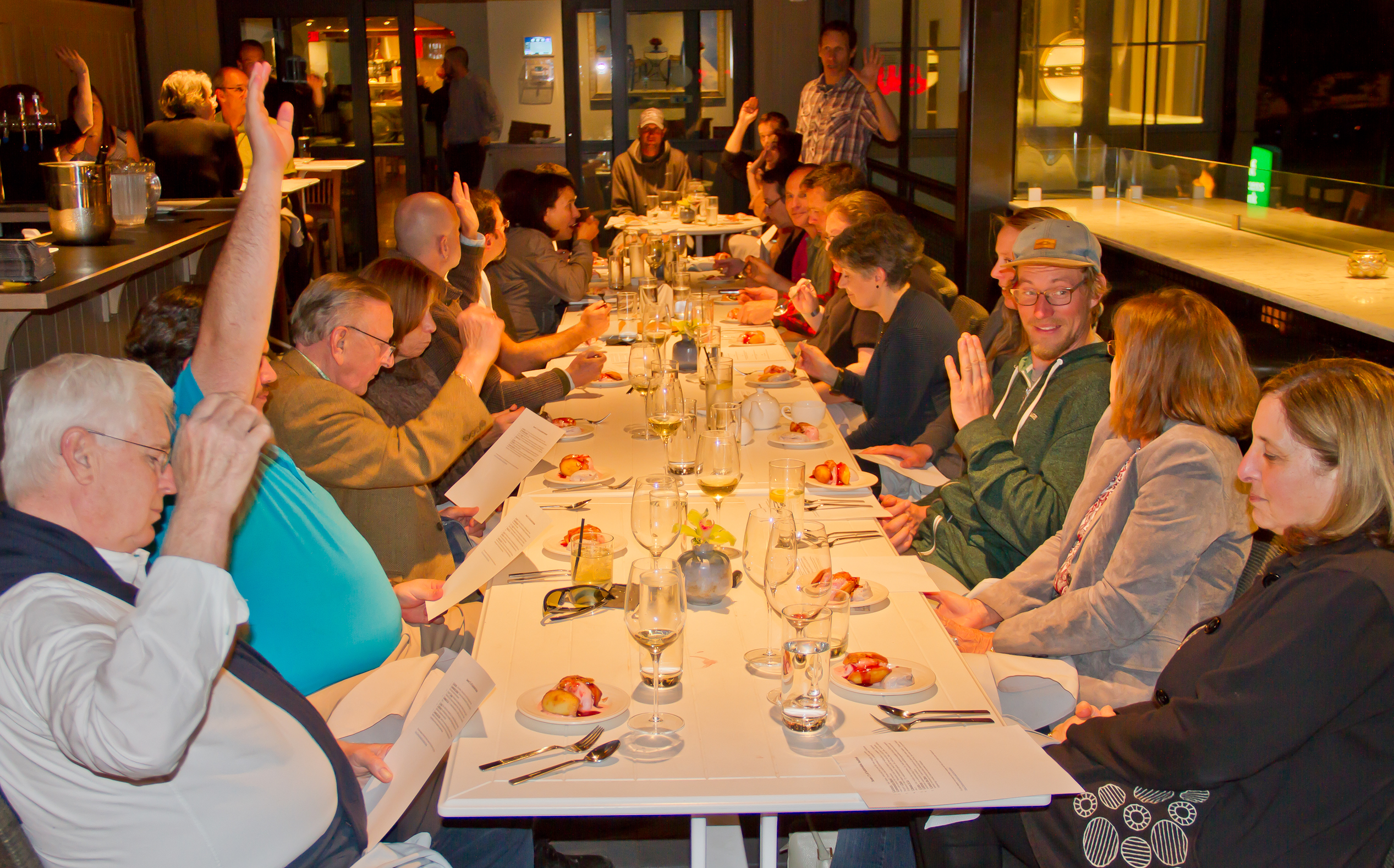
Capping the evening with a mission to spread the word over an inventive, and very satisfying dessert. Photo credit: Mike McGrail

Doing so likely supports fishermen like Capt. Tim Rider, or oystermen like Steve Weglarz of Cedar Point Shellfish and Brian Gennaco of Virgin Oyster, Co., who were both on hand to discuss local oyster aquaculture.

I asked everyone at the table to channel the energy from the event into conversations they have in their communities. Changing a broad national dynamic such as how we buy seafood in the U.S. happens at a grassroots level by spreading the message as often, as loudly, and as passionately as we can.

Top Photo: Reviewing the 7 C’s of Sustainability over dessert — Swedish Fish ice cream, lingonberry glaze, madeleine, almond brittle and blueberry cream legere. . Credit: Mike McGrail

All Blog Posts

KNOW FISH: Know your fishermen and make a difference

  • May 11, 2017October 20, 2021
  • by Colles Stowell
Share it!
Share

Relating sustainable seafood concepts is not always a linear conversation. Sure, you can cover the essentials: Buy local; buy abundant; avoid harmful harvest methods; be aware of any regulatory compliance issues. But getting the message to sink in involves an emotional trigger from the consumer. They have to care about it.

So I told the crowd at the KNOW FISH dinner at Franklin Oyster House in Portsmouth, NH Tuesday night that they might approach their next seafood purchase the same way they do when buying eggs or produce at a farmer’s market. That direct-from-the-producer purchase almost instantly resolves many of the trust issues that arise with buying seafood at a store or restaurant.

Seafood consumers have the right to ask the same questions standing at a seafood counter or sitting in front of a menu that they would have buying ground beef from the farmer. Where does it come from? How was it harvested? When was it harvested? If it was farmed, what was it fed?

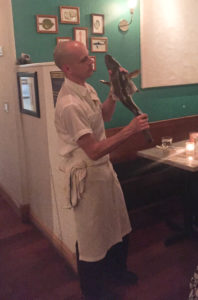
Franklin Oyster House Chef/Owner Matt Louis telling the tale of the cod. photo credit: Stephen Martin.

One conversation at a time

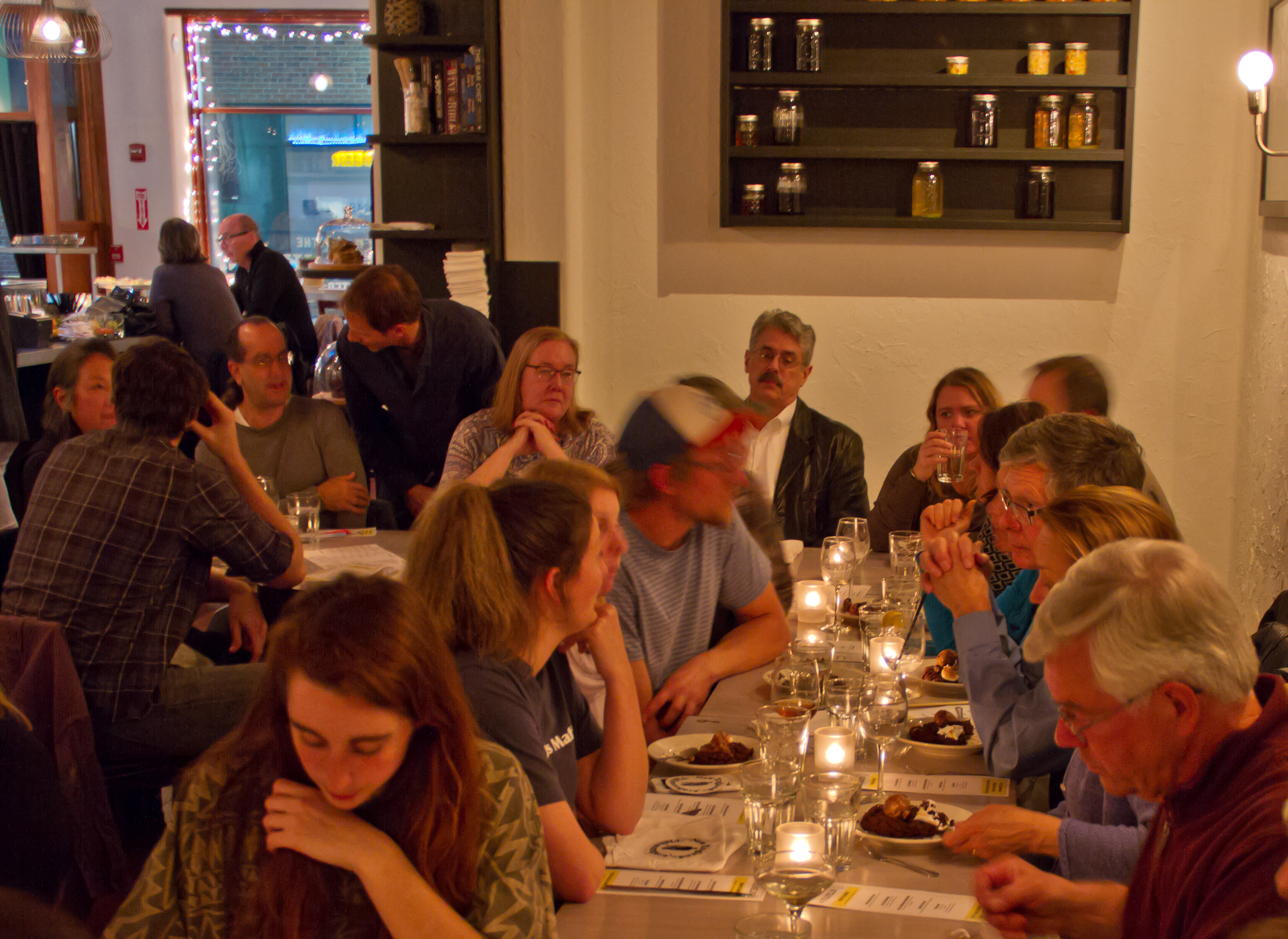
It was anything but a quiet dinner. It was an engaging conversation and everyone was involved. The food curious. The fishermen. The locals looking for an interesting evening discussion and dinner. The oystermen. The foodies. The activists.

At the outset, I invited everyone into the conversation by asking them to either announce why they’d attended the KNOW FISH dinner or to mention a key factor in their seafood buying decisions.

From there, the conversation took off, and we covered topics such as sustainable seafood definitions, the shockingly high proportion of imported seafood consumed in the U.S., industrial scale fishing impacts on global and domestic markets, climate change, what to look for in local seafood and how to support local fishermen.

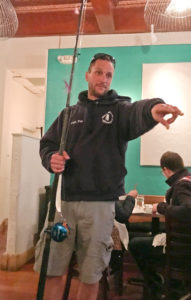
Capt. Tim Rider and the fishing gear responsible for the evening’s tasty meal. Photo credit: Kate Masury, Eating with the Ecosystem

Fish tales

People were able to ask Capt. Tim Rider about how and why he fishes with rod and reel for ground fish. They wanted to know where they could get his fish, which was brilliantly prepared by Chefs Matt Louis and Matt Decker. Salt Cod Brandade with a killer ramp pesto and Roasted Cod that was swimming about five hours before it arrived on our plates. And what a treat it is was to taste the spring bounty of fresh fiddleheads, asparagus and ramps!

Got fresh? How about swimming in 100 feet of cold North Atlantic water 5 hours before appearing as roasted cod in this photo? Photo credit: Kate Masury

Capt. Tim suggested attendees patronize restaurants like Franklin Oyster House Black Trumpet and 7th Settlement in Seacoast N.H., and When Pigs Fly Pizzeria in Kittery, Me. (as well as other area restaurants) that buy fish from New England Fishmongers, the company he and business partner Amanda Parks operate. He also mentioned that they have started a local community supported fishery, which like a CSA, allows people to buy shares of the upcoming catch every week during a season. This model replicates the farmer’s market buying experience.

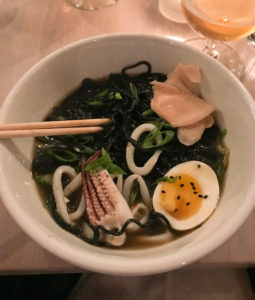
Attendees asked oysterman Tim Henry of Bay Point Oyster Company about the Franklin Oyster, which was served at the beginning of the meal, and which Tim grows expressly for Chef Matt Louis at Franklin Oyster House. They talked about some aquaculture details such as the process of nurturing the spat that grows into adult oysters with oysterman Brian Gennaco of Virgin Oyster Co. This conversation was set to the backdrop of an otherworldly Asian-inspired dish featuring grilled squid served over squid ink ramen cooked in a green crab stock. That stock fed the conversation about why green crabs do so much ecological harm and the ways of trying to popularize their use in cooking.

REALLY tempted to ask for seconds! photo credit: Kate Masury

As everyone tucked into a chocolate-coma-inducing dessert called “Phish food” (a “fudgy” cookie topped with chocolate ice cream, caramel and a torched marshmallow), we talked about how individually and together we can make a difference. Individually, attendees can refer to seven sustainable seafood principles printed on the back of the evening’s menu when considering seafood. Together, we all need to spread the message. When, where, how, and by whom seafood is harvested matters. It matters, locally to our diets, our conscience, the fishermen in our communities, the communities themselves, and the seafood resource. It also has global significance.

The next KNOW FISH dinner at Tinos Greek Kitchen on May 23 will continue this conversation.

The more we have these conversations, the more we shift the current domestic dynamic.

Here’s how to get your tickets and get in on the discussion.


Top photo credit: Stephen Martin


All Blog Posts

Whose protein is it anyway? Industrial fishing and it’s…

  • May 3, 2017October 20, 2021
  • by Colles Stowell
Share it!
Share

When we talk about food security, we broadly mean the ability of a people to have access to healthy, affordable food on a consistent basis. This dynamic assumes that the food has been legally harvested, has not been treated with tons of chemicals and is most often the product of local farmers and fishermen. From a global seafood perspective, the approach to food security has furthered the divide between the haves and the have-nots because food security overlooks two critical aspects: scale and community control.

Sure, money dictates the conversation, but the issue really comes down to scale. Artisanal fishermen, who either fish to eat or make a small living at local markets have a particular vested interest in the health and survival of the fishery. But larger operations have a different perspective. Because of their scale, they absolutely must focus on profit. Otherwise, they don’t survive. That viewpoint often puts fragile fisheries in peril.

A very long trawl

Take the fisheries off the coast of West Africa. Artisanal fishermen there typically harvest the migrating mackerel, anchovy, sardinella and other species passing through their waters. Unfortunately, their catches have plummeted as scores of foreign vessels have plundered their waters, scooping up millions of tons of fish illegally. A recent story in The New York Times spotlights illegal fishing off the coasts of Mauritania, Senegal, The Gambia, Guinea Bissau, Guinea, and Sierra Leone. This illegal harvest has cost these nations more than $2.3 billion in lost revenue, according to a report in the journal Frontiers in Marine Science.

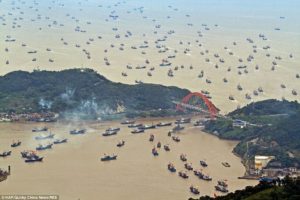
Want scale? Chinese fleet leaving busy harbor in Zhejiang Province.

The dominant foreign fleet is not surprisingly China, whose long-range fishing fleet has swelled to between 2,600 and 3,400 vessels (depending on whom you ask), which is at least ten times larger than that of the U.S. This fleet is government subsidized to both sate China’s enormous seafood appetite (which accounts for a third of global consumption, according to the U.N.), but also to grow foreign market revenue. China owns the global seafood export market and is responsible for more than 60% of the world’s exported farmed seafood.

China’s long-range fishing vessels working off the coast of Africa have increased from a dozen in 1985 to more than 450, according to Greenpeace. Much of the foreign fishing off the coast of Africa is illegal, whether because of intrusion within the 200-mile exclusive state waters, overharvest or other violations. Like other foreign fleets fishing illegally here, Chinese vessels fly local flags. They turn off their electronic monitoring devices. They fish in Senegalese (and other country’s) waters at night. They operate off the coast of other West African nations that don’t have much enforcement infrastructure.

By some estimates, one of China’s larger boats can theoretically haul in as much fish in one week as a Senegalese boat might harvest in an entire year.

So why should we care?

This should get our attention for several reasons. First, as foreign fleets deplete fish stocks off the coast of West Africa, they’re pushing small scale, artisanal fishermen out of business. Worse, they’re driving steep fish price increases in nations where food is already scarce in many regions, even as coastal populations increase.

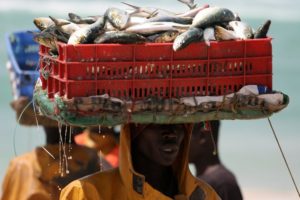
Senegal fish stocks have plummeted as the foreign industrial harvest has grown. Credit: Linda Schonknecht/Marine Photobank

Many of the migrating anchovy, mackerel and sardinella harvested there are ground up into fishmeal in processing plants in nearby Mauritania and elsewhere and sold to feed farmed shrimp, tuna and salmon (as well as pigs and chickens) shipped around the world.

Sadly, those fish fill much of the direct protein needs of people in coastal West Africa (as well as developing nations around the world). According to the UN Food and Agriculture Organization, seafood accounts for 20% of the protein intake of more than 3 billion people. In Senegal, those fish account for more than 40% of the country’s protein intake. A recent study states that 90% of the huge global harvest of these types of small oily fish could be consumed directly by humans rather than ground into fishmeal.

Food sovereignty imbalance

This is a regional food sovereignty issue because coastal Senegalese fishermen have little control over the massive Chinese fleet harvest that is taking their resource. This over-harvest crushes local communities and sends shock waves through global markets.

Here’s the kicker for U.S. seafood markets. That 90% of the seafood eaten in this country is imported has become a widely cited statistic. If China is by far the world’s largest exporter, and we import 90% of the seafood we eat here, there’s a damn good chance that the frozen fish sticks, farmed shrimp and salmon sold in supermarkets here are the byproducts of this illegal fishery off West Africa.

Again, the profit margins to feed higher priced farmed salmon and shrimp to the more well-to-do at the expense of the cheaper more readily accessible protein for the coastal impoverished seems a Faustian bargain. This type of “ocean grabbing” is global in scope and threatens the health of vital fish stocks as well as the lives of the people that depend on them.

Now think about small-scale fishermen in the United States, trying to earn a living, mostly complying with regulations and caring about the resource because their lives depend on it. Our markets are jammed with cheap, imported seafood, much of which is harvested in similar circumstances as mentioned above. And this seafood is pushing down market prices here because of its volume, making it harder for small-scale fishermen to compete.

Compounding the pressure on these small-scale fishermen are domestic policies like catch shares, which treat access to fishing areas like a market commodity to be traded like stocks and that encourage fleet consolidation. This consolidation raises the cost of doing business so high that many small-scale fishermen are forced out of business.

Some communities are fighting back against “ocean grabbing” by finding ways to gain local control over their fisheries and re-establishing their food sovereignty. Here is a link to The International Planning Committee for Food Sovereignty that is providing small-scale food producers and local organizations the infrastructure and guidance to strengthen their local markets.

What can we do about it?

Here are a few steps people can take in their personal lives to support local seafood systems and community fisheries:

  1. Know your seafood. I tell all of my classes, the best thing consumers can do is ask questions. Find out where, when, how and (if possible) by whom their seafood was harvested.
  2. Think about scale. Was this seafood caught by a local fisherman, or an industrial-scale operation?
  3. Find stores and restaurants that sell local, sustainably harvested seafood.
  4. Is there a community supported fishery near you? Like a CSA, CSFs, cut out the middle man and allow you to deal directly with fishermen. Get to know your fishermen and you’ll appreciate the work they put into it.
  5. Eat seasonally. Fish and shellfish aren’t necessarily available in one region throughout the year. So learn what is seasonally available near you.
  6. Do your research. Learn about local, regional and global fisheries issues. Learn about the different types of aquaculture and their environmental, social and economic impacts.
  7. Get involved. If these issues matter to you, be an evangelist. Share the message that our seafood decisions have an impact locally, regionally, nationally and globally.


Top photo credit: Inoussa Maiga


All Blog Posts

Age Is Irrelevant: Our Seafood Choices Matter

  • April 24, 2017October 20, 2021
  • by Colles Stowell
Share it!
Share

Standing in a light misting rain at a chilly March for Science rally with my daughter on my shoulders, I marveled at the number of families in attendance. The scene struck a chord with me. Science has a story for everyone, regardless of race, sex, age, income, etc. It’s all in how the story is told, and our willingness to listen to it.

Early involvement! Photo credit: Jaime Stowell

This is true for my work with One Fish Foundation. Regardless of where I’m speaking, there is one constant. The age may change, but the overall message is the same: Our seafood choices matter.

I saw this writ large last week when I spoke to two groups of high school seniors about climate change impacts on seafood in the Gulf of Maine, and then spoke to four groups of elementary students the next morning. That I delivered the latter talks in French was just icing on the cake.

What keeps everyone’s attention is the ability to tell a story that resonates.

Seafood, as a hook for discussing climate change

I initially engaged Portland High School students in the discussion by getting them to tell me what type of seafood they liked. Then we talked about how some of that seafood was likely caught … or farmed and the implications. From bycatch to chemicals, the narrative opened their eyes … quite wide with some stats … as to why they should try and find out where, when, how and even by whom (if possible) their seafood was caught.

That led into a more involved discussion about how climate change impacts, such as warming water, ocean acidification, changes in current and salinity, affect the seafood we eat globally, domestically and regionally in the Gulf of Maine. We talked about the mystery surrounding the collapse of the Northern Shrimp fishery in 2012, and the race for scientists and fishermen to get answers. Right now, scientists believe the shrimp have a narrow comfort range, and that the increasing temperatures in the Gulf of Maine may be affecting everything from reproduction to eating habits.

Students also learned that we’re gaining more information every day about the effects of warming waters, increased ocean acidity (particularly on molluscs’ ability to calcify their shells) and how ocean currents and salinity are changing. But as one of the lead authors of the Arctic Resilience Report told me last fall, we still have a way to go before we understand in depth how disparate climate change factors work in concert to affect different ecosystems or species in those ecosystems.

I left the students pondering the notion that rather than trying to fix climate change (we can’t), we need to learn how to adapt. This means finding more ways to better predict and respond to these changes. It also means that on a personal level, we need to understand what we can do. Students learned they have the right to try and find out when, where and how their seafood was harvested (or farmed). They also learned they can be evangelists for the sustainable seafood message.

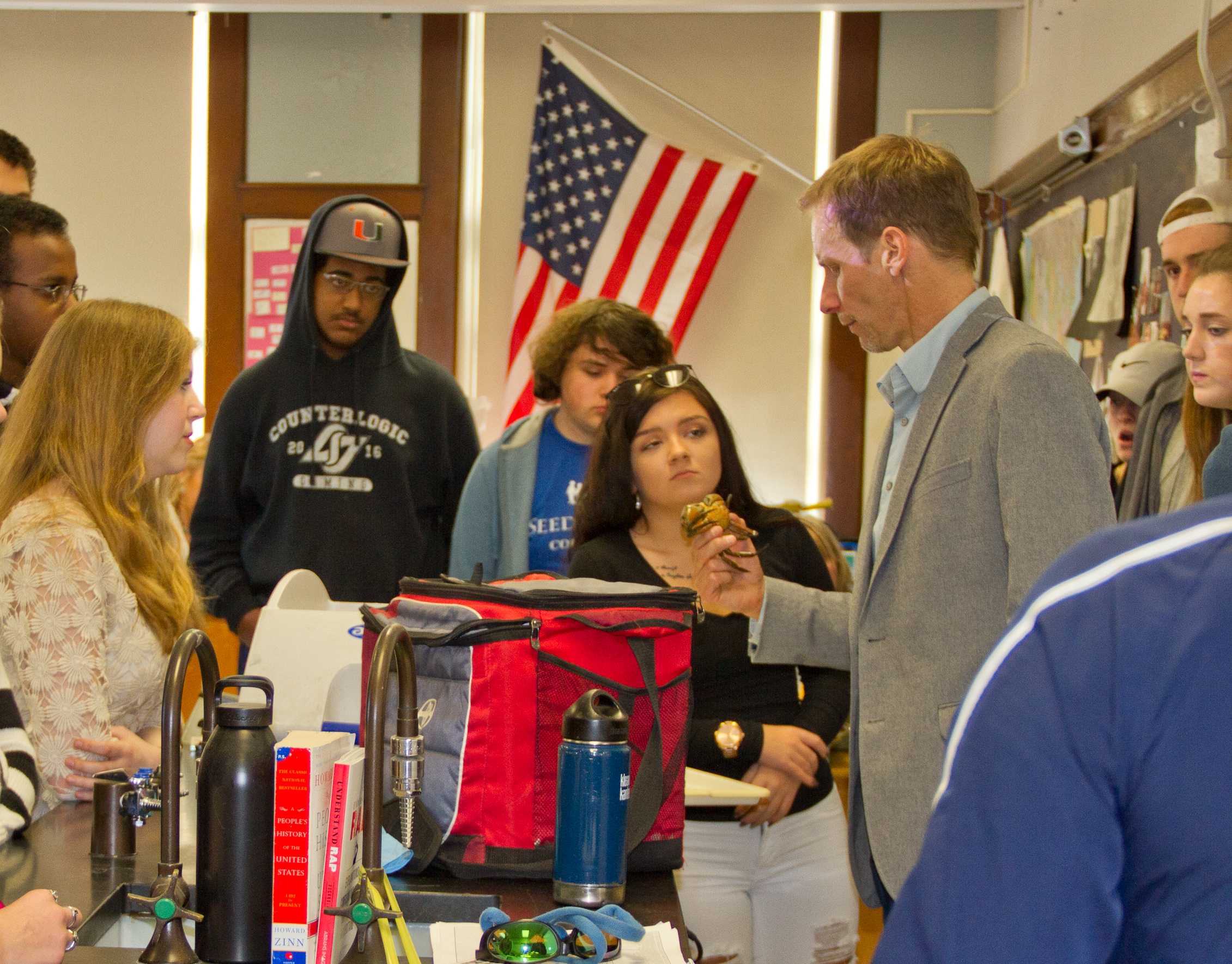
Hands-on…the crabs, the dead fish, the gear…

The younger the audience age, the more hands-on the discussion needs to be. So I hauled in a lobster trap, a turtle excluder device, some gillnet, live green crabs and a dead black seabass to L’Ecole Française Du Maine.

Turtle excluder devices are great conversation pieces…seriously. Photo credit: Elodie Le Nezet

I varied the message to accommodate students between ages 4 and 11. For the younger students we first talked about what seafood they liked before talking about the different methods for ensuring fishermen catch what they’re targeting so they can minimize bycatch. We talked about how a lobster trap works, how videos have shown lobsters can go in and out of these traps at will, and what it means when a lobsterman pulls up a trap filled with black sea bass.

We also used my daughter’s stuffed turtle to demonstrate how a turtle can escape being caught – and ultimately drowned in a trawl – by way of the grate used in a turtle excluder device. The primary message to them is that for the most part, fishermen want to take care of the resource, and that some capture methods are better than others at minimizing bycatch.

I extended that discussion with older students to include predator/prey relationships, and how things like bycatch or climate change are changing ecosystems in the Gulf of Maine. They loved seeing the green crabs up close as we discussed the devastation wrought on eelgrass beds as the crabs dig up clams, mussels and oysters.

All of the students wanted to touch the fish.

In the end, all of the students I spoke with last week, at Portland High School and L’Ecole Française Du Maine, began to understand that yes, where their seafood comes from and how it was harvested matters to them and the resource.


Top photo credit: Taylor Mason, College of the Atlantic

All Blog Posts

KNOW FISH Dinners: A Second Helping

  • April 21, 2017October 20, 2021
  • by Colles Stowell
Share it!
Share

You’d call a dinner and conversation event a success if the parting words of many of the attendees echoed this theme: “We should be having more of these conversations.” By that measure, last fall’s KNOW FISH dinners were a big success. Attendees learned about the provenance of the fish they were eating, they heard from the fisherman who sustainably caught their fish that day and they had a great conversation about why it all matters and what they can do.

So we’re doing it again. This spring’s KNOW FISH dinners will be held at Franklin Oyster House in Portsmouth on May 9, and Tinos Greek Kitchen in Hampton on May 23. Both events will begin at 6 p.m.

This is your chance to learn why the domestic seafood picture is so skewed. Yes, many people know the oft-cited statistic that more than 90% of seafood eaten in the U.S. is imported. But the reasons why are a compelling motivator for finding out where, when and how your seafood was harvested.

New England Fishmongers Partner Amanda Parks getting it done.

At the KNOW FISH dinners, you’ll be able to ask Capt. Tim Rider of New England Fishmongers why he risks life and limb to haul up to 80 miles offshore in the 36-foot F/V Finlander to fish with rod and reel in up to 400 feet of water. You’ll be able to ask an oysterman like Tim Henry of Bay Point Oyster Company about what it takes to grow oysters and why that is so important. You’ll learn about how their passion for what they do drives them to overcome obstacles and stay focused even as management policies change around them.

And you’ll feast on spectacular meals prepared by Chefs Matt Louis and Matt Decker of Franklin Oyster House and Chef Mark Segal of Tinos, using incredibly fresh, undeniably sustainable seafood. The fish and oysters will be whatever the ocean yields that day.

You’ll learn about some of the key domestic and global market dynamics that affect seafood sustainability. That information will help you better understand why your choices matter at restaurants and seafood stores. We’ll provide you with some memorable tips on buying seafood that is local, abundant, compliant and that minimizes ecosystem and environmental harm.

And we’ll talk about ways you can carry these messages forward into the community, and perhaps effect a sea change in seafood buying habits.

After all, this kind of change happens one conversation at a time … from the ground/sea floor up.

Come join us for great food, conversation and fun!

Get your tickets by following this link to Eventbrite.

All Blog Posts

On the Cafeteria Menu: Local, Abundant Seafood

  • April 12, 2017October 20, 2021
  • by Colles Stowell
Share it!
Share

Hospital food. School cafeteria food. Few menus instill as much dread, appetite aversion or standup comic material.

Fortunately, the farm/boat to table movement continues to grow, beyond the individual consumer to institutions. This message was boldly apparent at the Farm to Institution New England conference last week held in Leominster, Mass.

More than 400 representatives from various parts of the food system discussed many issues, challenges and solutions to streamlining the path for good, locally produced food to New England institutions like schools and healthcare facilities.

While this sounds like a fairly straightforward proposition, the process is by no means easy. Breaking decades of habit- and price-based sourcing patterns from national distributors while changing menus and “customer” palates takes time, patience, lots of education and some trial and error. Education of the palate can be one of the steeper challenges. How are you going to convince a bunch of middle school students to eat pollock?

There’s hake in that burger!

First, you have to make it tasty, and create a dish that is recognizable. For example, Cape Ann Fresh Catch Executive Director Donna Marshall has brought fish burgers and chowder into cafeterias for students to try. She rarely has any leftovers, and the sampling has led to seafood from Cape Ann Fresh Catch prepared and served in these cafeterias.

At the FINE conference, Jennifer Devivo, head chef at the Up Island Regional School District on Martha’s Vineyard described how she plays a game with her elementary and middle school students to guess what the fish of the day on Fridays will be. While eating locally harvested oysters or fried dogfish, students learn about who harvested the seafood (often a neighbor) how and when it was caught, and what role that species plays in the ecosystem.

It’s all in the narrative.

Finding balance

At the FINE Summit I was fortunate enough to moderate a panel about balancing institutional seafood demand with what’s locally available…and abundant. We engaged session attendees in an interesting discussion about abundance. The stock health of different species plays a critical role in eating with the ecosystem, or eating what’s locally available throughout the different seasons and migratory shifts in the ocean.

Titled Eating with the Ecosystem, the discussion began with me providing a brief overview of the regional, domestic and global seafood systems: more than 90% imported to the U.S., the average seafood travels more than 5,000 miles from boat to plate, we’re now growing more seafood for consumption than we’re harvesting, etc. I explained that all of these factors have an impact not just on the resource, but on fishermen and their communities.

Kate Masury discusses the concept of eating with the ecosystem. Credit: Brett Tolley

Kate Masury, program manager of Eating with the Ecosystem, a Rhode Island non-profit promoting a place-based approach to sustainable seafood, discussed recent research from the University of Rhode Island. The study compares the relative abundance of several species in the Gulf of Maine to how much of that species is landed. This ratio gives a visual of roughly what species are most abundant here because they are being harvested less.

Dogfish are at the top of the list, which is no surprise. However, 99% of U.S. caught dogfish, which by the way is delicious fried, is exported for … you guessed it, fish and chips. Lobsters, on the other hand, while still plentiful, are harvested at a high rate that fisheries managers say is sustainable. Hake, skate and scup were also under-harvested relative to abundance.

Bringing local, abundant seafood to hospitals and schools

Next, John Stoddard, healthy food in health care coordinator for Health Care Without Harm, explained some of the challenges and successes in working with healthcare institutions to choose locally harvested, abundant seafood. He pointed to Boston Medical Center and Massachusetts Eye and Ear as regional facilities sourcing seafood from Cape Ann Fresh Catch and the Gloucester Fishermen’s Wives Association.

Bob Bankhert, chef de cuisine at University of Massachusetts Amherst talked about the school’s successes in bringing locally available seafood to students. Here are some of the highlights:

  • 3,000 lbs of dogfish per month/ 500 lbs every Friday
  • 10,000 lbs of Acadian Redfish per year
  • average student consumes 21 lbs of seafood per year, vs. 14 lbs for average American.
  • UMASS Amherst ranked #1 by Princeton Review for campus food.

We had thoughtful discussion with session attendees about how to replicate this notion of eating what’s locally available and abundant, and how to get schools and hospitals to follow suit.

Again and again, the conversation kept coming back to telling the story … of the fish, the fishermen and the resource. Getting people to understand their relationship to the resource and the social, economic and ecosystem impacts their decisions have.

I walked away from the session and the conference with the sense the One Fish Foundation mission to expand the sustainable seafood conversation is making progress. This is especially true as we help engage partners like chefs, hospital advocates, community groups and the public around these issues.

Posts pagination

1 2 3 4 5 6 … 9

Recent Posts

  • Hurricane Ida wreaks havoc on Louisiana’s seafood industry
  • EPA Should Use Clean Water Act To Kill Zombie Mine
  • Slow Fish 2021: Relationship Matters
  • Faith, Façades, and Futility
  • Pebble Permit Paused: Politics at Play

Archives

  • September 2021
  • August 2021
  • April 2021
  • December 2020
  • August 2020
  • June 2020
  • February 2020
  • December 2019
  • November 2019
  • October 2019
  • July 2019
  • May 2019
  • April 2019
  • March 2019
  • January 2019
  • December 2018
  • November 2018
  • June 2018
  • May 2018
  • March 2018
  • February 2018
  • January 2018
  • December 2017
  • November 2017
  • October 2017
  • September 2017
  • August 2017
  • July 2017
  • June 2017
  • May 2017
  • April 2017
  • March 2017
  • January 2017
  • December 2016
  • November 2016
  • October 2016
  • September 2016
  • August 2016
  • July 2016
  • June 2016
  • May 2016
  • April 2016
  • March 2016
  • February 2016
  • January 2016
  • December 2015
  • November 2015
  • October 2015
  • September 2015
  • July 2015
  • June 2015
  • May 2015
  • April 2015
  • March 2015
  • February 2015
  • January 2015
Theme by Colorlib Powered by WordPress