Skip to content
One Fish Foundation
  • Blog
    • Aquaculture
    • Education
    • Environment
    • Policy
    • Wild Harvest
    • Fish Tales
  • About
    • About One Fish
    • About Colles Stowell
  • Education
    • Elementary School
    • Middle School
    • High School
  • KNOW FISH Dinners®
  • Resources
    • One Fish Podcast
    • One Fish Foundation in the news
    • The 7 C’s of Sustainable Seafood
    • Newsletter Archive
    • Recipes
      • Skate with Capers and Butter — Chef Rizwan Ahmed
      • Grandma Davis’ Fish Chowder — Jane Almeida
      • Ginger Garlic Tamari Scallops — Colles Stowell
      • Fish Stock — Evan Mallett
      • Mussels San Remo — Chef Rob Martin
      • Salted Pollock Croquettes – Chef Mark Segal
  • Connect
    • Contact OneFish
    • Social
      • Instagram
      • Facebook
      • Twitter
All Blog Posts

Swimming On: the Slow Fish USA gathering from 2016…

  • February 8, 2020October 19, 2021
  • by Colles Stowell
Share it!
Share

The inaugural Slow Fish event in North America took place in New Orleans in 2016. It was an enormous first step, fraught with last-minute adaptation forced by a 500-year flood event in a city that is rather accustomed to flooding. Who knew we’d be eating shrimp and oysters in a warehouse full of floats from perhaps the most raunchy Mardi Gras parade in the city? Nothing says seafood like having every part of outsized human anatomy in lewd, brightly decorated papier-mâché looming over you.

But we made it work! Everyone adapted to the unforeseen circumstances and we had great conversations about consolidation, youth in fisheries and overall messaging and values. We capped Slow Fish 2016 off with an incredible Cajun hog harvest celebration called a “boucherie” across the Mississippi River.

We gathered in San Francisco for Slow Fish 2018 following an intense, but amazingly productive four-month planning period that was delayed by the threat and lingering angst of devastating forest fires in the region. But for the commitment, creativity, and sheer will of everyone involved, Slow Fish San Francisco wouldn’t have happened. That gathering made space for fabulous networking, collective problem-solving, and energy dedicated to shared values for our seas and their stewards.

The San Francisco event took place in a cool warehouse (no sex floats) that we adapted to suit large group discussions, as well as smaller World Café roundtables and PechaKucha (or “Peche” Kucha) mini slide presentations/stories. We also had a Seafood Throwdown, off-site oyster, dinner, and movie events..

Fast forward two years and that energy is still strong. This year, Slow Fish 2020 will go down on March 19-22 in Seacoast N.H., with a Working Waterfront Tour, kick-off dinner, Sunday Fishtival and the programming of a two-day conference at the University of New Hampshire Peter T. Paul College of Business and Economics in Durham.
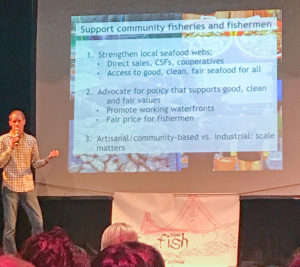
Setting the tone with the Slow Fish 101 presentation in San Franciso. Photo credit: Lance Nacio.

Circling back to Slow Fish USA origins on campus

We chose New England for 2020 to continue varying the geography of these events and give fish harvesters, fishmongers, and others from the region a chance to engage in these conversations.

New Hampshire is important because students at UNH were among the first in the country to embrace Slow Fish values back in 2013. At the time, they encouraged UNH Dining Services to sign a pact to source responsibly harvested seafood and  adhere to Slow Fish values. That pact is still in effect today. Bringing the conference to New Hampshire this year affirms how much the movement has grown in the years since and the importance of youth in the movement.

Rallying young people is especially important in New England as fish harvesters here are fighting against restrictive policies and well-funded efforts to consolidate the industry. This monopolization has created impossibly high barriers of entry for young fishermen and led to an ever-increasing age of the average fisherman, often called the “graying of the fleet.”

Moving the event around to key fisheries regions helps democratize the impact. Slow Fish continues to aim to create an open table for meaningful thinking around the core values of providing good, clean, and fair seafood to all.

At a time when equity, inclusion, and justice issues are increasingly visible, Slow Fish aims to ensure that small-scale and indigenous fish harvesters have fair access to the resource in a market too often dominated by billion-dollar corporations that only care about profits.
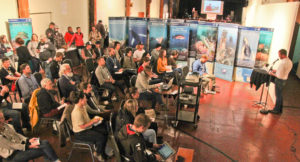
 

Sharing ideas, asking questions, expanding network connections, and collaborating on meaningful change. That’s the Slow Fish formula that will be at work at Slow Fish 2020 in New Hampshire. Photo credit: Eric Buchanan.

Diving deep

We’re going to talk about these and other critical issues in New Hampshire this year. For the first time, we’re going to merge the Slow Fish North America gathering and a regional Slow Food Northeast event, allowing members of both groups to get a better sense of how each group is working to shorten the distance from food source to plate.

Here is a sneak peek of what’s on tap for Slow Fish 2020, and why you should consider joining the conversation:

  • Deep Dive discussions on issues like aquaculture, climate change, and the Blue Commons;
  • Interactive World Café roundtables to explore challenges and opportunities facing youth, women, and indigenous fish harvesters; alternative seafood business leaders; and the Slow Fish Ark of Taste;
  • “Pesce” Kucha storytelling with slides;
  • Delicious food from all over the continent;
  • Tour of the seacoast N.H. working waterfront followed by an opening night feast;
  • Seacoast Restaurant Fish Week from Feb. 13 through Feb. 21 (restaurants in Seacoast NH and Maine provide a special Slow Fish menu and donate a portion of proceeds to Slow Fish);
  • Closing dinner event with music at the Paul College at UNH;
  • Fishtival on Sunday at Throwback Brewery (more food, music, beer, and hands-on demonstrations);
  • Several hands-on demonstrations of nose-to-tail, oyster shucking, etc.
  • A chance to dig into issues, collaborate, and kick it with old and new friends.

I can tell you first-hand that we are planning this year’s gathering with as much, if not more energy and drive as with NOLA and San Fran, and hopefully without any major and unexpected meteorological or other events.

So come join the conversation, expand your network, make new friends, hug old friends, eat fabulous food, and see what the New England Slow Fish and Slow Food communities have to offer!


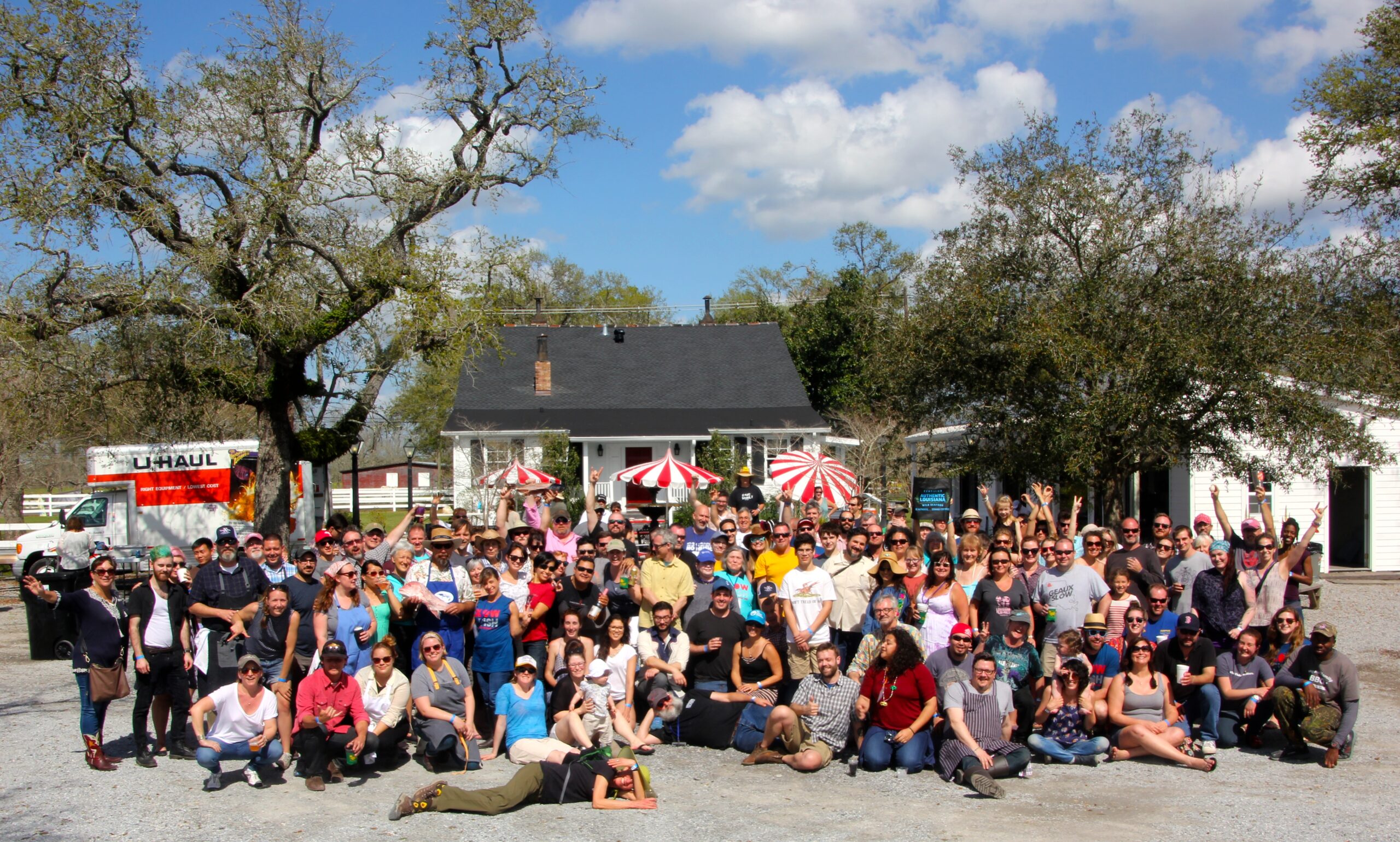
Top photo: Slow Fish 2016 in New Orleans, during the boucherie at Docville Farm. Credit: Eric Buchanan.
All Blog Posts

Attack of the Tiny Green Crabs

  • June 26, 2018October 20, 2021
  • by Colles Stowell
Share it!
Share

I geeked out at the Green Crab Summit in Portland earlier this month. Which is kind of ironic given that I double majored in English and French in college. I’ve always had a fascination with life in the oceans … just not enough to want to embrace organic chemistry in college or graduate work.

I parlayed my majors into a writing career that often drew on investigation to dig deeper into newspaper and magazine stories. The European Green Crab story is compelling. It’s also emblematic of humankind’s ability to alter natural balances with long-term negative consequences.

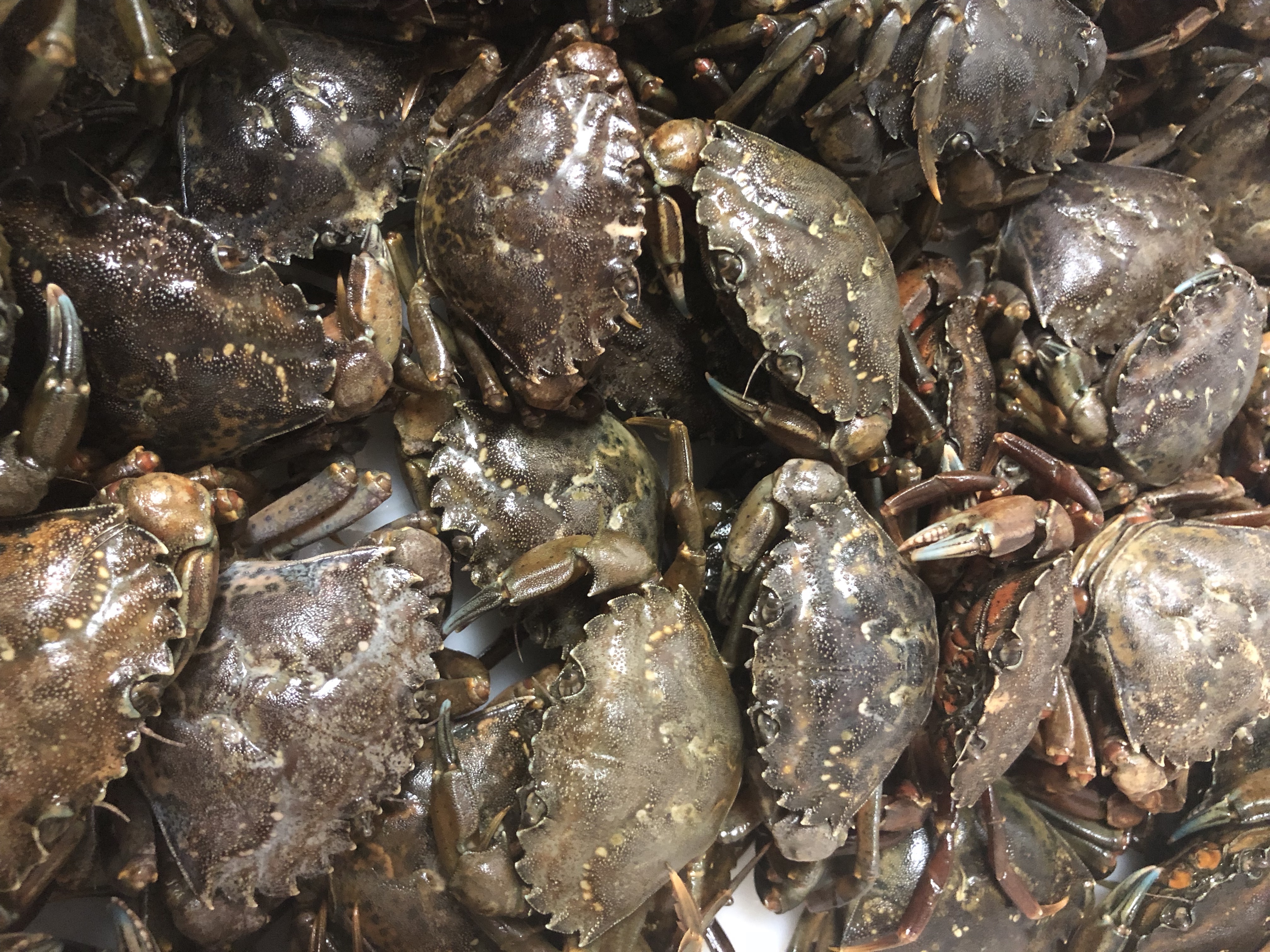
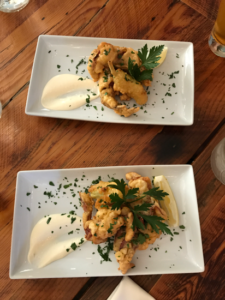
We’re working to nail down the timing of European Green Crabs here in the states. These soft shells were a delicacy at Enoteca Athena in Brunswick, Me. Photo: Marissa McMahan.

Abundant in Spain, France, Italy and other European countries, the green crab is not the frighteningly destructive, ecosystem-tipping species that it is here in North America. Many predators there like fish, crabs and birds help keep green crab populations in check. And Italian fish harvesters and chefs have figured out how to create a market for soft-shell Mediterranean green crabs (a slightly different species than the crabs we have here), as well as a top-dollar market for green crab as bait.


That’s not the case on this side of the Atlantic. The crabs were first officially documented between New Jersey and Cape Cod in 1817 after presumably hitchhiking aboard trans-Atlantic ships in the ballast. Their spread up the coast was steady and relatively uninhibited. To be sure, some were gobbled up by native species here such as striped bass, tautog, lobster, blue claw crabs and other species. But they weren’t and aren’t the regular diet for native species here as in Europe, and therefore they continue to spread.

Different story for other invasives, though. We’re now finding that the newly invasive Asian Shore Crab (first noted in 1988) seems to be displacing and possibly preying upon green crabs, dropping their populations significantly along rocky intertidal zones in Southern New England and heading northward as the water warms. However, we’re kind of swapping out one pest for another.

Christopher Baillie of the Marine Science Center at Northeastern University said Asian Shore Crabs are “generalist eaters” that may have an appetite for many native species such as lobsters, Jonah crabs and molluscs. While there are some Asian Shore Crabs already in Maine, he said they may be up here in bigger numbers in the near future. That’s not good considering they’re rampant in southern New England, where they’ve changed ecosystem balance by dominating once diverse habitats, with densities of up to 200 crabs per square meter.

Tough little buggers

Green crabs are tough, voracious, fertile and very hardy. They can live for days out of water. One crab can eat up to 40 mussels a day and lay 165,000 eggs a year. They are adapting to winter, which seems to be changing their spawning habits. They decimate vital eel grass beds while rooting out mussels, oysters and soft shell clams.

It’s the soft shell clams that have suffered the most at the claws of the green crabs. Casco Bay has witnessed a 70% drop in soft shell clam populations in the past decade. Maine’s landings have dropped from 8 million pounds in the 1970s to 1.5 million in 2016. Recent studies suggest that without significant steps to protect larval clams, 99% of the settling clams (the larval and growing stage molluscs) will fall to predation, and much of that comes from green crabs. Milky ribbon worms have also become a big problem.

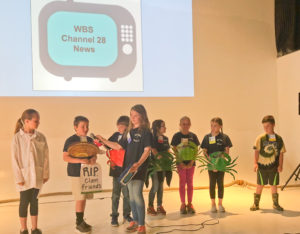
The news was even bleak on the West Bath School Channel 28 News, as students showcased what they’ve learned about green crabs…that they’re devastating to soft shell clams.

Adaptation will be central to protecting the soft shell clam industry and co-existing with green crabs, according to several researchers at the summit. As Sara Randall of the Downeast Institute put it, “We have to think of green crabs as a permanent part of our ecosystem. We need to be active, not passive.” Sara was part of a team of researchers that sifted through more than 34 tons of mud in a four-year study to determine what’s happening with soft shell clams and devise strategies such as protecting larval clams in screened boxes in tidal flats that would keep out green crabs.

However, as with everything concerning green crabs, it’s not that easy. Brian Beal has been studying green crabs and their impact on intertidal ecosystems for more than 30 years. A professor at the University of Maine at Machias, Brian has been outspoken about adapting to the new reality of green crabs and their impacts. “Population control is unlikely and impractical. They can’t be fished out,” he said, explaining that we’re talking about billions of organisms based on several trapping studies throughout the Gulf of Maine.

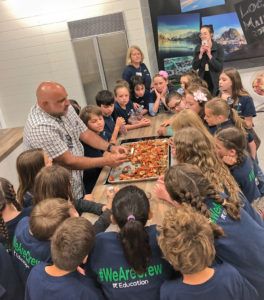
Commercial fisherman Jamie Bassett showing West Bath School students how to extract crab roe.

Green crab bisque, anyone?

One of the common discussion threads was finding ways to make humans the alpha green crab predator. How can we create culinary markets to make green crabs an attractive seafood choice? Again, it’s not so simple. First, their size means there’s little meat yield. And they’re built like tanks, so there’s a bunch of effort to get a small portion of meat.

Second, we Americans have a track record of following habit and price when making seafood decisions. This explains in part why 90% of the seafood we eat is imported. It’s cheaper and hews to menu selection we are most familiar with. Shrimp, salmon, tuna, etc. Collectively, we aren’t adventurous, and so, since we haven’t been eating green crabs for centuries, as they have in Italy (again the slightly different Mediterranean green crab), creating the marketing campaign to get us to start eating vast quantities of green crabs is a hard sell.

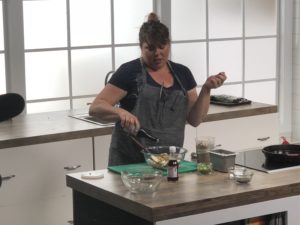
Chef Ali Waks-Adams laid down some green crab rangoon.

I know several chefs in coastal Maine and New Hampshire who are ready and willing to give it a go. Soft shell, stock, mixed in to other dishes. For example, at the event, Chef Ali Waks-Adams (executive chef at the Brunswick Inn) prepared delicious green crab Rangoon using mince (crabs that have been finely ground up, shell and all into a flavorful paste). She also demonstrated how to fry up the small crabs in a batter and eat them like popcorn. Chef Matt Louis (executive chef/owner of Moxy and The Franklin in Portsmouth, NH) created an inventive green crab pozoles dish and a delicately flavored green crab arancini. All of the food we sampled showed the tasty possibilities.

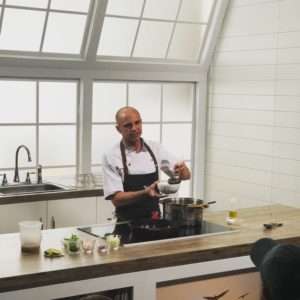
Chef Matt Louis using green crab for a pozoles, a traditional Mexican stew with hominy.

We still have a bit of research to do to nail down the soft shell season for green crabs. That’s because we don’t have the centuries of research the Italians do, and because the green crabs here seem to be adapting to the warming waters of the Gulf of Maine, which seems to be changing when they molt, or shed their old shells. Also, it’s easier to identify pre-molt Mediterranean green crabs than the species in the U.S.

Adapt or get run over

But even if we do create a viable market, we aren’t likely to make a huge dent in the green crab population. “The variability in density and mean size [of the crabs] will make it difficult to create a dependable fishery,” said Beal.

He also dropped another theory that raised several eyebrows. Clams aren’t just worried about the typically sized 3-inch or bigger crabs, but the 3 millimeter crabs feasting on clams that are half a millimeter in width. And it’s going to be damn hard to do much about those little s—s.

Beal agreed with others that adaption will be key, and we’re going to have to make some dramatic changes to the soft shell clam industry if we want to protect it. Some of his suggestions included increasing the amount of clam farming that now occurs, changing the size limit on clams to allow for the prime breeders to reproduce, and closing certain areas along the coast from May to July to allow for more productive spawning.

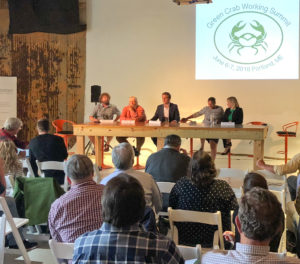
Some of the green crab brain trust discussing policy and other issues and how we need to continue to research and collaborate to better adapt to the new reality of Carcinus maenus.

We heard about one success in green crab mitigation in Canada from Gabrielle Beaulieu of Kejimkuik National Park Seaside Parks in Nova Scotia. She explained how a team of staff and citizen scientists harvested more than 2 million green crabs over a 10-year period. Following the intensive trapping and removal of the crabs, researchers noticed significant gains in eel grass recovery (in areas that crabs had mowed down) and soft shell clam populations.

Green crabs pose a significant threat to several commercially vital species in the Gulf of Maine. I agree with Brian Beale that putting a bounty on green crabs alone isn’t going to make a huge dent. However, I agree with others at the conference that we’re going to have to adapt, and implement a multi-pronged approach to mitigate the challenges. We’ll need to have some widespread harvest/green-crab-as-food markets opened up, along with raising public awareness both about the ecological threat and the culinary benefits of green crabs. We’re also going to have to take some significant steps as Brian mentioned to safeguard species like soft shell clams.

And yes, we need to devote more time, effort and financial resources to figuring out how to address this problem, and the looming time bomb of the Asian Shore Crabs. Knowledge is power … In this case, the power to adapt, rather than be overrun.


All Blog Posts

A College Student Walks into a Webinar…

  • November 23, 2017October 20, 2021
  • by Colles Stowell
Share it!
Share

One Fish Foundation Intern Jennifer Halstead is a senior at the University of New Hampshire. She has been instrumental with several One Fish projects, including the coordination of the recent Webinar co-hosted by One Fish Foundation and Local Catch, Fisheries Management: Best Available Science May Not Be Good Enough. Below is her take on the Webinar from the perspective of a college student, and why we should include college students in these discussions more frequently. And she’s right. Why wouldn’t we want to empower future leading researchers, fishermen and policy makers with a broader perspective and a voice?


By Jennifer Halstead

I had to drive to a neighboring town to run some errands immediately following the webinar, and I had a million thoughts swimming around in my head. So, I did what any millennial would do, and I used my smart phone to take notes for me, setting it to record as I drove.

Listening to the recording later, I realized some critical points. First, I was extremely fired up and passionate about the issues, and even a little angry about some of them. Second, I recognized through this webinar that the scientists, fishermen, and others taking part in the conversation represented a broad range of backgrounds and viewpoints, but were united on one theme: that the current fisheries management model doesn’t work for this extremely dynamic, and rapidly changing ecosystem.

Being a college student in marine sciences is exhilarating and intimidating. We’re presented with myriad challenges and questions, and rarely presented with solutions. We’re kind of left in limbo: We have a strong knowledge base, but a wide-open area to apply it, and we’re walking into a field of open-ended questions that have been asked for decades.

The curriculum of marine sciences now has a large portion of time allocated to climate change-related topics and challenges. As students, we’re presented with climate related disasters in all our classes. Not only is this depressing, but the lack of tangible solutions can take away our hope for our future in minutes. Being able to be part of an active discussion about how to change that as part of this Webinar put the last four years of me hearing about these unsolvable problems into a different perspective. I know we need change, because that’s what I’ve paid tuition to learn. An entirely different story starts when I hear other people talking about change, however. Suddenly, there’s a light ahead, collaboration forms, and solutions start to appear to all of those previously unsolvable problems.

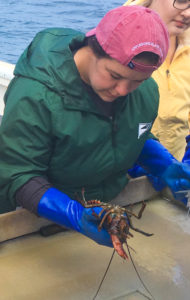
Determining lobster sex aboard the F/V Vivian Mae this summer.

I was emboldened by hearing fishermen and scientists talk about how different, fast-changing dynamics throughout the Gulf of Maine necessitate a different data approach: one that is more localized. Hearing them talk about a solution motivated me to keep moving forward and not feel as overwhelmed by the issues. We as college students will listen and take heart when authoritative voices such as fishermen, council members and scientists uniformly agree on the need for change and discuss possible solutions. Hopefully, these credible voices will resonate with the larger community.

To move forward, we need to analyze the current model and determine what the problems are that are highest in priority to address. In addition to this, we need to keep the conversation going, and keep working toward common goals.

The current data collection model is a One-Size-Fits-All model, but the consensus of the discussion was that one size does not fit all. Therefore, the current model is not doing its job and needs to change. The Gulf of Maine is an extremely dynamic region, with highly productive areas, multiple spawning areas and freshwater inputs. Unfortunately, it is feeling climate change impacts at an alarming rate. In a system with this many moving parts, we should not be employing a model that is rigid. Instead of adjusting this model, however, it may be easier to start with new ideas. Relying on data from random trawl surveys that occurred three years ago is not a solid foundation to build a management plan on.

So, let’s change the way we collect data. Fishermen are out on the water every day in different areas, looking for different target species and making different observations. Why not make their observations available for scientists to use, creating an up-to-date, usable set of data? Up-to-date data means that the moving and fluctuating parts of the system can be more accurately accounted for, and we can develop more accurate and successful management plans more quickly. Collaboration between fishermen and scientists when it comes to collection of data and observations is important. It helps refine the current model and bring the sides together while doing it.

A large part of creating change and addressing these problems exists in the need to have active discussions. Everyone sitting at the table, simply discussing the challenges, could lead to change. Different perspectives bring different ideas, and then solutions can start to form. College students taking part in such discussions and offering their perspectives could be integral to the formation of such solutions. That involvement would also likely encourage them (as it has with me) to dive deeper into the issues and help find solutions, rather than be overwhelmed with fear and gloom.

Along with this, it is imperative that all stakeholders be involved in these discussions. If we want to use data that fishermen collect, for example, we need to make sure they’re on board with the idea, and we need to see how much they’re willing to do to create a better system. If too much is put on the fishermen’s plates, or on the plates of any other group for that matter, the new method will work as effectively as the current one. It won’t.


Jennifer Halstead is a senior at University of New Hampshire studying marine biology, and intern for One Fish Foundation.

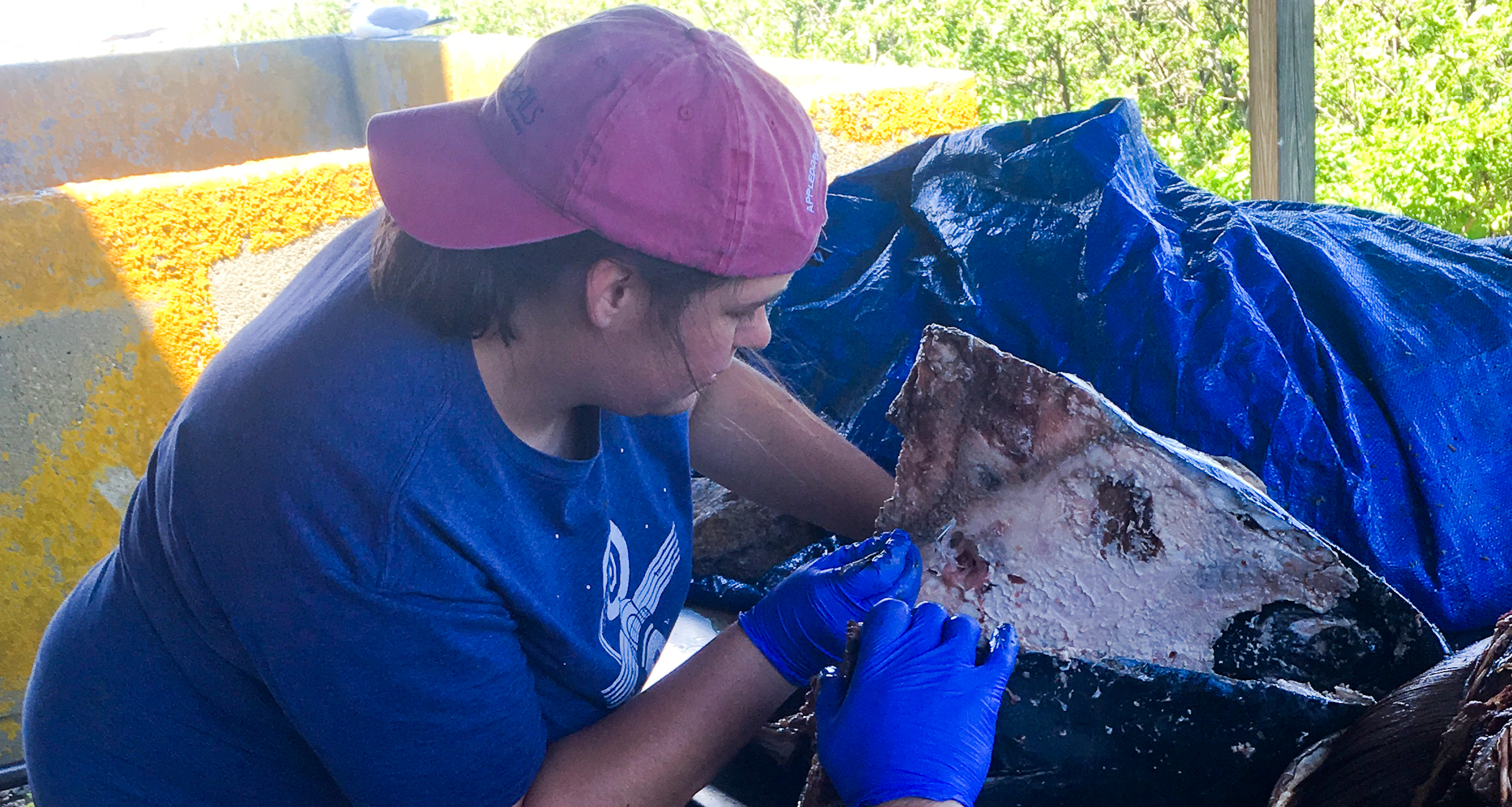
Top Photo: Jennifer extracts the otoliths (ear bones) of a bluefin tuna to determine its age.

Recent Posts

  • Hurricane Ida wreaks havoc on Louisiana’s seafood industry
  • EPA Should Use Clean Water Act To Kill Zombie Mine
  • Slow Fish 2021: Relationship Matters
  • Faith, Façades, and Futility
  • Pebble Permit Paused: Politics at Play

Archives

  • September 2021
  • August 2021
  • April 2021
  • December 2020
  • August 2020
  • June 2020
  • February 2020
  • December 2019
  • November 2019
  • October 2019
  • July 2019
  • May 2019
  • April 2019
  • March 2019
  • January 2019
  • December 2018
  • November 2018
  • June 2018
  • May 2018
  • March 2018
  • February 2018
  • January 2018
  • December 2017
  • November 2017
  • October 2017
  • September 2017
  • August 2017
  • July 2017
  • June 2017
  • May 2017
  • April 2017
  • March 2017
  • January 2017
  • December 2016
  • November 2016
  • October 2016
  • September 2016
  • August 2016
  • July 2016
  • June 2016
  • May 2016
  • April 2016
  • March 2016
  • February 2016
  • January 2016
  • December 2015
  • November 2015
  • October 2015
  • September 2015
  • July 2015
  • June 2015
  • May 2015
  • April 2015
  • March 2015
  • February 2015
  • January 2015
Theme by Colorlib Powered by WordPress