Skip to content
One Fish Foundation
  • Blog
    • Aquaculture
    • Education
    • Environment
    • Policy
    • Wild Harvest
    • Fish Tales
  • About
    • About One Fish
    • About Colles Stowell
  • Education
    • Elementary School
    • Middle School
    • High School
  • KNOW FISH Dinners®
  • Resources
    • One Fish Podcast
    • One Fish Foundation in the news
    • The 7 C’s of Sustainable Seafood
    • Newsletter Archive
    • Recipes
      • Skate with Capers and Butter — Chef Rizwan Ahmed
      • Grandma Davis’ Fish Chowder — Jane Almeida
      • Ginger Garlic Tamari Scallops — Colles Stowell
      • Fish Stock — Evan Mallett
      • Mussels San Remo — Chef Rob Martin
      • Salted Pollock Croquettes – Chef Mark Segal
  • Connect
    • Contact OneFish
    • Social
      • Instagram
      • Facebook
      • Twitter
All Blog Posts

Swimming On: the Slow Fish USA gathering from 2016…

  • February 8, 2020October 19, 2021
  • by Colles Stowell
Share it!
Share

The inaugural Slow Fish event in North America took place in New Orleans in 2016. It was an enormous first step, fraught with last-minute adaptation forced by a 500-year flood event in a city that is rather accustomed to flooding. Who knew we’d be eating shrimp and oysters in a warehouse full of floats from perhaps the most raunchy Mardi Gras parade in the city? Nothing says seafood like having every part of outsized human anatomy in lewd, brightly decorated papier-mâché looming over you.

But we made it work! Everyone adapted to the unforeseen circumstances and we had great conversations about consolidation, youth in fisheries and overall messaging and values. We capped Slow Fish 2016 off with an incredible Cajun hog harvest celebration called a “boucherie” across the Mississippi River.

We gathered in San Francisco for Slow Fish 2018 following an intense, but amazingly productive four-month planning period that was delayed by the threat and lingering angst of devastating forest fires in the region. But for the commitment, creativity, and sheer will of everyone involved, Slow Fish San Francisco wouldn’t have happened. That gathering made space for fabulous networking, collective problem-solving, and energy dedicated to shared values for our seas and their stewards.

The San Francisco event took place in a cool warehouse (no sex floats) that we adapted to suit large group discussions, as well as smaller World Café roundtables and PechaKucha (or “Peche” Kucha) mini slide presentations/stories. We also had a Seafood Throwdown, off-site oyster, dinner, and movie events..

Fast forward two years and that energy is still strong. This year, Slow Fish 2020 will go down on March 19-22 in Seacoast N.H., with a Working Waterfront Tour, kick-off dinner, Sunday Fishtival and the programming of a two-day conference at the University of New Hampshire Peter T. Paul College of Business and Economics in Durham.
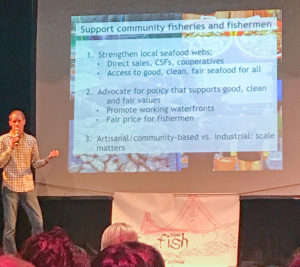
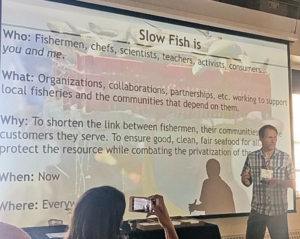
Setting the tone with the Slow Fish 101 presentation in San Franciso. Photo credit: Lance Nacio.

Circling back to Slow Fish USA origins on campus

We chose New England for 2020 to continue varying the geography of these events and give fish harvesters, fishmongers, and others from the region a chance to engage in these conversations.

New Hampshire is important because students at UNH were among the first in the country to embrace Slow Fish values back in 2013. At the time, they encouraged UNH Dining Services to sign a pact to source responsibly harvested seafood and  adhere to Slow Fish values. That pact is still in effect today. Bringing the conference to New Hampshire this year affirms how much the movement has grown in the years since and the importance of youth in the movement.

Rallying young people is especially important in New England as fish harvesters here are fighting against restrictive policies and well-funded efforts to consolidate the industry. This monopolization has created impossibly high barriers of entry for young fishermen and led to an ever-increasing age of the average fisherman, often called the “graying of the fleet.”

Moving the event around to key fisheries regions helps democratize the impact. Slow Fish continues to aim to create an open table for meaningful thinking around the core values of providing good, clean, and fair seafood to all.

At a time when equity, inclusion, and justice issues are increasingly visible, Slow Fish aims to ensure that small-scale and indigenous fish harvesters have fair access to the resource in a market too often dominated by billion-dollar corporations that only care about profits.
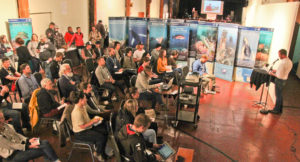
 

Sharing ideas, asking questions, expanding network connections, and collaborating on meaningful change. That’s the Slow Fish formula that will be at work at Slow Fish 2020 in New Hampshire. Photo credit: Eric Buchanan.

Diving deep

We’re going to talk about these and other critical issues in New Hampshire this year. For the first time, we’re going to merge the Slow Fish North America gathering and a regional Slow Food Northeast event, allowing members of both groups to get a better sense of how each group is working to shorten the distance from food source to plate.

Here is a sneak peek of what’s on tap for Slow Fish 2020, and why you should consider joining the conversation:

  • Deep Dive discussions on issues like aquaculture, climate change, and the Blue Commons;
  • Interactive World Café roundtables to explore challenges and opportunities facing youth, women, and indigenous fish harvesters; alternative seafood business leaders; and the Slow Fish Ark of Taste;
  • “Pesce” Kucha storytelling with slides;
  • Delicious food from all over the continent;
  • Tour of the seacoast N.H. working waterfront followed by an opening night feast;
  • Seacoast Restaurant Fish Week from Feb. 13 through Feb. 21 (restaurants in Seacoast NH and Maine provide a special Slow Fish menu and donate a portion of proceeds to Slow Fish);
  • Closing dinner event with music at the Paul College at UNH;
  • Fishtival on Sunday at Throwback Brewery (more food, music, beer, and hands-on demonstrations);
  • Several hands-on demonstrations of nose-to-tail, oyster shucking, etc.
  • A chance to dig into issues, collaborate, and kick it with old and new friends.

I can tell you first-hand that we are planning this year’s gathering with as much, if not more energy and drive as with NOLA and San Fran, and hopefully without any major and unexpected meteorological or other events.

So come join the conversation, expand your network, make new friends, hug old friends, eat fabulous food, and see what the New England Slow Fish and Slow Food communities have to offer!


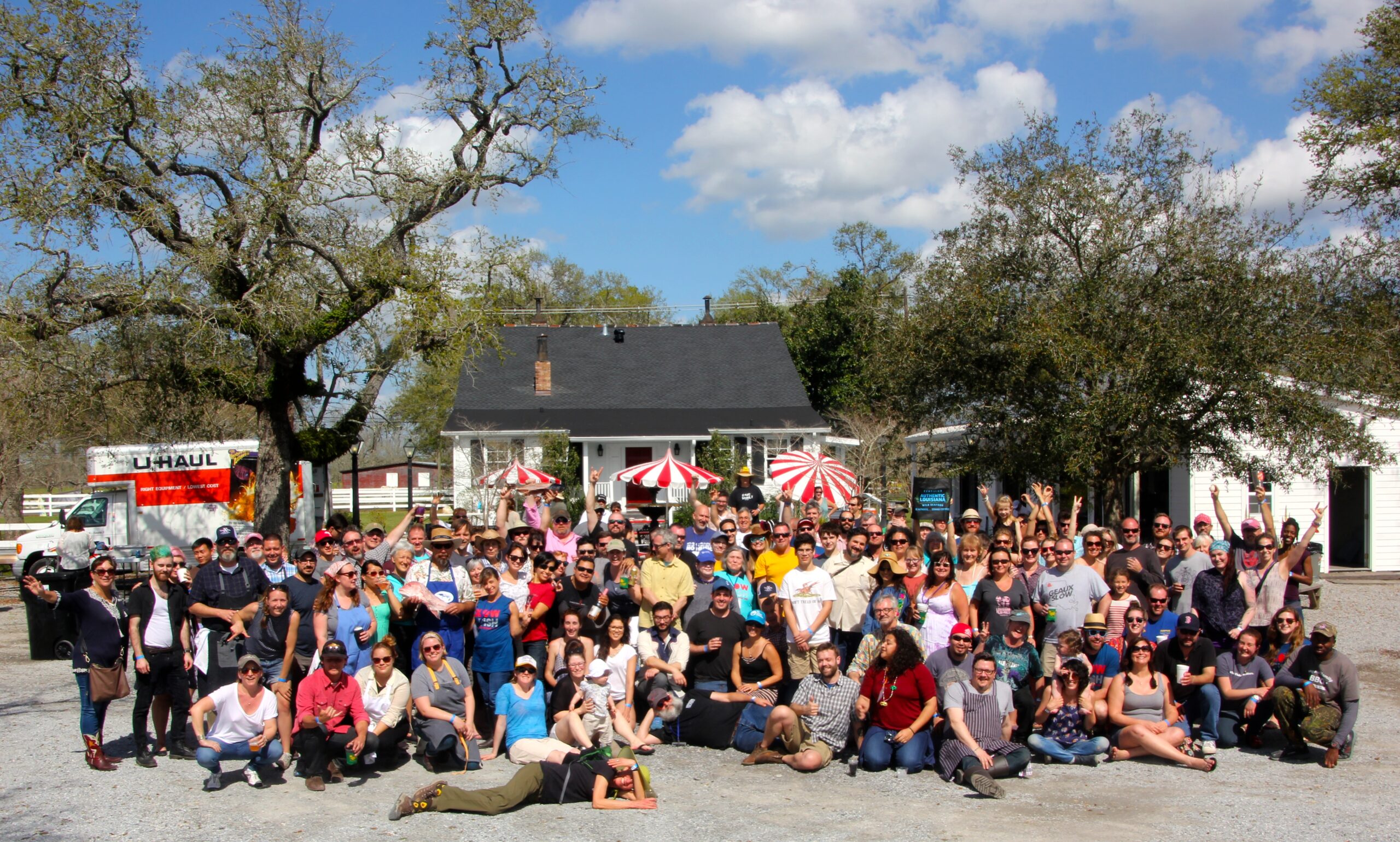
Top photo: Slow Fish 2016 in New Orleans, during the boucherie at Docville Farm. Credit: Eric Buchanan.
All Blog Posts

Seafood Learning Expeditions

  • December 9, 2019October 19, 2021
  • by Colles Stowell
Share it!
Share

With apologies to Charles Dickens, the Tale of Two Salmon began with a description of how it was the best of times, and then, how it was the worst of times.

How one species, Atlantic salmon, was pushed to near extinction because of 300+ years of intense fishing and damming of much of its critical habitat throughout New England and into Canada. How another group of salmonids, wild Pacific salmon (including king, sockeye, coho, pink and chum) were given lifelines by better management and some degree of habitat preservation.

And how the Pacific salmon in Alaska continue to provide largely abundant runs, serving a variety of stakeholders including commercial, recreational and subsistence fish harvesters. We discussed how policy there is a dynamic tool that better incorporates input from these different stakeholders, as well as up-to-the-minute harvest and escapement (fish that continue upstream to spawn) analysis to determine how and when the harvest starts and stops.

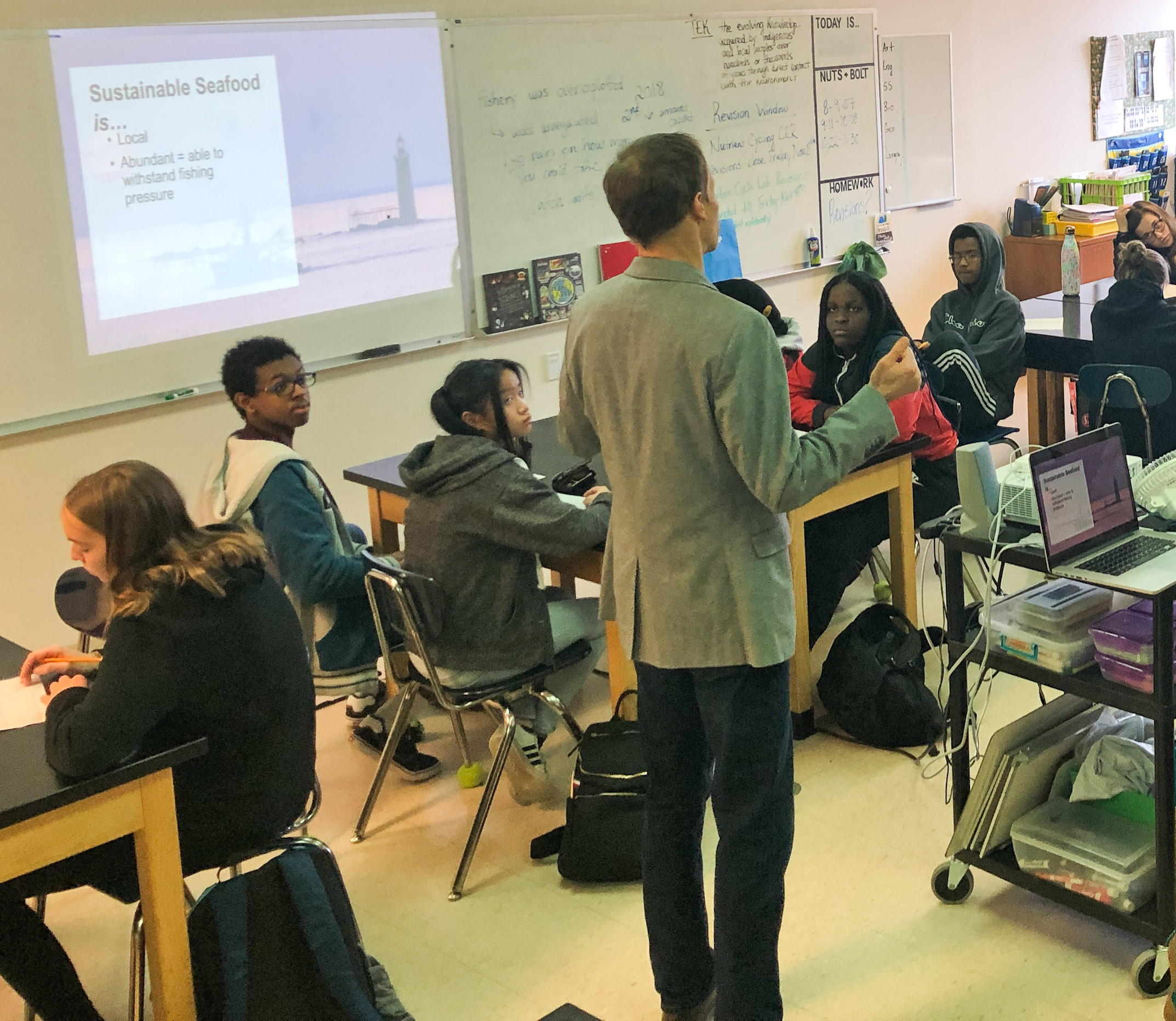
The focus on indigenous subsistence fishing was of particular importance to the 9th graders in Jenny Crowley’s ecology class at Casco Bay High School for Expeditionary Learning in Portland last month. They were learning about human interaction with natural resources and the impact humans can have on their surrounding environments. CBHS immerses students in “expeditions,” which allow them to dive deep into particular issues or topics while incorporating other facets of their education.

We talked about the delicate balance of policy on how to ensure different stakeholders have fair access to the resource. I shared my experience in Bristol Bay, Alaska this summer, talking with indigenous and subsistence fish harvesters there who described the traditions of learning to live in harmony with the salmon, the water and the land.

Finding that natural balance, taking only what they need to eat throughout the year and passing on that knowledge (like how to properly fillet a salmon using a traditional ulu knife and how to use the entire fish) are essential to maintaining that harmony from generation to generation.

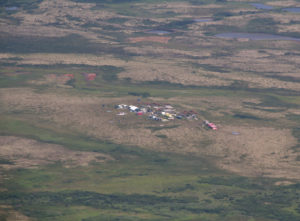
Pebble Mine exploration site. I took this photo during a flight to see how the mine would affect the headwaters of the world’s largest wild salmon run. I shared other photos depicting the breathtaking landscape that is veined with water. Students understood this one human “input” could result in devastation of that habitat.

We also spoke about how the different user groups in Alaska have united together in the past nearly two decades in solidarity to oppose the proposed Pebble Mine. It is largely due to that collaboration and the fierce determination to protect the resource that the proposed gigantic open pit copper and gold mine has not yet been built.

We talked about the tragedy of the commons and how communities working together to determine how best to manage the resource so it continues to provide for the entire community is absolutely essential.

So the students and I took those expeditions together in one-hour increments, talking about important socio-economic issues and how our choices affect the salmon and all marine life.

Collectively, we came to the conclusion that the type of community thinking in Alaska is one reason wild Pacific salmon there shade closer to the best of times.

Perhaps we should apply that model more diligently elsewhere.

All Blog Posts

Building Community Over Seafood

  • November 7, 2019October 19, 2021
  • by Colles Stowell
Share it!
Share
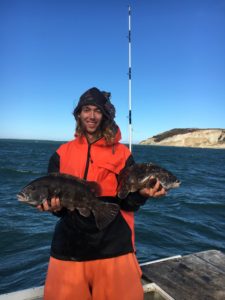
Otto Osmers with the freshly caught tautog for the dinner at Atria. Know the story of your seafood!

Otto Osmers sat down at a table with white linen, nice wine glasses, shiny silverware, an impressive printed menu featuring several courses and wine pairings and a bunch of folks he didn’t know. Sporting a ball cap, long hair and an easy smile, he calmly introduced himself as the stern man on the fishing boat that caught part of the night’s meal.

Though he’d initially expressed some reservation about being able to contribute to the conversation in a meaningful way, he earned the respect and attention of everyone at the table (and a round of applause from the nearly 60 people in the restaurant) by the end of the night.

Not bad for a 19-year-old who’s been fishing commercially since he was 15.

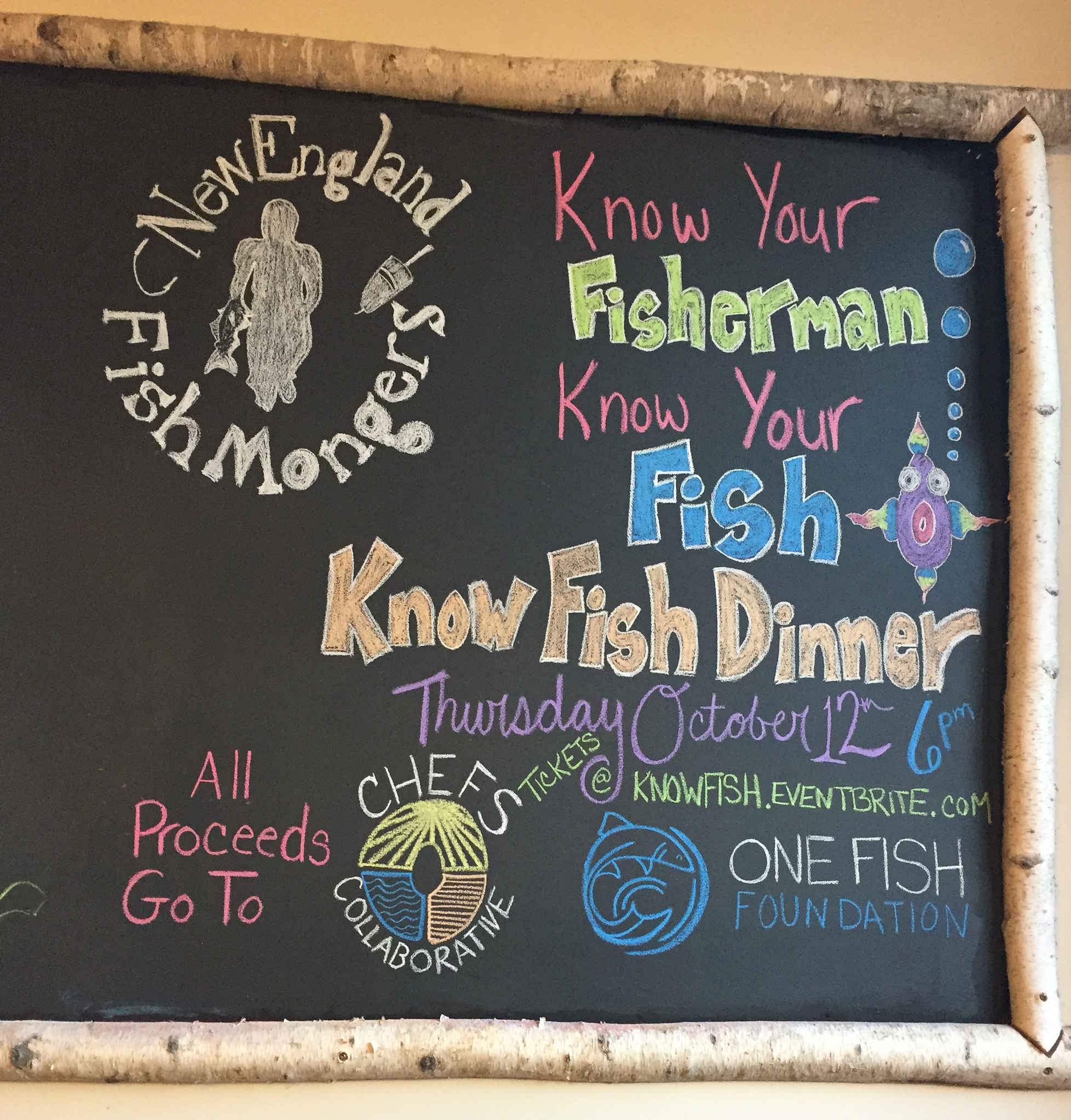
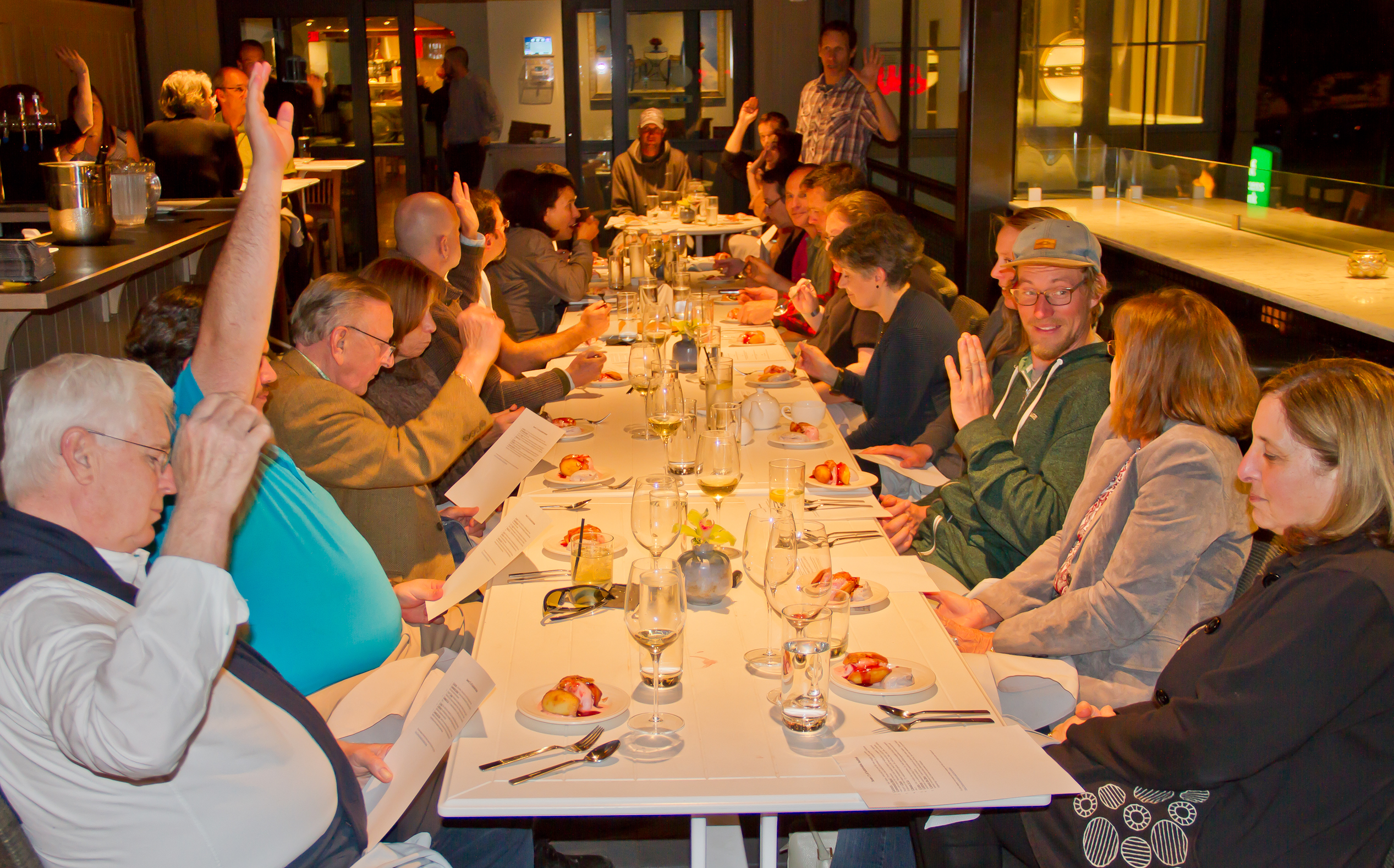
Score another success for the KNOW FISH Dinner® series.

Fishermen’s tales

The most recent KNOW FISH Dinner took place at Atria Restaurant in Edgartown on Martha’s Vineyard Oct. 26. The dinner was part of the annual Martha’s Vineyard Food and Wine Festival and was the product of the kind of collaboration that unites chefs, fishermen and advocates in ways that give hope to the notion we can change the industrial food supply chain.

How?

Relationships.

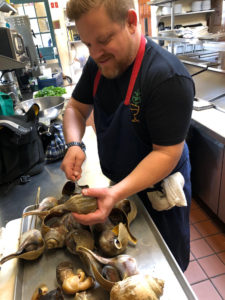
Chef Brendan Vesey removing the conchs that Capt. Andrew harvested.

Chef Brendan Vesey of Botanica Restaurant and Gin Bar in Portsmouth, N.H. was among the group of thinkers that helped build the KNOW FISH Dinner series in 2015. He and other Portsmouth, NH-area chefs were planning to participate in the massive tasting event during the Food and Wine Festival, but decided they wanted to do their own dinner during the four-day event.

So Brendan contacted me about doing a dinner that promotes the connection between seafood harvester and consumer and upholds the values behind a truly responsible seafood supply chain. This was in late Sept. Brendan connected me with Chef Christian Thornton at Atria, who is close friends with Chef Duncan Boyd, one of the original One Fish Foundation board members.

I then reached out to One Fish Foundation Board member and fellow Slow Fish colleague, Brett Tolley, who put me in touch with Shelley Edmundson of the Martha’s Vineyard Fishermen’s Preservation Trust. Shelley and her team work to support the livelihoods of the fishermen on Martha’s Vineyard. She connected me with Otto, Capt. Nick Wilbur, Captain Andrew Wheeler and Captain Arno Ewing.

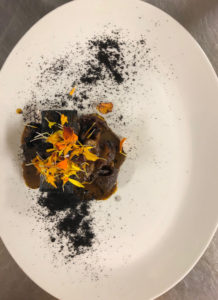
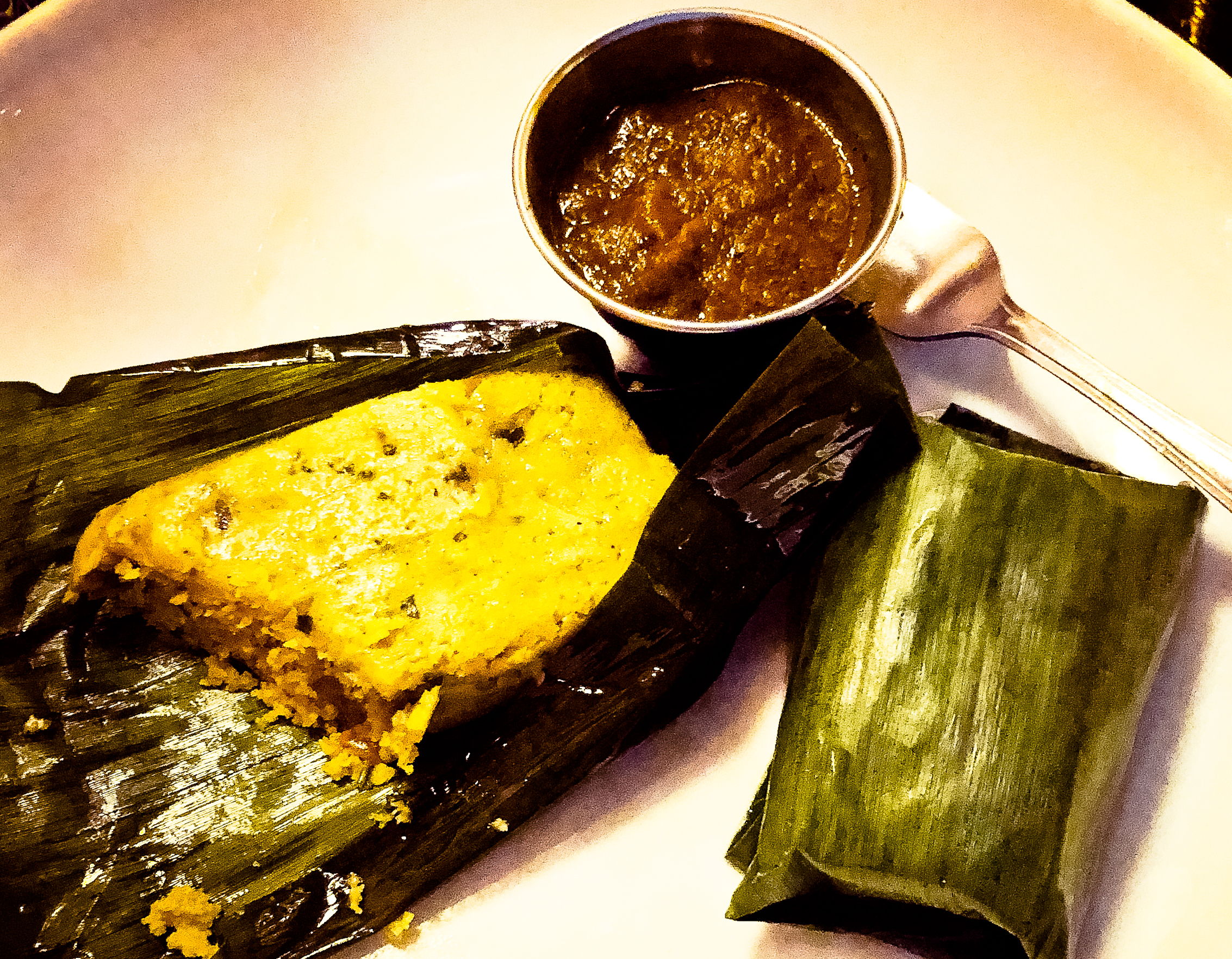
Chef David Vargas with a tasty and colorful presentation of Capt. Andrew’s cured conch and squid ink tamale.

Capt. Nick and Otto caught the tautog (think a brutish looking bottom fish with big lips and human-like teeth, per Otto’s great description to the crowd) that was served with the green crab gumbo prepared by Chef William Myska of Ore Nell’s Barbecue in Kittery, ME. Captain Andrew harvested the conch that Chef David Vargas of Vida Cantina in Portsmouth, NH turned into masa miso cured conch with squid ink tamale.

Chef Christian brought in Ryan Smith of Signature Oysters, whose Katama oysters Atria chefs turned into a trio of preparations: andouille roasted; cucumber granita mignonette; and yuzu broiled.

Captain Keper Connell caught the bluefin tuna that Chef Jeremy Glover of Raleigh Wine Bar and Eatery in Portsmouth, NH crafted into an amuse bouche of raw bluefin tuna in a peach boshi broth.

Chef Brendan broiled the locally sourced fluke from Menemsha Fish Market and served it with Hubbard squash and charred oyster mushrooms with a red wine leek sauce.

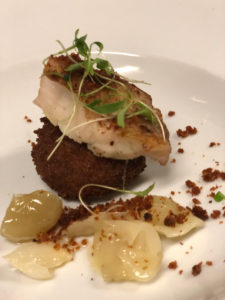
Capt. Nick Wilbur’s tautog resting on a fried okra cake prior to being smothered in smoked green crab gumbo prepared by Chef Will Myska. Perfect for New England fall.

All of the food was excellent. And the stories the chefs and the fishermen told about the seafood, how it was harvested, how it was prepared, helped stitch together this newly created ad hoc community of chefs, fishermen and consumers.

So yes. Relationships matter. As friend, colleague and founder of responsibly harvested seafood network Local Catch Josh Stoll often says, the definition of “local” is changing, becoming less about geography and more about relationships.

The KNOW FISH Dinner at Atria reinforced that. Yes, both the seafood and produce were “local,” or as local as possible (from Gulf of Maine, and some farms in N.H. and Maine). But what stood out to everyone in attendance were the stories from those who harvested and prepared the food.

Everyone, including those from the island and off-island, left knowing something more about the food they ate and the different links in the seafood supply chain. Before closing out the event, I asked folks to carry those stories with them and that sense of community we’d built. I asked them to try and establish relationships with fishermen or fishmongers and chefs in their community. Build the trust that elevates the community and the values we discussed. Ask questions.

And spread the message.


Big thanks to everyone who helped make this event happen, including the fish and shellfish harvesters: Otto, Capt. Andrew, Capt. Nick, Capt. Arno Ewing, Ryan, Capt. Keper, and Shelley for making the connections. Thanks to the chefs: Brendan, David, Will, Jeremy, and the entire crew at Atria. Special thanks to Chef Christian Thornton for hosting the event. Thanks also to Shauna Troy and J. Lohr Wines for providing the great vintner’s accompaniment to each course. Thanks to the Martha’s Vineyard Food and Wine Festival.  And many thanks to everyone who attended and elevated the discussion!


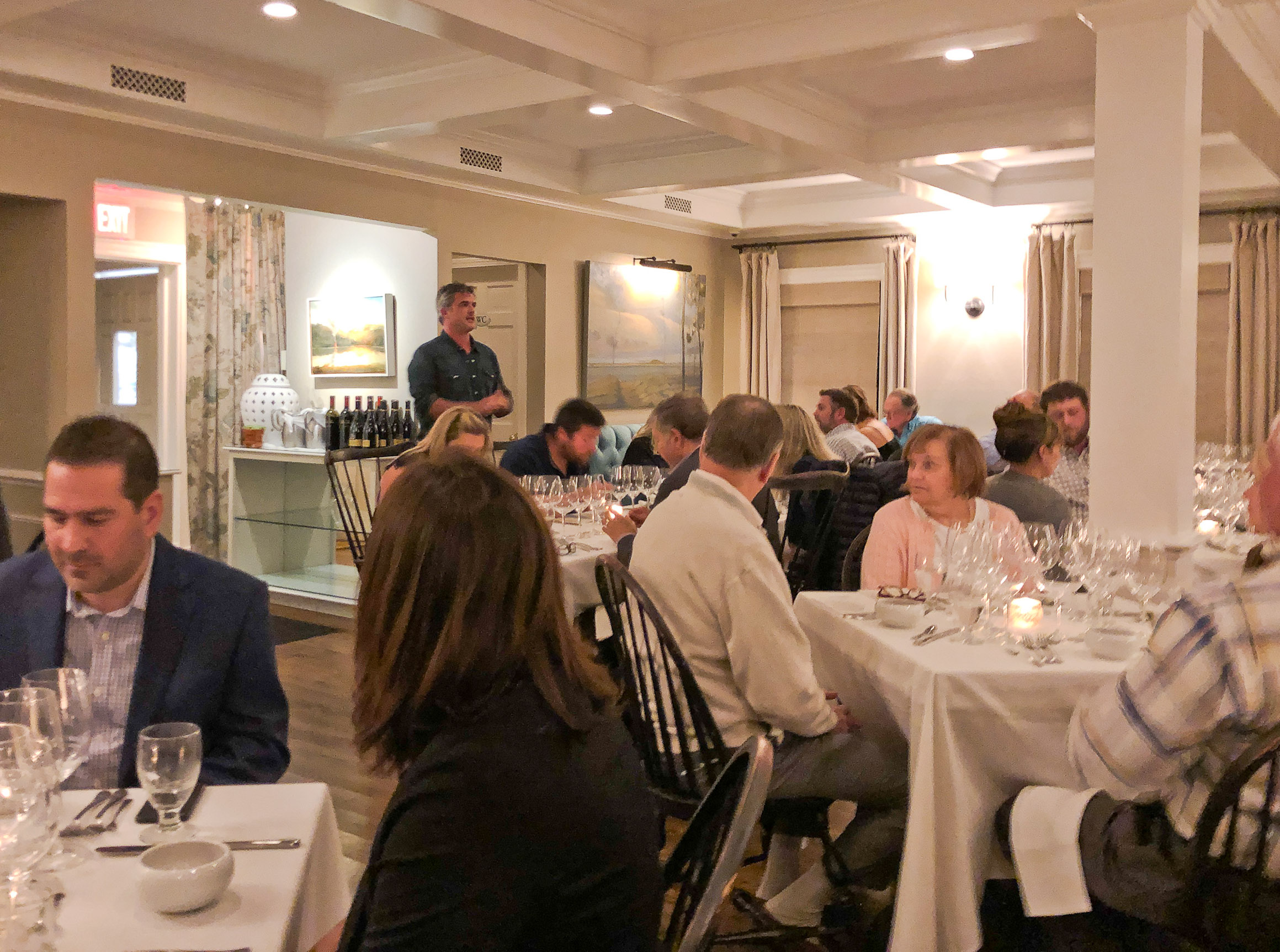
Top photo: Capt. Keper Connell tells the story of the bluefin tuna he caught and that everyone was enjoying.


All Blog Posts

Seafood Lovers and the Supply Chain

  • October 17, 2019October 19, 2021
  • by Colles Stowell
Share it!
Share

Most American consumers don’t know where their seafood comes from. In fact, a recent report from the Food Marketing Institute suggests that less than 30% of domestic consumers consider themselves knowledgeable about the seafood they eat.

 So why is that? And what can we do about it? What is the consumer’s role in the supply chain? It would be a fair assumption that the remaining 70% of those surveyed by FMI take a passive role. That is, they either rely on third-party information like eco-labels or they just don’t care. They surrender responsibility of the decision to someone else.

 No wonder our markets are so jammed with cheap, unhealthy imports.

 This topic was the crux of the fifth installment in the SlowFish webinar series, Slow Fish 201: Role of the Consumer, held on Sept. 23. To follow is a blog written by One Fish Foundation Intern Jennifer Halstead. In it, she captures some of the most salient points about how fishermen, fishmongers and others in the supply chain can help engage consumers in conversations about why they should care where, when, how and even by whom their seafood was harvested.


by Jennifer Halstead

Throughout the Slow Fish 201 Webinar series, expert panelists from different backgrounds, geographies and perspectives shared thoughts on how each link in the supply chain can help ensure the availability of responsibly harvested seafood. During the most recent webinar, Role of the Consumer, each panelist was thought-provoking, sharing their stories on how to engage consumers in the supply chain. Attendees left the discussion with a clear understanding of how consumers can become better informed (ASK QUESTIONS!!!) and assume a more active role in the supply chain.

On the panel were:

Patty Lovera, Food and Water Program Director, Food & Water Watch

Chef Evan Mallett, Chef, Co-owner, Black Trumpet

Capt. Tim Rider, New England Fishmongers

Charlie Lambert, Fisherman, Co-founder, Ocean2Table

Kirk Hardcastle, Premium Sales Accounts, Seafood Producers Cooperative

Colles Stowell, President, One Fish Foundation

Jessica Hathaway, Editor and Chief, National Fisherman, served as moderator

Each of them views the supply chain from a different perspective. But all of them agree that change within the supply chain is not only possible, but that it in many ways depends on consumers making smarter choices.

Fraud, mislabeling and a lack of transparency continue to cast a shadow over seafood sales in the U.S. It’s easy to see how consumers can feel helpless when it comes to fixing such issues. There are so many eco-labels providing conflicting guidelines and grocery store displays touting green-label “fresh, sustainably raised farmed salmon from Chile.”

As discussed during the webinar, well-informed seafood eaters have the power to pressure suppliers into knowing more about the products they are selling and to source from community-based fishermen who care about the resource.

Where to start

Panelists agreed that consumers should be asking restaurants and grocers a couple of questions just to get a part of the story of the seafood. It doesn’t have to be complicated or intimidating. You learn much just asking where, when and how it was harvested or grown. Even better if you can find out who harvested it. Is it local? Regional? Domestic? The U.S. has some of the best seafood safety and fisheries management policies in the world. If you can’t get domestic seafood, you’re better off choosing something else. Imported products carry a high risk of having been unsustainably farm raised or harvested.

“There is a lot of burden on the consumer,” said Patty Lovera. “We have to ask a lot of questions. The status quo in the supply chain isn’t good enough.” She and Colles Stowell both mentioned the influence consumers can have over retail seafood sourcing. If suppliers don’t know the answer to these questions, they will either feel compelled to learn, or responsible consumers will feel compelled to spend their money elsewhere.

What’s in season?

Chef Evan Mallett, Capt. Tim Rider and Charlie Lambert spoke about the importance of consumers better understanding seasonality. Just like when you go to the grocery store or market for vegetables and find different items available throughout the year, fish have their own seasonality. In New England, the height of the scallop season is in winter, while squid are generally available for a few weeks in the spring. Understanding what should be available during different times of the year will help consumers filter out which purveyors are supplying fresh, local fish and which are importing or using frozen, stored fish. “Being a chef is understanding sense of place, seasonal food, and the changes that the seasons bring,” said Mallet. That should also be true for consumers.

Eating seasonally enables consumers to enjoy fresh product throughout the year, experience cooking and preparing new species, support local fishermen, and promote healthy ecosystems by reducing fishing pressure on more popular species.

Location, location, location

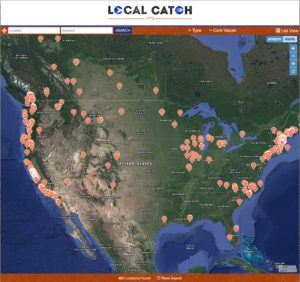
Some tools, such as the Local Catch nation-wide Seafood Finder, can help seafood eaters find local, responsibly harvested fish, shellfish and seaweed. In a map or list view, you can search for purveyors by location and species.

All agreed that consumer education is critical. Once consumers have enough information, they’ll feel empowered to own those decisions and will likely make smarter decisions again in the future. “Instead of telling people what to buy, which is what eco-labels do, we need to educate and equip them with tools to make the decision on their own,” said Colles. Charlie added, “We’re providing them with information and letting them complete the thought process on their own, … and not force-feeding the consumer.”

Buying local benefits the consumer, economies, and even the ecosystem. Fewer food miles, fresher products, strengthening local economies by building relationships with fishermen, and supporting healthy ecosystems are all advantages that consumers can feel good about.

Charlie acknowledged that carbon footprint is a growing concern for his customers. The average distance seafood travels from boat to plate in the U.S. is an astounding 5,000 miles. “The supply chain was largely hidden, and when it was exposed, it was very nasty. The West Coast is famous for market squid and calamari, but the supply chain is tumultuous. [The squid] is landed, frozen, shipped overseas, thawed, processed, refrozen, shipped back, thawed, then distributed to local businesses and consumers. The amount of food miles is not right,”he  said.

Quality is everything

Distance traveled can also (but not always) affect freshness. A fresher product tastes better and has a better shelf life. Rider said both his restaurant and retail customers note the long shelf life of his product because his crew properly bleeds and brines the fish on board the vessel at the time of catch, ensuring the fish is as fresh as possible for as long as possible. “Shelf life is huge. If something comes up and you can’t cook it when planned, it’s still good four days later.”

Chef Evan agreed: “ It was really with the first fish I got from Tim that I saw a marked difference between everything that I was getting from the Gulf of Maine before that.”

Product quality is integral to attracting and keeping customers. Kirk Hardcastle drove this point home, drawing on his decades of experience as fisherman, chef, distributor and now marketer with Seafood Producers Cooperative. “It starts with the fishermen, not the eco-labels, … making sure the quality of the product really comes through. … If it gets to someone’s house and the fish is poorly handled… You can put millions into messaging and you’ve burned it all away with the first bite of fish. Go for quality first and everything after that is easy,” he said.

Know your fisherman!

Charlie and Capt. Tim both sell directly to consumers: Charlie providing product from the network of fish harvesters he sources from in Monterey Bay up to San Francisco to his community supported fishery (CSF) customers, and Capt. Tim from the two boats he and his crew operate out of Maine and Mass. via drop-off points and farmer’s markets. When fishermen come off their boats into the community to sell their fish and meet customers, they’re building relationships that help support a stronger local economy.

These relationships build trust and help harvesters and consumers alike have open discussions about the industry, fishing methods, problems and challenges that fishermen have.

In the end, failure to know the story of seafood surrenders consumer decisions to other elements in the supply chain, which is often driven by industrial players with only profit in mind. Complacency in the supply chain will only ensure that consumers receive sub-par products, and the supply chain grows more opaque, rather than transparent. Lack of communication and interest can lead to what started this conversation last year, intentional mislabeling to turn a buck.

Smarter, responsible consumers and the relationships they forge with fishermen and fishmongers will help shift supply chains away from industrial-driven structures and toward a supply chain rooted in trust and knowledge.

In short, the role of the consumer is to ask questions and make responsible decisions. However, fishermen, chefs, retailers, distributors, educators, advocates and others in and around the supply chain should help consumers get smarter. That means telling the story of the seafood they’re selling.

Not sure where to start? Seafood eaters should ask the questions mentioned above. Check out the 7 C’s of Sustainable Seafood. If you can, buy local. If you can’t buy local, buy US caught and processed.

Fishermen, chefs and retailers should get to know their customers and tell them more about the seafood they’re selling them.

A supply chain built on trust is the best path forward.


Resources

7 C’s of Sustainable Seafood

Local Catch Core Values: Another reference point for how to think about the seafood supply chain.

Slow Fish Values: More values regarding seafood’s journey from boat to plate.

Eating with the Ecosystem, The 5 Anchors: A New England-focused view of values to consider when choosing seafood.

To view a recording of the webinar, follow this link.


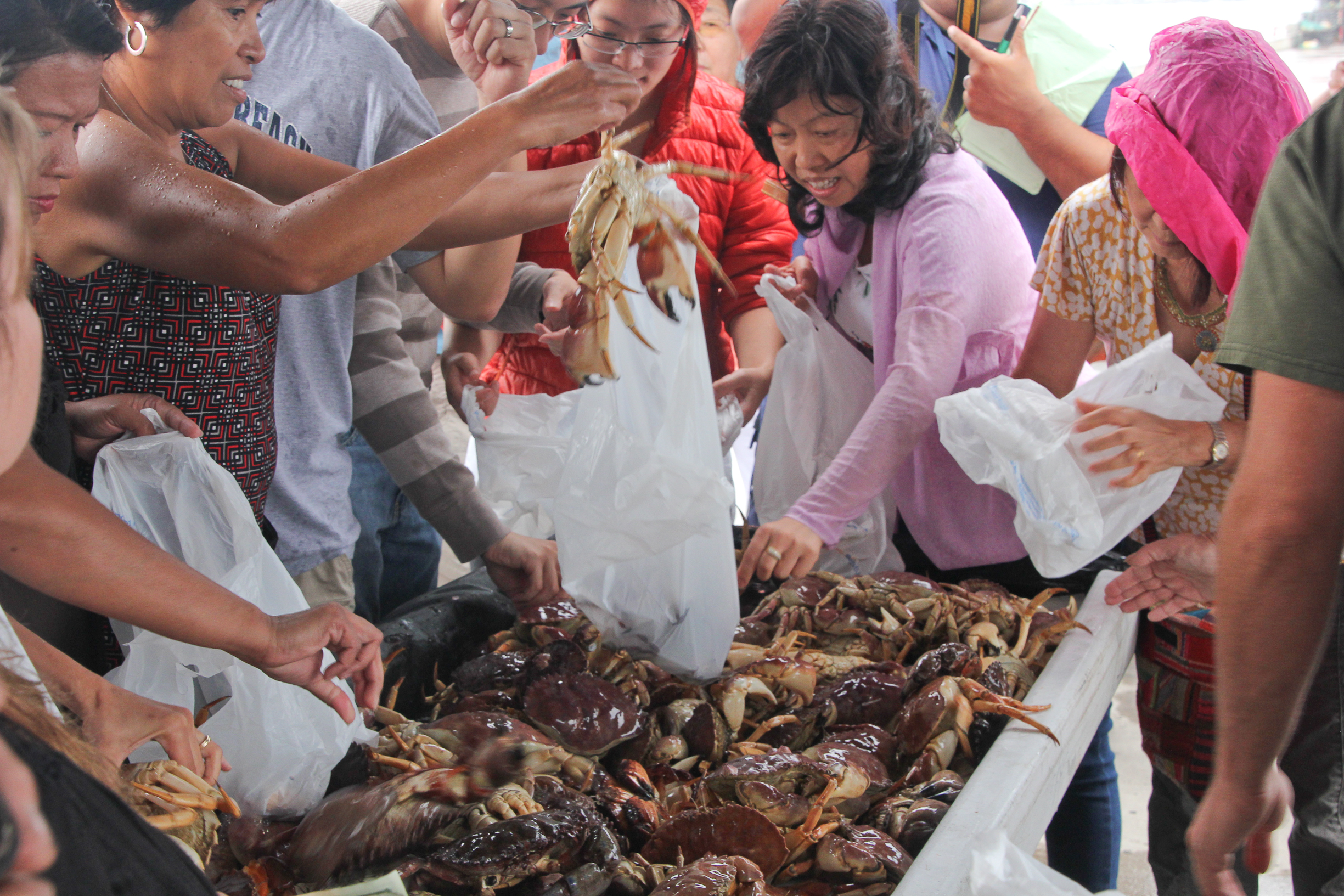
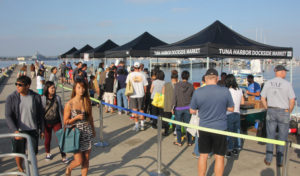
Top photo: Boat to consumer…literally.  Opening day for the Tuna Harbor Dockside Market in San Diego. Credit: Eric Buchanan

All Blog Posts

Sustainable Seafood in Diverse Classrooms

  • May 3, 2019October 19, 2021
  • by Colles Stowell
Share it!
Share

I often talk about “democratizing the message.” That is, I want to reach the largest audience across the broadest demographic possible: different age groups, cultural backgrounds, economic brackets, life experiences…everything. In short, the entire social fabric that relies on seafood for part of its diet.

Why? Because fundamental societal change doesn’t happen within only one demographic. This type of change may start in one group, but must transcend differences to scale up to have societal impact. This is especially true for the domestic seafood supply chain. Habit and price, fueled by an industrialized global seafood supply chain, are the main drivers behind the fact that 90% of the seafood we eat in the US is imported. That’s why we need to speak to the broadest range of seafood consumers.

The goal in these conversations is to provide new perspective that might help consumers, regardless of demographic, make better choices for themselves, the resource and fish harvesters in and around their communities. There are health and socio-economic costs of that frozen shrimp from Thailand that offset the cheaper price. If people I’ve spoken to choose the cheaper imported product for whatever reason (often price is the limiting factor, which is a much larger food and social justice issue), they do it with a broader understanding of the consequences of that decision. Hopefully we can work toward re-localizing our seafood supply chain so folks of all incomes can find local, responsibly harvested, affordably priced species, especially under-utilized species like dogfish or scup.

And it all starts with education.

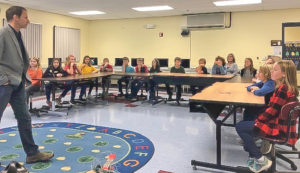
So, where can I find an audience with a range of cultural backgrounds, socioeconomic circumstances and life experiences? Our public schools bring together a cross section of society each day. I jumped at the opportunity to join students and teachers at two of Portland’s three public middle schools this spring.

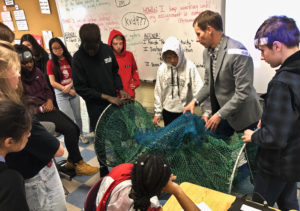
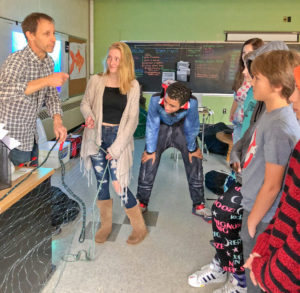
The Turtle excluder device is cumbersome, but a great hands-on tool for explaining innovation to reduce bycatch. photo: Lincoln Middle School Teacher Christel Driscoll

I seized the opportunity to democratize the message among students coming from diverse cultural backgrounds with respect to seafood while visiting classes at Lyman Moore Middle School and Lincoln Middle School a few weeks ago.

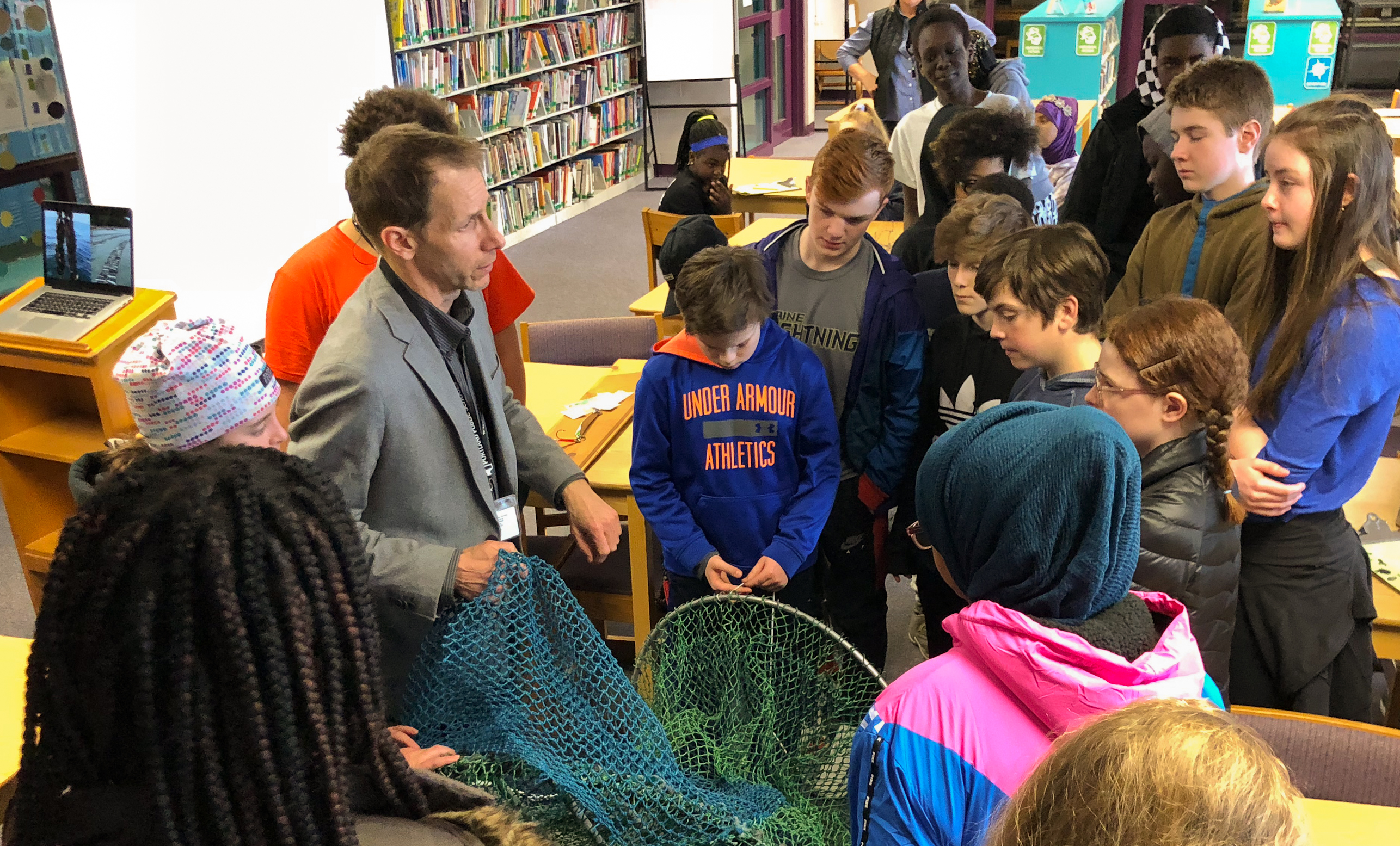
At Lyman Moore, I spoke to four large groups of 7th graders who reveled in laying hands on gill net, a turtle excluder device and a 24 oz. metal jig with some serious hooks. Fortunately, no one had to visit the school nurse afterward.

They also had the option to touch a dead black sea bass as we learned about why this mid-Atlantic species is showing up in lobster traps in and around Casco Bay, and the implications for marine ecosystem balance. This became a discussion about species adaptation as the Gulf of Maine continues to warm, and how climate change could impact what seafood is available down the road. We also talked about black sea bass as a local, underutilized species.

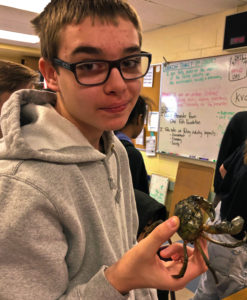
Live European green crabs held center stage as the keystone climate change adaptor species during the visit to Lincoln Middle school where I spoke with two classes of 8th graders taking a Sustainability Science course. The classroom, featuring a stove, sink, refrigerator and some counter space harkened back to the seemingly long-ago days of Home Economics.

“Can I keep it as a pet?” is one of the most common questions I get. Occasionally, when I ask what they’d do with it, I get, “I’ll feed it to my dog.” Ok. Eat the invasives!

This proved to be a perfect backdrop for discussing efforts to turn humans into pest control when it comes to green crabs, which are very fertile, very destructive (eating our mussels, clams and oysters at alarming rates) and have no significant natural predators. We also talked about industrial aquaculture, and how domestically grown oysters, mussels, clams and seaweed solve many of the serious issues with large-scale finfish aquaculture such as salmon (disease, sea lice, antibiotic use, feed sourcing and health and environmental impact).

In both schools, students took notes, asked questions and in some cases, showed a genuine interest in this new perspective: their decisions, whether they eat seafood or not, matter. Choosing locally harvested mackerel matters. Foregoing the single-use straw matters.

I passed out the 7 C’s of Sustainable Seafood in hopes they would take it home, put it on the fridge and have a conversation with their families and friends.

This is one important way to spread the message … regardless of demographic.

How do I know I made an impact? Among the several thank-you notes I received was one from a student whose uncle is from Senegal. I had spoken about how industrial Chinese fleets are vacuuming up the sardinella, anchovetta and mackerel artisanal and subsistence fishermen in West Africa depend on for their lives.

“All of these issues impact my future and hearing about the lack of knowledge many people have is very concerning, but I’m sure that eventually people will come to their senses and do something,” wrote the student.

Yes, people will come to their senses, hopefully, if we keep having conversations like this with people from diverse backgrounds.


All Blog Posts

DNA, Fraud and Next-Gen Scientists

  • March 27, 2019October 19, 2021
  • by Colles Stowell
Share it!
Share

Imagine a team of scientists collecting DNA samples to see if the seafood sold at local restaurants and stores is correctly labeled. They go to sushi shops, grocery stores and other retail venues and carefully place tiny samples of the fish in a small vial containing ethanol.

Then they take it to the lab where they will use genetic techniques, including Chelex extractions and polymerase chain reaction (PCR), to analyze the DNA of the sample to see if the snapper they purchased is actually Pacific rockfish. Their work is crucial. It will provide a deeper understanding of the rate at which seafood is mislabeled in area retail stores.

Now imagine these scientists are in high school.

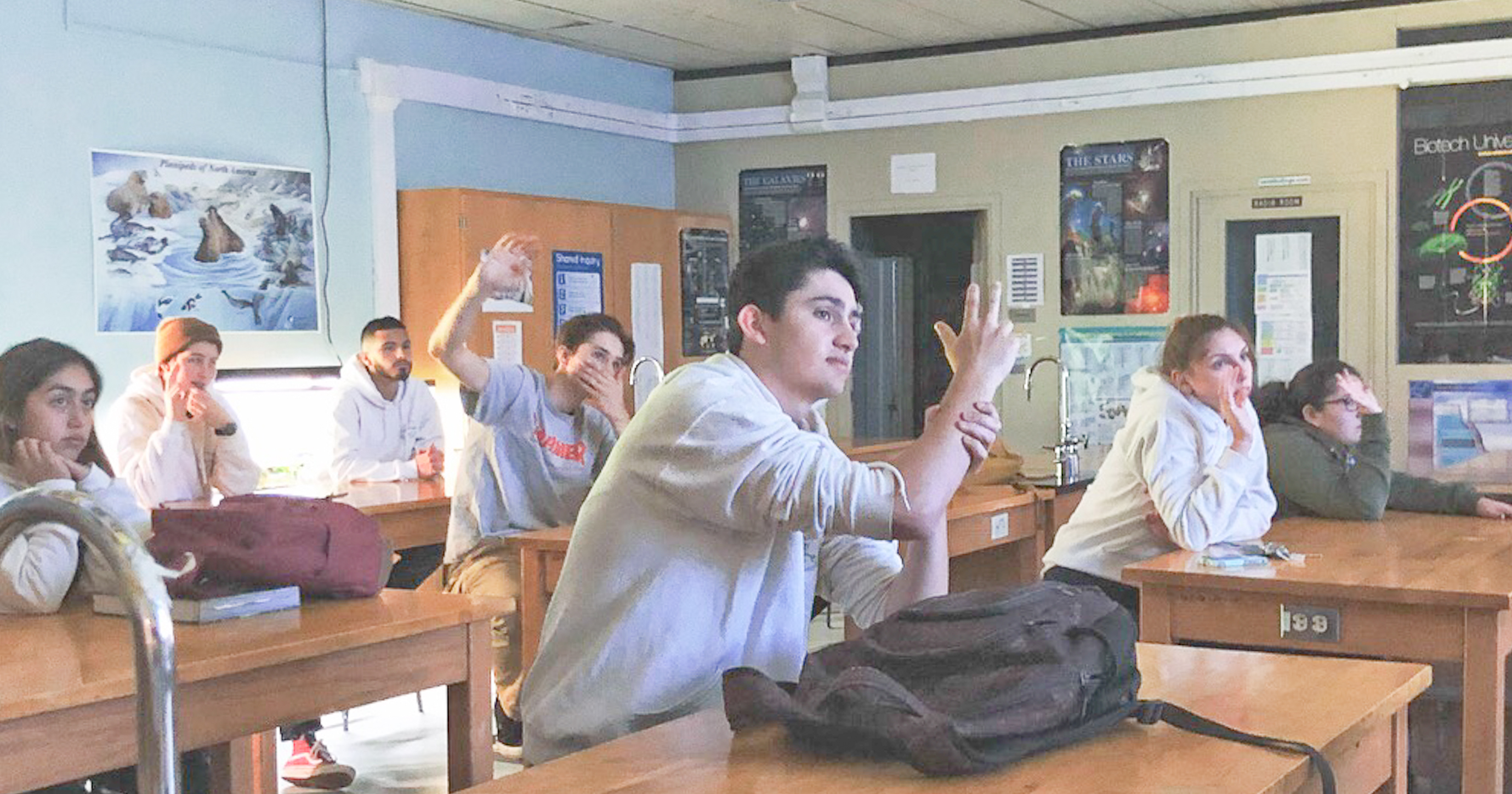
I was inspired by the senior biotech class I visited March 18 at Harbor High School in Santa Cruz, California. I was even more inspired by teacher Nehal Pfeiffer, who developed this project to combine classroom/lab study with real-world challenges. To get students thinking about how the process would work, she started students on testing different foods for genetically modified organisms (GMO).

The students were somewhat surprised to see high GMO content in Cheetos (corn) and veggie burgers (soy). Then the teacher had them break out into groups representing different players in the food industry such as farmers and Monsanto and try to get at the heart of the discussion.

You can guess how this ends up. Lively discussion. Engaged questions. Thoughtful conclusions.

Fraud talk

So I was honored to be invited to speak to these students about fraud in the seafood supply chain. I was there to give them a broader perspective of how and why it happens, the larger dynamic of US and global seafood consumption and what we can do about it.

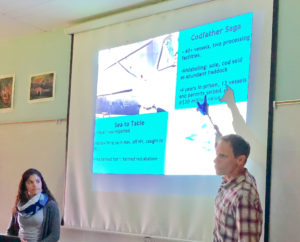
“Codfather” Carlos Rafael and Sea To Table are poster children for what can go wrong with fraud in the supply chain. Arina Favilla (left) helped coordinate the DNA sampling project. Photo credit: Stephanie Webb


After holding up Carlos Rafael and Sea To Table as prime examples of different types of fraud and their impacts on consumer trust, one student raised her hand and asked, “How can they get away with that? Who do we sue?”

Great question that prompted an excellent, interactive discussion. The truth is that current management policy, combined with a clunky mishmash of federal oversight spread over four disparate agencies with a confusing web of priorities and powers enables these types of fraud.

Rafael, the self-styled Codfather, was enabled by the catch share system in the New England groundfish fishery to amass a giant horde of access (permits) to essentially “own” the right to catch more groundfish than anyone else in and around the Gulf of Maine. He then used that power to force out many small-scale fishermen while vertically integrating so that his team of captains could work with his on-shore processing facilities to mask the cod and Dover sole he was catching as abundant (and less subject to expensive quota limits) haddock. He then sold this fish to New York restaurants for bags of cash.

Fortunately, he got caught bragging about the scheme to undercover IRS agents posing as Russian mafia.

I then explained the Sea to Table story as one of co-optation of values. One of the early pioneers of the national boat-to-plate sustainable seafood movement, Sea to Table was outed in an in-depth Associated Press exposé last summer, in which the Brooklyn-based company was alleged to have claimed some of its tuna had been locally harvested off Montauk, NY, when in fact it was caught in North Carolina. Other allegations include selling domestic seafood that may have been linked to international slave trade and offering wild harvested sea urchin that was actually farmed.

Taking initiative

My goal was to give Harbor High students an understanding of why this matters. Beyond the science, which is super cool and something I lament not having access to way back in my time, the understanding of how and why this type of fraud matters hopefully inspires these students to dig in. I’d love to see them discover the level of mislabeling in their communities, put that in context, and do something about it.

I hope they spread the message about why knowing where their (our) seafood comes from matters. I hope they ask questions and share the 7 C’s of Sustainable Seafood with family and friends. And I really hope they get involved in marine science, biotech, climate science or any related field. Seafood fraud is a significant problem and erodes the trust necessary to make community-based fisheries markets work.

And it is just one very complex problem in the domestic and global seafood supply chain.

So I would like to thank Nehal Pfeiffer at Harbor High, and University of California Santa Cruz graduate students Stephanie Webb, Arina Favilla and May Roberts, all of whom coordinated this year’s seafood project with Nehal, for inviting me to speak with the students.

My discussion with these thoughtful, determined students inspired me, giving me hope that we can address these complex issues together.


All Blog Posts

Fish, Tamales and Community

  • December 13, 2018October 19, 2021
  • by Colles Stowell
Share it!
Share


The banana leaf pollock dressed in a cilantro peanut tamale did it. I am no chef, but I like to cook and explore new interpretations of dishes I thought I knew. Growing up in New Orleans meant a vast menu of cool, authentic dishes that often transcended expectations.

I still remember the smell, taste and texture of the corn husk-wrapped tamales the neighborhood kids would buy from the old man pushing his cart up and down Napoleon Ave. We had no concept at the time of ingredient sourcing, labor, etc. We just knew that a couple of those tamales for $1 after playing football in the streets made for a great cap to the afternoon.

So biting into Chef David Vargas’ spin on the cod tamale opened my eyes and fired my taste buds. I would not have thought of this combination as a kid (I may not have wanted to try it). But it was a stark reminder of the beauty of culturally diverse approaches to seafood.

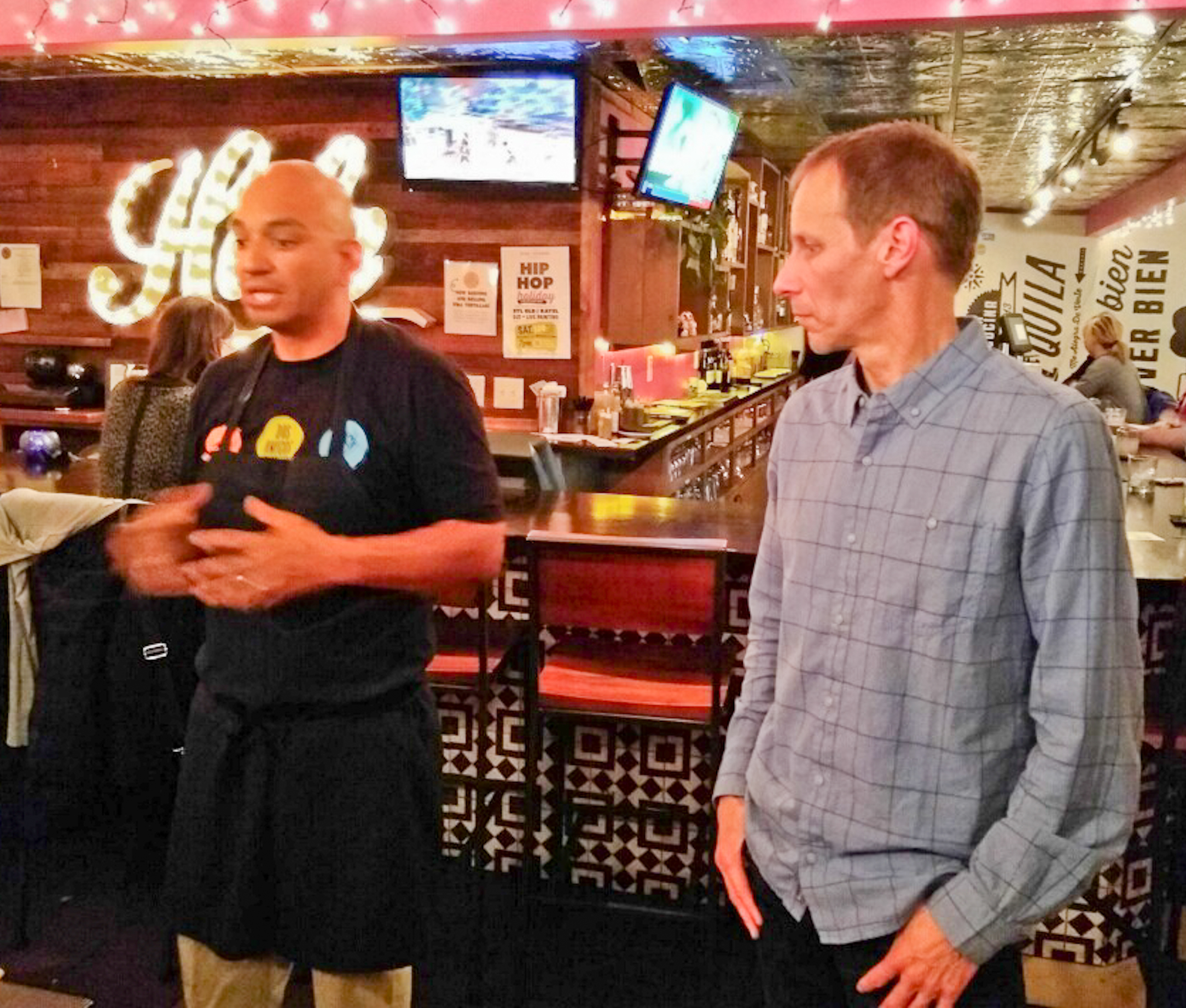
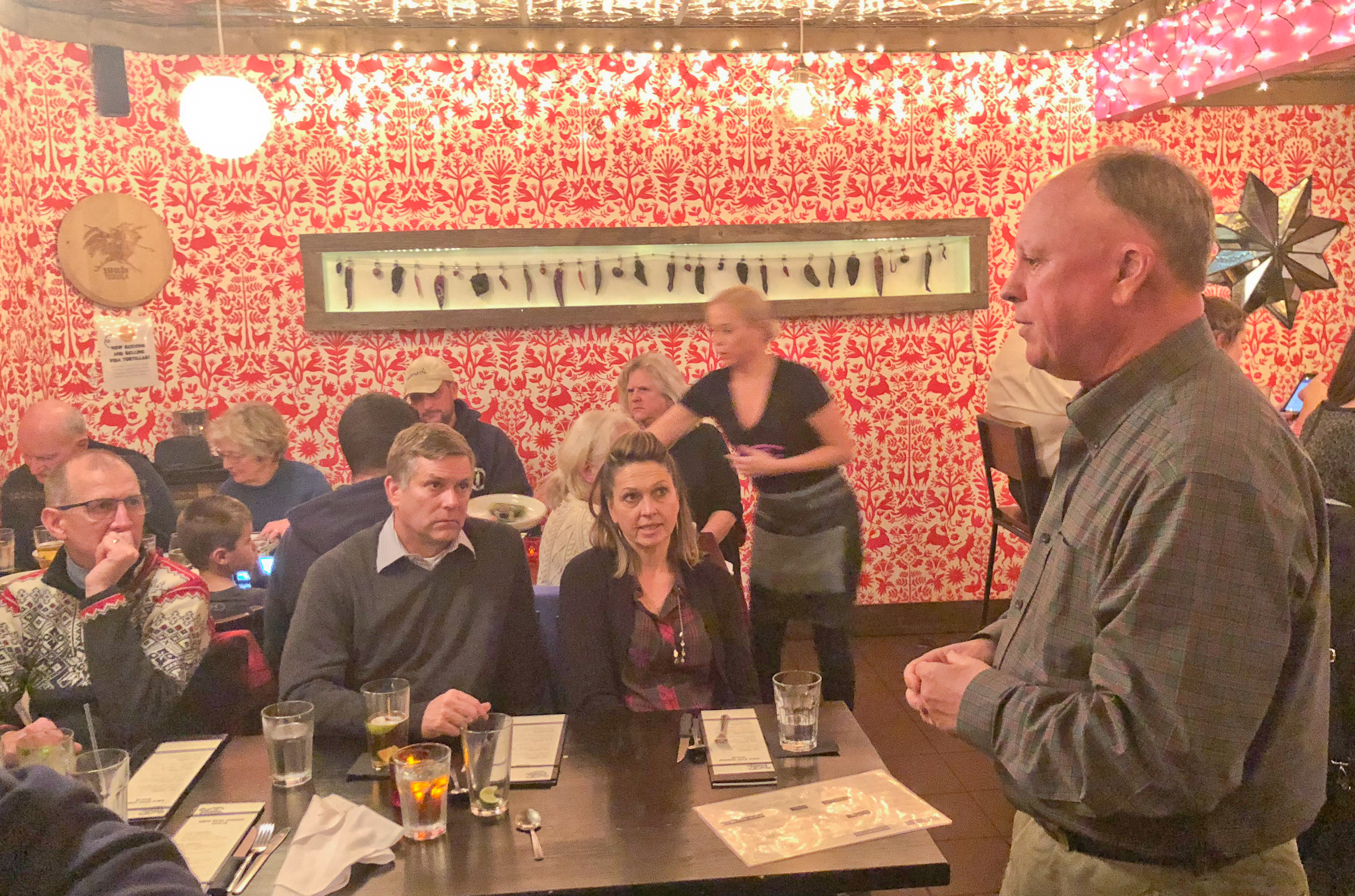
Chef David Vargas discusses his roots in local sourcing.

Deep roots

Chef David spoke about growing up in a Santa Ana (California) neighborhood of little means but deep cultural roots and strong food traditions. His family grew its own vegetables. If they wanted fresh seafood, they went to the local pier and caught it themselves. Local sourcing is ingrained in his DNA and is the bedrock of his menu at Vida Cantina in Portsmouth, N.H.

Chef David spoke about growing up in a Santa Ana (California) neighborhood of little means but deep cultural roots and strong food traditions. His family grew its own vegetables. If they wanted fresh seafood, they went to the local pier and caught it themselves. For him, local sourcing is ingrained in his DNA and is the bedrock of his menu at Vida Cantina in Portsmouth, N.H.

That explains his enthusiasm for hosting a KNOW FISH Dinner®. It was not too far of a leap from the community dining he grew up with, and the embracing of locally sourced food.

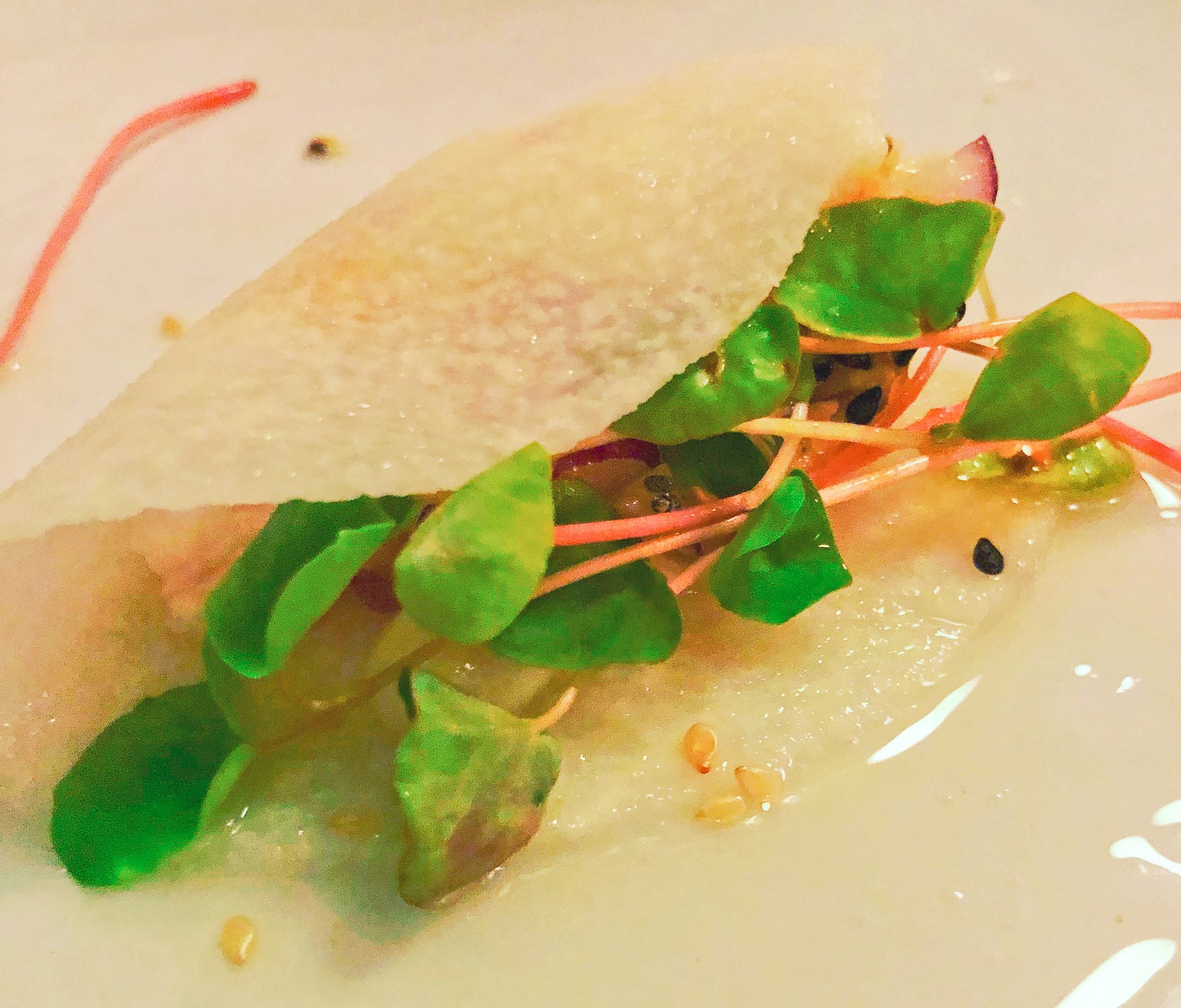
Cod ceviche, courtesy of Chef David Vargas and Capt. Tim Rider. Now that’s boat to table…with flair!

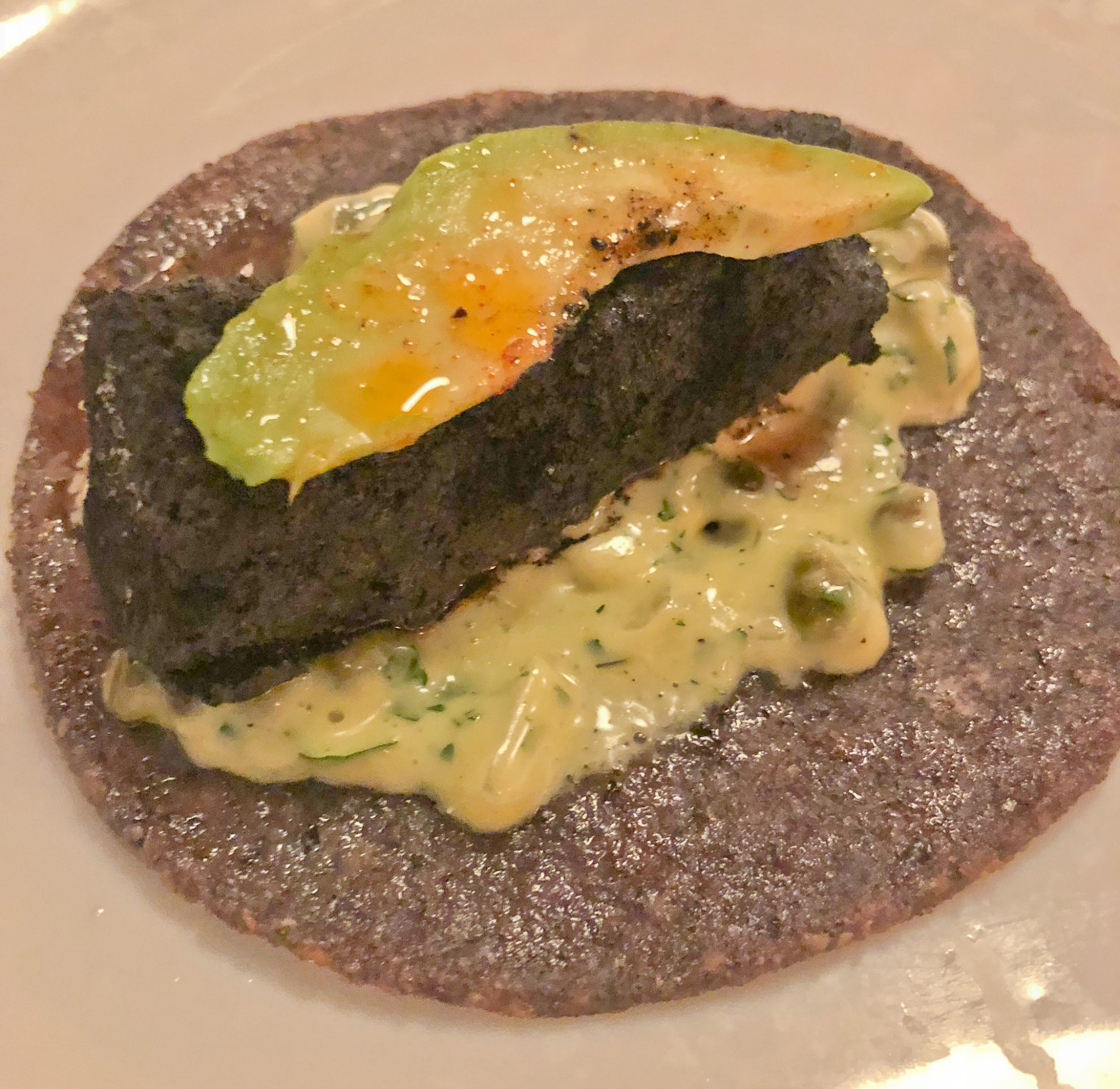
Capt. Tim Rider of New England Fishmongers provided the cod, haddock and pollock (that had been swimming the day before) Chef David turned into south-of-the-border feast fancies: cod ceviche served with a thin, but lightly crisp jicama tortilla and fresh mango, serrano and seeds; charred haddock taco paired with a crispy caper tartar sauce and marinated avocado; and the aforementioned tamale that also came with a mouth-warming charred arbol salsa.

Appreciating fish tales

Capt. Tim also provided some perspective on fishing for a living. He shed light on the passion, drive and unrelenting commitment required just to survive. The long hours, sometimes 20-hour days, sometimes 36 hours, are physically and psychologically draining to be sure.

Charred haddock taco. That marinated avocado complemented the charred coating on the haddock beautifully.

But the attendant pressures to make a living for a captain and crew outside of the actual harvest can be staggering. The expenses can drain bank accounts quickly, which leads to heavy debt. Beyond the table stakes of boat costs such as monthly payments, insurance, fuel, gear, maintenance etc. are, for many, the staggering fees just to be allowed to fish. Someone like Tim may have to pay in excess of $100,000 a year to someone else for the right to fish for cod, pollock, haddock, scallops, flounder and a host of other species in the Gulf of Maine.

It’s the complex, and often debilitating nature of the current fisheries management structure in New England and elsewhere in the United States. Without passion and commitment, facing those kinds of costs and demands on personal well-being would be a short-lived fool’s errand.

And so, KNOW FISH Dinner attendees at Vida Cantina last week gained new appreciation for the fish harvesters who produced the seafood they were eating.

Tim Henry of Bay Point Oyster Company describes the extraordinary patience and commitment to start and run a successful oyster farm.

They also heard from Tim Henry, owner of Bay Point Oyster Company, LLC., who also described the effort to produce top quality oysters right out of Great Bay in New Hampshire. It’s a three-year commitment, requiring tons of patience, significant capital, physical fortitude and an ability to adapt to constantly changing circumstance. Heavy rains can force the state to shut down the harvest, and alter scheduled deliveries, for example.

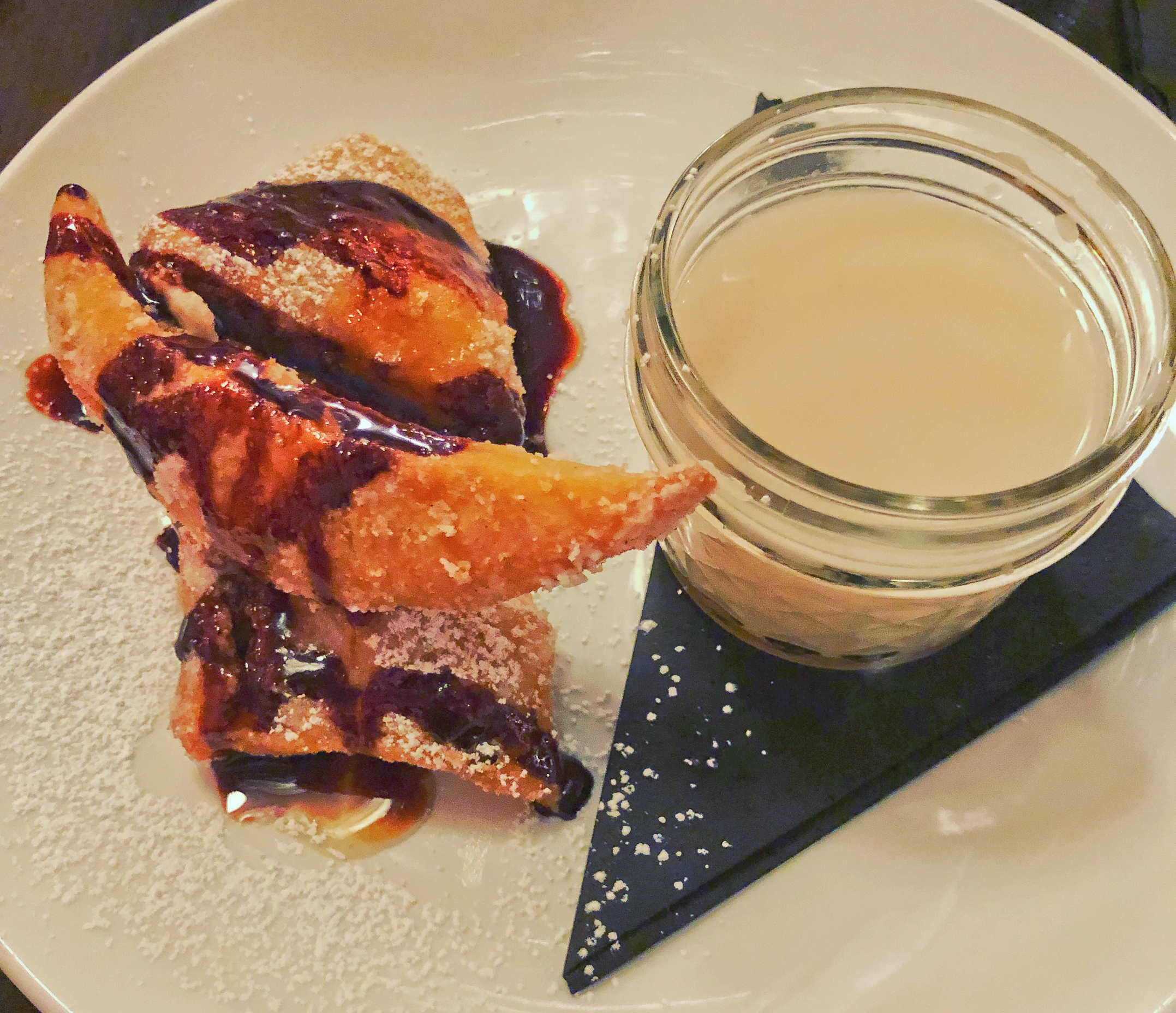
Dessert. This is the first good sopapilla I’d had since childhood.

As we dined on light, crisp sopapillas drizzled in chocolate sauce and local honey, we discussed why knowing the story behind the food we eat, especially the seafood we eat, matters. This is an important point for both classroom and community discussions. When you know when, where, how and by whom your seafood was harvested, you can appreciate the effort that went into producing that seafood. Moreover, you can trust it.

Frozen shrimp from Thailand? Not so much.

All Blog Posts

One Seafood Conversation at a Time

  • November 14, 2018October 20, 2021
  • by Colles Stowell
Share it!
Share

One conversation at a time. That’s been my mantra for changing the seafood purchasing dynamic in the U.S. Whether I’m speaking with a 76-year-old retiree sporting a blue blazer, a group of AP Environmental Sciences students or a cluster of six-year-olds anxious to get their hands on some live green crabs.

The question comes up occasionally. “How do you keep your content fresh?” It’s a good question. A lot of the eye-popping statistics don’t move much year after year. More than 50% of the seafood we eat is farm raised, and 90% of the shrimp we eat is farm raised. The fact remains, sadly, that at least 90% of the seafood we eat here is imported. Some argue the percentage is actually 91 or 94. Either way, the number has not gone down, and it isn’t likely to change substantially in the next few years unless we have some significant policy changes.

For me, it’s not the numbers that change so much. It’s the people I’m speaking with that change. I want to democratize the message. Reach as many people as I can. Tell them the story. Answer their questions. And hopefully convince them to take those messages with them so they change their buying habits and spread the word.
Each new face or group of faces is an opportunity to spread that message. And I’ve found the most effective way to ensure the message resonates is to adapt the way I tell the story to the audience. So the method of the story telling changes too.

This varies dramatically between classrooms by age and subject and also between different restaurant demographics I may be engaging. I look at each new “audience” and venue as a challenge. How do I connect? How do I engage? How do I get them to own the conversation so they own their next seafood decision?

Rye Elementary fifth graders catching on quick that they have the power to ask smart seafood questions at restaurants and stores. Photo credit: Jennifer Halstead

I thought of these questions, as I always do, prior to a couple of school visits last month. Part of my preparation involves strategizing with the teacher beforehand about where the students are in their curriculum and what messaging would best fit with what they’ve learned or with what they will learn.
I’ve established relationships with several teachers who know what to expect. I still check in with them beforehand to make sure there aren’t any new messages they want me to introduce, or advise them of some new content or props (live mackerel, gear, etc.) One of these teachers is Doris Gianforte, a 5th grade science teacher at Rye Elementary School in New Hampshire.
As usual, when I met with her students, they were well prepared. They wanted to know more about why we import so much seafood, and why green crabs are such ecological monsters on this side of the Atlantic, and not in Europe. They couldn’t wait until they had the opportunity to ask questions at a restaurant.

Prior to my visit with 7th grade students at Harpswell Coastal Academy in Maine, I had a good discussion with their teacher Sarah Crockett. We talked about how they were in the middle of field lab work on green crabs in conjunction with an education program at Gulf of Maine Research Institute.

So we discussed introducing green crabs as a climate change marker, one that has implications for local ecosystems and shifting predator/prey relationships.

These students were also very well prepared, accurately talking about when and how European green crabs were introduced in US waters, what they like to eat and why they’re so destructive.

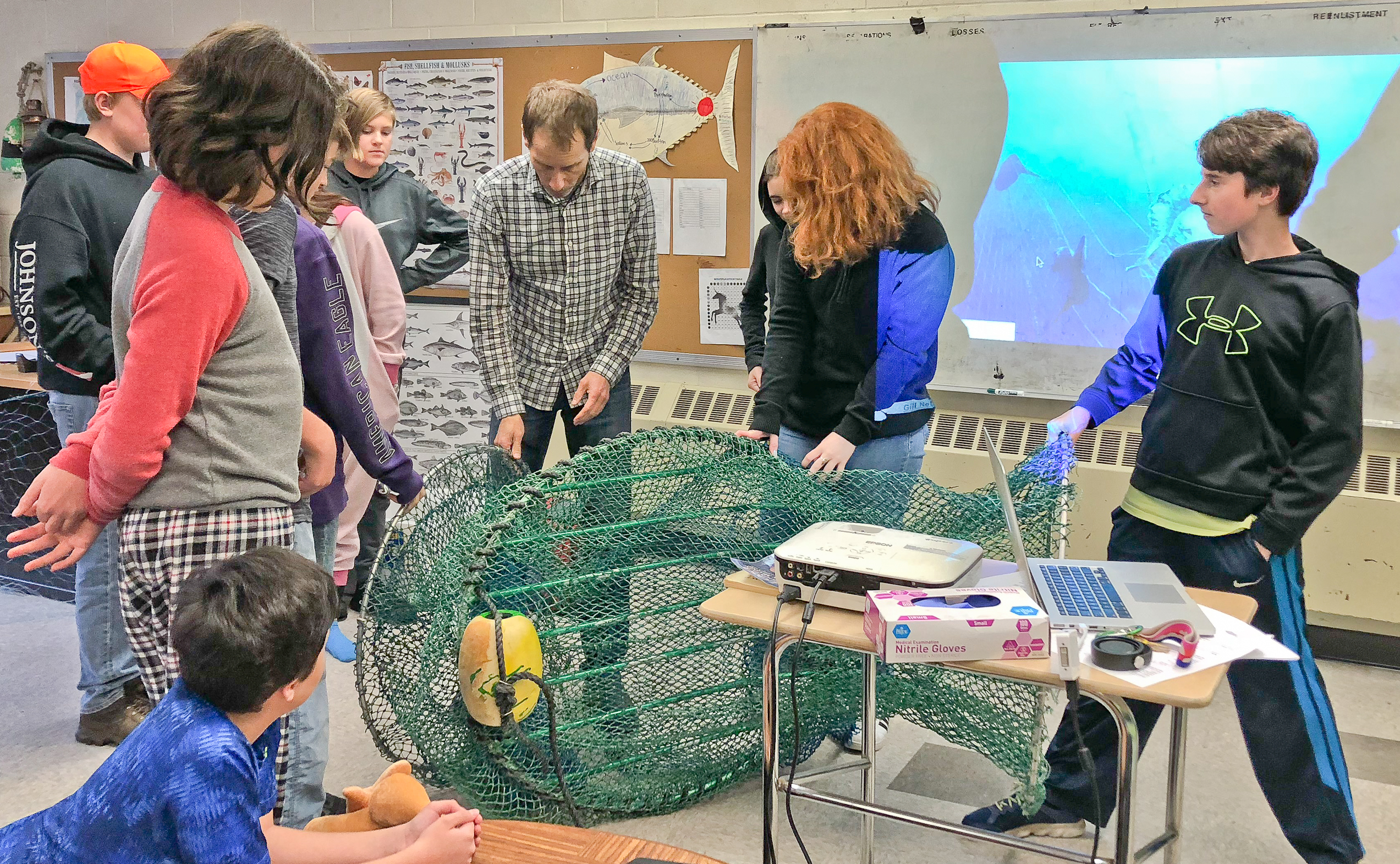
Harpswell Coastal Academy students learning about some measures to reduce gill net bycatch such as shorter soak times and acoustic pingers emitting signals to ward off marine mammals. Guess who didn’t get the memo about “Pajama Day.” Damn! Photo: Sarah Crockett

Students asked great questions about what fishermen and researchers are doing to minimize bycatch associated with different gear types. Like most students, getting their hands on some trawl net and a turtle excluder device helped them better understand efforts to reduce turtle bycatch in the Gulf of Mexico shrimp fishery as well as other fisheries.

These types of connections give me hope that change, real fundamental change, lies within the possibilities and ideas sparked by these conversations.

Even if it’s one at a time.


Top Photo: Harpswell Coastal Academy 7th graders getting their TED (turtle excluder device) talk on. Credit: Sarah Crockett


All Blog Posts

Fifth KNOW FISH Dinner zooms in on critical questions

  • October 15, 2017October 20, 2021
  • by Colles Stowell
Share it!
Share

“How do you know if it’s truly local?”

The question from Jordan Pike of Two Toad Farm in Lebanon, ME. during Thursday night’s KNOW FISH Dinner™ at 7th Settlement Brewery  in Dover, NH was seemingly simple. It is a question any farmer, fisherman, chef, baker or food producer encounters on a regular basis. But its implications are more significant because the complexity of the seafood system in the U.S.

We were discussing the dynamics of the domestic seafood system and some of the drivers behind the fact we import more than 90 percent of the seafood we eat in this country. That’s ironic when you consider we harvest over 5 million tons of seafood domestically on an annual basis… plenty enough to meet the demand.

Brian Gennaco of Virgin Oysters explains why oyster aquaculture is a labor of love. Three years from seed to harvest.

Breaking the habit

One of the largest hurdles is habit. We discussed how habit drives much of the seafood purchases linked to foreign sources. For example, consider the widespread habit of buying the same thing weekly, at the lowest price, without trying to find out more about where things like frozen shrimp or salmon fillets come from. Similarly, there is the habit of continuing with a flawed management system that opens the gate for cheap imports to feed the consumer habit.

Asking questions is one of the most effective ways to change these habits. I told the 35 attendees one of the first questions to ask is “Where is it from?” Buying locally sourced seafood is at least an initial step away from imports.

But Jordan’s question is also at the crux of getting to know our food and improving the relationship we have to our seafood. At its core, the question pits small local food producers against big operators like Monsanto, Thai Union, and the now somewhat defrocked “Codfather”, Carlos Rafael. Rafael, the largest fishing operator on the East Coast, was recently sentenced to nearly four years in prison, three years of additional probation and more than $200,000 in fines after pleading guilty to 28 counts of fisheries fraud. The court also seized a small portion of his assets.

One of Brian’s delicious oysters.

Jordan took the “local” question further. “How do you know the scallops you eat aren’t coming from boats owned by Rafael?”

Become a seafood detective

The answer isn’t simple. The U.S. is lagging in terms of comprehensive, transparent labeling systems that provide easily accessible information. The EU has such a system, and both consumers and fishermen are generally happy with it; consumers for obvious reasons, fishermen because they see it as a competitive advantage.

Absent such labeling, we must try to find such information by owning the responsibility to ask questions. Thursday night, we discussed the importance of forming relationships with fishermen in our communites or with restaurants and stores that buy seafood directly from fishermen in the community or the nearby region.

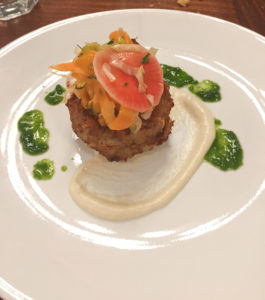
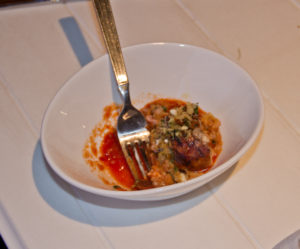
Potato fish cake (pollock), parsley two ways and a bright pickled vegetable salad.

The seafood counters and many of the restaurants I patronize know me and know I’m going to ask questions. They also know I can tell visually how relatively fresh different fish and shellfish are. They may not be able to tell exactly what boat Acadian Redfish on display is from, but they can tell me if it was caught in Casco Bay and when it was cut.

The truth is you may not really be able to learn the provenance of every piece of seafood you buy. Terms like “local” and “organic” have been co-opted improperly so often that their meanings have been diluted. So you ask questions, observe and make educated assumptions. And once you have established a relationship with a fisherman and/or a fishmonger or restaurateur you trust, you will have significantly increased the chance the seafood was harvested responsibly.

It was an excellent question that sparked a good conversation about what we as consumers can do to understand and embrace our relationship to the seafood we eat.

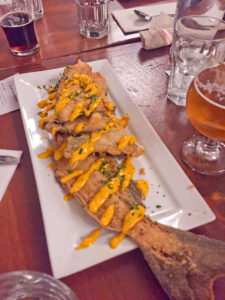
Look at all of that fried goodness! The remoulade was outstanding.

Good food, good convo

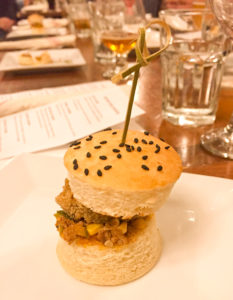
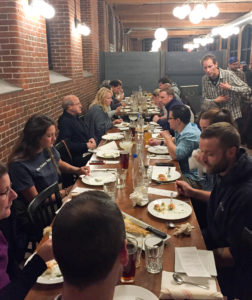
And it was just one part of a great evening of storytelling and diving into key issues with perspectives from Capt. Tim Rider of New England Fishmongers who donated the fish, Brian Gennaco of Virgin Oyster Co. who provided the oysters, and Chef Taylor Miller who put on a feast. (How about delightfully seasoned tuna pastrami, perfectly fried pollock carcasses and collars with plenty of meat on the bones, cornmeal dusted fried oyster with chorizo on brioche with garlic aioli, and some especially delicious gin-brined baked pollock served with cornmeal fried pollock with dill salt???)

We also heard from Joe Letourneau, the only other full-time, rod and reel groundfish commercial fisherman in the Gulf of Maine (aside from Capt. Rider); and, Kevin Jackson, who has a unique perspective as a NOAA observer that accompanies fishermen like Tim and Joe to research a variety of species, like wolfish. Kevin’s work is an example of scientists collaborating with fishermen on critical research to learn more about ocean resources.

Conversation upon conversation, building a movement.

This was the 5th dinner in the KNOW FISH Dinner series, and it is a continuation of our mission to change minds one conversation at a time. Attendees left with several compelling conversations to think about, as well as a menu with the 7 C’s of Sustainability printed on the back.

The next KNOW FISH Dinner will be at Otis Restaurant in Exeter, N.H. on Nov. 2.

Come join us for great food and a broader seafood perspective!

Get tickets here.

All Blog Posts

Getting Hands Wet and Talking Seafood

  • August 4, 2017October 20, 2021
  • by Colles Stowell
Share it!
Share

Every time I speak to a group of students, campers, adults, etc. I learn something.

First, I learn what the audience knows and doesn’t yet comprehend about seafood sustainability in broad terms. I learn who in the audience is more ready to engage in discussion, who wants to challenge pre-conceived notions, and who isn’t really into the conversation.

Depending on the age group and location, these types of interactions can sometimes provide glimpses into a community’s overall seafood IQ. Observing students while I teach a class also provides a mirror of how effectively I’m getting the message across.

Gill nets are hard to see on land as well as in the ocean. Photo: Rich Harty

My first observation at the Seacoast Science Center in Rye, N.H. this week was how lucky the Seaside Safari campers were to have such a program. Set on the shore near Odiorne Point, surrounded by acres of tide pools loaded with lobsters, green crabs, seaweed, etc., the camp provides direct, hands-on access to coastal marine ecosystems. Campers handle live green crabs while learning about invasive species; they turn over rocks and hunt for juvenile lobsters while learning about food webs; they talk about the warming Gulf of Maine while learning about climate change.

I wish I had access to a program like that at that age.

So it was a privilege to learn some things from these campers as we chatted. I re-confirmed that green crabs are a very effective, hands-on prop … almost to the point of distraction when they started fighting.

I learned that these campers, when prompted, were generally eager to learn how seafood ends up on their plates. They wanted to know how a turtle excluder device works, and its impact on reducing bycatch.

Demonstrating the escape hatch for turtles. Photo: Rich Harty

Some campers who had fished recreationally before were genuinely surprised that some fishermen use rod and reel to fish commercially. They were intrigued by the weight of the 14 oz jig used to get the flies down 400 feet to where the haddock, cod and pollock are.

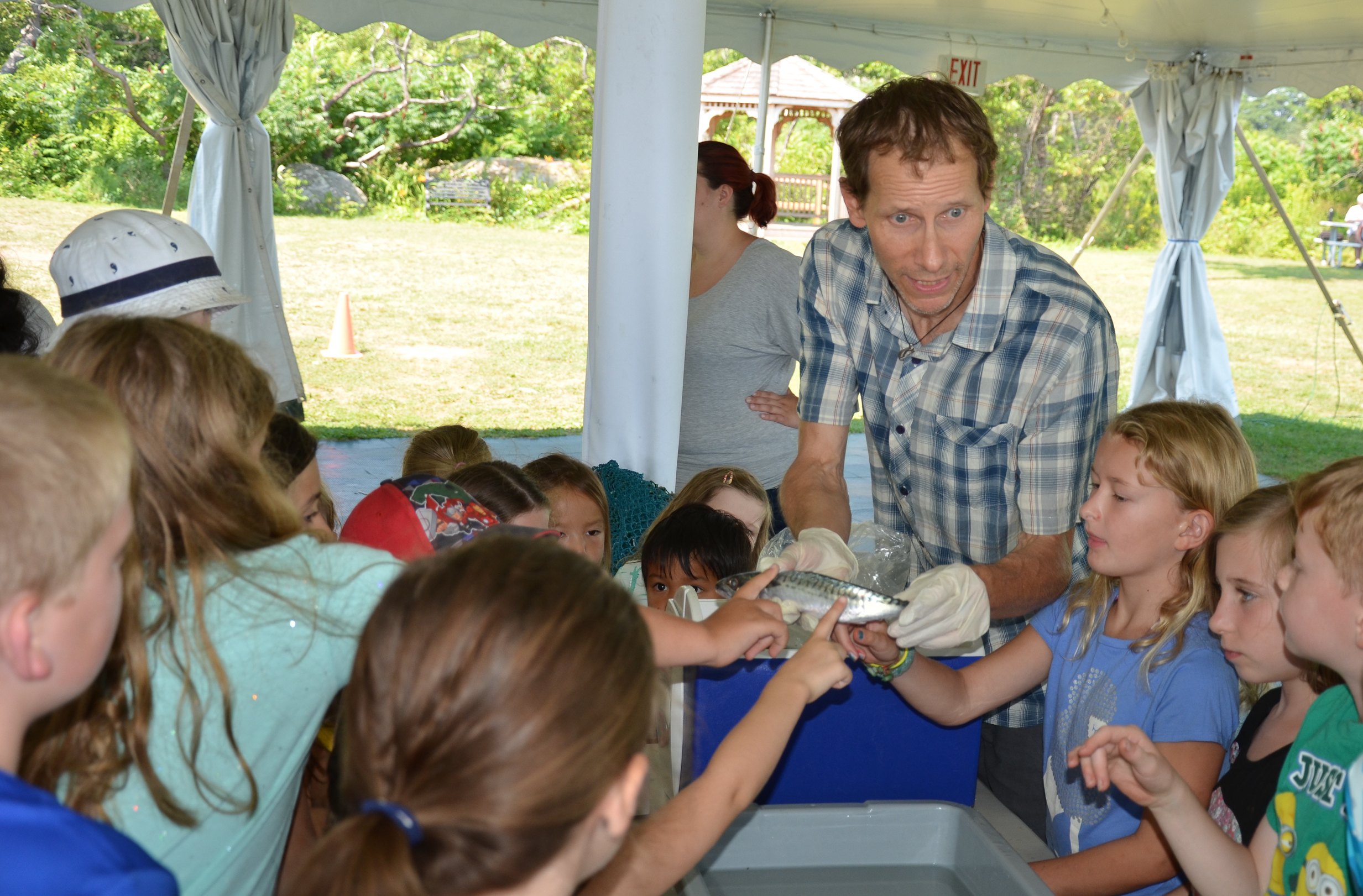
They were also pretty enthusiastic about touching the dead Atlantic mackerel while learning that mackerel are one of several forage fish species that are very important to seafood webs.

And they began to see their relationship to the seafood they eat.

And I learned, once again, that I love what I do.

All Blog Posts

Making Do at Slow Food Nations, Denver

  • July 19, 2017October 20, 2021
  • by Colles Stowell
Share it!
Share

Attending Slow Food Nations in Denver this past weekend, I had some expectations about the Slow Fish 101 presentation I would co-lead and the gumbo I would make.

As often happens, those expectations capsized last minute and I and many others had to adapt on the fly. For the second year in a row, the Slow Fish USA team had to respond quickly to a variety of circumstances outside our control.

In the midst of towed vehicles, last-minute technical presentation difficulties, and a bit of a cluster around the commissary kitchen, we scrambled to help each other out. And just as we did last year at the Slow Fish gathering in New Orleans, we made it work… well.

Blame it on the weather

Again, weather played a role, as it did last year when we had to change venues because a flood warning closed down the original host site. This time, I learned my Slow Fish 101 co-presenter Paul Molyneaux was stranded in Portland, Maine because of weather and would miss the presentation. Having fished commercially and written several books and articles about fisheries, Paul not only brings 40 years of experience to the conversation, he has also made important connections all over the world.

Anyone who loves seafood, cares about the resource and the fishermen who harvest it sustainably can be part of the Slow Fish movement. Photo: Kate Masury

We each had developed a portion of the deck, and his relied heavily on his global travels learning from and supporting artisanal fishermen and their efforts to thrive. I learned much about these issues from our discussions, but I didn’t feel good about trying to put my perspective on the narrative of all of his slides. So I was up until 11:30 the night before tweaking the slide deck to convey many of the same messages, but from a perspective I’m more comfortable with.

Slow Fish USA luminary Kevin Scribner prefaced the presentation next morning with a history of Slow Fish and provided valuable context for questions and discussion flow.

And it was a good discussion. The audience was a mix of Slow Fish representatives and Slow Food delegates interested in fisheries issues. We reviewed some compelling statistics demonstrating how current industrial seafood markets are stacked against small- and mid-scale fishermen.

We also discussed how Slow Fish empowers these fishermen around the world to compete in local and global markets using examples such as the Tuna Harbor Dockside Market in San Diego, Know Fish Dinners in New Hampshire and Maine, and projects that support artisanal fishermen in Uganda and Thorupstrand, Denmark.

Tuna Harbor Dockside Market, San Diego. Photo: courtesy THDM.

Tuna Harbor Dockside Market is a shining example of multi-tiered collaboration between fishermen, activists and government. More than three years ago, a group of San Diego fishermen sought a way to sell to consumers direct off the boat. Though there was no specific permit that would allow that type of retail setup, the city, county and state worked together to create legislation that supports the market.

The result?

  • Fishermen have created relationships with customers.
  • They’ve earned more money: sea urchin prices jumped from $.80 to $5 per lb. and mackerel rose from $.30 to processors to $4 per lb. to consumers.
  • Fishermen have changed the way they fish to accommodate market demand.
  • Fishermen’s families work the tents, getting their children’s hands on the product.

The audience posed great questions about aquaculture, fisheries management and the long-term prospects of wild harvest in the face of growing demand. The conversations continued even after we were kicked out of the room as the next group set up.

First mission accomplished.

Blood, sweat and gumbo

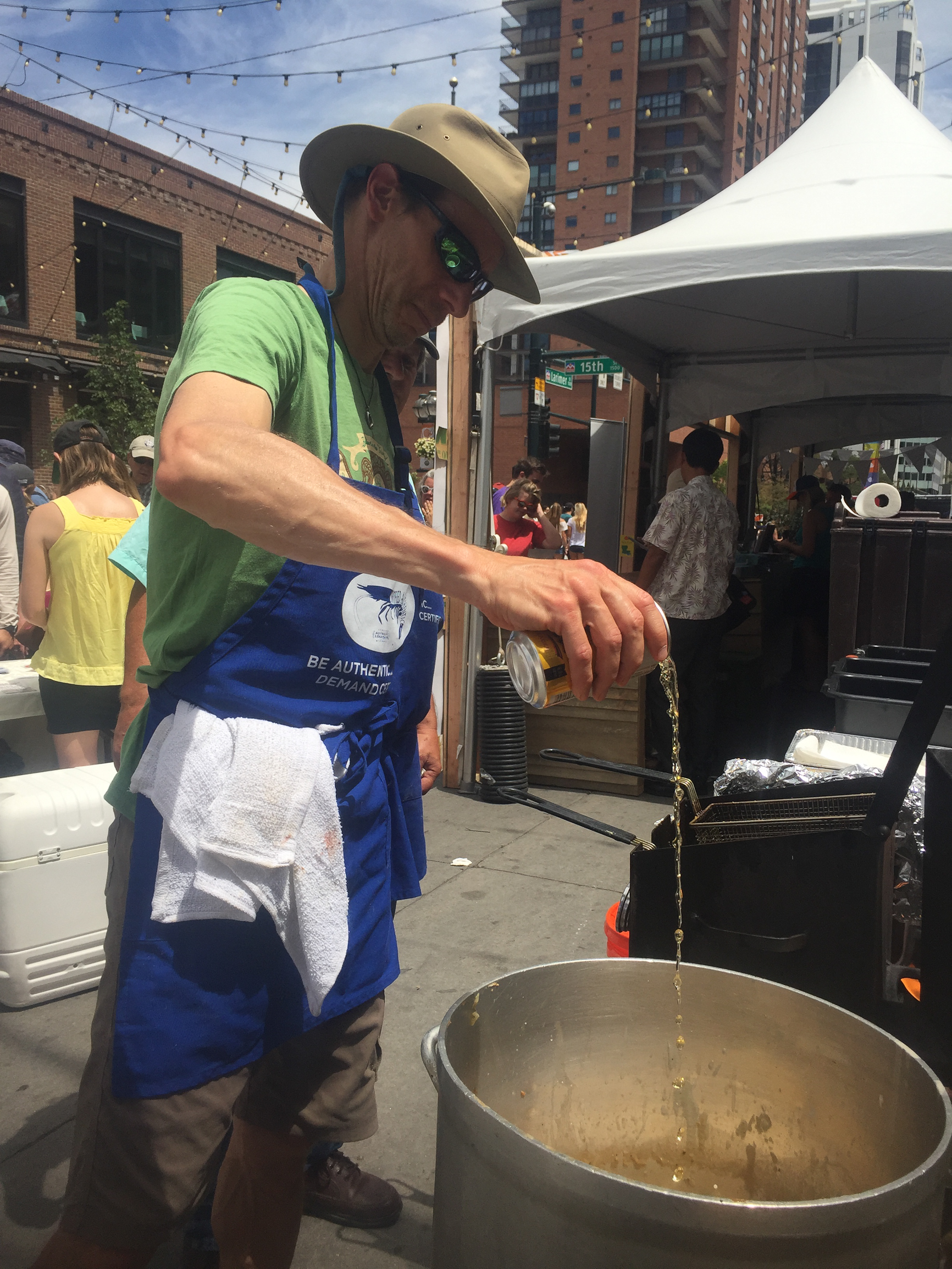
The plan was to highlight the story behind the fabulous shrimp and crabs from Lance Nacio’s Anna Marie Shrimp in Louisiana via gumbo. I also secured some of the best andouille sausage I’ve ever had from Toby Rodriguez, a born-on-the-bayou, pig whisperer, traditional butcher and co-owner of Lache Pas Boucherie and Cuisine in Lafayette, La. He had me at “I call bullshit on all commercially available andouille!”

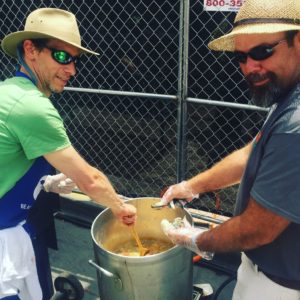
The BIG challenge was logistics, such as sourcing a 40-quart stockpot, stirrer, ladle and all of the flour, vegetables, oil etc. I’d need to deliver my standard of gumbo. I also needed a place to prep and make a stock. Even with weeks of planning, this still proved to be much more challenging than we expected or was necessary.

Thanks guidance from some chef friends, this was NOT a disaster.

Fortunately, because of the connections I’ve forged with Slow Fish and some outstanding chefs, I found what I needed. A couple of chefs, Kelly Whitaker of Basta in Boulder, and my dear friend Evan Mallett of Black Trumpet in Portsmouth, NH helped me figure out how to cook up about 30 pounds of rice (which was way out of my comfort zone.) Evan also chopped and connected me with a chef for the pot and three locally sourced chickens.

I prepped with help from old and new friends for nearly seven hours after presenting. The morning of the food service, I got a late start because we had to wait for the health inspector and I had to try and figure out how to get 50+ pounds of food in different containers and 12 quarts of stock from the commissary kitchen 5 blocks to the site where I’d cook the gumbo. With a dolly and someone’s truck, we made it work.

Lance’s blue claw crabs added flavor…and some down-and-dirty eating for lucky patrons.

Four hours, a few laughs, a couple of cuss words, a stream of sweat and an unfortunate slip of a knife later, and I was ladling gumbo to praise. We had three tents serving fried shrimp, Baja oysters, miso and seaweed, Alaska salmon, salmon poke and black cod. All of it delicious. The quality and freshness of each product was exceptional.

The moment of truth for me came late that afternoon when an elderly African American man sporting a comfortable sun hat and shades asked, “What you got in that gumbo, son?”

I told him the ingredients, mentioning Toby’s sausage, and the fact I smoked the chicken over apple wood that morning.

“Where you from?”

“New Orleans, sir.”

“Who taught you?”

“A Creole woman who took care of me when both my parents were working. Nothing written down. All oral tradition. Took two years of her whacking me over the head with a wooden spoon every time I messed up for me to start getting it right.”

“Ok. Let’s try it,” he said, dropping his ticket in the cup.

Nervously, I spooned out some rice and carefully selected a ladle that had shrimp, crab, two different kinds of sausage, chicken and as many vegetables as could fit.

The man took a spoonful and seemed to swirl the gumbo around in his mouth like a sommelier, which made me uncomfortable. If he didn’t like it, my day was lost.

He raised his head, sniffed, then a slight smile curled his mouth.

“A lot of flavors that work well together.”

“You like it?” I asked, for confirmation.

“Yes. You done good. Thank you.”

“Thank you, sir!!!”

Notice the gloved hand.

So what if I may have shaved some time off the back end of my life stressing over logistics. So what if I’m now struggling to type with nine fingers because I damn near sliced off the tip of my index finger early in the morning before really getting going on the gumbo. Someone in the tent trained in wilderness survival did a field repair to stop the bleeding so I could complete the mission. I got four stitches only after most of the gumbo was gone and I received “official” validation.

Group effort

All of this goes back to something Slow Food USA director (and former New Orleans high school classmate) Richard McCarthy said in opening remarks that Slow Food is about pluralism. Change doesn’t come from any one person. It comes from a collective force.

So it is true with Slow Fish and specifically, my mission with One Fish Foundation. Changing attitudes about consumer food and seafood purchases requires a group effort. It requires communication, collaboration, partnerships and adaptation. Adapting to unforeseen challenges to event execution is becoming an illustrative trend for Slow Fish USA. It’s because of the connections and friendships we’ve formed that we’ve been able to overcome some last-minute hurdles, working together to send our message.

It’s because of those connections, and the new connections we make that we will continue to steer the conversation toward preserving the seafood resource and the way of life of the fishermen who harvest and care for it.


Top Photo: Don’t forget the secret ingredient! Credit: Lance Nacio.


All Blog Posts

The Story of Seafood

  • May 25, 2017October 20, 2021
  • by Colles Stowell
Share it!
Share

There’s a fair amount of planning that goes into these KNOW FISH dinners. Working with fishermen and oystermen to provide product. Coordinating dates, menus, sales operations, space, staffing etc. with chefs. Logistics.

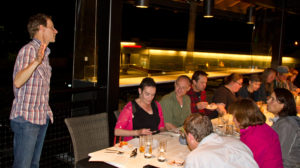
Despite all of this planning, sometimes things change last minute and you have to adapt. It’s an almost everyday occurrence in the restaurant industry, particularly when you strive to be farm- or boat-to-table.

And so I found myself shucking a few dozen oysters at Tinos Greek Kitchen less than an hour before guests were to arrive last night. As often happens, Mother Nature dictated a deadline change when it dumped heavy rain on Great Bay on the Piscataqua River over the weekend, forcing the state of New Hampshire to close the bay to shellfish harvesting the day before the event.

We scrambled to get some Gulf of Maine oysters, and processed them just in time for dinner. It became a great talking point about eating with the ecosystem (ie, adapting to what’s available and what Mother Nature allows). Fishing is no exception. Capt. Tim Rider of New England Fishmongers, who provided the fish for the dinner, will tell you change is a constant. He could find pollock in the same spot three days in a row in 300 feet of water 60 miles offshore. But on the fourth day, the wind is cranking at 30 knots with eight-foot swells and his boat, the F/V Finlander, stays docked. On the fifth day, the fish have moved out.

Snow Island Oysters, seeded in Quahog Bay off Harpswell, Maine to help clean the bay. Photo credit: Ed Marshall

Seafood stories

At the dinner, we discussed the importance of eating what’s locally available, abundant and in season. For example, squid are cruising in numbers in the Northeast Atlantic. Chef Mark Segal and his team prepared wood grilled squid (from the F/V Rimrack out of Rye, N.H.) with roasted eggplant, roasted red peppers, crispy smashed chickpeas, olives, pepperoncino, feta, egg breadcrumbs and green crab aqua pazzo. Fabulous. The plates went back to the kitchen scraped clean.

Stuffed local squid that didn’t last long in anyone’s dish. Photo credit: Mike McGrail

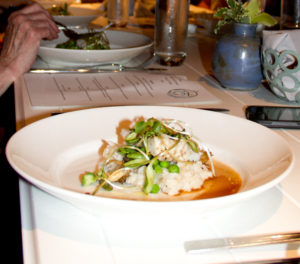
The menu itself testified to the narrative of eating what’s local and fresh. The fourth course was listed as “Local Whitefish al Forno” because Chef Mark prepared the menu not knowing which groundfish Capt. Tim would bring in that day. The pollock, which was fired to the perfect temperature, texture and taste, was served with finnan haddie (cold smoked Finlander haddock) risotto, English peas, fiddlehead ferns, and hen of the woods mushrooms. Stellar.

Fresh pollock al forno landed aboard the F/V Finlander. Photo credit: Mike McGrail

We discussed how every dish has a story, just as every piece of seafood we purchase has a story. The story tells where, when, how and by whom it was harvested. The question is whether we can get that story before we buy; whether we can believe that story; and what that story actually is. Because U.S. seafood consumption is so disproportionately skewed toward cheap imports (more than 90% of the total seafood consumed domestically), finding the truth behind the seafood requires vigilance from consumers. They have the right to find out these stories so they know what they’re eating.

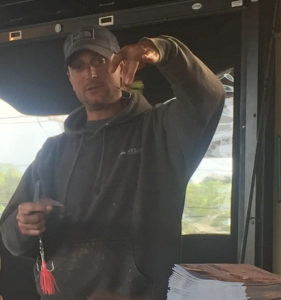
Capt. Tim rider displays a heavy jig and the type of fly used to catch groundfish, like the pollock on the menu. Photo credit: Ed Marshall

The Snow Island Oysters I helped shuck were from Quahog Bay in Harpswell. The Quahog Bay Conservancy seeded the oysters for aquaculture a few years back in an effort to help clean the bay. As filter feeders, oysters remove some of the excess particulate matter like plankton and nitrogen that could choke the bay with harmful algae if left unchecked.

Another course weaving in the local seafood narrative with a Greek twist featured Dolmades, grape leaves stuffed with Maine cultured mussels, golden raisins, red onion and served with saffron avgolemono (a Greek sauce featuring egg yolk, lemon and broth). Again, excellent Mediterranean flavors complementing Gulf of Maine seafood.

Rethinking seafood purchases

On the theme of adaptation, I urged attendees to re-think how they approach seafood purchases by taking a more active role in discovering the story behind the seafood. As with previous KNOW FISH dinners, we printed some sustainable seafood principles, called the 7 C’s of Sustainable Seafood, on the back of the menu. I encouraged them to take those concepts with them the next time they go to a seafood counter or a restaurant. Buying local is like making a covenant with local fishermen: “I trust you to provide good, sustainably harvested seafood. You trust me to pay a fair price.”

Capping the evening with a mission to spread the word over an inventive, and very satisfying dessert. Photo credit: Mike McGrail

Doing so likely supports fishermen like Capt. Tim Rider, or oystermen like Steve Weglarz of Cedar Point Shellfish and Brian Gennaco of Virgin Oyster, Co., who were both on hand to discuss local oyster aquaculture.

I asked everyone at the table to channel the energy from the event into conversations they have in their communities. Changing a broad national dynamic such as how we buy seafood in the U.S. happens at a grassroots level by spreading the message as often, as loudly, and as passionately as we can.

Top Photo: Reviewing the 7 C’s of Sustainability over dessert — Swedish Fish ice cream, lingonberry glaze, madeleine, almond brittle and blueberry cream legere. . Credit: Mike McGrail

Posts pagination

1 2 3

Recent Posts

  • Hurricane Ida wreaks havoc on Louisiana’s seafood industry
  • EPA Should Use Clean Water Act To Kill Zombie Mine
  • Slow Fish 2021: Relationship Matters
  • Faith, Façades, and Futility
  • Pebble Permit Paused: Politics at Play

Archives

  • September 2021
  • August 2021
  • April 2021
  • December 2020
  • August 2020
  • June 2020
  • February 2020
  • December 2019
  • November 2019
  • October 2019
  • July 2019
  • May 2019
  • April 2019
  • March 2019
  • January 2019
  • December 2018
  • November 2018
  • June 2018
  • May 2018
  • March 2018
  • February 2018
  • January 2018
  • December 2017
  • November 2017
  • October 2017
  • September 2017
  • August 2017
  • July 2017
  • June 2017
  • May 2017
  • April 2017
  • March 2017
  • January 2017
  • December 2016
  • November 2016
  • October 2016
  • September 2016
  • August 2016
  • July 2016
  • June 2016
  • May 2016
  • April 2016
  • March 2016
  • February 2016
  • January 2016
  • December 2015
  • November 2015
  • October 2015
  • September 2015
  • July 2015
  • June 2015
  • May 2015
  • April 2015
  • March 2015
  • February 2015
  • January 2015
Theme by Colorlib Powered by WordPress