Skip to content
One Fish Foundation
  • Blog
    • Aquaculture
    • Education
    • Environment
    • Policy
    • Wild Harvest
    • Fish Tales
  • About
    • About One Fish
    • About Colles Stowell
  • Education
    • Elementary School
    • Middle School
    • High School
  • KNOW FISH Dinners®
  • Resources
    • One Fish Podcast
    • One Fish Foundation in the news
    • The 7 C’s of Sustainable Seafood
    • Newsletter Archive
    • Recipes
      • Skate with Capers and Butter — Chef Rizwan Ahmed
      • Grandma Davis’ Fish Chowder — Jane Almeida
      • Ginger Garlic Tamari Scallops — Colles Stowell
      • Fish Stock — Evan Mallett
      • Mussels San Remo — Chef Rob Martin
      • Salted Pollock Croquettes – Chef Mark Segal
  • Connect
    • Contact OneFish
    • Social
      • Instagram
      • Facebook
      • Twitter
All Blog Posts

“We’ll Always Have Paris”… or not

  • June 10, 2017October 20, 2021
  • by Colles Stowell
Share it!
Share

Some interesting questions on climate change arise as I’m preparing a discussion on seafood sustainability with college students next week. The administration’s withdrawal from the landmark Paris climate accord have brought these questions to the fore, even if the underlying causes have been brewing for some time.

  1. What message are we sending high school and college students if we as a country (the largest historical contributor to climate change) step away from a global agreement on the issue?
  2. How do we convince students who may be on the fence about pursuing marine or climate science careers that we need more research, funding and more young brilliant minds to help us try to keep up with climate change if our government shows little willingness to believe in the need for, much less fund further research?

Throwing down a challenge

This spring I developed new high school lesson plans for seniors that focused on climate change impacts on seafood in the Gulf of Maine. The narrative begins with a broad view of the domestic and global seafood dynamic, and then focuses on why consumers should care, highlighting everything from bycatch to environmental impact and social ramifications.

Then we discuss the rapid temperature increase in the Gulf of Maine (faster than 99% of the Earth’s oceans), recent research on changes to global ocean currents and salinity and increasing ocean acidification due to higher absorption of man-made CO2. We talk about how fishermen are on the front lines of recognizing climate change impacts, and how they are struggling to interpret what the long-term ramifications are on their livelihoods. We discuss how researchers continue to improve our visibility into near- and long-term impacts of warming water, OA, and current and salinity changes.

We also discuss how despite these advances, we’re still often two steps behind climate change because we have much more research to do to figure out how myriad factors work in concert to change marine ecosystems where fish and shellfish try to thrive. A lot of the complex geophysical interactions demand more research so that we can have a more precise view of how we must adapt to, not fix, climate change impacts.

Then I challenge them to help find a solution. I urge any of them remotely interested in marine or climate sciences to commit to help us better understand these issues. Doing so would not just help from an environmental perspective, but an economic and social one as well. If our oceans rise by nearly seven feet by the end of the century (as some scientists now predict), water temperatures increase by several degrees and the ocean’s acidity increases just a little bit, seafood markets could suffer tremendously.

Mixed messages

So when the 2nd largest polluter in the world (China is tops by far, but the US has generated more over time) pulls out of the most significant global agreement on climate change – one that it helped coordinate – what does that say to these students? At a time when we should be doing everything to encourage young people to pursue these careers, our administration is caving to an industry that is literally fueling the problem.

The irony is staggering.

I will continue proselytizing. This is not the time to let political isolationism derail global momentum toward some semblance of unified action on climate change. Stepping away now simply cedes the leadership role to other countries that may have more to gain.

Reneging on the deal may also create another hurdle to convincing students we need their help. Why would they want to spend the time and energy diving into the issues if there isn’t going to be any money to support their efforts?

Rallying cry

Conversely, the administration’s move may have some consequences advisers may not have fully predicted ahead of time. Climate change has again become a major topic of conversation here. Individual cities and states are talking about signing on independently. Perhaps the withdrawal will, like other recent administration edicts, become a galvanizing point.

I hope so. That would make these discussions more relevant, and perhaps, more effective. I’ll have a better perspective next week after I speak with the students participating in the Sustainable Marine Fisheries Course at the Shoals Marine Laboratory hosted by N.H. Sea Grant.


Additional reading:

Vox overview of the Paris Accord and climate change.

The Economist view of the impact of the US withdrawal.

New York Times analysis with compelling graphics on the implications of the withdrawal.

National Review blog showing conservative support for the administration’s decision.

Climate Nexus analysis disputing conservative claims in the president’s speech on the withdrawal.


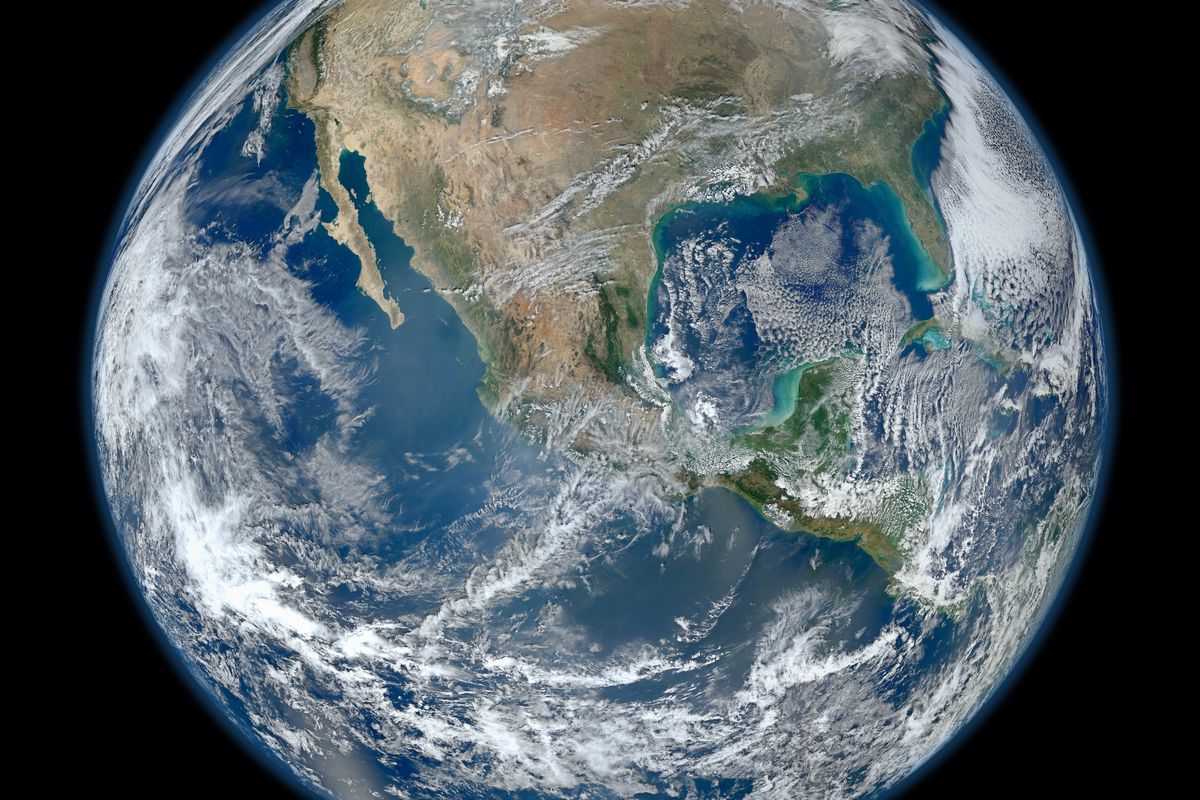
Top photo credit: (NASA/NOAA/GSFC/Suomi NPP/VIIRS/Norman Kuring)
All Blog Posts

Climatologist Sees Climate Change as Innovation Opportunity

  • April 11, 2016October 20, 2021
  • by Colles Stowell
Share it!
Share

Cameron Wake is used to being called “Dr. Doom.” He’s an ice core paleoclimatologist at the University of New Hampshire who’s been studying glaciers and their behavior for more than 30 years. He’s been on the forefront of some of the leading research into climate change, much of which now predicts more than six feet of sea level rise by 2100. That’s not fully accounting for the possible 20-25 additional feet of higher water if all of the earth’s glaciers melt.

So naturally, he does his best to be optimistic.

“Climate change is the innovation opportunity of the 21st century,” he says, whether at a climate summit hosted by MIT Seagrant in 2014, or at an intimate gathering of 200 in Portsmouth, N.H. on March 28. Even though the range of possible sea level rise jumped 2.6 feet from 2014 to 2016, his insistence on the opportunity angle echoes some of the enthusiasm born of the global climate accord reached in Paris in December.

“Climate changes,” he said. “It always has and it always will. The biggest difference today is that there is an extensive and ever-growing body of scientific evidence that shows that humans are the main driver of that change.”

But, we have time to avoid some of the darkest “Dr. Doom” predictions … if we act now, and decisively, he said.

There is an interesting dialectic at play with climate change that can be a bit challenging to grasp. At the Maine Fisherman’s forum last month, NOAA’s John Hare made a striking comment: “Climate change has a long memory.” The next 25-50 years of climate change are already fixed based on what we’ve done up until now. However, the steps we take now to reduce greenhouse gases, widely accepted as the leading culprit causing global warming, will affect our climate after 50 years or so.

In Portsmouth, Wake described why studying the different strata of glaciers yields so much information about what the climate has done in the past. “Glaciers are great archives,” he said. “We can look at oxygen isotopes to see what has happened.” One fairly constant measure is that when CO2 levels are high, the temperatures are higher, when they are low, temperatures are low.

Wake put some of the need to act immediately and globally in context with some recent data:

  • Within the past 18,000 years, massive ice sheets that once covered North America and Northern Europe have melted;
  • To slow long-term climate change effects, we need to keep global CO2 at 400 parts per million. We are now on a path toward 1,000 parts per million;
  • Arctic sea ice is the air conditioner for the northern hemisphere, reflecting UV rays back into the atmosphere. If that ice melts, it will lead to warming of the atmosphere and the oceans, accelerating global warming;
  • We’ve seen a significant reduction in Arctic sea ice in the summer since 1975. Sea ice is likely going to disappear in the Arctic Ocean this summer;
  • The rate of the Greenland ice sheet moving toward the ocean where it melts has doubled in the past decade. One particular glacier, the size of Mount Washington in N.H., has doubled its rate toward the Atlantic;
  • We may not fully understand the physics of glacial movement and melting in light of global warming for another decade;
  • There will be no shortage of fresh water in New England. The number of rain events in Southern N.H. with more than four inches in 48 hours is projected to jump from four between 1980-2009 to nearly 12 between 2070 to 2099. This means we’ll have more water falling in fewer events, making coastal and flood plain areas more vulnerable;
  • “It’s a challenge to talk about future on climate because we don’t know what humans are going to do,” said Wake, explaining why climatologists now use two scenarios representing high and low carbon emissions. While there is little variability between the two scenarios until 2050 because the pattern is locked, potential temperature ranges for New Hampshire vary widely afterward. If we drastically cut greenhouse gases, the average number of summer days hotter than 90 degrees Fahrenheit would be 20-25. If we continue on our current path of greenhouse gas emissions, New Hampshire could experience 50-60 days above 90 degrees;

“We can’t wait until 2050 or 2080 to address this challenge,” he said. “We won’t have enough money in one year to adapt. We need to keep checking back in with the science. Where there is little tolerance for risk, communities should commit to 4 feet of sea level of rise, but be flexible to manage to 6.6 feet.”

Solutions

To begin with, we need to at least meet the emissions goals set at the Paris accord. It was a significant achievement to get nearly 200 nations to commit to do something to reduce carbon emissions, with a goal of limiting global temperature increase to 2 degrees Celsius (3.5 degrees Fahrenheit) by 2100. But even with those commitments, we’d only keep the global temperature rise to 3 degrees Celsius, many scientists say. We have to get the largest polluters, China, the U.S., India and other countries to cut more.

“We must decouple economic growth from greenhouse emissions,” said Wake. That means leaving a lot of fossil fuels in the ground. To prevent global temperature increases of more than 2 degrees Celsius, we must not burn 82% of the coal, 49% of the gas and 33% of the oil global reserves. We also need to increase annual global renewable energy investments to at least $1 trillion, he said. That kind of investment will likely yield innovations that make renewable energy more affordable and accessible on a global scale.

Most importantly, he said, we need to make personal commitments to reduce our carbon footprints. “I think every home should be its own powerhouse,” he said. Solar panels, efficient heating systems, better insulation, efficient windows, etc. are all some of the ways to reduce the carbon footprint of our homes.

“Think about what you can do. Your family. Your community.”

Resources

 Cameron Wake’s slide presentation in Portsmouth

Chasing ice: Incredible video of largest ice calving event (Ilulissat Glacier, Greenland) ever captured on film.

New York Times article on new research showing how quickly the West Antarctic ice sheet could melt

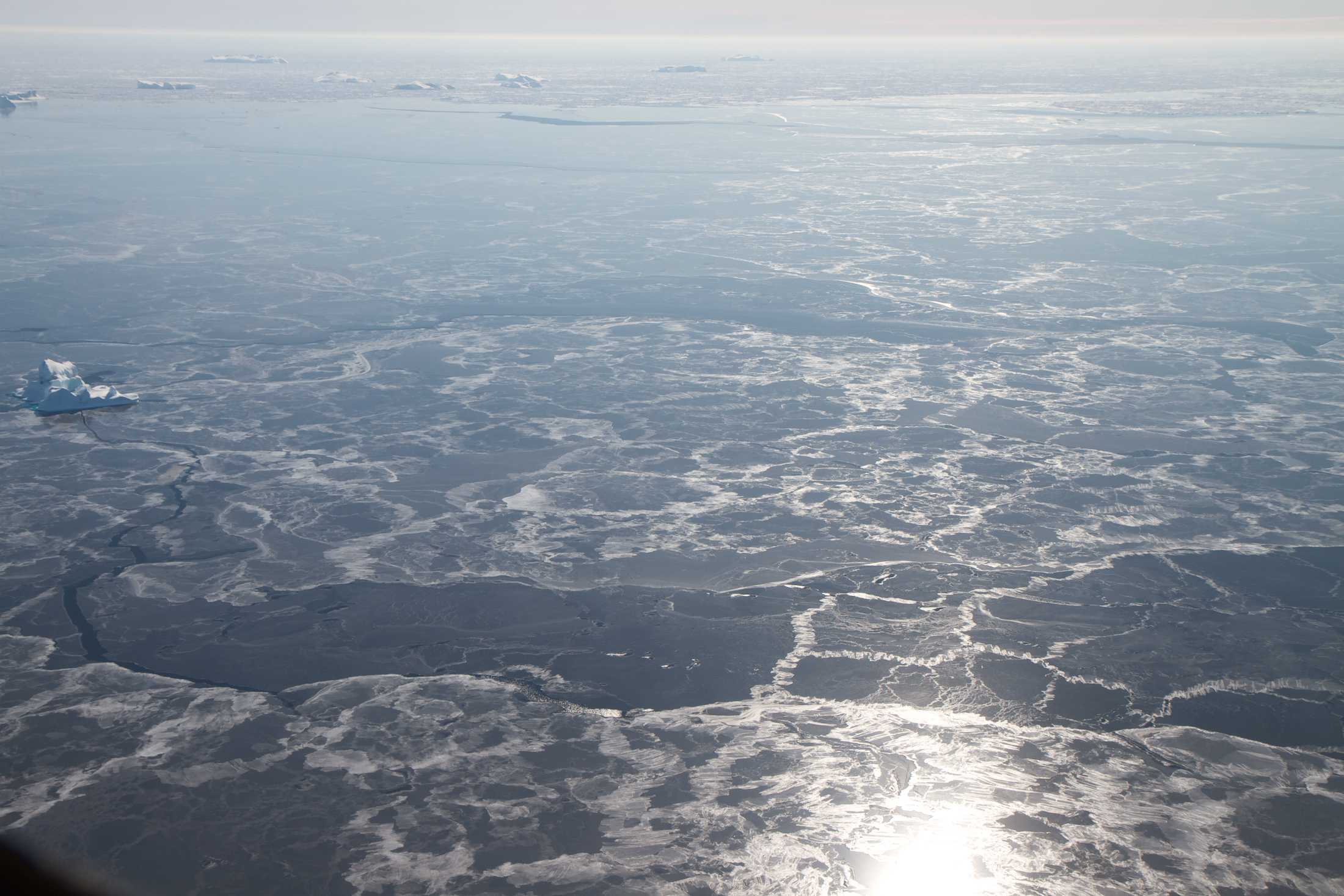
photo: Thin sea ice and a few floating ice bergs near the Denmark Strait off of eastern Greenland. Credit: NASA/Jefferson Beck

All Blog Posts

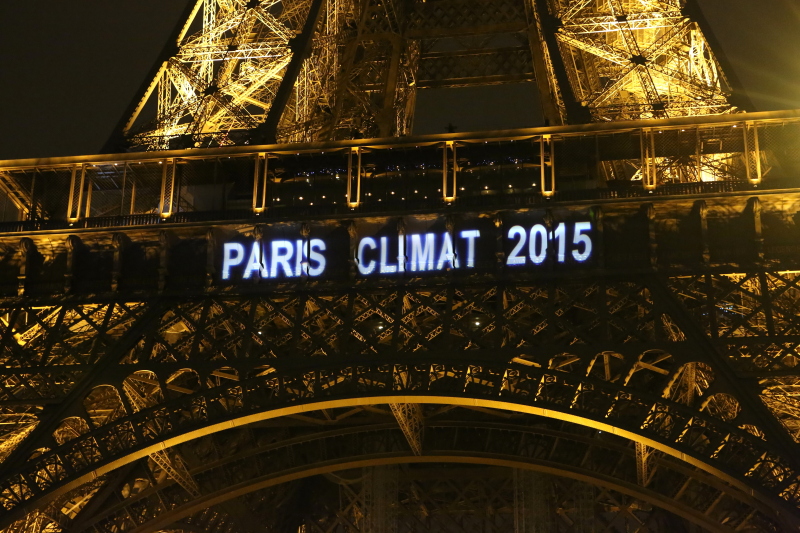
Paris Accord Sets Global Climate Change Commitment

  • December 15, 2015October 20, 2021
  • by Colles Stowell
Share it!
Share

Something happened in Paris on Friday that many thought wouldn’t.

Agreement.

Agreement by nearly 200 countries that climate change is a significant problem with short- and long-term global implications that we must address collectively. It was an uphill slog. Those countries signed a pact to reduce their carbon footprints and slow the pace of global warming in the coming century.

In a nutshell, after months and years of preparation, with weeks of hard back-and-forth negotiation culminating in two overnight sessions, nearly 200 countries agreed that:

  • Climate change exists and has the potential to do irreparable harm to the planet;
  • Global commitment to reduce greenhouse gases is critical to minimizing this harm;
  • Each country must commit to reducing carbon emissions, and revise those commitments to ever stricter standards every five years;
  • Each country must demonstrate what measures it has taken to cut emissions via a transparent process, every five years;
  • The goal is to keep the global temperature increase below 2 degrees Celsius, if not 1.5 degrees;
  • Forest preservation is critical to offsetting carbon emissions, and countries should enact policies to limit logging and save intact forests; and
  • Developed countries like the U.S., France, England, etc. should take the lead in providing funds for programs to reduce global carbon emissions, including those in developing countries.

Establishing a framework

To be sure, this is a first step. Conference organizers in Paris and elsewhere must have looked at this effort like herding cats. Coal gobbling countries like China, India and the U.S. have traditionally held different views on their responsibilities for and the extent of climate change. Smaller developing countries like the Marshall Islands, which are sounding the alarm bell that they’re losing ground…literally, have completely different views.

Such widespread agreement is monumental in the shadow of the failed 2009 climate agreement in Copenhagen. While the 2009 summit only suggested what to do, this accord is an almost Earth-wide acknowledgement that countries need to tackle this collectively, and a legally binding commitment to do so.

Will it stop global warming completely by on its own? No, say many scientists. The real tipping point would be to prevent the average global temperature increase from exceeding 2 degrees Celsius, or 3.6 degrees Fahrenheit. Scientists say that if global annual temperatures rise above 2 degrees, the planet will be past the point of repair, and the Greenland and West Antarctic ice sheets will melt, sea levels could rise 20 feet, etc.

But as written, this agreement will only limit global temperature rise by about 3 degrees Celsius if countries achieve their current emissions reductions commitments, according to some scientists. It’s far better than the status quo, which is on track to bring an increase of more than 4 degrees Celsius and potential catastrophe. Still, on the new path the oceans will continue to rise, and polar caps will continue to melt, only at a slower pace.

To meet the agreement’s goal of avoiding damaging climate change, the nations of the world must step up the ambition of their cuts over time. The pact is voluntary for countries to strive for that 2 degree goal. What is legally binding is that each country commits to some kind of carbon emissions reduction, that they commit to continuing to reduce emissions more significantly every five years, and that they demonstrate what they have done, again every five years.

One of the biggest reasons the Paris agreement does not specify benchmarks for each country is that the United States Congress would have to vote on such a measure. And the Republican-controlled U.S. Senate would have nixed any such wording. Interestingly, the U.S. Republican party is the only political party in a study of nine developed countries that flat out denies “anthropogenic climate change.” More interestingly, the study suggests that opposition to addressing climate change is strongest in countries with large reserves of oil, natural gas, and/or coal (all of which the U.S. has in abundance).

Reason for optimism

Though it will not stop global warming, this binding agreement sets a precedent for global cooperation to combat climate change and hold each other accountable. Five years ago, this seemed like an impossible task. It also hopefully creates momentum to bring the discussion to the forefront of critical diplomatic and business discussions. It sends a signal that fossil fuels do more harm than good, and should stay where they are. It will force countries to start thinking harder about developing infrastructure for alternative energy, and create a path for industries and investors to spur innovation to scale up clean energy.

And perhaps it sets a framework for more aggressive action on a global scale if the scientific evidence shows our climate is changing faster than predicted.

I’m going to teach middle school students this week about how the warming Gulf of Maine has become home to some invasive species. The European Green Crab, for example, is a warm-water invader that has been showing up in increasing numbers for the past couple of decades. It eats larval shellfish like clams, mussels and oysters. It also destroys eelgrass habitats that are nurseries for many species.

Those kinds of invasive migrations are likely to continue for a while. But I look forward to capping off the classes with a ray of hope offered by the events in Paris last Friday.


Here’s some additional reading:

Science Alert: Here’s what you need to know about the new Paris climate deal

National Geographic: Paris Agreement Catalyzes Global Cooperation Toward a Low-Carbon Future

New York Times: Climate Accord Is a Healing Step, if Not a Cure

BBC: What did the Copenhagen climate summit achieve?

2012 Republican Party Platform

Recent Posts

  • Hurricane Ida wreaks havoc on Louisiana’s seafood industry
  • EPA Should Use Clean Water Act To Kill Zombie Mine
  • Slow Fish 2021: Relationship Matters
  • Faith, Façades, and Futility
  • Pebble Permit Paused: Politics at Play

Archives

  • September 2021
  • August 2021
  • April 2021
  • December 2020
  • August 2020
  • June 2020
  • February 2020
  • December 2019
  • November 2019
  • October 2019
  • July 2019
  • May 2019
  • April 2019
  • March 2019
  • January 2019
  • December 2018
  • November 2018
  • June 2018
  • May 2018
  • March 2018
  • February 2018
  • January 2018
  • December 2017
  • November 2017
  • October 2017
  • September 2017
  • August 2017
  • July 2017
  • June 2017
  • May 2017
  • April 2017
  • March 2017
  • January 2017
  • December 2016
  • November 2016
  • October 2016
  • September 2016
  • August 2016
  • July 2016
  • June 2016
  • May 2016
  • April 2016
  • March 2016
  • February 2016
  • January 2016
  • December 2015
  • November 2015
  • October 2015
  • September 2015
  • July 2015
  • June 2015
  • May 2015
  • April 2015
  • March 2015
  • February 2015
  • January 2015
Theme by Colorlib Powered by WordPress