Skip to content
One Fish Foundation
  • Blog
    • Aquaculture
    • Education
    • Environment
    • Policy
    • Wild Harvest
    • Fish Tales
  • About
    • About One Fish
    • About Colles Stowell
  • Education
    • Elementary School
    • Middle School
    • High School
  • KNOW FISH Dinners®
  • Resources
    • One Fish Podcast
    • One Fish Foundation in the news
    • The 7 C’s of Sustainable Seafood
    • Newsletter Archive
    • Recipes
      • Skate with Capers and Butter — Chef Rizwan Ahmed
      • Grandma Davis’ Fish Chowder — Jane Almeida
      • Ginger Garlic Tamari Scallops — Colles Stowell
      • Fish Stock — Evan Mallett
      • Mussels San Remo — Chef Rob Martin
      • Salted Pollock Croquettes – Chef Mark Segal
  • Connect
    • Contact OneFish
    • Social
      • Instagram
      • Facebook
      • Twitter
All Blog Posts

Opening Eyes and Providing Hope

  • March 23, 2018October 20, 2021
  • by Colles Stowell
Share it!
Share

Every class I speak to has a different dynamic. Aside from age and geography, there are other variables such as social fabric/personalities, ranges of interest in marine sciences, topics already covered in their curricula. These variables can sometimes determine how fast I make connections and get students engaged in the conversation.

This is why I work with teachers in advance to get a sense of the class dynamic and ensure I weave my message into content the students can relate to, either because they have already covered some of the material, or are about to do so.

Such was the case this week when Jennifer Halstead, One Fish Foundation’s intern, and I visited Thornton Academy in Saco, Maine. We had the pleasure of speaking to two groups of seniors. One was a group of AP Environmental Science students already conversant in eutrophication, ocean acidification and thermohaline circulation.

That background knowledge allowed us to dive deeper into issues around environmental impact of industrial aquaculture such as algal blooms (see Chile in 2016), net pen escapes (see Cooke Aquaculture last August) and feed (see West Coast of Africa…ongoing).

The key to successfully engaging students in the discussion about seafood sourcing and personal choices is connecting them emotionally to the narrative. When students care, they join the conversation and carry the salient points with them going forward…hopefully.

As Jennifer walked the environmental science students through how ocean acidification can impact shellfish ability to calcify protective shells, they immediately connected with the images of larval sea snails and blue mussels, both clearly compromised by more acidic waters.
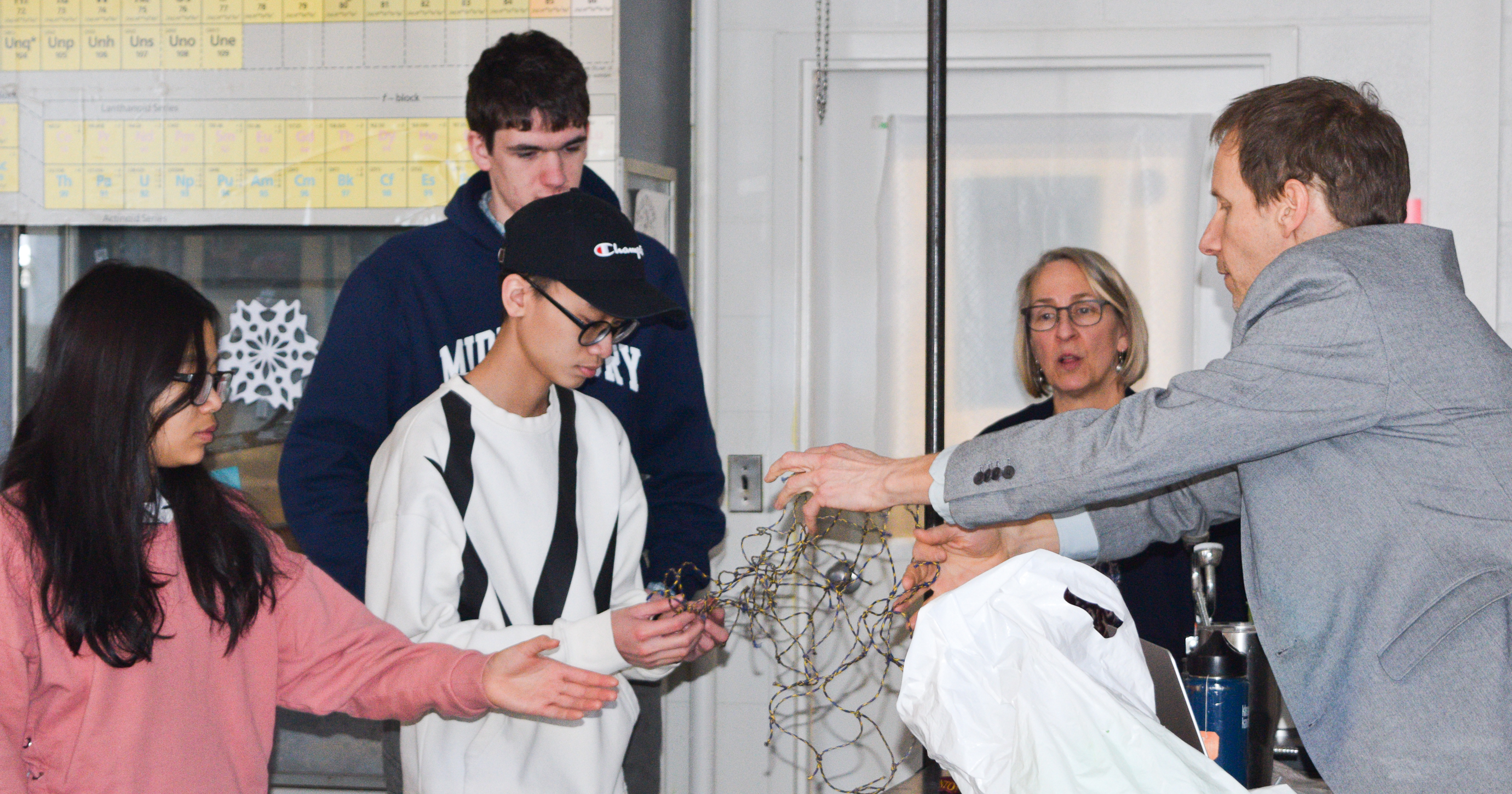
Students in the senior marine science class engaged in the discussion about why European green crabs are capable of significantly shifting ecosystem balance. Naturalized “residents” in North America since the early 1800s, green crabs are everywhere. You can scarcely turn over a rock without finding at least one along New England coasts.

They are fertile (students were surprised to hear that one female can lay up to 190,000 eggs in its lifetime), hardy (they seem to be adapting to winter and changing their spawning habits) and very destructive. They are also voracious eaters. While handling some live crabs, students learned that one crab can eat up to 40 mussels in a day. To get to larval mussels, clams and oysters, green crabs tear up vital eel grass beds, which are precious nursery habitat for a host of species such as hermit crabs, sea snails, other shellfish and even smaller bait fish.
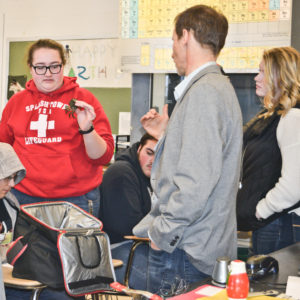
 

Can you eat this thing? Well, yes, but not easily.

Students asked good questions about what we are doing to try to become the predator that keeps green crabs in check. They learned some chefs make seafood stock with the crabs, while others are working with researchers from the Island Institute, New Hampshire Sea Grant and the Massachusetts Department of Marine Fisheries to determine when the crabs molt. Doing so would help them harvest crabs to cook up as tasty soft shell crabs, just as you’d find in the south.

In both classes, we discussed some of the challenges fishermen, scientists and policy makers must address in ensuring different seafood stock health in the face of issues like climate change, bycatch, industrial scale fishing and aquaculture and environmental impact.
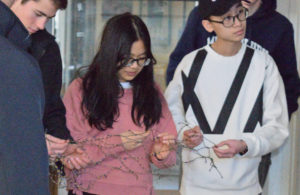
And as we discussed how the fast changing Gulf of Maine affects local species and introduces new invasive species, we also discussed ways the industry is adapting to these changes. Rather than rob students of hope, we talked about our need and ability to adapt to, not solve, climate change and its impact on seafood in the Gulf of Maine.


All photos credit: Jennifer Halstead
 

All Blog Posts

Fishing, Passion and Bad Music

  • June 20, 2017October 20, 2021
  • by Colles Stowell
Share it!
Share

I don’t know if it was Queensryche, Dokken or Whitesnake. Whatever flavor of 80’s hair band, the music was pulverizing my ear drums. As they pulsed laterally, the fluid in my ears splashed up and down every time the bow of the boat jumped six feet and plunged back down on the back side of a wave, punctuated by the incessant hammering of the kick drum in the background.

What were we doing?

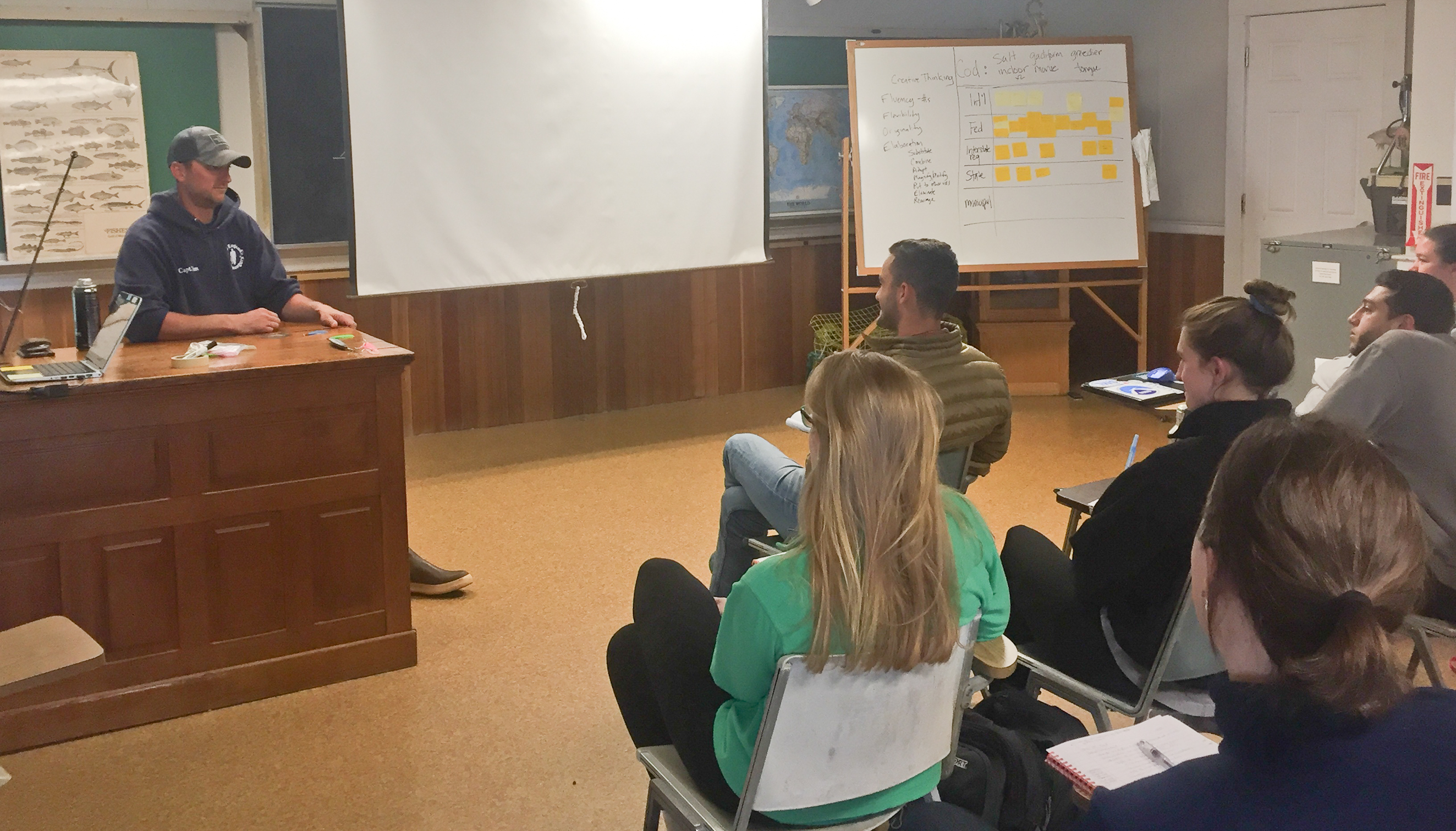
I was heading out to the Shoals Marine Laboratory on Appledore Island off the coast of Portsmouth, N.H. to talk with some students from the University of New Hampshire, Cornell University and Carleton College about regional, domestic and global seafood markets, consumer choices, market influences and climate change impacts. The students were participating in a two-week intensive sustainable fisheries course coordinated by N.H. Seagrant. I was riding with Capt. Tim Rider, whose fondness for that particular XM station was amplified by the conditions.

June in New England. Heading to the lab in wind-driven rain, but fortunately out of the six-foot waves … and the music. Photo: Tim Rider

A fisherman’s tale

If you’ve ever attended one of the KNOW FISH dinners, you know Tim is very passionate about what he does: bucking the trend toward high-bycatch harvesting by fishing for groundfish in up to 500 feet of water 80 miles offshore with rod and reel. And he’s not shy about sharing his feelings on current management policies, consolidation of the fleet (forcing small-scale fishermen out) and the need for change.

Perhaps it is this passion and willingness to speak out that has alternately cast him as either a pioneer striving to do the right thing against many odds or a loud-mouthed maverick who refuses to get in line. Perhaps that’s why he’s been lauded by restaurant chefs and consumers for the quality of his product, and vilified – even threatened – by others in the industry who don’t share his views.

That passion, along with a lifelong obsession of fishing and the experiences he’s had trying to survive make for a compelling, if a bit incessant, narrative. He keeps on talking, he says, because he has a lot to say.

The unsuspecting students at the Shoals Marine Laboratory heard stories of being shut down from speaking in New England Fisheries Management Council meetings, excessive and unfounded accusations from law enforcement, and confrontations with other fishermen who don’t like him rocking the boat.

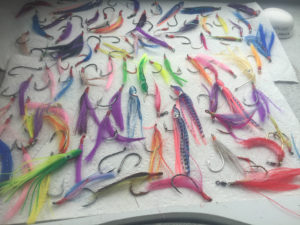
“Bait,” or the tools of the trade.

Struggling against poor policy

He provides a firsthand account of how the current management system has pushed him to the brink of bankruptcy multiple times, even as he’s trying to support his wife and young son and his crew. He talks about the money trail that has played a significant role in dictating fisheries management policy, including controversial catch shares.

Set up to allow fishermen to self-regulate by creating a marketplace for access to different fisheries, catch shares have spawned a money-driven resource grab in which access is bought and sold like stocks. The result is now an unfair system that too often privatizes the resource at the expense of small-scale fishermen who don’t have the money to buy quota or to compete in the limited fisheries allotted to fishermen with no specific quota.

Tim has joined a sector, or group of fishermen with quota, that is primarily “geared” toward fishermen using hooks rather than nets. The hope is to work collectively to promote low-impact fishing and perhaps gain a stronger voice during council meetings.

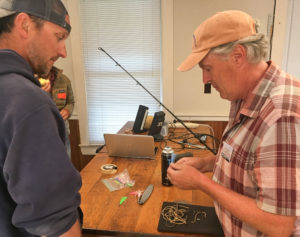
Reviewing new and old fishing gear with Dr. Nathan Hamilton, professor of archaeology at Univ. of Southern Maine. Photo: Owen Nichols

And for as many stories Tim told, the students on Appledore Island were engaged. They asked pertinent and insightful questions. They wanted to know about possible management solutions. They even laughed at some of his jokes.

Most importantly, they took advantage of a special opportunity to speak with a fisherman who gives his blood and sweat 12 days out of 14 (sometimes more than that), leaving the dock at 1 a.m. and returning at 9 p.m. because he believes in what he’s doing.

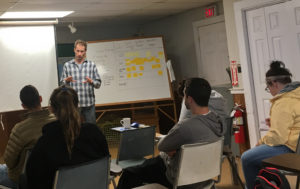
Talking about how consumer habit driven by price and convenience have opened the flood gates to cheap seafood imports. Photo: Owen Nichols

Changing habits

The students also asked smart questions about the big picture of local, national and global seafood dynamics. While Tim pointed to access and quota as two of the biggest issues with fisheries here, I added habit: Policy maker habit in keeping a faulty, skewed system in play; and fishermen and operator habit to own the most quota and to resist change for obvious reasons.

And worse still: Consumer habit. One of the most significant drivers for the amount of imported seafood eaten in the U.S. is consumer choices, dictated largely by price and convenience. We discussed how getting smarter about seafood systems and how to get closer to the domestic source (local fishermen) is crucial to changing that dynamic.

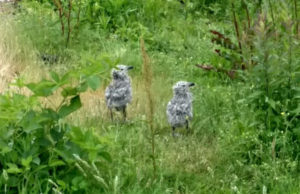
As a annoying as the adults can be, seagull chicks register high on the cute scale. At least we didn’t get attacked by the mamma. Photo: Tim Rider

We also talked about climate change and its impact on everything from native and invasive species to ocean acidification and changing currents. We talked about the need to keep diving into these issues and pursue careers in marine science, climatology, ecology, etc. to help solve some of the complex challenges climate change presents.

Students thanked us for coming and talked about some of the projects they were working on and their planned study focus in college.

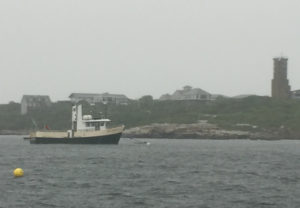
Departure, before the fog really set in.

On the ride home, as the grey skies grew darker into dusk and the bow bobbed to the pounding beat of blaring rap music, Tim and I remembered why we took a full day off to plow through some fairly gnarly weather and talk to a handful of college students from across the northeast.


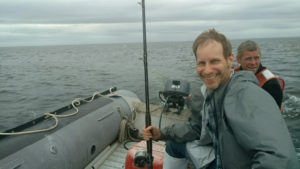
Top photo: Capt. Tim Rider telling fish tales.

Recent Posts

  • Hurricane Ida wreaks havoc on Louisiana’s seafood industry
  • EPA Should Use Clean Water Act To Kill Zombie Mine
  • Slow Fish 2021: Relationship Matters
  • Faith, Façades, and Futility
  • Pebble Permit Paused: Politics at Play

Archives

  • September 2021
  • August 2021
  • April 2021
  • December 2020
  • August 2020
  • June 2020
  • February 2020
  • December 2019
  • November 2019
  • October 2019
  • July 2019
  • May 2019
  • April 2019
  • March 2019
  • January 2019
  • December 2018
  • November 2018
  • June 2018
  • May 2018
  • March 2018
  • February 2018
  • January 2018
  • December 2017
  • November 2017
  • October 2017
  • September 2017
  • August 2017
  • July 2017
  • June 2017
  • May 2017
  • April 2017
  • March 2017
  • January 2017
  • December 2016
  • November 2016
  • October 2016
  • September 2016
  • August 2016
  • July 2016
  • June 2016
  • May 2016
  • April 2016
  • March 2016
  • February 2016
  • January 2016
  • December 2015
  • November 2015
  • October 2015
  • September 2015
  • July 2015
  • June 2015
  • May 2015
  • April 2015
  • March 2015
  • February 2015
  • January 2015
Theme by Colorlib Powered by WordPress