Skip to content
One Fish Foundation
  • Blog
    • Aquaculture
    • Education
    • Environment
    • Policy
    • Wild Harvest
    • Fish Tales
  • About
    • About One Fish
    • About Colles Stowell
  • Education
    • Elementary School
    • Middle School
    • High School
  • KNOW FISH Dinners®
  • Resources
    • One Fish Podcast
    • One Fish Foundation in the news
    • The 7 C’s of Sustainable Seafood
    • Newsletter Archive
    • Recipes
      • Skate with Capers and Butter — Chef Rizwan Ahmed
      • Grandma Davis’ Fish Chowder — Jane Almeida
      • Ginger Garlic Tamari Scallops — Colles Stowell
      • Fish Stock — Evan Mallett
      • Mussels San Remo — Chef Rob Martin
      • Salted Pollock Croquettes – Chef Mark Segal
  • Connect
    • Contact OneFish
    • Social
      • Instagram
      • Facebook
      • Twitter
All Blog Posts

What It Means To Be Local

  • June 16, 2018October 20, 2021
  • by Colles Stowell
Share it!
Share

Update as of 4:45 p.m. 6-17-18:

Adding a link to the latest response from Sea To Table Founder Sean Dimmin to the AP story. In the response, he goes on the defensive, calling out “numerous misstatements and false allegations,” alluding to shoddy or incomplete reporting. Dimin points out instances where the reporting does seem to leave a bit of detail and process open to question. He also admits Sea To Table could have better communicated with its suppliers (in particular, Gosman’s) and with its customers.

That’s all fine. He’s saying the right things for someone in his predicament. But I don’t think the conversation should end there. Those in the domestic seafood industry, and those who promote it, face a steep challenge. Trust is absolutely essential to trying to convince even small percentages of US consumers to get seafood smart and buy domestically. The original premise behind Sea To Table or any similar minded operation is to promote local seafood, fishermen and waterfronts, often regardless of customer geography. So even if lapses in communication to customers or partners that led to  mislabeling, etc., are the only truly valid mistakes made, we need to be having this conversation. As we’re trying to limit the more than 1.5 million tons of cheap, imported farmed shrimp (among other unsustainably harvested species) flooding markets in this country every year, we need to be honest and forthright.

I do not agree with some who claim the negative attention and likely serious sales hit to Sea To Table is just desserts and the company should go away. I think these communications issues don’t rest with Sea To Table alone in the industry. It’s a tough, and generally laudable mission these companies try to accomplish. But I also don’t think we can make excuses for those whose lapses could set the entire movement back by calling trust in domestic seafood systems into question. We need to have these conversations, find solutions and move forward to turn that 90% domestic import figure around.


It all comes down to trust … and relationships.

This week’s news that one of the rising stars of the locally sourced, sustainable seafood movement may have been selling seafood that wasn’t local, may have been mislabeled and was possibly linked to slave labor in other countries sent shock waves through the industry.

Brooklyn-based Sea To Table has built quite a following with its promise of sustainable, traceable, domestically harvested wild seafood delivered to your doorstep. Clients included celebrity chefs like Rick Bayless national food chains such as Chopt Creative Salad, a bunch of universities like Yale, eateries at the Empire State Building and Chicago O’Hare airport and the home meal kit provider Hello Fresh. It can be found in almost every state.

But an Associated Press report issued earlier this week shed light on some of the issues that can arise with this boat-to-table model and the temptation of entrepreneurs to co-opt, then sweep aside the spirit and intent of terms such as “sustainable seafood” and “local.”

The colossal irony being that they may be knowingly or unknowingly violating the principles they promote, all in an attempt to bring clarity and trust to what Sea to Table Founder Sean Dimin calls “the historically opaque seafood industry.” The Sea To Table business model is to work with some 60 “local” fishermen and fishing operations/distributors to source “traceable” seafood from around the country.

The AP report outlines a lengthy investigation uncovering a slew of allegations that run headlong into the company’s  mission statement. For example, promoting fresh, locally caught yellow fin tuna in the winter off New York, when the migration south occurred several months beforehand and no local fishermen had been out. Or charges that some of the seafood Sea to Table sold was in fact imported and linked to Indonesian operations with a history of labor abuse. Other charges included selling farm-raised seafood despite the wild-only claim.

So yes, this was big news in that it surprised many in the industry. It will also raise lots of questions, piss some people off and confuse the hell out of consumers. What are they supposed to do to be sure they are buying local, sustainable seafood?

Dimin is correct in that the seafood industry is indeed opaque. There are few places that have completely transparent supply chains. Consider that seafood travels more than 5,000 miles on average from boat to plate in this country, often changing hands at least seven times.

The AP report is informative and sad, but it isn’t really broaching any new allegations about industry practices. Check out this exhaustive AP report on slave labor linked to imported seafood. The fact we import 90% of the seafood we eat just means more of the seafood consumed in the U.S. may be linked to brutal labor practices.

But the issue of trust and misrepresentation goes beyond just the seafood industry. The whole concept of questionable food sourcing and marketing practices isn’t new. For example, the Tampa Bay Times ran a series in 2016 about the farm-to-table movement, and how many restaurants and purveyors were glazing over, and sometimes outright lying about the provenance of their food.

What is local?

All of this goes back to a discussion I had this week with Josh Stoll, a research professor at the University of Maine and a co-founder of Local Catch, an organization that promotes community-supported fisheries and other direct-to-consumer operations aimed at bringing people closer to their seafood.

We discussed how the Sea to Table news raises the very valid question of how to define “local” and how to re-build consumer trust. Josh spends much of his time working to streamline and improve community-based fisheries governance for the benefit of fishermen, their communities and consumers.

“The definition of ‘local’ is evolving,” he said. “It’s less about geography and more about relationships.”

He’s exactly right. Just as the terms “organic” and “sustainable” have been stripped of their original intents by overuse and bastardization of meaning, “local” without valid context has become vapid marketing speak. It could mean so many things and nothing at all if there is no valid context to support its use.

Case in point: Sea To Table uses “local” in the first sentence of its mission statement to showcase the quality of the seafood it sources. Now, regardless of whether the company knowingly misled customers, it has much work to do to re-establish credibility. Dimin and his crew can’t just plead that they are still offering “local” seafood. They have to earn back that trust.

How? By going back to the basic mission and working to repair the relationships that the company was built on. Not an easy task.

When I host KNOW FISH Dinners® and invite people to talk to the fish harvester who caught the fish they are eating, I’m creating a direct link to the food producer that more often than not remains a mystery in this “opaque” industry. I tell people I want them to think about their next seafood purchase the same way they think about buying eggs or produce from a farmer at a farmer’s market.

Those are the kinds of relationships that define “local” for me.

Know your seafood, know your provider

So, say you live in Kansas. You probably don’t live next door to a commercial fish harvester. This is where enterprises like Sea To Table have begun to fill the void. The problem arises when customers take the “local” claim on faith without establishing some kind of relationship with the provider. If they get to know the provider, even if the provider is a distributor with direct links to the fish harvester, they get a better sense of the values and ethics used by the provider to promote their product. They should also be able to get the story of the fish harvester as well. Same goes for distributors like Sea To Table. They need to build solid relationships with the fish harvesters and docks providing the seafood to ensure they hew closely to strict guidelines.

That’s how you build trust. The AP story calls the latter point about Sea To Table’s supplier relationships into question.

Sure there are situations when establishing that level of trust isn’t possible. But one of the key points I make with folks is that knowledge really is power. Consumers fare much better ensuring the quality and provenance of the seafood they purchase when they get smart about what is locally and seasonally available, who has the best product, and who is trustworthy. This all takes time.

But it’s worth it.

Owning the relationship

Can things still go awry? Absolutely. Sea To Table is the proof. I’m not sure I believe this was a wholesale willful violation of trust. Read Sean Dimin’s first letter in response to the AP story. As I said, there are no new revelations in the news story about what happens in the industry. And Sea To Table has much work to do to repair its reputation. More so now that Sen. Edward Markey has asked NOAA and the Federal Trade Commission in a letter to investigate the claims against Sea To Table.

The situation underscores the fact there are many gray areas in domestic food systems. But it also reinforces the notion that people should take more ownership of their seafood purchases. Again, it’s all about relationships. We talk about the relationship people have to the seafood they eat during these hosted KNOW FISH Dinners. Their (our) choices have an impact on the resource, the fish harvester and the community. Getting closer to the source, even if that closeness is more relational than geographic, will minimize the risk of being misled.

That 90% import statistic won’t change unless we build, strengthen and multiply these very important relationships.

Check out the Local Catch website as it is a good resource for finding responsibly harvested seafood throughout the country. I believe there are several  operations who are delivering on their promise of responsibly harvested product. You can find some of them listed on the Local Catch website.

Also, stay tuned for more discussion about this topic. It is a fundamental reason for why we should care where, when, how and by whom our seafood was harvested.

If you’d like additional perspective, read Paul Greenberg’s take on the situation here.


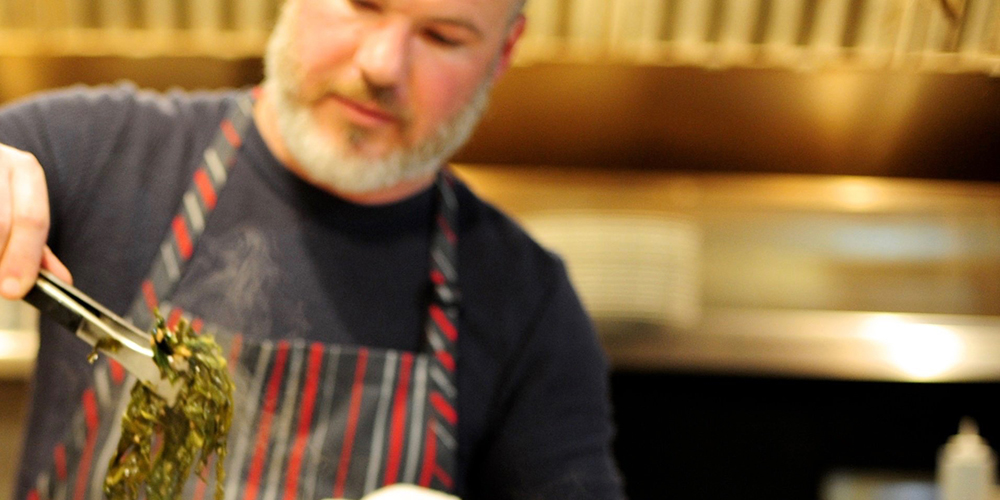
Photo courtesy of New England Fishmongers
All Blog Posts

KNOW FISH: Know your fishermen and make a difference

  • May 11, 2017October 20, 2021
  • by Colles Stowell
Share it!
Share

Relating sustainable seafood concepts is not always a linear conversation. Sure, you can cover the essentials: Buy local; buy abundant; avoid harmful harvest methods; be aware of any regulatory compliance issues. But getting the message to sink in involves an emotional trigger from the consumer. They have to care about it.

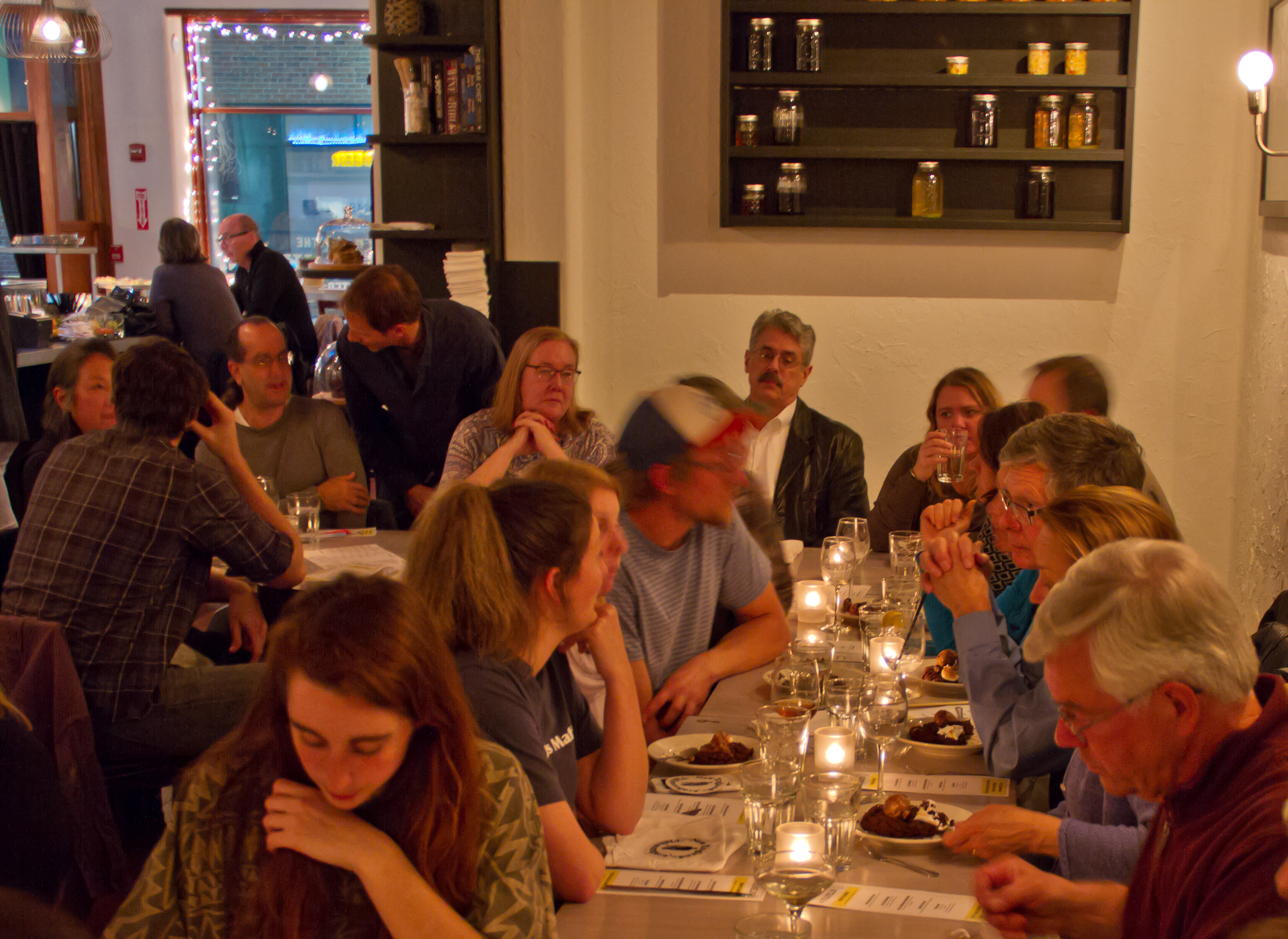
So I told the crowd at the KNOW FISH dinner at Franklin Oyster House in Portsmouth, NH Tuesday night that they might approach their next seafood purchase the same way they do when buying eggs or produce at a farmer’s market. That direct-from-the-producer purchase almost instantly resolves many of the trust issues that arise with buying seafood at a store or restaurant.

Seafood consumers have the right to ask the same questions standing at a seafood counter or sitting in front of a menu that they would have buying ground beef from the farmer. Where does it come from? How was it harvested? When was it harvested? If it was farmed, what was it fed?

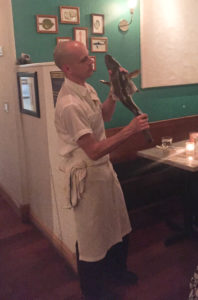
Franklin Oyster House Chef/Owner Matt Louis telling the tale of the cod. photo credit: Stephen Martin.

One conversation at a time

It was anything but a quiet dinner. It was an engaging conversation and everyone was involved. The food curious. The fishermen. The locals looking for an interesting evening discussion and dinner. The oystermen. The foodies. The activists.

At the outset, I invited everyone into the conversation by asking them to either announce why they’d attended the KNOW FISH dinner or to mention a key factor in their seafood buying decisions.

From there, the conversation took off, and we covered topics such as sustainable seafood definitions, the shockingly high proportion of imported seafood consumed in the U.S., industrial scale fishing impacts on global and domestic markets, climate change, what to look for in local seafood and how to support local fishermen.

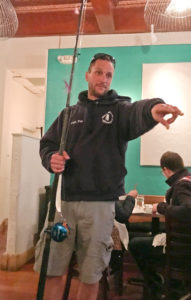
Capt. Tim Rider and the fishing gear responsible for the evening’s tasty meal. Photo credit: Kate Masury, Eating with the Ecosystem

Fish tales

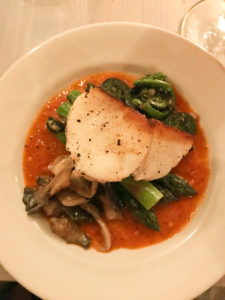
People were able to ask Capt. Tim Rider about how and why he fishes with rod and reel for ground fish. They wanted to know where they could get his fish, which was brilliantly prepared by Chefs Matt Louis and Matt Decker. Salt Cod Brandade with a killer ramp pesto and Roasted Cod that was swimming about five hours before it arrived on our plates. And what a treat it is was to taste the spring bounty of fresh fiddleheads, asparagus and ramps!

Got fresh? How about swimming in 100 feet of cold North Atlantic water 5 hours before appearing as roasted cod in this photo? Photo credit: Kate Masury

Capt. Tim suggested attendees patronize restaurants like Franklin Oyster House Black Trumpet and 7th Settlement in Seacoast N.H., and When Pigs Fly Pizzeria in Kittery, Me. (as well as other area restaurants) that buy fish from New England Fishmongers, the company he and business partner Amanda Parks operate. He also mentioned that they have started a local community supported fishery, which like a CSA, allows people to buy shares of the upcoming catch every week during a season. This model replicates the farmer’s market buying experience.

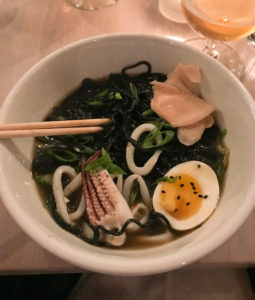
Attendees asked oysterman Tim Henry of Bay Point Oyster Company about the Franklin Oyster, which was served at the beginning of the meal, and which Tim grows expressly for Chef Matt Louis at Franklin Oyster House. They talked about some aquaculture details such as the process of nurturing the spat that grows into adult oysters with oysterman Brian Gennaco of Virgin Oyster Co. This conversation was set to the backdrop of an otherworldly Asian-inspired dish featuring grilled squid served over squid ink ramen cooked in a green crab stock. That stock fed the conversation about why green crabs do so much ecological harm and the ways of trying to popularize their use in cooking.

REALLY tempted to ask for seconds! photo credit: Kate Masury

As everyone tucked into a chocolate-coma-inducing dessert called “Phish food” (a “fudgy” cookie topped with chocolate ice cream, caramel and a torched marshmallow), we talked about how individually and together we can make a difference. Individually, attendees can refer to seven sustainable seafood principles printed on the back of the evening’s menu when considering seafood. Together, we all need to spread the message. When, where, how, and by whom seafood is harvested matters. It matters, locally to our diets, our conscience, the fishermen in our communities, the communities themselves, and the seafood resource. It also has global significance.

The next KNOW FISH dinner at Tinos Greek Kitchen on May 23 will continue this conversation.

The more we have these conversations, the more we shift the current domestic dynamic.

Here’s how to get your tickets and get in on the discussion.


Top photo credit: Stephen Martin


All Blog Posts

Of Pollock and Perception

  • June 7, 2016October 20, 2021
  • by Colles Stowell
Share it!
Share

I like a good discussion. That is my goal every time I walk into a classroom. I want students regardless of age to ask questions and even challenge me, as was the case a few weeks ago at Portland High School. Within the first five minutes or so, I can get a rough gauge of the overall class dynamic and determine which course the discussion will take.

My classroom last Saturday was a 100-year-old bakery, complete with freshly used dough machines, sacks of flour, wooden kneading blocks, coolers, rolling racks and trays of sealed brownies, blondies and linzer tortes. (I admit to nearly succumbing to covert temptation.)

What a great spot for a delicious dinner and compelling conversation! The location was the original Rosemont Market and Bakery in Portland, Maine. The “students” were in fact area adults interested in learning more about the local and global seafood system.

The discussion was free-flowing, dynamic, interactive, engaging, humorous. Just about all that I had planned for when originally working with Chef Bryan Dame to set up a sustainable seafood dinner a couple of months ago. The goal was to pair creative, tasty dishes featuring local, abundant seafood with a conversation about where the seafood comes from (ie, the boat and/or the harvester), and why knowing this kind of information is important.

So we first talked about a common definition of what sustainable seafood is and isn’t. As I explained how the average seafood consumed in the U.S. travels more than 5,000 miles from boat to plate, we feasted on locally sourced pollock and mussels ceviche served over a creamy corn pudding. The accompanying seaweed biscuits and sea salt nori butter were surprisingly addictive. I mentioned the pollock came from the Finlander out of Eliot, Maine, a boat that travels some 80 miles off shore to jig fish for pollock, haddock and other groundfish species. Jig fishing means virtually no bycatch, or the capture and possibly killing unintended species, a significant problem with some wild harvest methods.

The conversation then turned to the domestic and global seafood picture, with perhaps a little surprise at the revelation that 90% of the seafood eaten in the U.S. is imported. We discussed the implications of that while diving into Acadian rockfish served with local spinach and a bacon jam that would make anything taste better. (I kept thinking about ice cream.) The rockfish, also known as ocean perch or Acadian redfish, was supplied by the Dee Dee Mae II out of Biddeford.Rosemont2-2

We also looked at how global seafood demand continues to grow as the population surges toward 9 billion by 2050, and how almost 5 billion people now depend on seafood for at least 10% of their per capita annual animal protein intake. And as the wild harvest of seafood has remained relatively constant over the past decade, aquaculture has nearly doubled.

We discussed how bivalve (oyster, clam and mussel) and seaweed aquaculture is growing in Maine as we ate pan-roasted hake served over smoked mussels and spring pea puree with pillow-soft potato gnocchi. The mussels came from Pemaquid Mussel Farms and the seaweed (used in almost every course) came from Maine Sea Fresh Farms. The hake came from the November Gale out of Five Islands, Maine.

Finfish aquaculture and the ramifications of recent U.S. and Canada approvals of GMO salmon sparked lively interaction about balancing the needs of feeding a growing global population and addressing the many concerns with farmed fish. Hormone and antibiotic use, disease, environmental degradation (such as clearing out critical nursery habitats like mangroves for shrimp farms) are all significant challenges to widespread acceptance of fish farming. GMO salmon have a much steeper hill to climb because of the significant issues with the lack of labeling and questionable science.

The group collectively pondered the ramifications while dipping into dessert: dulse panna cotta (a subtle, unique whisper of the sea) with light, toasted sesame cookies.

The food and the narrative were perfect complements. And the evening reminded me why I started One Fish Foundation. Engaging people, no matter the age, in a discussion about where their seafood comes from, and why they should think about their decisions at a restaurant or seafood store is important to them and the resource. Just as with farms, we have a connection to the fish and shellfish we eat, and those who harvest them. And every decision we make has an impact on the resource.

All of the fish we ate was local and abundant, which are two of the most significant factors in determining seafood sustainability. Chef Bryan delivered on the promise of making what was once called “trash fish,” but is now better known as “abundant”, sing in beautifully prepared and creative dishes that we all enjoyed immensely.

We sourced the fish from Harbor Fish Market in Portland, which is where Rosemont gets most of the seafood they offer in their five area markets. Harbor Fish does a good job at sourcing locally, whenever possible, and being forthright about where its seafood comes from. That’s an important factor when deciding where to buy fish. You want to know they’ll tell you the truth about its provenance.

Rosemont owners John Naylor and Molly Thompson were very gracious in welcoming One Fish Foundation into their “kitchen.” The level of dialogue was inspiring, hopefully to the point that the conversation will continue among those who attended, and spread into their communities.

That’s why I do this.


Photo credits: Molly Thompson. Top: Chef Bryan Dame, seaweed whisperer.

All Blog Posts

New Trade Deal Could Handcuff Local Seafood Systems

  • June 16, 2015October 20, 2021
  • by Colles Stowell
Share it!
Share

Tell me if this is your definition of democracy: Ramming through a piece of legislation that Congress is not allowed to amend, that the public is not allowed to review and comment on, and that would ultimately surrender control over local seafood resources to foreign companies, while paving the way for cheaper, less regulated product to flood domestic markets.

Sound farfetched?

Read more “New Trade Deal Could Handcuff Local Seafood Systems” →

Recent Posts

  • Hurricane Ida wreaks havoc on Louisiana’s seafood industry
  • EPA Should Use Clean Water Act To Kill Zombie Mine
  • Slow Fish 2021: Relationship Matters
  • Faith, Façades, and Futility
  • Pebble Permit Paused: Politics at Play

Archives

  • September 2021
  • August 2021
  • April 2021
  • December 2020
  • August 2020
  • June 2020
  • February 2020
  • December 2019
  • November 2019
  • October 2019
  • July 2019
  • May 2019
  • April 2019
  • March 2019
  • January 2019
  • December 2018
  • November 2018
  • June 2018
  • May 2018
  • March 2018
  • February 2018
  • January 2018
  • December 2017
  • November 2017
  • October 2017
  • September 2017
  • August 2017
  • July 2017
  • June 2017
  • May 2017
  • April 2017
  • March 2017
  • January 2017
  • December 2016
  • November 2016
  • October 2016
  • September 2016
  • August 2016
  • July 2016
  • June 2016
  • May 2016
  • April 2016
  • March 2016
  • February 2016
  • January 2016
  • December 2015
  • November 2015
  • October 2015
  • September 2015
  • July 2015
  • June 2015
  • May 2015
  • April 2015
  • March 2015
  • February 2015
  • January 2015
Theme by Colorlib Powered by WordPress