Skip to content
One Fish Foundation
  • Blog
    • Aquaculture
    • Education
    • Environment
    • Policy
    • Wild Harvest
    • Fish Tales
  • About
    • About One Fish
    • About Colles Stowell
  • Education
    • Elementary School
    • Middle School
    • High School
  • KNOW FISH Dinners®
  • Resources
    • One Fish Podcast
    • One Fish Foundation in the news
    • The 7 C’s of Sustainable Seafood
    • Newsletter Archive
    • Recipes
      • Skate with Capers and Butter — Chef Rizwan Ahmed
      • Grandma Davis’ Fish Chowder — Jane Almeida
      • Ginger Garlic Tamari Scallops — Colles Stowell
      • Fish Stock — Evan Mallett
      • Mussels San Remo — Chef Rob Martin
      • Salted Pollock Croquettes – Chef Mark Segal
  • Connect
    • Contact OneFish
    • Social
      • Instagram
      • Facebook
      • Twitter
All Blog Posts

Students Teaching Students

  • May 24, 2018October 20, 2021
  • by Colles Stowell
Share it!
Share

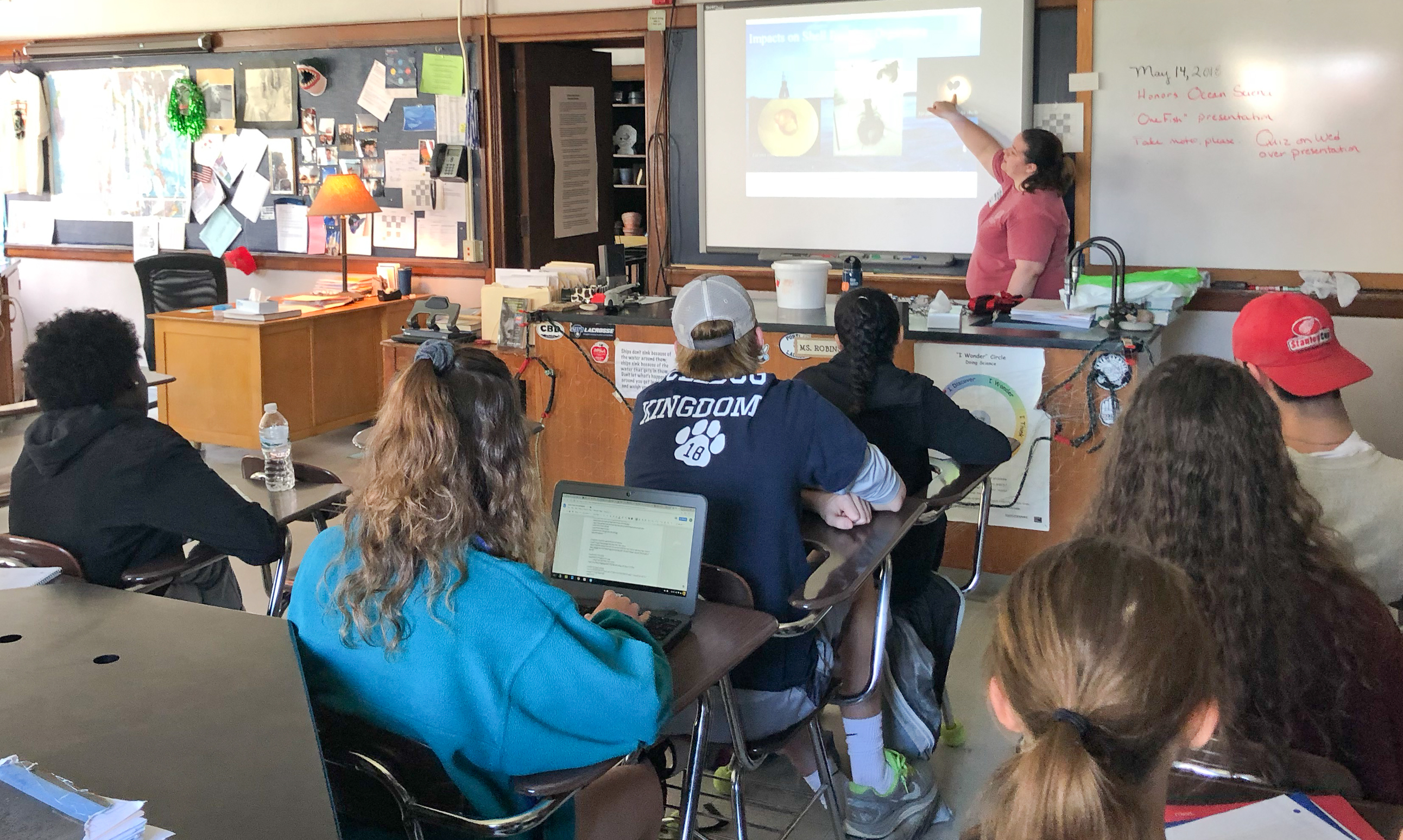
Last week, One Fish Foundation visited Portland High School for the third year in a row to discuss seafood sustainability with seniors taking a Marine Sciences course. Intern Jennifer Halstead, a senior at the University of New Hampshire, adeptly presented a clear, concise and digestible explanation of ocean acidification and how it is affecting cornerstone Gulf of Maine species like lobster and mussels. In this guest blog, Jennifer discusses the importance of taking advantage of opportunities to speak to students and community members about ocean acidification, other challenges our oceans face with climate change, and why we all need to be involved.

By Jennifer Halstead

Speaking to a crowd of people, no matter the size or demographic, can be at once daunting and rewarding, especially for a college student. Truly. It’s empowering to have people listen to your words. It’s uplifting to have them ask questions and even challenge your ideas.

Talking to a small class of students at Portland High School last week was no different. Ocean acidification (OA) is something that’s not easy to wrap your head around, but these students understood the urgency related to the issue. If at least one of them continues to ask questions and be curious, I feel as though I did my job.

Sadly, we don’t know how acidification is going to impact lobsters, one of the most important economic industries in Maine (the entire industry, including the supply chain is valued at over $1 billion). [Lobster harvests already face threats from the rapidly warming Gulf of Maine. A recent study suggests the lobster harvest could decline by as much as 62% by 2050 if the Gulf of Maine keeps warming at its current pace].

As concerned citizens and scientists, we need to start asking more questions and demanding more answers. And that is how we create change. The power is in your hands – our hands – to save oceans and our beloved lobster rolls.

I’ve spent a good portion of my college career learning about OA. Unfortunately, while our understanding of the impacts of OA is growing, OA is occurring more rapidly than we can keep up with in some places, including the Gulf of Maine. The West Coast has dealt with OA fallout, such as steep declines in oyster hatchery production in 2005, which threatened economics and 130 years of oyster hatchery history. In the Gulf of Maine, we haven’t seen complete devastation yet, but top scientists fear that it’s coming, and so do I.
Part of Jennifer’s research on OA: a type of sea snail on the left, and blue mussel on the right. Both the sea snail and the half mussel shell you can almost see through (on the right) were exposed to acidic water. Increased acidity in the ocean weakens many shellfish’s capabilities to calcify their shells and protect themselves from disease. Credit: Jennifer Halstead.

We understand climate change impacts like OA, temperature, salinity, and currents, but not the details of how they interact and impact different species. We don’t understand the entire system. We only understand the pieces. Imagine trying to put a puzzle together with no idea what the end result is supposed to look like. That’s the immense challenge of trying to understand climate change impacts here in the Gulf of Maine and elsewhere; things are happening now that we won’t fully realize for several months, or even years.

To move forward and get research to catch up with the changes in the Gulf of Maine, we need the public’s interest and support. We need people to ask questions and demand answers. Spreading the word about these issues through presentations and hands-on demonstrations is a key piece to garnering support for these causes. Every time I stand in front of a group of people and talk to them about acidification, I can see us moving forward. Future generations are interested in problems, but even more interested in pushing for solutions.

As a college student, I often get asked where I see myself in 5 years, or what I want to do after I graduate. My broad answer is that I hope to be doing something to change the world for the better. To do that, I’ll keep standing in front of crowds of people, telling them about problems our oceans face, and asking for their help in saving them.
All Blog Posts

A scientist, a fisherman and a healthcare rep enter…

  • November 14, 2017November 15, 2017
  • by Colles Stowell
Share it!
Share

Back in January as everyone was adjusting to a new political landscape, I was on a call with Brett Tolley of the Northwest Atlantic Marine Alliance and Bob Steneck, Professor of Oceanography, Marine Biology and Marine Policy at University of Maine. We were talking about a recent report on climate change impacts in the Gulf of Maine, and what fisheries policy may look like in the context of climate impact and the shifting political landscape.

Needless to say there were many unanswered questions. At the time, the administration threatened to cut crucial funding for Sea Grant, climate science and even some fisheries management programs. Our discussion centered on how to adapt more nimbly to climate change impacts on fisheries, and how to make fisheries management more efficient and effective. We also wondered how significantly US fisheries management could shift in a year or two.

That conversation was the seed for last Friday’s (Nov. 3) Webinar: Fisheries Management: Best Available Science May Not Be Good Enough. The discussion was a frank look at the issues with current fisheries policy based on specific examples and some speculation on what management would look like if it were more localized and relied on a different data modeling system.

Joining me on the call were David Goethel, commercial fishermen from Hampton, NH and former three-term member of the New England Fisheries Management Council; John Stoddard, New England Regional Coordinator for Health Care Without Harm’s Healthy Food in Health Care program; and Steneck.

This was a diverse panel with deep knowledge from broad perspectives. Steneck has been at the forefront of research on coral, lobsters, urchins, kelp, forage fish and species interrelationships in coastal ecosystems. Goethel has the unique experience of a commercial fishermen who has had to shift his harvest target and method because of changes in the Gulf of Maine, and who has spent several years either as an advisor to the Atlantic States Marine Fisheries Council or NEFMC. John Stoddard brought an institutional buyer’s perspective to the panel. He knows what healthcare representatives want from the seafood they serve their patients. They do have some concerns about sustainability, and when policy creates market forces that may limit access to locally harvested seafood, they may want to know what can be done to change the dynamic.

How’d we get here?

Steneck methodically walked us through some of the core issues with the current management system. Chief among those is the fact the Gulf of Maine, as well as other US coastal ecosystems, are changing faster than we can manage them. We have been a couple of steps behind climate change because our current data assessment system takes several years between collection and analysis and policy action. In essence, by the time policy has been set, the seascape has changed because of rising temperatures, current shifts, increased ocean acidification, etc. All of these changes have forced commercially valuable species to shift their patterns and adapt.

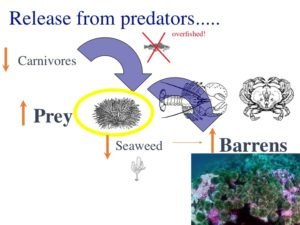
Overfishing of cod resulted in a sea urchin boom in the Gulf of Maine that collapsed in a decade. Interspecies relationships are critical to understanding dynamically changing ecosystems, and are often overlooked with current data management tools.

He pointed to the cod collapse in particular as a bellwether for how we missed the warning signs because of static data analysis, and how that type of “miss” happens frequently due to the data-intensive approach to stock assessment. He showed a brief video featuring a Canadian fisherman who said he had the trip reports to show cod stocks persistently dropping in key areas … data the government ignored because of its current management system.

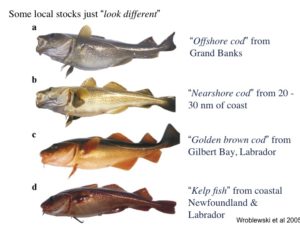
Genetically distinct cod inhabit different ocean ecosystems and should be managed accordingly, not as one, all-inclusive species.

Steneck concluded that we need to “reinvent fisheries management to include multiple, independent indicators”, rather than drill down into details of one species without taking into account other critical factors such as complex interspecies relationships. Taking into account the dynamic changes within spatially appropriate areas of observation will give a more accurate view of fisheries and how quickly they change. Equally importantly, he stressed the need to expand collaboration with fishermen, mining their knowledge base to enhance data collection and analysis.

A unique point of view

David Goethel echoed those concerns. From both perspectives as fisherman and NEFMC member, he saw how current modeling methods’ stagnation meant policy did not match actual stock health and ability to withstand fishing pressure. He pointed to the impact the recent collapse of capelin in Newfoundland had on cod, seals and northern shrimp. Like Steneck, he called for managing fisheries based on the correct spatial scale and with a better understanding of changing predator-prey relationships.

Getting his point across at a management council meeting.

He also urged continued public/fishermen input at council meetings. The system breaks down when fishermen who feel disenfranchised by restrictive policies don’t participate in the process. He decried a lack of transparency in the policy process that frustrates fishermen to the point where many don’t believe it’s worth their time to speak out.

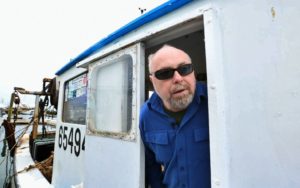
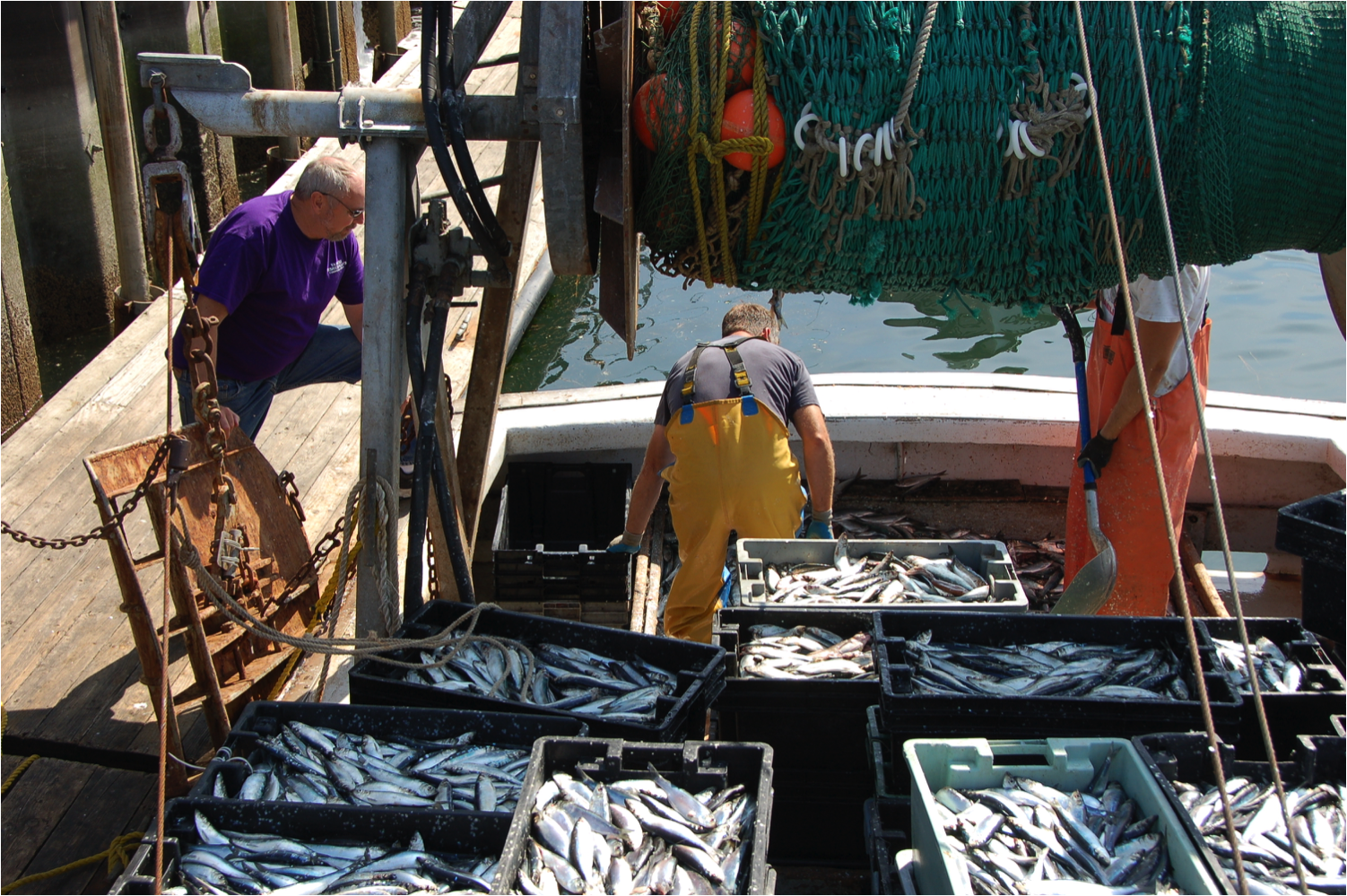
Aboard the Ellen Diane

Goethel agreed with Steneck that data poor methods based on local, spatially appropriate areas of survey would provide the local detail current “big solution” modeling misses. He also agreed that involving more fishermen in the process would play a significant role in collecting more accurate data in a timely fashion, and restoring more fishermen’s faith in the process.

A healthcare approach

Stoddard emphasized Health Care Without Harm’s mission to provide locally sourced, sustainable seafood, with a goal toward supporting community based fishermen. This is a critical issue healthcare industry staff are finding with many patients, especially in coastal New England. Some of these patients have had family or friends who fished commercially, so the some of these issues matter to them.

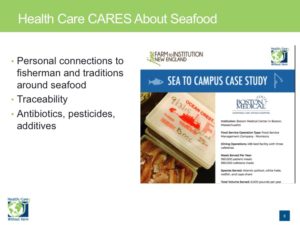
An example of a successful program providing locally harvested seafood to patients.

He said Health Care Without Harm has steadily moved away from big ecolabels such as MSC to support more locally focused programs. Stoddard highlighted a successful program by which Massachusetts Eye and Ear Infirmary sources locally harvested seafood from Gloucester via the Gloucester Fishermen’s Wives Association. Such programs address patient demand for locally sourced seafood while strengthening healthcare institutions’ support of surrounding communities … and specifically fishermen.

Continuing the dialogue

It was a good discussion, with some engaged back and forth on next steps. For example, one of the parting questions focused on what a successful, cooperative data-poor, localized management program might look like. Steneck suggested a demonstration project within an already existing sample area (under the current management system), using a data poor assessment approach. Goethel suggested using echo system modeling that incorporates multiple species relationships, that he believes would yield a more realistic view of stock health.

The next step in the community discussion about these issues is to begin planning the next conversation. At the outset, I said we weren’t going to solve all of the issues we discussed in one conversation. But the goal is to follow up the conversation with another Webinar that explores a bit deeper what a demonstration project might look like, the type of data to study, and the hoped-for outcomes.

We will aim to set up another Webinar in the first quarter of 2018 tapping the collective knowledge of a well-informed panel, willing to explore the possibilities and elevate the discussion. Ultimately, we hope to build a foundation of knowledge that may lead to a roadmap for change.

Stay tuned.

If you’d like to view the Webinar, click on this link and then the tab that says Watch Now: Fisheries Management: Best Available Science May Not Be Good Enough.


All Blog Posts

Getting Hands Wet and Talking Seafood

  • August 4, 2017October 20, 2021
  • by Colles Stowell
Share it!
Share

Every time I speak to a group of students, campers, adults, etc. I learn something.

First, I learn what the audience knows and doesn’t yet comprehend about seafood sustainability in broad terms. I learn who in the audience is more ready to engage in discussion, who wants to challenge pre-conceived notions, and who isn’t really into the conversation.

Depending on the age group and location, these types of interactions can sometimes provide glimpses into a community’s overall seafood IQ. Observing students while I teach a class also provides a mirror of how effectively I’m getting the message across.

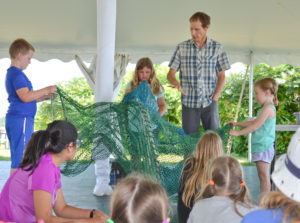
Gill nets are hard to see on land as well as in the ocean. Photo: Rich Harty

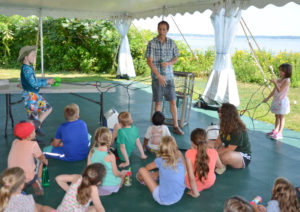
My first observation at the Seacoast Science Center in Rye, N.H. this week was how lucky the Seaside Safari campers were to have such a program. Set on the shore near Odiorne Point, surrounded by acres of tide pools loaded with lobsters, green crabs, seaweed, etc., the camp provides direct, hands-on access to coastal marine ecosystems. Campers handle live green crabs while learning about invasive species; they turn over rocks and hunt for juvenile lobsters while learning about food webs; they talk about the warming Gulf of Maine while learning about climate change.

I wish I had access to a program like that at that age.

So it was a privilege to learn some things from these campers as we chatted. I re-confirmed that green crabs are a very effective, hands-on prop … almost to the point of distraction when they started fighting.

I learned that these campers, when prompted, were generally eager to learn how seafood ends up on their plates. They wanted to know how a turtle excluder device works, and its impact on reducing bycatch.

Demonstrating the escape hatch for turtles. Photo: Rich Harty

Some campers who had fished recreationally before were genuinely surprised that some fishermen use rod and reel to fish commercially. They were intrigued by the weight of the 14 oz jig used to get the flies down 400 feet to where the haddock, cod and pollock are.

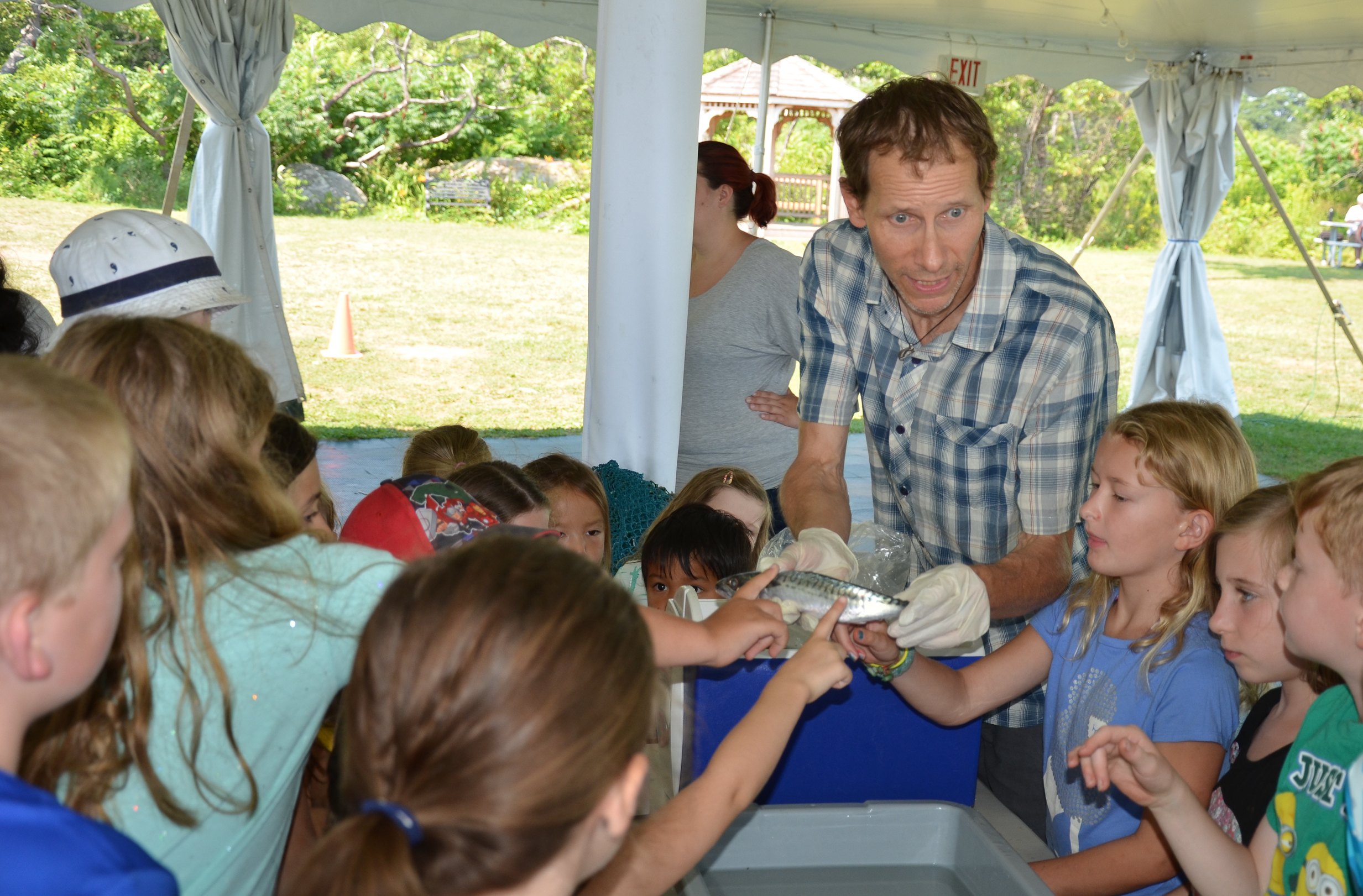
They were also pretty enthusiastic about touching the dead Atlantic mackerel while learning that mackerel are one of several forage fish species that are very important to seafood webs.

And they began to see their relationship to the seafood they eat.

And I learned, once again, that I love what I do.

All Blog Posts

Climate Change Could Threaten Several Northeast Fisheries New Study…

  • February 6, 2016October 20, 2021
  • by Colles Stowell
Share it!
Share

Go ask Long Island lobstermen … if you can find any … what they think about climate change. Trouble is, there aren’t many left because there aren’t many lobsters left in Long Island Sound. Same thing with Atlantic cod fishermen. There aren’t nearly as many boats targeting cod compared to 25 years ago because there are fewer fish.

We can blame climate change to a degree. No, it would be shortsighted to blame all fisheries depletions on warming waters. Myriad factors including fishing pressure can conspire to harm stock health. But a new study from NOAA underscores a concern many scientists and fishermen share: ever warming waters will continue to dramatically impact fisheries.

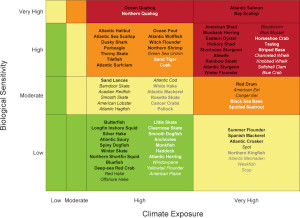
Published in the journal PLOS ONE, the study relies on a new methodology to look at how 82 species in the Northeast region have been and will be affected by climate change. Specifically, the study measures which species will be most vulnerable to climate change effects, including ocean acidification, as well as which species’ migratory patterns will most likely change because of ocean warming. In a nutshell, species that live along the ocean floor such as cod, mussels and lobsters, and those like salmon and sturgeon that migrate between salt and fresh water are most at risk.

Some of the species’ responses we already know. As the Gulf of Maine warms faster than 99% of all ocean climates on earth (at a rate of a half a degree Fahrenheit increase per year for the past decade), several native species have reacted. Lobsters have moved north and east along the coast, leaving fisheries in Long Island and Cape Cod in succession. The Northern Shrimp fishery has collapsed in the past few years. Scientists speculate the combination of warming waters limiting spawning and reducing the amount of plankton the shrimp eat is largely to blame. Scientists also say these warming waters limit cod reproduction and health and survivability of juveniles.

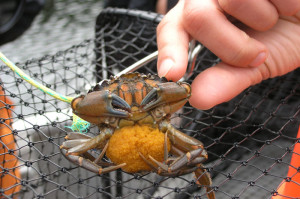
European green crab. Credit: NOAA

Gulf of Maine temperature increases have opened the door to invasive species like black sea bass and scup, and have made bays and estuaries more hospitable to European green crabs, whose numbers have risen exponentially in the past few years. Green crabs wreak havoc on eelgrass flats as they burrow in to eat larval mussels, clams and oysters.

Jon Hare, a fisheries oceanographer at NOAA Fisheries’ Northeast Fisheries Science Center (NEFSC) and lead study author, said the main purpose of this study is to give fisheries managers and other stakeholders tools to take climate change into account when devising management policy.

“We’re never going to have perfect information,” he said. “The ecosystem is going to change because of a combination of anthropogenic influence such as greenhouse gas and natural climate variability.” To keep up with the pace of that change, which has been dramatic in the past 10 years, Hare and his colleagues developed a methodology that incorporates already established research and factors in expert extrapolation. This methodology helps them predict things like how mussels will respond to warming waters or how they will react to increased acidity in their ecosystem in the next 10 years.


Overall climate vulnerability is denoted by color: low (green), moderate (yellow), high (orange), and very high (red). Certainty in score is denoted by text font and text color: very high certainty (>95%, black, bold font), high certainty (90–95%, black, italic font), moderate certainty (66–90%, white or gray, bold font), low certainty (<66%, white or gray, italic font). Source: Hare et al (2016)

The scientists graded each of the 82 species’ vulnerabilities taking into account different variables, and set those grades to peer review. The result is a composite view of how likely a species may suffer reproductive pressures from increased temperatures or how likely a species may change migratory patterns.

Hare said other studies are beginning in the Bering Sea and off the coast of California, and the National Marine Fisheries Service wants to conduct these studies on all U.S. coasts.

No doubt much discussion will arise from this study and others like it. Some will question the study’s approach, efficacy or even need. Some fishermen may view the study as simply another tool for regulatory bodies like the New England Fisheries Management Council to further restrict fishing without real stakeholder permit. Others might ask why this hasn’t occurred before.

I see a couple of potential positive outcomes. First, the fact that NOAA is not only acknowledging climate change, but also actively trying to take steps to factor that into management decisions is significant. Like any federal agency, NOAA moves at a glacial pace (I wonder how long we’ll be able to use that descriptor…). But Hare and his colleagues eschewed the traditional approach to ecosystem-based management via species-specific analyses, which could take decades, to adopt a faster, potentially more efficient methodology for studying the issue. This is largely because climate change has been transforming ecosystems faster than we can study them.

Secondly, Hare says he hopes this tool becomes iterative — that in fact it will adapt as ecosystems change so scientists and researchers will have a chance to keep closer tabs of impacts than before. Some of fishermen’s frustrations with past NOAA research/policies is that that they are static, and don’t change dynamically with ecosystems. But Hare hopes the iterative process for this methodology will take into account fishermen input when considering which species may be affected by climate change. “Fishing communities will be impacted as well,” he said.

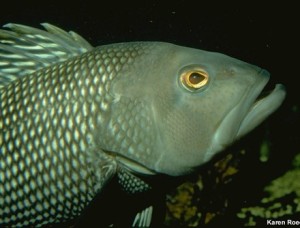
One impact is that some of these communities will start adapting to the changing marine ecosystems and harvest “locally abundant” species that were once considered invasive species. For example, black sea bass have started showing up in lobster traps in Maine because they’ve followed the warming trend north. Now they are an available seafood choice in local stores and restaurants.

black sea bass Credit: NOAA

I too hope this process becomes more collaborative. Because without that interactive participation in the science and policy making, the process will continue to be viewed by many as a set of unilateral decisions curtailing fisheries at the expense of small scale fishermen. As Hare said, even if we magically stopped all green house emissions now, the lingering effects of warming oceans would continue for decades.

Acting now, collaboratively, is the best chance at present for ensuring we effectively manage fisheries even as warming waters seek to change the dynamics. I attended a workshop a year ago in which scientists (including Hare), fishermen, and policy makers discussed how to better predict climate change impacts on fisheries and how to communicate that to fishermen.

Perhaps this is the first step.


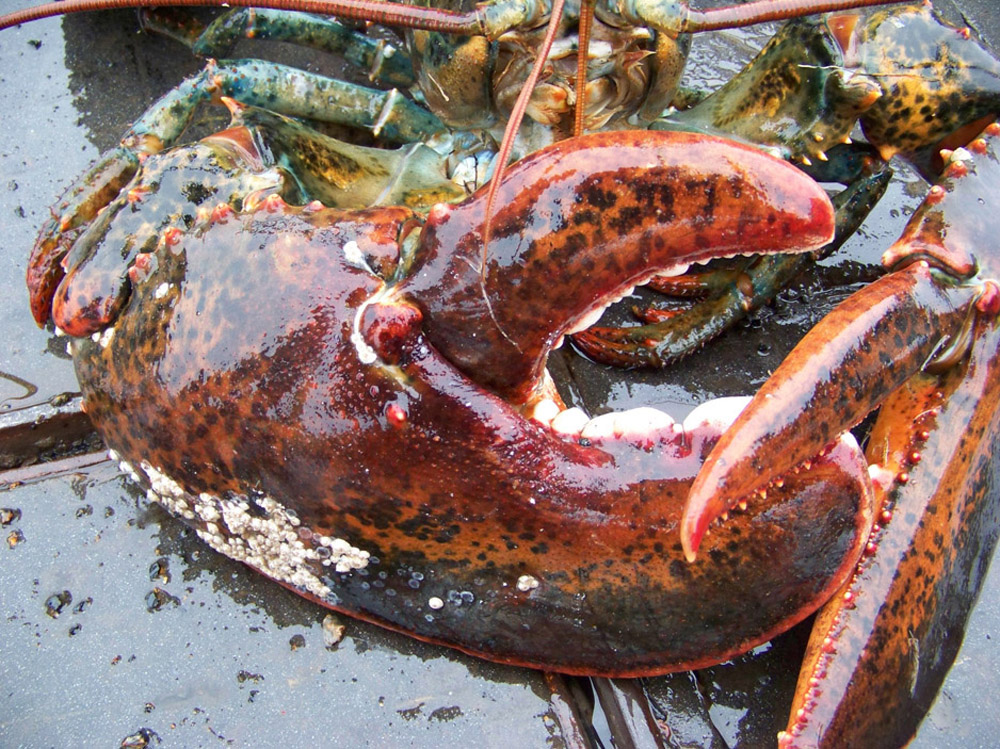
Lobster photo credit: NOAA

All Blog Posts

Rising Temperatures Raising Global Warming Alarms

  • January 28, 2016October 20, 2021
  • by Colles Stowell
Share it!
Share

Summers in New Orleans can all but suffocate the uninitiated. The heat and humidity in August make a five block walk feel like a five mile run in normal conditions. The last time I experienced it for any length of time was in 1985, when I rode the streetcar to and from downtown for a summer job as an accounting clerk. After a couple of days of showing up drenched in my suit and tie, I began tucking my office clothes in a backpack and wearing shorts for the commute. Read more “Rising Temperatures Raising Global Warming Alarms” →

All Blog Posts

Starting the Sustainable Seafood Conversation Early

  • November 7, 2015October 20, 2021
  • by Colles Stowell
Share it!
Share

The moment you realize you’re doing the right thing in life is a special one. It’s not a frequent enough occasion (at least not for me). I stumble, literally and figuratively, make mistakes and then do my best not to repeat them.

Sometimes I’m even successful. Read more “Starting the Sustainable Seafood Conversation Early” →

All Blog Posts

Climate Change: Setting the Wrong Records

  • October 29, 2015October 20, 2021
  • by Colles Stowell
Share it!
Share

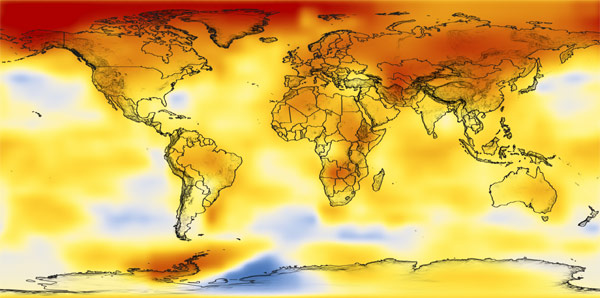
Not surprisingly, the latest global climate stats are discouraging. Last September was the warmest September of combined global land and ocean temperatures during the 136-years of recorded climate history. According to the report from the NOAA National Centers for Environmental Information, this is the fifth consecutive month of setting such an ignominious record.

Here are a couple of “high”lights:

  • 2015 was 1.62°F above the 20th century average of 59.0°F. The previous record was Sept. 2014.
  • 2015 was the highest departure from average for any month in 1,629 months since the record began in January 1880.
  • Global sea surface temperatures were 1.46°F above the 20th century average of 61.1°F, the highest departure for September on record. Scientists attribute this to powerful El Niño conditions.
  • The first nine months of 2015 comprised the warmest such period on record across the world’s land and ocean surfaces, at 1.53°F above the 20th century average, surpassing the previous records of 2010 and 2014 by 0.21°F.
  • Precipitation varied widely globally, with some places like Australia getting much less rain than normal, while some areas in Northwest Africa and Eastern Europe getting 200% of normal rainfall.

What does all of this mean? It means the climate is warming faster than we’ve anticipated in the past, particularly as the range of temperature increases above normal are getting higher. It means this global warming trend is going to continue unless we take some serious steps to curtail greenhouse gas emissions and other manmade climate change factors.

Warming oceans could change how, where and even if we find traditionally local seafood here in New England. The Gulf of Maine is warming faster than most ocean areas on the planet. This trend could force lobsters to move farther north and east to cooler waters, making it more expensive and time-consuming to fish them. Lobster fisheries could effectively shut down in some areas, as has been the case in Long Island sound and around Cape Cod.

I attended a workshop last year about how to better predict climate change impacts on fisheries. The upshot? We need to act now, and collaboratively among scientists, policy makers, fishermen and community activists to figure out a plan to adapt to climate change, and perhaps slow its progress.

Here are some additional resources about the trend:

NOAA Climate Science Strategy

Union of Concerned Scientists: Climate Hot Map

NOAA: What is El Niño?

Climate Nexus


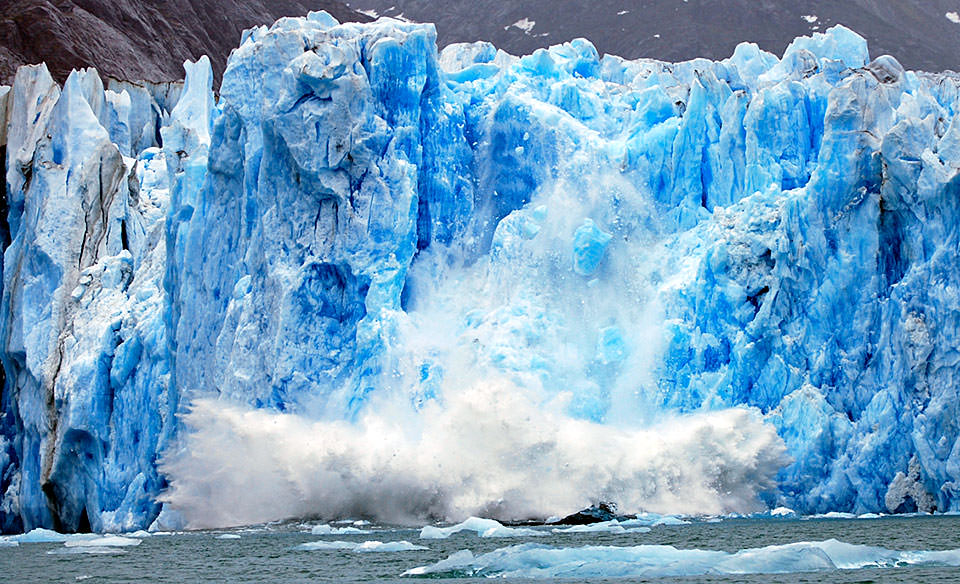
Photo: Calving glaciers are telltales of global warming.

Credit: NOAA

All Blog Posts

Fishermen and Scientists Discuss Climate Change Impacts On Gulf…

  • January 5, 2015October 20, 2021
  • by Colles Stowell
Share it!
Share

This blog originally appeared Jan. 5, 2014 on the Cape Ann Fresh Catch website.

One of the benefits of writing about sustainable seafood is the opportunity to attend informative workshops and conferences about the subject. The Island Institute hosted a workshop in Portland in December 2014 about current and future impacts of climate change on fishing in the Gulf of Maine. The Island Institute is a nonprofit aimed at supporting the state’s island and working waterfronts. Chief among these is the fishing community.

Scientists from NOAA, Gulf of Maine Research Institute (GMRI) and the National Weather Service met with Island Institute representatives and commercial fishermen to discuss everything from rising water temperatures and ocean acidification to current and future predictive modeling technologies. Fishermen described how they’ve had to change tactics as cod fishing has all but stopped and lobster continue to move down east (north and east along Maine’s coastline) following cooler temperatures. They want to know if they can get more accurate, more predictive data to better plan ahead and adapt for upcoming fishing seasons based on the rapid changes.

Make no mistake. Things are changing quickly in the Gulf of Maine (GOM). In fact, ocean temps are rising faster here than anywhere else in the world. And the dynamic modeling presented at the conference was a bit scary. The water temperature has risen by nearly half a degree Fahrenheit per year for the past 10 years. That’s a big increase ¾ one which analysis suggests has had varied impacts on lobster and cod.

Scientist currently think that warming largely comes from the atmosphere, due to increased CO2 levels stemming from human activity. CO2 accounted for 82% of all greenhouse gases (the main contributor to global warming because it traps solar radiation in earth’s atmosphere) in the U.S. in 2012, according to the Environmental Protection Agency. Atmospheric CO2 levels doubled from 1860 to present. Scientists think they will double again in the next 70 years. That could increase global temperatures by several degrees in the same time period … which could have catastrophic impacts on coastal fishing, as well as coastlines, flood zones, real estate, etc.

Then there are the rising acidity levels. Ocean acidification is already occurring. As atmospheric CO2 rises, the ocean PH (which measures acidity) drops. PH levels are measured in very small increments. But when scientists predict PH levels will drop .2 to .4 in 100 years, the ecological impact could be significant. Even slight changes in PH levels could affect the ability of shellfish to develop normally hard shells to fend off disease. The economic impact could be devastating.

Fishermen in attendance talked about seeing cod fishing vanish and watching as lobstering areas have moved up the coast as waters have warmed. The past couple of years have had good to great landing years, but they have come much earlier than normal, and the effect hasn’t necessarily been good for market price. For example, in 2012 there was a glut of lobster on the market with full traps coming early in the season due to warmer water. But the molting season coincided with the prime trapping season, and Maine lobstermen were stuck with low-value product that could not be shipped to Canada (where such shedding lobster are processed) because the plants weren’t open yet. So the industry had a bumper crop, but the downstream effect was a net loss of millions of dollars.

GOM warming also appears to have a negative effect on cod stocks. Andy Pershing, chief scientific officer at GMRI, said his studies so far indicate that warmer water seems to produce fewer cod, meaning catches would be further reduced.

Fishermen at the meeting said they need better communication of trustworthy information so they can more quickly adapt to imminent fishery changes caused by environmental change. But improving the science and infrastructure to be helpful and accessible to fishermen is one thing. Getting lobstermen and fishermen who’ve been doing the same thing for decades to adapt is a much bigger challenge.

One thing is certain. The Gulf of Maine fisheries are changing more rapidly than many northern New England fishermen are really prepared for. Two fishermen from Chatham, Mass. said they’re making much of their living on dogfish and skates and moving further off shore, which is a bigger capital expense. It was a different story 10 years ago, and will be a different story in another 10 years.

Aside from the eye-popping data, the single biggest take-away for me was the kind of collaboration that is essential for developing and maintaining sustainable fisheries. Fishermen sitting down with scientists talking about the data that is now available and the data they would need to make smart decisions. What’s needed next is collaboration with policy makers to effect management plans that will support sustainability and fishermen.


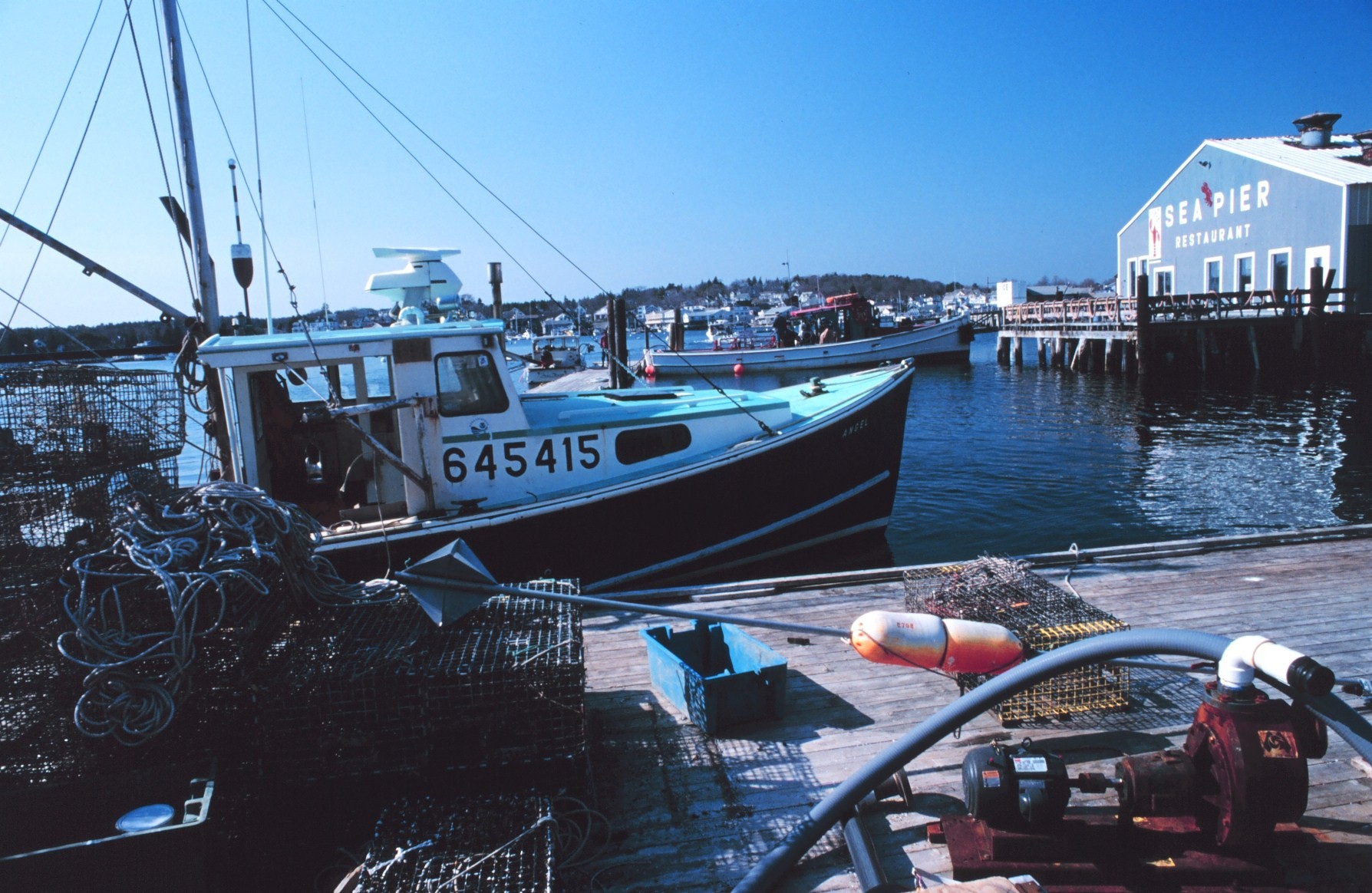
photo: Lobster boat docked at Boothbay Harbor, Maine. William B. Folsom, NMFS

Recent Posts

  • Hurricane Ida wreaks havoc on Louisiana’s seafood industry
  • EPA Should Use Clean Water Act To Kill Zombie Mine
  • Slow Fish 2021: Relationship Matters
  • Faith, Façades, and Futility
  • Pebble Permit Paused: Politics at Play

Archives

  • September 2021
  • August 2021
  • April 2021
  • December 2020
  • August 2020
  • June 2020
  • February 2020
  • December 2019
  • November 2019
  • October 2019
  • July 2019
  • May 2019
  • April 2019
  • March 2019
  • January 2019
  • December 2018
  • November 2018
  • June 2018
  • May 2018
  • March 2018
  • February 2018
  • January 2018
  • December 2017
  • November 2017
  • October 2017
  • September 2017
  • August 2017
  • July 2017
  • June 2017
  • May 2017
  • April 2017
  • March 2017
  • January 2017
  • December 2016
  • November 2016
  • October 2016
  • September 2016
  • August 2016
  • July 2016
  • June 2016
  • May 2016
  • April 2016
  • March 2016
  • February 2016
  • January 2016
  • December 2015
  • November 2015
  • October 2015
  • September 2015
  • July 2015
  • June 2015
  • May 2015
  • April 2015
  • March 2015
  • February 2015
  • January 2015
Theme by Colorlib Powered by WordPress