Skip to content
One Fish Foundation
  • Blog
    • Aquaculture
    • Education
    • Environment
    • Policy
    • Wild Harvest
    • Fish Tales
  • About
    • About One Fish
    • About Colles Stowell
  • Education
    • Elementary School
    • Middle School
    • High School
  • KNOW FISH Dinners®
  • Resources
    • One Fish Podcast
    • One Fish Foundation in the news
    • The 7 C’s of Sustainable Seafood
    • Newsletter Archive
    • Recipes
      • Skate with Capers and Butter — Chef Rizwan Ahmed
      • Grandma Davis’ Fish Chowder — Jane Almeida
      • Ginger Garlic Tamari Scallops — Colles Stowell
      • Fish Stock — Evan Mallett
      • Mussels San Remo — Chef Rob Martin
      • Salted Pollock Croquettes – Chef Mark Segal
  • Connect
    • Contact OneFish
    • Social
      • Instagram
      • Facebook
      • Twitter
All Blog Posts

Life Lessons From Rosie’s Gumbo

  • December 4, 2017October 20, 2021
  • by Colles Stowell
Share it!
Share

I remember coming home from school, walking through the gate, past the yew bushes and down the walkway past the open den windows.  The aroma of the trinity (onions, bell peppers and celery) simmering in the roux would grab me. I could smell the sausage, and sometimes even the shrimp. There was something else earthy that I couldn’t identify.

Perhaps it was the filé, or the thyme. Perhaps it was the blend of everything “getting happy” together in the pot.

Or maybe it was just the love. Rosie put a lot of love in her gumbo.

As a child growing up in New Orleans, these were some of the root smells of my evolution. Red beans and rice. Shrimp creole. And Rosie’s gumbo.

Rosie took care of me when both my parents worked. She also helped my mom around the house. They were best friends. They frequently discussed the latest events on the afternoon soap operas…”The Young and the Restless,” “The Guiding Light”…all that crap. And they confided in each other. They supported each other through some heavy life challenges.

Rosie was the one I’d go to when I was sick. Unlike mom, who had plenty to say on a variety of topics, Rosie was more quiet, saying only what she needed to say, and usually, saying it very directly.

Truth be told, when I was less than 10 years old, I picked out the andouille and smoked sausage, the ham and the shrimp from her gumbo and left the rest. It wasn’t until my teens and early 20s that I truly started to appreciate the magic. It wasn’t until my early 30s that I had the courage to ask her to teach me how to make it.
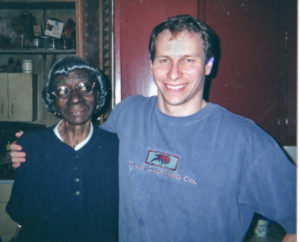
Chef and apprentice. I must have had a good lesson. No visible spoon marks.

I was not afraid of her teaching me a recipe. My mom was an excellent cook, and she taught me how to follow a recipe. She taught me to have the courage to try new things and learn from my mistakes.

The daunting prospect of trying to learn how to cook without a recipe scared the hell out of me. Rosie cooked by instinct. The “recipe” was in her head, a tradition passed down over generations. And gumbo isn’t quite as simple as mac and cheese.

During the two-plus-year process of learning how to make gumbo, my relationship with Rosie grew more profound and more meaningful than we could have imagined. That’s probably because it was an intense experience requiring no shortage of patience from both of us.

She taught me to use all five senses. But it was the process of trying to create a common language that I could understand that proved most challenging.

“First you make the roux,” she’d say. “Get a spoon of oil and a spoon of flour and stir it in the hot pan.”

“How big a spoon?”

“The wooden spoon in your hand.”

“But how much is in that? What if I don’t have a spoon exactly this size?”

WHACK!

The spoon found the side of my head and I didn’t ask that question again.

“You want the roux to be the color of milk chocolate before you add the trinity.”

“What color of milk chocolate? I like a lot of chocolate in my chocolate milk.”

WHACK!
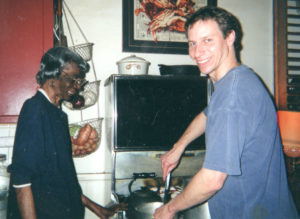
Stir the roux, boy…

Two years and several such reprimands later, I must have taken enough lumps to start to get the hang of it. She taught me to watch the roux until it was LIGHT milk chocolate color; to listen to the sound of the roux as it set up; to smell the nuttiness as it approached the right stage before adding the trinity. I learned to smell that sweet, earthy smell of the vegetables sweating in the roux. I felt the density of the roux ball as I stirred it to make sure not to burn the flour. After adding the water and stock, I learned to taste it to gauge how much salt and pepper to add. I learned the timing of when to add the sausage, shrimp, and other ingredients.

I remember nervously handing over a bowl that I made entirely on my own for her to judge.

“You done good.”

Graduation

I’ve made gumbo many, many times since my formative learning. Before each time, I thank Rosie for showing me how to do it right. Because of her tutelage, I’m now able to scale my gumbo up or down in volume based on the scope of the audience. I can make it with different ingredients. In October, I made gumbo for a chef friend’s wedding using seafood from the Gulf of Maine. I made a lobster stock, added mussels and clams and lobster, and I smoked a skate wing. I added some phenomenal andouille. It went over well.
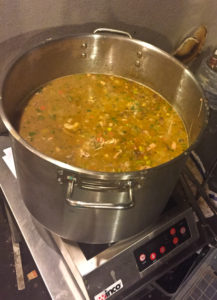
Making roux on an induction burner was nerve racking. What would Rosie think?

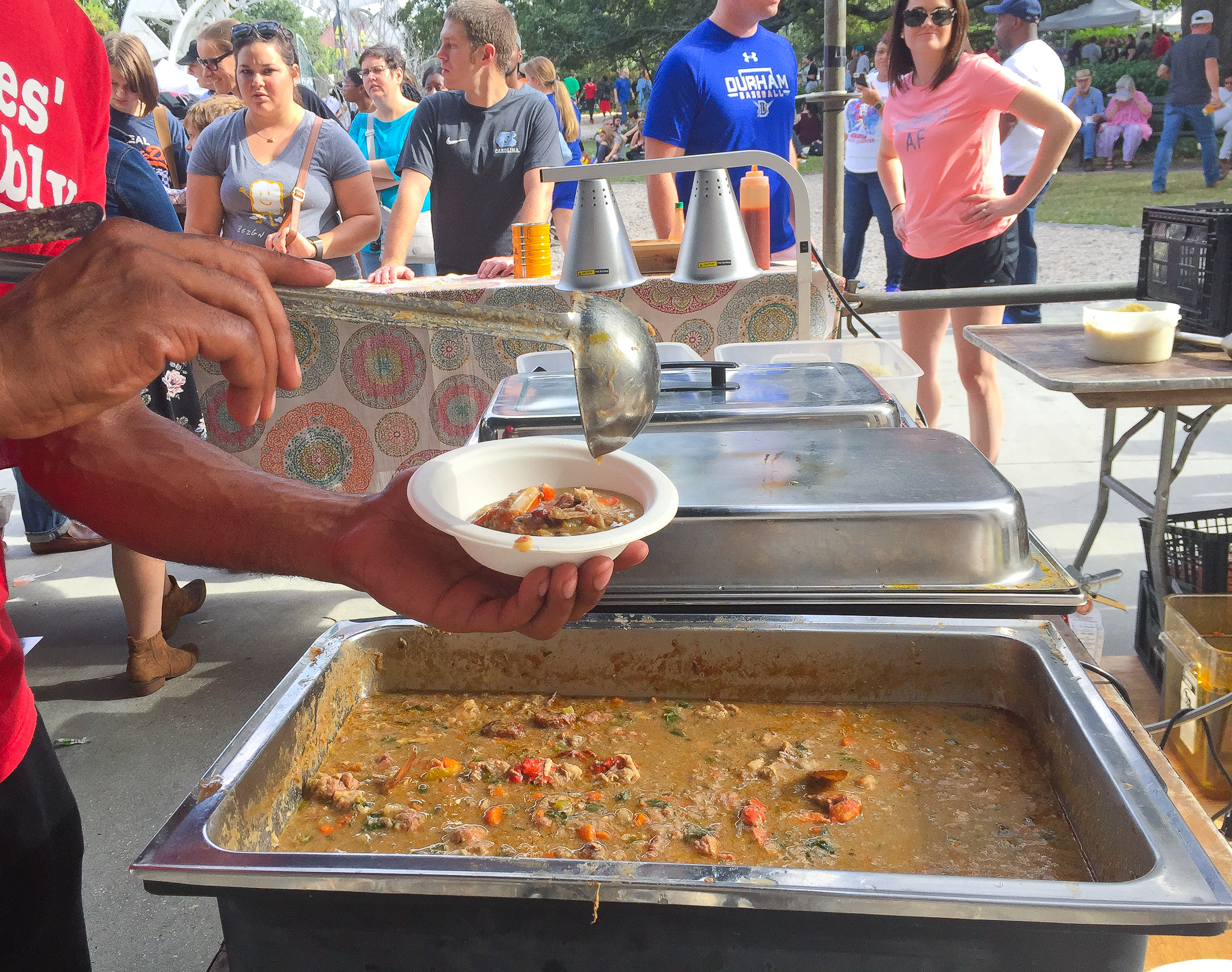
I just recently made more than 90 quarts for the Tremé Creole Gumbo Festival held Nov. 18 and 19 in New Orleans. Dana Honn, colleague, friend and chef/co-owner of Café Carmo in New Orleans invited me down after seeing that I cooked a lot of gumbo at Slow Food Nations in Denver this summer.

Gumbo Fest was a blast. It was exhausting. I think I cooked or helped stage and take down the booth for something like 36 hours over three days. I learned much from Dana and his crew. I learned about what it takes to sell your food. I learned more about what I can do (making gumbo on an induction burner!).
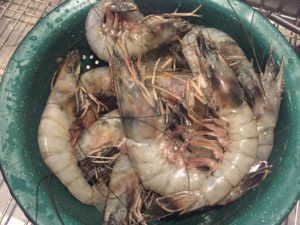
Such a treat to cook with wild caught Gulf of Mexico seafood!

But the highlight for me wasn’t just the end product, or the enthusiastic response from some customers, or the stellar Gulf of Mexico shrimp and crabs from friend Lance Nacio’s Anna Marie Shrimp, or the otherworldly andouille, chaurice and tasso from my friend and pig whisperer Toby Rodriguez.
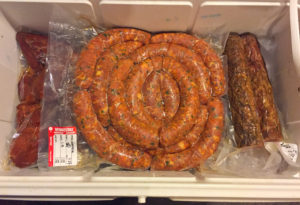
Got pork? Toby’s products are the best I’ve ever cooked with.

No, the real highlight for me occurred during a panel discussion I was moderating on gumbo heritage and the idea of preserving the tradition of local, sustainable sourcing. On the panel with me were Dana, friend and colleague Gary Granata, who has travelled the world to discover how different people deal with changing waterways, and Ryan Prewitt, chef/partner of the highly acclaimed Pesche Seafood Grill in New Orleans.

We each had a different take on the importance of sourcing your food (whether or not for gumbo) locally from producers you know or from sources you know who take care of their products. We talked about how gumbo is and was a communal event, dating back centuries to West African roots. You don’t cook gumbo for one person. Traditionally, neighbors would bring something to throw into the pot, or something to go with the gumbo.

Toward the end of the discussion, I asked each panelist to talk about his first, most powerful memory of gumbo.

Naturally, I spoke about Rosie. About that smell in the house and the yard. About taking my lumps. About the sense of family around her and her family. About teaching her grandson Gary how to bang on the drums. About the pride I felt in watching him grow and eventually march with one of the best high school bands during Mardi Gras. About the profound sadness of her death in the mid 90s. About the heartbreak of losing track of Gary and his mom Betty after Katrina hit. His home was boarded up with a big X painted on the door by the National Guard.

We tried FEMA. We tried the sheriff’s department. For months I went online checking displaced victims websites. Nothing. We didn’t know if they were alive and had evacuated, … or not.

Just before I’d reached this part of my narrative, a family of four came into the audience and sat down. I mentioned that a month prior to Gumbo Fest, I’d been planning to make gumbo for my chef friend’s wedding, and was thinking about Rosie, as always, and about Gary and his mom, when I got a Facebook message.

It was from Gary.

Fighting to keep my composure in front of the festival audience, I said “Gary, would you please come up here? I just want you all to know that I haven’t seen this person in 20 years, and I hadn’t heard from him until last month.”

We hugged, tears in our eyes, for it had been a long time of not knowing.

It was a seminal moment for both of us for Gary and his family to taste the gumbo his grandmother taught me to make. I often wonder what Rosie would think of my gumbo now that I’ve adapted it to my own particular style.
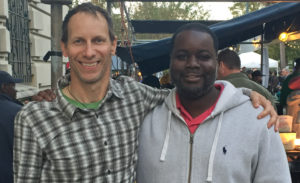
Gumbo truly is a community event. It brings people together. At the outset of the discussion, I told the audience that for me, the most important ingredient isn’t the roux, or the trinity or okra. (There’s often a vocal battle line drawn between the okra crowd, and the file/roux crowd in Louisiana). It’s love. You’ve got to love the food first. And it’s also important to love the people you’re cooking for. You and they will taste the difference.

This perhaps is the most important lesson I’ve learned as a home cook.

Thanks, mom. Thanks, Rosie.


All Blog Posts

Making Do at Slow Food Nations, Denver

  • July 19, 2017October 20, 2021
  • by Colles Stowell
Share it!
Share

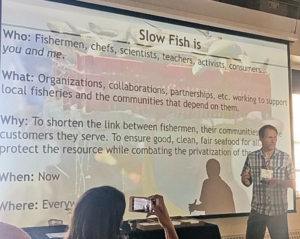
Attending Slow Food Nations in Denver this past weekend, I had some expectations about the Slow Fish 101 presentation I would co-lead and the gumbo I would make.

As often happens, those expectations capsized last minute and I and many others had to adapt on the fly. For the second year in a row, the Slow Fish USA team had to respond quickly to a variety of circumstances outside our control.

In the midst of towed vehicles, last-minute technical presentation difficulties, and a bit of a cluster around the commissary kitchen, we scrambled to help each other out. And just as we did last year at the Slow Fish gathering in New Orleans, we made it work… well.

Blame it on the weather

Again, weather played a role, as it did last year when we had to change venues because a flood warning closed down the original host site. This time, I learned my Slow Fish 101 co-presenter Paul Molyneaux was stranded in Portland, Maine because of weather and would miss the presentation. Having fished commercially and written several books and articles about fisheries, Paul not only brings 40 years of experience to the conversation, he has also made important connections all over the world.

Anyone who loves seafood, cares about the resource and the fishermen who harvest it sustainably can be part of the Slow Fish movement. Photo: Kate Masury

We each had developed a portion of the deck, and his relied heavily on his global travels learning from and supporting artisanal fishermen and their efforts to thrive. I learned much about these issues from our discussions, but I didn’t feel good about trying to put my perspective on the narrative of all of his slides. So I was up until 11:30 the night before tweaking the slide deck to convey many of the same messages, but from a perspective I’m more comfortable with.

Slow Fish USA luminary Kevin Scribner prefaced the presentation next morning with a history of Slow Fish and provided valuable context for questions and discussion flow.

And it was a good discussion. The audience was a mix of Slow Fish representatives and Slow Food delegates interested in fisheries issues. We reviewed some compelling statistics demonstrating how current industrial seafood markets are stacked against small- and mid-scale fishermen.

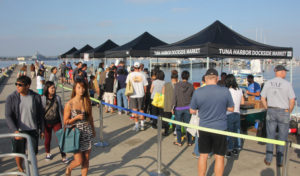
We also discussed how Slow Fish empowers these fishermen around the world to compete in local and global markets using examples such as the Tuna Harbor Dockside Market in San Diego, Know Fish Dinners in New Hampshire and Maine, and projects that support artisanal fishermen in Uganda and Thorupstrand, Denmark.

Tuna Harbor Dockside Market, San Diego. Photo: courtesy THDM.

Tuna Harbor Dockside Market is a shining example of multi-tiered collaboration between fishermen, activists and government. More than three years ago, a group of San Diego fishermen sought a way to sell to consumers direct off the boat. Though there was no specific permit that would allow that type of retail setup, the city, county and state worked together to create legislation that supports the market.

The result?

  • Fishermen have created relationships with customers.
  • They’ve earned more money: sea urchin prices jumped from $.80 to $5 per lb. and mackerel rose from $.30 to processors to $4 per lb. to consumers.
  • Fishermen have changed the way they fish to accommodate market demand.
  • Fishermen’s families work the tents, getting their children’s hands on the product.

The audience posed great questions about aquaculture, fisheries management and the long-term prospects of wild harvest in the face of growing demand. The conversations continued even after we were kicked out of the room as the next group set up.

First mission accomplished.

Blood, sweat and gumbo

The plan was to highlight the story behind the fabulous shrimp and crabs from Lance Nacio’s Anna Marie Shrimp in Louisiana via gumbo. I also secured some of the best andouille sausage I’ve ever had from Toby Rodriguez, a born-on-the-bayou, pig whisperer, traditional butcher and co-owner of Lache Pas Boucherie and Cuisine in Lafayette, La. He had me at “I call bullshit on all commercially available andouille!”

The BIG challenge was logistics, such as sourcing a 40-quart stockpot, stirrer, ladle and all of the flour, vegetables, oil etc. I’d need to deliver my standard of gumbo. I also needed a place to prep and make a stock. Even with weeks of planning, this still proved to be much more challenging than we expected or was necessary.

Thanks guidance from some chef friends, this was NOT a disaster.

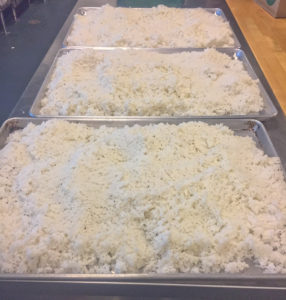
Fortunately, because of the connections I’ve forged with Slow Fish and some outstanding chefs, I found what I needed. A couple of chefs, Kelly Whitaker of Basta in Boulder, and my dear friend Evan Mallett of Black Trumpet in Portsmouth, NH helped me figure out how to cook up about 30 pounds of rice (which was way out of my comfort zone.) Evan also chopped and connected me with a chef for the pot and three locally sourced chickens.

I prepped with help from old and new friends for nearly seven hours after presenting. The morning of the food service, I got a late start because we had to wait for the health inspector and I had to try and figure out how to get 50+ pounds of food in different containers and 12 quarts of stock from the commissary kitchen 5 blocks to the site where I’d cook the gumbo. With a dolly and someone’s truck, we made it work.

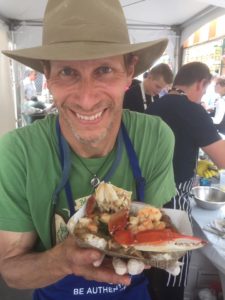
Lance’s blue claw crabs added flavor…and some down-and-dirty eating for lucky patrons.

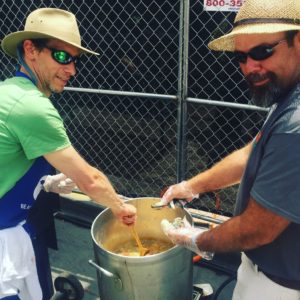
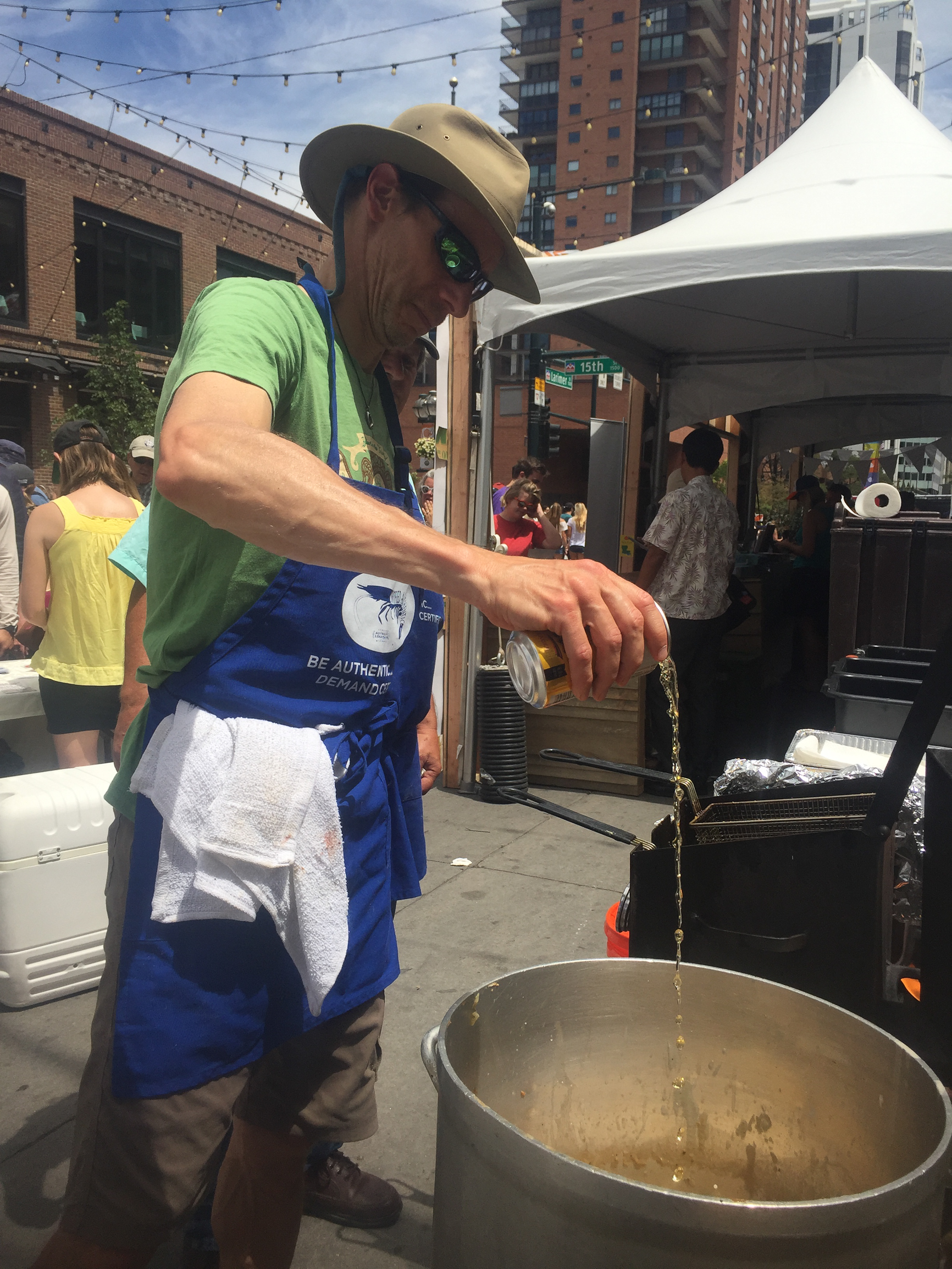
Four hours, a few laughs, a couple of cuss words, a stream of sweat and an unfortunate slip of a knife later, and I was ladling gumbo to praise. We had three tents serving fried shrimp, Baja oysters, miso and seaweed, Alaska salmon, salmon poke and black cod. All of it delicious. The quality and freshness of each product was exceptional.

The moment of truth for me came late that afternoon when an elderly African American man sporting a comfortable sun hat and shades asked, “What you got in that gumbo, son?”

I told him the ingredients, mentioning Toby’s sausage, and the fact I smoked the chicken over apple wood that morning.

“Where you from?”

“New Orleans, sir.”

“Who taught you?”

“A Creole woman who took care of me when both my parents were working. Nothing written down. All oral tradition. Took two years of her whacking me over the head with a wooden spoon every time I messed up for me to start getting it right.”

“Ok. Let’s try it,” he said, dropping his ticket in the cup.

Nervously, I spooned out some rice and carefully selected a ladle that had shrimp, crab, two different kinds of sausage, chicken and as many vegetables as could fit.

The man took a spoonful and seemed to swirl the gumbo around in his mouth like a sommelier, which made me uncomfortable. If he didn’t like it, my day was lost.

He raised his head, sniffed, then a slight smile curled his mouth.

“A lot of flavors that work well together.”

“You like it?” I asked, for confirmation.

“Yes. You done good. Thank you.”

“Thank you, sir!!!”

Notice the gloved hand.

So what if I may have shaved some time off the back end of my life stressing over logistics. So what if I’m now struggling to type with nine fingers because I damn near sliced off the tip of my index finger early in the morning before really getting going on the gumbo. Someone in the tent trained in wilderness survival did a field repair to stop the bleeding so I could complete the mission. I got four stitches only after most of the gumbo was gone and I received “official” validation.

Group effort

All of this goes back to something Slow Food USA director (and former New Orleans high school classmate) Richard McCarthy said in opening remarks that Slow Food is about pluralism. Change doesn’t come from any one person. It comes from a collective force.

So it is true with Slow Fish and specifically, my mission with One Fish Foundation. Changing attitudes about consumer food and seafood purchases requires a group effort. It requires communication, collaboration, partnerships and adaptation. Adapting to unforeseen challenges to event execution is becoming an illustrative trend for Slow Fish USA. It’s because of the connections and friendships we’ve formed that we’ve been able to overcome some last-minute hurdles, working together to send our message.

It’s because of those connections, and the new connections we make that we will continue to steer the conversation toward preserving the seafood resource and the way of life of the fishermen who harvest and care for it.


Top Photo: Don’t forget the secret ingredient! Credit: Lance Nacio.


All Blog Posts

Slow Fish Gumbo

  • July 8, 2017October 20, 2021
  • by Colles Stowell
Share it!
Share

I like farmer’s markets. I like talking to farmers about how they grow food, from discussing the subtle flavor profiles of 40 different types of garlic to the homemade sticky buns some breeders feed heritage pigs. That’s because I like good food and the interesting story behind it. I like connecting with the farmers who produce the food my wife and I prepare for our family. I no longer can stand walking into a big grocery store chain where all too often the story behind the food is muddled, glossed over or fabricated.

Slow Food has done much to shift the paradigm away from the agribusiness, industrial food system culture that so dominates local, regional, national and international grocery store shelves. Its central premise is to make good, clean, fair food accessible to all. That is, Slow Food promotes food that hasn’t been grown in industrial environments flecked with chemicals and other additives; food that hasn’t traveled long distances; and, food that is sold at a fair price by the farmer to the consumer.

Slow Fish has the same essential mission: to ensure good, clean, fair seafood is available to all. This mission also promotes shortening the supply chain between the producer – in this case, fishermen – and the consumer, while ensuring fishermen have a chance to earn a fair market price.

Representing One Fish Foundation, I will have the opportunity to discuss the Slow Fish mission at the Slow Food Nations Conference in Denver next week. I’ll be co-leading a presentation on how Slow Fish aims to shine a spotlight on local seafood producers providing fresh, local, responsibly harvested fish and shellfish to their communities and beyond. We’ll talk about why so much of the seafood eaten in the U.S. is imported, and ways that small scale fishermen have banded together to change that dynamic. We’ll encourage attendees to get involved by starting a community supported fishery (same as a CSA, but for seafood), join the discussion on improving management policies, or simply demand local seafood at nearby restaurants and grocery stores.

It will be a good discussion.

I will also help drive the point home by making gumbo with shrimp and blue claw crabs from the Gulf of Mexico harvested by Lance Nacio and Anna Marie Shrimp. For me, this will be a treat because it’s been far too long since I’ve been able to cook with the seafood of my New Orleans heritage (now that I live in Maine).

I will also be cooking with andouille sausage made by Toby Rodriguez, a butcher, chef, and authority on Cajun food traditions who gives dissertations on why commercially available andouille is crap. I can still remember the smell of traditional andouille as it was rendered before the roux was made when I was young. I’ve not really had that rich, dense, somewhat spicy flavor in decades, but it will grace the gumbo I make at Slow Food Nations.

The gumbo in effect will be a metaphor for Slow Food and Slow Fish. Standing up to industrial food systems often means establishing a relationship with your food producer and weaving their narratives into the dish you’re preparing. It’s a shared narrative, steeped in tradition, trust, good will and that not-too-subtle, nutty-sweet aroma of the trinity (celery, peppers and onions) after you first stir it into the roux.

Recent Posts

  • Hurricane Ida wreaks havoc on Louisiana’s seafood industry
  • EPA Should Use Clean Water Act To Kill Zombie Mine
  • Slow Fish 2021: Relationship Matters
  • Faith, Façades, and Futility
  • Pebble Permit Paused: Politics at Play

Archives

  • September 2021
  • August 2021
  • April 2021
  • December 2020
  • August 2020
  • June 2020
  • February 2020
  • December 2019
  • November 2019
  • October 2019
  • July 2019
  • May 2019
  • April 2019
  • March 2019
  • January 2019
  • December 2018
  • November 2018
  • June 2018
  • May 2018
  • March 2018
  • February 2018
  • January 2018
  • December 2017
  • November 2017
  • October 2017
  • September 2017
  • August 2017
  • July 2017
  • June 2017
  • May 2017
  • April 2017
  • March 2017
  • January 2017
  • December 2016
  • November 2016
  • October 2016
  • September 2016
  • August 2016
  • July 2016
  • June 2016
  • May 2016
  • April 2016
  • March 2016
  • February 2016
  • January 2016
  • December 2015
  • November 2015
  • October 2015
  • September 2015
  • July 2015
  • June 2015
  • May 2015
  • April 2015
  • March 2015
  • February 2015
  • January 2015
Theme by Colorlib Powered by WordPress