Skip to content
One Fish Foundation
  • Blog
    • Aquaculture
    • Education
    • Environment
    • Policy
    • Wild Harvest
    • Fish Tales
  • About
    • About One Fish
    • About Colles Stowell
  • Education
    • Elementary School
    • Middle School
    • High School
  • KNOW FISH Dinners®
  • Resources
    • One Fish Podcast
    • One Fish Foundation in the news
    • The 7 C’s of Sustainable Seafood
    • Newsletter Archive
    • Recipes
      • Skate with Capers and Butter — Chef Rizwan Ahmed
      • Grandma Davis’ Fish Chowder — Jane Almeida
      • Ginger Garlic Tamari Scallops — Colles Stowell
      • Fish Stock — Evan Mallett
      • Mussels San Remo — Chef Rob Martin
      • Salted Pollock Croquettes – Chef Mark Segal
  • Connect
    • Contact OneFish
    • Social
      • Instagram
      • Facebook
      • Twitter
All Blog Posts

DNA, Fraud and Next-Gen Scientists

  • March 27, 2019October 19, 2021
  • by Colles Stowell
Share it!
Share

Imagine a team of scientists collecting DNA samples to see if the seafood sold at local restaurants and stores is correctly labeled. They go to sushi shops, grocery stores and other retail venues and carefully place tiny samples of the fish in a small vial containing ethanol.

Then they take it to the lab where they will use genetic techniques, including Chelex extractions and polymerase chain reaction (PCR), to analyze the DNA of the sample to see if the snapper they purchased is actually Pacific rockfish. Their work is crucial. It will provide a deeper understanding of the rate at which seafood is mislabeled in area retail stores.

Now imagine these scientists are in high school.

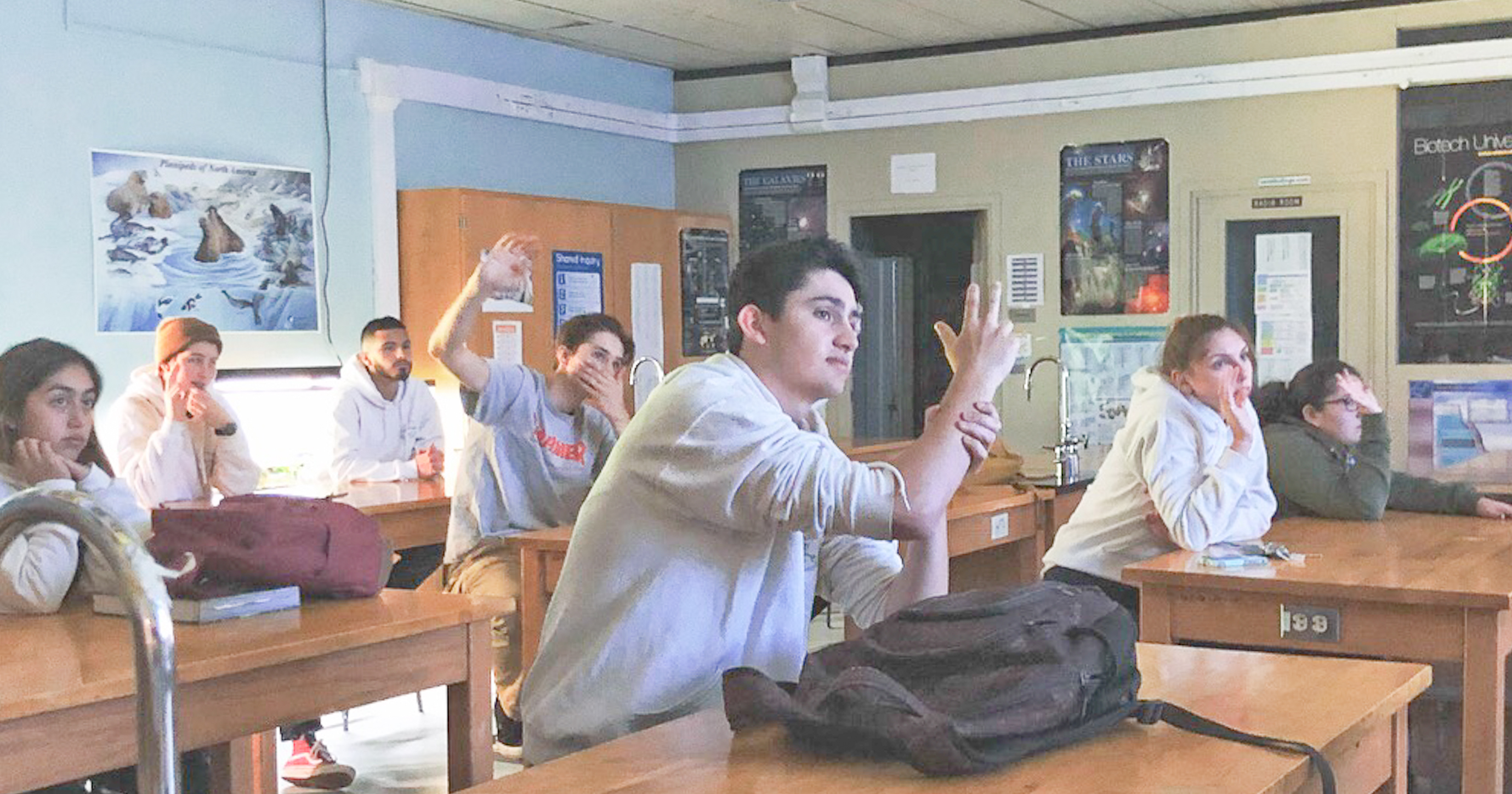
I was inspired by the senior biotech class I visited March 18 at Harbor High School in Santa Cruz, California. I was even more inspired by teacher Nehal Pfeiffer, who developed this project to combine classroom/lab study with real-world challenges. To get students thinking about how the process would work, she started students on testing different foods for genetically modified organisms (GMO).

The students were somewhat surprised to see high GMO content in Cheetos (corn) and veggie burgers (soy). Then the teacher had them break out into groups representing different players in the food industry such as farmers and Monsanto and try to get at the heart of the discussion.

You can guess how this ends up. Lively discussion. Engaged questions. Thoughtful conclusions.

Fraud talk

So I was honored to be invited to speak to these students about fraud in the seafood supply chain. I was there to give them a broader perspective of how and why it happens, the larger dynamic of US and global seafood consumption and what we can do about it.
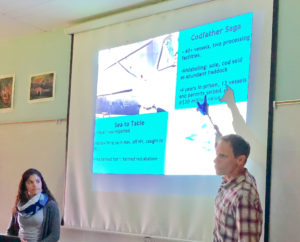
“Codfather” Carlos Rafael and Sea To Table are poster children for what can go wrong with fraud in the supply chain. Arina Favilla (left) helped coordinate the DNA sampling project. Photo credit: Stephanie Webb


After holding up Carlos Rafael and Sea To Table as prime examples of different types of fraud and their impacts on consumer trust, one student raised her hand and asked, “How can they get away with that? Who do we sue?”

Great question that prompted an excellent, interactive discussion. The truth is that current management policy, combined with a clunky mishmash of federal oversight spread over four disparate agencies with a confusing web of priorities and powers enables these types of fraud.

Rafael, the self-styled Codfather, was enabled by the catch share system in the New England groundfish fishery to amass a giant horde of access (permits) to essentially “own” the right to catch more groundfish than anyone else in and around the Gulf of Maine. He then used that power to force out many small-scale fishermen while vertically integrating so that his team of captains could work with his on-shore processing facilities to mask the cod and Dover sole he was catching as abundant (and less subject to expensive quota limits) haddock. He then sold this fish to New York restaurants for bags of cash.

Fortunately, he got caught bragging about the scheme to undercover IRS agents posing as Russian mafia.

I then explained the Sea to Table story as one of co-optation of values. One of the early pioneers of the national boat-to-plate sustainable seafood movement, Sea to Table was outed in an in-depth Associated Press exposé last summer, in which the Brooklyn-based company was alleged to have claimed some of its tuna had been locally harvested off Montauk, NY, when in fact it was caught in North Carolina. Other allegations include selling domestic seafood that may have been linked to international slave trade and offering wild harvested sea urchin that was actually farmed.

Taking initiative

My goal was to give Harbor High students an understanding of why this matters. Beyond the science, which is super cool and something I lament not having access to way back in my time, the understanding of how and why this type of fraud matters hopefully inspires these students to dig in. I’d love to see them discover the level of mislabeling in their communities, put that in context, and do something about it.

I hope they spread the message about why knowing where their (our) seafood comes from matters. I hope they ask questions and share the 7 C’s of Sustainable Seafood with family and friends. And I really hope they get involved in marine science, biotech, climate science or any related field. Seafood fraud is a significant problem and erodes the trust necessary to make community-based fisheries markets work.

And it is just one very complex problem in the domestic and global seafood supply chain.

So I would like to thank Nehal Pfeiffer at Harbor High, and University of California Santa Cruz graduate students Stephanie Webb, Arina Favilla and May Roberts, all of whom coordinated this year’s seafood project with Nehal, for inviting me to speak with the students.

My discussion with these thoughtful, determined students inspired me, giving me hope that we can address these complex issues together.


Aquaculture

Canada Greenlights GE Salmon

  • June 5, 2016October 20, 2021
  • by Colles Stowell
Share it!
Share

Congrats Canada! You may become the first nation in the world to sell genetically modified animals as food.

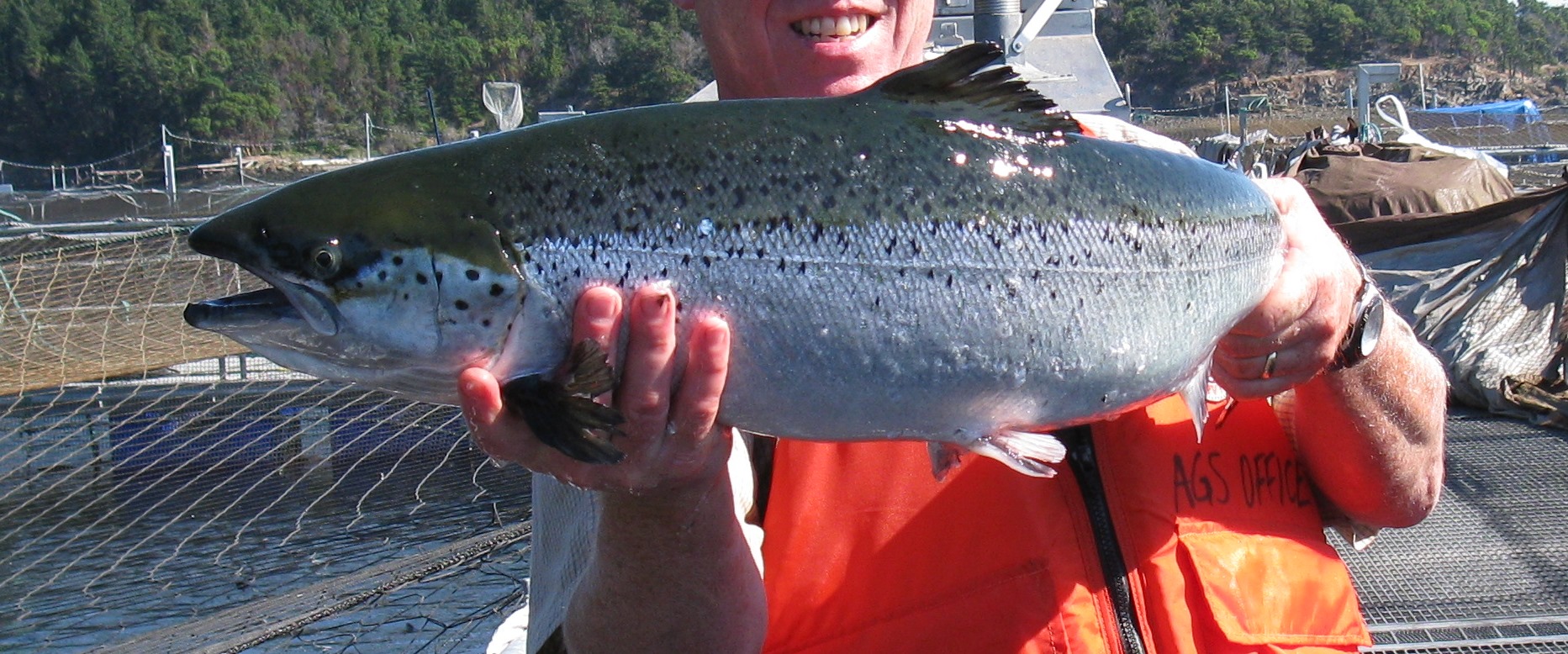
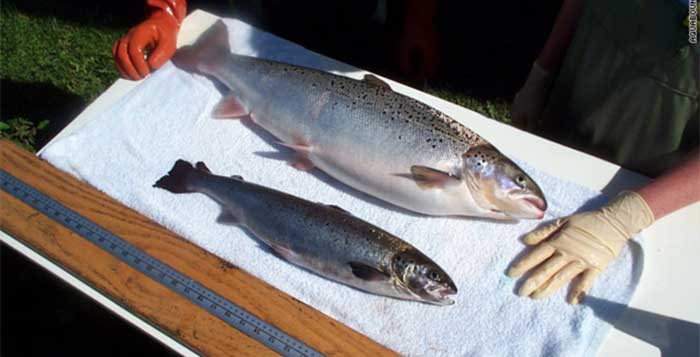
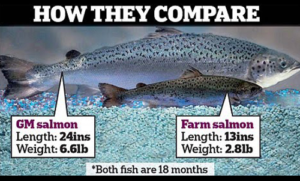
That’s because the health ministry approved Mass.-based AquaBounty’s genetically engineered (GE) salmon as a safe food source for sale May 19. Dubbed “Frankenfish” by critics, AquAdvantage salmon are grown from eggs developed in Prince Edward Island and raised in land-based pens in Panama. AquAdvantage salmon promises to grow to market size twice as fast, requiring about a quarter of the feed than other farmed salmon. Proponents see this as reducing environmental impact while meeting increasing demand. Critics see it as a dangerous money grab setting a bad precedent.

From the Health Canada statement announcing the approval:

“GM [genetically modified] foods are becoming more common every day and are part of the regular diets of Canadians. GM foods that have been approved by Health Canada have been consumed in Canada for many years, and are safe and nutritious. Changes to the genes of plants and animals can improve food quality and production – for instance by reducing the need for pesticides, making crops resistant to drought, preventing bruising, or allowing foods to be grown more quickly.”

I’ll get back to that last sentence. First, some background. The U.S. Food and Drug Administration actually approved AquaAdvantage Salmon for sale last November, but ran into a wall of opposition, including a legal challenge filed by several environmental groups such as the Center for Food Safety, Food and Water Watch and Friends of the Earth. They claim the FDA does not have the authority to regulate GE animals based on a decades-old law used to regulate animal drugs and cosmetics. To wit, the FDA used the 1938 Food and Drug Cosmetic act to qualify the gene manipulation in GE salmon as an animal drug safe for human consumption.

Huh? As I’ve blogged before, this just seems like a ridiculous premise to be basing an important food safety issue potentially affecting millions of U.S. consumers.

So, the U.S. market may have to wait a bit longer for its shot at GE salmon than Canada. Unless there is another legal challenge in Canada. Ecology Action Centre in Halifax is currently appealing a federal court ruling against the centre’s previous suit challenging Canada’s approval of production of the eggs at a plant in PEI.

AquaBounty says it won’t have any market-ready salmon for a year.

Transparency and fairness

The issues surrounding GE salmon are many, but they generally center on transparency and fairness. Most critics want — at a minimum — mandatory labeling of all GE salmon, not to mention all GE foods. But the industry has fought this tooth and nail, claiming that it would unfairly bias consumer decisions because of the negative connotation widely associated with the genetically modified food industry.salmon comp

This has been borne out by several studies showing that despite scientists’ proclamations that GE foods are safe for human consumption, an overwhelming majority of consumers, up to two-thirds or more, do not trust the science. Not only do they think GE salmon isn’t safe, they also don’t think scientists have a clear understanding of all of the potential health risks. Not coincidentally, a majority of scientists in a poll by the Pew Research Center and U.S. members of the American Association for the Advancement of Science suggests 88% of scientists polled believe genetically modified foods are safe to eat, while only 37% of the U.S. public thinks it’s safe.

I am in the same camp. I don’t think enough long-term, independent research has ruled out all risks associated with ingesting this type of hormone. Consider that FDA approval is based on the agency’s analysis of the test results paid for and submitted by AquaBounty … not by an independent third-party group with no vested interest in the outcome. For reference, see page 16 of this Congressional Research Service report, noting concerns over the FDA review process. To me, this leaves too much room to force the results into pre-determined conclusions, and perhaps explains in part why there is so much general skepticism about safety.

As such, I think the transparency issue is paramount. If the FDA or Health Canada deem GE salmon safe, they should require all such products be clearly labeled. One would think that if AquaBounty wants to appear trustworthy, it would label its product to demonstrate it’s not hiding anything from customers.

Ah, but there’s the problem. AquaBounty is following Monsanto’s playbook, spending tons of money to prevent labeling. Both the FDA and Health Canada claim that labeling is not necessary because “scientific research” suggests that there will be no “material difference” in the nutritional profiles between GE products and a non-GE counterpart. The FDA is offering GE producers like AquaBounty the option of voluntarily labeling the product, which is code for “You don’t have to do this.”

Here’s the fairness issue. Consumers wishing to buy organic pancake mix can look at the product to see a seal indicating the producer has paid a fee to have the product inspected and certified, along with a label that clearly indicates all of the ingredients. Hell, the same is true for a box of non-organic cookies. Salt, sugar, fat grams. All of that stuff must be listed somewhere. So why shouldn’t AquaBounty be compelled to tell the public that a hormone from an ocean pout (a completely different species) has been used in the “manufacturing” of that salmon fillet? Even if you can argue that doesn’t change the nutritional profile, it sure changes the ingredient list that yielded the end product.

Several big-name stores like Whole Foods, Trader Joes, Safeway and Kroger have pledged to not sell GE salmon.

It’s a slippery slope. Approving GE salmon using antiquated animal drug legislation or whatever other rationale without a fully thorough, third-party, long-term analysis is bad enough. Allowing AquaBounty to hide its product in a veil of secrecy, deliberately misinforming consumers, is egregious.


Top photo credit: AquaBounty

All Blog Posts

FDA Rubber Stamps Genetically Modified “Frankenfish”

  • November 23, 2015October 20, 2021
  • by Colles Stowell
Share it!
Share

You may well have heard last week the FDA cleared the path for genetically modified salmon to hit the market after a protracted five-year review. It was a landmark decision that could have long-lasting implications for other genetically engineered (GE) products such as livestock (pigs, cattle, chickens) as well as reinforcing industry opposition to labeling such products (as in produce).

In a nutshell, the FDA determined the AquAdvantage salmon created by Massachusetts-based AquaBounty is safe to eat, and does not require specific labeling to identify that the fish has been genetically modified.

The AquAdvantage salmon are grown from eggs developed in Prince Edward Island and raised in land-based pens in Panama. The industry selling point for GE salmon is that it grows twice as fast on about a quarter of the feed that traditionally farmed salmon require. So some advocates point to AquAdvantage as a more environmentally friendly method of aquaculture that could meet the huge demand for salmon without raping wild populations.

Sadly, this decision sets a very bad precedent that could really confuse consumers, not to mention raising all kinds of scary questions about what happens when we eat food that has been injected with growth hormones.

Let’s take a look at some of the more pressing concerns:

  • Hormone use – The fish are developed with a growth hormone gene from a Chinook salmon and more genetic material from an ocean pout that help the salmon grow to market weight in less than 20 months, while traditional farming requires up to 36 months. While the FDA says this hormone is safe for the fish and for humans, there really hasn’t been enough detailed study about the long-term health effects on humans who ingest this kind of hormone.
  • No labeling – If it’s safe for consumers, why not label the product? It’s a simple question that has been raised about GE produce. Short of a credible answer, we’re left to suspect that there’s something AquaBounty or Monsanto don’t want us to know. The FDA says it can only compel GE manufacturers to claim the product has been genetically altered “… if there is a material difference – such as a different nutritional profile – between the GE product and its non-GE counterpart.” So what part of injecting a hormone combining material from two vastly different species to create a third isn’t “a material difference?”
  • FDA regulation: So this is interesting. The FDA wants to regulate GE salmon under the same framework as it regulates veterinary drugs because of the hormone involvement. The FDA says the hormone “meets the definition of a drug.” This suggests the FDA doesn’t have an effective framework for adequately reviewing and regulating GEsalmon. To wit, the FDA seems to be applying antiquated ideological governance to a very modern, technical challenge.
  • Geography: I can’t put my finger on it, but something seems strange about a Mass. company using eggs developed in Canada to “create” fish to be raised in Panama. Smacks a little too much like “Blade Runner” to me.

From a practical standpoint, the labeling issue is almost hypocritical. If food manufacturers are required to tell how much sugar, salt and fat grams go into a box of cereal, why shouldn’t salmon farmers have to tell the truth about genetically engineering the fish? If it’s about a potential stigma image, then create a better, more believable narrative, or just don’t genetically engineer the fish. Trying to mask it just raises more suspicion. The FDA’s one consolation to those clamoring for GE labeling? Voluntary labeling.

Yeah, that’s likely to happen.

I admit I’ve evolved a bit in my thinking on finfish aquaculture. I still have many questions and several concerns. But some operations using closed, re-circulating systems that minimize environmental and ecosystem impact and use more plant-based feed could meet a need. Any operation certified as having outright banned hormones or antibiotics and having eliminated the problem of farmed fish escapes is better than GE.

It will be at least two years before Frankenfish hits markets. And even then, it will likely be only a small fraction of globally available farmed salmon as AquaBounty’s infrastructure is still small. Whole Foods, Trade Joes, Safeway and Kroger have all pledged to not sell the fish. The Center for Food Safety has said it will sue the FDA over this decision.

Polls in the last five years by NPR and New York Times suggest overwhelming majorities of the public would not eat GE salmon.

Count me as one in those numbers. I fear this will open a door we shouldn’t open now, and once we step through, there won’t be any turning back.


Recent Posts

  • Hurricane Ida wreaks havoc on Louisiana’s seafood industry
  • EPA Should Use Clean Water Act To Kill Zombie Mine
  • Slow Fish 2021: Relationship Matters
  • Faith, Façades, and Futility
  • Pebble Permit Paused: Politics at Play

Archives

  • September 2021
  • August 2021
  • April 2021
  • December 2020
  • August 2020
  • June 2020
  • February 2020
  • December 2019
  • November 2019
  • October 2019
  • July 2019
  • May 2019
  • April 2019
  • March 2019
  • January 2019
  • December 2018
  • November 2018
  • June 2018
  • May 2018
  • March 2018
  • February 2018
  • January 2018
  • December 2017
  • November 2017
  • October 2017
  • September 2017
  • August 2017
  • July 2017
  • June 2017
  • May 2017
  • April 2017
  • March 2017
  • January 2017
  • December 2016
  • November 2016
  • October 2016
  • September 2016
  • August 2016
  • July 2016
  • June 2016
  • May 2016
  • April 2016
  • March 2016
  • February 2016
  • January 2016
  • December 2015
  • November 2015
  • October 2015
  • September 2015
  • July 2015
  • June 2015
  • May 2015
  • April 2015
  • March 2015
  • February 2015
  • January 2015
Theme by Colorlib Powered by WordPress