 All Blog Posts
Hearing Nature’s Lessons in the Classroom

“Nature has it right. It’s set things up that work. When we interfere, we mess it up.”
We’ve seen a lot of words of wisdom from different mindfulness gurus and healing practitioners in the past couple of weeks. Sometimes they come from a place of unclouded truth, such as the perspective of a fifth grade student.
The quote above stemmed from a conversation about genetically engineered salmon at Rye Elementary School yesterday. We were talking about finfish farming and some of the drawbacks of the fish pellets used as feed, including the demand on ecologically critical forage fish and the reduced nutritional value. We discussed how farmed salmon have been found to have lower beneficial Omega 3s because of their feed than the naturally high Omega 3s of wild salmon. We discussed the same issues with GE salmon, as well as the various unknown risks of engineering fish as food and it’s ecological impact.
So when the student spoke about interfering with Nature’s design, I smiled and asked him to repeat it so that everyone in the class of 20 or so could hear it. Several in the class nodded their agreement.
I’d made a connection.
Every dialogue with students, their parents, sustainable seafood dinner attendees, etc. is based on telling a story and making connections. A connection that will resonate. A connection that will knit together the information into one cohesive, compelling narrative. A connection that will inform decisions in the future.
When I’ve made a good connection, the effect is immediate and sometimes profound. It is especially rewarding when someone who is 11 years old comes up with such clarity. It is also enlightening. I often learn something about myself and the message I’m sending just by listening to students.
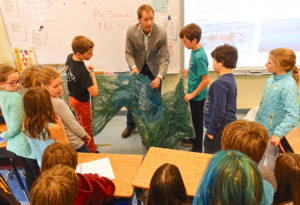
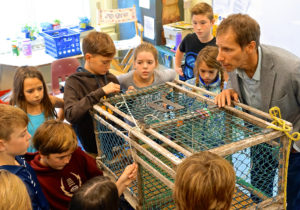
The students at Rye Elementary asked thoughtful questions. They were truly engaged in the conversation. We poked at a lobster trap. We stretched out a turtle excluder device and talked about how it is an example of what we’re doing to reduce bycatch. We touched on how climate change is affecting the Gulf of Maine.
By the end of each of the three classes I visited, students seemed to take ownership of the fact that they do have a choice at restaurants or grocery stores and that their choice matters.
They left armed with questions to ask:
Where is it from? How was it caught? Was it farmed? Were there any hormones, antibiotics or pesticides used?
Perhaps they will spread the word … one connection at a time.
Photo credit: Denise Wheeler