Skip to content
One Fish Foundation
  • Blog
    • Aquaculture
    • Education
    • Environment
    • Policy
    • Wild Harvest
    • Fish Tales
  • About
    • About One Fish
    • About Colles Stowell
  • Education
    • Elementary School
    • Middle School
    • High School
  • KNOW FISH Dinners®
  • Resources
    • One Fish Podcast
    • One Fish Foundation in the news
    • The 7 C’s of Sustainable Seafood
    • Newsletter Archive
    • Recipes
      • Skate with Capers and Butter — Chef Rizwan Ahmed
      • Grandma Davis’ Fish Chowder — Jane Almeida
      • Ginger Garlic Tamari Scallops — Colles Stowell
      • Fish Stock — Evan Mallett
      • Mussels San Remo — Chef Rob Martin
      • Salted Pollock Croquettes – Chef Mark Segal
  • Connect
    • Contact OneFish
    • Social
      • Instagram
      • Facebook
      • Twitter
All Blog Posts

Changing Oceans, Changing Fishermen

  • March 6, 2016October 20, 2021
  • by Colles Stowell
Share it!
Share

Should fishermen be the face of climate change?

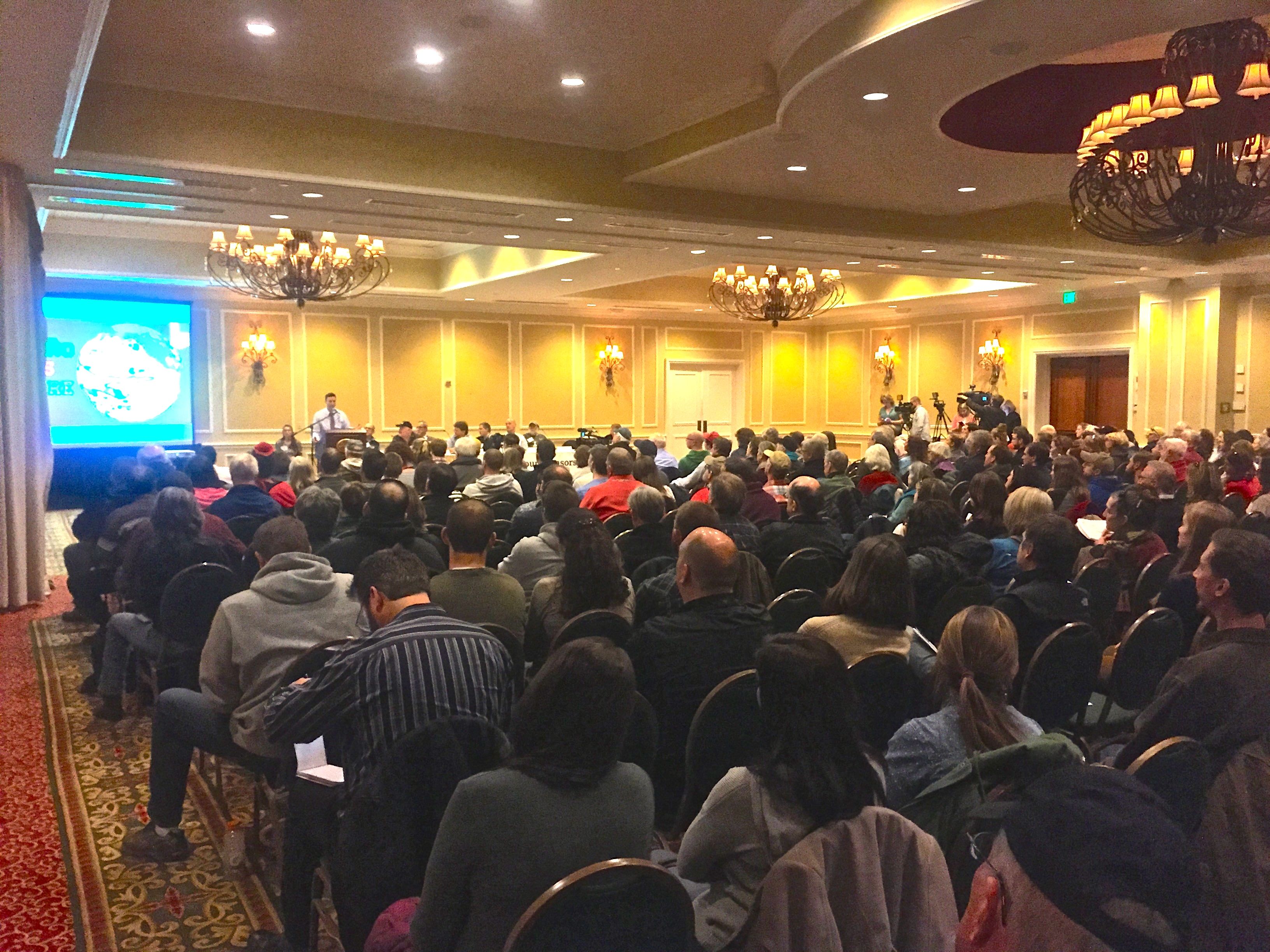
This was one of the more compelling questions posed at the Maine Fishermen’s Forum in Rockland on March 4.

It’s an interesting posit with many implications. For anyone in and around the industry, the answer is pretty straightforward. Fishermen are on the frontlines of how climate change impacts fisheries around the world. Along with researchers, fishermen are the first to see changes in everything from migratory patterns to spawning success and recruitment and predator/prey relationships.

Just ask Linda Williams. She is former chair of the Western Rock Lobster Council in Western Australia. Her husband and son fish for western rock lobster. She told a crowd of 300-400 that fishery has undergone mammoth changes in the past decade. Ten years ago, the average annual haul was 10 million kilograms, brought in by 600 boats during a roughly nine-month season. Now it is 5-6 million kilograms, brought in by 250 boats year round. The interesting catch? They are now logging record profits and working less.

So how did this happen? In 2009, lobstermen and researchers noticed a significant drop in the number of late larval stage lobsters in normal locations. Females were releasing eggs earlier than ever, which affected migratory patterns of the lobsters as they grew from larvae. The end result would be fewer lobsters caught in season and a downward spiral. This coincided with a warming trend of about 1-3 degrees Celsius over long-term summer averages, which also coincided with changing currents along the Western Australia coast.

Seeing the potential for disaster, lobstermen, scientists and policy makers worked together to form a quota system based on predictive analyses of future harvests determined by current larval settlement (the numbers and location of late larval stage lobsters). The industry anticipates how changing water temperatures and shifting currents will affect harvest 3-4 years in advance. Now the fishery operates profitably, even as the oceans are warming around them.

That kind of adaptation was the theme from other commercial fishermen. John Mellor fishes for Dungeness crabs and sablefish (black cod) off California. He sensed trouble in the water a year ago, noticing a milky, bluish hue and seeing big schools of anchovies flopping around the surface gasping for air. The culprit was algal blooms sucking up too much oxygen and releasing high concentrations of domoic acid (a neurotoxin) along the West Coast. California’s witness to climate change has coincided with this year’s El Nino, which extended a three-year period of lower than average storm and wind activity that would otherwise mix up the currents and slow the progress of algal blooms and the resulting red tides.

Filter feeders like clams, mussels and worms absorb the neurotoxin, and the crabs eat them, posing a threat to human health. Mellor explained the devastation to the industry when shortly before this season was to begin, California shut down the fishery indefinitely. Crabs represent 2/3 of his income, and he said he was fortunate to have a sablefish permit just to keep operating. Many fishermen are facing foreclosure etc.

“I see you enjoying your lobster fishery,” he said to the audience. “I suggest you keep an eye on the water. If you see it start to change a milky blue, be prepared.” He said fishermen need to adapt as quickly as the oceans are changing to survive.

Keith Colburn, who fishes Alaska king crab and has appeared on the TV show “The Deadliest Catch,” said in 30 years on the water, the most dramatic weather and water changes have occurred in the last 15 years, including the three coldest years and the three warmest years in Alaska. He said 20 years ago, they might have one storm that registers 50-knot winds per year. Now they may have 10-15 storms of that magnitude.

Noting the migration of the lobster fishery out of Long Island South and north of Cape Cod, he said somewhat jokingly, “If I was a Maine lobsterman, I’d be thinking about getting a Canadian passport soon. Each of you came out here to discuss a topic no one wants to think about. But we need to think about it.”lobster
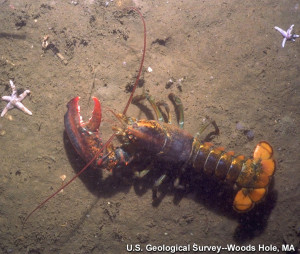
A fisherman from Point Judith, R.I. noted that their lobster fishery has been devastated by black sea bass (a mid-Atlantic species following warming waters north along the coast) and dogfish devouring larval lobsters. As regional waters warmed, more of these predators invaded the region and outnumbered the lobsters and other local species. The local fleet dropped from 150 boats 10 years ago to zero now, by his reckoning.

Scientists keep ringing the alarm bell

Scientists on the front edge of the latest climate research such as John Hare of NOAA and Andy Pershing of Gulf of Maine Research Institute highlighted just how much the water has warmed in the Gulf of Maine and how much that has impacted several native species.

Pershing noted how the Gulf of Maine is warming faster than 99% of the oceans on the planet at a rate of .23 degrees C or .4 degrees F per year, almost four times faster than anywhere else. He said because of the record warmth of the past several months allowing to El Nino, normal current variability and the recent warming trend, lobstermen could expect this year’s shed (when lobsters shed their shells) to happen anywhere from two to three weeks before the usual timeframe of the first week in July. That kind of predictability helps lobstermen at least have some idea of when their season will be most productive and profitable and plan ahead.

John Hare discussed his recent research methodology, which helps scientists, fishermen and policy makers better predict how climate change will impact growth and migratory patterns of 82 Northeast species. He said 42% of those species have a very high potential vulnerability to climate change, while 50% are likely to change their distribution because of warming waters. (See chart below).
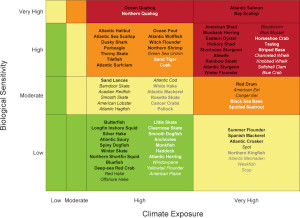
Overall climate vulnerability is denoted by color: low (green), moderate (yellow), high (orange), and very high (red). Certainty in score is denoted by text font and text color: very high certainty (>95%, black, bold font), high certainty (90–95%, black, italic font), moderate certainty (66–90%, white or gray, bold font), low certainty (<66%, white or gray, italic font). Source: Hare et al (2016)

“Warming oceans and acidification are posing a significant threat to fisheries,” Hare said. “I firmly believe we can only face these changes together.”

Which brings us back to the original question posed by chef and author Barton Seaver. He asked if fishermen could be the voice of social change at a time when politicians and scientists are often seen as bloviating by those who deny climate change exists. Perhaps fishermen, whose lives depend on the weather, could deliver a broad enough, “Everyman” appeal to spark a larger movement to minimize greenhouse gases, slow global warming and better manage the health of our oceans. Colburn, the Alaskan king crab fisherman responded, “Being that fishing is America’s oldest job, I think as fishermen we could ban together, we could start to change our patterns.”

But perhaps the question isn’t so much should fishermen be the face of climate change, but will they? As Colburn said, “A lot of fishermen want to believe that the environment is not changing.” So, getting them to sound an alarm may be a tough ask. But as the ranks of those fishermen pushed to the brink swell, like California’s Mellor, or those that found a way to adapt, like Western Australia’s Murray, perhaps there will be enough momentum for a unified voice, as Seaver suggested.

Forums like this one, uniting scientists and fishermen to understand how things are changing and how quickly they’re changing, and to work together to figure out how to adapt are significant starting blocks. And if you can get policy makers, such as John Bullard, Northeast Regional Administrator for NOAA Fisheries, to not only attend such meetings, but state publicly that we need to do something about climate change (as he did here), perhaps there is enough accountability and unity in place for us to do something to protect the climate collectively.

If we can get all of these stakeholders at the same table, working together, as John Hare suggested, we can do better adapting to how rapidly the oceans are changing, and maybe even limit the long-term damage. Doing so would help us better deliver on the Slow Food promise of good, clean, accessible and fair seafood for all.

As consumers grappling with the implications of global warming on the seafood we eat, we should understand that “eating within the ecosystem” is now more important than ever. That is, we should eat what is locally available, sustainably harvested and seasonal. Choosing “invasive” black sea bass here in Maine rather than big name species facing multiple stresses — including climate — is a step in the right direction.


Additional reading

 Check out this column by Bren Smith, a commercial fisherman who adapted to the changing climate by embracing the “eating within the ecosystem” philosophy.


All Blog Posts

When the Levee Breaks, Sugar

  • February 13, 2016October 20, 2021
  • by Colles Stowell
Share it!
Share

UPDATE 02/16/16: The U.S. Army Corps of Engineers plans to release water this week from Lake Okeechobee south to Everglades National Park, where it is badly needed. Doing so will alleviate the burst of polluted fresh water released into the Caloosahatchee and St. Lucie rivers and slow some of the negative impacts already taking place in those estuaries. The Everglades has been drier than normal for several years, and the fresh water influx will help balance the salinity levels to restore marsh areas. The water would pass through a reservoir south of the lake, where it will be purged of some of the unwanted nutrients from the lake.


In case you haven’t heard, Lake Okeechobee is rising. El Niño has spanked several areas in the U.S. with higher-than-average rainfall, and the second largest freshwater lake in the lower 48 states is now at 16 feet. Its average depth is between 10 and 12 feet. Officials with the U.S. Army Corps of Engineers and the South Florida Water Management District worried the 32-foot tall, 143-mile levee surrounding the lake could fail if any more rain fell. Ironically, this is “the dry season.”

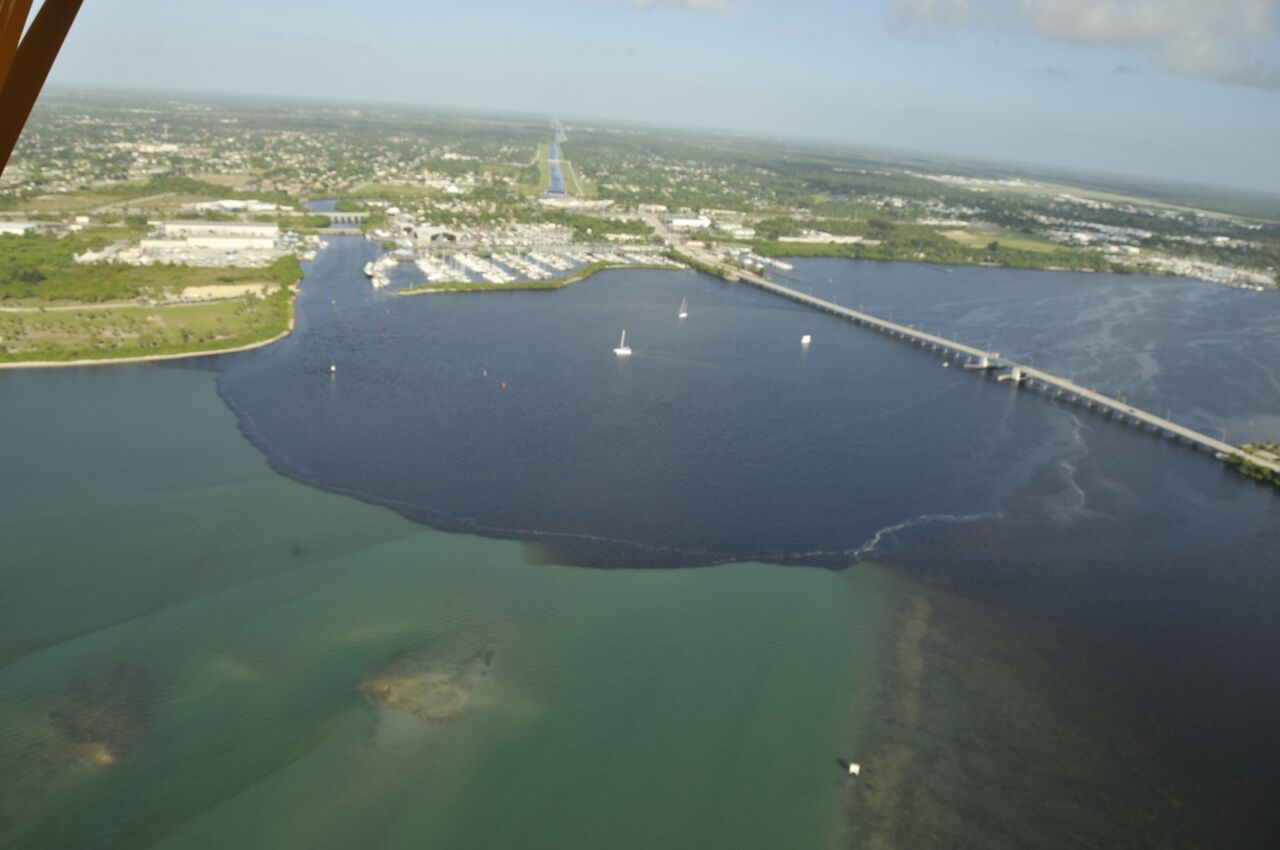
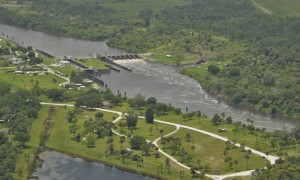
So last week they unleashed up to 4.9 billion gallons of water (think 7,400 Olympic swimming pools) per day out of two dams: one heading east via the St. Lucie River to the Atlantic Coast, and the other heading west via the Caloosahatchee River to the Gulf of Mexico. These outlets to the rivers were created decades ago to help manage the lake’s water levels. The “wet” season for the region is June through September, and for the past several years, these releases have unleashed torrents of dirty brown and sometimes green water through these canals.

Where does that polluted water come from? The agricultural and other pollutants dumped into the lake from areas north. Why not allow excess lake water to flow south, as it had for nearly 6,000 years before humans got involved? Because politically and financially powerful U.S. Sugar (hereon called Big Sugar) owns more than 60,000 acres of land directly south of the lake to grow and refine sugar cane. And because this has been the status quo for decades when state and federal regulators and the Corps of Engineers first laid out the plans for water management. In fact, it was because of the sugar industry that the water was diverted east and west to make those massive sugar cane fields arable.

So let’s summarize: An ill-conceived plan by man to redirect Nature’s intended path for water drainage to accommodate Big Sugar, as well as big development, now has imperiled several thousand people, their homes, their drinking water and the health and welfare of millions of acres of precious wetlands which serve as the nursery for some of the most ecologically rich, coastal habitat in the country.

And here’s the painful kicker. The state had the option to purchase that land as the first step to help restore the withering Everglades for several years up until last Oct. The state failed to exercise that option, and now Big Sugar wants to put up several thousand homes and big warehouses. Last fall, Fla. voters overwhelmingly approved a measure that would use some real estate tax money to buy lands for conservation and improved water quality. But the state government has so far used those funds toward agency support (salaries, insurance, etc.), not buying the more than 40,000 acres Big Sugar agreed to sell seven years ago. Several environmental groups have filed a lawsuit that is currently pending.

rushing water

The damage done

The nitrogen and phosphorous that pours into the lake from agriculture gets blasted out of canals into the St. Lucie and Caloosahatchee estuaries. The excess nutrients wreak havoc on the ecosystem, causing oxygen-choking algal blooms, massive fish kills and severe damage to prime shellfish habitats. Moreover, the influx of freshwater tips the delicate salinity balance in the marsh, killing vital grasses and forcing out species living in the brackish (part salt, part fresh) water. Conversely, during the dry season, the Corps releases much less fresh water (because it’s used for agriculture) than the Everglades needs to sustain that balance. That is, when the salinity gets too high, root structures get damaged and the vegetation can die in the marsh.

A technical study conducted by the University of Florida Water Institute last year makes several recommendations to reduce these outflows into the St. Lucie and Caloosahatchee river systems. Chief among them is to restore southerly flows into the estuaries after the water from the lake has been stored and treated in yet-to-be-built reservoirs. The study calls for similar reservoirs to be built or extended north of the lake and in or near the St. Lucie and Caloosahatchee basins. All of this would also help restore the Everglades.

As a former journalist, I have an inherent mistrust of politicians because too many times I’ve seen up close how they essentially followed the money. As a recreational fishermen, I don’t trust the state to consider the long-term economic impact if recreational fishing plummets because vital species can’t tolerate drastic habitat change. The impact for commercial fishermen could be equally dire.

As a New Orleans native whose elderly parents rode out Hurricane Katrina, only to leave two days after the storm on the last passable road and ultimately sell their house because the infrastructure was a shambles, I inherently don’t trust the U.S. Army Corps of Engineers.

About a year after Katrina, I spoke to the Corps colonel in charge of rebuilding the city’s levees. I asked him point blank why the Corps was restoring the levees to their previous standard of being able, in theory, to withstand a category 3 hurricane, when the city had just been devastated by a category 5 storm. He said the reconstruction was following the path laid out by Congress and the state. I asked him if he thought that was a good idea, and he said, “It’s not my call.”

Right now, the call on the future of the Everglades and the Indian River basin is in the hands of Florida’s governor and legislature. I only hope there are enough politicians outside of the mold that made me mistrustful in the first place to do the right thing. I hope enough of them will see that actually delivering on the promises they made to voters … to protect precious resources like the Everglades and surrounding watersheds … far outweighs surrendering integrity to the financial puppetry Big Sugar offers.

If not, getting re-elected won’t be so easy if a major environmental/economic disaster occurs and Florida becomes more of a poster child for environmental failure than it already is.

Here is some additional reading:

March 2015 Miami Herald column by Carl Hiassen about the money trial

Miami Herald Op Ed proposing a joint fix between state and Congress

Florida Department of Environmental Protection history of Lake Okeechobee

The News-Press: Fort Myers paper’s article on Gov. Rick Scott and legislators recently asking Army Corps to release lake water south toward Everglades

Huffington Post Column by Alan Farago


photos: Storm water releases. credit: Jaqqui Thurlow-Lippisch

Recent Posts

  • Hurricane Ida wreaks havoc on Louisiana’s seafood industry
  • EPA Should Use Clean Water Act To Kill Zombie Mine
  • Slow Fish 2021: Relationship Matters
  • Faith, Façades, and Futility
  • Pebble Permit Paused: Politics at Play

Archives

  • September 2021
  • August 2021
  • April 2021
  • December 2020
  • August 2020
  • June 2020
  • February 2020
  • December 2019
  • November 2019
  • October 2019
  • July 2019
  • May 2019
  • April 2019
  • March 2019
  • January 2019
  • December 2018
  • November 2018
  • June 2018
  • May 2018
  • March 2018
  • February 2018
  • January 2018
  • December 2017
  • November 2017
  • October 2017
  • September 2017
  • August 2017
  • July 2017
  • June 2017
  • May 2017
  • April 2017
  • March 2017
  • January 2017
  • December 2016
  • November 2016
  • October 2016
  • September 2016
  • August 2016
  • July 2016
  • June 2016
  • May 2016
  • April 2016
  • March 2016
  • February 2016
  • January 2016
  • December 2015
  • November 2015
  • October 2015
  • September 2015
  • July 2015
  • June 2015
  • May 2015
  • April 2015
  • March 2015
  • February 2015
  • January 2015
Theme by Colorlib Powered by WordPress