Skip to content
One Fish Foundation
  • Blog
    • Aquaculture
    • Education
    • Environment
    • Policy
    • Wild Harvest
    • Fish Tales
  • About
    • About One Fish
    • About Colles Stowell
  • Education
    • Elementary School
    • Middle School
    • High School
  • KNOW FISH Dinners®
  • Resources
    • One Fish Podcast
    • One Fish Foundation in the news
    • The 7 C’s of Sustainable Seafood
    • Newsletter Archive
    • Recipes
      • Skate with Capers and Butter — Chef Rizwan Ahmed
      • Grandma Davis’ Fish Chowder — Jane Almeida
      • Ginger Garlic Tamari Scallops — Colles Stowell
      • Fish Stock — Evan Mallett
      • Mussels San Remo — Chef Rob Martin
      • Salted Pollock Croquettes – Chef Mark Segal
  • Connect
    • Contact OneFish
    • Social
      • Instagram
      • Facebook
      • Twitter
All Blog Posts

A scientist, a fisherman and a healthcare rep enter…

  • November 14, 2017November 15, 2017
  • by Colles Stowell
Share it!
Share

Back in January as everyone was adjusting to a new political landscape, I was on a call with Brett Tolley of the Northwest Atlantic Marine Alliance and Bob Steneck, Professor of Oceanography, Marine Biology and Marine Policy at University of Maine. We were talking about a recent report on climate change impacts in the Gulf of Maine, and what fisheries policy may look like in the context of climate impact and the shifting political landscape.

Needless to say there were many unanswered questions. At the time, the administration threatened to cut crucial funding for Sea Grant, climate science and even some fisheries management programs. Our discussion centered on how to adapt more nimbly to climate change impacts on fisheries, and how to make fisheries management more efficient and effective. We also wondered how significantly US fisheries management could shift in a year or two.

That conversation was the seed for last Friday’s (Nov. 3) Webinar: Fisheries Management: Best Available Science May Not Be Good Enough. The discussion was a frank look at the issues with current fisheries policy based on specific examples and some speculation on what management would look like if it were more localized and relied on a different data modeling system.

Joining me on the call were David Goethel, commercial fishermen from Hampton, NH and former three-term member of the New England Fisheries Management Council; John Stoddard, New England Regional Coordinator for Health Care Without Harm’s Healthy Food in Health Care program; and Steneck.

This was a diverse panel with deep knowledge from broad perspectives. Steneck has been at the forefront of research on coral, lobsters, urchins, kelp, forage fish and species interrelationships in coastal ecosystems. Goethel has the unique experience of a commercial fishermen who has had to shift his harvest target and method because of changes in the Gulf of Maine, and who has spent several years either as an advisor to the Atlantic States Marine Fisheries Council or NEFMC. John Stoddard brought an institutional buyer’s perspective to the panel. He knows what healthcare representatives want from the seafood they serve their patients. They do have some concerns about sustainability, and when policy creates market forces that may limit access to locally harvested seafood, they may want to know what can be done to change the dynamic.

How’d we get here?

Steneck methodically walked us through some of the core issues with the current management system. Chief among those is the fact the Gulf of Maine, as well as other US coastal ecosystems, are changing faster than we can manage them. We have been a couple of steps behind climate change because our current data assessment system takes several years between collection and analysis and policy action. In essence, by the time policy has been set, the seascape has changed because of rising temperatures, current shifts, increased ocean acidification, etc. All of these changes have forced commercially valuable species to shift their patterns and adapt.
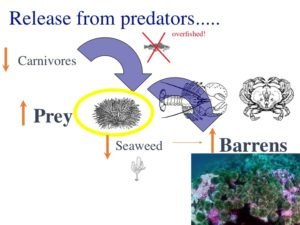
Overfishing of cod resulted in a sea urchin boom in the Gulf of Maine that collapsed in a decade. Interspecies relationships are critical to understanding dynamically changing ecosystems, and are often overlooked with current data management tools.

He pointed to the cod collapse in particular as a bellwether for how we missed the warning signs because of static data analysis, and how that type of “miss” happens frequently due to the data-intensive approach to stock assessment. He showed a brief video featuring a Canadian fisherman who said he had the trip reports to show cod stocks persistently dropping in key areas … data the government ignored because of its current management system.
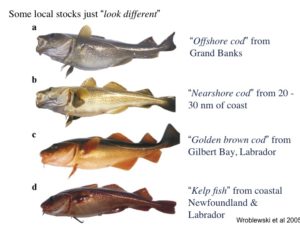
Genetically distinct cod inhabit different ocean ecosystems and should be managed accordingly, not as one, all-inclusive species.

Steneck concluded that we need to “reinvent fisheries management to include multiple, independent indicators”, rather than drill down into details of one species without taking into account other critical factors such as complex interspecies relationships. Taking into account the dynamic changes within spatially appropriate areas of observation will give a more accurate view of fisheries and how quickly they change. Equally importantly, he stressed the need to expand collaboration with fishermen, mining their knowledge base to enhance data collection and analysis.

A unique point of view

David Goethel echoed those concerns. From both perspectives as fisherman and NEFMC member, he saw how current modeling methods’ stagnation meant policy did not match actual stock health and ability to withstand fishing pressure. He pointed to the impact the recent collapse of capelin in Newfoundland had on cod, seals and northern shrimp. Like Steneck, he called for managing fisheries based on the correct spatial scale and with a better understanding of changing predator-prey relationships.
Getting his point across at a management council meeting.

He also urged continued public/fishermen input at council meetings. The system breaks down when fishermen who feel disenfranchised by restrictive policies don’t participate in the process. He decried a lack of transparency in the policy process that frustrates fishermen to the point where many don’t believe it’s worth their time to speak out.
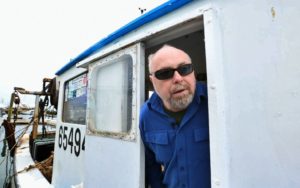
Aboard the Ellen Diane

Goethel agreed with Steneck that data poor methods based on local, spatially appropriate areas of survey would provide the local detail current “big solution” modeling misses. He also agreed that involving more fishermen in the process would play a significant role in collecting more accurate data in a timely fashion, and restoring more fishermen’s faith in the process.

A healthcare approach

Stoddard emphasized Health Care Without Harm’s mission to provide locally sourced, sustainable seafood, with a goal toward supporting community based fishermen. This is a critical issue healthcare industry staff are finding with many patients, especially in coastal New England. Some of these patients have had family or friends who fished commercially, so the some of these issues matter to them.
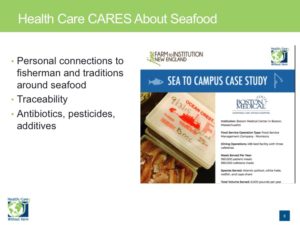
An example of a successful program providing locally harvested seafood to patients.

He said Health Care Without Harm has steadily moved away from big ecolabels such as MSC to support more locally focused programs. Stoddard highlighted a successful program by which Massachusetts Eye and Ear Infirmary sources locally harvested seafood from Gloucester via the Gloucester Fishermen’s Wives Association. Such programs address patient demand for locally sourced seafood while strengthening healthcare institutions’ support of surrounding communities … and specifically fishermen.

Continuing the dialogue

It was a good discussion, with some engaged back and forth on next steps. For example, one of the parting questions focused on what a successful, cooperative data-poor, localized management program might look like. Steneck suggested a demonstration project within an already existing sample area (under the current management system), using a data poor assessment approach. Goethel suggested using echo system modeling that incorporates multiple species relationships, that he believes would yield a more realistic view of stock health.

The next step in the community discussion about these issues is to begin planning the next conversation. At the outset, I said we weren’t going to solve all of the issues we discussed in one conversation. But the goal is to follow up the conversation with another Webinar that explores a bit deeper what a demonstration project might look like, the type of data to study, and the hoped-for outcomes.

We will aim to set up another Webinar in the first quarter of 2018 tapping the collective knowledge of a well-informed panel, willing to explore the possibilities and elevate the discussion. Ultimately, we hope to build a foundation of knowledge that may lead to a roadmap for change.

Stay tuned.

If you’d like to view the Webinar, click on this link and then the tab that says Watch Now: Fisheries Management: Best Available Science May Not Be Good Enough.
 

All Blog Posts

MSC Ecolabel Trashed by Founder

  • December 7, 2016October 20, 2021
  • by Colles Stowell
Share it!
Share

The question invariably arises at sustainable seafood dinner events or even in casual conversation.

“What about the MSC (Marine Stewardship Council) standard?”

Involuntarily, I shake my head, before explaining the complex nature of ecolabels, which seek to certify seafood as sustainably harvested, but often raise more questions than they answer.

That complexity came to the fore last week when the World Wide Fund for Nature (WWF) ignited a firestorm with a detailed … and leaked … report castigating the MSC, one of the best known labeling organizations. The report questions the non-profit’s neutrality, process and overall effectiveness in adequately protecting the resource and objectively informing consumers about the sustainability of the seafood they purchase.

The colossal irony here is that WWF was one of the key founders of MSC, a non-governmental organization (NGO). And now it has become an outspoken critic. Here is a link to the leaked WWF report. WWF claims the report was not finalized and has tried to backtrack. However, the 58-page document has detailed citations and thoroughly explained timelines noting the events that led to the drafting of the report, which by the way, is marked “FINAL.”

What rules?

The catalyst for this report was the MSC certification of certain tuna fisheries in the Indian Ocean. One of the key principles of the original MSC guidelines for certification was that fisheries have a set of harvest control rules (HCRs) that ensure the health of the fishery. WWF now claims there are “several troubling systemic flaws” in the MSC certification process and that the mission appears to have become more about profits from the royalties paid to have the MSC logo than the original mission.

That’s a stinging accusation from one of the organization’s original founders.

Some of the most damning accusations include:

  • Certification of fisheries where no credible HCRs exist;
  • Changing the process language on the fly to accommodate certification of fisheries whose certification has been challenged;
  • A clunky appeals/challenge process that generally falls on deaf ears; MSC admits that very few stakeholder comments (13%) have any impact on the process;
  • A system of contracting third-party certifiers that do not respond to stakeholder comments;
  • Conflict of interest whereby MSC profits from the royalties on the logo fees while “objectively” certifying the fisheries.

And if this report weren’t enough, Brendan May, MSC’s former CEO for five years wrote a blog about the WWF report. While he doesn’t directly indict MSC, the fact he is taking time to acknowledge the report says something about its significance.

An ecolabel’s complicated path

When I started writing about sustainable fisheries six years ago, I initially supported the concept of transparency in labeling. There were a few emerging standards, Friend of the Sea, Dolphin Safe and the Marine Stewardship Council among them. MSC’s goals were broad and ambitious. The U.K. based non-profit set a goal to certify 20% of the world’s fisheries by 2020.

But as I dug deeper in my research, I started seeing inconsistencies. Accusations from within and outside the industry arose, claiming MSC certified fisheries that aren’t sustainably managed and that the NGO instituted a system that isn’t objective. Witness the certification of the North Atlantic longline swordfish operation. The fishery was certified despite the high bycatch of sharks. The further I dug in, the more I realized how complex and thorny implementing proper transparency schemes really is.

So when asked, I explain this complexity, and some of the issues with all ecolabeling systems, then go into some detail about MSC.

This leaked report further underscores that complexity, and where good intentions can get thoroughly clouded by money. I still strongly advocate for transparency in seafood distribution from boat to plate. The U.S. has a long way to go, as do many other countries.

But if you aren’t going to really be transparent or objective, why bother?

When in doubt, ask questions

I tell my students and interested adults their best line of defense is knowledge. Get smart about some of the issues around seafood sustainability. Learn more about the environmental, ecosystem, socio-economic impact of different harvest and aquaculture methods.

Ask questions:

  1. Is it local? Was it caught, cleaned and/or filleted locally?
  2. How was it harvested?
  3. If it was farmed, were there any antibiotics, hormones or pesticides used?
  4. When was it harvested?

If you can’t get answers to these questions from your fishmonger or restaurant, perhaps you should consider something else.

I suggest people take a look at the Local Catch core values, which gives a good overview of how local, transparent community-based fisheries benefit both consumers and fishermen. These principles are rooted in accountability and trust: accountability in the fishermen who strive to take care of the resource and trust from the community that the fishermen are delivering sustainably harvested seafood.

Additional resources:

Marine Stewardship Council standards

World Wide Fund for Nature Overview of Tuna fisheries and relationship with MSC

The Times article, in which the publication first announced the leaked WWF report.

Undercurrent News article, in which MSC responds to the WWF report.

Ecolabel Index — gives a quick overview of different ecolabels from building design to farming and seafood.

Recent Posts

  • Hurricane Ida wreaks havoc on Louisiana’s seafood industry
  • EPA Should Use Clean Water Act To Kill Zombie Mine
  • Slow Fish 2021: Relationship Matters
  • Faith, Façades, and Futility
  • Pebble Permit Paused: Politics at Play

Archives

  • September 2021
  • August 2021
  • April 2021
  • December 2020
  • August 2020
  • June 2020
  • February 2020
  • December 2019
  • November 2019
  • October 2019
  • July 2019
  • May 2019
  • April 2019
  • March 2019
  • January 2019
  • December 2018
  • November 2018
  • June 2018
  • May 2018
  • March 2018
  • February 2018
  • January 2018
  • December 2017
  • November 2017
  • October 2017
  • September 2017
  • August 2017
  • July 2017
  • June 2017
  • May 2017
  • April 2017
  • March 2017
  • January 2017
  • December 2016
  • November 2016
  • October 2016
  • September 2016
  • August 2016
  • July 2016
  • June 2016
  • May 2016
  • April 2016
  • March 2016
  • February 2016
  • January 2016
  • December 2015
  • November 2015
  • October 2015
  • September 2015
  • July 2015
  • June 2015
  • May 2015
  • April 2015
  • March 2015
  • February 2015
  • January 2015
Theme by Colorlib Powered by WordPress