Skip to content
One Fish Foundation
  • Blog
    • Aquaculture
    • Education
    • Environment
    • Policy
    • Wild Harvest
    • Fish Tales
  • About
    • About One Fish
    • About Colles Stowell
  • Education
    • Elementary School
    • Middle School
    • High School
  • KNOW FISH Dinners®
  • Resources
    • One Fish Podcast
    • One Fish Foundation in the news
    • The 7 C’s of Sustainable Seafood
    • Newsletter Archive
    • Recipes
      • Skate with Capers and Butter — Chef Rizwan Ahmed
      • Grandma Davis’ Fish Chowder — Jane Almeida
      • Ginger Garlic Tamari Scallops — Colles Stowell
      • Fish Stock — Evan Mallett
      • Mussels San Remo — Chef Rob Martin
      • Salted Pollock Croquettes – Chef Mark Segal
  • Connect
    • Contact OneFish
    • Social
      • Instagram
      • Facebook
      • Twitter
All Blog Posts

Hurricane Ida wreaks havoc on Louisiana’s seafood industry

  • September 8, 2021October 20, 2021
  • by Colles Stowell
Share it!
Share

This time, the levees around New Orleans held. The reduced flooding in the city after Hurricane Ida helped minimize the catastrophic loss of life following Hurricane Katrina 16 years ago.

But some levees in southern parishes didn’t fair as well. And Ida’s widespread devastation fueled by sustained 150 mph winds will have long-term consequences for Louisiana’s seafood industry.

I spoke with Lance Nacio, owner of Anna Marie Seafood in Montegut, La. on Monday to get a sense of what folks down there are dealing with. Here is a quick snapshot of our conversation:

  • He and his family are fine, living on his two fishing boats and in his house. The house, the boats and the processing facilities all weathered the storm pretty well, though there are some things to fix.
  • His boats are trapped in the canal across the street from his house until Sept. 29, which is the estimated time when power should be restored to allow the drawbridges to raise and let the boats motor to the Gulf of Mexico and begin fishing.
  • More than 60% of the structures in Terrebonne Parish (the 2,000-square mile parish south and west of New Orleans where Lance and many other fishermen live) are uninhabitable, according to authorities.
  • Lance predicts that many residents will not return in what may be a more expansive exodus than after Katrina.
  • This exodus will not only include fishermen, but also those who run critical infrastructure operations like docks, ice houses, boat maintenance operations, processing facilities, etc.
  • He will be working with Chef Dana Honn of Carmo to provide meals for first responders and line crews from across the country.

In essence, the industry in the state that provides the highest volume of domestically harvested wild shrimp and crab is in trouble. The entire regional seafood supply chain from boat to plate will likely be a shell (take or leave the pun) of itself in just a few months, sending shock waves across the country and around the world. As Dana said, “The fish will be out there. But with no infrastructure in place, who’s going to come back?” Louisiana Congressman Garrett Graves has formally called on the US Department of Commerce to declare a Fisheries Disaster Determination for the region to unlock funds to counteract the pending economic damage.

Worse still is the likelihood that further climate change will spin off more intense hurricanes like Ida and Katrina more frequently, leaving the Gulf Coast more vulnerable to long-term ecosystem damage.

This summer alone has seen several catastrophic events highlighting how climate change can have severe impacts on food systems:

  • the sweltering heat weave that smothered the Pacific Northwest for several days, literally cooking some oysters in their shells;
  • the anemic wild Pacific salmon runs in the Yukon territories, forcing remote Indigenous communities to scramble for winter food stores;
  • the devastating fires across California and other western states that have devoured millions of acres of old growth forest (very important to watersheds) and farmland.

Want to get involved? Here are a few ways to do so with a focus on Hurricane Ida’s aftermath:

  • Several people and organizations are raising funds for relief efforts, including providing food, shelter, medical services and supplies, debris removal, and repairs. Here are a couple of resources:
    • Chef Dana is raising money to support Lance’s efforts to help his community and feed first responders and line workers.
      • Venmo: @Lance-Nacio
      • PalPal: orders@annamarieshrimp.com
      • Zelle: Lance Nacio
    • Coastal Communities Consulting, Inc. is a nonprofit organization supporting coastal businesses and fishermen in La. It is doing good work to provide info on everything from prescriptions to food and water as well as coordinating donations.
    • Gulf South Rapid Response Community Controlled Fund provides disaster relief directly to frontline communities in the Gulf South impacted by climate disasters. Local leaders have committed to a transparent and accountable process for the money – which will allow communities to practice self-governance and self-determination.
  • The Gulf Coast Center for Law and Policy is hosting a national press conference Thursday Sept. 9 from 10:30 am – 11:30 am CDT to address Ida’s impact on the Gulf Coast region and the nation. Here’s a link to more information.
  • Learn more about the Sustaining America’s Fisheries for the Future Act, which is a congressional bill that mandates accounting for climate change when setting fisheries policy in the U.S. This bill officially calls for the re-authorization of the Magnuson-Stevens Act, the primary fisheries management policy for the U.S. If you agree with its direction, contact your Congressional representatives and tell them to support it.
  • Learn more about the Keep America’s Waterfronts Working Act, a congressional bill that aims to preserve working waterfronts, like the ones in jeopardy in southern Louisiana following Hurricane Ida. Again, if you like what you see, contact your Congressional representatives.

The last thing we can all do is spread the word. The more folks know what’s going on and what’s at stake, the more the broader community can get involved and help chart the industry’s future.

We’ll post more updates in this blog and via our Facebook page.


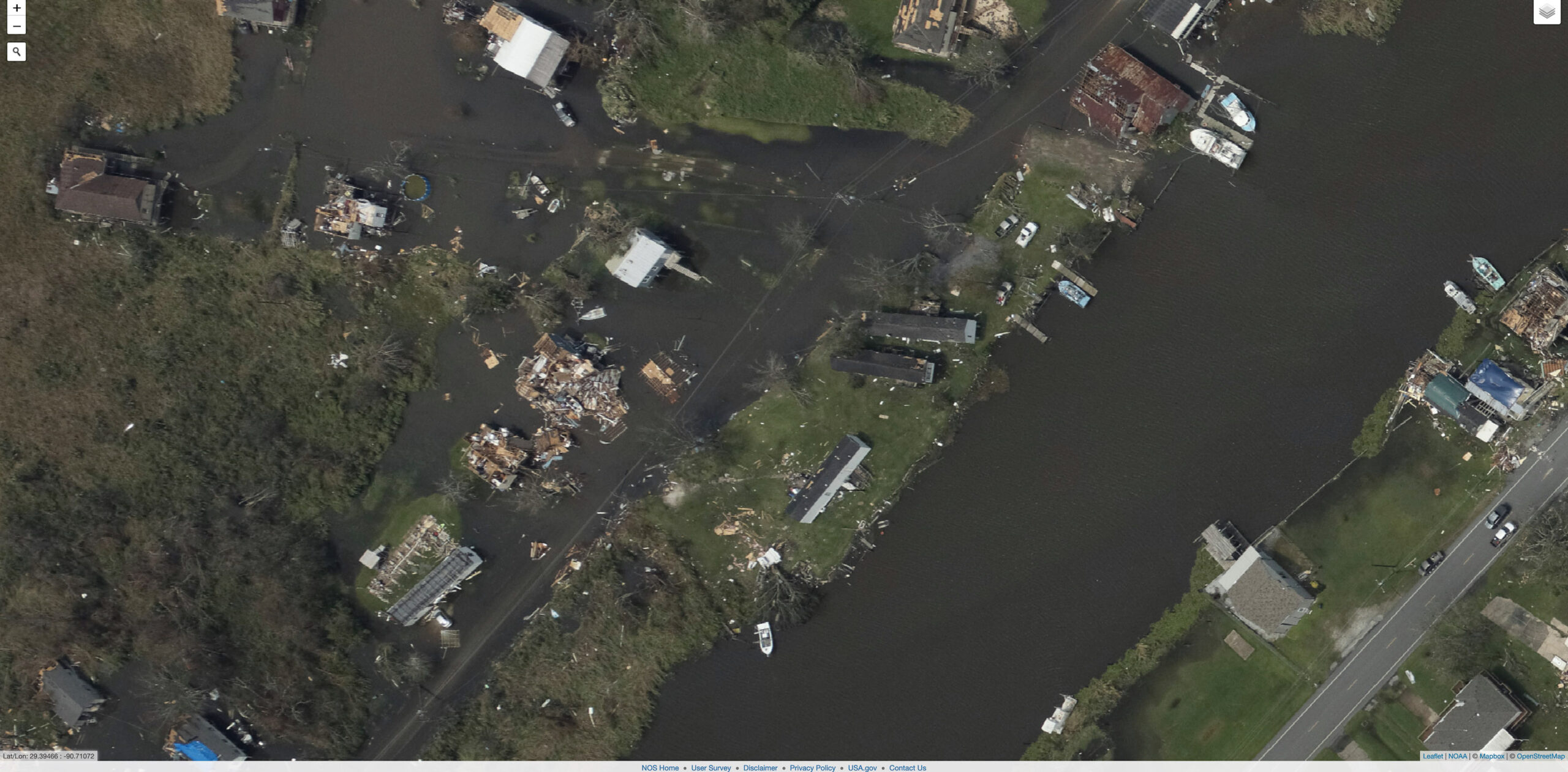
Top photo: NOAA satellite image of Hurricane Ida’s destruction in Terrebonne Parish.
All Blog Posts

Life Lessons From Rosie’s Gumbo

  • December 4, 2017October 20, 2021
  • by Colles Stowell
Share it!
Share

I remember coming home from school, walking through the gate, past the yew bushes and down the walkway past the open den windows.  The aroma of the trinity (onions, bell peppers and celery) simmering in the roux would grab me. I could smell the sausage, and sometimes even the shrimp. There was something else earthy that I couldn’t identify.

Perhaps it was the filé, or the thyme. Perhaps it was the blend of everything “getting happy” together in the pot.

Or maybe it was just the love. Rosie put a lot of love in her gumbo.

As a child growing up in New Orleans, these were some of the root smells of my evolution. Red beans and rice. Shrimp creole. And Rosie’s gumbo.

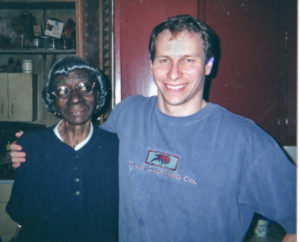
Rosie took care of me when both my parents worked. She also helped my mom around the house. They were best friends. They frequently discussed the latest events on the afternoon soap operas…”The Young and the Restless,” “The Guiding Light”…all that crap. And they confided in each other. They supported each other through some heavy life challenges.

Rosie was the one I’d go to when I was sick. Unlike mom, who had plenty to say on a variety of topics, Rosie was more quiet, saying only what she needed to say, and usually, saying it very directly.

Truth be told, when I was less than 10 years old, I picked out the andouille and smoked sausage, the ham and the shrimp from her gumbo and left the rest. It wasn’t until my teens and early 20s that I truly started to appreciate the magic. It wasn’t until my early 30s that I had the courage to ask her to teach me how to make it.

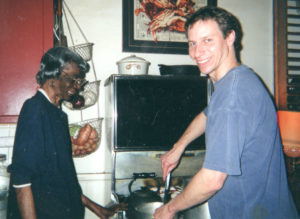
Chef and apprentice. I must have had a good lesson. No visible spoon marks.

I was not afraid of her teaching me a recipe. My mom was an excellent cook, and she taught me how to follow a recipe. She taught me to have the courage to try new things and learn from my mistakes.

The daunting prospect of trying to learn how to cook without a recipe scared the hell out of me. Rosie cooked by instinct. The “recipe” was in her head, a tradition passed down over generations. And gumbo isn’t quite as simple as mac and cheese.

During the two-plus-year process of learning how to make gumbo, my relationship with Rosie grew more profound and more meaningful than we could have imagined. That’s probably because it was an intense experience requiring no shortage of patience from both of us.

She taught me to use all five senses. But it was the process of trying to create a common language that I could understand that proved most challenging.

“First you make the roux,” she’d say. “Get a spoon of oil and a spoon of flour and stir it in the hot pan.”

“How big a spoon?”

“The wooden spoon in your hand.”

“But how much is in that? What if I don’t have a spoon exactly this size?”

WHACK!

The spoon found the side of my head and I didn’t ask that question again.

“You want the roux to be the color of milk chocolate before you add the trinity.”

“What color of milk chocolate? I like a lot of chocolate in my chocolate milk.”

WHACK!

Stir the roux, boy…

Two years and several such reprimands later, I must have taken enough lumps to start to get the hang of it. She taught me to watch the roux until it was LIGHT milk chocolate color; to listen to the sound of the roux as it set up; to smell the nuttiness as it approached the right stage before adding the trinity. I learned to smell that sweet, earthy smell of the vegetables sweating in the roux. I felt the density of the roux ball as I stirred it to make sure not to burn the flour. After adding the water and stock, I learned to taste it to gauge how much salt and pepper to add. I learned the timing of when to add the sausage, shrimp, and other ingredients.

I remember nervously handing over a bowl that I made entirely on my own for her to judge.

“You done good.”

Graduation

I’ve made gumbo many, many times since my formative learning. Before each time, I thank Rosie for showing me how to do it right. Because of her tutelage, I’m now able to scale my gumbo up or down in volume based on the scope of the audience. I can make it with different ingredients. In October, I made gumbo for a chef friend’s wedding using seafood from the Gulf of Maine. I made a lobster stock, added mussels and clams and lobster, and I smoked a skate wing. I added some phenomenal andouille. It went over well.

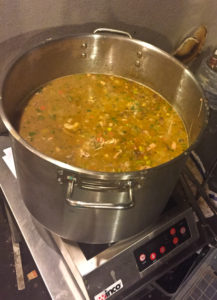
Making roux on an induction burner was nerve racking. What would Rosie think?

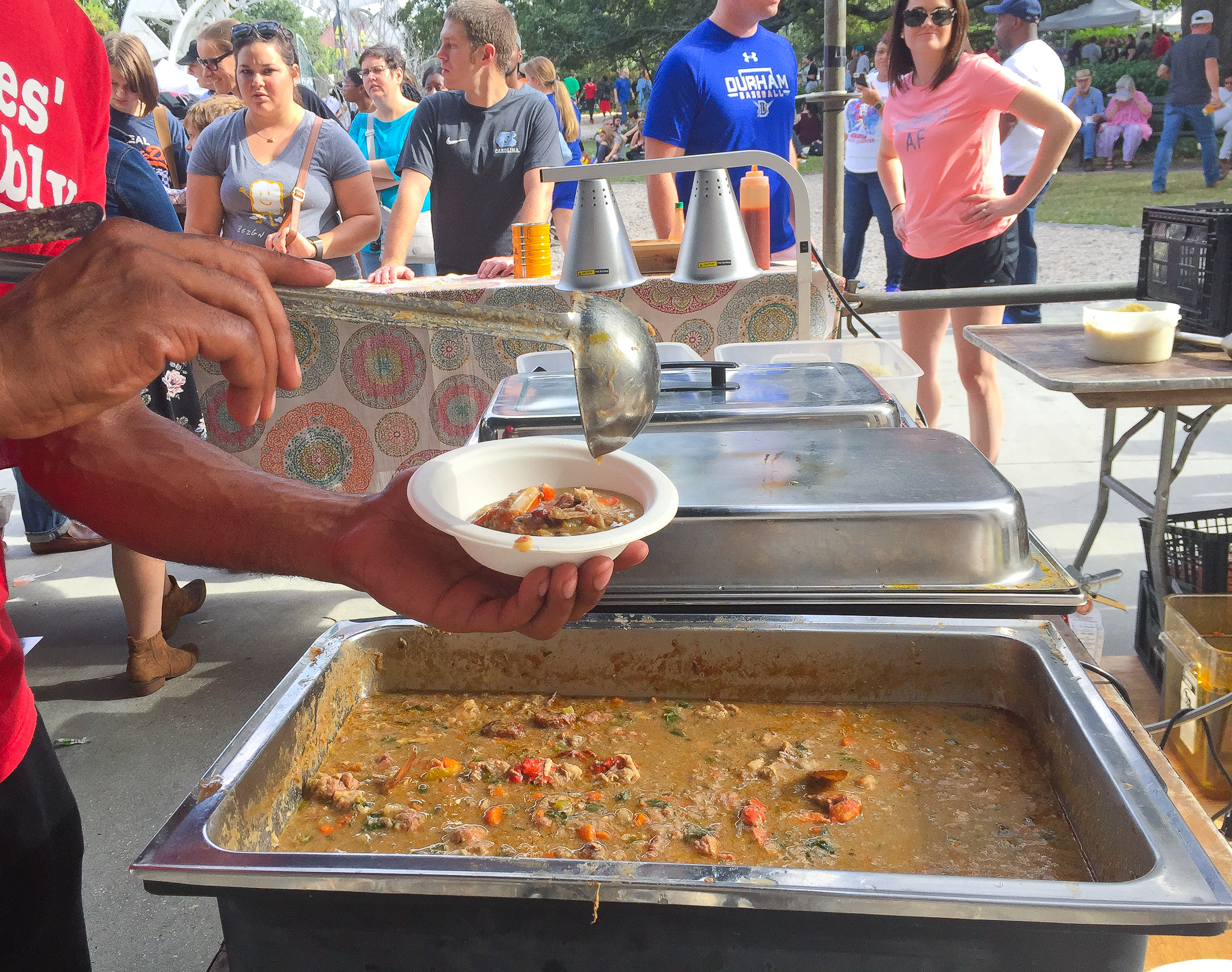
I just recently made more than 90 quarts for the Tremé Creole Gumbo Festival held Nov. 18 and 19 in New Orleans. Dana Honn, colleague, friend and chef/co-owner of Café Carmo in New Orleans invited me down after seeing that I cooked a lot of gumbo at Slow Food Nations in Denver this summer.

Gumbo Fest was a blast. It was exhausting. I think I cooked or helped stage and take down the booth for something like 36 hours over three days. I learned much from Dana and his crew. I learned about what it takes to sell your food. I learned more about what I can do (making gumbo on an induction burner!).

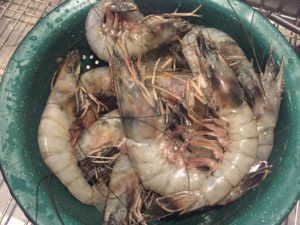
Such a treat to cook with wild caught Gulf of Mexico seafood!

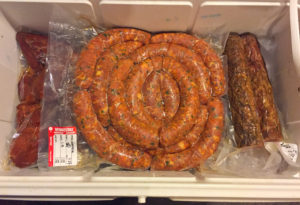
But the highlight for me wasn’t just the end product, or the enthusiastic response from some customers, or the stellar Gulf of Mexico shrimp and crabs from friend Lance Nacio’s Anna Marie Shrimp, or the otherworldly andouille, chaurice and tasso from my friend and pig whisperer Toby Rodriguez.

Got pork? Toby’s products are the best I’ve ever cooked with.

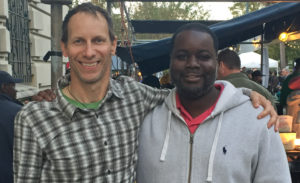
No, the real highlight for me occurred during a panel discussion I was moderating on gumbo heritage and the idea of preserving the tradition of local, sustainable sourcing. On the panel with me were Dana, friend and colleague Gary Granata, who has travelled the world to discover how different people deal with changing waterways, and Ryan Prewitt, chef/partner of the highly acclaimed Pesche Seafood Grill in New Orleans.

We each had a different take on the importance of sourcing your food (whether or not for gumbo) locally from producers you know or from sources you know who take care of their products. We talked about how gumbo is and was a communal event, dating back centuries to West African roots. You don’t cook gumbo for one person. Traditionally, neighbors would bring something to throw into the pot, or something to go with the gumbo.

Toward the end of the discussion, I asked each panelist to talk about his first, most powerful memory of gumbo.

Naturally, I spoke about Rosie. About that smell in the house and the yard. About taking my lumps. About the sense of family around her and her family. About teaching her grandson Gary how to bang on the drums. About the pride I felt in watching him grow and eventually march with one of the best high school bands during Mardi Gras. About the profound sadness of her death in the mid 90s. About the heartbreak of losing track of Gary and his mom Betty after Katrina hit. His home was boarded up with a big X painted on the door by the National Guard.

We tried FEMA. We tried the sheriff’s department. For months I went online checking displaced victims websites. Nothing. We didn’t know if they were alive and had evacuated, … or not.

Just before I’d reached this part of my narrative, a family of four came into the audience and sat down. I mentioned that a month prior to Gumbo Fest, I’d been planning to make gumbo for my chef friend’s wedding, and was thinking about Rosie, as always, and about Gary and his mom, when I got a Facebook message.

It was from Gary.

Fighting to keep my composure in front of the festival audience, I said “Gary, would you please come up here? I just want you all to know that I haven’t seen this person in 20 years, and I hadn’t heard from him until last month.”

We hugged, tears in our eyes, for it had been a long time of not knowing.

It was a seminal moment for both of us for Gary and his family to taste the gumbo his grandmother taught me to make. I often wonder what Rosie would think of my gumbo now that I’ve adapted it to my own particular style.

Gumbo truly is a community event. It brings people together. At the outset of the discussion, I told the audience that for me, the most important ingredient isn’t the roux, or the trinity or okra. (There’s often a vocal battle line drawn between the okra crowd, and the file/roux crowd in Louisiana). It’s love. You’ve got to love the food first. And it’s also important to love the people you’re cooking for. You and they will taste the difference.

This perhaps is the most important lesson I’ve learned as a home cook.

Thanks, mom. Thanks, Rosie.


Recent Posts

  • Hurricane Ida wreaks havoc on Louisiana’s seafood industry
  • EPA Should Use Clean Water Act To Kill Zombie Mine
  • Slow Fish 2021: Relationship Matters
  • Faith, Façades, and Futility
  • Pebble Permit Paused: Politics at Play

Archives

  • September 2021
  • August 2021
  • April 2021
  • December 2020
  • August 2020
  • June 2020
  • February 2020
  • December 2019
  • November 2019
  • October 2019
  • July 2019
  • May 2019
  • April 2019
  • March 2019
  • January 2019
  • December 2018
  • November 2018
  • June 2018
  • May 2018
  • March 2018
  • February 2018
  • January 2018
  • December 2017
  • November 2017
  • October 2017
  • September 2017
  • August 2017
  • July 2017
  • June 2017
  • May 2017
  • April 2017
  • March 2017
  • January 2017
  • December 2016
  • November 2016
  • October 2016
  • September 2016
  • August 2016
  • July 2016
  • June 2016
  • May 2016
  • April 2016
  • March 2016
  • February 2016
  • January 2016
  • December 2015
  • November 2015
  • October 2015
  • September 2015
  • July 2015
  • June 2015
  • May 2015
  • April 2015
  • March 2015
  • February 2015
  • January 2015
Theme by Colorlib Powered by WordPress