Skip to content
One Fish Foundation
  • Blog
    • Aquaculture
    • Education
    • Environment
    • Policy
    • Wild Harvest
    • Fish Tales
  • About
    • About One Fish
    • About Colles Stowell
  • Education
    • Elementary School
    • Middle School
    • High School
  • KNOW FISH Dinners®
  • Resources
    • One Fish Podcast
    • One Fish Foundation in the news
    • The 7 C’s of Sustainable Seafood
    • Newsletter Archive
    • Recipes
      • Skate with Capers and Butter — Chef Rizwan Ahmed
      • Grandma Davis’ Fish Chowder — Jane Almeida
      • Ginger Garlic Tamari Scallops — Colles Stowell
      • Fish Stock — Evan Mallett
      • Mussels San Remo — Chef Rob Martin
      • Salted Pollock Croquettes – Chef Mark Segal
  • Connect
    • Contact OneFish
    • Social
      • Instagram
      • Facebook
      • Twitter
All Blog Posts

Arctic Climate Change Could Have Irreversible Global Impact

  • December 21, 2016October 20, 2021
  • by Colles Stowell
Share it!
Share

Every time I read a story with dire predictions about climate change impacts I imagine a gong the size of a barn door sending a warning echo off the mountains in the distance.

A team of scientists recently released a report stating that changes in the Arctic climate, everything from melting polar ice caps to warming waters and changing ocean salinity is happening faster than previously predicted. Currently, the atmospheric temperatures there are about 20 degrees Celsius warmer than normal and water temperatures are 4 degrees warmer than normal. The likelihood of no summer sea ice forming this century is very high.

Arctic tipping points

The Arctic Resilience Report states that all of this could push conditions in the Arctic toward 19 regime shifts or tipping points – climate situations that if reached, may prove to be irreversible. For example, the Greenland ice sheet is widely considered the Northern Hemisphere’s air conditioner. It is massive, nearly 1.1 million square miles, and it serves a critical role in keeping temperatures above the equator from getting too hot. This massive sheet of ice acts like a mirror, reflecting the sun’s powerful rays back into space and minimizing solar radiation warming.
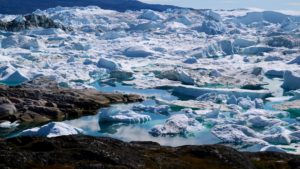
The melting Greenland ice sheet. Photo by Marcus Carson

But as global temperatures have risen, the ice sheet has become thinner and smaller, and as waters around the sheet have become warmer, they have accelerated melting. This creates a cycle in which the sheet’s shrinking could accelerate localized climate change, which could further accelerate the ice sheet’s shrinking. If the ice sheet disappears (which could take centuries), scientists predict it could cause global sea levels to rise by more than 20 feet.

This is just one of the 19 tipping points. Others include: Arctic sea ice loss, which would have some of the same effects as the melting of the Greenland ice sheet; changes in ocean salinity and current, which could spread warmer water faster than normal, with global implications; changes in land-based ecosystems that could release more greenhouse gases and reduce ice/snow reflectivity; and changes in Arctic snow patterns, which could also increase global ocean temperatures that effect climate patterns such as the monsoon season in Asia.

Fisheries impact

And then there is the impact on fisheries. The report cites manmade climate change (greenhouse gases, warming oceans, pollution, etc.) as well as other external factors like fishing pressure, as drivers for what could result in fisheries collapses in the Arctic. This could play out in a couple of different ways. First, a combination of warming water, shifting current, salinity and acidification could alter the vital nutrient upwellings that produce the plankton forage fish feed on. If the forage fish don’t thrive, neither do commercially important species like salmon, cod, pollock and shrimp. Couple that with continued fishing pressure, and you’ve got a recipe for collapse.
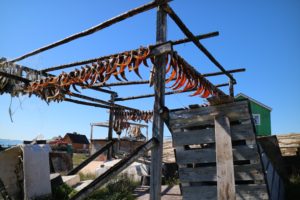
Climate change could cause fisheries collapse in the Arctic and elsewhere. Photo by Marcus Carson

The question is, how could fisheries collapse in the Arctic affect fisheries elsewhere?

This is no small question.

Complex challenges

So I asked Marcus Carson, one of the lead authors of the 218-page report. He talked about what we know and don’t know about how rapidly things are changing. “Often, when we see these things, it’s really hard to set in motion the processes we need to take them back,” he said from his home in Sweden.

“The challenge is the relational understanding. We understand the silos [warming oceans, ice melt, carbon storage in peat bogs, etc.] pretty well. What we’re lacking is how these connections in these really complex systems really work.”

Marcus Carson. Photo by Mark Tozer

For example, he mentioned that ocean acidification, the process by which the overall acidity of the ocean increases due to increased environmental carbon release, was not included as one of the tipping points in the report because scientists couldn’t pinpoint how it will behave in concert with other factors like salinity, temperature, current, etc. What scientists do know is that the rate of acidification in the Arctic has increased twice as high as almost anywhere on earth, and that acidification is generally higher in colder water.

“What we don’t understand is the exact relation between climate change and ocean acidification where fisheries are involved,” he said. Many species follow temperature, which is the case with some species here in the Gulf of Maine. For example, as waters have warmed off Long Island Sound, lobsters have pushed north and east, and there is no sustainable lobster fishery there anymore.

We also know as we dump more carbon into the atmosphere and put more chemicals into our estuaries, the acidity goes up. But as Carson said, we don’t yet know how changes in acidification from these types of drivers will work in concert with temperature, salinity, current to affect marine food webs. Species that are more tolerant of some or all of these drivers will likely thrive more in a changing Arctic climate than others.
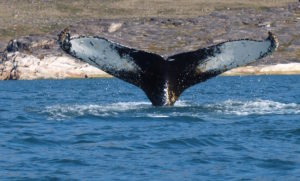
We need to better understand how all climate change factors could affect entire food webs. Photo by Mark Tozer

“There may be some biological variability that might get species competing with each other moving into the same space,” he said.

When it comes to impact on climate change in the Arctic affecting fisheries there and elsewhere, we still have to take a broad view. There will undoubtedly be an impact, especially when considering how currents will channel warmer, denser water globally.

A global climate

“There’s a saying around the working groups of the Arctic Council. ‘What happens in the Arctic doesn’t stay there.’ A lot of changes beyond seasonal fluctuations aren’t generated there. They start outside the Arctic, and get in there,” he said. And the changes in the Arctic may have global impacts.

“The implication with these 19 potential shifts … is that when these things start interacting with one another, the concern is that we could be setting forces in motion that are wildly out of our control,” he said.
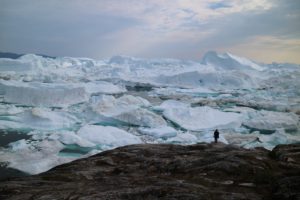
The cycle continues. Melting ice sheet allows more solar rays to warm oceans and atmosphere, accelerating ice melt. Photo by Marcus Carson

Not surprisingly, almost every response option cited in the report for the 19 tipping points calls for some form of reducing global greenhouse gases and shifting toward renewable energy.

This is the same message a majority of scientists have been saying in ever growing numbers and volume. However, the incoming administration has virtually declared war on climate change science.

Asked about threats to defund NASA’s climate science regimen, Carson used the analogy of “tearing the instrument panel out of your plane while in flight. It’s like you want to poke our eyes out while we’re heading into these big changes.”

Indeed.

That gong is getting louder. Do you hear it?
 

All Blog Posts

Paris Accord Sets Global Climate Change Commitment

  • December 15, 2015October 20, 2021
  • by Colles Stowell
Share it!
Share

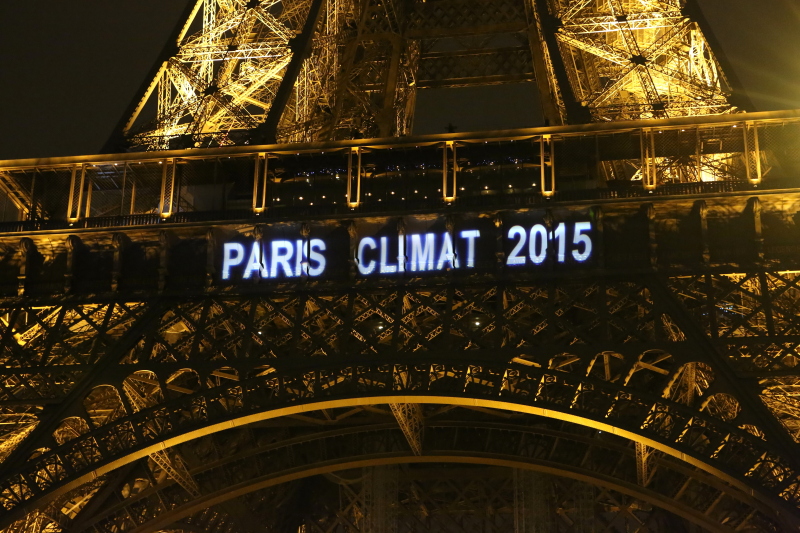
Something happened in Paris on Friday that many thought wouldn’t.

Agreement.

Agreement by nearly 200 countries that climate change is a significant problem with short- and long-term global implications that we must address collectively. It was an uphill slog. Those countries signed a pact to reduce their carbon footprints and slow the pace of global warming in the coming century.

In a nutshell, after months and years of preparation, with weeks of hard back-and-forth negotiation culminating in two overnight sessions, nearly 200 countries agreed that:

  • Climate change exists and has the potential to do irreparable harm to the planet;
  • Global commitment to reduce greenhouse gases is critical to minimizing this harm;
  • Each country must commit to reducing carbon emissions, and revise those commitments to ever stricter standards every five years;
  • Each country must demonstrate what measures it has taken to cut emissions via a transparent process, every five years;
  • The goal is to keep the global temperature increase below 2 degrees Celsius, if not 1.5 degrees;
  • Forest preservation is critical to offsetting carbon emissions, and countries should enact policies to limit logging and save intact forests; and
  • Developed countries like the U.S., France, England, etc. should take the lead in providing funds for programs to reduce global carbon emissions, including those in developing countries.

Establishing a framework

To be sure, this is a first step. Conference organizers in Paris and elsewhere must have looked at this effort like herding cats. Coal gobbling countries like China, India and the U.S. have traditionally held different views on their responsibilities for and the extent of climate change. Smaller developing countries like the Marshall Islands, which are sounding the alarm bell that they’re losing ground…literally, have completely different views.

Such widespread agreement is monumental in the shadow of the failed 2009 climate agreement in Copenhagen. While the 2009 summit only suggested what to do, this accord is an almost Earth-wide acknowledgement that countries need to tackle this collectively, and a legally binding commitment to do so.

Will it stop global warming completely by on its own? No, say many scientists. The real tipping point would be to prevent the average global temperature increase from exceeding 2 degrees Celsius, or 3.6 degrees Fahrenheit. Scientists say that if global annual temperatures rise above 2 degrees, the planet will be past the point of repair, and the Greenland and West Antarctic ice sheets will melt, sea levels could rise 20 feet, etc.

But as written, this agreement will only limit global temperature rise by about 3 degrees Celsius if countries achieve their current emissions reductions commitments, according to some scientists. It’s far better than the status quo, which is on track to bring an increase of more than 4 degrees Celsius and potential catastrophe. Still, on the new path the oceans will continue to rise, and polar caps will continue to melt, only at a slower pace.

To meet the agreement’s goal of avoiding damaging climate change, the nations of the world must step up the ambition of their cuts over time. The pact is voluntary for countries to strive for that 2 degree goal. What is legally binding is that each country commits to some kind of carbon emissions reduction, that they commit to continuing to reduce emissions more significantly every five years, and that they demonstrate what they have done, again every five years.

One of the biggest reasons the Paris agreement does not specify benchmarks for each country is that the United States Congress would have to vote on such a measure. And the Republican-controlled U.S. Senate would have nixed any such wording. Interestingly, the U.S. Republican party is the only political party in a study of nine developed countries that flat out denies “anthropogenic climate change.” More interestingly, the study suggests that opposition to addressing climate change is strongest in countries with large reserves of oil, natural gas, and/or coal (all of which the U.S. has in abundance).

Reason for optimism

Though it will not stop global warming, this binding agreement sets a precedent for global cooperation to combat climate change and hold each other accountable. Five years ago, this seemed like an impossible task. It also hopefully creates momentum to bring the discussion to the forefront of critical diplomatic and business discussions. It sends a signal that fossil fuels do more harm than good, and should stay where they are. It will force countries to start thinking harder about developing infrastructure for alternative energy, and create a path for industries and investors to spur innovation to scale up clean energy.

And perhaps it sets a framework for more aggressive action on a global scale if the scientific evidence shows our climate is changing faster than predicted.

I’m going to teach middle school students this week about how the warming Gulf of Maine has become home to some invasive species. The European Green Crab, for example, is a warm-water invader that has been showing up in increasing numbers for the past couple of decades. It eats larval shellfish like clams, mussels and oysters. It also destroys eelgrass habitats that are nurseries for many species.

Those kinds of invasive migrations are likely to continue for a while. But I look forward to capping off the classes with a ray of hope offered by the events in Paris last Friday.


Here’s some additional reading:

Science Alert: Here’s what you need to know about the new Paris climate deal

National Geographic: Paris Agreement Catalyzes Global Cooperation Toward a Low-Carbon Future

New York Times: Climate Accord Is a Healing Step, if Not a Cure

BBC: What did the Copenhagen climate summit achieve?

2012 Republican Party Platform

Recent Posts

  • Hurricane Ida wreaks havoc on Louisiana’s seafood industry
  • EPA Should Use Clean Water Act To Kill Zombie Mine
  • Slow Fish 2021: Relationship Matters
  • Faith, Façades, and Futility
  • Pebble Permit Paused: Politics at Play

Archives

  • September 2021
  • August 2021
  • April 2021
  • December 2020
  • August 2020
  • June 2020
  • February 2020
  • December 2019
  • November 2019
  • October 2019
  • July 2019
  • May 2019
  • April 2019
  • March 2019
  • January 2019
  • December 2018
  • November 2018
  • June 2018
  • May 2018
  • March 2018
  • February 2018
  • January 2018
  • December 2017
  • November 2017
  • October 2017
  • September 2017
  • August 2017
  • July 2017
  • June 2017
  • May 2017
  • April 2017
  • March 2017
  • January 2017
  • December 2016
  • November 2016
  • October 2016
  • September 2016
  • August 2016
  • July 2016
  • June 2016
  • May 2016
  • April 2016
  • March 2016
  • February 2016
  • January 2016
  • December 2015
  • November 2015
  • October 2015
  • September 2015
  • July 2015
  • June 2015
  • May 2015
  • April 2015
  • March 2015
  • February 2015
  • January 2015
Theme by Colorlib Powered by WordPress