Skip to content
One Fish Foundation
  • Blog
    • Aquaculture
    • Education
    • Environment
    • Policy
    • Wild Harvest
    • Fish Tales
  • About
    • About One Fish
    • About Colles Stowell
  • Education
    • Elementary School
    • Middle School
    • High School
  • KNOW FISH Dinners®
  • Resources
    • One Fish Podcast
    • One Fish Foundation in the news
    • The 7 C’s of Sustainable Seafood
    • Newsletter Archive
    • Recipes
      • Skate with Capers and Butter — Chef Rizwan Ahmed
      • Grandma Davis’ Fish Chowder — Jane Almeida
      • Ginger Garlic Tamari Scallops — Colles Stowell
      • Fish Stock — Evan Mallett
      • Mussels San Remo — Chef Rob Martin
      • Salted Pollock Croquettes – Chef Mark Segal
  • Connect
    • Contact OneFish
    • Social
      • Instagram
      • Facebook
      • Twitter
All Blog Posts

One Seafood Conversation at a Time

  • November 14, 2018October 20, 2021
  • by Colles Stowell
Share it!
Share

One conversation at a time. That’s been my mantra for changing the seafood purchasing dynamic in the U.S. Whether I’m speaking with a 76-year-old retiree sporting a blue blazer, a group of AP Environmental Sciences students or a cluster of six-year-olds anxious to get their hands on some live green crabs.

The question comes up occasionally. “How do you keep your content fresh?” It’s a good question. A lot of the eye-popping statistics don’t move much year after year. More than 50% of the seafood we eat is farm raised, and 90% of the shrimp we eat is farm raised. The fact remains, sadly, that at least 90% of the seafood we eat here is imported. Some argue the percentage is actually 91 or 94. Either way, the number has not gone down, and it isn’t likely to change substantially in the next few years unless we have some significant policy changes.

For me, it’s not the numbers that change so much. It’s the people I’m speaking with that change. I want to democratize the message. Reach as many people as I can. Tell them the story. Answer their questions. And hopefully convince them to take those messages with them so they change their buying habits and spread the word.

Each new face or group of faces is an opportunity to spread that message. And I’ve found the most effective way to ensure the message resonates is to adapt the way I tell the story to the audience. So the method of the story telling changes too.

This varies dramatically between classrooms by age and subject and also between different restaurant demographics I may be engaging. I look at each new “audience” and venue as a challenge. How do I connect? How do I engage? How do I get them to own the conversation so they own their next seafood decision?
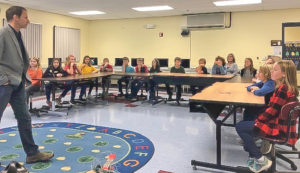
Rye Elementary fifth graders catching on quick that they have the power to ask smart seafood questions at restaurants and stores. Photo credit: Jennifer Halstead

I thought of these questions, as I always do, prior to a couple of school visits last month. Part of my preparation involves strategizing with the teacher beforehand about where the students are in their curriculum and what messaging would best fit with what they’ve learned or with what they will learn.

I’ve established relationships with several teachers who know what to expect. I still check in with them beforehand to make sure there aren’t any new messages they want me to introduce, or advise them of some new content or props (live mackerel, gear, etc.) One of these teachers is Doris Gianforte, a 5th grade science teacher at Rye Elementary School in New Hampshire.

As usual, when I met with her students, they were well prepared. They wanted to know more about why we import so much seafood, and why green crabs are such ecological monsters on this side of the Atlantic, and not in Europe. They couldn’t wait until they had the opportunity to ask questions at a restaurant.

Prior to my visit with 7th grade students at Harpswell Coastal Academy in Maine, I had a good discussion with their teacher Sarah Crockett. We talked about how they were in the middle of field lab work on green crabs in conjunction with an education program at Gulf of Maine Research Institute.

So we discussed introducing green crabs as a climate change marker, one that has implications for local ecosystems and shifting predator/prey relationships.

These students were also very well prepared, accurately talking about when and how European green crabs were introduced in US waters, what they like to eat and why they’re so destructive.
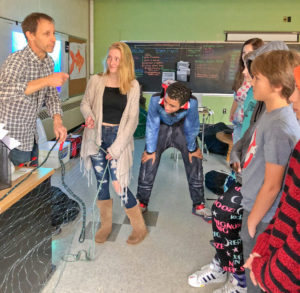
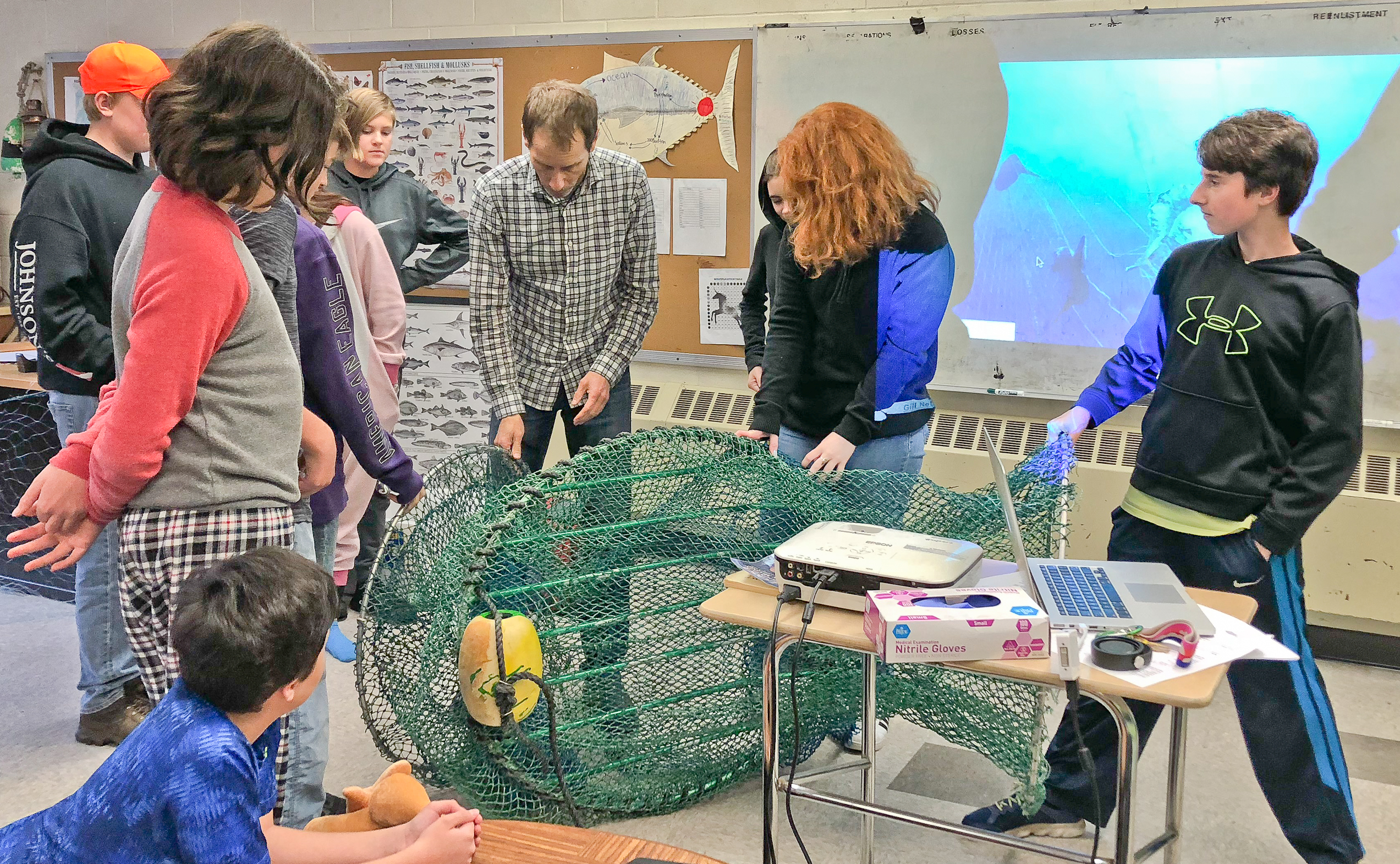
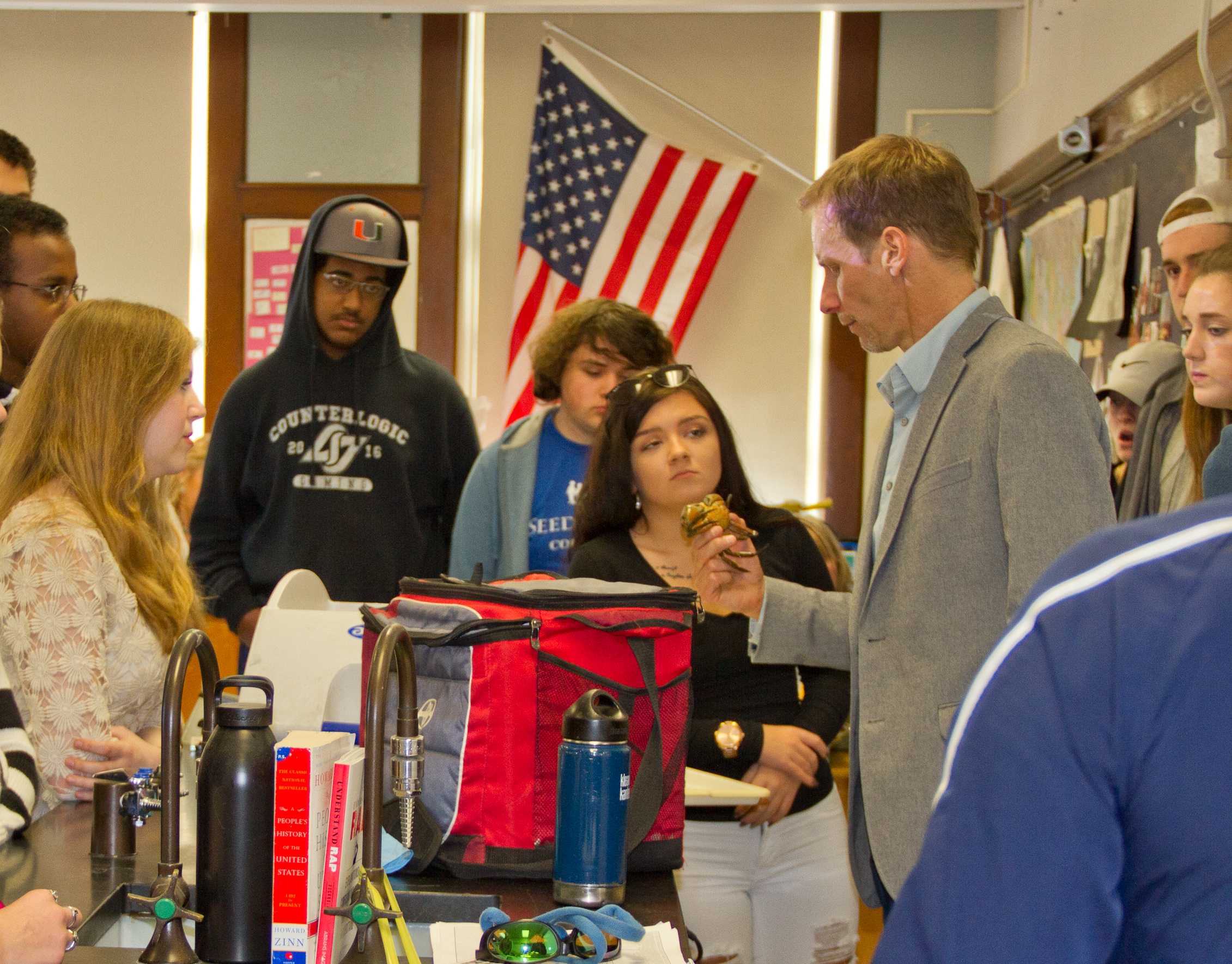
Harpswell Coastal Academy students learning about some measures to reduce gill net bycatch such as shorter soak times and acoustic pingers emitting signals to ward off marine mammals. Guess who didn’t get the memo about “Pajama Day.” Damn! Photo: Sarah Crockett

Students asked great questions about what fishermen and researchers are doing to minimize bycatch associated with different gear types. Like most students, getting their hands on some trawl net and a turtle excluder device helped them better understand efforts to reduce turtle bycatch in the Gulf of Mexico shrimp fishery as well as other fisheries.

These types of connections give me hope that change, real fundamental change, lies within the possibilities and ideas sparked by these conversations.

Even if it’s one at a time.


Top Photo: Harpswell Coastal Academy 7th graders getting their TED (turtle excluder device) talk on. Credit: Sarah Crockett
 

All Blog Posts

Age Is Irrelevant: Our Seafood Choices Matter

  • April 24, 2017October 20, 2021
  • by Colles Stowell
Share it!
Share

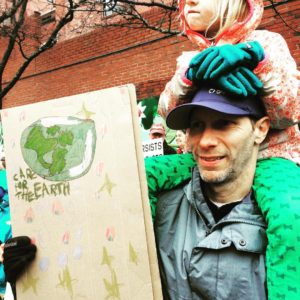
Standing in a light misting rain at a chilly March for Science rally with my daughter on my shoulders, I marveled at the number of families in attendance. The scene struck a chord with me. Science has a story for everyone, regardless of race, sex, age, income, etc. It’s all in how the story is told, and our willingness to listen to it.

Early involvement! Photo credit: Jaime Stowell

This is true for my work with One Fish Foundation. Regardless of where I’m speaking, there is one constant. The age may change, but the overall message is the same: Our seafood choices matter.

I saw this writ large last week when I spoke to two groups of high school seniors about climate change impacts on seafood in the Gulf of Maine, and then spoke to four groups of elementary students the next morning. That I delivered the latter talks in French was just icing on the cake.

What keeps everyone’s attention is the ability to tell a story that resonates.

Seafood, as a hook for discussing climate change

I initially engaged Portland High School students in the discussion by getting them to tell me what type of seafood they liked. Then we talked about how some of that seafood was likely caught … or farmed and the implications. From bycatch to chemicals, the narrative opened their eyes … quite wide with some stats … as to why they should try and find out where, when, how and even by whom (if possible) their seafood was caught.

That led into a more involved discussion about how climate change impacts, such as warming water, ocean acidification, changes in current and salinity, affect the seafood we eat globally, domestically and regionally in the Gulf of Maine. We talked about the mystery surrounding the collapse of the Northern Shrimp fishery in 2012, and the race for scientists and fishermen to get answers. Right now, scientists believe the shrimp have a narrow comfort range, and that the increasing temperatures in the Gulf of Maine may be affecting everything from reproduction to eating habits.

Students also learned that we’re gaining more information every day about the effects of warming waters, increased ocean acidity (particularly on molluscs’ ability to calcify their shells) and how ocean currents and salinity are changing. But as one of the lead authors of the Arctic Resilience Report told me last fall, we still have a way to go before we understand in depth how disparate climate change factors work in concert to affect different ecosystems or species in those ecosystems.

I left the students pondering the notion that rather than trying to fix climate change (we can’t), we need to learn how to adapt. This means finding more ways to better predict and respond to these changes. It also means that on a personal level, we need to understand what we can do. Students learned they have the right to try and find out when, where and how their seafood was harvested (or farmed). They also learned they can be evangelists for the sustainable seafood message.

Hands-on…the crabs, the dead fish, the gear…

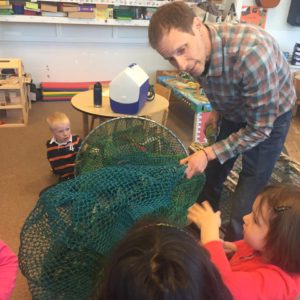
The younger the audience age, the more hands-on the discussion needs to be. So I hauled in a lobster trap, a turtle excluder device, some gillnet, live green crabs and a dead black seabass to L’Ecole Française Du Maine.

Turtle excluder devices are great conversation pieces…seriously. Photo credit: Elodie Le Nezet

I varied the message to accommodate students between ages 4 and 11. For the younger students we first talked about what seafood they liked before talking about the different methods for ensuring fishermen catch what they’re targeting so they can minimize bycatch. We talked about how a lobster trap works, how videos have shown lobsters can go in and out of these traps at will, and what it means when a lobsterman pulls up a trap filled with black sea bass.

We also used my daughter’s stuffed turtle to demonstrate how a turtle can escape being caught – and ultimately drowned in a trawl – by way of the grate used in a turtle excluder device. The primary message to them is that for the most part, fishermen want to take care of the resource, and that some capture methods are better than others at minimizing bycatch.

I extended that discussion with older students to include predator/prey relationships, and how things like bycatch or climate change are changing ecosystems in the Gulf of Maine. They loved seeing the green crabs up close as we discussed the devastation wrought on eelgrass beds as the crabs dig up clams, mussels and oysters.

All of the students wanted to touch the fish.

In the end, all of the students I spoke with last week, at Portland High School and L’Ecole Française Du Maine, began to understand that yes, where their seafood comes from and how it was harvested matters to them and the resource.


Top photo credit: Taylor Mason, College of the Atlantic

Recent Posts

  • Hurricane Ida wreaks havoc on Louisiana’s seafood industry
  • EPA Should Use Clean Water Act To Kill Zombie Mine
  • Slow Fish 2021: Relationship Matters
  • Faith, Façades, and Futility
  • Pebble Permit Paused: Politics at Play

Archives

  • September 2021
  • August 2021
  • April 2021
  • December 2020
  • August 2020
  • June 2020
  • February 2020
  • December 2019
  • November 2019
  • October 2019
  • July 2019
  • May 2019
  • April 2019
  • March 2019
  • January 2019
  • December 2018
  • November 2018
  • June 2018
  • May 2018
  • March 2018
  • February 2018
  • January 2018
  • December 2017
  • November 2017
  • October 2017
  • September 2017
  • August 2017
  • July 2017
  • June 2017
  • May 2017
  • April 2017
  • March 2017
  • January 2017
  • December 2016
  • November 2016
  • October 2016
  • September 2016
  • August 2016
  • July 2016
  • June 2016
  • May 2016
  • April 2016
  • March 2016
  • February 2016
  • January 2016
  • December 2015
  • November 2015
  • October 2015
  • September 2015
  • July 2015
  • June 2015
  • May 2015
  • April 2015
  • March 2015
  • February 2015
  • January 2015
Theme by Colorlib Powered by WordPress